
 Poisonous

What to do after someone eats a white wild mushroom
Treat an amatoxin exposure as an emergency long before anyone confirms a species. If a person or an animal may have eaten a white wild mushroom, call Poison Control at 1-800-222-1222 in the United States. Say that an Amanita is possible, because that word changes how the specialist handles the call.
Destroying angels are the all-white members of the amatoxin group. Eastern North America usually means Amanita bisporigera, the west has Amanita ocreata, the western destroying angel, and Europe has Amanita virosa. All three carry the same class of liver toxin, so the species name changes very little about what happens next.
Most of these poisonings do not begin with someone hunting Amanita. They begin with a white mushroom in a lawn, a park strip, or a wood edge that looked close enough to something familiar. The death cap is often greenish and looks unusual, while the destroying angel looks ordinary.
Warning
Symptoms usually start six to twenty-four hours after the meal, so feeling fine that evening proves nothing. Waiting for vomiting before calling gives the toxin a head start on the liver.
The illness follows a staged course instead of a straight line. Severe stomach symptoms arrive first, then ease enough that the person can look recovered, while liver injury continues underneath. Emergency departments admit suspected cases because of that false recovery, and they do not send a comfortable patient home.
The full course appears under amatoxin poisoning. Bring the mushroom, or whatever remains of it, in paper instead of plastic. Mycologists can often work from a fragment, a cap, or a spore deposit left on a plate.
How do you separate a destroying angel from an edible white mushroom?
Everything about the eastern destroying angel, Amanita bisporigera, is white. Cap, gills, stem, ring, and spore print all share that color, which takes color off the table. The whole decision then rests on structure.
Start at the base, and leave the cap for later. The volva is a membranous sac around the swollen base, and it usually sits below the surface. Pulling the mushroom up by the stem is the surest way to leave it behind, so dig the whole mushroom out and keep the base attached to it.
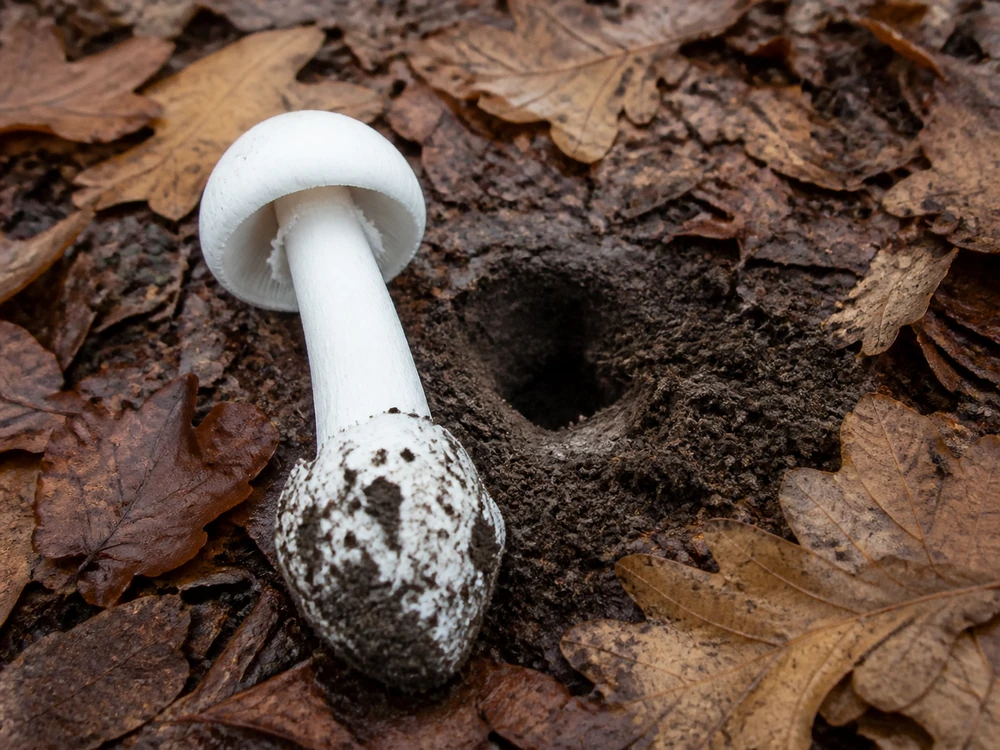
The warning pattern is all five together. One missing feature is a reason to slow down, and the complete set is a reason to stop. Rain or handling can strip the ring, so a missing ring alone never clears a white mushroom.
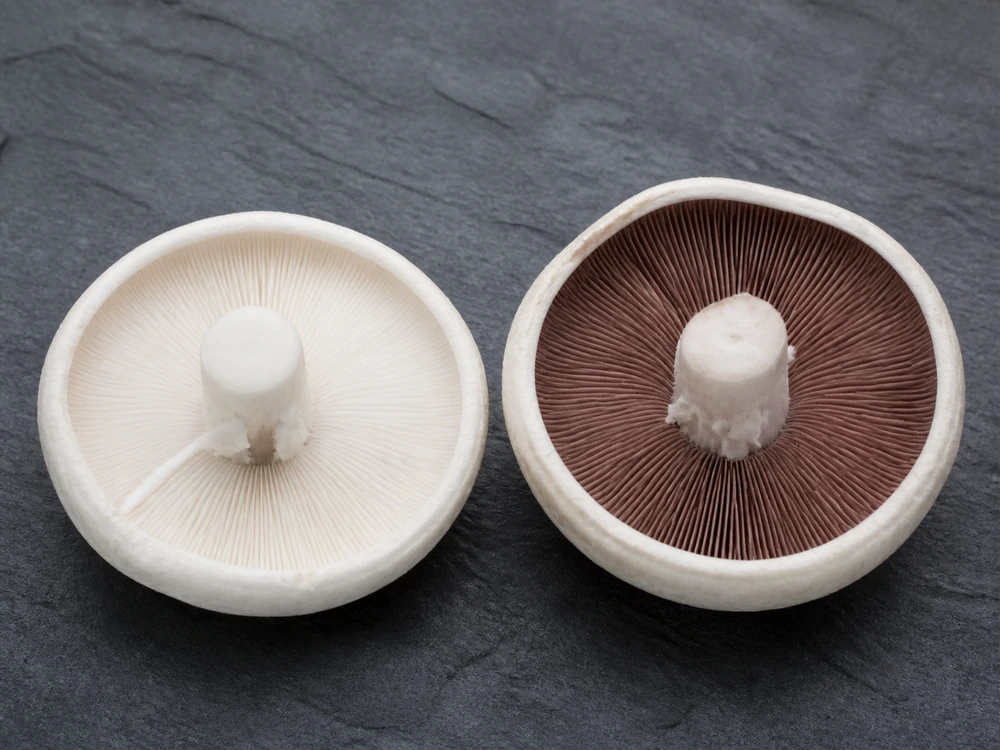
Two edible mushrooms account for most of the confusion, and spore color separates both of them. Meadow mushrooms and the cultivated button mushroom start with pale gills that turn pink and then chocolate brown, and both drop a brown spore print. The destroying angel keeps white gills for its whole life and prints white. Age makes that check reliable, because a very young Agaricus can still look pale underneath.
| What you are holding | Gills on a mature specimen | Spore print | Stem base |
|---|---|---|---|
| Destroying angel | White, and they stay white | White | Swollen and sitting in a membranous sac |
| Meadow mushroom | Pink, then chocolate brown | Brown | Plain, with no sac |
| Shop button mushroom | Pink, then chocolate brown | Brown | Cut flat, with no sac |
| Puffball | None, because it has no gills | None while the inside is solid | Solid white throughout when cut |
Gills that never turn brown are the line between this mushroom and the edible one it imitates.
The gill check for a white cap
Give a doubtful cap an overnight spore print instead of judging fresh gills in the field. Within an hour, a thin deposit rarely shows its color.
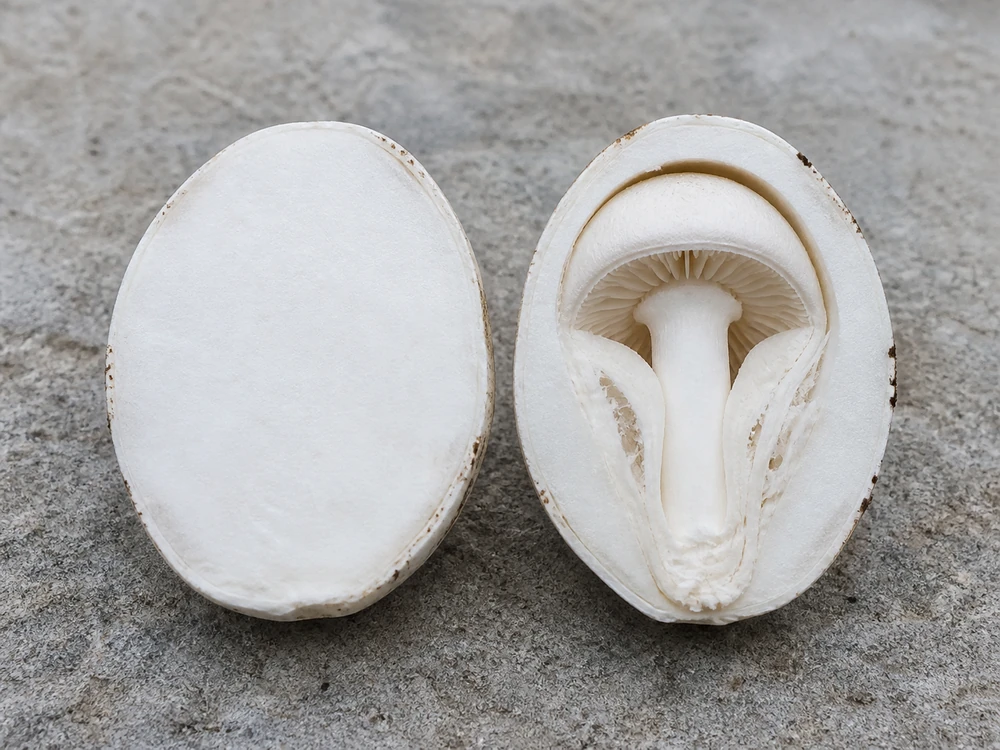
The third confusion happens earlier in the mushroom's life. Before the cap opens, the destroying angel is a smooth white egg sitting in the ground. At that stage it can pass for a small puffball, which people do collect and eat. Cutting the egg in half from top to bottom answers the question immediately.
One field chemical test is worth knowing, though it supports a conclusion and cannot make one on its own. Potassium hydroxide turns the cap of Amanita bisporigera yellow when you add a drop.
Note
No home test, cooking step, or preparation makes this mushroom safe. Silverware does not darken, boiling does not draw the toxin out, and drying concentrates the mushroom without removing the toxin.
Do not lean on taste, smell, insect damage, or whether animals have been feeding on the mushroom. Slugs and some rodents chew destroying angels without visible harm, because they handle the toxin differently from people. Their appetite is no safety test.
Why destroying angels turn up in lawns and park strips
Destroying angels are mycorrhizal, so the fungus lives in partnership with tree roots and takes its carbon from the tree. Oaks are the usual partner in eastern North America, and other hardwoods host it across its range. That partnership explains why the mushrooms rise straight out of soil and never from wood. Even a cluster beside a stump usually grows from the roots below and not from the stump itself, and wood-growing species form a separate group with a different set of risks.
The same partnership explains where people meet them. Any place with mature oaks has the conditions, including a back lawn, a school ground, a campground, or the grass strip between a sidewalk and a street. Fruiting runs from summer into fall and follows warm rain by several days. Your lawn may show nothing for years and then produce a dozen after one wet week.
- Partner trees
- Oaks most often, with other hardwoods across its range
- Substrate
- Soil, never wood, because the fungus feeds through living roots
- Peak season
- Summer into fall, a few days after warm rain
- Typical setting
- Woods, wood edges, lawns, parks, and street plantings with mature trees
Common names travel badly, so the distribution needs a plain statement. The eastern species is Amanita bisporigera, the western one is Amanita ocreata and fruits mainly in spring under oaks, and the European one is Amanita virosa. If you compare a specimen against a guide, check which continent that guide describes.
Why no cooking method makes a destroying angel safe
Destroying angels have no culinary use at any age, in any quantity, by any method. Amatoxins are heat stable, so frying, boiling, roasting, and pressure cooking leave them intact. Drying removes water and leaves the toxin behind in a more concentrated piece. Soaking, parboiling, and pouring off the water are common folk steps for other species, and none of them works here.
Those intact amatoxins make small amounts dangerous too. One cap can carry a lethal adult dose, because a single mushroom can contain up to 15 milligrams of amatoxin and a lethal dose can be as low as 0.1 milligram per kilogram of body weight.
Warning
Never keep a suspected destroying angel in the same bag, basket, or pan as food mushrooms. Fragments and spores transfer, and a mixed basket destroys the evidence a poison specialist would otherwise use.
Separation from the moment a specimen leaves the ground is the safe habit. One paper bag per species keeps an unknown from touching a meal. It also keeps a whole specimen available for review.
What to do when destroying angels appear in your yard
Nobody cultivates destroying angels, and you cannot grow this fungus the way you grow an oyster or a shiitake. It needs a living tree partner, which rules out a bag of sawdust in a closet. For most people the question runs the other way.
Usually destroying angels have turned up in the yard, with children, dogs, or curious visitors around. Removing the mushrooms does not remove the fungus. The living part threads through the soil around the tree roots and will fruit again under the right weather.
Pick the visible mushrooms anyway, because you are managing exposure and not the organism. Take the whole mushroom including the buried base, and put it in household waste instead of compost. That habit keeps the caps away from children playing on the lawn.
Handling one does not poison you, since the toxin only acts once someone swallows it. Wash your hands afterward so fragments do not reach food, and keep the collecting away from kitchen surfaces.
Dogs are the recurring problem in yards with oaks. If your dog swallows a piece, it needs a veterinary call immediately, and overnight watching is not enough. The same delay applies to dogs, so mushrooms and dogs is a call-first situation.
The final decision on a white wild mushroom
The final decision on a white wild mushroom is stricter than on almost anything else in a basket. If you cannot see the base, you do not have enough of the mushroom to identify it, because a cap alone is no specimen. The ring can wash off in rain, the gills can look pale on a young edible, and the sac that would answer the question stays in the ground. Each of those losses removes evidence, and none of them leaves a doubt you can reason around.
White mushrooms deserve a slower process than a chanterelle or a morel for that reason. Dig the mushroom, keep it whole, print it overnight, and compare it against a guide written for your own continent. If you cannot finish any part of that sequence, do not eat the mushroom.
Key takeaway
White spore prints do not mean safe. Many edible mushrooms print white, and so does every destroying angel.
No version of this species rewards a close call. The foraging safety rules lay out a wider field routine that reaches beyond Amanita, and the habits stay the same whatever you are picking.
One name, three species
Destroying angels belong to the genus Amanita in the family Amanitaceae, which also holds the death cap and the fly agaric. Features that bear on safety partly define the genus, including free gills, a white spore print, and a universal veil that leaves a sac or warts at the base.
The name destroying angel covers a species group, and no single mushroom owns it. Amanita bisporigera is the common eastern North American one, Amanita ocreata the western one, and Amanita virosa the European one. Specialists separate those species on characters a forager cannot use in the field. Amanita bisporigera, for example, has two-spored basidia, round spores, and a yellow cap reaction to potassium hydroxide.
The common name white death cap also circulates, and it adds confusion without adding clarity. It blurs two species that a reader may be trying to keep apart. The same problem shows up across other dangerous lookalikes, where the deciding feature is rarely the one that catches the eye.


 Caution

 Edible

 Choice edible
