Why the western species needs its own warning
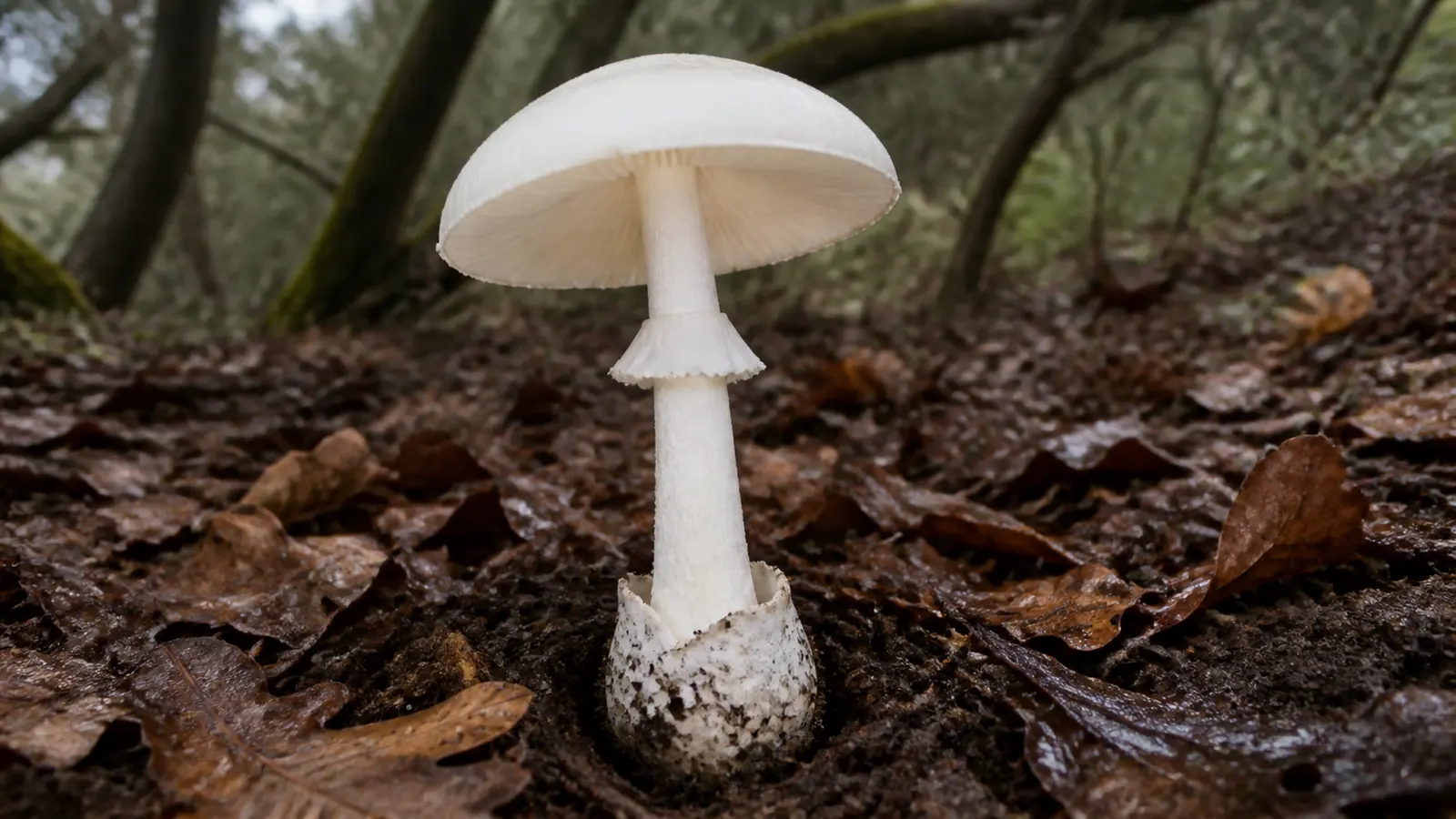
Western destroying angel is the West Coast species behind the destroying angel name. Amanita ocreata is native to western North America and fruits with living oaks, often during the wet months when California foragers also encounter springtime amanitas.
The mushroom is usually white from cap to stem, but older caps can develop cream, tan, pinkish, or ochre color near the center. White color alone cannot confirm this species, and a little cap color does not clear a specimen for eating.
Its most important structures are easy to lose. The ring high on the stem is thin and fragile, while the membranous volva sits around the swollen base below leaf litter or soil.
Pulling the stem leaves the volva behind, and rain or handling can remove the ring.
That combination explains why a cap photo cannot settle the identification. A useful collection includes the entire base, side and underside views, the host trees, the substrate, and the date.
Missing evidence should stop an edible decision rather than invite a guess.
The danger is current, not historical. A CDC investigation covering November 2025 through March 2026 documented 39 suspected amatoxin poisonings in northern California.
Five cases were linked by patient photos and regional mycologists to Amanita ocreata, while the outbreak as a whole caused three liver transplants and four deaths.
Warning
A person can feel well for hours after eating an amatoxin mushroom. The quiet interval is part of the poisoning pattern, not evidence that the meal was safe.
How do you identify a western destroying angel?
White to cream, smooth, and usually non-striate, sometimes developing a pale tan, pinkish, or ochre center with age.
Crowded, white, and free from the stem. They stay white as the mushroom matures.
White with a swollen base inside a thin membranous volva. The upper ring is fragile and may tear away or disappear.
White and unchanging when cut. Odor is mild when fresh and can become unpleasant with age. Never taste it.
Begin with the specimen base. Excavate around the mushroom and lift the stem with the surrounding cup intact, because the thin white volva is often buried and can remain in the ground when a mushroom is pulled.
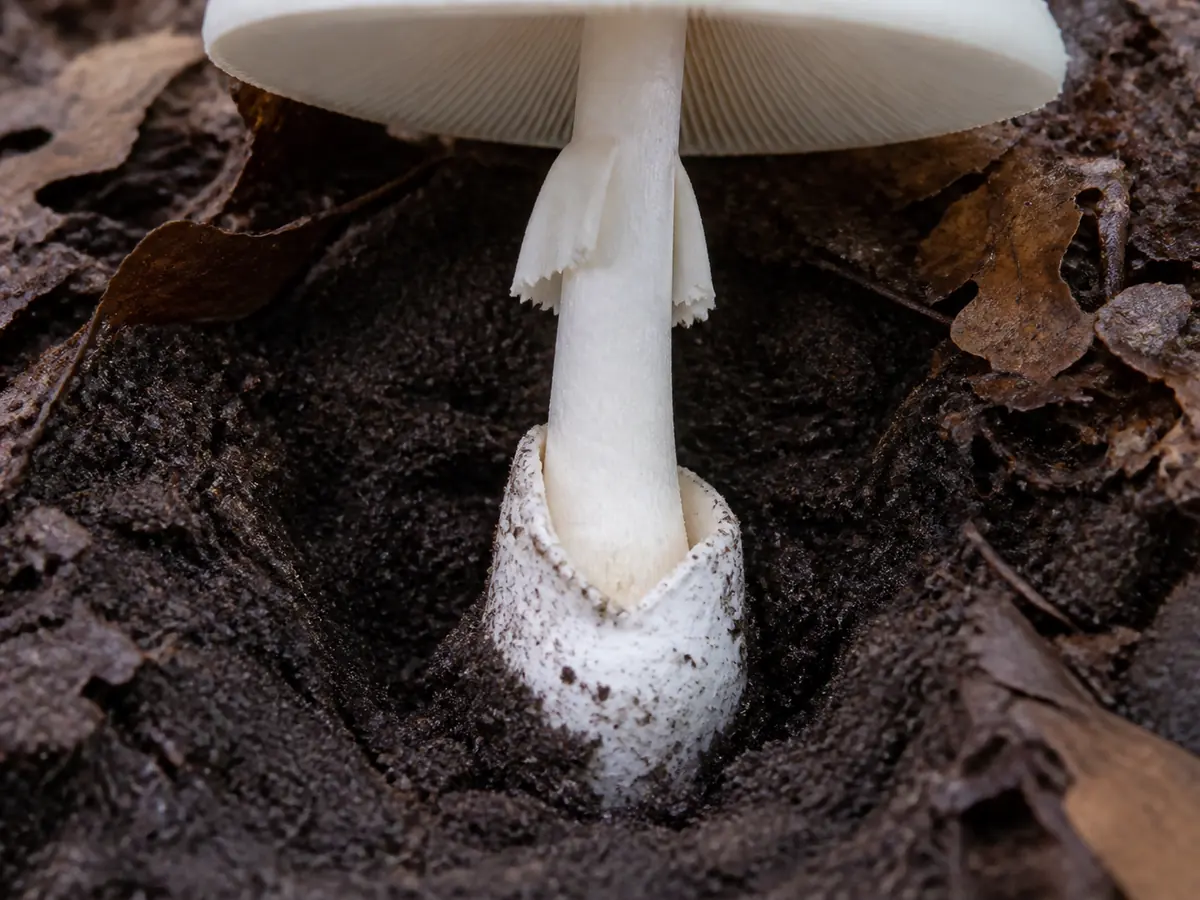
A mature cap is smooth and white to cream, sometimes with a warmer center.
The margin is normally smooth rather than deeply grooved, and the crowded white gills stop before reaching the stem.
The stem is white and firm, with a skirtlike ring on the upper portion when that ring has survived weather and handling. A missing ring does not make a white amanita safe because Amanita ocreata can lose it.
| Field character | Western destroying angel | What the difference means |
|---|---|---|
| Stem base | Swollen inside a membranous volva | A cut or missing base removes the strongest warning structure |
| Mature gills | White | Pink or chocolate-brown gills point toward Agaricus, but pale young gills remain ambiguous |
| Ring | Present when intact, often fragile | Absence cannot clear a damaged specimen |
| Cap margin | Smooth or only faintly lined | Long, deep grooves support springtime amanita instead |
| Season and trees | Wet-season fruiting with western oaks | This separates it from eastern and European destroying angel species |
A white spore print supports placement in Amanita but does not prove Amanita ocreata. Many white-spored mushrooms are harmless, and several western amanitas share the same print color.
A drop of potassium hydroxide can turn the cap surface yellow, but that chemical reaction is supporting evidence for trained identifiers. It cannot replace the intact base, full field characters, range, host, and microscopy when a species-level decision matters.
Young fruiting bodies begin inside a universal veil and can resemble white eggs. Cutting one lengthwise reveals the developing cap, gills, and stem inside, while a true puffball has an even interior with no miniature mushroom structures.
Do not cut every white egg in a patch and treat the test as permission to eat, since unopened deadly amanitas can still be difficult to separate from one another.
If someone may have eaten this mushroom, act now. Call Poison Control at 1-800-222-1222 (US) or emergency services before symptoms appear, and save a piece of the mushroom for identification.
What should happen after a possible exposure?
If someone may have swallowed this mushroom, call Poison Control at 1-800-222-1222 in the United States or local emergency services now. Do not wait for nausea, vomiting, or diarrhea because the first symptoms often begin more than six hours after the meal.
Save the remaining mushroom, meal scraps, and clear photos of the cap, gills, stem, and intact base. Keep the specimen in paper and tell the clinician that an amatoxin-producing Amanita is possible.
Which western mushrooms create the closest confusion?
California oak woodland creates a difficult overlap. Western destroying angel can fruit in the same season and habitat as springtime amanita, and it can stand near pale death caps or white Agaricus.
The safest comparison uses the whole mushroom and its maturity. One cap color or a missing ring cannot carry an edible decision.
Springtime amanita, Amanita velosa, is the most important local contrast because some experienced foragers eat it. It normally has a salmon, apricot, or warm tan cap, a deeply striate margin, a thick veil patch on the cap, and no ring.
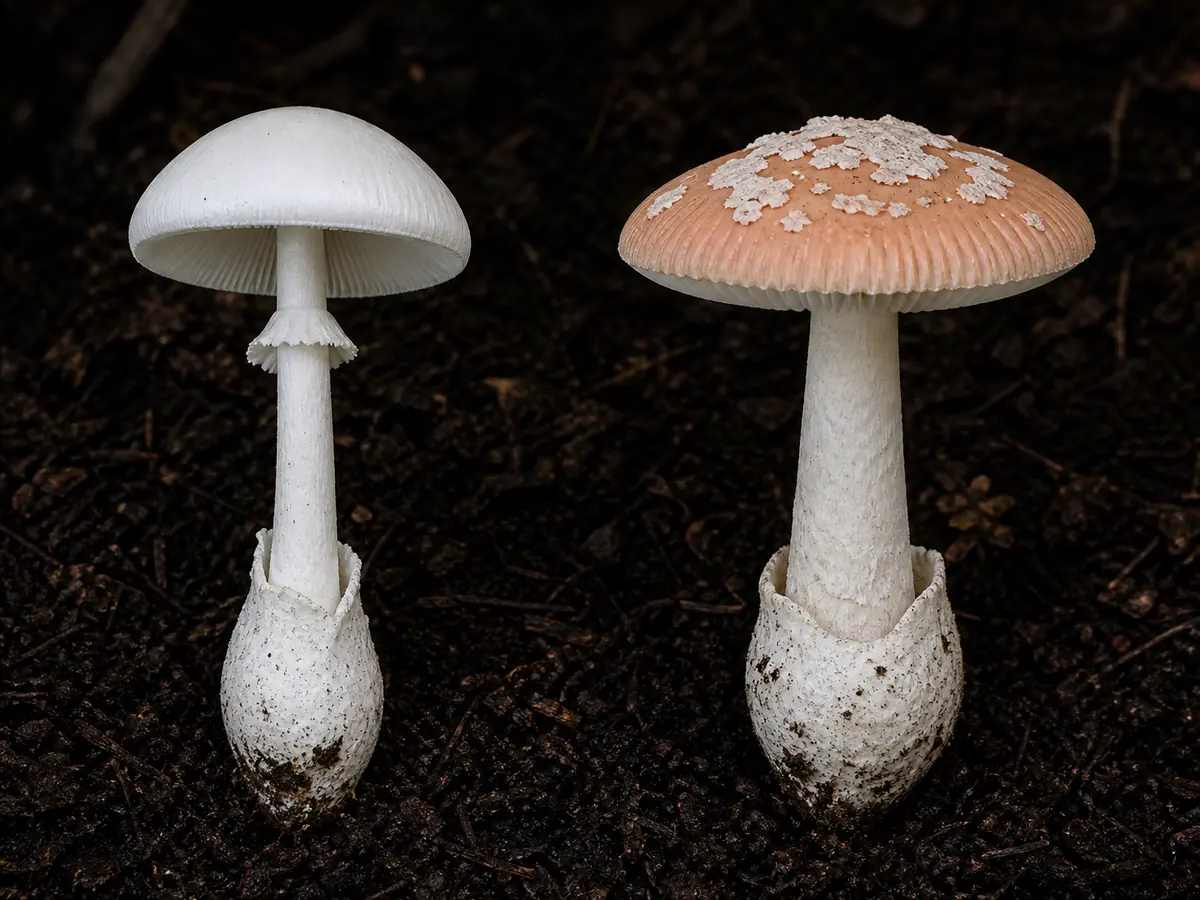
That comparison has a dangerous limit. A western destroying angel ring can fall away, and its cap center can pick up warmer color with age, so an apparently ringless spring mushroom is not safe on that observation alone.
| Lookalike | Features that point away from western destroying angel | Why uncertainty remains dangerous |
|---|---|---|
| Springtime amanita | Warm salmon or tan cap, deeply striate margin, thick cap patch, no ring | Both grow with western oaks in spring, and a destroying angel can lose its ring |
| Death cap | Usually olive, bronze, or greenish cap over white gills and a baglike volva | Pale death caps share the same amatoxins and require the same emergency response |
| Meadow mushroom | Gills mature from pink to chocolate brown, brown spore print, no volva | Young gills can still be pale, so maturity and the intact base matter |
| Puffball | Solid, even interior with no cap, gills, or stem inside | An unopened amanita hides a formed mushroom inside its white outer veil |
Key takeaway
Do not learn an edible western Amanita by memorizing a single difference from Amanita ocreata. A safe determination requires the complete edible species pattern, regional experience, and an intact specimen.
Where and when does Amanita ocreata fruit?
Western destroying angel forms a mycorrhizal partnership with living trees rather than feeding on a log. The fruiting body rises from soil around roots, especially under oaks in California and the Pacific Northwest.
Coast live oak woodland is a classic setting, but the same root relationship can place mushrooms beside paths, in campgrounds, and in urban parks with mature oaks.
A maintained landscape does not lower the toxin risk.
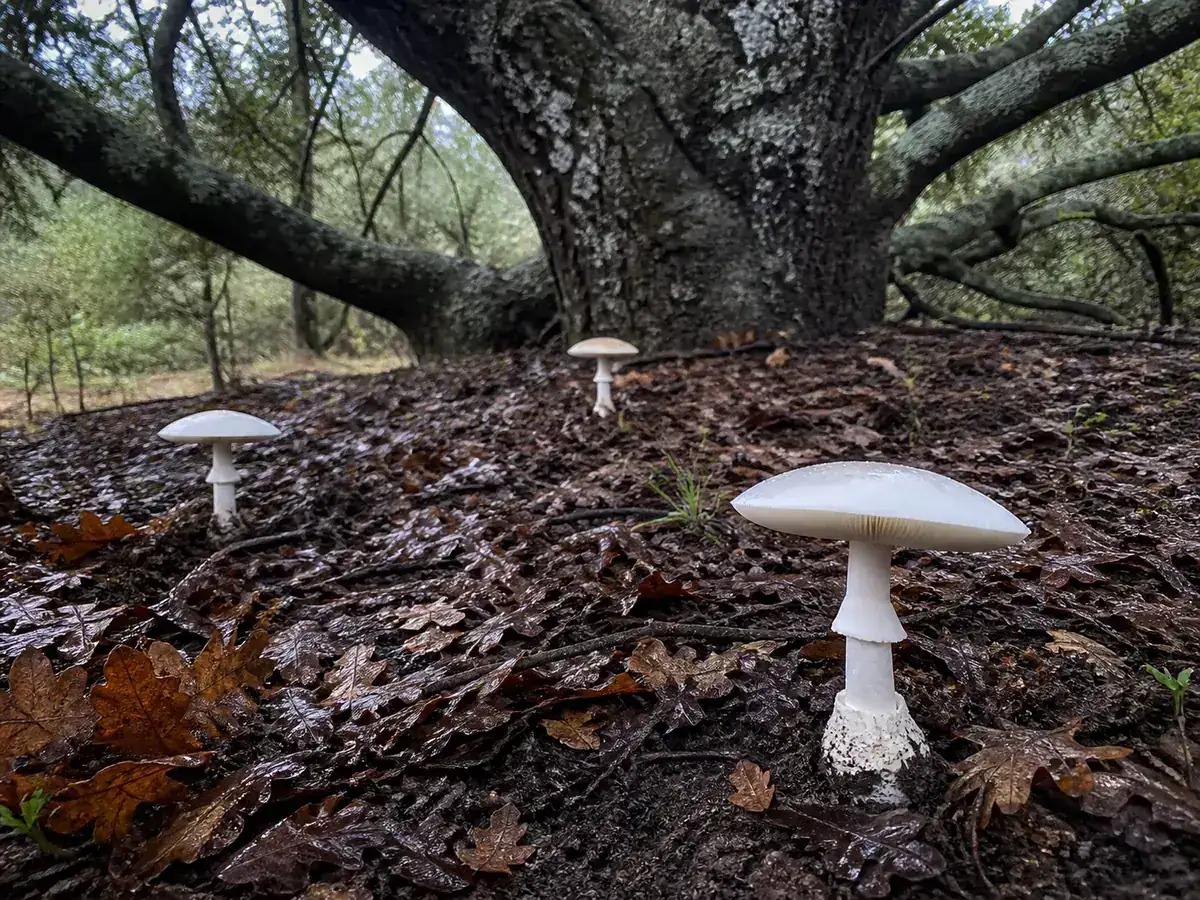
The California coast key describes Amanita ocreata as primarily a spring fruiter near oak.
The 2025 to 2026 CDC investigation found that amatoxin-producing amanitas can bloom widely after heavy rain, and it treats late fall through mid-spring as the main regional risk period for public warnings.
Removing visible mushrooms protects children and pets from immediate exposure, but it does not remove the underground fungus. Check the same oak root zone again after later rain and dispose of fruiting bodies where they cannot be eaten.
What happens after amatoxin enters the body?
Amatoxins enter liver cells and interrupt RNA polymerase II, which stops essential protein production and leads to cell death. Cooking does not denature these toxins, so the dose reaches the body even after a thoroughly cooked meal.
The clinical course can mislead both patients and clinicians. Stomach symptoms often start more than six hours after ingestion, then may ease while laboratory evidence of liver injury and clotting problems develops.
No standardized treatment regimen or FDA-approved antidote exists. Hospitals use poison-center guidance, aggressive supportive care, repeated laboratory tests, and selected off-label or investigational treatments according to the case.
Early contact changes the options available, so call Poison Control before symptoms rather than trying charcoal, milk thistle, vomiting, or another home treatment.
Can any preparation make it safe?
Western destroying angel has no culinary use. Amatoxins are not destroyed by frying, boiling, drying, or freezing, or by any other kitchen preparation.
Do not place a suspected specimen in a food basket or on a cutting board. Keep it separate in paper if it is needed for identification, and discard it after poison specialists or a mycologist no longer need the evidence.
Warning
Never taste a suspected Amanita ocreata. Taste is not an identification test, and swallowing even a small piece creates a medical emergency.
How does Amanita ocreata fit the destroying angel group?
Amanita ocreata Peck belongs to family Amanitaceae and section Phalloideae, the group that also contains the death cap and other amatoxin-producing amanitas. NCBI records it as the current species name and the western North American destroying angel.
The broader common name creates a geographic trap. Amanita bisporigera is the familiar eastern North American destroying angel, while Amanita virosa is European.
Their shared warning structures and toxins do not make their seasons, hosts, or microscopic characters interchangeable.
This profile focuses on the western species and its California-centered identification decisions. The broader destroying angel profile covers the common-name group across continents.
Western destroying angel safety questions
Is western destroying angel poisonous?
How soon do symptoms start after eating it?
What should I do if someone may have eaten one?
Can western destroying angel lose its ring?
How is it different from springtime amanita?
Where does Amanita ocreata grow?
Sources & References
- CDC Morbidity and Mortality Weekly Report Northern California Amanita poisonings from November 2025 through March 2026, including five Amanita ocreata cases, symptom timing, outcomes, and treatment limits.
- Santa Cruz Mycoflora California Amanita key covering the white fruiting body, volva, fragile ring, oak association, spring season, and separation from Amanita velosa and Amanita phalloides.
- UC Irvine Natural History of Orange County Documented Orange County specimens showing the ring, volva, immature egg, western range, oak association, and alpha-amanitin toxicity.
- NCBI Taxonomy Browser Current taxonomic identity for Amanita ocreata Peck and its Amanitaceae lineage.
- Poison Control Public guidance for suspected wild mushroom poisoning and the United States Poison Control number.
- CDC MMWR 2017 Amatoxin heat stability, RNA polymerase II mechanism, delayed clinical phases, and supportive treatment evidence.