Why this white spring amanita is deadly
Fool's mushroom is one of the white amanitas called destroying angels. The name usually refers to Amanita verna, a European spring-fruiting member of the same amatoxin-producing group as the death cap.
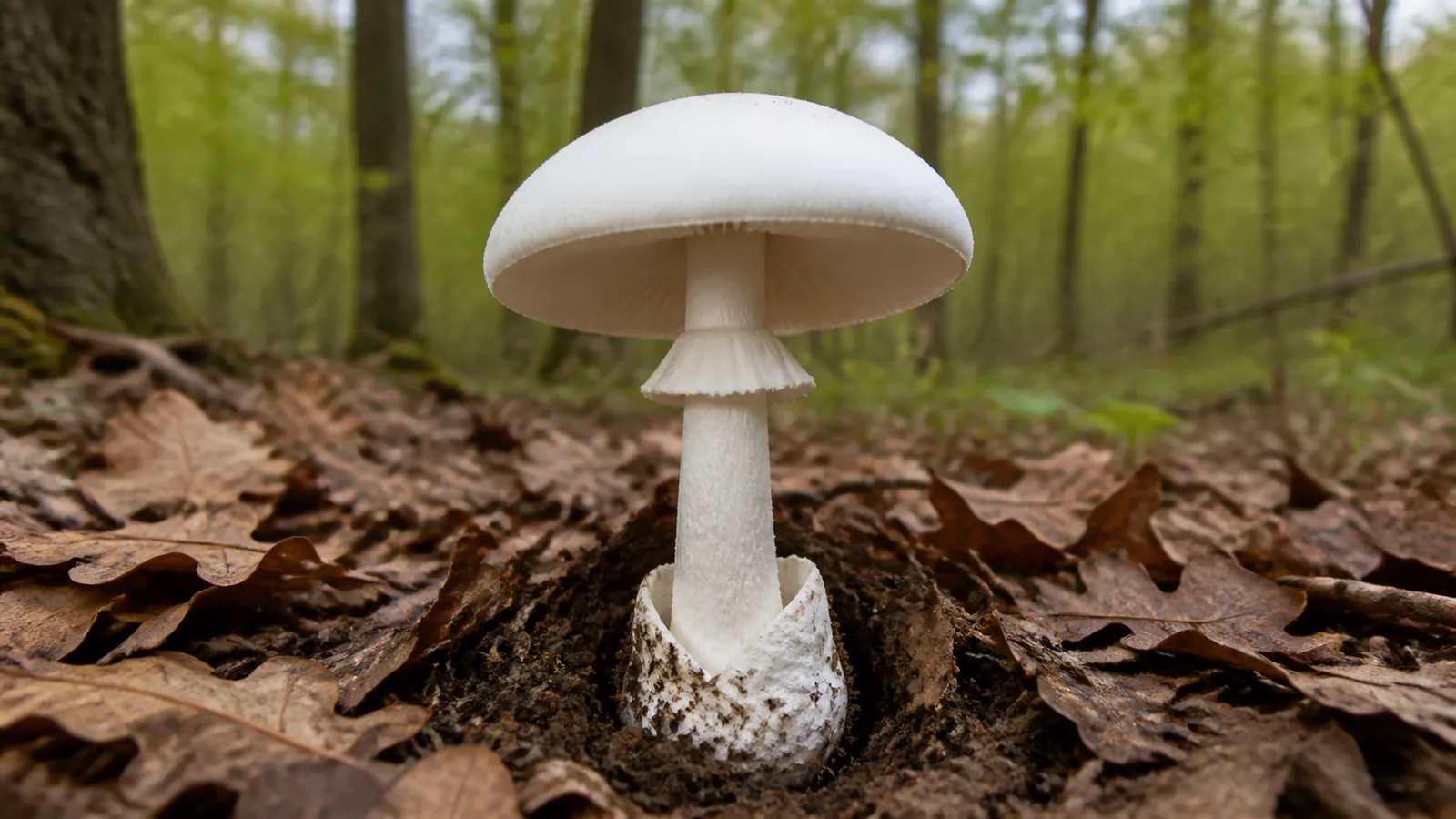
The whole fruiting body is pale. A smooth white cap opens above free white gills, while the stem carries a ring and rises from a bulb enclosed by a membranous volva.
Those features must be read together. White color occurs in many unrelated mushrooms, and the volva can remain underground when someone pulls the stem.
The common name creates a second problem. White deadly amanitas occur on several continents, but a North American specimen should not be named Amanita verna from appearance alone because regional destroying angels belong to different species.
A useful field record therefore includes the complete base, mature gills, nearby trees, date, region, and several views. A single overhead photograph cannot establish the species or support an eating decision.
Warning
A symptom-free evening after a meal does not clear an amatoxin exposure. The delay between ingestion and stomach illness is a defining danger of this poisoning pattern.
How can you recognize the complete mushroom?
White, smooth, and usually 5 to 10 cm across, opening from hemispherical to convex or nearly flat. The margin is not strongly lined.
Crowded, white, and free from the stem. They remain white as spores mature.
White with an upper skirtlike ring and a bulbous base enclosed by a white membranous volva. The volva may remain buried in soil.
White and unchanging when cut, with little odor when young and a less pleasant smell in age. Never taste it.
Excavate the specimen rather than pulling it. The white, sacklike volva around the bulbous base is often hidden by soil and leaf litter, and leaving it behind removes one of the strongest Amanita warnings.

The cap begins rounded and expands to convex or nearly flat, usually reaching about 5 to 10 cm. Its surface is smooth and white, sometimes cream in age, without the obvious colored center expected on a typical death cap.
Look underneath before deciding what the cap resembles. The crowded gills are free from the stem and stay white at maturity, while the spore deposit is also white.
The white stem has a bulb at its base and normally a skirtlike ring above the middle. Rain, slugs, or handling can damage the ring, so absence is weaker evidence than an intact ring.
| Evidence | Fool's mushroom pattern | Limit of the character |
|---|---|---|
| Mature gills | White and free | Several other amanitas share both traits |
| Stem base | Bulb inside a membranous volva | Pulling can leave the volva in the ground |
| Stem ring | Usually present above mid-stem | Weather or handling can remove it |
| Spore print | White | A white print identifies neither species nor edibility |
| Season and range | Spring in warmer European woodland | Climate and local fruiting dates vary |
A potassium hydroxide reaction has been used in keys to separate white members of section Phalloideae, but published European work indicates that the Amanita verna name has covered more than one closely similar lineage. Chemical spot tests belong in a complete expert identification, not in a shortcut for food safety.
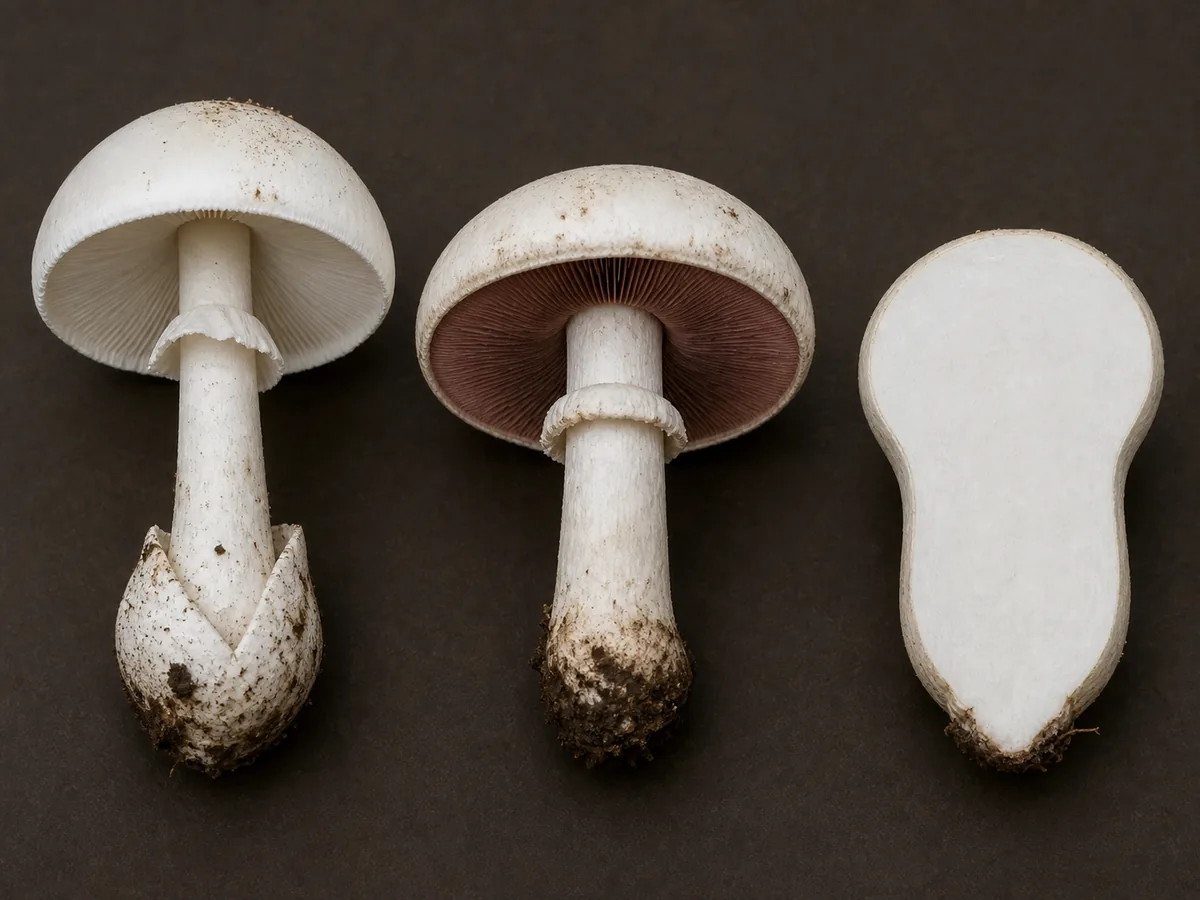
Young buttons are especially hazardous because the universal veil encloses the cap, gills, and stem like a white egg. A lengthwise cut through a true puffball shows even flesh, while an amanita button contains the outline of a developing mushroom.
That cut is a warning check, not proof that every uniformly white specimen is edible.
If someone may have eaten this mushroom, act now. Call Poison Control at 1-800-222-1222 (US) or emergency services before symptoms appear, and save a piece of the mushroom for identification.
What should happen after a possible exposure?
If someone may have swallowed it, call Poison Control at 1-800-222-1222 in the United States or the local poison center or emergency service elsewhere. Do not wait for vomiting or diarrhea because the first illness can begin six hours or more after the meal.
Save uncooked specimens, meal remains, and photos that show the cap, underside, stem, and intact base. Place the specimen in paper, keep it away from food, and tell clinicians that an amatoxin-producing Amanita may be involved.
Which white mushrooms cause the closest mistakes?
The closest mistakes arise because edible white mushrooms may be found in the same broad landscape, while other deadly amanitas share nearly every visible structure. Start with the intact base and mature gill color, then use range, season, host, and expert microscopy to narrow the species.
Never treat one difference as permission to eat a white mushroom.
A white or pale field mushroom can have a stem ring, but its gills progress from pink to chocolate brown and it lacks a volva. Very young Agaricus gills can still be pale, so the base and a mature specimen remain essential.
| Lookalike | Features that point away from fool's mushroom | Safety limit |
|---|---|---|
| Field mushroom | Pink to brown mature gills, brown spore print, no volva | Young gills may still look pale |
| Puffball | Uniform interior without a cap, gills, or stem | Amanita buttons hide formed structures inside |
| Destroying angel species | Differences depend on region, season, and microscopy | They share deadly amatoxins, so confusion does not reduce risk |
| Pale death cap | Often olive, bronze, or yellowish cap with the same white gills and volva | White forms occur and are equally dangerous |
| White dapperlings | No true sacklike volva, different cap and stem textures | Some are toxic, and a missing base prevents comparison |
European Amanita virosa usually fruits later in woodland and often has a more fibrous or shaggy stem. It is also deadly, so separating the two changes the name but not the emergency response.
Key takeaway
If a white gilled mushroom has been pulled, trimmed, or photographed without its base, the evidence is incomplete. Do not use it for food.
What does the name Amanita verna cover?
Amanita verna belongs to family Amanitaceae and section Phalloideae, which contains the death cap and other amatoxin-producing amanitas. The common name spring destroying angel reflects its European spring season, not a universal white-mushroom identity.
Modern study of Mediterranean white amanitas has found that specimens historically placed under Amanita verna include closely related lineages that can require chemical reactions, microscopy, and DNA evidence to separate. A field photo may support the deadly group while remaining insufficient for a species name.
NCBI currently records Amanita verna and the common name fool's mushroom, but North American white destroying angels should be assessed under their regional species. This page therefore uses the traditional European identity and states the taxonomic limit rather than exporting the name worldwide.
Where does fool's mushroom fruit?
Fool's mushroom is mycorrhizal. Its underground fungus exchanges nutrients with living tree roots, which is why fruiting bodies rise from soil and leaf litter rather than directly from a log.
Warm European broadleaf woodland is the central habitat, with oak repeatedly associated with the species complex. The spring season is useful only inside the correct region, since weather can shift fruiting and other white amanitas occupy later windows.
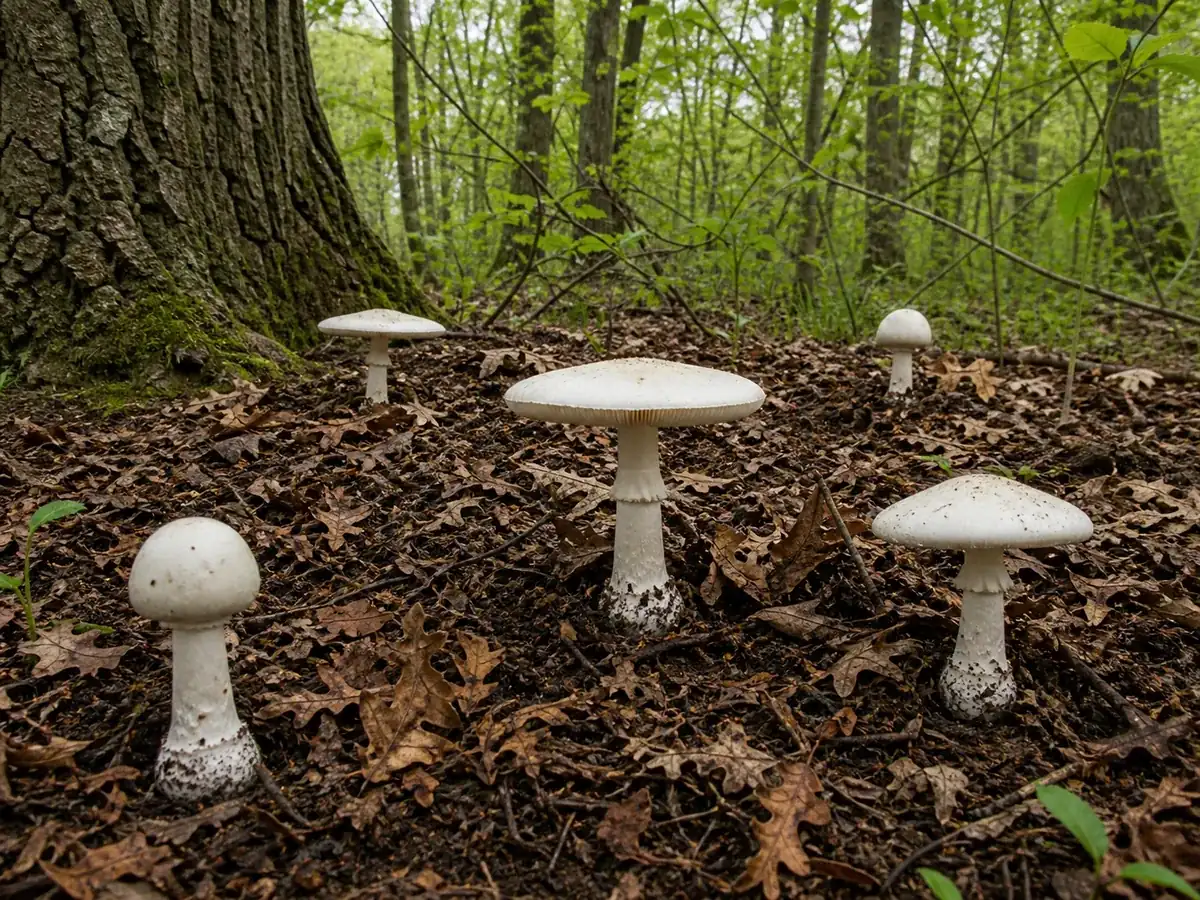
Amanita roots can persist after visible mushrooms are removed. Picking fruiting bodies can reduce immediate access for children or pets, but later rain may produce another flush in the same root zone.
Record the tree canopy as carefully as the mushroom. Host, climate, date, and region often carry more taxonomic value than a slightly cream cap or a torn ring.
Why can amatoxin poisoning seem to improve?
Amatoxins inhibit RNA polymerase II, preventing cells from making essential proteins. The liver receives a particularly damaging dose, and kidney injury or failure of blood clotting can develop as poisoning progresses.
The early course is deceptive. A person may feel normal for six hours or longer, then develop intense vomiting, diarrhea, and abdominal pain before appearing to improve.
Apparent recovery does not mean the toxin has cleared. Hospitals use serial blood tests, poison-center consultation, supportive treatment, and transplant assessment according to the individual case.
There is no home antidote and no single standardized treatment that makes waiting safe. Call before symptoms, preserve evidence, and do not induce vomiting or try an herbal product unless a poison specialist directs it.
Can cooking remove the toxins?
Fool's mushroom has no culinary use. Boiling, frying, drying, freezing, pickling, or discarding cooking water does not make amatoxins safe.
Keep a suspected specimen out of a mixed basket because fragments can travel between mushrooms. Use a separate paper container if an identifier or poison center needs the sample, then follow their disposal instructions.
Warning
Do not nibble and spit as an identification test. Taste cannot distinguish an amatoxin mushroom, and swallowing a small fragment can create a serious exposure.
Fool's mushroom questions
Is fool's mushroom edible?
What should I do after a possible bite?
How do you distinguish it from a field mushroom?
Can fool's mushroom lose its ring or volva?
Is Amanita verna found in North America?
When and where does fool's mushroom grow?
Sources & References
- NCBI Taxonomy Browser Current Amanita verna identity, Amanitaceae lineage, and common names.
- Mediterranean Amanita Phalloideae study Taxonomic complexity of European white amanitas and the limits of field characters and KOH reactions.
- Amanitin content of Amanita verna Measured alpha, beta, and gamma amanitins in European Amanita verna samples.
- CDC MMWR Delayed amatoxin syndrome, severe outcomes, emergency response, and current treatment limits.
- Mushroom poisoning updated review Amatoxin mechanism, clinical progression, and organ injury.
- First Nature Amanita key Whole-specimen Amanita characters including free white gills, white spore print, ring, and volva.
- First Nature Amanita virosa European destroying angel comparison and spring occurrence of Amanita verna.