What is the booted amanita?
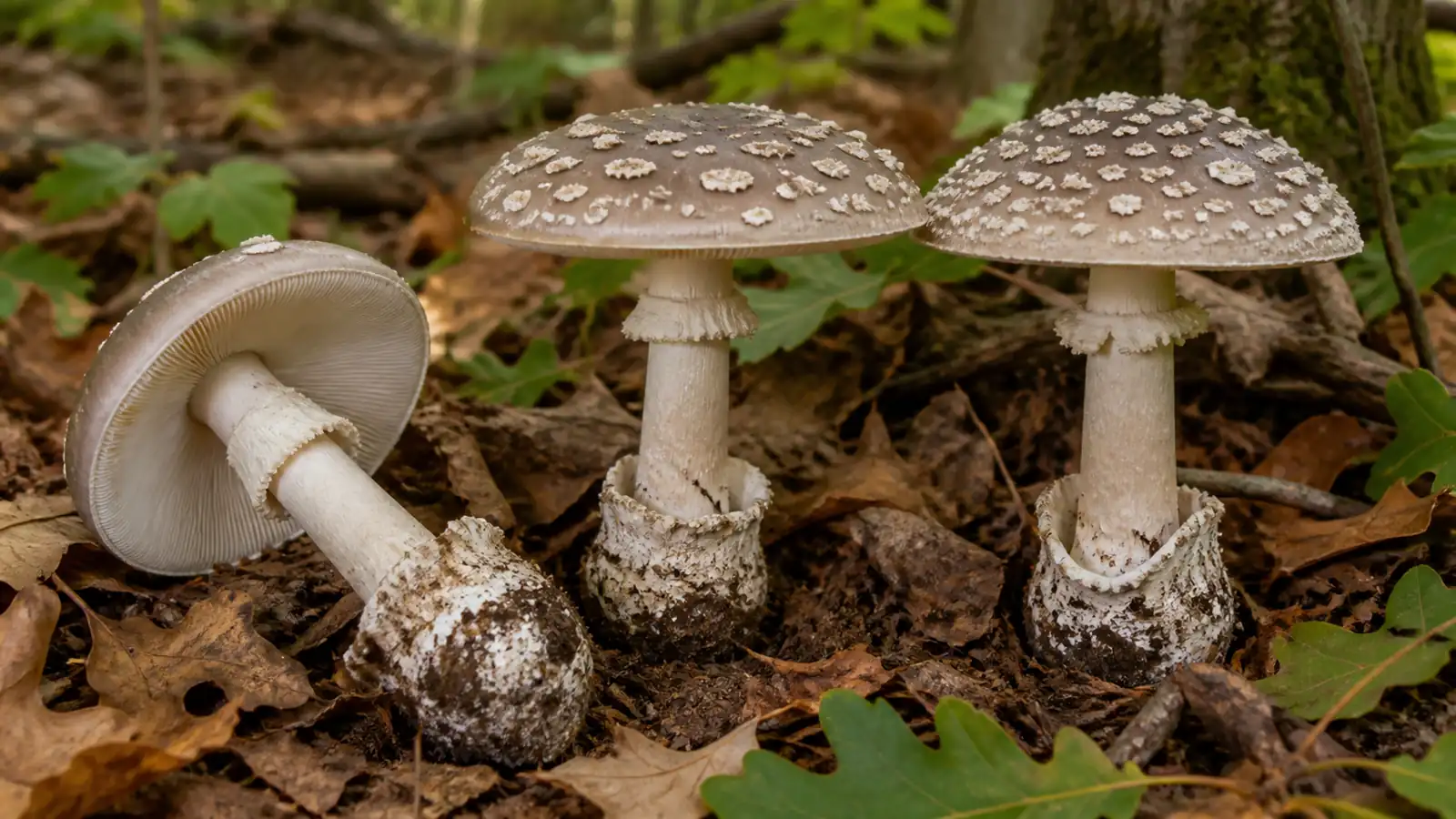
Booted amanita is a pale member of the panther group whose universal veil forms a collar around the swollen stem base. The cap often fades from a brown or tan center toward a cream margin scattered with white patches.
A second veil covers the young gills and usually leaves a ring. That ring can pull upward into a shallow funnel, which explains the modern common name small funnel-veil amanita.
Key takeaway
Preserve both veil systems. Cap patches and the basal boot come from the universal veil, while the stem ring comes from the partial veil that protected the gills.
The cap margin develops clear radial grooves as it expands.
Those striations help place the mushroom within section Amanita, but they do not select one species from the regional panther and gemmed groups.
White gills remain free from the stem and produce a white deposit. A white print excludes some brown-spored lookalikes but adds little within Amanita, where many poisonous and deadly species share it.
The older name Amanita cothurnata appears in toxicology and field literature.
Current North American treatments commonly place that concept under A. multisquamosa, so both names should be searched when evaluating an exposure or historical record.
This mushroom contains or has been reported with neuroactive isoxazoles in its taxonomic group. Effects may include nausea, confusion, agitation, altered perception, poor coordination, drowsiness, seizures, or coma, and the course cannot be predicted from cap size.
Drying or simmering is not a public safety protocol. Concentrations vary, identification can be wrong, and home processing does not create a standardized product.
A reader should learn why the base matters, how the two veils differ, which regional names are current, and what evidence to preserve after exposure.
How do the two veil systems identify it?
Convex to nearly flat, about 4 to 11 cm, pale cream to tan with a darker brown center, scattered white veil patches, and a distinctly striate margin.
Crowded, white, and free from the stem, with shorter gills interspersed.
White, about 8 to 13 cm, with a membranous ring that may turn upward and a bulbous base surrounded by a boot-like or rolled collar of universal veil tissue.
White flesh with a mild odor; never taste an Amanita in the panther group.
Record the mushroom in place before lifting it. Show cap color, scattered veil patches, marginal grooves, surrounding trees, soil, and the depth at which the stem enters the ground.

Excavate one complete base by loosening soil around the bulb. Pulling upward often shears the collar away and leaves it in the ground, creating an incomplete specimen that appears safer than it is.

Photograph in place
Photograph the untouched cap and habitat from above and the side.
Excavate the base
Lift the complete bulb with its collar, then brush rather than wash it.
Record both veils
Document free gills, ring orientation, cap striations, and veil-patch texture.
Separate the stages
Keep young and mature stages separate and use a current eastern North American Amanita key.
Universal-veil patches should be described as powdery, felted, irregular, or wart-like before they rub off. Their color and arrangement can support a comparison, yet weather makes them too unstable to carry the name alone.
The cap margin should be photographed with backlighting that reveals true grooves. Cracks caused by drying are irregular, while anatomical striations run evenly inward from the edge.
Free gills stop just short of the stem. A close side section can show the gap, but cutting should happen only after the intact fruiting body and veil structures have been recorded.
A white print is obtained from a mature cap on dark material.
Do not infer safety from the result because destroying angels, fly agarics, edible grisettes, and many other Amanita share pale spores.

Microscopy evaluates spore dimensions, amyloid reaction, basidia, veil tissues, and cap-surface structure. DNA is valuable in regional complexes where older names were applied across several eastern species.
Photograph the bulb from every side.
A collar can be interrupted, doubled, tilted, or obscured by soil, and one frontal view may make a rolled boot look like a loose sac.
A formal voucher should include the whole dried specimen, fresh color notes, odor, tree inventory, location, date, and photographs of both veils. Never discard the base after taking a cap for sequencing.
During a suspected poisoning, do not delay care while pursuing an exact species. Send the poison center photographs of the cap, gills, ring, and base, and keep remaining material refrigerated in paper rather than sealed wet plastic.
Veil architecture changes as the mushroom expands. Photograph a button, an opening cap, and a mature specimen when they clearly belong to the same fruiting group, since each stage preserves a different part of the two-veil system.
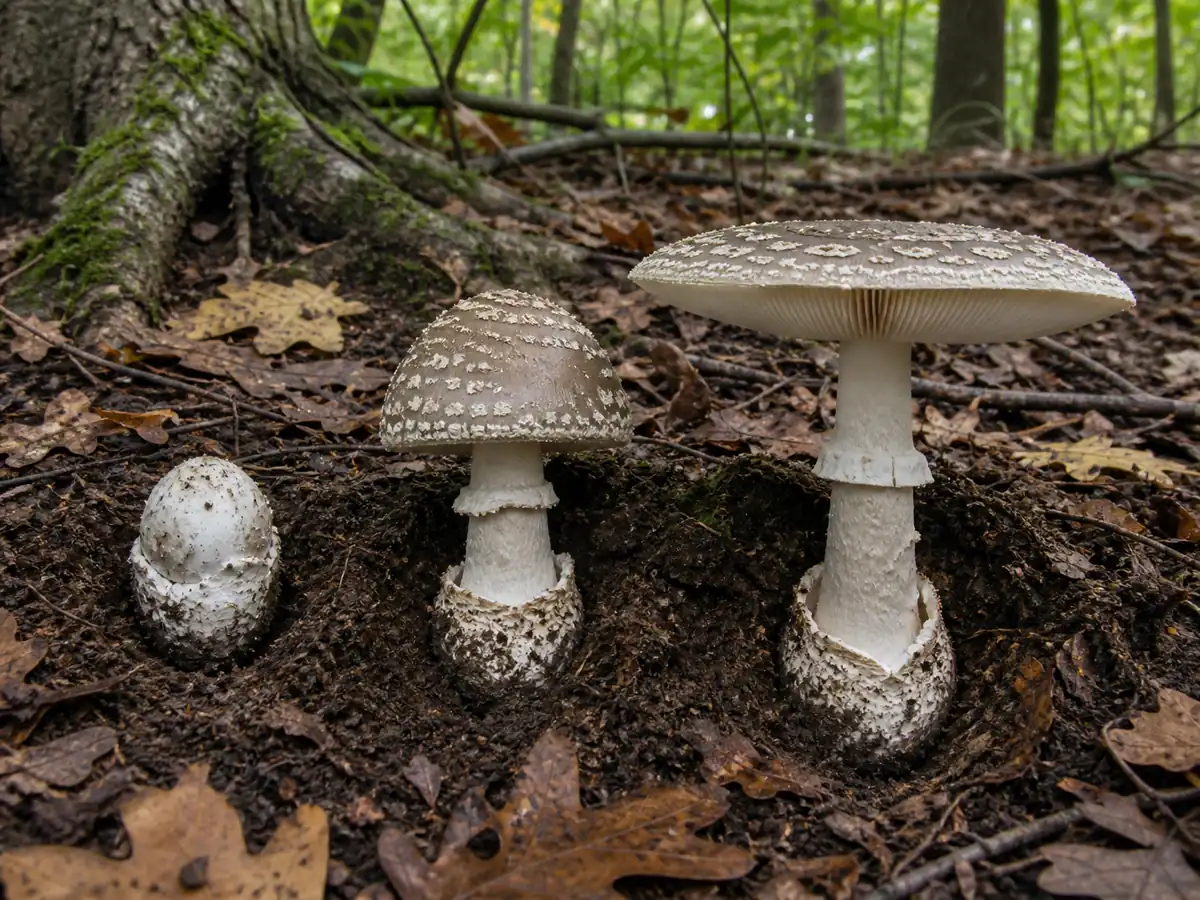
The universal veil may leave both cap patches and a basal collar. Compare their texture and color because rain can remove the cap evidence while protected tissue remains around the bulb.
The partial veil attachment can pull the ring upward as the stem elongates. A funnel-shaped ring is useful, but an ordinary hanging or collapsed ring does not exclude the species.
The bulb must remain attached to its cap. Never mix excavated bases beside several loose caps, because the most important identification structure then loses its specimen identity.
When preparing a voucher, cut the dried fruiting body only after external documentation. Keep one half intact and use the other for internal veil, flesh, and tissue study.
If someone may have eaten this mushroom, act now. Call Poison Control at 1-800-222-1222 (US) or emergency services before symptoms appear, and save a piece of the mushroom for identification.
Which pale Amanitas share a collared base?
Booted amanitas overlap with other pale members of Amanita section Amanita. The complete stem base, cap-margin striations, universal-veil remnants, ring, free white gills, and region must be examined together.
Warning
Never eat a booted Amanita. Species in the panther and fly-agaric groups can cause severe neurotoxic poisoning, and washed caps or trimmed bases remove the structures needed to distinguish them.
| Candidate | Cap and veil | Stem-base pattern |
|---|---|---|
| Amanita multisquamosa | Pale margin, darker tan-brown center, white patches, striate edge | Bulb with a boot-like collar, usually a ring on the stem |
| Amanita velatipes | Pale yellow to tan, often with veil patches | Bulb and collar, with a veil that may form a high funnel-like ring |
| Amanita albocreata | Small pale cap, often with patches | Booted base but typically no persistent stem ring |
| Amanita frostiana | Brighter yellow-orange cap | Collar-like volva and small stature |
| Amanita pantherina group | Brown cap with white warts | Collared or rimmed bulb, regional species differ |
| Amanita sect. Phalloideae | Pale cap and white gills | Sac-like volva rather than the same rolled boot pattern, deadly amatoxin risk |
The basal collar is not a decorative extra. It is universal veil tissue left where the young mushroom broke from its enclosing covering, and it can be buried completely below the soil line.
Dig around one specimen with a small tool and lift the intact bulb. A snapped stem can look like a ringed white-gilled mushroom from several unrelated groups and should never be used for a food decision.
The partial veil can be variable. It may hang downward, pull upward into a funnel, collapse against the stem, or disappear with age, so multiple developmental stages are more informative than one mature mushroom.
White warts aloneRain can wash them away, and several Amanita species carry pale veil patches.
Brown center aloneHydration and age alter cap contrast.
Striate margin plus booted bulbThe combination supports section Amanita placement.
Regional taxonomyEastern A. multisquamosa should not be replaced with a European panther name from an image search.
A destroying-angel comparison remains necessary whenever a white or pale Amanita is incomplete. Even if the expected volva differs, the consequence of a mistaken edible claim is too severe to dismiss a specimen with its base missing.
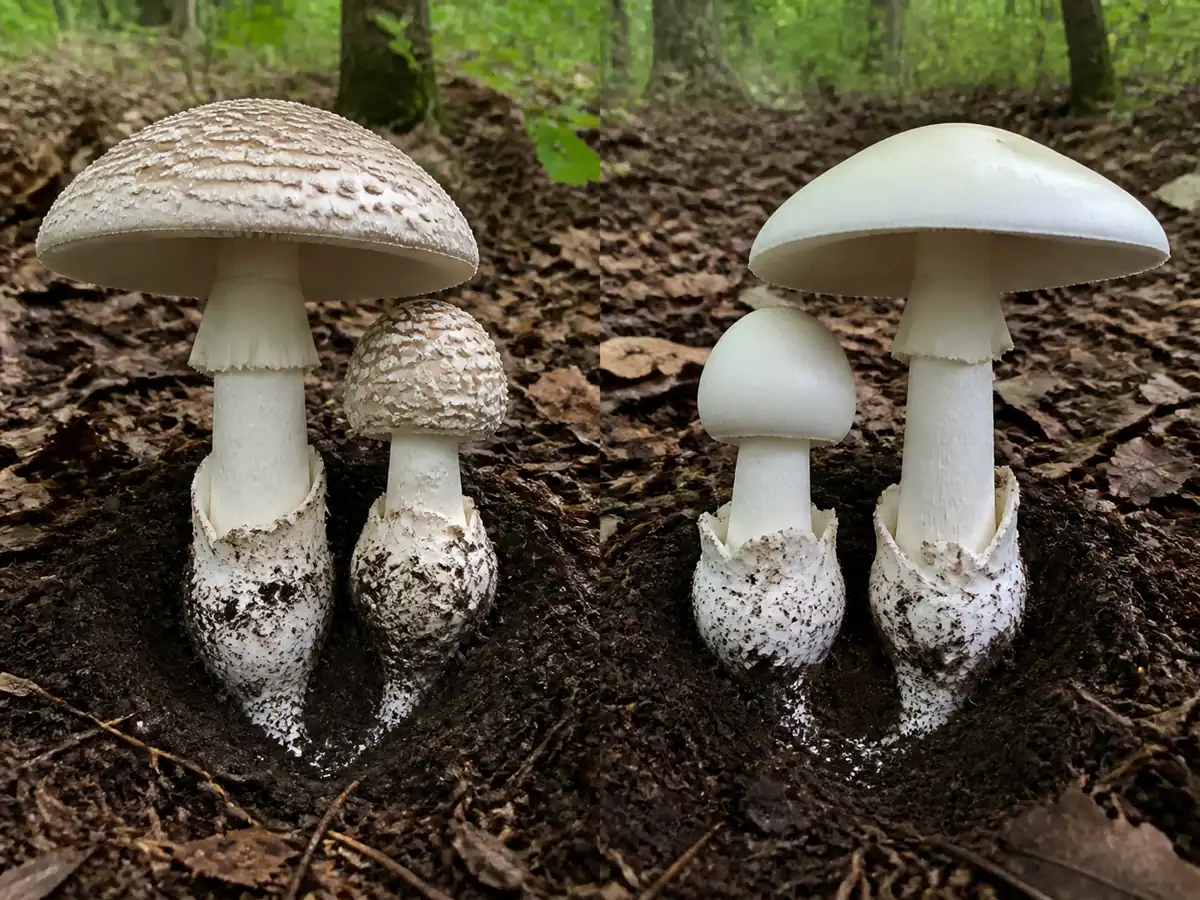
Amanita velatipes overlaps in pale color and a high funnel-like veil, but cap tones, veil distribution, size, and eastern range need a specialist key. One unusually upright ring cannot carry that comparison.
Ringless A. albocreata becomes a practical trap when the partial veil of A. multisquamosa has disappeared. Search the stem for remnants, compare size, and preserve the complete booted base for microscopy.
Pale destroying angels generally carry a sac-like volva and lack the same striate panther-group margin, but damaged specimens can erase both contrasts. Treat an incomplete white Amanita as a medical-risk specimen rather than a puzzle with an edible answer.
Veil pattern outranks cap color. Pale tan, cream, yellow, and brown shift with age, while the relationship among patches, ring, bulb, and collar records development.
Is Amanita cothurnata the current name?
The name booted amanita has been applied to Amanita cothurnata in eastern North America. Current sources often treat A. cothurnata as a heterotypic synonym of A. multisquamosa, a name published by Charles Horton Peck.
The concept belongs to Amanita section Amanita and the panther group. Its booted base describes a morphology shared with several relatives rather than a one-species category.
Taxonomic updates matter clinically because chemistry attributed to an older name may represent a broader or different lineage.
They do not weaken the immediate treatment decision after ingestion, which is to seek poison-service advice.
A sequence without a photographed complete base can still leave morphological questions. The best voucher joins DNA with cap, gill, veil, bulb, habitat, and developmental-stage evidence.
Synonymy does not mean every historical specimen was interpreted identically. Authors may have applied Amanita cothurnata, the variety Amanita pantherina multisquamosa, or Amanita multisquamosa with different limits across time.
A modern record should state which concept and regional key were used. This is especially important when comparing toxin reports, because chemistry follows authenticated material rather than a common name.
The current name does not erase the older evidence. Searching both combinations connects modern field identification with toxicology and poison-center records that predate the synonym decision.
When sequence data disagree with morphology, recheck the specimen chain before announcing a range extension. A mixed base, mislabeled tissue tube, or contaminated sequence can create a taxonomic contradiction that no cap photograph resolves.
Which trees support this eastern Amanita?
Amanita multisquamosa forms ectomycorrhizae with living trees in eastern North American woodland. The underground mycelium exchanges soil water and nutrients with fine roots in return for photosynthetic carbon.
Fruit bodies rise from soil rather than dead logs. A cap near a stump may still be connected to living roots, so substrate and host should be documented separately.
Mixed oak, beech, hickory, and conifer stands can create several plausible hosts. The nearest trunk is not always the partner because roots overlap below the surface.

Note
Excavate only the one specimen needed for documentation. Repeated digging damages fine roots and veil evidence while adding little to a colony record.
Summer and autumn moisture triggers fruiting, but the same mycorrhizal partnership may persist through years without visible mushrooms.
Absence during drought does not show that the fungus has left the site.
Amanita fruiting bodies are eaten by insects and mammals despite human toxicity. Human food rules cannot be inferred from animal feeding because species, dose, metabolism, and behavior differ.
Site records should include tree mix, soil drainage, slope, litter, recent weather, and whether multiple Amanita species occur nearby. Mixed fruitings make it especially important to keep every collected base with its own cap.
Removing mushrooms does not remove the mycelium or make a yard safe permanently. Where children or pets are at risk, supervise access, remove fruiting bodies with gloves before they decay, and continue monitoring after rain.
Do muscimol claims make it medicinal?
Muscimol and ibotenic acid are pharmacologically active compounds, not proof that a wild Amanita is medicine. A mushroom with variable chemistry and uncertain identity has no safe self-treatment dose.
Commercial gummies, tinctures, or dried caps do not make a wild collection interchangeable with a tested pharmaceutical. Labels, legality, contaminants, and dose accuracy create separate risks.
Do not use booted amanita for sleep, pain, anxiety, or intoxication. Seek ordinary medical advice for symptoms rather than substituting a poisonous mushroom preparation.
Can any preparation make it edible?
There is no culinary use for booted amanita. Do not parboil, ferment, dry, or repeatedly boil it in an attempt to create food.
Home processing cannot standardize ibotenic acid and muscimol, and an identification error can substitute another Amanita with a different toxin syndrome. A recipe cannot repair that biological uncertainty.
Keep booted amanitas out of edible baskets from the moment of collection. White fragments and loose veil patches become impossible to reassign after several mushrooms are cleaned together.
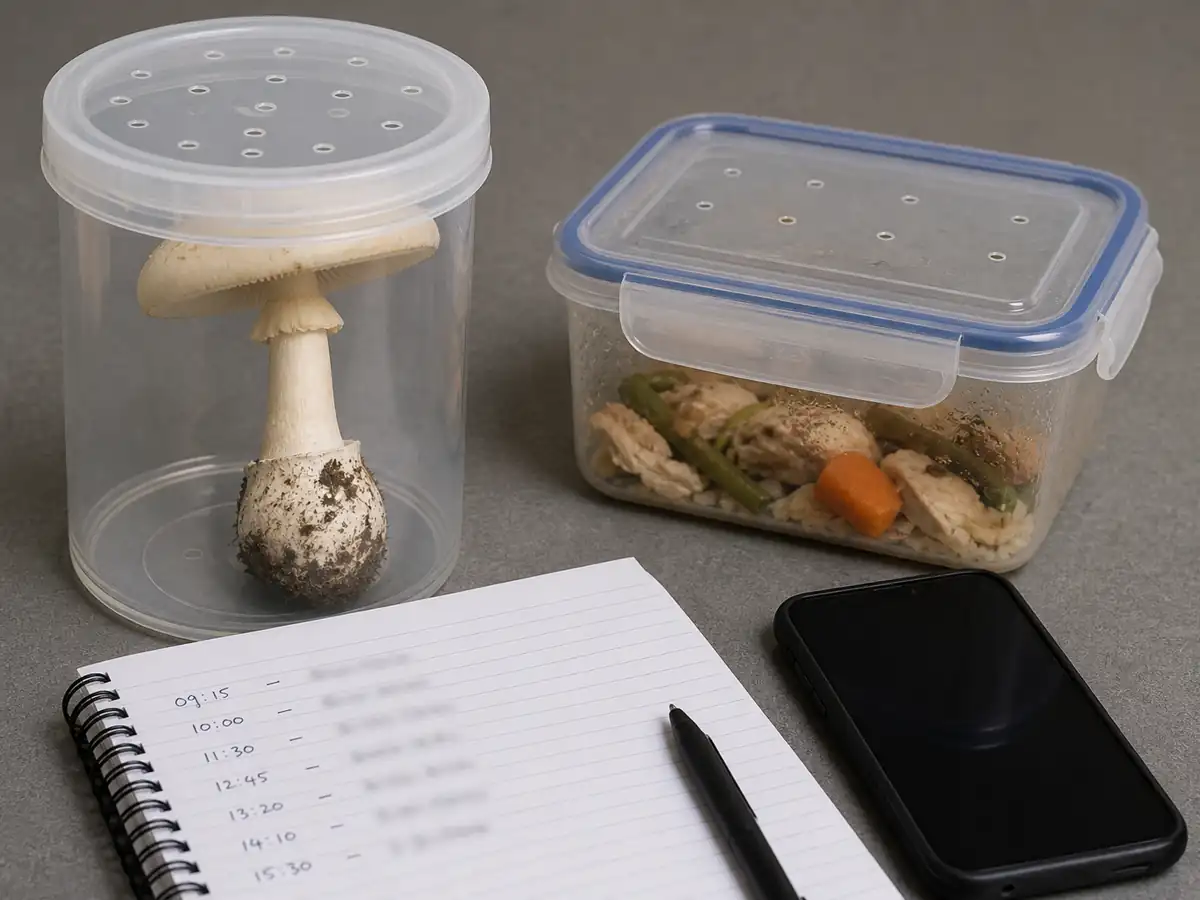
Booted amanita poisoning questions
Is booted amanita poisonous?
What is the boot at its base?
What color is its spore print?
Why must the whole base be collected?
Is Amanita cothurnata a synonym?
What should happen after ingestion?
Sources & References
- NCBI Taxonomy Current-name record and A. cothurnata synonym context.
- Su et al., Toxicon Ibotenic acid and muscimol distribution in Amanita section Amanita.
- Blue Ridge Poison Center guide Regional morphology and poison-center context for A. multisquamosa.
- Studies in the Amanitaceae Specialist nomenclature and morphology resource.