
 Poisonous

Why a brown cap alone does not identify Panther Cap
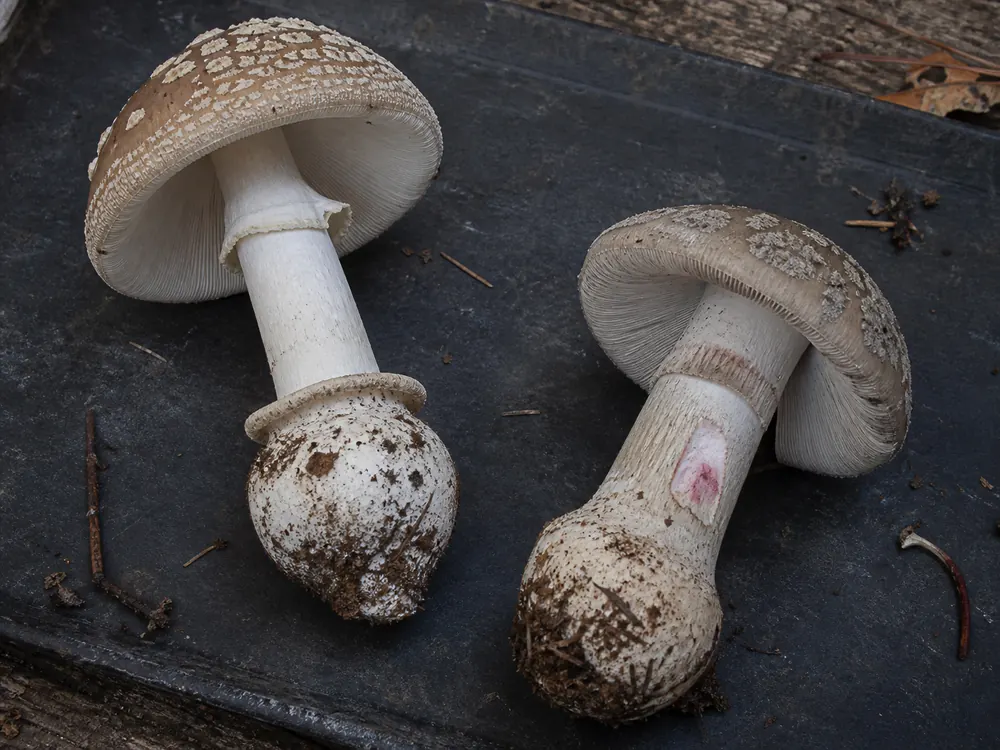
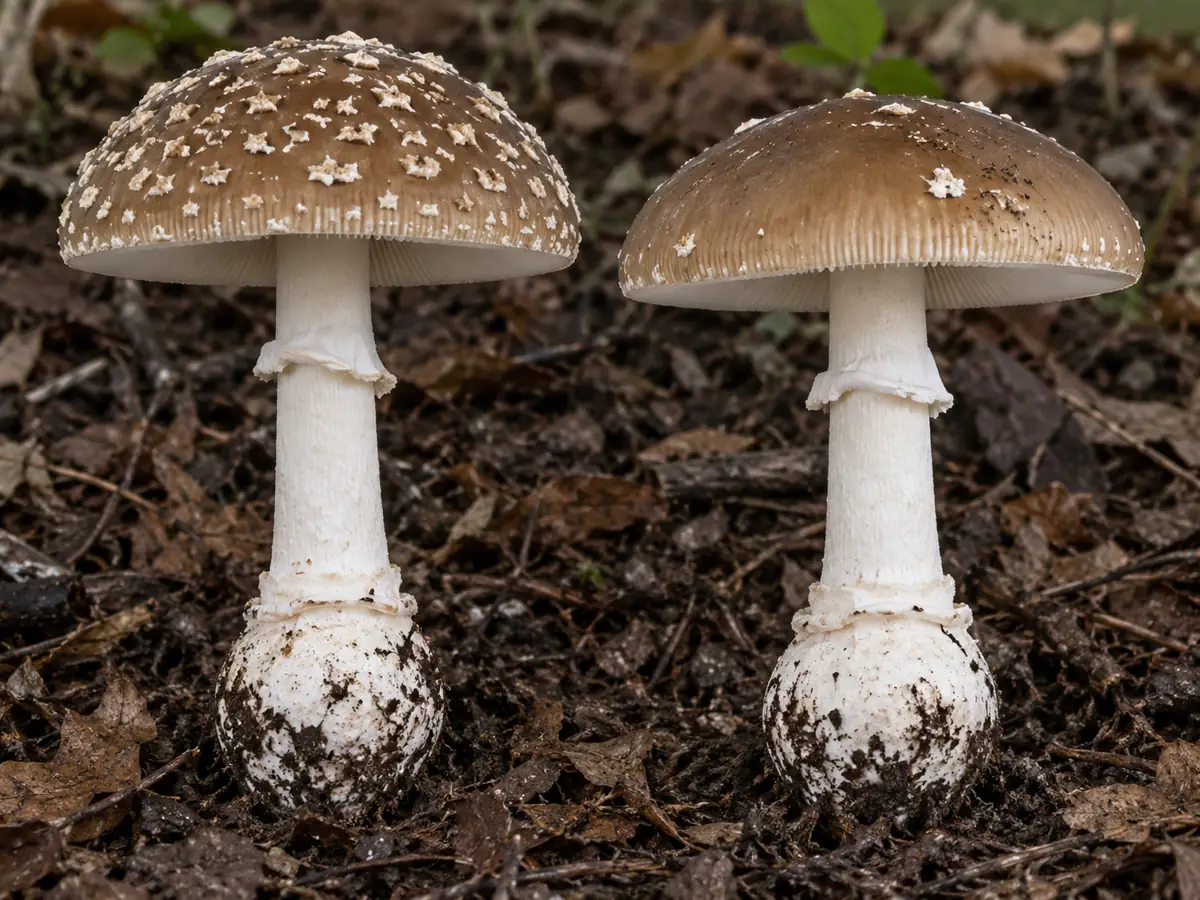
The European Panther Cap, Amanita pantherina, pairs a brown cap and pale veil remnants with white gills and a distinctive rim around its bulb. Those features last for different lengths of time. Rain and handling strip the loose cap warts easily, so an older or rain-soaked mushroom can look nothing like the familiar spotted picture. The collar on the bulb usually survives longer, which is why the base carries so much of the identification.
People also attach the name to mushrooms photographed far outside Europe and western Asia. Specialist taxonomy separates several American and Asian panther-like Amanitas, so a shared common name tells you little about whether two photos show the same species. Its toxins work on nerve signaling: ibotenic acid and muscimol, which documented exposures link to clumsy movement, agitation, depressed consciousness and severe coma. Fly Agaric carries the same main toxins, though its red cap looks nothing like this brown one.
For a brown woodland find, your job is to see whether the cap, gills, ring, flesh and complete base all match the regional description. Skipping any of those parts leaves the identification open. If someone may already have eaten one, medical advice comes before finishing the identification.
Read the two veils, then the complete mushroom
Mature European Panther Caps often have caps about 3.7-11 cm across, in shades from deep brown through hazel to pale ochre-brown. The specialist species account describes a shiny cap that turns sticky when wet and shows short grooves near the margin. Those measurements describe the species, and no single specimen has to fit them to count. Cap color and size overlap with other Amanitas, and photos seldom keep scale, gill attachment and the underside of the bulb in the same frame.
The stem ring and basal collar have different origins
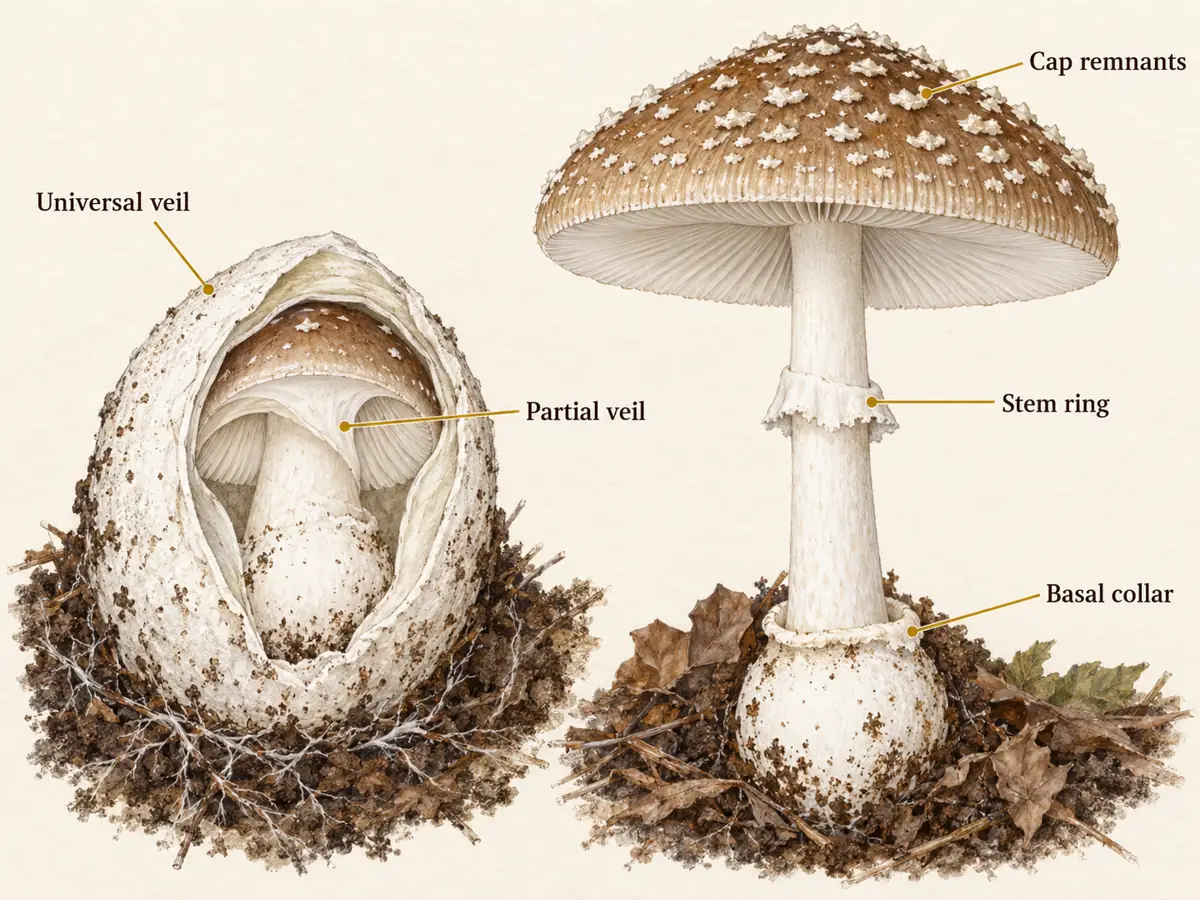
The universal veil wraps the young mushroom completely. As the cap expands it tears, leaving warts on the cap and tissue around the stem base, which mycologists call the volva. Panther Cap's volval tissue is fragile, so the cap and the base rarely keep equally obvious remnants. You can find a nearly bare cap above a bulb that still has a clear collar.
The partial veil is a separate membrane that covers the young gills under the cap. It leaves the stem ring, which sits partway up the stem. The basal collar sits much lower, as a ridge where the stem joins the bulb. So when a description mentions only a white ring, you still need to know which of these two structures it means.
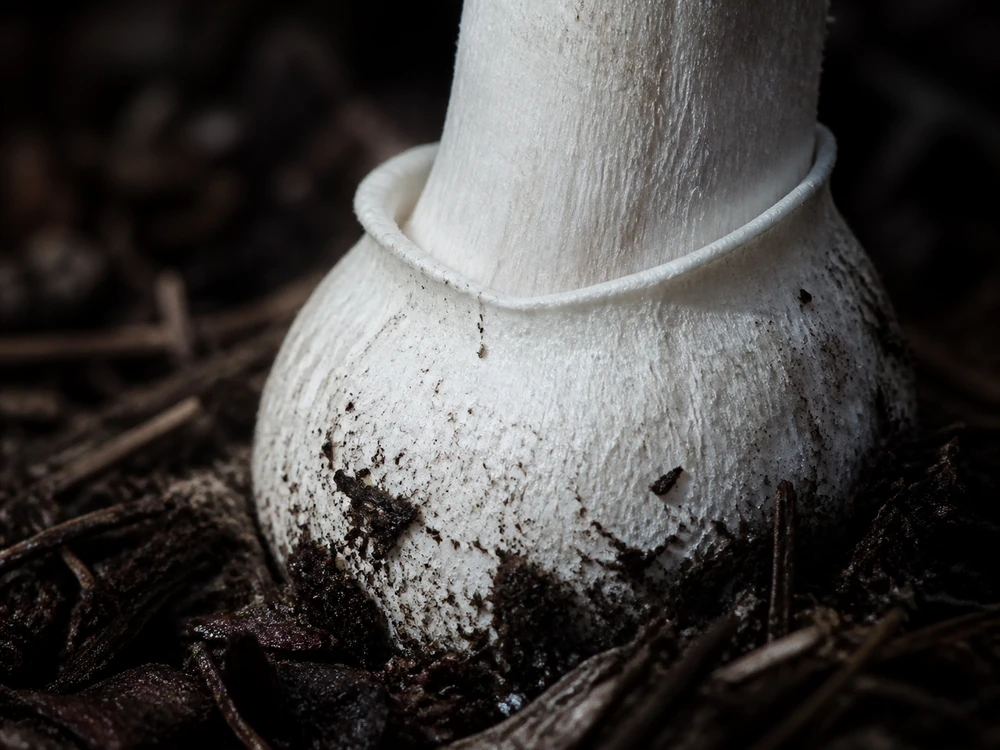
Panther Cap's bulb runs from rounded to egg-shaped or spindle-shaped, with at least one volval ring near its upper edge. Some guides compare the collar to a rolled sock, and extra veil bands may wrap the bulb lower down. Soil can hide this joint, and pulling the mushroom up by its stem often leaves the collar in the ground. That bare swollen base only counts as evidence when you know the whole base came up with it.
Rain changes the cap without changing the species
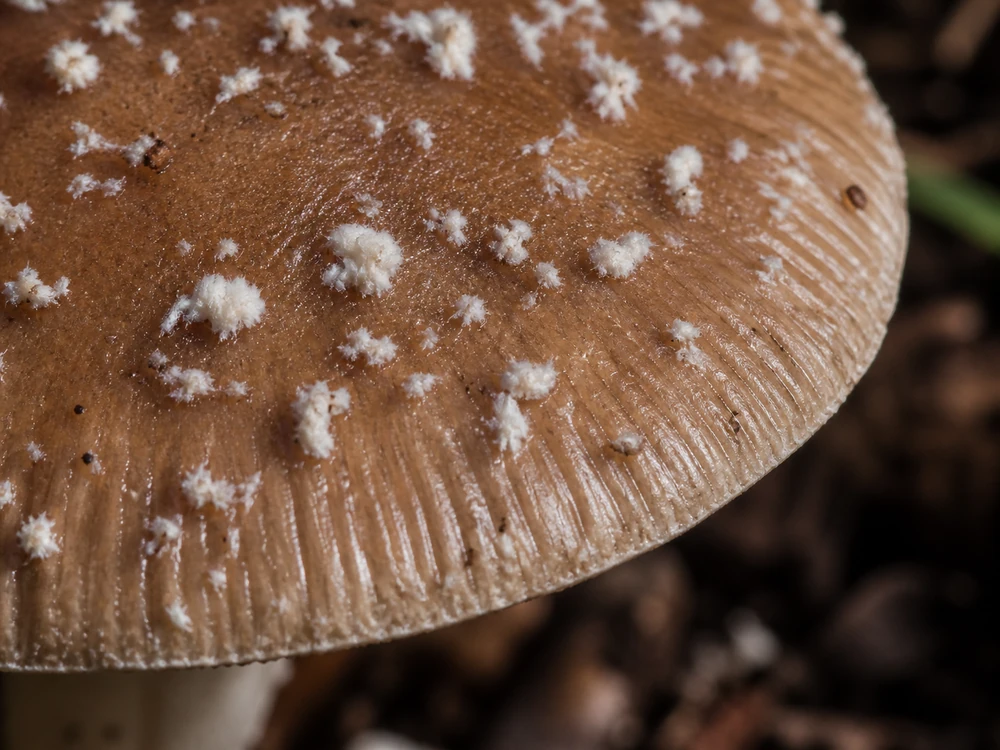
The white to cream warts are loose veil fragments that sit on top of the cap. Brushing, handling or wet weather can knock off the most familiar part of the pattern. So a smooth brown cap does not rule out Panther Cap, and white flecks on a brown cap do not confirm it, since other Amanitas keep veil tissue too. The short grooves at the margin belong to the cap itself, and they only carry weight when the ring, flesh and base point the same way.
Young caps that still curve inward make the margin hard to read. Growth also changes how much of the gills and ring you can see. Your immature specimen therefore cannot show every adult feature yet, and you should not expect it to.
The underside and collection must preserve the remaining evidence
Its gills are white and crowded, and their inner ends stop short of the stem or barely touch it. Free gills describe how the gills meet the stem, and they say nothing about edibility. White gills also turn up across other Amanitas. The stem ring is usually membranous, sits fairly low for a European member of this group and has a smooth upper surface. It soon collapses against the stem, so an old or torn ring tells you far less than an intact one.
The flesh stays white when you cut or bruise it. Its white spore print fits the group, yet several other white-spored Amanitas give the same print. Microscopy can add spore shape and chemical reactions, though those need a regional key and someone trained to read it. No microscope can bring back a basal collar that stayed in the soil.
When you keep a specimen for an expert to identify, these steps preserve the evidence from that same individual:
Nearby fruiting bodies may sit at different stages, but you cannot combine them into one imaginary complete specimen. Pairing a collar from one mushroom with a cap from another shows nothing about either of them, and that mix-up sits among the classic identification mistakes with Amanitas. Each identification has to rest on features from the same individual.
What Panther Cap poisoning can do to the brain
Ibotenic acid acts at glutamate receptors that carry excitatory signals, while muscimol acts at GABA receptors that carry inhibitory ones. Those two actions explain why the poisoning targets the brain and nerves. They cannot tell you the order in which one person's symptoms will appear. So a sleepy patient can still be in danger, and so can an excited one.
Reported signs include poor coordination, hallucinations and agitation, alongside drowsiness or deeply reduced consciousness. The excitatory toxin does not stop brain function from dropping sharply, and an agitated phase gives no sign that the danger has passed. In the 2015 case report on burst suppression, the authors discuss altered glutamate and GABA signaling as a possible cause of an unusual EEG pattern. That proposal covers one patient's brain recording, and it falls short of explaining every symptom or every Panther Cap exposure.
What the case reports show and leave open
Reports published under the Panther Cap name prove that serious effects can occur. Each history differs in how much the person ate, how firmly anyone identified the mushroom and how the illness ran. You learn the range of outcomes from them, and averaging them into a reassuring forecast would throw that range away. The species name in a clinical paper also comes without a later taxonomic check of the specimen, so these histories cannot identify a regional lookalike for you.
| Report | Documented observation | What the observation does not establish |
|---|---|---|
| Satora and colleagues, 2006 | Two adults developed poor coordination, hallucinations and alternating depressed and overactive behavior after one shared meal, with onset reported at two hours | A universal onset window, a safe portion or a guarantee that later symptoms will follow the same course |
| Burst-suppression report, 2015 | One patient had coma with an EEG pattern of alternating activity and electrical suppression, then recovered without sequelae a week after ingestion | That every coma has this EEG pattern, or that recovery can be managed at home |
| Cirronis and colleagues, 2025 | One patient had severe coma and confirmed epileptiform activity, with neurological disturbance still observed through hospital day seven | How often seizures occur, or a standard duration for every poisoning |
In the 2006 report by Satora and colleagues, two adults ate five fruiting bodies between them. The authors give no measured toxin dose that would apply to a future meal. Counting mushrooms therefore cannot define a safe amount or predict how badly another person will react. The later severe cases also rule out any promise that symptoms always clear within a few hours, and a published recovery under medical care gives nobody permission to wait at home without advice.
This brain-centered pattern differs from the delayed liver injury that some other poisonous Amanitas cause. Even so, you cannot sort an uncertain mushroom or a mixed meal into either pattern from the first symptom, because the actual species may still be unknown. Mushroom poisoning symptoms vary across many other species as well. Feeling well shortly after a suspected meal does not show that the exposure is harmless.
The first-aid steps can begin while you gather the details a poison service will ask for. Note where the mushrooms came from, when the meal happened, who ate it and what remains. You do not have to diagnose the poisoning yourself before you call. If the person collapses, has a seizure, struggles to breathe or cannot be woken, Poison Control's emergency guidance sends you straight to emergency services.
Warning
Urgent exposure response
In the United States, call Poison Control at 1-800-222-1222 immediately after suspected ingestion. Call 911 if the person collapses, has a seizure, has trouble breathing or will not wake up. Elsewhere, use the local poison service and emergency number.
Woodland context supports an identification, but does not settle it
Panther Cap lives in partnership with tree roots through mycorrhizae, and its mushrooms come up from the ground in suitable woodland. Wood-decay fungi work differently, fruiting straight from the wood they digest. So a stump beside your mushroom does not make wood its food source. Roots and buried wood often share the same patch of soil, and you have to read the surroundings with that in mind.
The specialist European account lists oaks, chestnuts and conifers as partners, plus a published subalpine record with rockrose. With that spread of hosts, no single tree has to be present for a Panther Cap record. The nearest trunk may not even be the partner, because roots reach well beyond the base of a tree. Your habitat photo of several neighboring trees tells a specialist far more than a note naming only the closest one.
In Europe it usually fruits from summer into autumn, which fits the pattern of fall mushrooms in mixed woods. The season gives context, and it cannot confirm a find or rule out an unresolved Amanita. Location, host trees, ground and maturity together tell a specialist which regional species belong in the comparison.
A suspected meal needs medical advice before a species name
Panther Cap has no place in an edible mushroom basket. It stays poisonous when the cap loses its spots, when it resembles a Blusher and when someone gives it a reassuring common name. No tested household method turns it into food. Cooking or drying cannot make up for an uncertain species, and the case reports offer no safe dose.
After a suspected meal, call a poison service first. The service can work out the Latin name with you, so you do not need to delay the call until an online identification looks convincing. Leftover mushrooms and photos can speed that work up. In the 2025 case, stems left in the garden and photos taken there helped identify the mushrooms involved.
Uneaten specimens from the same collection give the service something to examine, yet they cannot prove that every mushroom in a mixed dish matched them. The history needs to separate what people ate, what remains and whether they gathered several kinds together. Bring the collection place, meal time, the names of everyone who ate and the remnants to the call.
Because Panther Cap affects the brain, the person who ate it may become less alert as time passes. Their ability to describe the meal or find a photo can fade, so a witness's account may carry the history. Treat any leftover material as evidence for professionals, and never taste another piece or repeat the recipe. Treatment decisions belong to the poison service and the clinical team, who may have to plan for an unknown or mixed exposure.
The European name cannot identify every panther-like Amanita
Amanita pantherina belongs to Amanitaceae and sits in section Amanita, a group that also holds Fly Agaric. Sharing a family or section puts the species in context. It does not give the members a uniform look or identical poisoning severity.
The specialist account ties the European species to material first described from France and Germany, with a range that extends into western Asia. It also splits off several mushrooms that people have called Panther Cap in the Americas and in eastern or southern Asia. American examples include Amanita multisquamosa and Amanita velatipes, along with the western panther-like taxon once filed under pantherina. These names illustrate a naming problem, and they do not form an identification key for another continent.
So before you apply European measurements to a North American record labeled A. pantherina, check which regional species concept the record follows. The label alone cannot show whether an older source used the name broadly. The word volva has the same issue, since it names universal-veil remnants that may form a collar or other structures instead of one intact sack. When a description says a mushroom has a volva, it still needs to say what form that tissue takes and where it sits.

 Caution


 Choice edible
