What is the blusher mushroom?
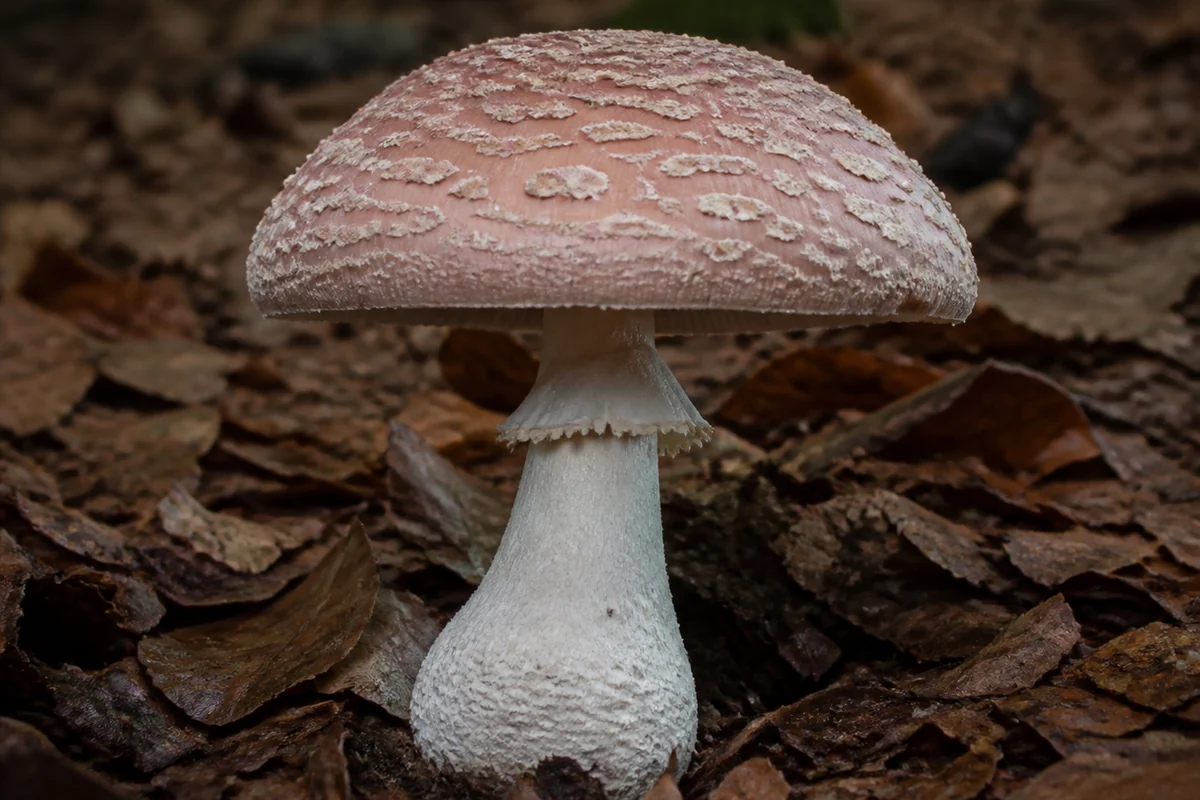
A blusher is a medium to large gilled mushroom with a dull pinkish brown cap, small grayish warts scattered over it, and white gills that flush pink where something has eaten them.
It is one of the few members of the Amanita family with a long European tradition of being eaten, alongside a much longer list of relatives that are dangerous or lethal.
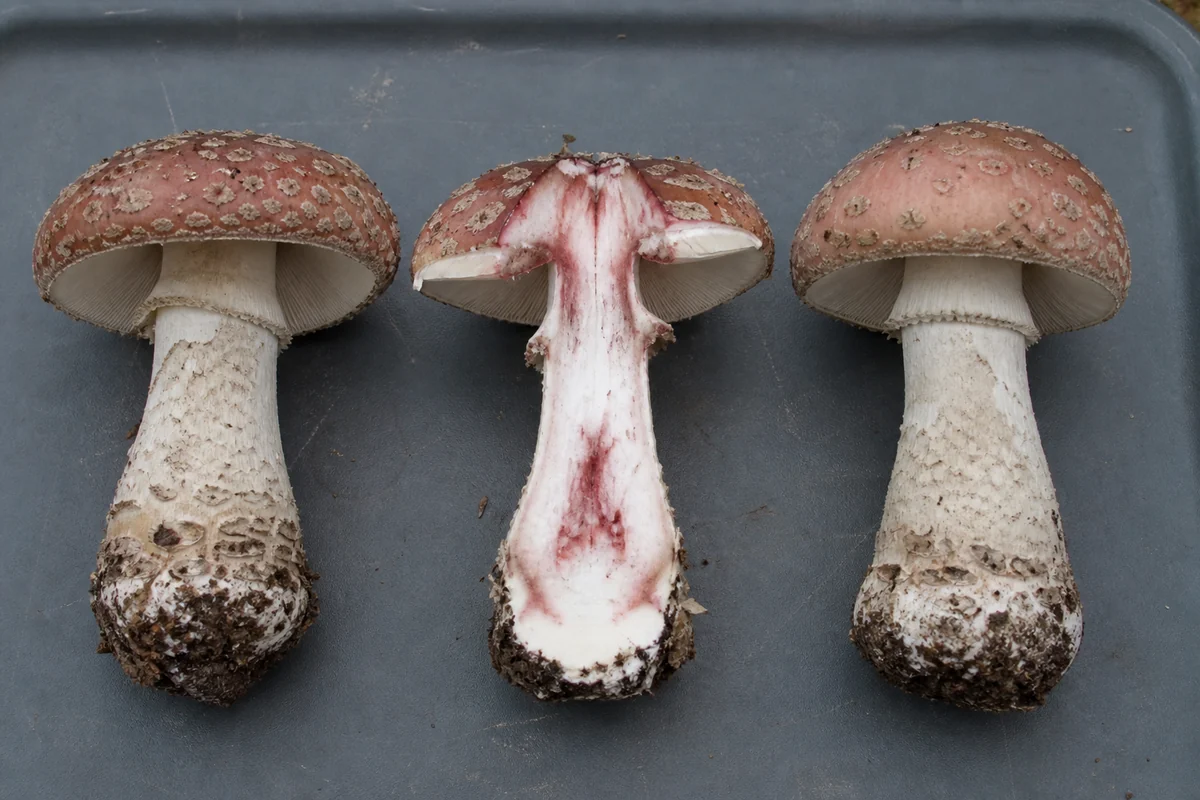
The name comes from the blush. Cut flesh, bruised gills and old larval tunnels all turn pink and then a dull wine red, usually within a few minutes.
That reaction is the reason the mushroom has a friendly common name in half a dozen languages, and it is also the reason people trust it faster than they should.
European foragers who pick it usually describe it the same way, as the one mushroom in this genus they will carry home and nothing else from the same wood.
That is a rule about the picker rather than about the mushroom. It exists because the cost of being wrong here is not an upset stomach, and because the characters that separate a blusher from its worst relatives are small, structural and easy to destroy while collecting.
How do you identify a blusher?
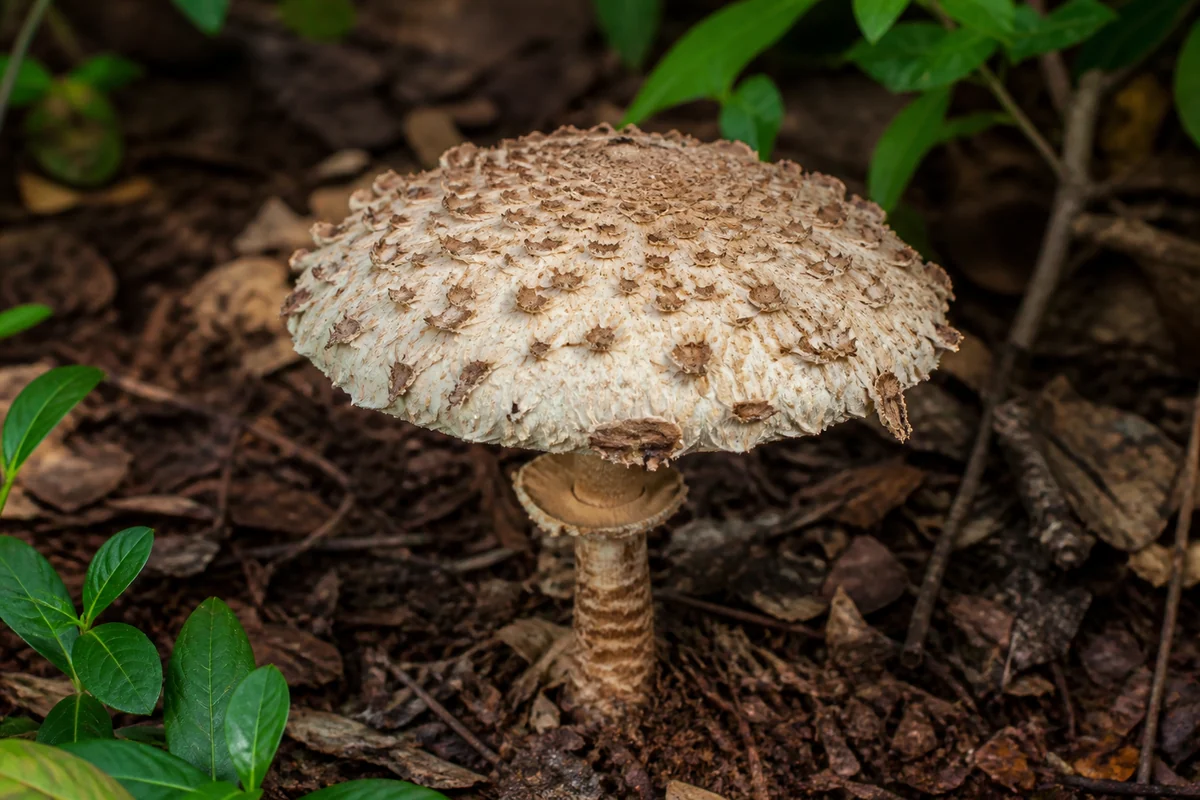
Dull pinkish brown to reddish brown, 5 to 20 cm across when fully open, tacky in wet weather, and scattered with small grayish pink veil warts that wipe off. The margin stays smooth rather than grooved.
White and crowded, adnate to almost free of the stem, and flushing pink where bruised or nibbled.
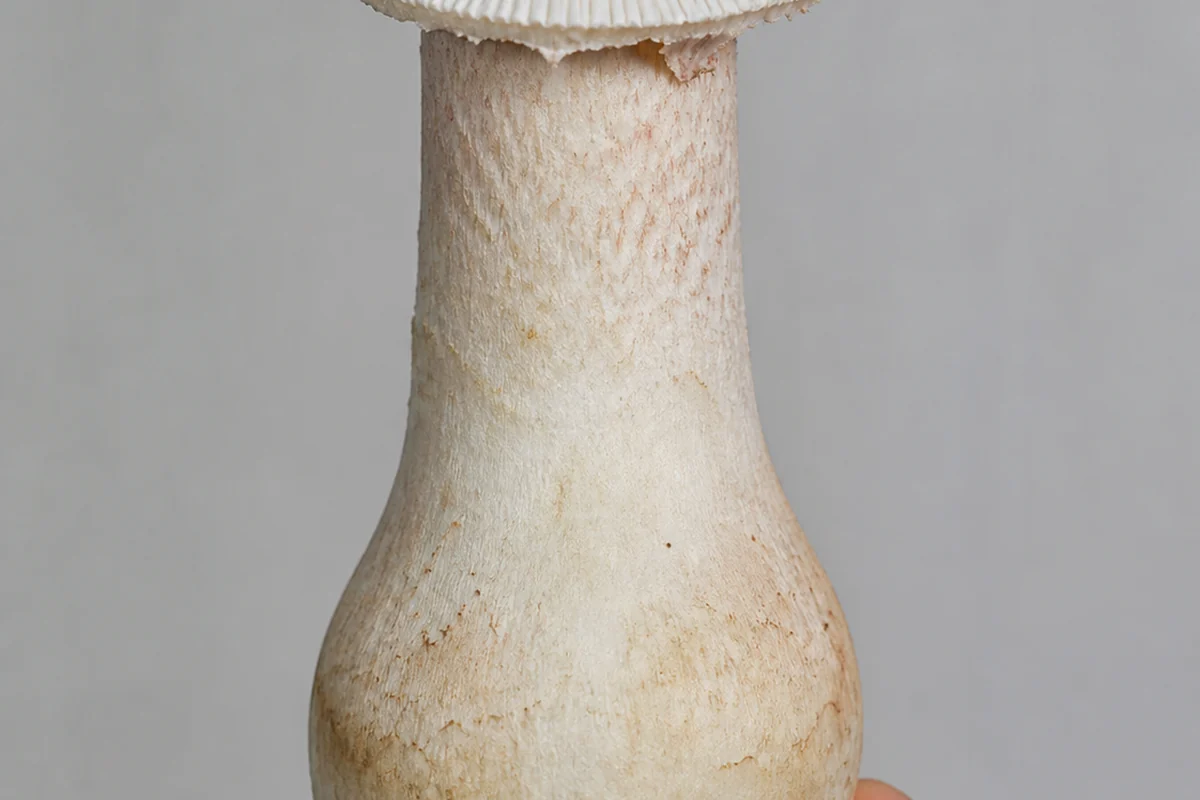
White, 7 to 15 cm long and 1 to 2 cm thick, staining pink where handled, carrying a fragile skirt-like ring whose upper surface is finely grooved, and widening below into a turnip-shaped bulb with no cup and no sharp rim.
White, turning pink to wine red within minutes of being cut or tunnelled by larvae, with a faint mild smell and no distinctive odor.
Work from the base upward and lift the whole mushroom out of the ground before deciding anything.
The base is where every Amanita question is settled, and a specimen snapped off at soil level has already thrown away the evidence.
Four characters carry the identification, and no single one of them is enough on its own. | Character | Blusher | Why it matters | | --- | --- | --- | | Damaged flesh | Turns pink then wine red | Confirms the species group, not the safety | | Cap margin | Smooth, not grooved | Separates it from several grooved-margin relatives | | Ring upper surface | Finely grooved | A character most lookalikes lack | | Stem base | Turnip-shaped bulb, no cup, no rim | Rules out the deadly sac-based species | The warts on the cap are soft, grayish pink, and easily rubbed away, so heavy rain can strip a cap bare. Those warts are the remains of the veil that wrapped the whole young mushroom, and they sit on the cap surface rather than being part of it.
A washed cap is not a different mushroom, but it is a mushroom with one fewer character available, and the remaining ones have to carry more weight.
How often that happens depends on the weather the mushroom grew through, which is why the same species can look so different across one wet autumn.
The ring repays a slow look. Hold the stem upright and read the surface facing the cap, because the grooves run radially across it and are easy to miss on a ring that has already collapsed against the stem.
A young button hides most of this. Everything that decides the question is still sealed inside the veil, which is a good reason to leave the smallest ones alone rather than to name them optimistically.
The blush itself is the character people ask about most, and it is the one that needs the most care.
It usually shows within a few minutes of a cut, but it comes on slowly in cold weather and can be faint on a very young button.
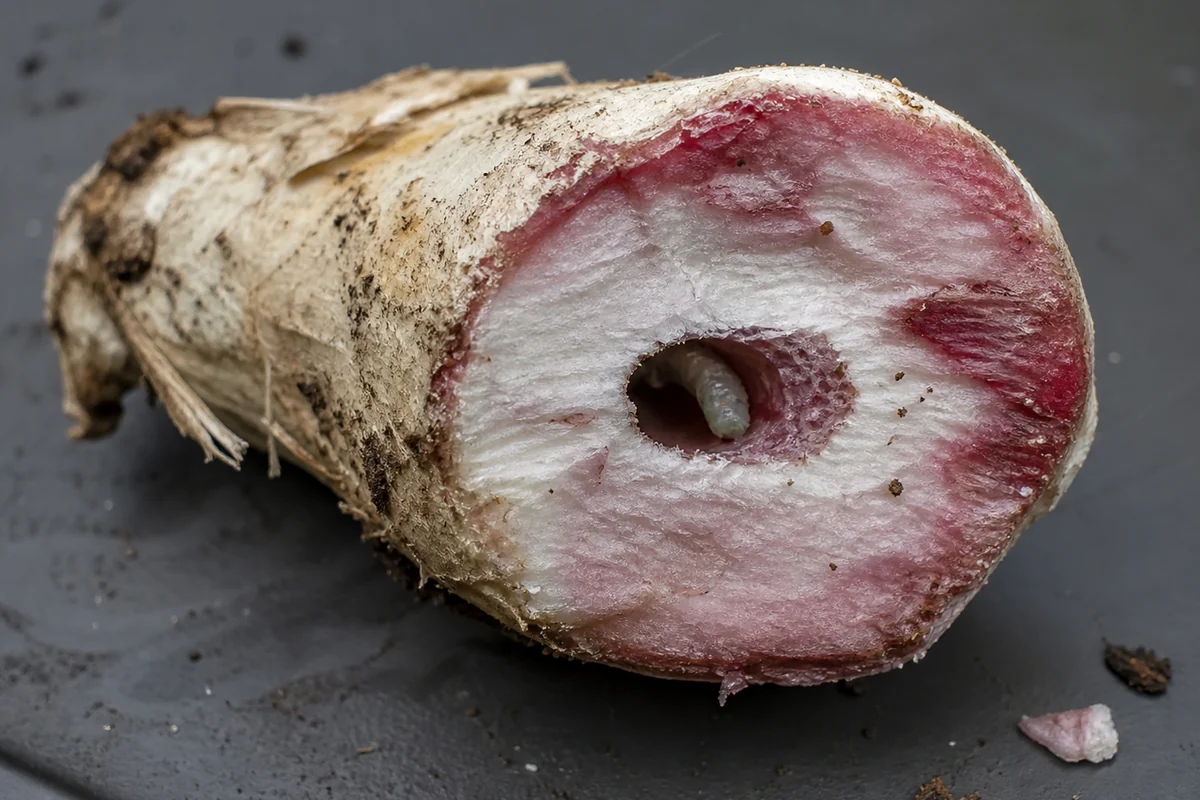
The stain moves a mushroom into a group and never out of the genus.
What a positive test is actually worth
So a specimen that has not reddened yet is not disqualified, and a specimen that has reddened is not finished. The stain moves a mushroom into a group and leaves the naming to the base and the ring.
Under a microscope the spores are amyloid, meaning they stain blue-black in iodine, which cleanly separates this group from several relatives whose spores do not.
That test settles arguments, and it is not available to somebody standing in a wood, so it belongs in the record rather than in the decision.
What is available in a wood is time. A specimen laid on a tray for ten minutes with its base cleaned and its stem cut will have shown you the stain, the ring surface and the shape of the bulb, and none of that survives being carried loose in a bag.
What can be mistaken for a blusher?
The blusher's real problem is not that other mushrooms look like it, but that they are in the same genus.
The panther cap is the classic European confusion, and it keeps its flesh white where a blusher reddens, carries a grooved cap margin, and sits on a bulb with a distinct collar.
That page holds the full character-by-character comparison, because the mistake is more often made from the panther cap side than from this one. The gemmed amanita group is the paler confusion, and the pale straw and tan forms in it overlap in color with a weathered blusher.
Warning
The death cap and the destroying angel are in this genus too. Both sit in a membranous cup at the base, both stay white when cut, and both are lethal in amounts smaller than a single cap.
A stain test does not sort those out, because they never had a stain to lose.
The practical rule most European foragers settle on is that the blusher is the only mushroom in this genus they pick, and that they name every specimen individually rather than by the basket.
Two blushers and one unnamed white Amanita in the same bag is not a basket of blushers.
Warning
A positive stain is not a passport. Pink flesh narrows a specimen to a group, and everything after that comes from the ring, the cap margin and the base. If any one of those is missing or unclear, the specimen stays unnamed and does not get eaten.
How do you cook a blusher?
A blusher must be cooked through, and this is not the usual advice about wild mushrooms being easier to digest when cooked. Raw blusher flesh contains rubescenslysin, a protein of roughly 35 kilodaltons that breaks open red blood cells, and white blood cells turn out to be more sensitive to it than red ones.
The protein is thermolabile, which is the useful part. Heat unfolds it, and an unfolded protein of this kind does not reassemble on cooling.
Tip
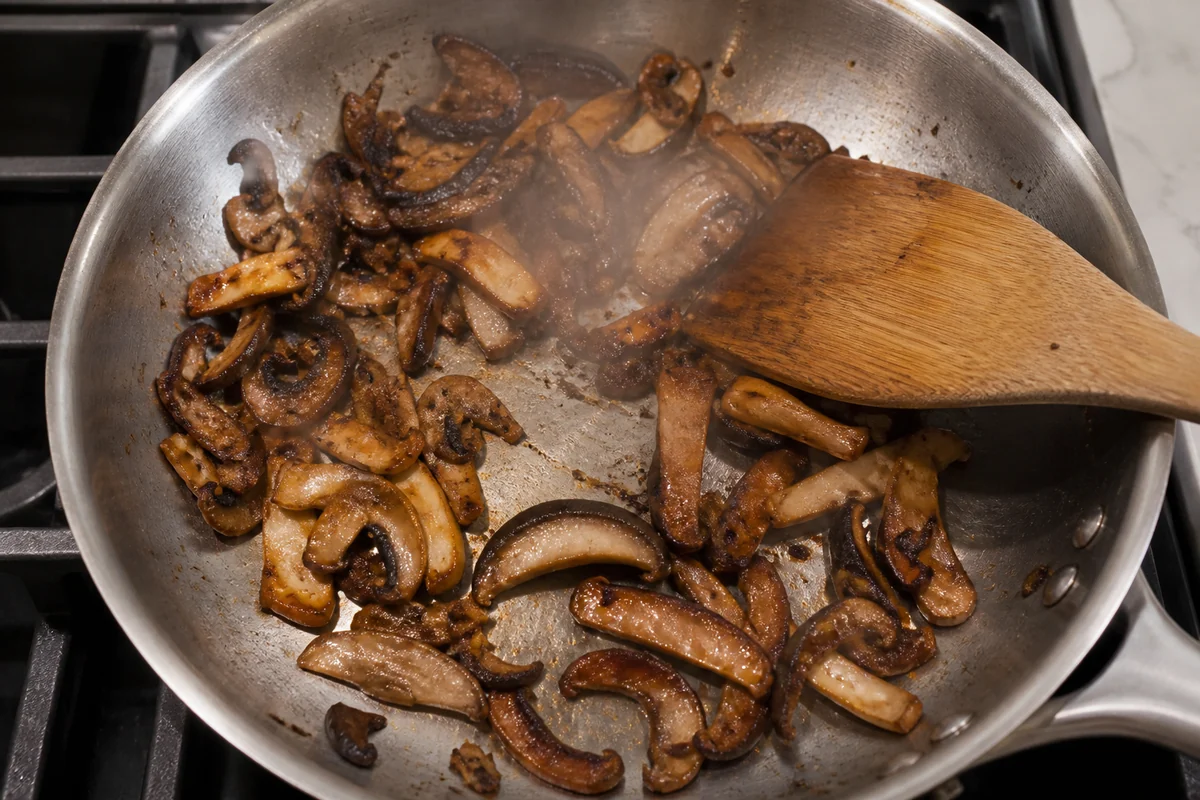
Cook slices right through rather than browning the outsides. Several minutes at a genuine frying heat, not a fast sear on a crowded pan, is what the rule is actually asking for.
The laboratory work behind that toxin is dramatic and needs reading carefully. Rats given the purified protein by injection died at 1.4 milligrams per kilogram, with haemolysis and lung damage.
An injected dose of isolated protein is not a plateful of undercooked mushroom, and the honest summary is that heat-sensitive toxins of this class rarely cause real poisonings precisely because cooking removes them.
What people actually report from undercooked blushers is stomach upset, cramping and vomiting rather than anything resembling the animal studies.
The practical failure is almost always the pan rather than the cook. A pan loaded with wet mushrooms drops below frying temperature and steams them in their own liquid, which browns nothing and leaves thick pieces barely warmed through.
Cooking in two batches fixes it, and so does letting the released water boil off before the heat is turned down.
In the pan the species is mild and slightly nutty, firm when young, and soft and watery once the cap has flattened out.
Most people who pick it take only young, tight caps, both because the texture is better and because a young specimen still has all its identifying characters attached.
Drying is not a substitute for cooking here. A dried slice has lost its water and not necessarily been held at any temperature, so dried material still goes into a hot pan or a long simmer rather than straight into a cold dish.
Where and when do blushers grow?
The blusher is mycorrhizal, which means it trades sugars for minerals with living tree roots and cannot be separated from its partner. It is unusually flexible about which partner it takes, working with beech, oak and birch as readily as with pine and spruce, which is why it turns up in almost every kind of European woodland.
- Partner trees
- Beech, oak, birch, pine and spruce
- Soil preference
- Poor, acidic and often sandy
- Main season
- June to October in Britain and Ireland
- Fruiting trigger
- Warm ground with sustained rain
Poor acidic ground suits it better than rich soil, so heathy birch woods and old conifer plantations often produce more of it than a fertile beech hanger will.
That preference follows from what the partnership is for. A tree on thin acidic soil has more to gain from trading sugar for minerals it cannot reach, so the fungi that offer that trade are better rewarded there.
The season is long by Amanita standards. Blushers start in early summer, well before most autumn species, and keep going until the first hard frosts.
The early end of that run is worth knowing, because a June flush arrives when most people are not looking and when the woods hold very little else of any size.
Weather does more than set the timing here, because it also changes what the mushroom looks like when you find it.
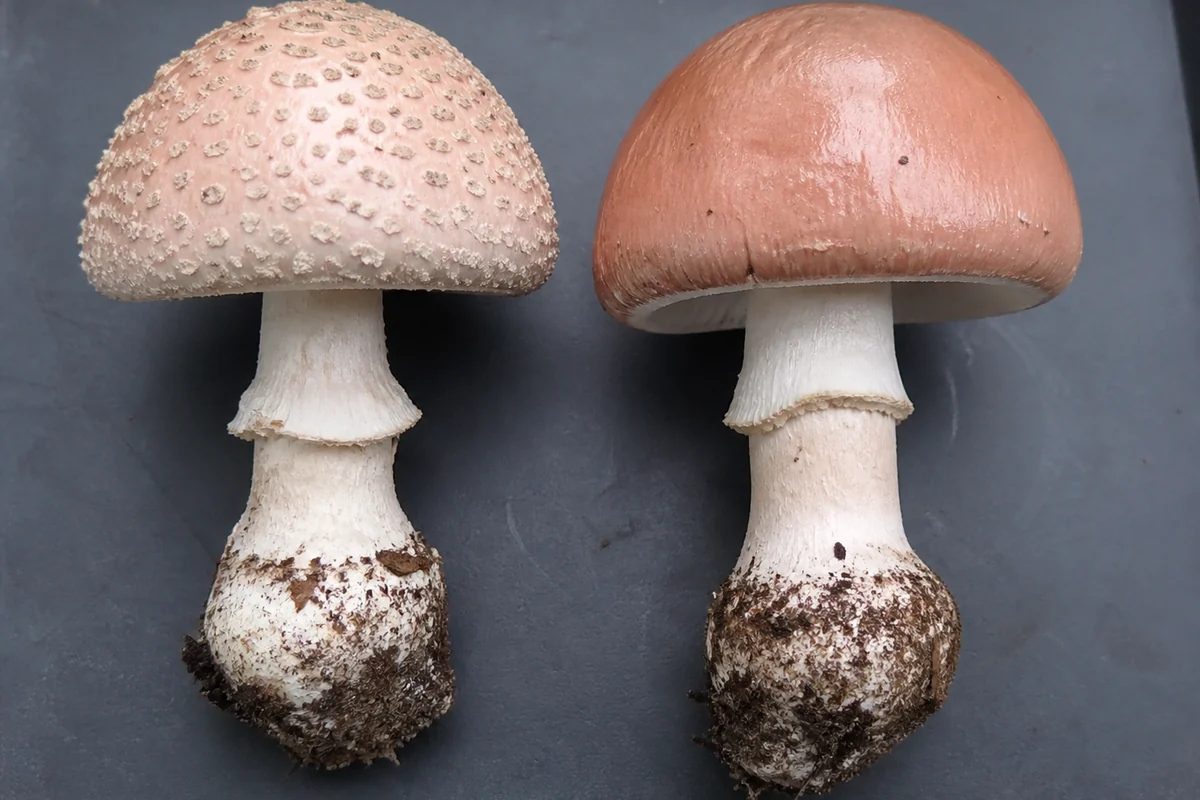
A dry spell leaves the warts intact and a long wet one washes them away, so a basket picked after four days of rain can look like a different species to somebody working from photographs.
Its introduced range tells the same story the pine plantation species tell. It reached Chile, Argentina, Australia and South Africa on the roots of planted European trees, and it lives there inside those plantations rather than spreading into native forest.
Larvae find it early and thoroughly, which matters here more than in most species.
Old tunnels through the stem go red, so a heavily infested specimen is often the one showing the clearest color change on the page and the one least worth carrying home.
Can blushers be cultivated?
The blusher cannot be cultivated on a substrate, and the reason is the same one that applies to every mycorrhizal species. It fruits only from a living partnership with tree roots, so there is no sawdust block or grain jar version of it.
Nobody has a commercial reason to try. It is abundant wild, it has no market price, and its close relatives make it an awkward species to sell to strangers.
Is there any medicinal use?
No medicinal use attaches to the blusher that is worth reporting.
The compound it is known for is a toxin rather than a therapeutic, and no clinical work uses this species.
Is it worth eating for nutrition?
Nothing about the blusher's nutrition sets it apart from other wild gilled mushrooms.
Cooked, it delivers the ordinary profile of the group, which is mostly water, a little protein, some B vitamins and a useful amount of fiber for the calories involved.
Nobody eats it for nutrition, and the decision to pick one has always been about flavor and about whether the picker trusts their own identification.
One small thing does follow from the cooking rule. Because the mushroom has to be cooked hard and for a while, it arrives at the plate having lost more water and more of the heat-sensitive vitamins than a lightly cooked mushroom would.
Is the American blusher the same species?
The name is where an American reader should stop and check.
Amanita rubescens was described from northern Europe, and the specialist treatment of the genus states that no rubescent North or Central American material is assignable to it.
Note
The reddening amanitas of North America are a set of separate species that have been going under a borrowed European name. A field guide that calls them A. rubescens is using a label, not making an identification.
Two replacement names are already in circulation and both are worth recognizing on a label. In western North America the reddening species is Amanita novinupta, the blushing bride, which has a formal description of its own.
East of the Rockies the situation is looser. Several distinct reddening species appear to be involved, and they have been travelling under the provisional working name Amanita amerirubescens while the group is sorted out.
A provisional name is a placeholder for a question, not an answer to it. It says that somebody has established these are not the European mushroom and has not yet established how many things they are.
That matters practically, because edibility reports for the European species were never gathered from those populations.
An American reader is therefore working with a mushroom whose identity is unsettled and whose eating record was borrowed from a different continent, which is a thinner basis than the popularity of the name suggests.
The species sits in a group whose members have amyloid spores and bulbous but uncupped bases, which is the structural reason the genus splits the way it does rather than by color.
Color is the character people reach for first in this genus and the one that survives the least. A cap bleached by rain, a specimen browned by frost and a young one still half in its veil can all be the same species, and the base and ring will say so when the color does not.
Frequently Asked Questions
Is the blusher edible?
Does a blusher always turn pink?
What happens if you eat a blusher raw?
How is a blusher different from a panther cap?
Is the American blusher the same mushroom?
Why are blushers always full of maggots?
Sources & References
- Amanita rubescens, Blusher mushroom Field description used for cap and stem dimensions, ring character, gill attachment, spore print, habitat and the June to October British and Irish season, together with the statement that the species must be thoroughly cooked.
- Studies in the Amanitaceae: Amanita rubescens Specialist genus treatment used for the veil warts, nonstriate margin, turnip-shaped bulb, amyloid spores, the introduced southern hemisphere range, and the statement that no rubescent North or Central American material is assignable to this species.
- Toxic effects in mouse and rat of rubescenslysin from Amanita rubescens Animal study reporting the intravenous rat lethal dose and the haemolysis and lung damage that followed, used here as the source of the injected-protein figures rather than as a dietary risk estimate.
- Damage in vitro to various organs and tissues by rubescenslysin from the edible mushroom Amanita rubescens Laboratory study describing rubescenslysin as a thermolabile acidic protein of about 35 kilodaltons and reporting that white blood cells were more sensitive to it than red cells.
- Amanita rubescens (MushroomExpert.Com) Source for the North American naming position, including the western species Amanita novinupta and the provisional name Amanita amerirubescens covering several probably unnamed eastern species.