
 Poisonous

What the familiar red cap does not tell you
Fly agaric is poisonous, even though its red cap has become a familiar storybook symbol. The Amanita muscaria on this page is the Eurasian species in the strict sense. If you photograph a similar mushroom in North America, its looks alone cannot earn it this name.
Its main neuroactive compounds are ibotenic acid and muscimol, as a review of fly agaric chemistry and poisoning describes. These chemicals differ from psilocybin in structure and in the illness they cause. Expectations borrowed from psilocybin effects can therefore hide the signs you most need to notice after an exposure.
Poison-center reports describe shifting mixes of symptoms. They include nausea, vomiting, confusion, agitation, poor coordination, hallucinations, sleepiness and seizures. In 2022, a clinical paper described two severe cases, including one death. That report shows a serious outcome can happen. It cannot supply a typical dose or a reliable forecast for the next patient.
observationHuman reports document alternating central nervous system excitation and depression after ingestion.
observationSevere complications, including coma, respiratory compromise, and seizure, appear in published clinical evidence.
forecastOne case report cannot establish when symptoms will begin, how long they will last, or who will recover without intensive care.
forecastA cap count, preparation claim, or symptom-free interval cannot clear a suspected exposure.
Treat the person, the specimen and the product as separate evidence. Someone may need urgent care even when the mushroom photo is incomplete. Retail labels can also fail to name what the product really contained.
The common name brings a chemical distraction of its own. Chemists first isolated muscarine from fly agaric. Modern reviews, however, tie its typical intoxication to ibotenic acid and muscimol, and that picture differs from the cholinergic pattern of muscarine poisoning.
Reconstruct the mushroom after rain and age
The familiar white spots are loose scraps of the universal veil, and they do not stay on the cap for good. Heavy rain can wash them away, while age shifts the scarlet toward orange. What remains can be a smooth cap that no longer looks like the storybook picture.
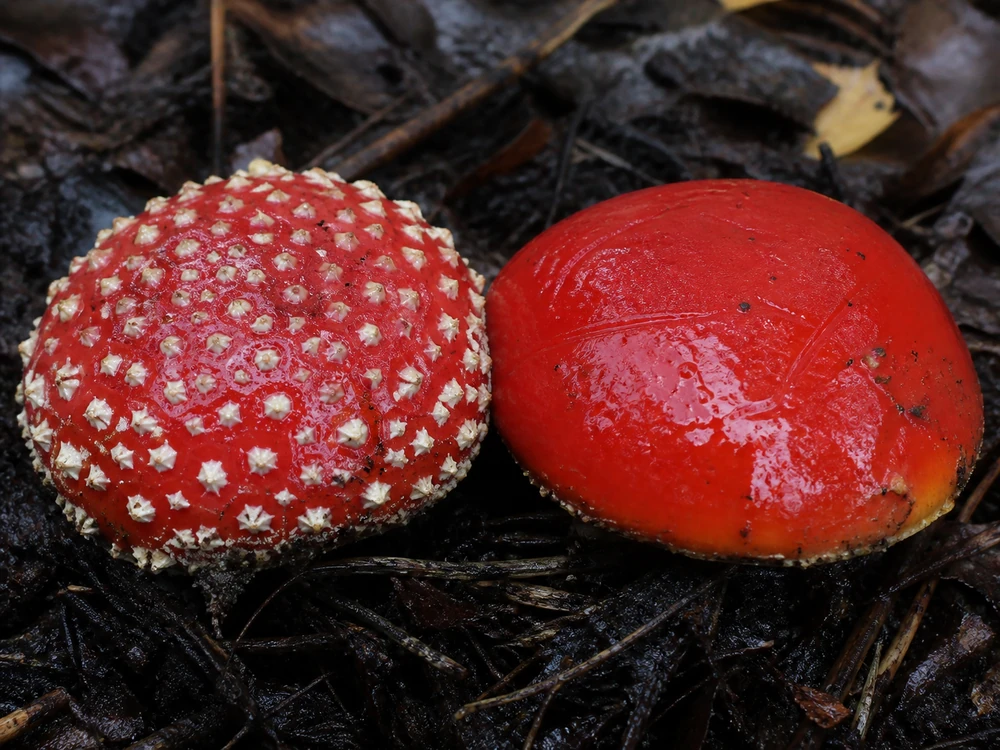
Mature Eurasian specimens typically have a 10 to 20 cm scarlet or orange-red cap and white crowded gills free from the stem. Below them sit a white hanging ring and a swollen base ringed with veil scales. Their white spore print fits the genus, yet it cannot fix the species by itself. Of all these features, the base survives rain and age best.
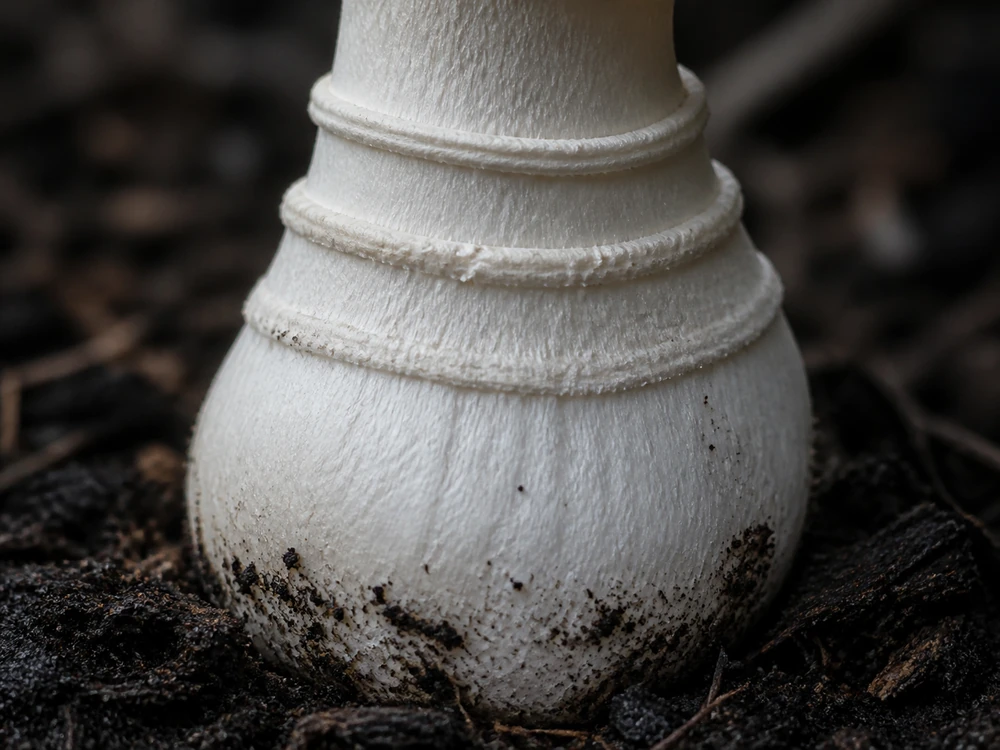
Dig out the whole base before you compare names. If the stem snaps, you can lose the difference between concentric scales, a sharp collar and a free membranous sac. Those base shapes separate fly agaric from the other Amanitas in the table below.
| Comparison | Gills and stem | Cap surface | Complete base |
|---|---|---|---|
| Eurasian fly agaric | White gills, white stem, hanging white ring | Scarlet to orange-red, often with loose white patches | Swollen bulb with concentric veil scales |
| Panther cap | White gills and stem, fragile ring | Brown with removable pale warts | Bulb with a more sharply defined collar |
| Caesar's mushroom | Yellow gills, yellow stem, yellow ring | Orange and normally without white patches | White bag-like volva |
| Red Russula | Pale gills, brittle stem, no ring | Red and smooth | No Amanita bulb or volva |
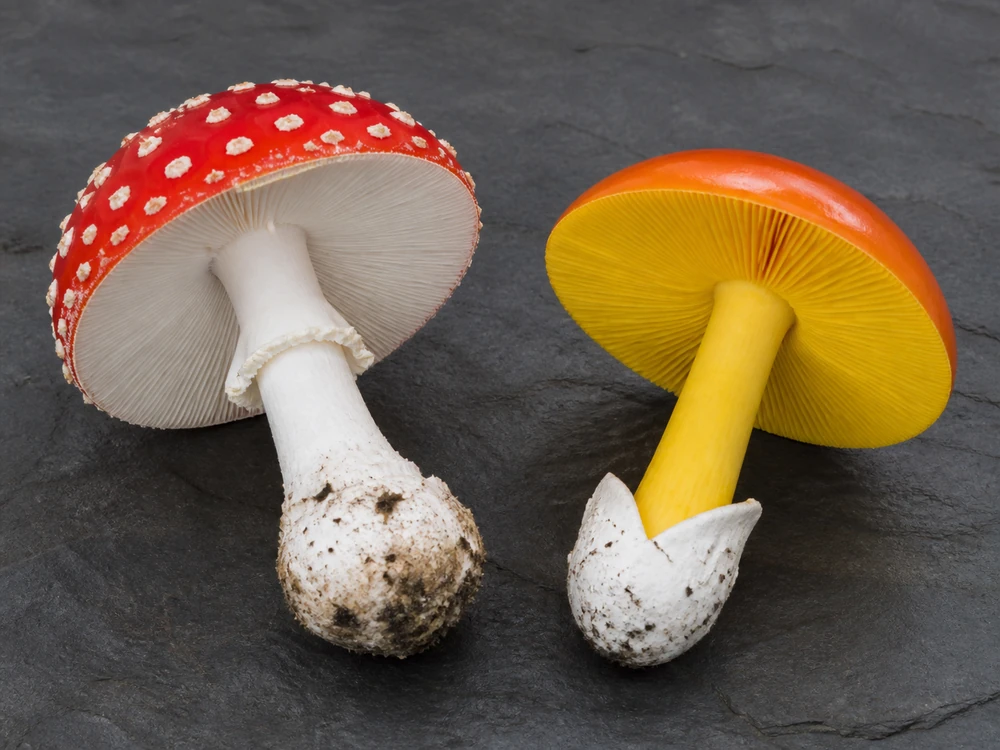
The death cap and the destroying angel both sit in a free sac at the base, unlike the concentric scales of fly agaric. That comparison describes structure only. Any incomplete Amanita stays unidentified, and it must never go into a food basket.
Read the trees, season, and geographic boundary
Fly agaric forms ectomycorrhizal partnerships with living trees. British descriptions stress birch, pine and spruce, and other Eurasian records add further hardwood and conifer hosts. So note the whole tree community around the mushroom, and not just the trunk nearest the cap.
Its mushrooms rise from soil linked to fine roots. The cap you find beside a stump may therefore belong to a living tree some distance away. Its closeness to wood does not make it a wood decomposer.
The fruiting season ties the mushroom to its place as closely as the trees do. In Britain and Ireland, recorded fruiting runs mainly from August through November. Weather and latitude move that window across Eurasia. For that reason, your own dated habitat photo tells you more than a calendar borrowed from another region.
Moving host trees also explain records outside the native range. The species has travelled with planted trees into parts of the Southern Hemisphere. There, it reflects an introduced fungus-root partnership, and it gives no proof of one naturally global population.
Geography belongs in the identification. North American red, orange or yellow muscarioid Amanitas have a complicated regional taxonomy. Name them from a current local authority, and do not assign them to Eurasian A. muscaria by default.
Why this poisonous mushroom is not a food choice
Fly agaric is poisonous, and nobody has shown that any preparation method makes it safe to eat. Historical accounts of people eating it do not establish a safe household process, dose or finished product. Even the most convincing cap has no place in a meal. Keep uncertain mushrooms away from food, children and your other collected species. Save material only when a poison service asks for it for identification.
In September 2024, the FDA's scientific memorandum reached a narrower regulatory conclusion for the United States. It classed A. muscaria, its extracts, muscimol, ibotenic acid and muscarine as unapproved food additives. That status applies when someone adds them, or plans to add them, to conventional food. Under the federal rules it cites, food that holds such an unsafe additive counts as adulterated.
That ruling covers conventional food in the United States only. It does not decide other product categories, and it says nothing about how to identify a mushroom in the field.
Separate a retail label from exposure evidence
Retail mushroom gummies raise a different evidence problem from an intact mushroom. In a 2024 CDC investigation, five people needed hospital evaluation after eating gummies labeled with A. muscaria or other mushrooms. Lab analysis of several sampled brands found substances their labels did not disclose.
Investigators could not confirm every ingredient printed on the tested products' labels. So a package name cannot prove which listed compound, from A. muscaria to muscimol, ibotenic acid or muscarine, made someone ill. The illness may come from an ingredient the label never mentioned.
Warning
After a mushroom or mushroom-product exposure, call Poison Control in the United States at 1-800-222-1222, or the local poison service elsewhere. Call emergency services for collapse, seizure, breathing trouble, severe confusion, or a person you cannot wake. Do not induce vomiting, try a home remedy, or wait for a predicted timeline.
Save the package, lot number, receipt, leftover product, mushroom material and photos when you can do so safely. Doctors and health investigators use these details to tell a wild mushroom exposure from a mislabeled or mixed store product.
Keep Eurasian and North American names apart
GBIF's backbone taxonomy accepts Amanita muscaria (L.) Lam. as a species in the Amanitaceae. In the strict sense, the name belongs to the Eurasian fly agaric. It does not cover every red muscarioid Amanita worldwide.
In 2006, a molecular study recovered Eurasian, Eurasian-alpine and North American groups within the broad fly agaric complex. It also found that cap and wart color do not reliably track those lineages. Red caps with white warts therefore cannot tell you which lineage you are holding.
North American fly agarics share the warts, the skirt-like ring and the concentric shaggy zones at the top of the bulb. The red-capped western form, Amanita muscaria var. flavivolvata, has warts that start yellow and fade to white in sunlight. It is most common in the Pacific Northwest and the Rocky Mountains.
From the northern Midwest and the boreal northeast south to the Appalachians, the common form is var. guessowii, with a yellow to orange cap. MykoWeb's clinician reference on toxic fungi of western North America presumes that these varieties are toxic too. So the color difference gives you no reason to treat one as safe.
Regional taxonomic work continues, and older field-guide names may not match current local concepts. Location is part of the name check, so name a North American collection from a current regional source. None of this turns an uncertain specimen into a harmless one. Similar muscarioid Amanitas can share ibotenic acid and muscimol. You still need a full field record to sort out shape, place and clinical evidence.


 Choice edible


