What is a matsutake mushroom?
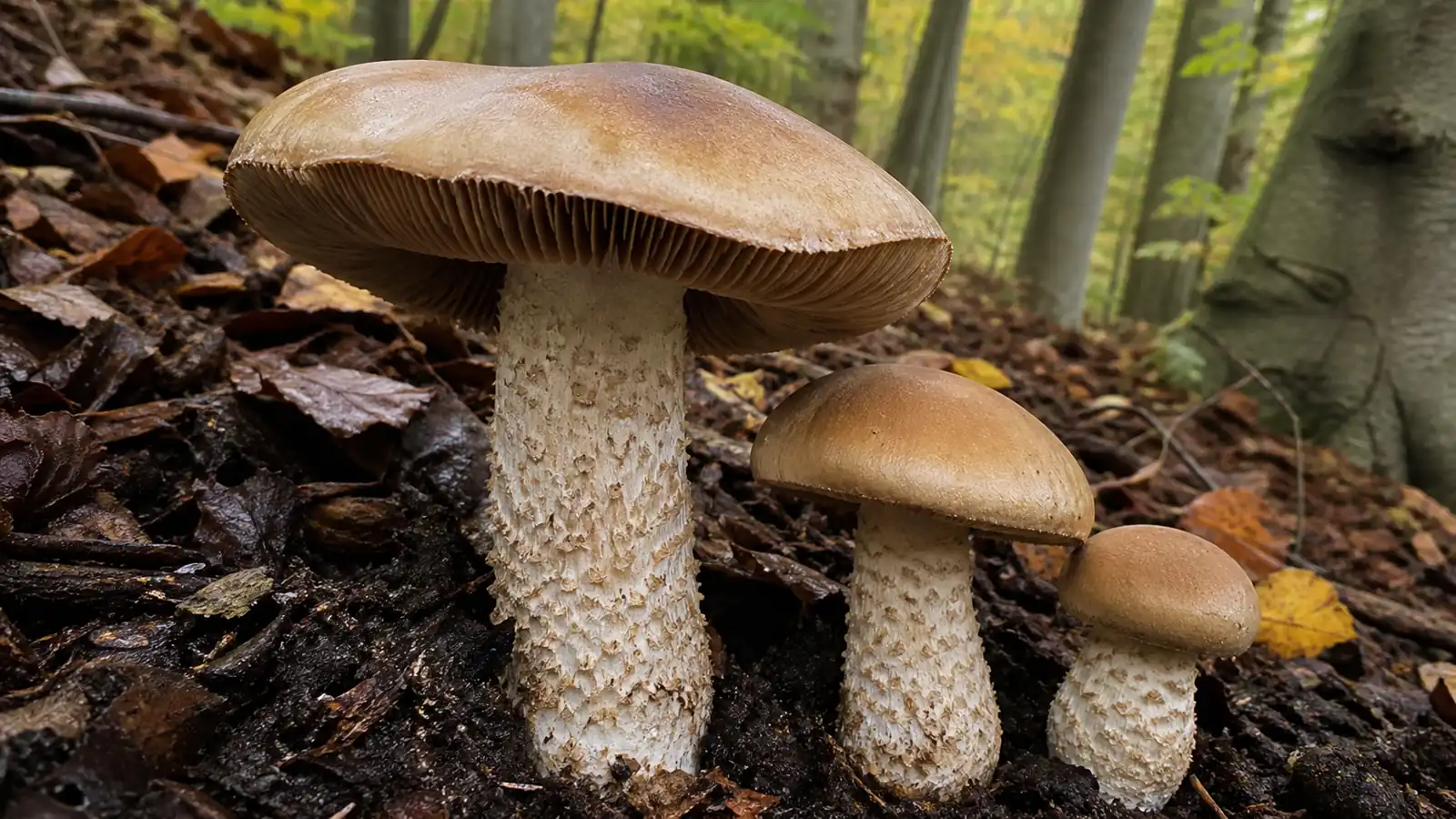
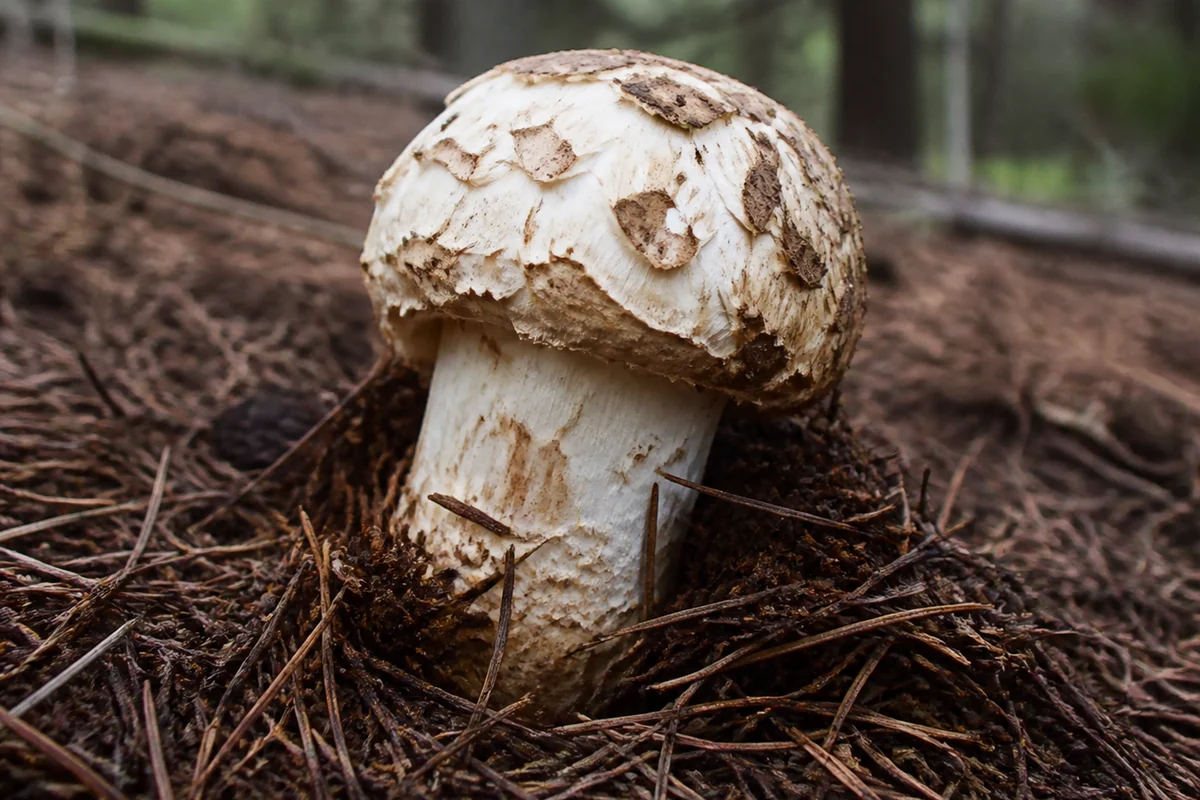
A matsutake is a heavy, firm gilled mushroom with a white cap overlaid by flattened brown fibres, a thick shaggy ring and a solid stem patterned in the same brown below it.
It is dense in a way most woodland mushrooms are not. A matsutake in the hand feels closer to a raw potato than to a field mushroom, and that firmness survives cooking.
The smell arrives before the identification does. Experienced pickers often report smelling a patch before seeing anything, and the description that recurs across languages is spice over pine.
The Japanese name means pine mushroom, which is the plainest possible summary of where it lives and what it cannot live without. The same mushroom is songi in Korea and songrong in China, and both names point at pine as well.
It is a choice edible by any measure and it is also the one mushroom on this site whose page has to spend as much time on money as on cooking.
How do you identify a matsutake?
White beneath flattened brown fibrous scales that spread as it opens, commonly 8 to 20 cm across, staying domed and closed over the stem for a long time before flattening.
Crowded, white and notched at the stem, bruising and aging to a dull brown.
Thick and solid, white above a firm shaggy ring and patterned with the same flattened brown fibres below it, ending in a blunt base rather than tapering to a point.
Firm, dense and white, with a strong spicy smell that most people describe as cinnamon over pine resin.
Smell it first, and then work through the structure.
Check the characteristic aroma alongside the other identification features.
A white mushroom with no smell does not go in the basket, whatever else about it looks right.
The rule that survives everything else

The measurements are worth carrying because a good matsutake is a substantial thing. A single top-grade specimen can weigh more than a small basket of anything else in the same wood.
| Character | Matsutake | Note |
|---|---|---|
| Cap | 8 to 20 cm across | Stays closed over the stem a long time |
| Smell | Strong spicy cinnamon and pine | The character that decides it |
| Ring | Thick, shaggy, standing out | Not a thin hanging skirt |
| Stem below the ring | Brown fibrous patches on white | Matches the cap surface |
| Stem base | Solid and blunt | Never a tapering point |
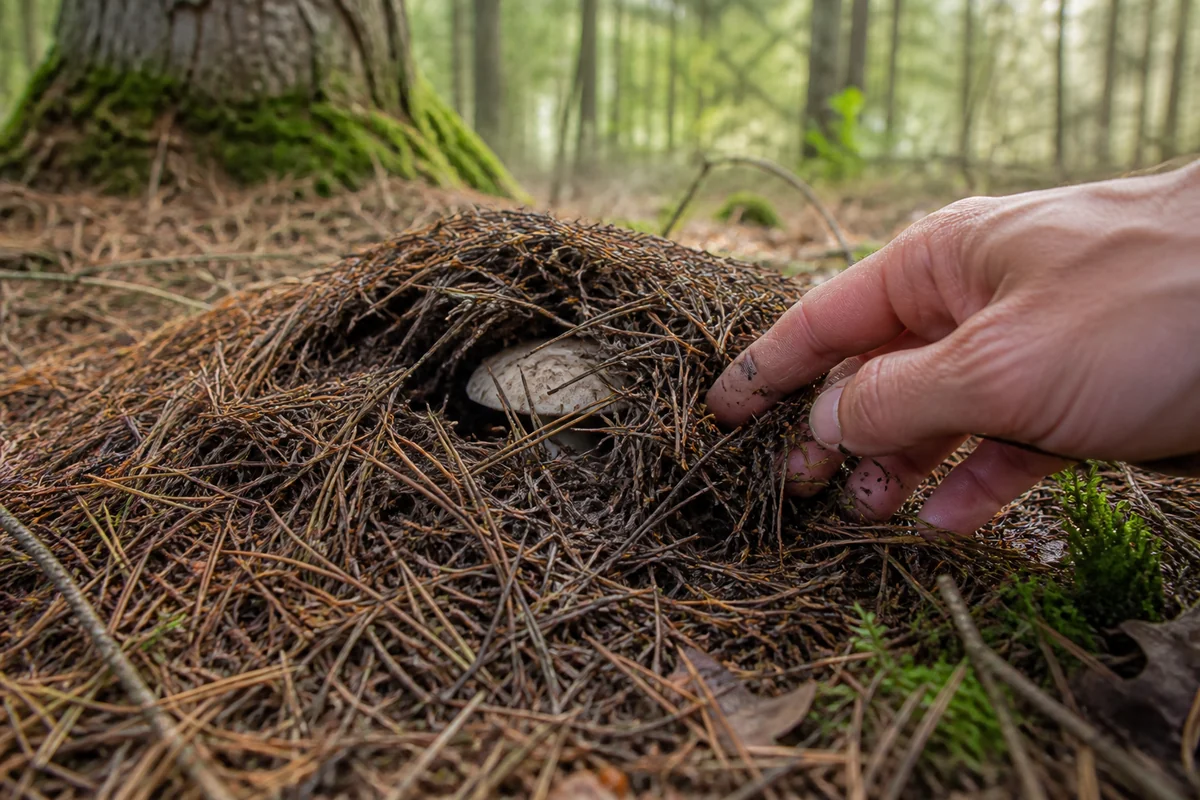
Most matsutake are found before they are seen, which changes how the search works. The mushroom pushes up under the needle litter and cracks it into a small dome rather than breaking through, so pickers learn to read the ground surface rather than to scan for caps.
The ones worth the most are the ones still fully closed, with the cap gripping the stem and the veil unbroken.
That grading is commercial rather than culinary. An open matsutake tastes much the same and sells for a fraction of the price.
Japanese grading runs several tiers below that top one, and it turns on how far the cap has opened, whether the stem is straight, and whether an insect got there first.
For anybody picking rather than selling, none of it matters. A cracked, curved, half-open matsutake with a strong smell is the same dinner as a perfect one.
What poisonous mushroom looks like a matsutake?
One lookalike matters and it is a serious one.
Amanita smithiana is a whitish mushroom of Pacific Northwest conifer forest that grows in the same ground at the same time of year, and people have been hospitalized after collecting it as matsutake.
Warning
It contains allenic norleucine, which damages kidneys. Reported cases describe stomach symptoms within about six hours and kidney failure developing over the following one to four days, with some patients needing dialysis.

Three characters separate them and all three are easy once the whole mushroom is out of the ground.
Strong spicy smell, solid blunt base
Keep itBoth characters agree and neither is available on a broken stem
No smell, or a base that tapers to a point
Leave itEither one alone is enough to reject, and together they describe the poisoning cases
Eaten, then stomach symptoms within hours
Seek medical assessmentKidney failure in these cases develops over the following one to four days
The smell is the first. Matsutake is unmistakably spicy and A. smithiana is not, so a white mushroom with no smell should never go in the basket regardless of how right it looks.
The smell is the first. Matsutake is unmistakably spicy and A. smithiana is not, so a white mushroom with no smell should never go in the basket regardless of how right it looks.
The base is the second. A matsutake stem is solid and ends bluntly, while A. smithiana swells and then tapers to a narrow point that reaches down into the soil like a parsnip.
The veil is the third.
Matsutake has a firm ring that stays as a ring, and A. smithiana carries crumbly shaggy fragments along the cap edge and the stem instead.
Amanita smithiana is a member of the Amanita family, which is worth knowing because it means the base was always going to be the character that mattered.
Both mushrooms are members of large groups with regional species, and neither is the only white mushroom in a conifer wood. The rule that survives all of that is the smell.
There is a practical reason this confusion keeps happening rather than being a beginner error. Commercial picking is fast, competitive and often done by people paid by weight, and a smell test takes a second that a rushed picker does not always take.
Warning
Never snap a suspected matsutake off at ground level. The stem base is one of the three characters that separates it from a mushroom that causes kidney failure, and a broken stem has thrown that character away.
How do you cook matsutake?
Everything about cooking a matsutake is about protecting the smell.
Never wash one. Water strips the aroma and the mushroom is usually clean anyway, so the standard preparation is to scrape the base with a knife and wipe the cap with a damp cloth.
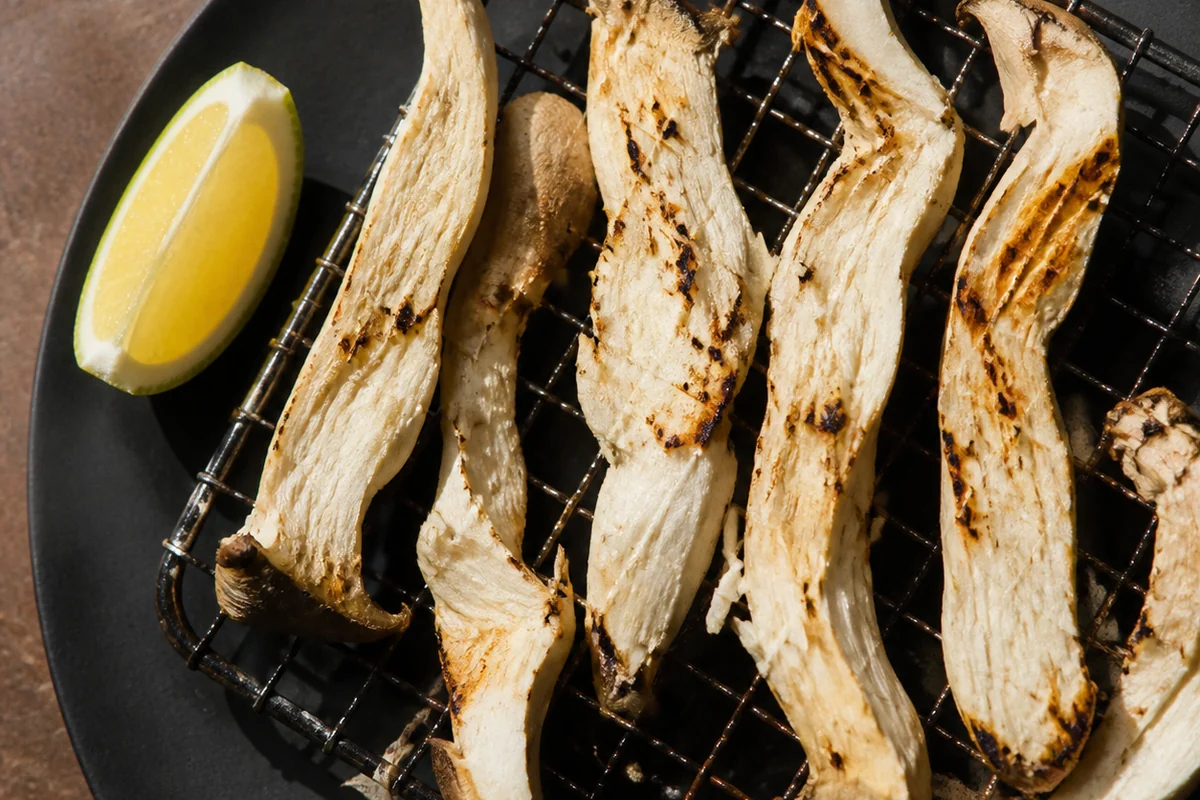
Tearing beats slicing here for the same reason it does with maitake. A torn surface is rough and releases more aroma than a cut one, and the pieces hold together because the flesh is so dense.
The classic uses are deliberately restrained. Grilled with a squeeze of citrus, steamed in a light broth, or cooked with rice so the smell carries through the whole pot.
Tip
Add it late to anything wet. Long boiling drives the aroma off, so a matsutake goes into a broth in the last couple of minutes rather than at the start.
The texture is the second reason to keep the cooking short. Matsutake stays firm and slightly crunchy where other mushrooms go soft, and overcooking trades that away for nothing.
Nobody should feel obliged to like it.
The smell is strong and genuinely divisive, and plenty of people who enjoy every other wild mushroom find this one medicinal.
Can matsutake be farmed?
The matsutake has never been cultivated, and that failure is the direct cause of its price.
It fruits only from a living partnership with pine roots, and decades of research in Japan have not produced a reliable way to establish that partnership and bring it to fruiting on demand.
Work continues and has managed pieces of the problem, including growing the fungus in culture and infecting seedlings, but the step from an infected seedling to a fruiting hillside has not been solved. So every matsutake anybody has ever eaten came out of a forest floor, and the supply is whatever the forests produced that autumn.
That is why the market behaves the way it does. A good season in one country moves the price everywhere, and a bad one cannot be answered by growing more.
It is worth putting that beside the mushrooms that are farmed. Shiitake, oyster and enoki all fruit on dead wood or sawdust, which is a substrate somebody can sterilize, fill a bag with and stack on a shelf.
A matsutake needs a living pine, poor soil, an open canopy and time.
None of those fit in a bag.
Is it worth eating for nutrition?
Matsutake gives the ordinary profile of a firm wild mushroom, with some protein, B vitamins, potassium and fiber for very few calories. It is denser than most mushrooms of its size, so a given weight goes further on a plate than the same weight of something softer.
Nobody has ever bought one for the nutrition. This is a mushroom bought for a smell, at a price set by scarcity, and the nutritional column is beside the point.
Where do matsutake grow?
The matsutake is mycorrhizal with pine, and the partnership is unusually demanding about the state of the forest floor.
It wants poor, well drained soil under open pine with a thin litter layer. Rich ground, deep leaf mold and a closed canopy all suppress it, which is the opposite of what most woodland mushrooms want.
- Partner
- Pine, especially Japanese red pine in East Asia
- Ground
- Poor, well drained, with a thin litter layer
- Canopy
- Open rather than closed and shaded
- Season
- Autumn, around October and November in the Pacific Northwest
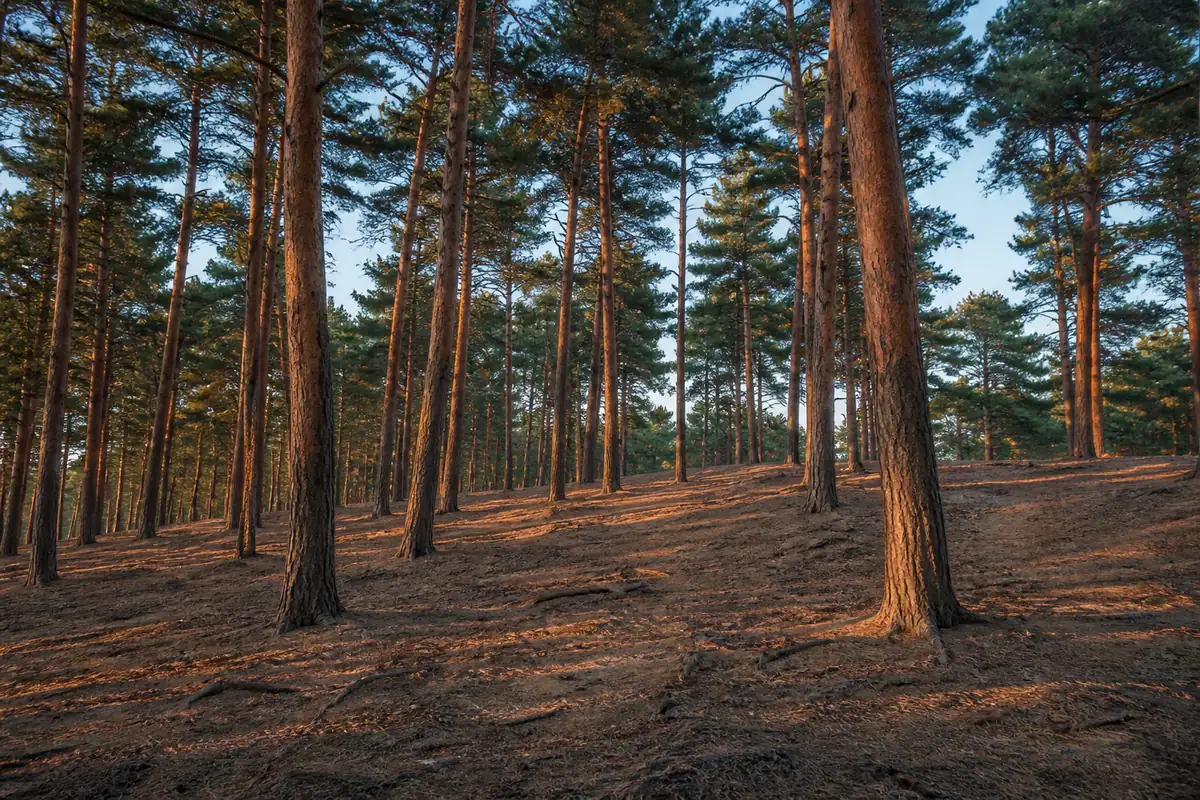
That preference has a consequence people usually get backwards. This is not a mushroom of untouched forest, and the Japanese pine hillsides that produced it in quantity were kept open by people gathering firewood and raking litter for centuries.
The fungus grows outward through the soil as a dense mat and fruits in a ring at its edge, which pickers call a shiro. A productive shiro is treated as an asset and its location is not shared.
A shiro is a physical thing you can see once you know to look.
The soil inside it is bound into a pale compacted mat, other plants struggle in it, and the ring of fruiting bodies sits at the outer margin where the mat is still advancing.
It can also be old. Some shiro are believed to have been producing for decades, which is why a mapped one is worth more to a picker than any single autumn's harvest.
Picking practice reflects that. Careful pickers lift each mushroom and close the litter back over the ground rather than raking a patch open, because the mat underneath is the thing that has to survive to next year.
Is there any medicinal use?
Matsutake appears in laboratory research on polysaccharide extracts, as most commercially important mushrooms do.
None of that supports a medicinal claim. There is no clinical evidence base here, and the mushroom's standing rests entirely on being food.
Why is matsutake so expensive?
The price question has an answer and it is about forests rather than fashion.
Japanese production ran at something like 6,000 to 12,000 tonnes a year from the 1910s through the 1940s. By 2009 the recorded figure was 24 tonnes.
That is a fall of more than ninety five percent, and the species is now listed as vulnerable on the IUCN Red List.
Note
Two causes are usually given together. An introduced pine wilt nematode killed host pines outright, and the traditional management that kept those hillsides open and their litter thin was abandoned as people stopped gathering firewood and leaf litter.
The second cause is the one worth sitting with, because it means the forest did not become wilder in a way the fungus liked. It became shadier and richer, and this mushroom cannot live in shady rich ground.
Demand did not fall with supply, which is what produced the modern trade. Matsutake now travels to Japan from Korea, China, Canada, the United States, Mexico, Turkey and Scandinavia, and the mushrooms in those countries are closely related species rather than the same one.
The North American ones carry their own names, with Tricholoma murrillianum in the Pacific Northwest and Tricholoma magnivelare in the northeast.
For a cook the distinction rarely matters, and for a reader following a field guide it does, because the characters and the season are described from local material rather than from Japanese material.
The trade this created is unusual and worth understanding before reading any price. Mushrooms picked in Oregon or British Columbia are graded, chilled and flown to Japan within a couple of days, and the figure quoted in a news story is almost always the top grade at a Japanese auction rather than what a picker was paid.
Prices per kilo that reach the headlines therefore describe one end of a long chain. The picker's share of it moves with the season and is a small fraction of the number.
Frequently Asked Questions
Why is matsutake so expensive?
What does matsutake smell like?
What poisonous mushroom looks like matsutake?
Can matsutake be cultivated?
Should you wash matsutake?
Is American matsutake the same species as Japanese matsutake?
Sources & References
- Matsutake General account used for the cap size, the ring, the spicy cinnamon aroma, the pine hosts in East Asia and North America, the autumn season, and the regional species names Tricholoma murrillianum and Tricholoma magnivelare.
- Tricholoma matsutake on the IUCN Red List Conservation assessment used for the vulnerable listing and for the Japanese production figures, including 6,000 to 12,000 tonnes a year during the 1910s to 1940s against 51 tonnes in 2007 and 24 tonnes in 2009, and for the attribution of the decline to pine wilt nematode and changed forest management.
- Acute renal failure associated with suspected Amanita smithiana mushroom ingestions: a case series Case series used for the poisoning pattern, in which patients who believed they had collected matsutake developed gastrointestinal symptoms and then delayed renal failure.
- Amanita smithiana mushroom ingestion: a case of delayed renal failure and literature review Case report and review used for the timing, with gastrointestinal effects within about six hours and renal insufficiency developing over one to four days, and for the nephrotoxin allenic norleucine.
- Advances in the cultivation of the highly-prized ectomycorrhizal mushroom Tricholoma matsutake Review used for the state of cultivation research, including progress on culturing the fungus and infecting seedlings alongside the unsolved step of reaching reliable fruiting.