What makes a mushroom a burnt knight?
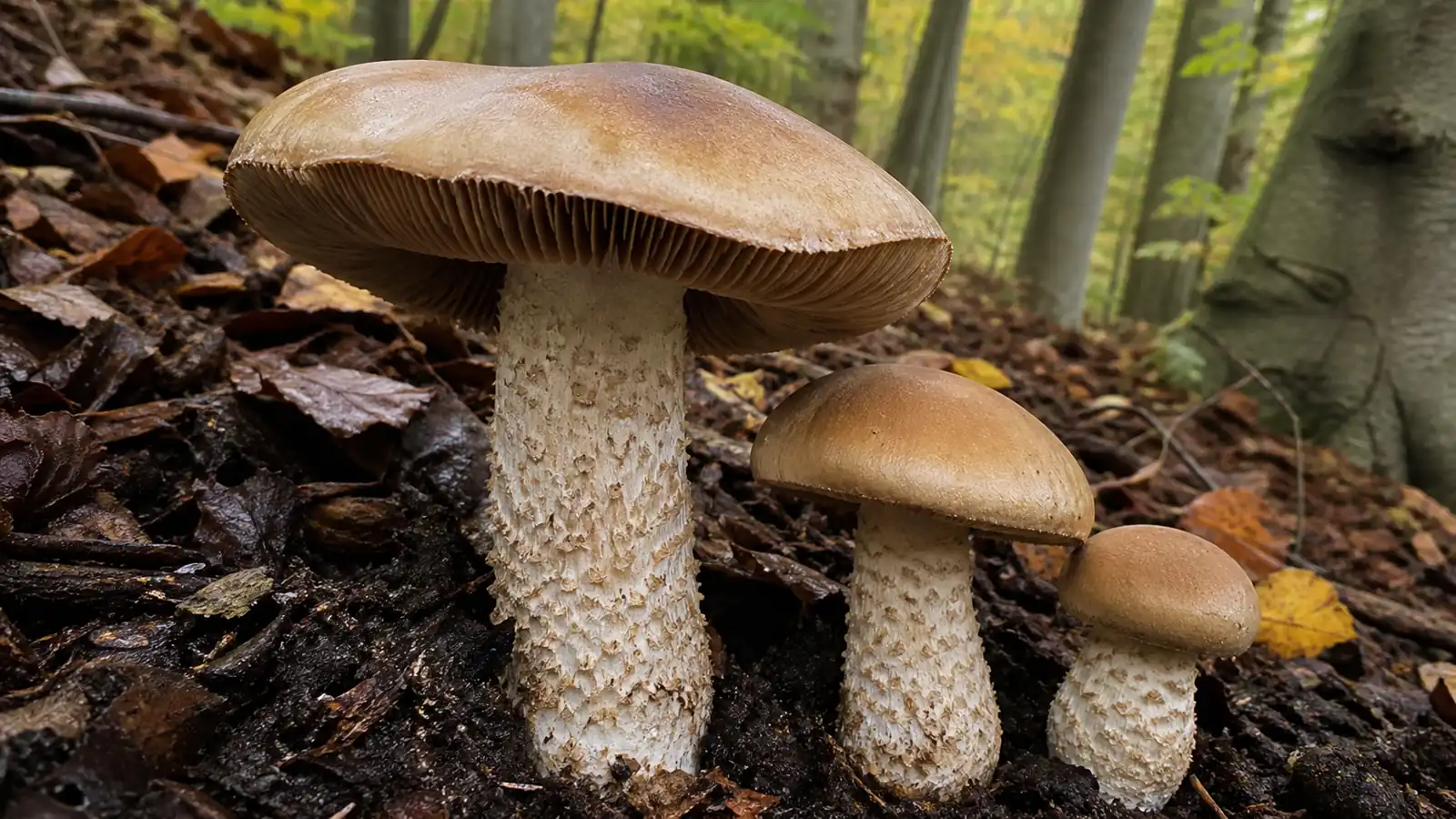
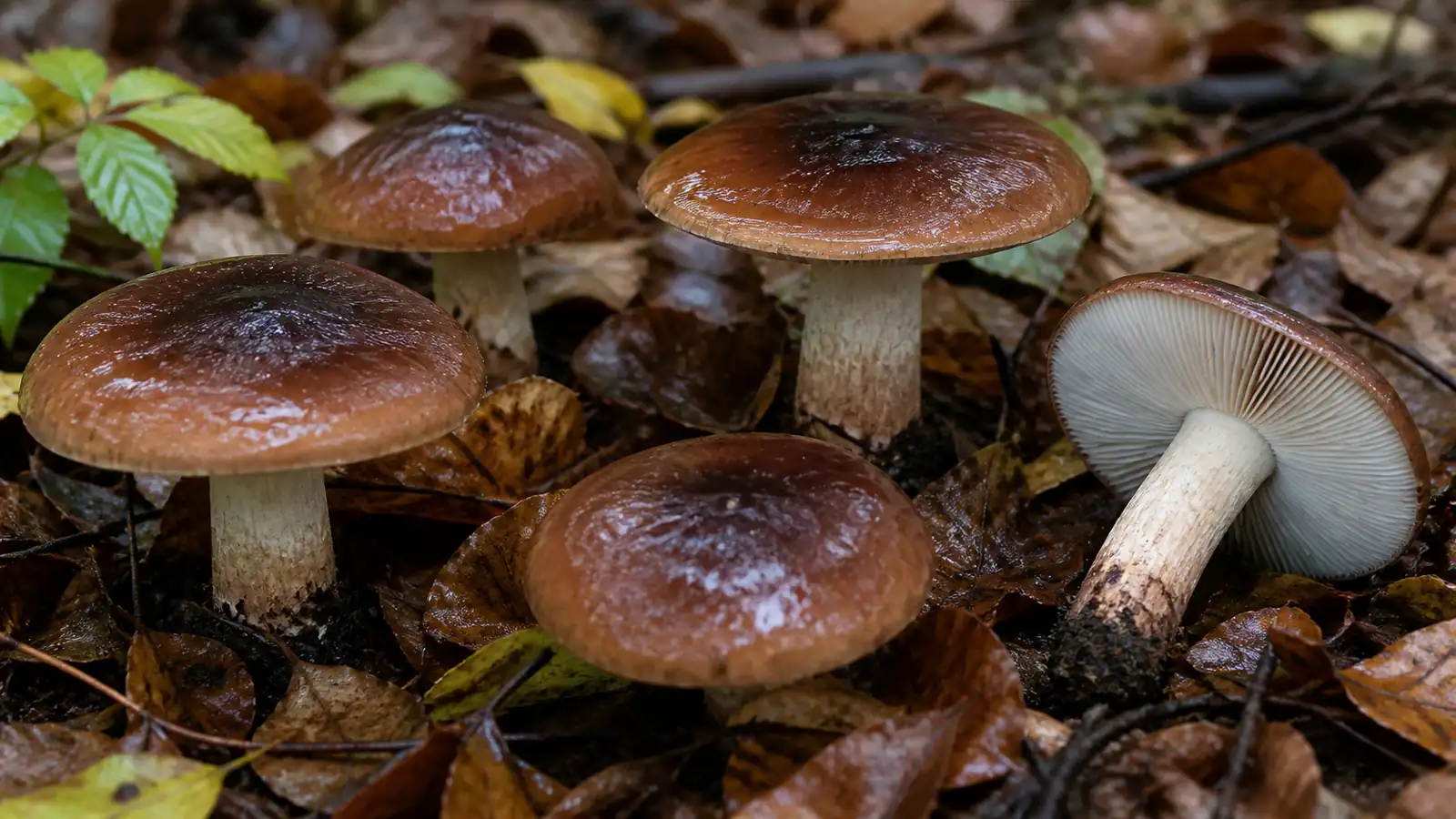
Burnt knight has a polished chestnut cap that looks darkest at the center and paler near the edge. Rain turns the surface distinctly sticky, while dry weather can leave it smooth and deceptively ordinary.
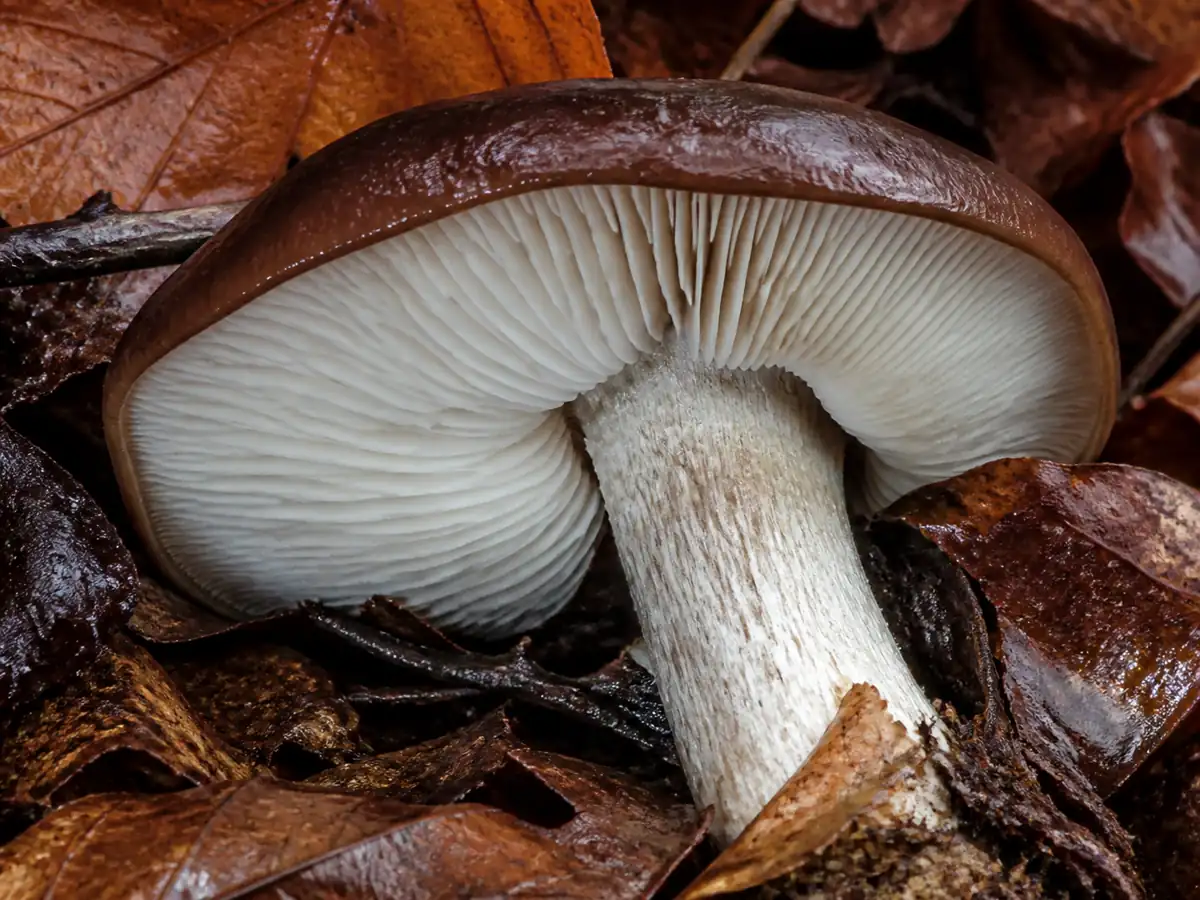
Pale gills curve toward the stem and meet it through a notch. Brown spots appear with age and handling, echoing the burnt tones of the cap and common name.
Treat the specimen as a brown knight first. White spores, notched gills, a ringless stem, and soil growth under a host tree establish the group before species-level details are considered.
The lower stem develops reddish-brown fibers or staining beneath a paler upper zone. There is no membranous ring and no Amanita-like volva at the base.
A mealy odor can be present, but odor descriptions vary with the observer and the age of a stored collection.
It should support structural evidence rather than decide the name.
The bitter or astringent taste reported in technical keys is not a public identification test. Deliberate tasting is unnecessary for a mushroom classified as poisonous.
Ustalic acid was isolated from poisonous Japanese material historically called T. ustale, and case residues have been analyzed by LC-MS/MS. Later phylogenetic work showed that the Japanese common-name complex contains several lineages.
That history creates an important editorial distinction.
The clinical lesson about gastrointestinal poisoning is strong, while the exact toxin profile of every European or global brown knight cannot be assumed identical.
The European species is associated especially with beech. A visually similar cap under pine on another continent should not inherit the name or a food conclusion from a translated field guide.
For readers, the safe answer is direct. Do not eat burnt knight, document host and fresh cap texture, and preserve meal and specimen evidence if exposure occurs.
How do you confirm a brown Tricholoma?
Convex to broadly flattened, commonly 4 to 10 cm, chestnut to dark reddish brown, smooth and viscid when wet, with a paler margin that may become wavy.
Crowded, white to cream, notched near the stem, and developing rusty-brown spots or edges with age and bruising.
Firm, 4 to 10 cm long, whitish above and reddish brown below, finely fibrillose, without a ring or volva.
White flesh with a mealy odor and bitter or astringent taste that should not be tested on an unknown Tricholoma.
Photograph the cap while it is still moist enough to show surface texture. Include attached leaves or the sheen only as context, since pouring water onto a dry cap does not recreate natural viscosity.
Record cap condition
Record wet or dry cap texture and the original unhandled colors.
Photograph gill attachment
Photograph gill attachment and brown spotting from the side and below.
Preserve the stem base
Keep the complete ringless stem base and list all nearby trees.
Print and key the specimen
Produce a white print, examine spores and cap tissue, and apply a regional Tricholoma key.
A mature print on dark material confirms white spores. The result rejects brown-spored Cortinarius but cannot separate many knights from one another.
The gill notch is easiest to see in a clean vertical slice near the stem. Do not confuse a torn free gill with the deliberate curve and small sinus typical of Tricholoma.
Cap cuticle structure matters microscopically. A viscid ixocutis differs from the dry scaled surface of T. imbricatum, while pigmentation and hyphal arrangement help among smoother brown species.

Measure several mature spores from a print rather than immature spores still on the gill.
Record length, width, shape, and any reaction required by the chosen key.
Stem color should be mapped before soil or handling spreads brown across the surface. Photograph the pale apex, transition, lower fibrils, and unsheathed base in one frame.
The cap margin may remain inrolled when young and become wavy with expansion.
A split or uplifted old margin reflects development and weather, not automatically a different species.
Host evidence deserves a wide habitat photograph. Beech roots can extend beneath mixed woodland, while an adjacent pine can tempt a collector toward the wrong ecological interpretation.
DNA is especially valuable for Japanese, North American, or range-edge collections because multi-gene studies have divided mushrooms formerly grouped under familiar European names. A sequence should remain tied to a dried voucher and fresh morphology.
If the specimen was part of a meal, preserve all stages of evidence.
Keep uncooked mushrooms, cooked leftovers, vomitus only if medical staff request it, photographs, collection location, number of diners, time eaten, and symptom onset.
Do not wait for a perfect name before seeking help. Poison management can begin from the syndrome and available evidence while a mycologist refines the identification.
Cap viscosity should be recorded in the field with weather conditions.
A specimen dried by wind on the way home cannot be reliably classified as naturally dry, and adding water later changes the surface artificially.
Brown gill spots should be mapped before transport. Pressure from other caps can create new stains and make a clean young fruiting look older than it was.
Microscopic cap tissue helps distinguish a gelatinized surface from dry interwoven hyphae. Take the section from a protected cap area that has not been rubbed or colonized by mold.
Host and cap texture must agree. A smooth sticky brown knight under beech fits a different route through the key than a dry scaly mushroom under pine.
Use separate paper packets for specimens from different trees or fruiting groups. This prevents white spores, broken gills, and brown stem fibers from becoming a composite specimen that never existed.
If someone may have eaten this mushroom, act now. Call Poison Control at 1-800-222-1222 (US) or emergency services before symptoms appear, and save a piece of the mushroom for identification.
Which brown knights look similar?
Brown-capped Tricholoma overlap in white spores, notched gills, ringless stems, and root partnerships. Host, cap viscosity, gill staining, stem color boundary, odor, microscopy, and modern regional taxonomy are all needed.
Warning
Do not eat a brown knight mushroom. Tricholoma ustale and related taxa cause gastrointestinal poisoning, while several edible-looking Tricholoma cannot be separated by cap color alone.
| Candidate | Cap and gills | Host or other distinction |
|---|---|---|
| Tricholoma ustale | Smooth viscid chestnut cap, white notched gills developing brown spots | Strong European association with beech |
| Tricholoma ustaloides | Similar reddish-brown cap | Different cap cuticle and microscopic characters |
| Tricholoma pessundatum group | Brown viscid cap and spotted gills | Often associated with conifers and regionally distinct taxa |
| Tricholoma albobrunneum | Chestnut cap, pale gills, brown lower stem | Commonly linked with pine and separated by current keys |
| Tricholoma imbricatum | Brown cap and white spores | Dry cap with coarse radial scales, usually under pine |
| Tricholoma matsutake group | Brown-scaled cap and white spores | Distinctive spicy odor, cottony veil or ring zone, regional host pattern |
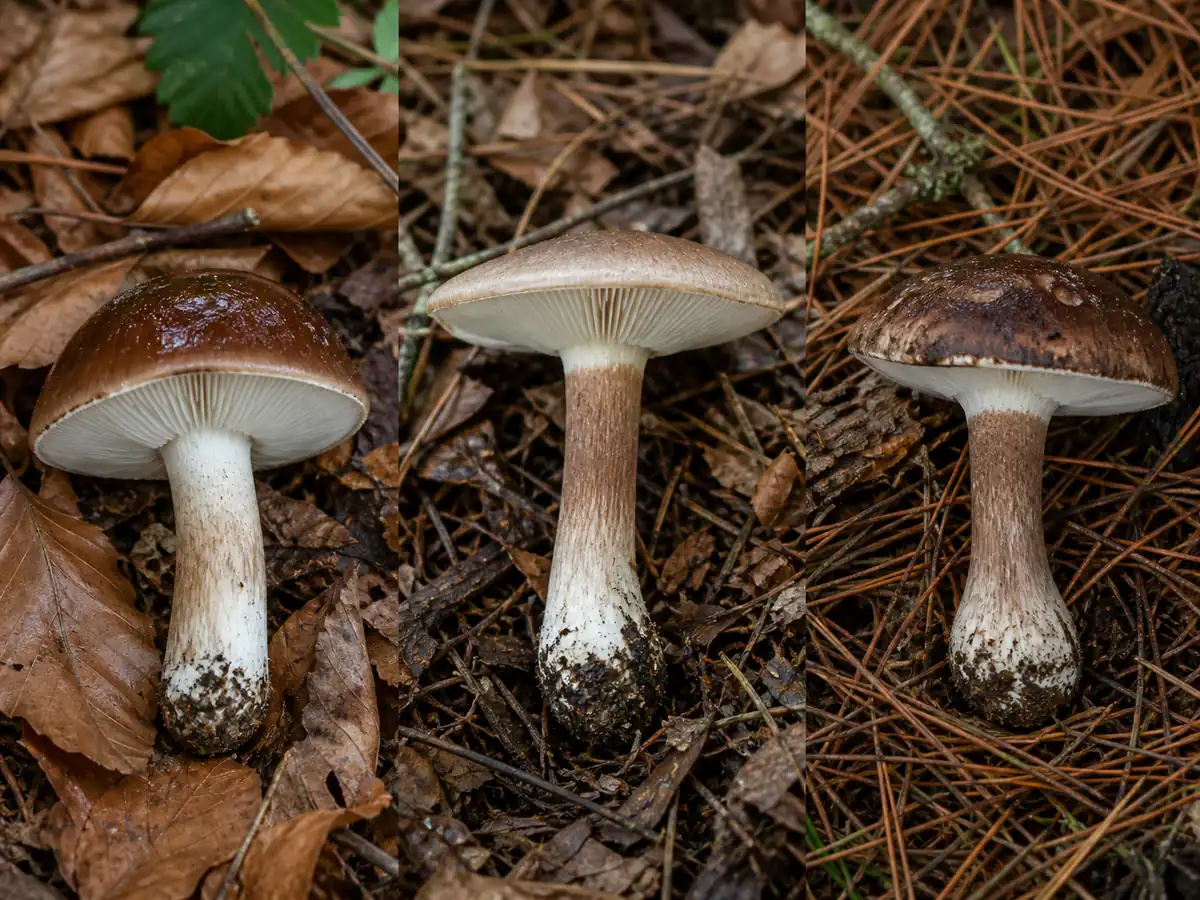
The smooth cap becomes sticky in wet weather and may carry leaves against its surface. A dry specimen can lose that clue, so weather and fresh texture should be recorded rather than reconstructed later.
White gills develop brown spots as they age or bruise. Spotting supports the comparison but is not exclusive, and decay can produce similar marks on unrelated mushrooms.
Host is a major boundary. European T. ustale is strongly associated with beech, while brown knights under pine may belong to T. albobrunneum, T. pessundatum, or another regional lineage.
- Reject a brown cap alone because dozens of woodland mushrooms share chestnut tones.
- Reject a white print alone because many Tricholoma and unrelated genera are white-spored.
- Photograph the notched gill attachment and its small indentation before the gill reaches the stem.
- Build a complete host record that lists beech, oak, pine, spruce, and other trees instead of only the nearest trunk.
Japanese mushrooms historically called T. ustale were revised into several clades, including newly described T. kakishimeji and T. kakishimejioides.
Do not transfer poisoning chemistry or names between continents without checking the voucher concept.
T. imbricatum is usually dry and radially scaly rather than smoothly viscid. Photograph cap texture before rain, transport, or handling mats the scales and narrows that distinction.
Matsutake-group mushrooms have a more distinctive spicy odor and veil development, yet damaged material can lose both. Commercial value should never pressure an observer to explain away a missing ring zone or conflicting host.
Brown Cortinarius can share woodland color but develops rusty spores and often cortina fibers. A white print and Tricholoma-style notched gills reject that route only when the specimen is mature and complete.
The comparison must begin before cleaning. Washing, peeling, or trimming removes cap viscosity, gill spots, stem fibers, and the exact soil attachment needed to separate brown knights.
When a mixed basket contains an uncertain Tricholoma, retain every intact brown knight for the poison service and remove the whole mixed batch from food. Sorting chopped pieces after cooking is not a defensible identification method.
Why does the beech association matter?
Tricholoma ustale forms ectomycorrhizae with living trees. European records emphasize beech woodland, where fruiting bodies emerge from soil through autumn leaf litter.

The fungus trades soil-derived water and nutrients with fine roots for plant carbon. It is not feeding on the fallen leaves in the same way as a litter-decomposer mushroom growing nearby.
Beech association materially strengthens the European species concept. Autumn moisture allows mushrooms to appear even though the underground partnership persists between fruiting years.
Mixed woodland complicates host assignment.
Photograph a broad circle around the collection, identify all plausible trees, and avoid treating one fallen leaf on the cap as proof of the root partner.
Brown knights can fruit in arcs or scattered troops following root zones. The visible pattern may suggest the host direction but cannot show which fine roots are colonized.
Do not rake leaf litter or dig trenches to follow the colony. Such disturbance damages roots and removes the moisture layer that supports fruiting.
Removing caps does not eliminate the mycorrhizal fungus.
In a yard where poisoning risk concerns children or pets, remove fruiting bodies as they appear and supervise access rather than applying fungicide around tree roots.
Regional ecology can expose a misapplied name. A supposed T. ustale in a habitat and host combination outside the supported European concept should be documented as an uncertain brown Tricholoma until specialist review.
Is Japanese kakishimeji the same species?
Tricholoma ustale was described in the broad historical genus Agaricus and transferred to Tricholoma in the nineteenth century. It belongs to a group of reddish-brown knights whose limits have changed with DNA evidence.
A multi-gene revision showed that Japanese kakishimeji traditionally called T. ustale contained four lineages. Two matched other named species groups, and two were described as T. kakishimeji and T. kakishimejioides.
- European concept: T. ustale remains a beech-associated European taxon.
- Japanese poison literature: Older material may represent newly resolved kakishimeji lineages rather than the European species.
- North American records: Visually similar brown knights require current local keys and should not inherit the European name automatically.
Taxonomy changes the precision of chemical statements but not the food-safety response.
A poisonous kakishimeji-group collection with gastrointestinal symptoms remains medically relevant even while specialists refine its name.
Search older literature with T. ustale and kakishimeji, then inspect collection origin, host, voucher, and sequence data. A title alone cannot prove that the tested mushroom matches the profile's taxon.
The Japanese revision also demonstrates why poisoning names need vouchers. A case label based only on the traditional common name can be clinically useful while remaining taxonomically broader than a modern species.
Ustalic acid findings should therefore be attached to the analyzed material and its lineage where known. They support a strong no-food conclusion for the poisonous complex without proving identical concentration in every European fruiting.
Taxonomic precision strengthens toxicology. It lets later studies compare chemistry, host, geography, and symptoms without treating several brown knights as one worldwide organism.
For public identification, use T. ustale only inside its supported concept. A photo from another continent may be labeled Tricholoma species or brown knight group until modern local evidence resolves it.
Can boiling or salting make it edible?
Do not cook burnt knight. Historical recommendations involving boiling, salting, or other processing are not a validated public method and conflict with documented gastrointestinal poisoning.
Ustalic acid has been detected in leftover food from poisoning cases. A soup or sauce can carry exposure even when a diner avoids visible mushroom pieces.
If a brown knight enters a mixed collection, separate the entire uncertain batch from food. Do not try to identify chopped or cooked pieces from cap color after the gills, stem, and host record are lost.
Symptoms can include abdominal pain, vomiting, and diarrhea, sometimes beginning within hours. Contact a poison service, maintain hydration only as medical advice directs, and do not induce vomiting unless instructed.

Burnt knight poisoning questions
Is burnt knight edible?
What symptoms can it cause?
What color is its spore print?
Which tree is associated with European T. ustale?
Is Japanese kakishimeji the same species?
Does boiling remove the toxin?
Sources & References
- Yamada et al., Mycoscience Multi-gene revision of Japanese kakishimeji and separation from European T. ustale.
- Yoshioka et al., Forensic Science International LC-MS/MS detection of ustalic acid in mushroom and poisoning-case leftovers.
- Sano et al., Chemical Communications Isolation and structural identification of ustalic acid and related compounds.
- Japan Ministry of Health natural toxin profile Poisoning syndrome, onset, case context, and public-health guidance.