What the poisoning record proves and leaves unresolved
Avoid eating yellow knight. The original French record contains severe delayed muscle injury and deaths, while later research has not established which amount, person, population, or exact member of the yellow knight complex determines the risk.
Between 1992 and 2000, 12 people in France were hospitalized with rhabdomyolysis after meals attributed to Tricholoma equestre. Three died.
All 12 had eaten at least three consecutive meals containing large quantities of the mushrooms. Fatigue, muscle weakness, and pain began 24 to 72 hours after the last meal, then worsened over several days in the severe cases.
The sequence describes the observed cluster, not a rule for what must happen before poisoning occurs. French food-safety reviewers explicitly found that the evidence could establish neither a toxic dose nor a tolerable dose after single or repeated consumption.
A later Polish study followed ten healthy volunteers after one meal of molecularly identified mushrooms and found no meaningful biochemical change. Its survey also found few reported adverse events, but a small single-exposure study and retrospective reports cannot erase a rare fatal cluster or supply a safe dose.
| Evidence | What it supports | What it cannot establish |
|---|---|---|
| French case series | A serious delayed rhabdomyolysis signal after repeated meals | A minimum dangerous amount or a harmless single portion |
| Ten healthy volunteers | No measured injury after one studied meal in this small group | Safety for repeated meals, other people, or all yellow knight lineages |
| Forager survey | Many respondents reported past consumption without rhabdomyolysis | Verified identity, exact exposure, or absence of rare risk |
| French food regulation | A precautionary ban on commerce under three legal names | A rule against private possession, picking, or consumption |
French law now prohibits importing, exporting, holding for sale or free distribution, selling, and distributing T. auratum, T. equestre, and T. flavovirens. The decree regulates trade and distribution. It does not state a general ban on private possession, picking, or consumption.
Warning
After a suspected meal, new muscle pain, marked weakness, dark urine, breathing difficulty, or profound fatigue needs urgent medical assessment. Tell clinicians what was eaten, when each meal occurred, and whether a specimen or photograph remains.
Ordinary cooking was already part of the reported exposure. No validated home preparation neutralizes the unresolved hazard, and an uneventful meal does not test future safety.
The disputed evidence therefore changes how the conclusion should be worded, but it does not support personal experimentation. The clinical syndrome is covered in equestre rhabdomyolysis.
Build the field identity from the underside up
Bright greenish yellow when young, developing a brown to reddish brown center with age, 5 to 10 cm, sticky when fresh and often sand-covered.
Bright to pale yellow, crowded, and attached to the stem by a notch.
Pale yellow and fairly stout, usually buried deep in sandy soil.
White flesh that remains unchanged when cut, with a mealy odor rather than a coal-gas smell
Start underneath the cap. Yellow knight combines yellow gills, a white spore print, and the notched gill attachment typical of Tricholoma.
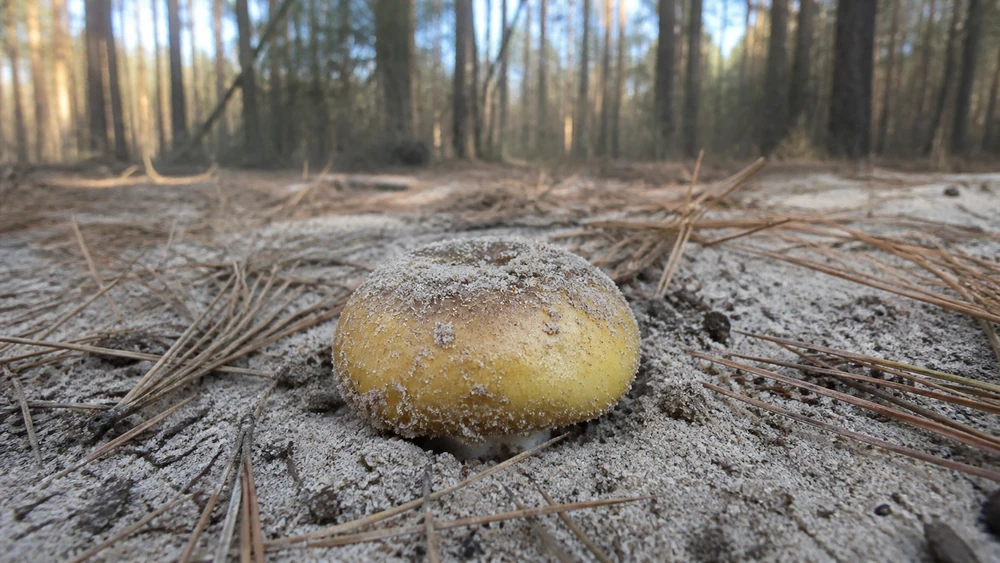
The cap is yellow to olive yellow, often sticky when fresh, and usually develops a brownish center with age. Sand commonly adheres to that moist surface.

A complete stem matters. It should lack both a ring and the abrupt bulb shown by some unrelated yellow mushrooms, while the base may sit deeply buried.
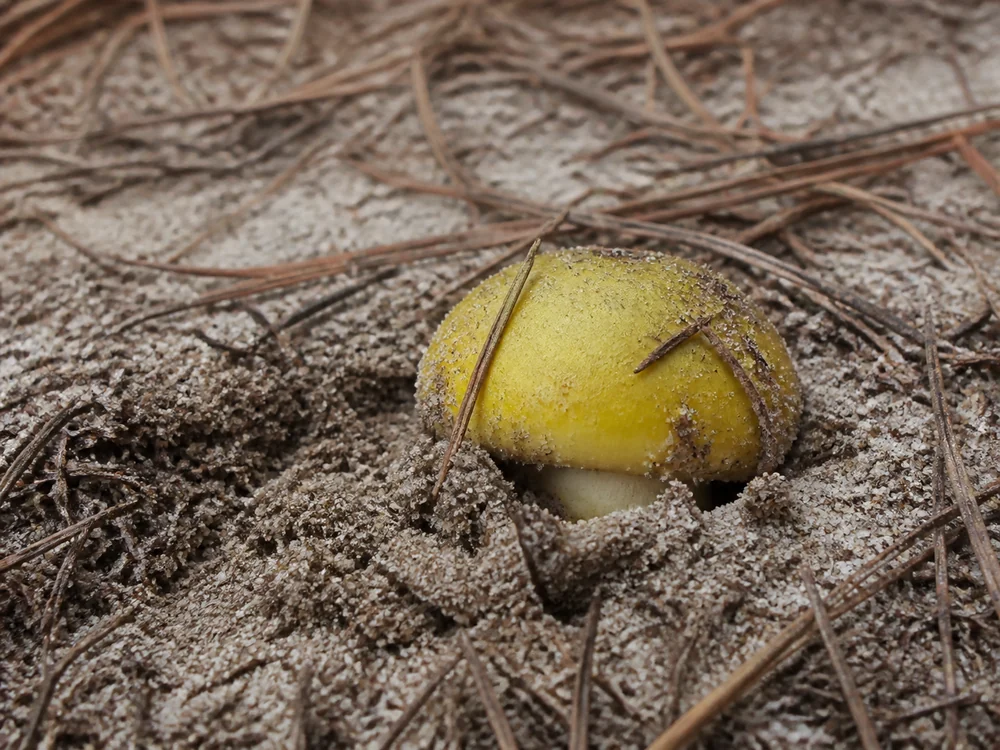
No single yellow feature proves the name. Use the whole combination, then keep the mushroom out of food because field characters do not resolve the toxicology or every cryptic lineage.
Sulphur knight can also be yellow, but its strong coal-gas or tar-like odor conflicts with the mealy smell expected here. A smell difference is useful for rejection, not a license to eat the specimen that remains.
A white spore print separates this group from yellowish mushrooms that mature to pink, rust, or brown spores. The white spore print result still leaves several pale-spored genera and must be read with the notched gills and ringless stem.
Microscopy and DNA may be needed within the yellow Tricholoma complex. Photographs should capture the cap, underside, full stem base, nearby trees, and substrate because a cap-only image discards most of the useful evidence.
If someone may have eaten this mushroom, act now. Call Poison Control at 1-800-222-1222 (US) or emergency services before symptoms appear, and save a piece of the mushroom for identification.
The conifer and sand evidence behind the name
Yellow knight forms a mycorrhizal partnership with living conifers. The best-known European records come from poor, acidic, sandy ground with pines, including the coastal pine habitat described in the French cases.
Look for caps pressing through sand and needle litter from late summer into fall, sometimes later in mild coastal weather. Much of the stem can remain underground, so the exposed cap may understate the mushroom's size.
The ecology is also a taxonomic clue. Molecular work separates broadleaf-associated T. frondosae from the conifer-associated T. equestre complex, while showing that conifer partners vary among geographic collections.
Record the tree as carefully as the cap. A photograph of nearby pine needles, the soil, and the intact stem base gives a reviewer evidence that color alone cannot provide.
Reports under the T. equestre name span Europe, Asia, and North America, but that map should not be read as one uniform lineage. North American treatments warn of considerable cryptic diversity, so a distant yellow collection may not be taxonomically identical to material from southwestern France.
This is a mycorrhizal mushroom, which explains why it follows suitable trees rather than dead logs or a cultivator's substrate. Dense fruiting in a good patch explains historic bulk gathering, but abundance says nothing about food safety.
Why neither tradition nor one meal supplies a safe dose
Yellow knight has a long history as food, especially where sandy pine woods produced it in quantity. That history explains why later poisonings were disputed, but it cannot identify a safe portion or preparation.
The French patients ate cooked mushrooms. Cooking did not prevent the reported syndrome, and no validated boiling, drying, freezing, or other kitchen method removes the unresolved risk.
Do not turn the repeated-meal pattern into advice to eat it once. Regulators reviewed both single and repeated exposure and concluded that the available evidence could not establish a toxic dose or a tolerable dose.
The 2018 volunteer study adds useful counterevidence because ten healthy adults showed no biochemical injury after one controlled meal. Ten people and one exposure cannot test rare susceptibility, repeated intake, different populations, or every lineage sold under this name.
French Decree 2005-1184 prohibits importing, exporting, holding for sale or free distribution, selling, and distributing the three named taxa fresh or processed. The text concerns commercial and free distribution activities, so this page does not recast it as a ban on private picking or possession.
For a meal, choose a mushroom whose identity and edibility do not depend on resolving a fatal but uncommon signal. An uneventful family tradition is exposure history, not a controlled safety result.
When yellow knight appears beneath planted conifers
Yellow knight depends on living tree roots, so it does not behave like a saprotrophic mushroom that fruits from a bag of straw or a block of sawdust. There is no established home cultivation method for producing identified, food-safe fruiting bodies.
It may appear without invitation beneath planted conifers where sandy, acidic soil suits the fungus. Finding it in a garden or managed landscape is evidence of a tree partnership, not evidence of cultivation control or edibility.
Leave an unknown fruiting in place if nobody is at risk of eating it. If removal is necessary around children or pets, photograph it first, lift the complete fruiting body, bag it, wash your hands, and keep it out of food waste used for tasting or compost experiments.
The underground fungal partner remains after visible mushrooms are removed. Fruiting can recur with suitable weather, so prevention depends on supervision and disposal rather than trying to eradicate the mycelium.
No clinical benefit offsets the uncertainty
Yellow knight has no established therapeutic use. Research on the species centers on adverse effects, species identity, and the unresolved cause of muscle injury rather than a clinical benefit.
Cell, animal, or chemical findings would not make a wild specimen a treatment. No preparation, dose, or patient group has been shown to receive a medical benefit that could justify the food-safety uncertainty.
Do not use this mushroom as medicine or a self-test. New weakness or dark urine after consumption calls for urgent assessment, not another dose or a home remedy.
Why exposure history matters more than nutrients
A nutrient table would answer the wrong question for yellow knight. Any ordinary protein, mineral, or fiber contribution can be obtained from foods without this unresolved association with fatal rhabdomyolysis.
The case record shows repeated large meals before illness, while the French review found too little evidence to define either a toxic dose or a tolerable dose. There is no evidence-based serving recommendation for yellow knight.
The small volunteer experiment and the Polish survey make the scientific picture less simple, but they do not produce a threshold. The volunteer result applies to ten selected healthy adults after one studied exposure, and the survey depended largely on remembered consumption and field identification.
If symptoms follow a suspected meal, record the time and amount of every mushroom meal rather than reporting only the most recent plate. Preserve uncooked material, scraps, or clear photographs because delayed onset can otherwise separate the illness from the exposure in a clinician's history.
Muscle pain, weakness, dark urine, or breathing difficulty needs urgent care. Do not wait for every symptom to appear, and do not use a previous uneventful meal to rule out the mushroom.
Legal names, molecular lineages, and the old cases
The name problem has two different layers, and their dates matter. French regulators in 2003 and 2005 faced a legal naming question because Tricholoma auratum, T. equestre, and T. flavovirens were used inconsistently for similar yellow mushrooms.
The 2005 decree therefore names all three. That wording keeps a commercial prohibition from failing when a product uses one synonym or a broad treatment, but it does not by itself prove that every name represents one biological species.
A 2013 two-marker molecular study later found European T. auratum, T. equestre, and T. flavovirens samples within one species. It also separated broadleaf-associated T. frondosae and found an Asian cluster that may warrant recognition below or beyond the current name.
Later molecular evidence clarifies biology, not the cause of each old poisoning. The case specimens were not all preserved for modern sequence confirmation, so taxonomy can narrow possibilities without retrospectively assigning every meal to a sequenced lineage.
Modern North American descriptions still warn that the group contains considerable cryptic diversity. Use T. equestre here as the profile's practical name, while treating geography, host tree, morphology, and sequence evidence as part of a defensible identification.
The genus remains recognizable by a gilled mushroom body, a pale spore deposit, and gills that are often notched at the stem. Those genus traits identify a relationship, not an edibility category.
Evidence-based answers about yellow knight
Is yellow knight poisonous?
Can one small serving be considered safe?
When can rhabdomyolysis symptoms start?
Does cooking make yellow knight safe?
What did the later volunteer study find?
What exactly does French law prohibit?
Sources & References
- New England Journal of Medicine, Bedry et al. 2001 Primary French case series for 12 patients, three deaths, consecutive meals, delayed symptoms, and excluded alternative causes.
- AFSSA opinion 2002-SA-0285 French food-safety assessment for fragmented toxicology, nomenclature uncertainty, and the inability to set a toxic or tolerable dose.
- AFSSA opinion 2005-SA-0095 Official opinion supporting a permanent decree and recommending all three legal names because nomenclature lacked consensus.
- Légifrance Decree 2005-1184 Official continuing French prohibition covering import, export, possession for sale or free distribution, sale, and distribution of three named taxa.
- Moukha et al., Fungal Biology 2013 Two-marker molecular study separating legal nomenclature history from later evidence about European, broadleaf-associated, and Asian lineages.
- Klimaszyk and Rzymski, Toxins 2018 Counterevidence from a Polish survey, toxicology records, and ten healthy volunteers after one molecularly identified exposure.
- MushroomExpert, Tricholoma equestre Field morphology for ringless stem, notched yellow gills, white spore print, mealy odor, sandy pine habitat, and cryptic diversity.