What is a sulphur knight?
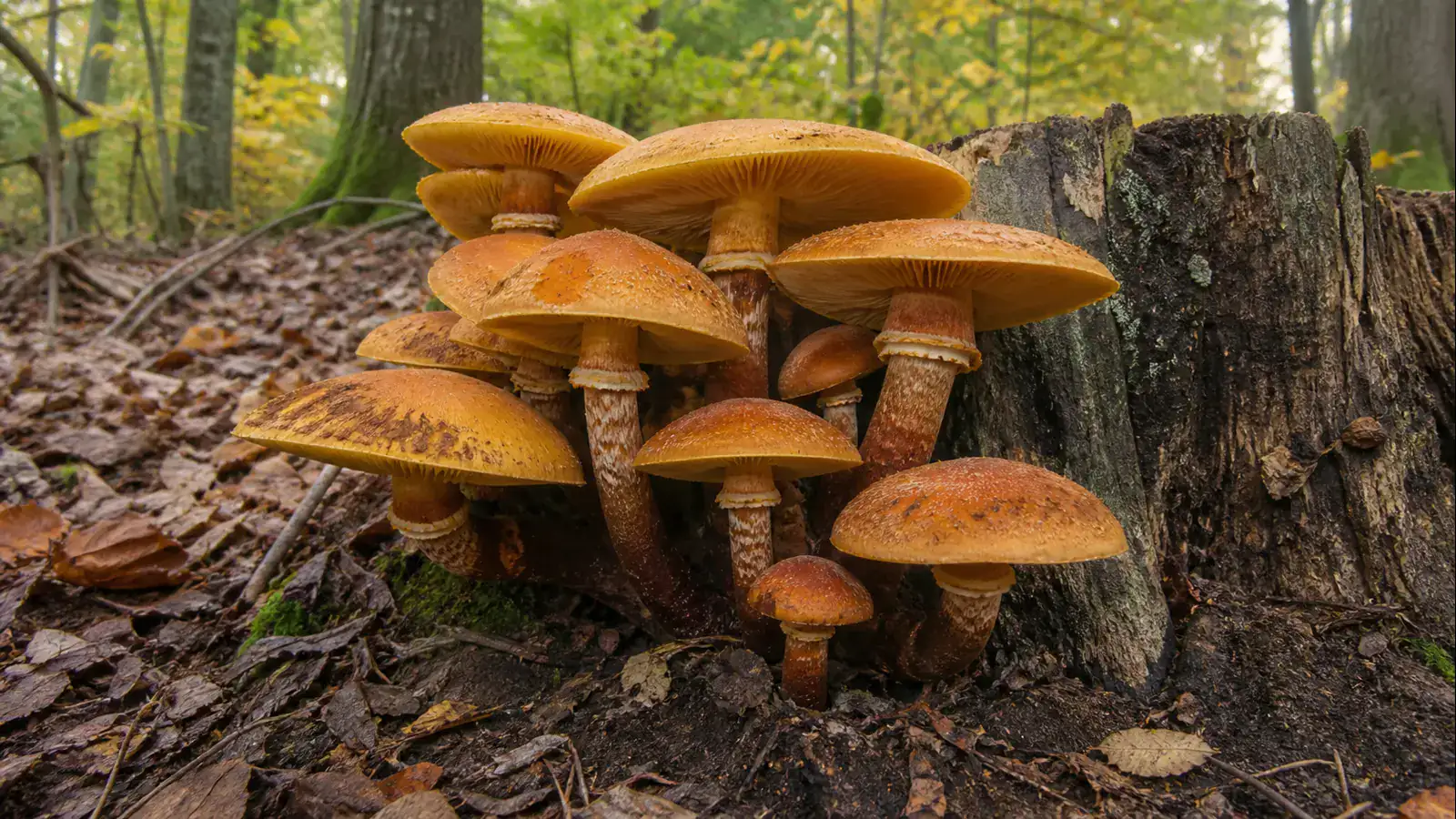
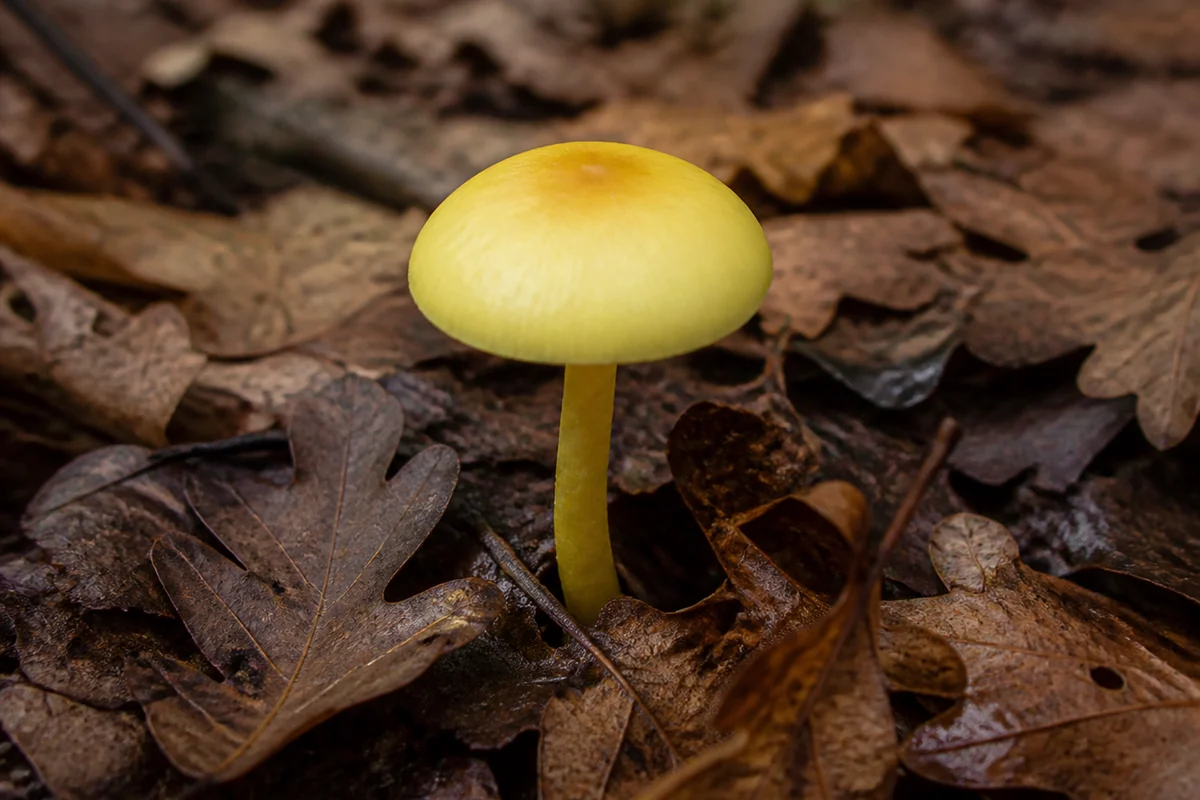
A sulphur knight is a small bright yellow gilled mushroom of oak and beech woodland, yellow in the cap, the gills, the stem and the flesh alike.
The old English name gas works mushroom is the best description anybody has managed. Victorian gas works smelled of coal tar, and a fresh sulphur knight in a warm hand smells the same way.
The smell is strong enough that people often find the mushroom by following it. A few of them in leaf litter can be noticed from several paces away on a still day.
It is the one common yellow woodland mushroom in Europe that does this, which is what makes an unphotographable character so useful in practice.
Yellow, by contrast, is doing almost no work. Yellow woodland mushrooms are ordinary, they turn up in several unrelated families, and a yellow cap narrows a specimen far less than most people assume.
How do you identify a sulphur knight?
Sulphur yellow, sometimes browner at the middle, 3 to 8 cm across, convex and flattening with age, dry rather than sticky.
Bright sulphur yellow, broad, widely spaced and notched where they meet the stem.
Yellow throughout, slender, 3 to 5 cm tall and 6 to 10 mm across, often slightly fibrous.
Yellow through the cap and stem, with a very strong smell of coal gas or tar that is obvious from a distance.
Smell it, and then check that the yellow goes all the way through.
A yellow mushroom with no smell is not this species, and a yellow mushroom with white flesh is not this species either.

The measurements place it as a small mushroom, which is worth expecting.
| Character | Sulphur knight | Note |
|---|---|---|
| Cap | 3 to 8 cm, sulphur yellow | Sometimes browner at the middle |
| Gills | Broad, widely spaced, yellow | Notched at the stem |
| Stem | 3 to 5 cm, yellow throughout | Slender and fibrous |
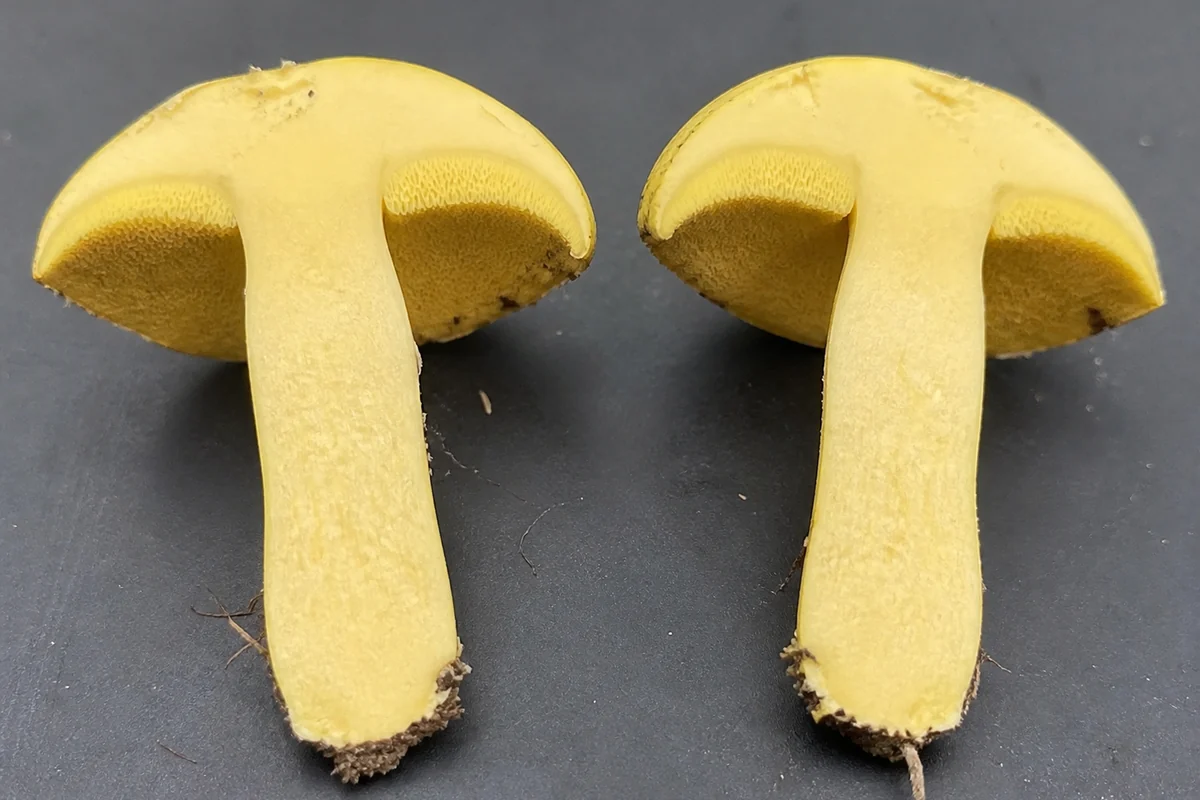
| Flesh | Yellow in cap and stem | The character people skip |
| Smell | Strong coal gas or tar | The character that decides it |
There is a right way to smell a mushroom and most people do it badly. Holding a whole cap up to the face and inhaling hard is the usual attempt and it is close to the worst one.
Break a small piece off, warm it for a moment between finger and thumb, then cup it close and breathe in through the nose in short sniffs rather than one long one. A long inhalation saturates the sense and gives a worse answer than three short ones.
Warming matters more than anything else in that sequence. Volatile compounds do not travel from cold flesh, which is why a mushroom that smells of nothing on a frosty morning can be unmistakable indoors ten minutes later.
Cutting one does two jobs at once, which is why it is worth doing rather than just handling the outside.
It shows the flesh color, and it releases far more of the smell than an intact mushroom gives off.
A spore print is white and adds very little here. It confirms the broad group and leaves every yellow member of that group still on the table.
If someone may have eaten this mushroom, act now. Call Poison Control at 1-800-222-1222 (US) or emergency services before symptoms appear, and save a piece of the mushroom for identification.
What is the difference between a sulphur knight and a yellow knight?
The comparison that matters is with the yellow knight, which is edible in some traditions and legally restricted in French commerce after a series of poisonings.
That page carries its own complicated story, and the part relevant here is simply how to tell the two apart.

Three characters do it and color is not one of them.
The smell is first. A yellow knight smells mealy, like fresh flour or cucumber, and a sulphur knight smells of a gas works.
The flesh is second. A yellow knight has white flesh where this one is yellow through the cap and the stem.
The gills are third. A yellow knight has thin crowded gills where these are broad and widely spaced, and its cap is stickier and usually darker and more olive.
Several other small yellow woodland mushrooms exist and most of them are not in this genus at all.
Yellow russulas, yellow waxcaps and a range of small yellow species from other families all share the color and share almost nothing else, so a yellow cap on its own places a mushroom in a very large and very mixed group.
None of them smells like this, so the smell keeps working as a first filter even when the name at the end is not known.
That is the useful way to hold this character. It does not tell you what a mushroom is, and it reliably tells you what one of them is not.
Warning
The smell rejects rather than confirms. A gas works smell means this mushroom is not going in the basket, and the absence of that smell does not identify anything or make a yellow mushroom safe.
Where do sulphur knights grow?
The sulphur knight is mycorrhizal, living in partnership with tree roots rather than on dead material.
Oak and beech are the usual partners. It also turns up in conifer woodland here and there, and under willow on damp ground, which is a habitat worth knowing because it is not where anybody looks for it.
- Partner trees
- Mainly oak and beech, sometimes conifers or willow
- Ground
- Woodland litter, including damp ground under willow
- Season
- Late summer and autumn, occasionally from late spring
- Habit
- Scattered or in small groups
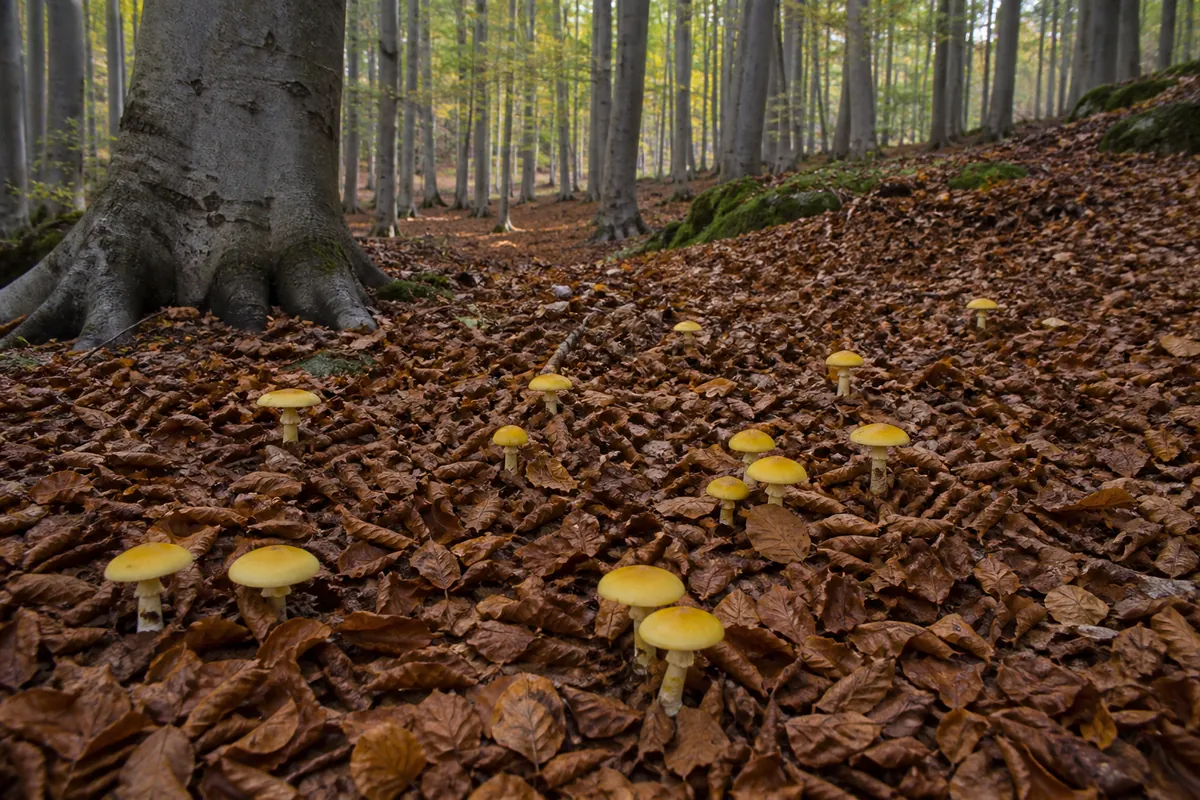
The season is unusually long for a woodland Tricholoma. Most of the genus is firmly autumnal and this one occasionally appears as early as late spring.
The willow habitat deserves a second mention because it breaks the pattern. Damp ground under willow is not oak or beech woodland, and somebody who has learned this species in a dry oak wood can be caught out by finding it somewhere that feels wrong.
It is common rather than rare across most of its range, which matters for how a reader should weigh a find.
A small bright yellow mushroom in an oak wood in October is much more likely to be this than anything unusual.
Common is also why it turns up in identification requests so often. It is bright, it is easy to see against fallen leaves, and it sits at exactly the size that makes people pick one up.
Can you eat a sulphur knight?
There is no culinary use of the sulphur knight and there never was.
It is poisonous, with reported effects that are mostly gastrointestinal alongside some neurological symptoms, and nothing about the mushroom rewards the risk.
Note
The smell does most of the protective work by itself. Very few people get as far as cooking something that fills a kitchen with the smell of a gas leak, which is probably why serious poisonings from this species are not common despite how common the mushroom is.
That is a piece of luck rather than a safety feature, and it is worth naming as such.
Anybody cooking a mixed basket in a hurry, with a cold or with a strong-smelling dish already on the stove, has lost exactly the protection that keeps the rest of us out of trouble. Some people cannot use this character at all, and that is worth saying directly rather than leaving somebody to discover it.
A heavy cold, long-term smoking and the partial loss of smell that many people carry after illness all reduce or remove the one test this page relies on. So does simply being in a group where somebody else already smelled it and said so.
Note
If you cannot smell reliably, this character is not available to you and the sensible move is to lean harder on the ones that are. Yellow flesh through the cap and stem, and broad widely spaced gills, are both visible and both reject a yellow knight.
The practical rule follows from that. Sort a basket outdoors and by nose before anything reaches the kitchen, because a kitchen is the worst possible place to notice a smell.
Outdoors the air is moving and the background is leaf litter, and indoors it is competing with everything else in the room.
A basket that seemed fine on a kitchen counter has not been checked.
Can sulphur knights be cultivated?
The sulphur knight cannot be cultivated, because it fruits only from a partnership with living tree roots.
There would be no reason to try. A poisonous mushroom that smells of coal gas has no market at any price.
Is there any medicinal use?
There is no medicinal use of the sulphur knight. It appears in chemistry literature for its odor compounds rather than for anything therapeutic, which is a different kind of interest entirely.
Why sulphur knight is not food
No nutritional information exists for this species and none would mean anything.
Nutrition tables describe foods, and this mushroom is not one.
The useful number here is a distance rather than a quantity, which is how far away the smell can be noticed on a still day.
That is not a joke at the reader's expense. For a mushroom nobody should eat, the measurement worth recording is the one that keeps it out of a basket.
Why do so many Tricholoma species smell?
Smell is a serious character in this genus rather than a curiosity, and several members are named for it.
Tricholoma contains species described as mealy, as soapy, as sweet and as unpleasant, and the smell often does more separating work than the color does.
Key takeaway
The compound responsible for the coal gas smell here is skatole, which is also the compound behind the smell of a coal tar works and of a good deal else nobody wants to name at dinner.
That single compound is why the description is so consistent across languages and centuries. People describing this mushroom in different countries were smelling the same molecule.
It also explains why the descriptions vary in tone while agreeing on substance. Skatole reads as tar and gas at high concentration and as something quite different and almost floral when very dilute, so accounts calling this mushroom sweetish and accounts calling it foul can both be honest.

The genus also has its own naming trouble, and yellow species have been split and merged repeatedly as molecular work has gone on.
None of that changes what a forager does. The smell was the deciding character before anybody sequenced anything, and it still is.
Frequently Asked Questions
Is the sulphur knight poisonous?
What does a sulphur knight smell like?
How do you tell a sulphur knight from a yellow knight?
What makes the smell?
Can you identify it from a photograph?
Where does it grow?
Sources & References
- Tricholoma sulphureum, Sulphur Knight mushroom Field description used for the cap and stem dimensions, the broad distant sinuate sulphur yellow gills, the white spore print, the very strong coal gas odor and the gas works mushroom name, the oak and beech habitat including willow on damp ground, and the season from late spring through autumn.
- Tricholoma sulphureum General account used for the identification of skatole as the compound responsible for the smell, for the classification as inedible and suspected poisonous with mostly gastrointestinal and some neurological effects, and for the comparison with Tricholoma equestre by cap stickiness, flesh color, gill spacing and smell.