Is fool's funnel poisonous?
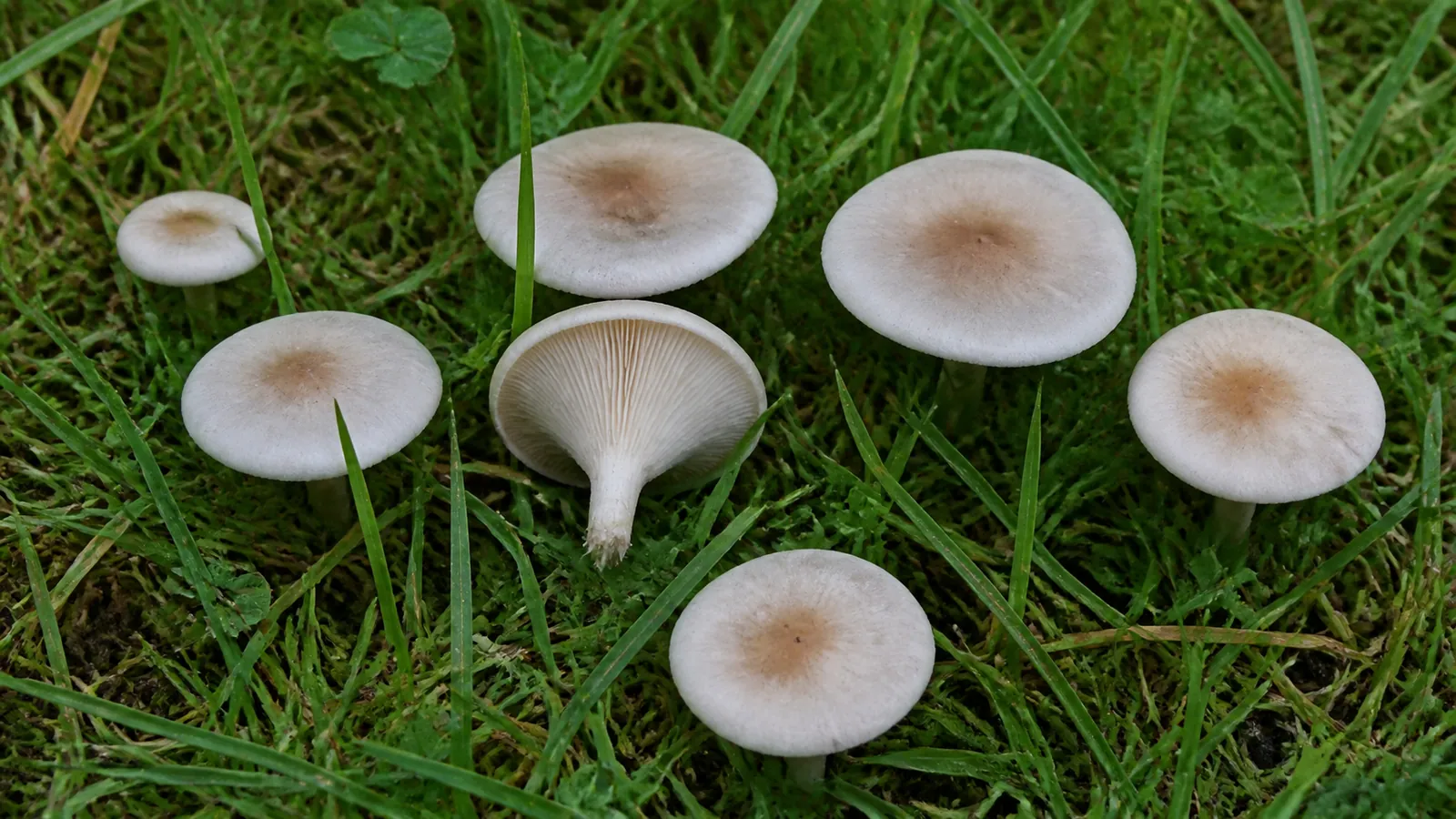
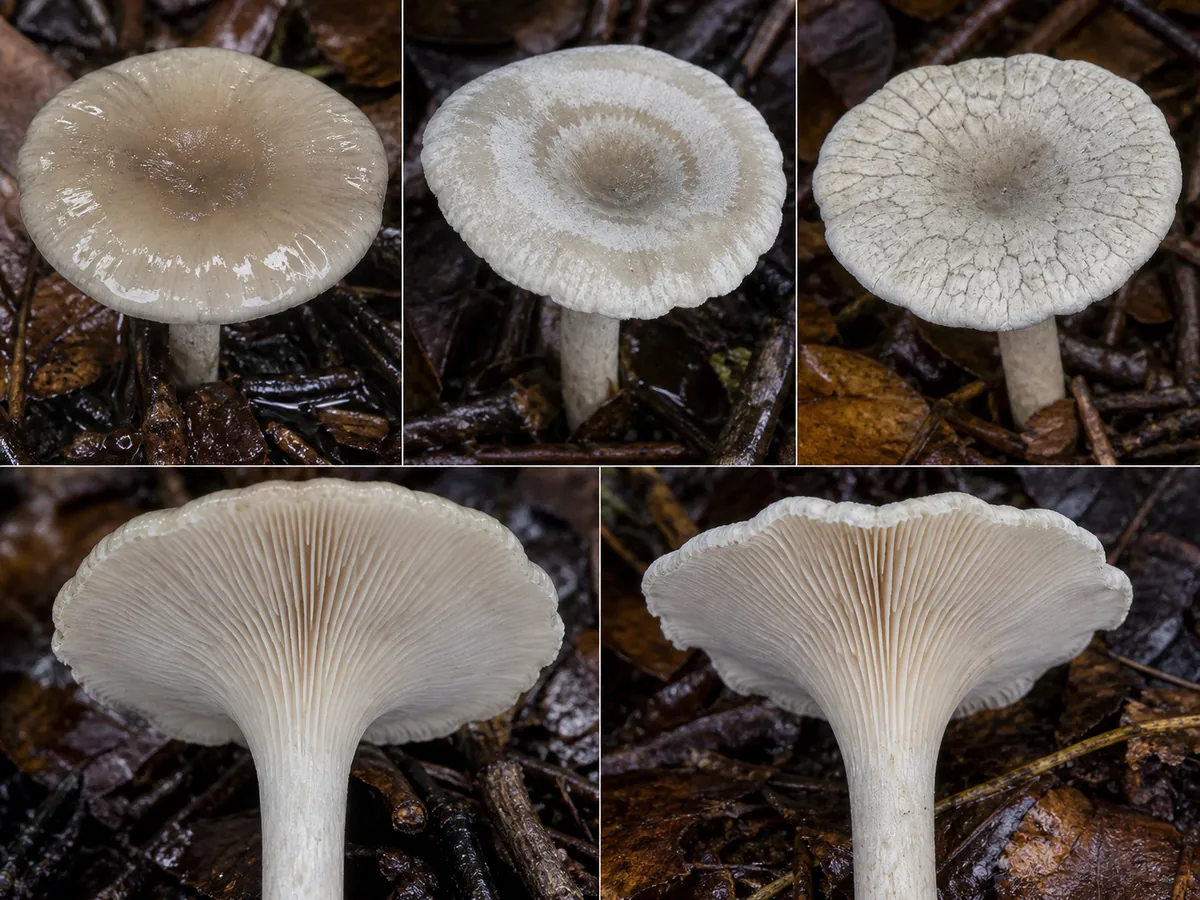
The cap changes with moisture so strongly that one colony can look like several species. Wet mushrooms appear buff-gray or pale tan, while drying leaves a white frosted surface broken into concentric bands and irregular cracks.
Young caps are low and convex with an inrolled edge.
They flatten and may become shallowly depressed, but many never form the deep central funnel suggested by the common name.
The crowded gills run down the stem and remain pale. This decurrent attachment separates the mushroom from free-gilled lawn species, though several white funnels share it.
The stem is slender, fibrous, and ringless. Grass, sand, and white mycelial felt can cling to the base, so it should be lifted whole rather than cut at lawn height.
Colonies form troops, arcs, or fairy rings because the underground mycelium expands through thatch and soil. The same geometry appears in unrelated edible and poisonous fungi.
The small neat cap can be more dangerous than a dramatic toadstool. Muscarine content is invisible and is not reduced to a safe level by ordinary cooking.
How do you identify fool's funnel?
Usually 2 to 6 cm across, initially convex then flat to shallowly funnel-shaped, whitish with a buff center, and often covered by a thin frosted bloom that cracks into rings or patches.
Crowded, white to cream, and distinctly decurrent, running down the slender stem.
Short, fibrous, white to buff, ringless, often slightly enlarged at the base, and sometimes fused with grass or soil debris.
Thin pale flesh with a mild mealy or indistinct odor. Never taste it.
Photograph the colony from above before taking a close view. The spacing, complete arc, grass condition, and individual cap stages help explain the fruiting pattern.
The white spore print supports a funnel group but cannot separate C. rivulosa from close relatives. Spore dimensions, cap tissue, chemistry, and regional keys may be necessary.
Older literature often uses Clitocybe dealbata for overlapping material. Some modern treatments separate or synonymize names differently, so a field observer should preserve measurements and images rather than force every pale lawn funnel into one label.
Do not identify by ring formation.
Map the colony for ecology, then identify each mushroom from anatomy and mature spores.
If someone may have eaten this mushroom, act now. Call Poison Control at 1-800-222-1222 (US) or emergency services before symptoms appear, and save a piece of the mushroom for identification.
What happens if you eat fool's funnel?
Heavy sweating, salivation, tears, abdominal cramps, vomiting, diarrhea, pinpoint pupils, wheezing, airway secretions, a slow pulse, and low blood pressure fit the syndrome. The common name sweating mushroom points to one symptom but understates the breathing and circulation risks.
Call Poison Control or emergency services immediately after suspected ingestion.
Save the mushrooms and photograph the lawn colony, cap surfaces, gills, full stems, and any other species collected nearby.
A colony photograph should include the complete arc and a close view of several cap stages. Mowing may scatter fragments from more than one species, so collect intact specimens just outside the cut strip when possible.
If a dog ate mushrooms from a ring, note chewing, drooling, vomiting, diarrhea, urination, breathing sounds, weakness, and pulse changes for the veterinarian. Do not assume the animal selected the same species shown in the nearest photograph.
The site's mushroom poisoning symptoms page explains why timing helps clinicians without identifying the mushroom by itself. A mixed basket or uncertain species can produce a different course.
Repeated secretions and diarrhea can wet clothing and bedding enough to conceal ongoing fluid loss. Record urine, alertness, ability to stand, and breathing effort rather than judging recovery from fewer vomiting episodes.
Do not drive alone when faintness, blurred vision, or a slow pulse is developing. Keep the poison service on speaker when directed and have another person gather specimens without delaying transport.
Atropine is selected against clinical signs, not used as a preventive household drug. Other medications with anticholinergic effects can cause confusion, overheating, urinary retention, and abnormal heart rhythm when taken without supervision.
Warning
Wet breathing, difficulty breathing, fainting, confusion, or a very slow pulse requires emergency care. Do not induce vomiting or self-treat with an anticholinergic drug.
Why is a fairy ring mushroom comparison risky?
Fairy ring mushroom creates the most familiar lawn comparison, but it has a smooth tan cap, widely spaced gills that do not run strongly down the stem, and an unusually tough wiry stem. Fool's funnel is softer, paler, and more crowded beneath.
White funnel species can be harder to separate and should not be treated as edible substitutes. Experts often reject white clitocyboid mushrooms as food because close field matches have conflicting toxicity.
The fairy ring mushroom's stem can be twisted without snapping easily, while the fool's funnel stem is more fragile and fibrous. Drought can pale the fairy ring cap and rain can darken the fool's funnel, reducing the color contrast.
The miller has a mealy odor and pinkish spores with gills descending the stem, but cap form and odor overlap.
A mature spore print and microscopy carry more weight than scent.

| Candidate | Better evidence | Failure case |
|---|---|---|
| Fairy ring mushroom | Tough wiry stem, distant gills, smooth tan cap | Dry caps become pale |
| The miller | Pink spores, stronger mealy odor | Both have descending gills |
| Other white funnels | Microscopy and current taxonomy | Macroscopic separation may be unreliable |
| Small waxcaps | Thick waxy gills, often different texture | Pale grassland forms overlap from above |
Key takeaway
Reject small white grassland funnels from a food collection when species confirmation depends on cap color or odor alone.
What creates an arc across a lawn?
Fool's funnel decomposes dead organic material in grass thatch and upper soil. Its mycelium can expand outward over time, with fruiting bodies appearing near the active edge as an arc or circle.
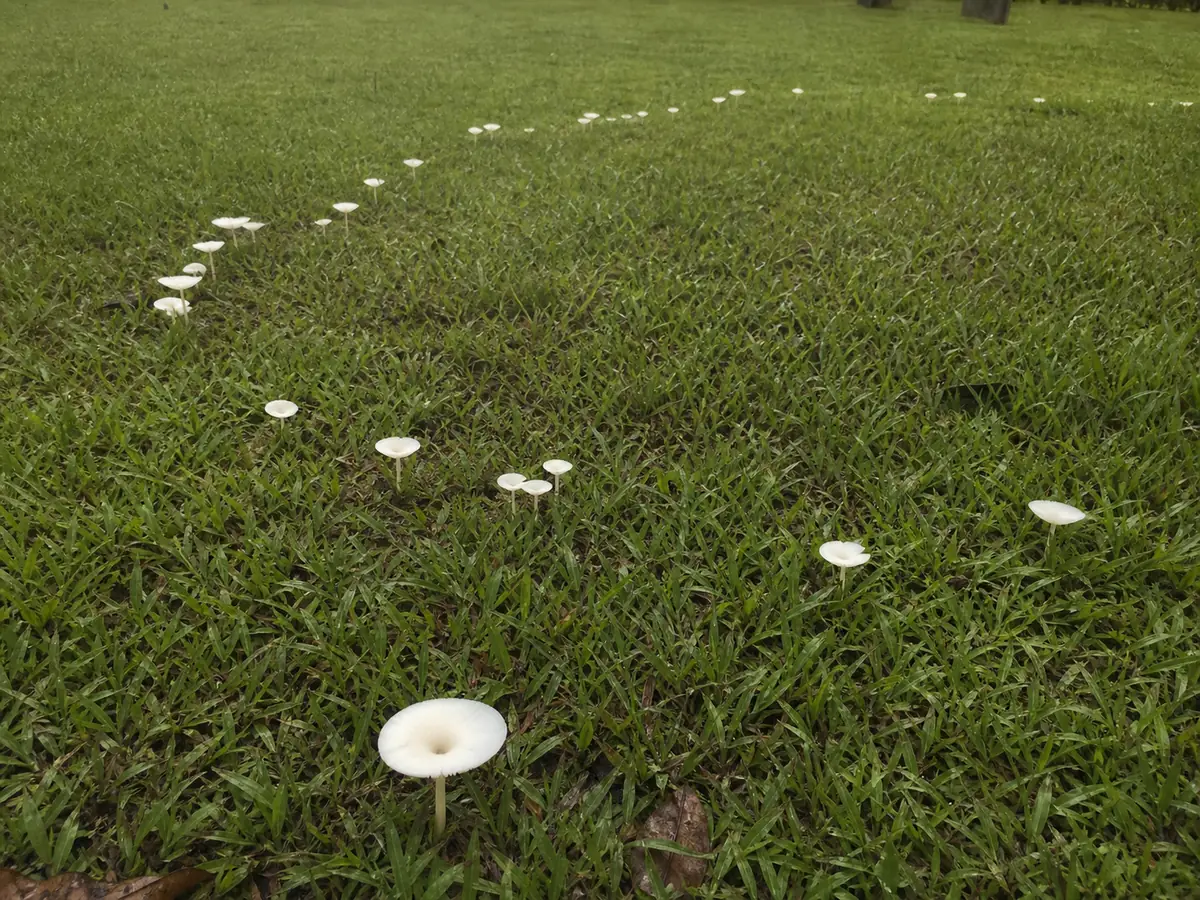
Lawns, parks, playing fields, road verges, pastures, dunes, and grassy woodland edges all provide suitable organic matter. Short mowing makes the caps more visible but also leaves fragments that children or pets can pick up.
Removing mushrooms promptly reduces access, though new caps can emerge after later rain. Chemical lawn treatment is rarely an immediate safety solution because the mycelium occupies soil and the exposure risk comes from fruiting bodies.
The ring may stimulate or stress grass depending on nutrient release, water movement, and dense fungal growth.
Grass color tells you about turf response, not mushroom toxicity.
Use gloves or a tool for repeated yard cleanup, bag the mushrooms, and recheck the same arc during wet weather.
How can the same fool's funnel change color between rain and dry weather?
A fool's funnel cap is hygrophanous, so water held in the cap changes how light passes through the tissue. Fresh wet caps can look gray-brown or buff, then dry toward chalky cream from the center or in irregular patches.
That transition can happen while the mushroom remains rooted in the lawn. A ring photographed after rain may appear to contain two species when exposed caps have dried faster than sheltered caps under taller grass.
Cap is wet and darker
Record the smooth surface, margin, gills, and exact lawn positionWet color is temporary and should not become the whole identification.
Cap is drying in patches
Rephotograph the same specimen before collecting itPatchy pallor can look like scales or disease even though only moisture changed.
Cap is dry and pale
Compare it with mature wet specimens from the same ringA dry white cap can overlap most strongly with edible lawn lookalikes.
The gills, stem texture, spore deposit, cap size, and colony pattern do not become optional when the color fits. Weather explains variation inside a specimen, but it does not prove the species.
A repeat visit after rain can clarify the moisture cycle without turning the lawn into a food source. Mark the position, photograph rather than taste, and keep children and pets away from the fruiting arc.
Why does a fairy ring fail as a food test?
A ring records the outward growth of fungus through soil or thatch, not the identity or edibility of the mushrooms above it. Many unrelated lawn fungi can form circles, partial arcs, or scattered troops when only part of an underground colony fruits.
The mushrooms form a clean circle
Photograph the whole ring and several intact specimensGeometry preserves colony context but cannot name the species.
Two cap colors share one arc
Compare wet and dry states before assuming two speciesFool's funnel can fade unevenly as exposed caps dry first.
Several mushroom forms share the lawn
Keep each form and its exact position separateTwo colonies can cross or fruit through the same grass.
Children or pets use the area
Remove accessible fruiting bodies and inspect again after wet weatherPicking caps reduces immediate access but does not remove the underground fungus.
Dark green grass, bare patches, or a nearly perfect circle may help explain where the fungus is active. Those lawn effects do not replace gill attachment, cap surface, stem texture, spore color, scale, and expert confirmation.
A fairy ring is a map of growth, not a certificate of safety. Treating the lawn and identifying a mushroom are separate tasks, even when the same ring prompted both questions.
Are rivulosa and dealbata the same mushroom?
The names Clitocybe rivulosa and Clitocybe dealbata have been applied to closely overlapping white lawn funnels. Authorities differ on whether they represent separate species, synonyms, or a complex requiring further study.
The epithet rivulosa refers to channel-like cracks or markings, matching the rivulets that appear as the frosted cap surface breaks. Dealbata refers to a whitewashed appearance.
Public safety does not depend on resolving every name in the complex.
A muscarine-risk white funnel remains excluded from food when taxonomy is uncertain.
How does muscarine affect airways and heart rate?
Muscarine activates peripheral muscarinic receptors and drives parasympathetic functions far beyond normal levels. Sweat, saliva, tears, intestinal fluid, and airway mucus increase while the heart can slow and the bronchi constrict.
The syndrome is generally early, which helps clinical triage, but rapid onset does not make it harmless. Severe bronchial secretions, bronchospasm, bradycardia, and hypotension can require airway and cardiovascular support.
Atropine is used by clinicians when symptoms warrant it.
Dose and monitoring depend on the patient's signs rather than a guessed number of mushrooms.
Research published in 2024 identified a phosphorylated precursor associated with muscarine metabolism in C. rivulosa. That biochemical finding sharpens toxicology and creates no medicinal role for the mushroom.
Can muscarine be cooked out?
Fool's funnel has no culinary use. Muscarine is not removed reliably by sautéing, boiling, drying, or pickling.
The false champignon name reflects its history of confusion with edible grassland mushrooms. It should never be used as an invitation to test a pale lawn cap.
Keep lawn collections separated by species and preserve the stem bases. Once mixed, the small pale caps and fragments are difficult to assign safely.
If a suspected fool's funnel entered a cooked dish, do not pick out visible pieces and serve the rest. Preserve the food, contact Poison Control, and follow its advice.
Fool's funnel questions
Is fool's funnel poisonous?
Does it always have a deep funnel?
Why does it grow in a ring?
How is it different from fairy ring mushroom?
Does cooking remove muscarine?
What should I do in a yard with children?
Sources & References
- Dörner et al., Angewandte Chemie Muscarine chemistry in Clitocybe rivulosa and clinical significance.
- Additional Information Necessary, Deutsches Ärzteblatt C. rivulosa toxicity and white-Clitocybe food rejection.
- North American Mycological Association Muscarine symptoms and response.
- Missouri Poison Center Muscarinic onset and symptom table.
- University of Minnesota Extension Many unrelated saprotrophic fungi can produce lawn rings or arcs.