
 Poisonous

What is a tiger knight mushroom?
Tiger knight is a large gray Tricholoma whose dark scales can make its cap look spotted like a leopard or striped like a tiger. Those common names describe the surface only. Naming the species takes far more than the pattern, because gray knights share many of the same pale parts.
Its full profile joins a broad dry cap, pale notched gills, a thick solid stem with no ring, white spores and a mealy smell. The mushroom comes up from soil, where it partners with living trees, and it does not grow from stumps or logs. Your complete field identification should keep the cap, underside, whole stem and host trees tied to one specimen.
Such a dramatic cap tempts you into trusting one striking trait. Regular scales carry real weight, yet rain, age and handling can flatten them. Other Tricholoma species also carry fibers or scales of their own.
Where you found it changes the name too. European T. pardinum is well established, while North American material filed under that name may include oak and conifer partners that specialists treat with caution. That doubt never opens up an edible option: tiger knight is poisonous, and any robust gray Tricholoma you cannot resolve stays out of a meal.
Which features identify a tiger knight?
Photograph the cap before you clean or wet it. Its natural dryness, the debris stuck to it and the raised edges of the scales all count as evidence, and washing can wipe them away.
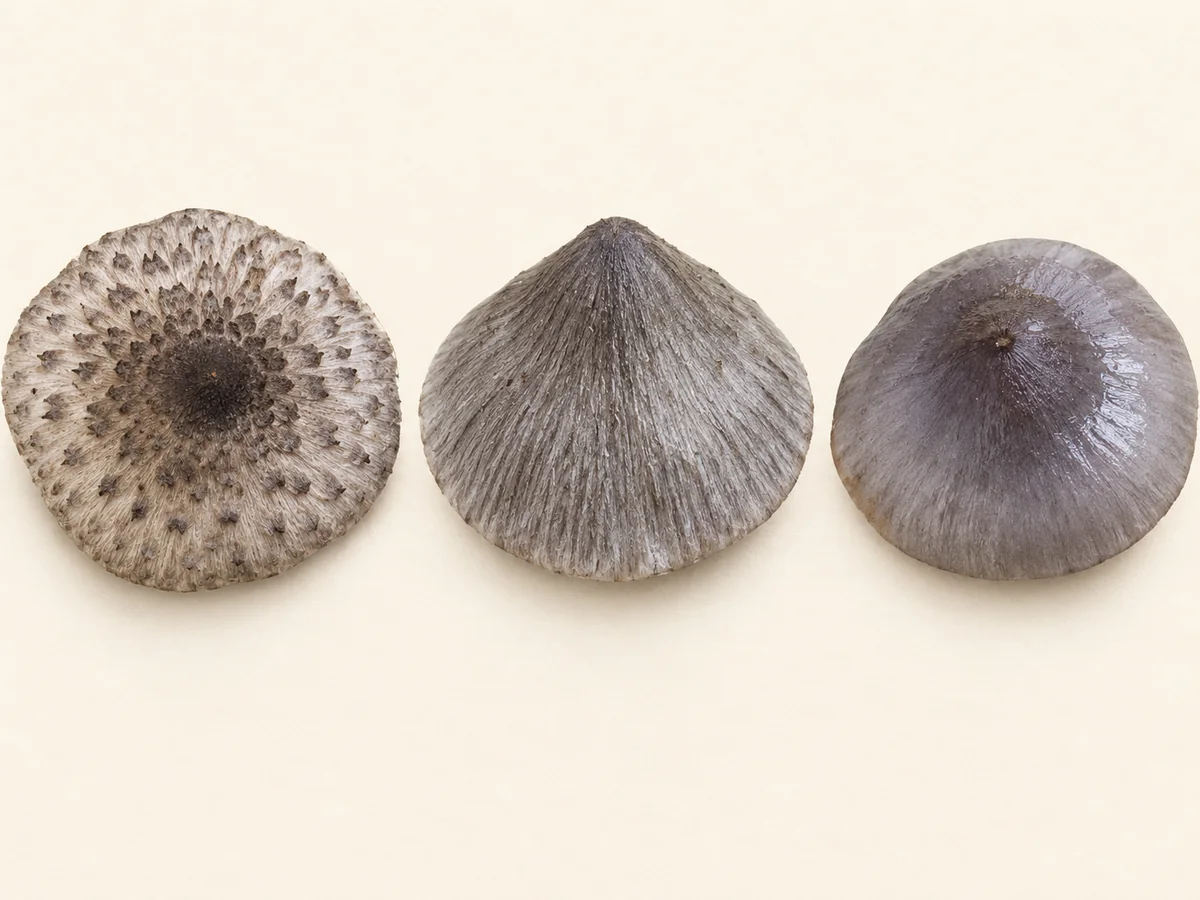
The North American description gives a cap about 4-15 cm across, while the California account commonly puts it around 5-12 cm. Young caps start broadly convex or bell-shaped and can flatten with age. Small gray-brown to nearly black scales sit in a regular scatter over a whitish to pale gray-brown background. The center usually looks darkest, and the margin turns paler.
You are looking for raised scales, beyond mottled color. Pressed fibers, dirt or water stains can draw dark lines on a cap without forming the small raised scales of a typical tiger knight.
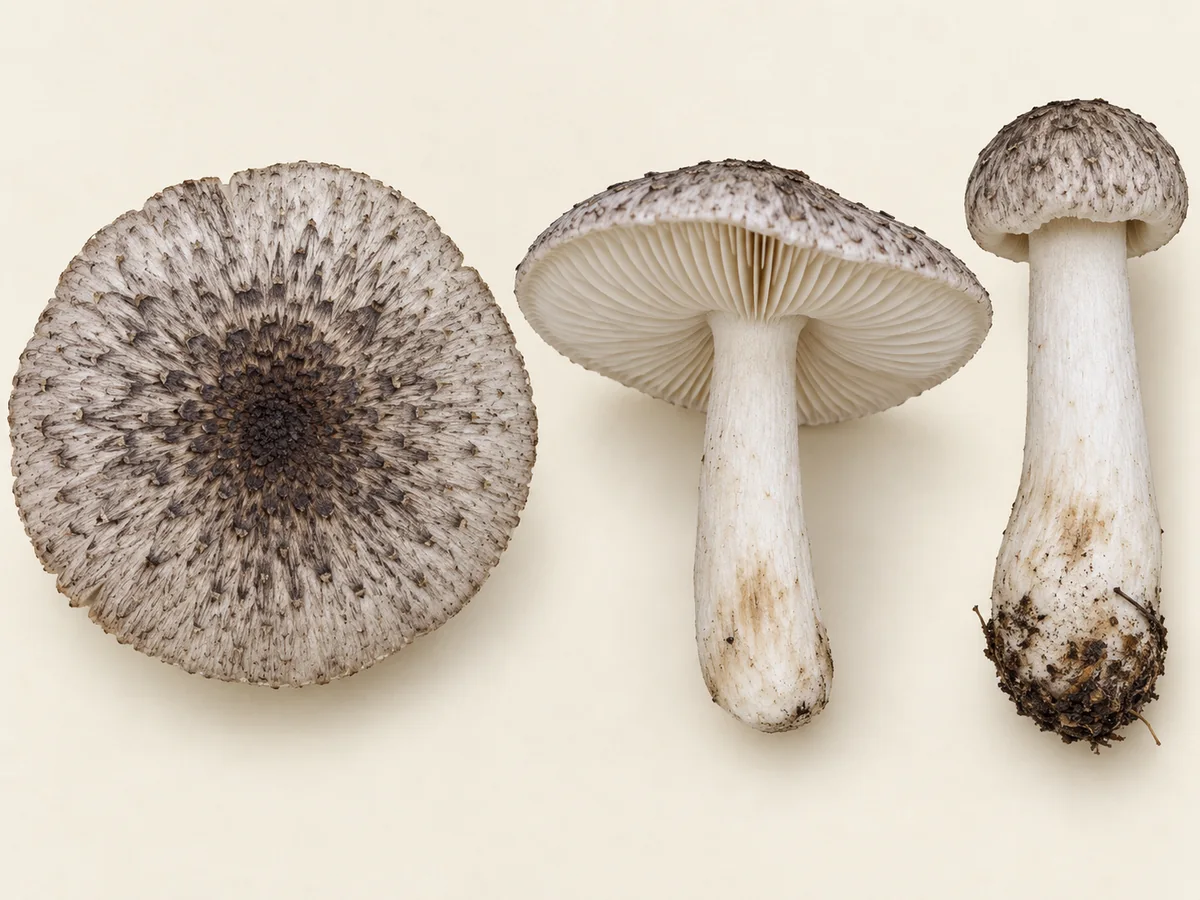
Its flesh runs thick and white to ash-gray, and field accounts say it keeps that color when cut. Those accounts describe a mealy smell and taste. Waft the smell toward you, and never taste a poisonous candidate.
The gills sit close together and look broad and white to cream. Each one runs toward the stem, then curves upward into a notched gill attachment, with short gills filling the gaps between full-length ones. Gill edges may brown with age or bruising. That browning fits the description, though pressure in a basket and decay can leave brown marks too.
Tiger knight's stem stands sturdy, solid and ringless, commonly 7-12 cm long and 1.5-3.5 cm thick. It looks white, even in width or slightly club-shaped, and may pick up brown handling marks toward the bottom. Lacking a ring describes this specimen without separating it from every gray knight. Dig out the whole base, so you can judge its shape and check whether soil hid anything more.
Your white spore print agrees with Tricholoma. It rules out rusty- or dark-spored mushrooms, yet many knights and unrelated pale-gilled mushrooms print white as well.
Under a microscope you can confirm smooth pale spores and add cap-tissue details, but you still need a current regional key to read them. Your white print and one spore measurement cannot make up for missing habitat notes, and they cannot turn a damaged specimen into a safe food identification.
Safety notes on Tiger Knight
One peer-reviewed clinical review places Tricholoma pardinum in a syndrome that commonly begins about 30 minutes to 4 hours after ingestion, sometimes as late as 6 hours. Vomiting, diarrhea and low blood pressure can follow, and nobody has yet identified the toxin responsible. Belgium's Poison Centre summary allows serious intestinal symptoms from this group to appear up to eight hours after eating. Those windows tell you to act early, yet they cannot diagnose the mushroom or predict how one person will fare.
Repeated vomiting and diarrhea can dry the body out and upset its electrolytes. The clinical review describes supportive treatment such as fluids, electrolyte replacement and anti-nausea medicine, and doctors should direct that care instead of anyone improvising it at home.
Do not wait for mushroom poisoning symptoms before seeking advice. After a possible ingestion, call a poison service immediately; in the United States, call Poison Control at 1-800-222-1222.
Call emergency services for collapse, severe weakness, trouble breathing, seizure, confusion or inability to wake the person. Keep remaining mushrooms and photographs if they are already available, but do not delay the call while trying to prove the species.
Where and when does tiger knight grow?
Tiger knight lives in a mycorrhizal partnership with living tree roots. The fungus passes water and minerals to the tree and takes back sugars the tree makes from sunlight. What you see above ground is a short-lived reproductive part. Most of the fungus spreads as mycelium around the roots and through the soil, so picking the caps leaves the partnership intact.
European accounts usually place T. pardinum under conifers. Northern and mountain reports from North America also stress conifers, while coastal California collections have come from under tanoak, madrone and live oak. That split may reflect more than a flexible fungus. The North American name may cover populations whose link to European T. pardinum, or to species such as T. venenatum and T. smithii, still carries caveats.
Most fruiting happens in fall, and some West Coast records run into winter. Our page on fall mushrooms explains how cool rain and host trees shape the season, though timing never proves the species. You may find tiger knights alone, scattered or in small groups. Sometimes they form a ring or arc along tree roots, yet that visible pattern cannot show which root tips carry the fungus.
Take one wide photo that shows the likely conifers and hardwoods, then write down the region and elevation. Close-up cap shots lose the habitat evidence you need to choose between regional gray-knight concepts.
Key takeaway
Treat host and geography as part of the specimen record. They narrow the correct key, while cap scales, gills, stem and spores carry the morphological comparison.
What should you do after a possible ingestion?
Tiger knight has no supported use in cooking. Cooking, parboiling, drying or pickling sets no safe portion, and since nobody knows the toxin, no home method has a verified target to remove. When someone mistakes it for an edible knight, everyone who shares the dish can fall ill. Keep any uncertain gray Tricholoma out of the kitchen, whatever one person tolerated or a tradition from another region suggests.
After a possible ingestion, start first aid and call for advice immediately. Tell the poison service the meal time, possible amount, number of diners, symptoms and any medical conditions the specialist asks about. Do not induce vomiting or give a home remedy unless a professional tells you to. Fluid loss may grow serious, and professionals should match any fluids or anti-nausea medicine to the person.
Save uncooked mushrooms, cooked leftovers and clear photos if you have them. Keep each specimen group separate, because a mixed meal may hold more than one species, and the most recognizable cap cannot explain it safely. The Latin name can come after the call. Medical care does not need to wait while an online forum argues over several regional gray knights.
Why does the tiger knight name change by region?
Tricholoma pardinum is a well-established European name, but using it in North America gets harder. Field accounts there describe a northern and mountain conifer partner, plus a coastal California mushroom tied to oaks and madrone that may belong to another species. In some western treatments, the similar T. venenatum looks slightly paler and less scaly. T. smithii may explain part of the mountain conifer material, and sorting all this out takes regional morphology, ecology and often DNA evidence.
We keep that doubt attached to the place. You can call a North American collection a tiger-knight candidate without pretending that DNA has confirmed the European name for every population.
None of this weakens the response to an exposure. The robust scaled gray mushroom and its close toxic lookalikes stay out of food, and nobody should hold back from calling a poison service while waiting for a final species name.


 Choice edible

 Caution
