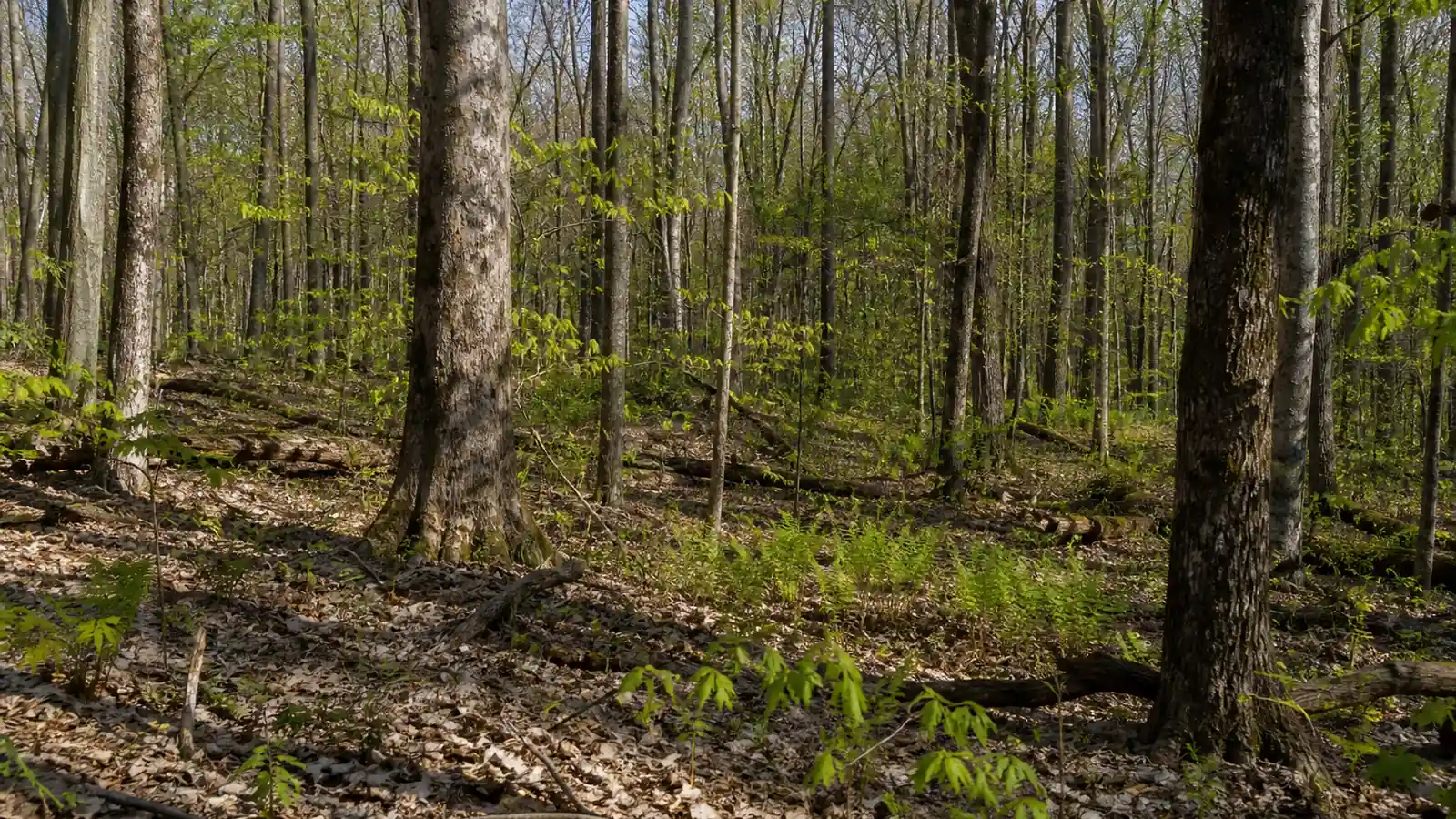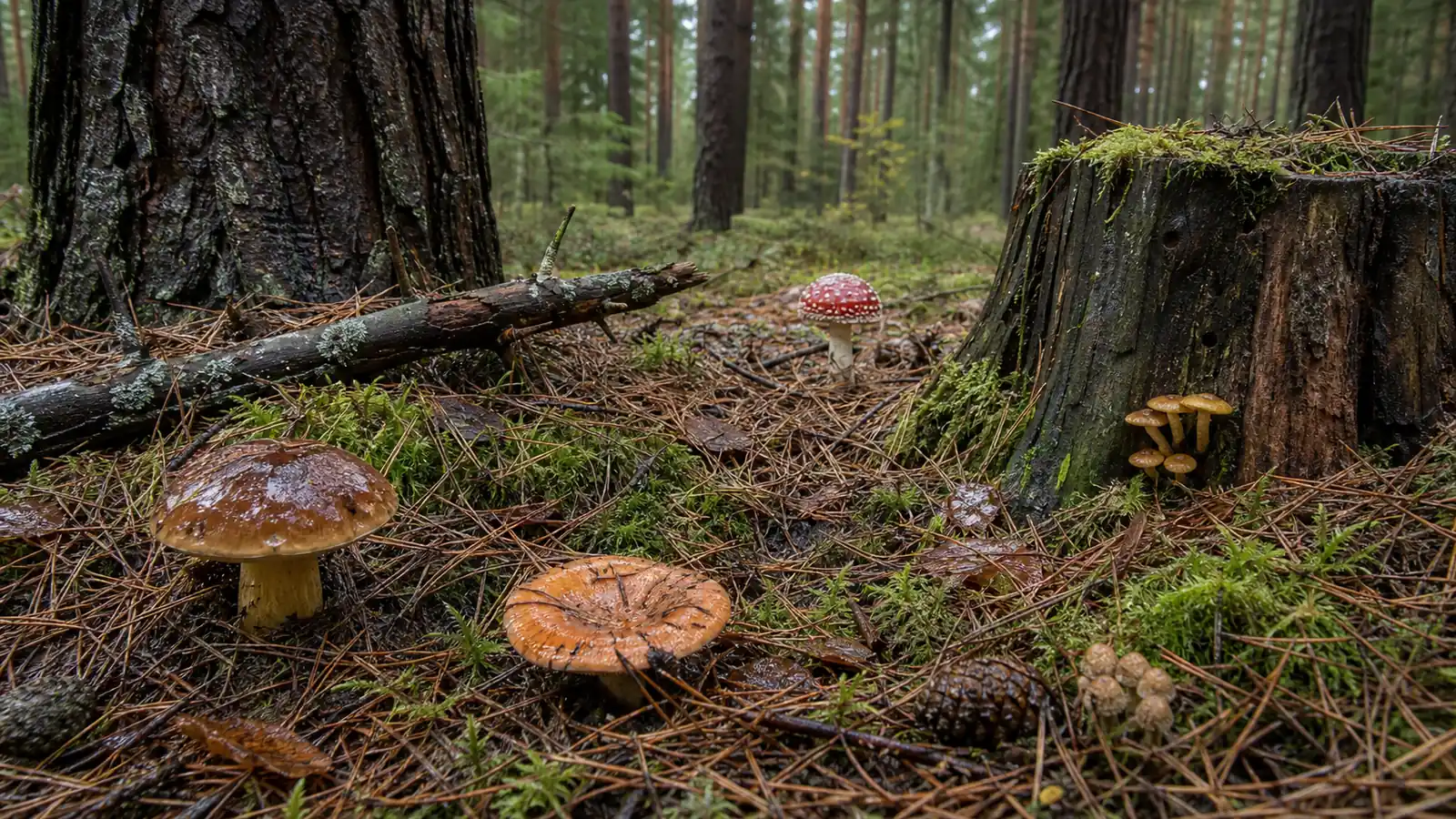
Many large mushrooms under pine are ectomycorrhizal partners of living roots, including Suillus, milk caps, brittlegills, Amanitas, and Tricholoma groups. Other fungi decompose cones, needles, stumps, logs, or buried roots.
Confirm a true pine from attached needle bundles and cones, then record the mushroom's exact substrate, underside, complete stem base, region, weather, and neighboring trees.
Mushrooms under pine trees usually fall into two ecological groups. Many are root partners fruiting from soil, while others decompose cones, needles, buried roots, stumps, or logs.
That distinction matters because under pine is not the same as growing on pine, so trace the mushroom to soil or wood before using the tree as an identification clue.
Pines host boletes, milk caps, brittlegills, Amanitas, matsutake relatives, false truffles, and many small litter fungi. The local pine species, soil, rainfall, season, and neighboring trees determine which of those groups is plausible.
Prove the Pine Association Before Naming a Mushroom
True pines carry needles in bundles of two, three, or five called fascicles, while spruce and fir needles attach singly and can support a different fungal community.
Photograph an attached bundle with its basal sheath, a cone, bark, and the whole crown. Fallen needles alone cannot prove pine because litter moves and mixed conifer roots overlap underground.
| Evidence | What it can establish | What it cannot establish |
|---|---|---|
| Attached needle bundle | A true pine and a useful species-group clue | Which root system the mushroom contacts |
| Mushroom scattered in intact soil | A possible root partner | Pine as the only nearby host |
| Cap emerging through needles | Surface cover only | Whether the fungus uses litter, soil, cone, or buried wood |
| Cluster from one woody point | Decomposition of pine wood or a buried root | Edibility or exact species |
Once the pine is confirmed, the cutaway shows why needle cover cannot distinguish living-root soil from cone material or buried wood.

Use a clean twig from the same standing tree, not a loose branch from the ground. In planted landscapes, roots from pine, oak, birch, and ornamental trees can cross beneath one apparent drip line.
ForagingMushroom foraging laws in France: what the five liter rule meansRoot Partners Explain Many Large Soil Mushrooms
Pines rely heavily on ectomycorrhizal fungi. The fungus surrounds fine root tips and extends into soil, exchanging mineral nutrients and water for sugars made by the tree.
Because a mushroom is the reproductive structure of a much larger underground organism, fruiting near the crown edge can fit the same root partnership as fruiting close to the base.
The comparison holds scale steady so pore surfaces, damaged gills, brittle tissue, veil structures, and dense white gills can carry the distinction.

Pine association can narrow a genus without closing a species. Some Suillus have strong host preferences among two-needle or five-needle pines, while other candidates occur with several conifers.
The same warning applies to matsutake. Commercial names cover more than one regional species, and white gilled mushrooms under pine include unrelated taxa, so scent and host are not sufficient clearance to eat.
Warning
Preserve every Amanita base | Do not cut a soil mushroom at ground level when an Amanita is possible. Carefully expose the entire bulb or cup, keep the specimen separate, and never eat an identification based on a cap photograph.
Read a Slippery Jack as a Pine Specialist
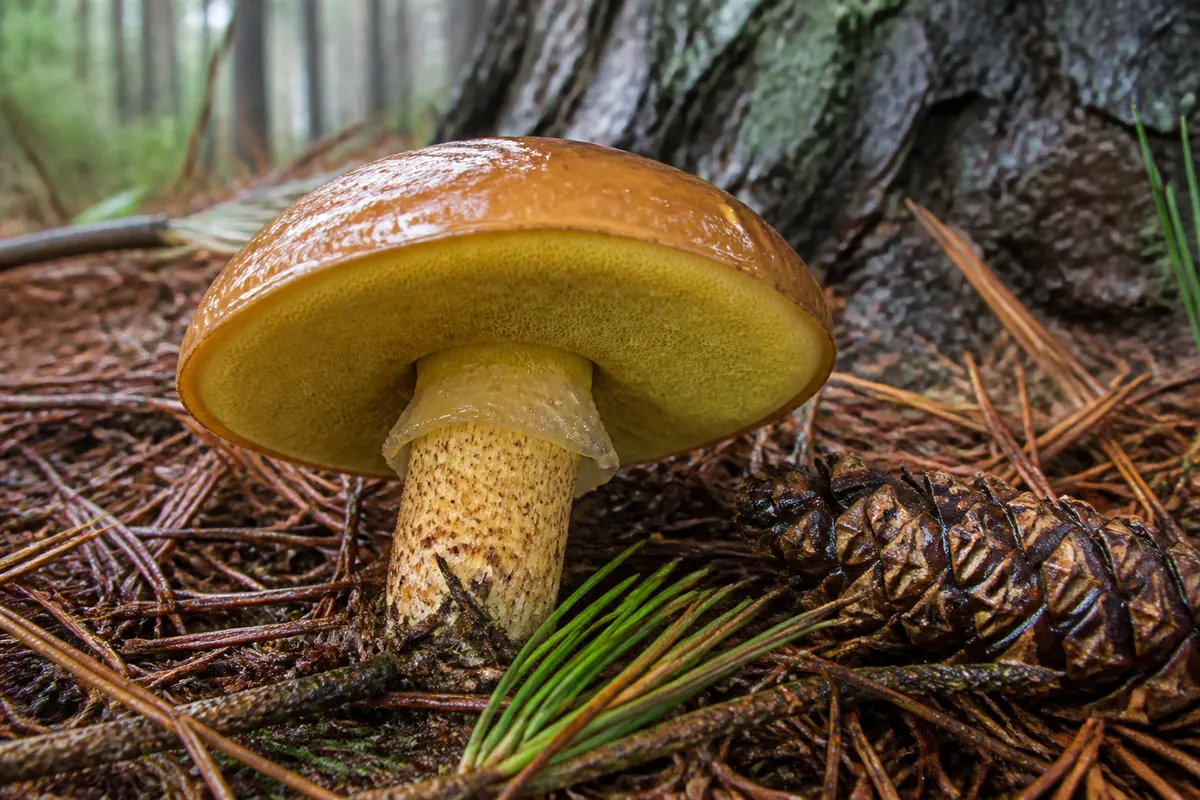
Slippery jack, Suillus luteus, is a named example of the pine relationship rather than a synonym for every slimy bolete. It commonly shows a brown to reddish-brown viscid cap, yellow pores, and a ring left by a partial veil, with glandular dots often visible on the upper stem.
Nearby Suillus species can share a sticky cap and pine habitat while differing in ring, droplets, pore pattern, staining, and host preference. A wet cap can also make unrelated mushrooms feel slippery, so pine plus slime is not a species diagnosis.
| Character | Supports Suillus luteus | Reason to keep comparing |
|---|---|---|
| Brown viscid cap | Fresh caps are smooth and sticky, then may become shiny as they dry | Rain makes many caps wet, and color shifts with age |
| Yellow pore surface | Tubes and pores replace blade-like gills | Several pine boletes have yellow pores |
| Persistent ring | A partial veil commonly leaves a membranous ring | The ring can collapse or tear, and other Suillus differ |
| Pine root zone | The species is ectomycorrhizal with Pinus | Multiple pine-associated boletes can share one stand |
The field image keeps those characters on one intact specimen, so the table remains a test rather than a collection of isolated close-ups.
Pine Cones, Needles, Stumps, and Roots Feed Decomposers
Small mushrooms in pine litter may decompose needles, cone scales, twigs, or buried bark. Their substrate can disappear beneath only a few centimeters of duff, making a soil mushroom appear root-associated.
Clusters are especially worth tracing because several stems converging on one buried point often indicate wood, while individually spaced caps can still arise from one extensive mycelium.
The four field checks turn a uniform needle layer into separate cone, litter, stump, and buried-root records.
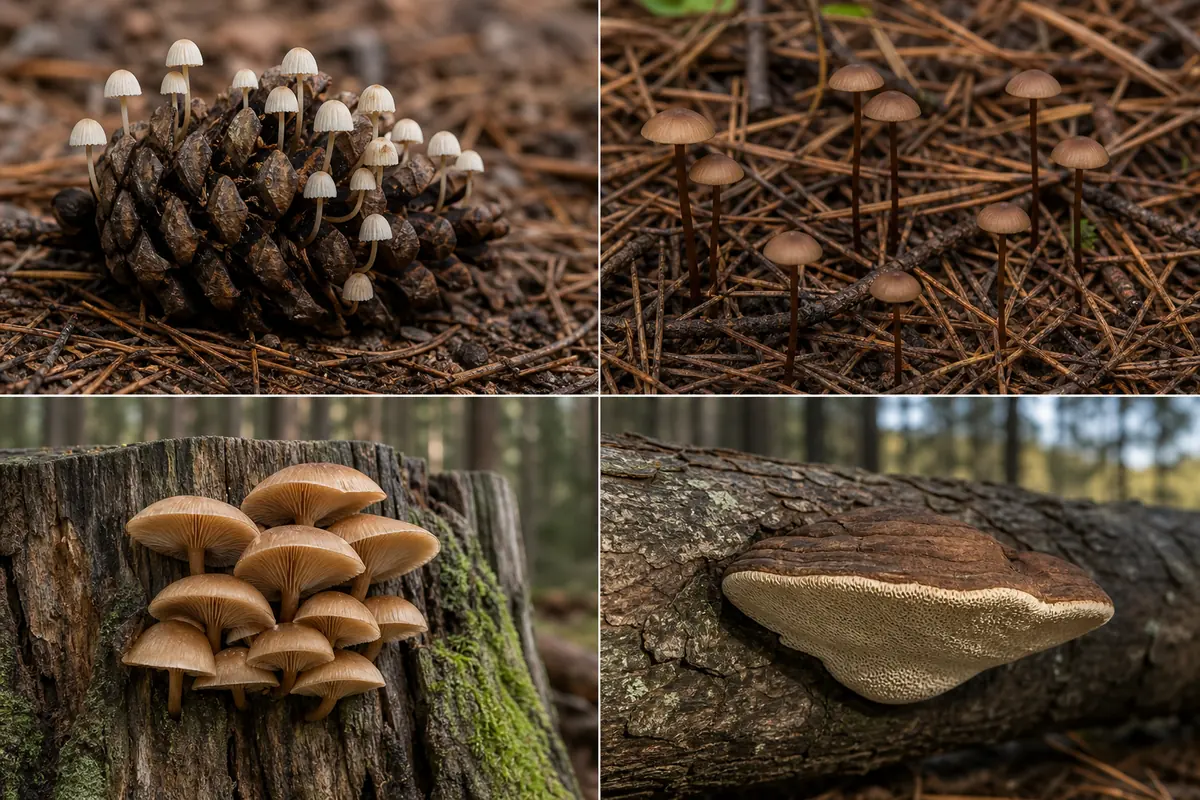
Dead pine can also carry root and butt rot fungi that fruited while the tree was alive. A mushroom at the base of a standing pine deserves both an identification record and a separate tree-condition assessment.
ForagingMushroom foraging laws in the UK: what is actually legalWeather and Soil Shift the Fruiting Window
Rain starts the search clock, but soil temperature, prior moisture, species, elevation, and the time needed for a primordium to mature mean one wet day does not guarantee mushrooms the next morning.
Sandy pine barrens drain quickly, mossy coastal forests retain moisture, and high-elevation stands cool earlier. Read the site, not a universal calendar.
The repeated viewpoint separates a new flush from the fading and structural damage that follow drying or frost.
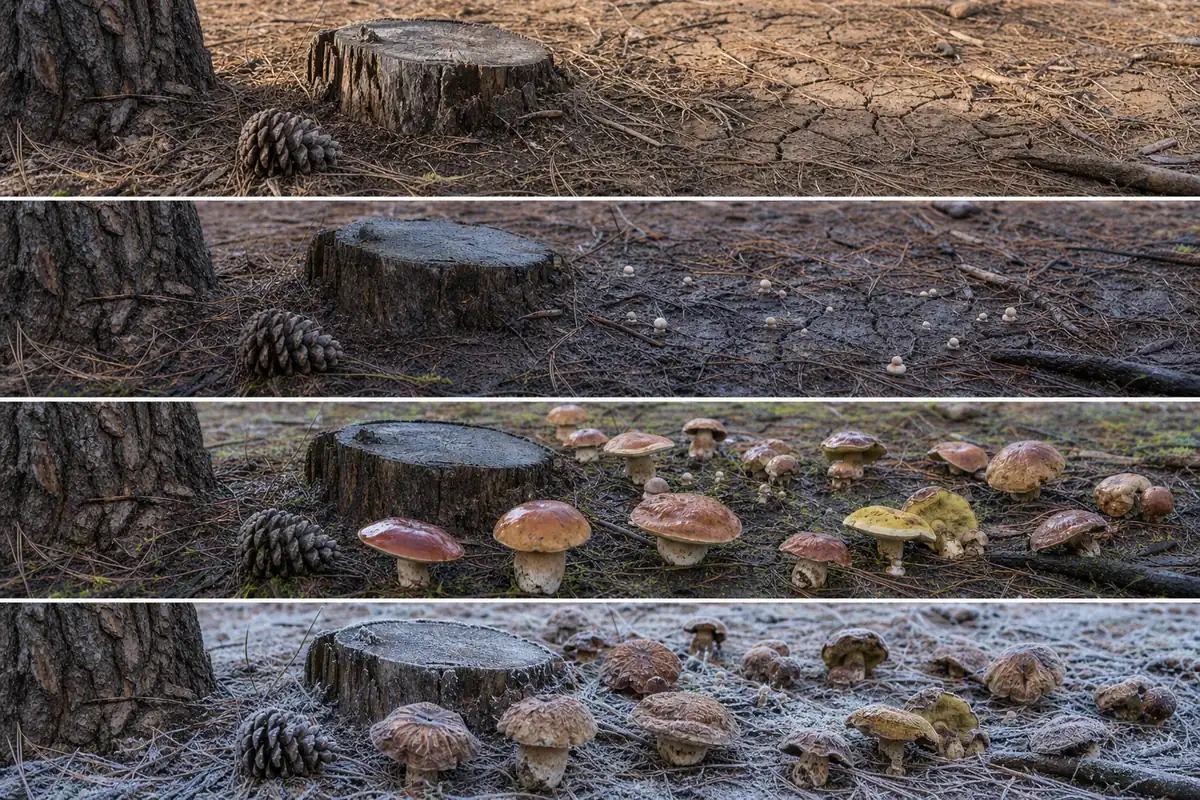
Repeated visits to one marked route provide better evidence than searching farther after every shower. Record soil moisture and fruiting dates so a local pattern can emerge across seasons.
Search Pine Duff Without Erasing the Evidence
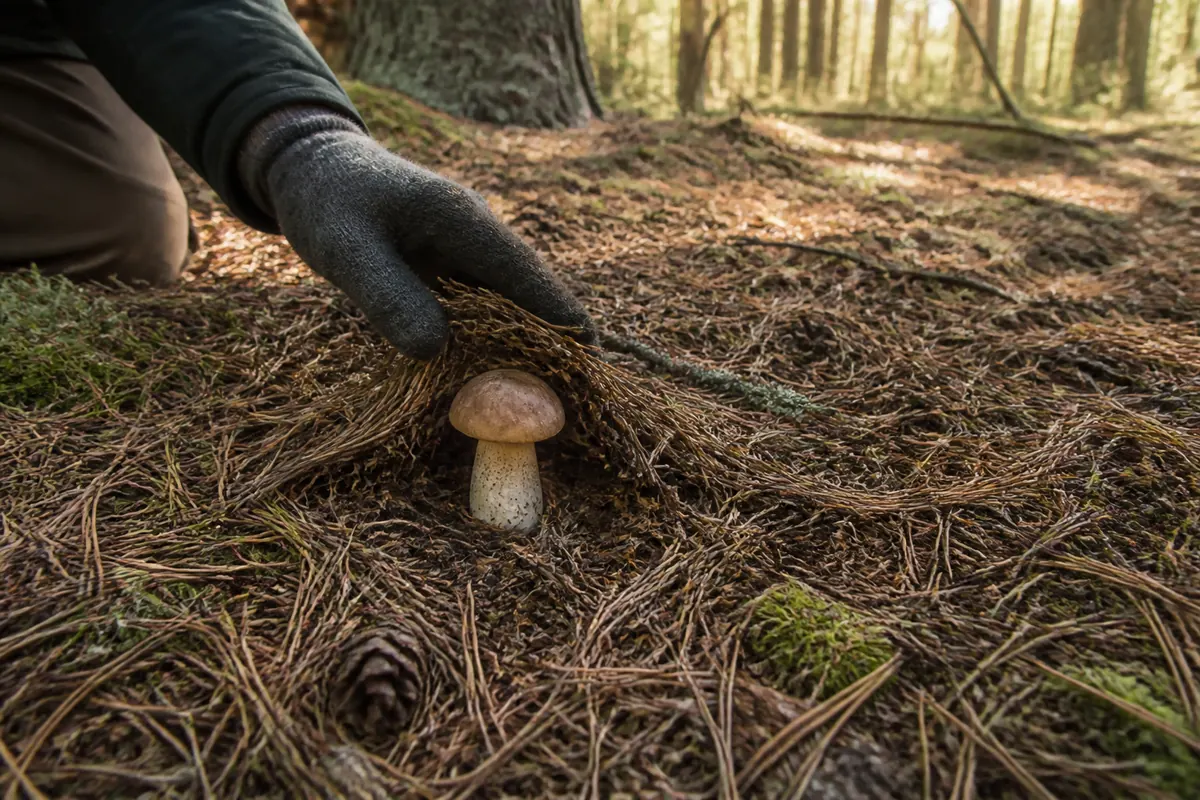
Pine needles can bridge over a young cap and leave only a small hump, crack, or patch of lifted moss. Walk slowly across the contour and change your viewing angle because low side light reveals those shapes better than a straight-down scan.
Move only the loose needles that cover the cap, then stop. Raking a wide patch breaks small fruit bodies, dries the surface, mixes substrates, and can remove the veil or stem-base evidence needed to distinguish an Amanita from a bolete or gilled mushroom.
- Check raised needles and radial cracks without sweeping the surrounding floor.
- Photograph the undisturbed hump before exposing the cap.
- Lift loose duff with a twig or gloved fingers until the underside and complete base can be recorded.
- Trace any cluster only far enough to reveal cone, root, or buried wood attachment.
- Replace the needles after the record so the soil surface retains shade and moisture.
Turn the Pine Clue Into a Complete Identification
Begin with an in-place photograph wide enough to include the pine and every other possible host. Then record the mushroom before handling changes its surface.
- Show whether the fruit body rises from mineral soil, moss, litter, cone, buried wood, stump, root, or log.
- Photograph cap, underside, stem, complete base, veil remnants, cluster arrangement, and a scale.
- Note odor without inhaling closely, bruising, latex, pore changes, flesh changes, and spore deposit when a key requires it.
- Record pine needle bundle count, cones, region, elevation, slope, recent weather, and neighboring trees.
- Keep different-looking specimens in separate paper packets so characters and spore deposits do not mix.
A spore print can support a group comparison, but it cannot rescue missing field context. White prints occur across Amanitas, Tricholoma, and other unrelated gilled mushrooms.
Do not taste an unknown mushroom or use animal feeding, cooking, peeling, or a phone app as a safety test. Host evidence reduces possibilities, but it never replaces species-level identification and species-specific edibility guidance.
Sources & References
- USDA Forest Service Pine mycorrhizal fungi and mechanisms.
- USDA Forest Service Forest mushroom ecology and habitat.
- University of Wisconsin Botany Matsutake identification limits.
- North Carolina State Extension Pine tree characters.