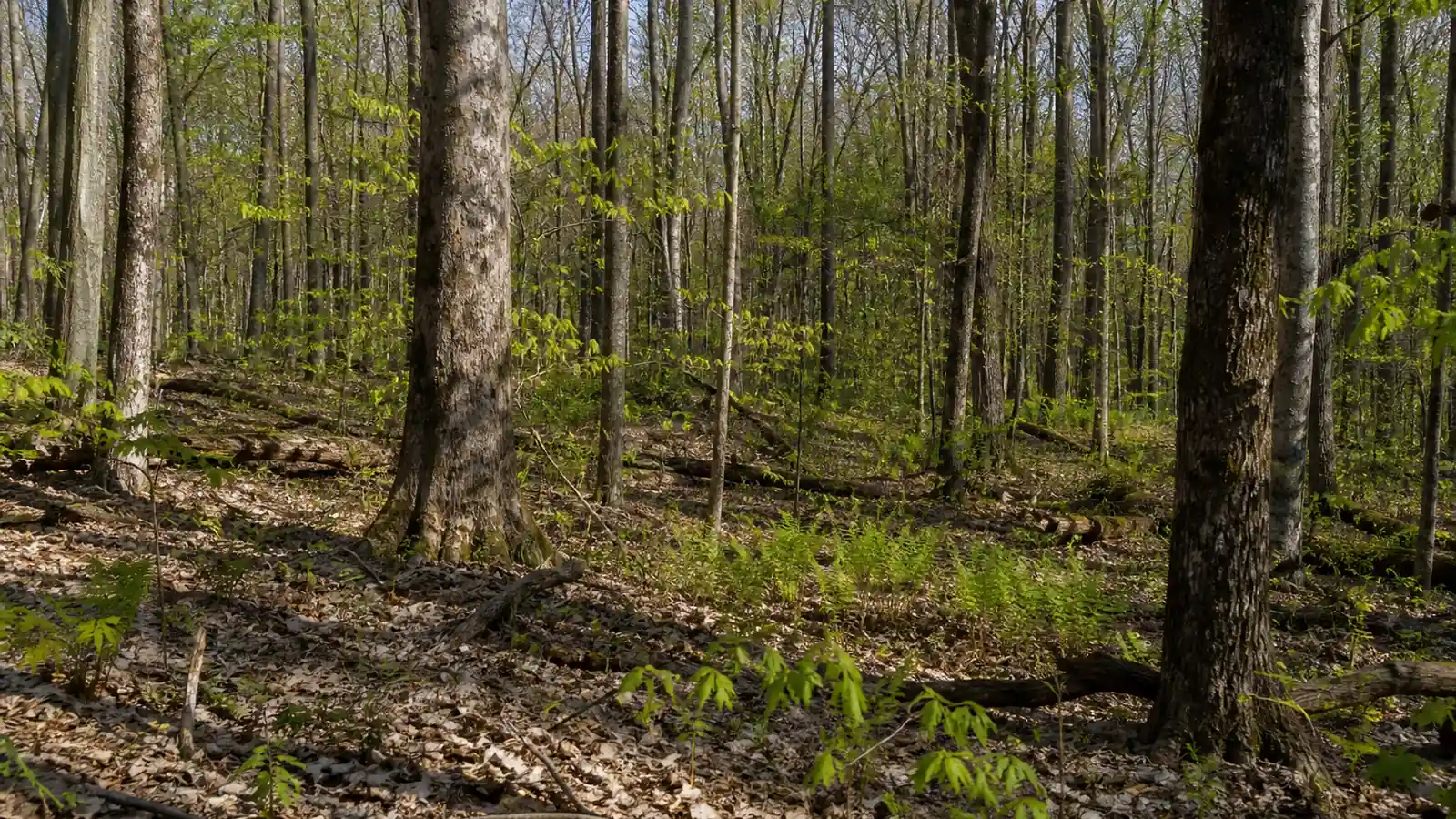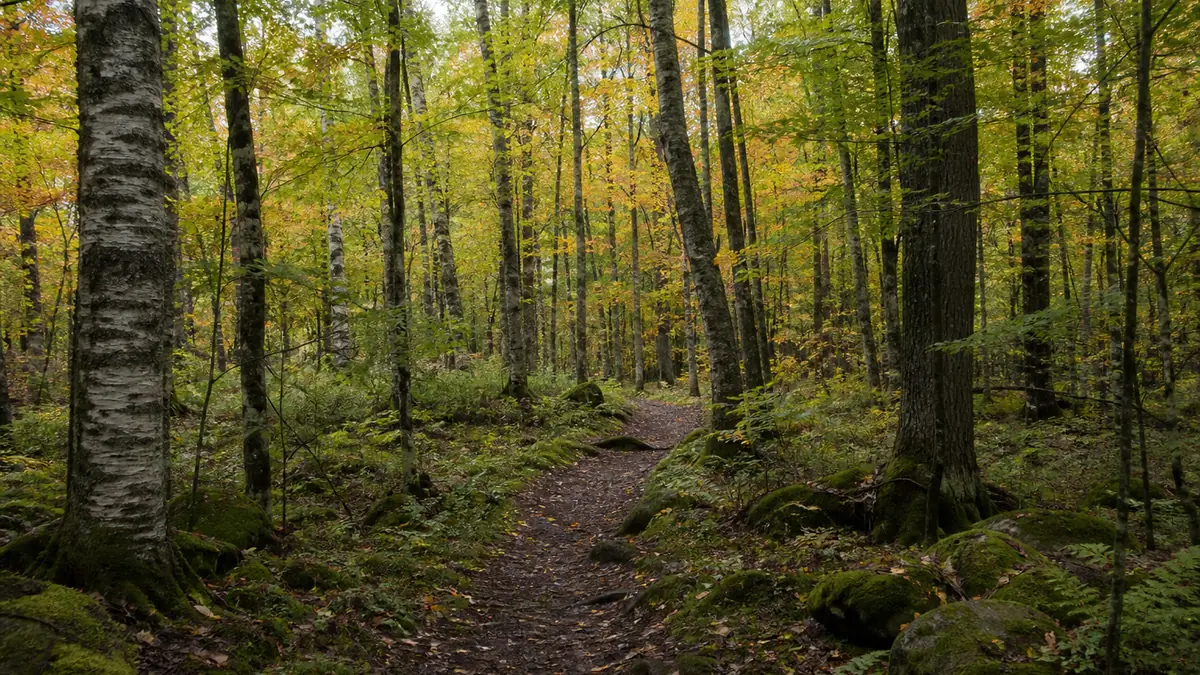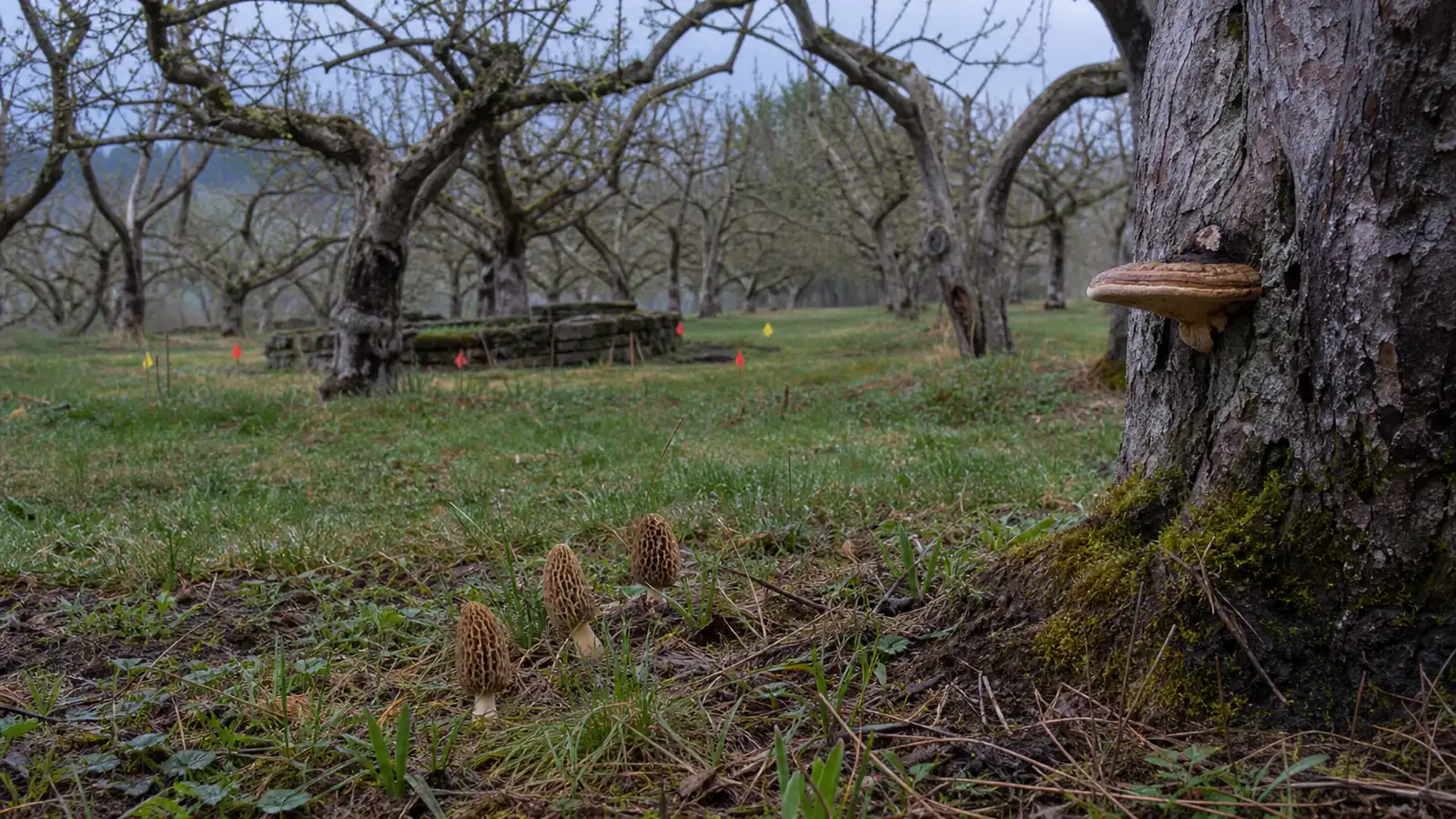
Old apple trees can mark morel habitat and support wood decomposers, but historic orchards may retain lead and arsenic from past pesticides. Mushroom identity and land-use safety require separate evidence.
Research orchard history, confirm legal access, identify the complete specimen, and obtain appropriate site guidance before considering any food collection.
Mushrooms around apple trees can indicate decomposing orchard wood, buried roots, a living tree with internal decay, or a seasonal soil fungus using another nearby host. Old orchards add a separate question that must be answered before food collection: what was applied to that ground?
Morels are often reported from aging or abandoned apple orchards, but an apple tree is a habitat clue, not a morel identification and not proof that the site is clean. Confirm the fungus, the exact substrate, and the land-use history as three independent decisions.
Start With Orchard History, Not the Mushroom Basket
Lead-arsenate pesticides were used in many apple and pear orchards from the late nineteenth century until just before 1950. Lead and arsenic can remain in soil long after the original trees, sprayers, and packing sheds disappear.
An old apple row, scattered large trunks, a former farm name, or historic aerial imagery can reveal previous orchard use. None measures contamination, and a clean-looking site can still carry residues.
| Site question | Evidence worth finding | What it decides |
|---|---|---|
| Was this land an orchard before 1950? | Historic aerials, plat maps, farm records, extension archives, and owner history | Whether legacy lead-arsenate use is plausible |
| Where were chemicals mixed or stored? | Shed pads, loading areas, dumps, and former tank locations | Where exposure may differ from the tree rows |
| Has the soil been tested? | Laboratory report with sampling locations and methods | Whether local authorities can interpret measured lead and arsenic |
| Is collecting legal? | Written landowner or agency rules | Whether observation may proceed to harvest |
The site map connects each historical clue to a place that can be sampled or excluded.
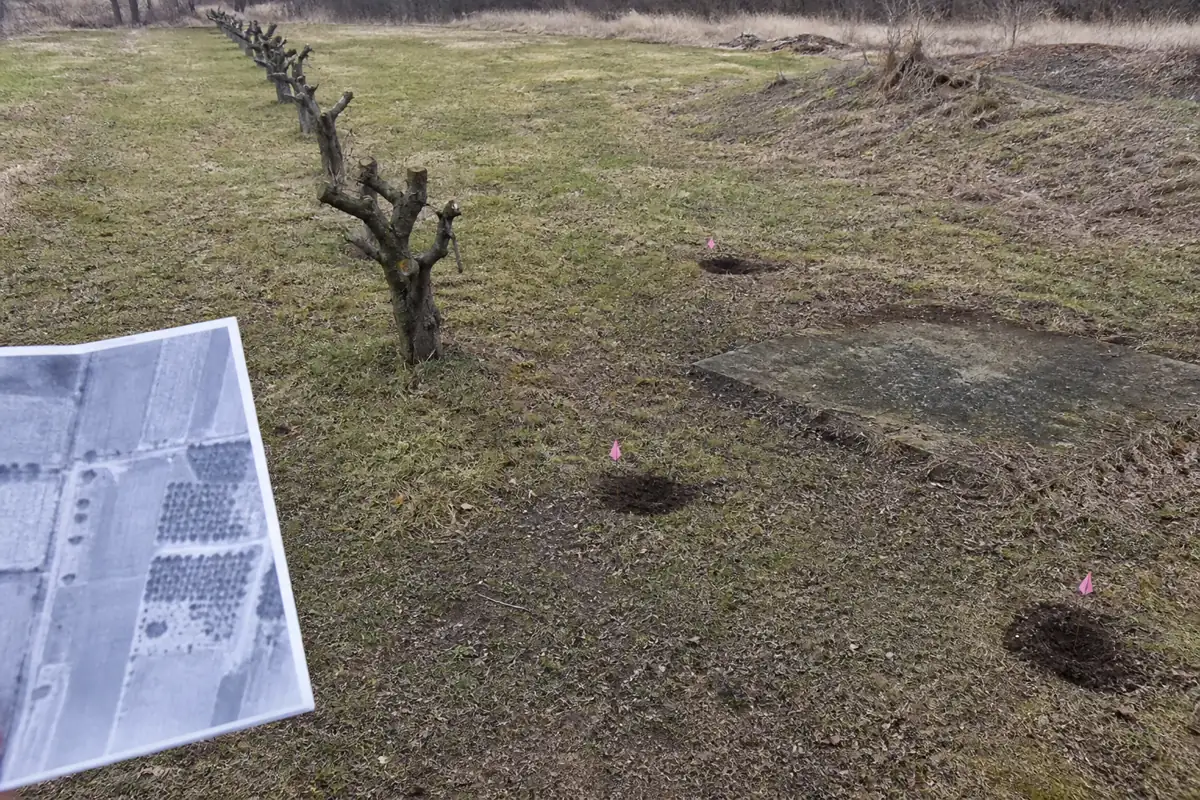
Washington State, for example, requires mitigation for certain former-orchard development soils above 20 ppm arsenic or 250 ppm lead. Those are state cleanup thresholds for that program, not mushroom edibility limits and not a substitute for local public-health advice.
Lead and arsenic do not announce themselves through mushroom color, shape, odor, or insect damage. Washing soil from a cap may remove dirt, but it cannot answer whether a fruit body accumulated a contaminant while it developed.
Ask who owns the land before requesting tests. A residential yard, public park, working orchard, and abandoned commercial block can fall under different agencies, sampling programs, and collection rules.
When a laboratory result exists, keep its sample depth and exact location with the number. A sample from a former shed pad cannot describe every tree row, and a composite sample may hide a small hotspot.
Warning
Unknown old orchard means no food collection | If the land history or soil condition cannot be resolved, photograph mushrooms and leave them. Contact the relevant environmental or public-health agency for site-specific interpretation rather than inventing a safe distance from one tree.
Morels Near Apple Need Complete Identification
Morels can fruit in some old orchards, especially around declining trees and disturbed ground, but the association is variable. Soil temperature, moisture, region, orchard age, groundcover, competing vegetation, and recent disturbance all change the result.
A true morel has a cap deeply pitted into ridges and hollows, with the cap attached to the stem and the fruit body hollow from top to bottom when cut lengthwise. Similar false-morel forms can have lobed, wrinkled, chambered, or cottony interiors.
The cut specimens make the interior test visible without turning orchard habitat into proof.
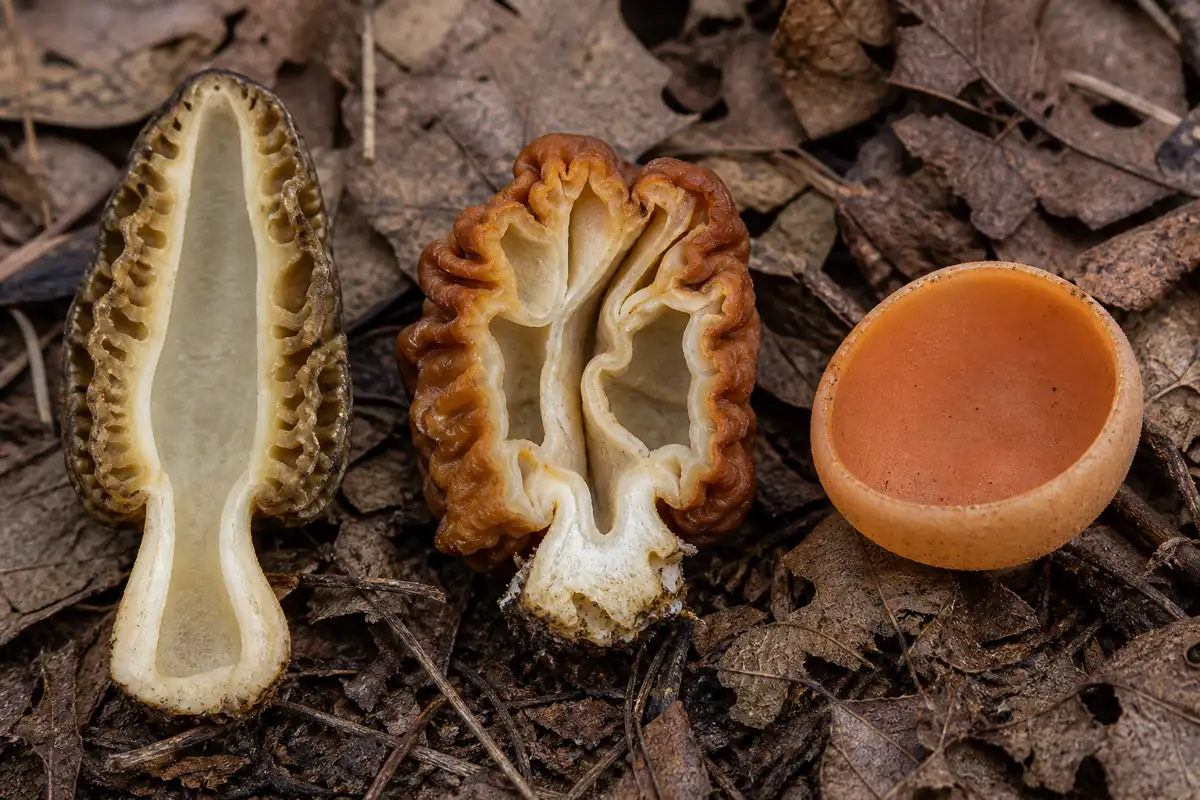
An apple tree can help you choose where to look, particularly around old drip lines, moss edges, thin grass, and disturbed soil. It cannot clear a specimen for eating.
Cut only one representative fruit body when local rules allow. The lengthwise cut should show the cap attachment, the interior from tip to stem base, and any cottony material or chambers before the specimen dries.
A darkened, waterlogged, frost-damaged, or insect-tunneled morel can lose useful characters. In that condition, a confident name from habitat and a single exterior photograph is a poor trade for the consequences of a mistake.
Note
Keep the two tests separate | First identify the mushroom. Then decide whether the collection site is suitable for food. A perfect morel identification does not erase contaminated soil or illegal access.
Apple Wood Supports Decomposers and Tree-Decay Fungi
Pruning wounds, cavities, dead limbs, stumps, and fallen orchard wood create several fungal entry points. Brackets on a living trunk may reveal internal decay, while clustered gilled mushrooms can arise from buried roots after a tree was removed.
The whole-tree view preserves fruiting position before a close-up removes that context.
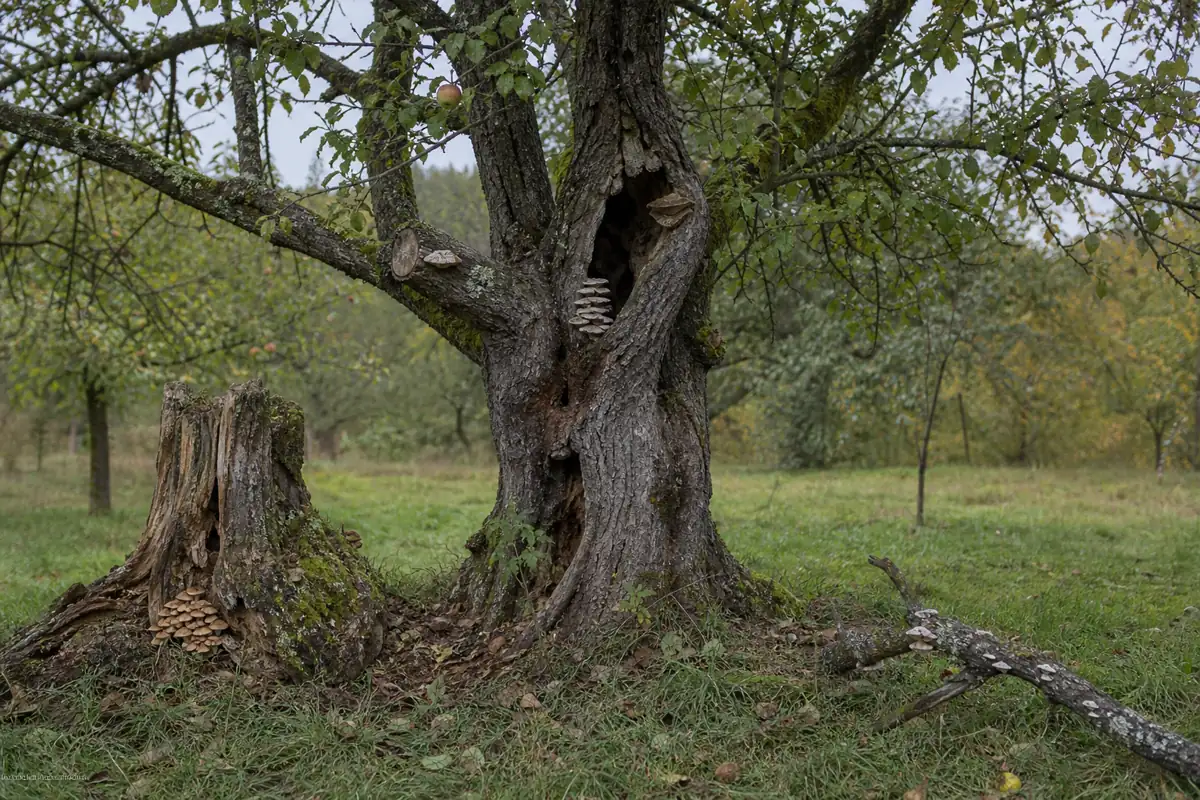
Hard shelves with pores, pale gilled fans, thin zoned brackets, and honey-colored clusters represent different groups. A common name based on color alone hides the anatomy needed for identification.
Fresh mushrooms at a pruning cut often appear long after the original injury. The visible shelf is a reproductive structure, while fungal tissue may already occupy a much larger volume of wood.
Branch position changes the practical response. A small decomposer on a fallen twig is primarily an identification question, while a conk at the base of a living tree beside a house is also a structural-risk question.
Do not seal a conk with paint, burn it off, or pour fungicide into the cavity. Those actions do not restore digested wood, and a cosmetic change can make later inspection harder.
Distinguish Mushroom Fruit Bodies From Apple Diseases
Apple scab, cankers, fire-blight strikes, burr knots, lichens, and decayed pruning stubs can all be mistaken for “fungus†in a general sense. Most do not form a collectible cap-and-stem mushroom.
A canker is an area of dead or sunken bark continuous with the branch. A lichen is a thin or leafy organism on the bark surface.
A mushroom fruit body projects from soil or wood and carries a fertile surface such as gills or pores.
| Observed form | Inspect next | Appropriate decision |
|---|---|---|
| Sunken or cracked bark lesion | Lesion margin, branch dieback, pruning wound, and regional disease guide | Diagnose tree disease, not a mushroom species |
| Gray-green crust or leafy patch | Surface texture and whether bark beneath remains intact | Record a lichen rather than scrape it off |
| Projecting shelf | Underside pores, attachment, age, and internal tree symptoms | Identify the fungus and assess tree risk separately |
| Cluster at ground level | Shared base, buried wood, complete stems, and spore deposit | Determine wood attachment before calling it terrestrial |
The comparison makes each visible form lead to a different next inspection.
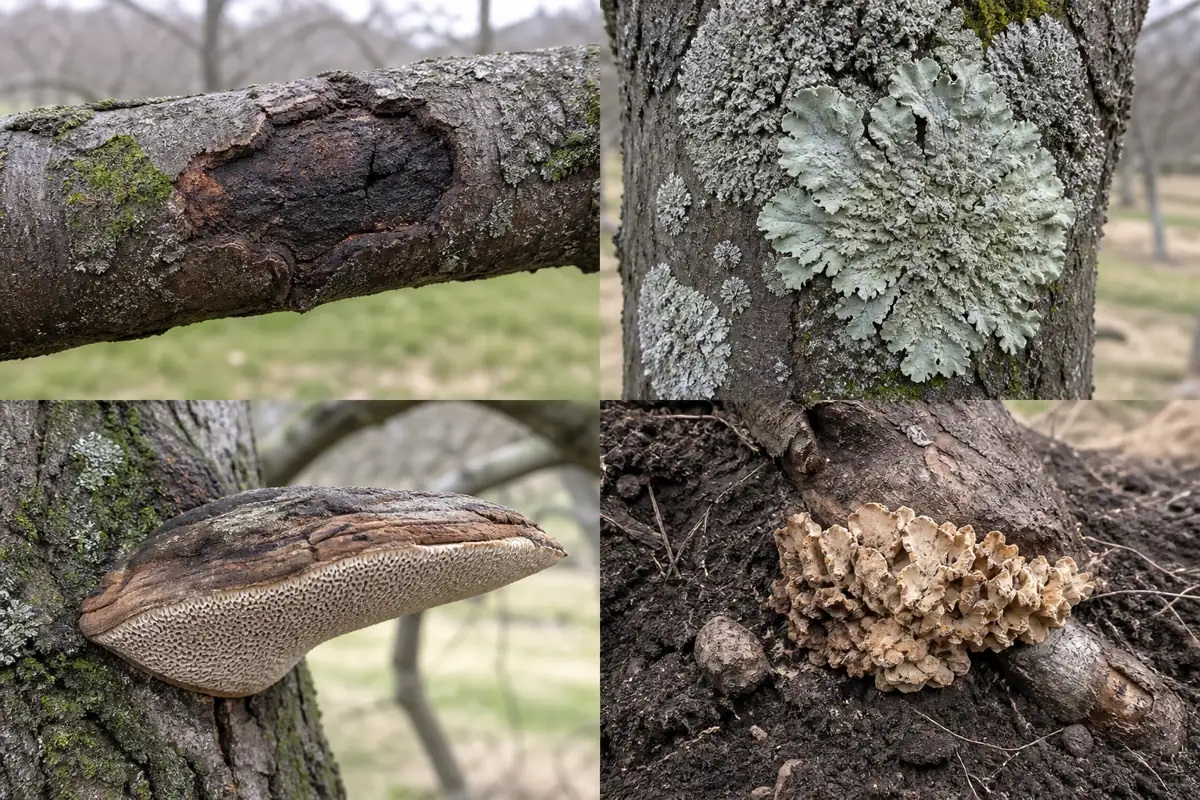
Removing a fruit body does not remove mycelium established inside wood. If a shelf returns on a tree over a driveway, play area, building, or livestock pen, a qualified arborist should assess the whole tree.
ForagingMushroom foraging laws in Germany: protected species and small quantitiesWhich Mushrooms Are Plausible Around Apple Trees?
An orchard produces several substrates at once, so a useful candidate list starts with position rather than edibility. Soil morels, gilled mushrooms on buried roots, leathery brackets on dead branches, and large shelves on living wood require different evidence.
These profiles are hypotheses, not a menu. Several toxic mushrooms can share brown caps, white gills, clustered growth, or an orchard setting.
Photograph the attachment point before comparing candidate species. Without it, six named possibilities merely replace one unsupported guess with six unsupported guesses.
Season Changes What the Orchard Shows
Morels belong to a spring search in many temperate regions, but calendar dates shift with latitude, elevation, soil warming, and the year's weather. A south-facing open row can finish while a shaded swale is only beginning.
Wood fungi follow a different clock. Perennial conks remain visible through winter, annual brackets often appear after warm wet periods, and buried-root clusters may erupt after rain when the tree that fed them has been gone for years.
| Orchard signal | What may be visible | Best follow-up |
|---|---|---|
| Swelling apple buds and warming soil | Early spring cups and the first morels in suitable regions | Check soil structure and specimen interiors, then revisit cool edges |
| Full leaf and drying grass | Fewer exposed soil fungi, persistent conks, shaded deadwood fruiting | Search wound sites, fallen limbs, moss, and north-facing litter |
| Late-summer rain after heat | Fresh annual brackets, oysters, and root-connected clusters | Photograph rapidly before insects and heat change the surfaces |
| Leaf fall and cool wet weather | Deadwood fungi become easier to see; buried wood remains active | Map attachments before leaves cover bases and small logs |
| Winter dormancy | Old conks, cavities, pruning wounds, and tree architecture stand out | Record tree condition; do not identify a fresh species from a weathered remnant |
The useful revisit is tied to a change in substrate moisture or fruit-body condition. A generic promise about a fixed number of days after rain ignores shade, soil, wind, and wood moisture.
Separate the Food Decision From the Tree Decision
A correctly identified edible mushroom can grow from a tree that is structurally compromised. Harvesting the shelf does not repair the tree, and leaving it in place does not tell you whether the branch will hold.
- Food question
- Has the exact mushroom been identified, is the specimen fresh, is collection legal, and is the site suitable for food?
- Tree question
- Is the fungus attached to living wood, where is the decay, what targets are beneath it, and who can inspect the remaining structure?
Photograph the whole crown before approaching a suspect tree. Hanging limbs, split unions, cavities, recent root movement, or a heavy lean can make the best close-up angle an unsafe one.
If a conk is above a roof, path, parking space, play area, or livestock enclosure, keep people out of the likely fall zone and contact a qualified arborist. The species name can inform an inspection, but it cannot replace measurements of the tree.
ForagingMushroom foraging laws in the UK: what is actually legalDo Not Manufacture an Edibility Answer
Apple wood does not make an unknown mushroom safe. Neither do deer bites, insect holes, a pleasant smell, white flesh, cooking, peeling, soaking, or a phone app result.
Wild mushroom identification has to reconcile the cap, fertile surface, stem, base, interior, spore deposit, substrate, growth pattern, maturity, and region. If important characters disagree, the correct result is unresolved.
Use the beginner identification workflow to organize the evidence, then consult a knowledgeable local identifier for any food decision. The foraging safety rules still apply after a likely name is found.
Warning
Symptoms after eating require prompt help | If anyone becomes ill after eating a wild mushroom, contact emergency services or a poison center now. Keep uncooked material, cooked leftovers, photographs, and the time eaten for medical identification.
Search an Old Orchard Without Flattening Its Evidence
Walk the row before searching individual trunks. Note slope, drainage, former shed sites, stump lines, mixed trees, dumped wood, irrigation channels, and recent mowing.
Spring mushrooms dry quickly in open grass but persist under leaf litter, moss, low branches, and north-facing banks. Search these transitions with your eyes and a low viewing angle rather than raking.
The route image shows how those actions connect across one orchard rather than five isolated stops.
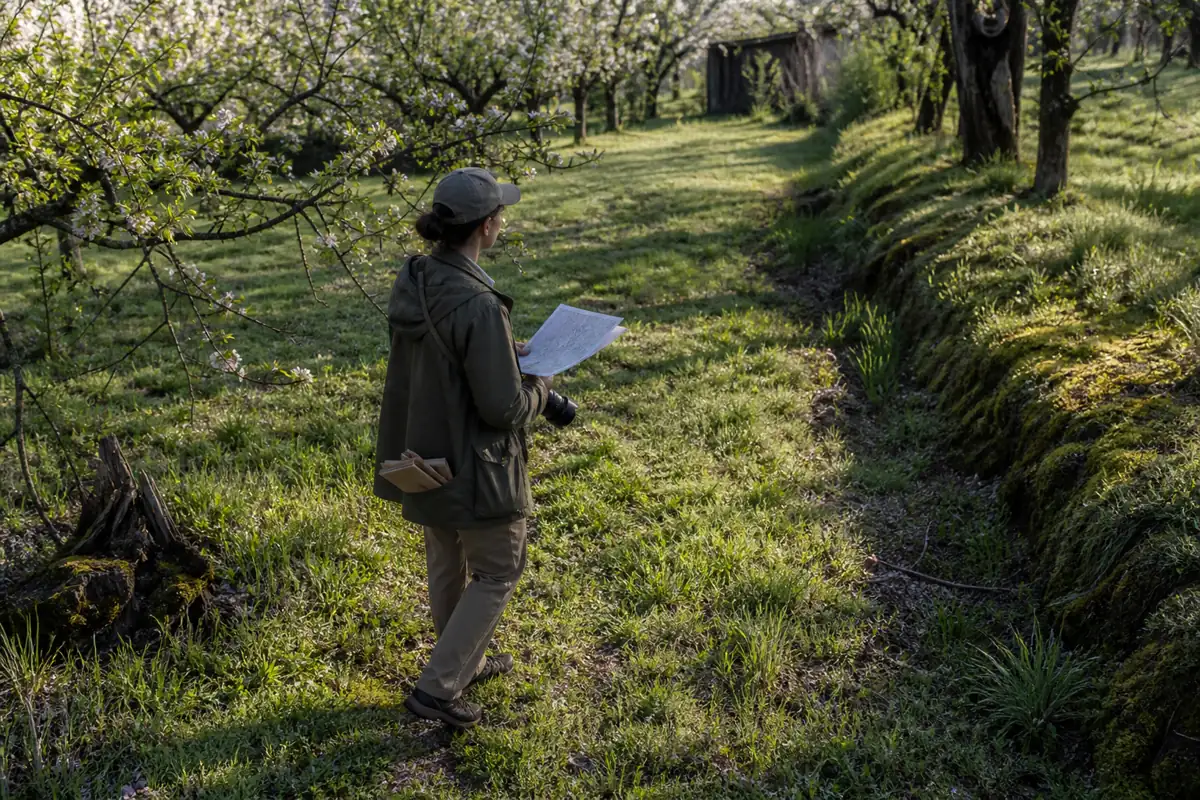
Repeat the same route from the same direction. Comparable photographs reveal whether fruiting moved from open soil to a shaded edge, whether a cluster expanded along a buried root, and whether a conk returned at the same wound.
Do not rake leaf litter or overturn every log. A slow low-angle scan finds more intact specimens and preserves the moisture layer that supports later fruiting.
Build a Record That Survives Review
A useful apple-orchard record connects three scales. The landscape photographs establish land use, the tree photographs establish host and condition, and specimen images establish fungal anatomy.
- Record the property or agency rule and avoid publishing precise locations for vulnerable private sites.
- Photograph tree crown, bark, attached leaves or fruit, trunk base, wounds, and neighboring species.
- Show exact substrate, cap, underside, complete stem, interior, bruising, and a ruler.
- Note recent rain, soil moisture, temperature trend, mowing, disturbance, and orchard management history.
- Cite the laboratory or agency interpretation used for any contamination decision.
This specimen record can include a spore print after the field observations are preserved. It cannot distinguish clean from contaminated ground.
The best outcome is sometimes a documented observation with no harvest. That choice preserves the fungus, avoids an unresolved exposure, and leaves a field record that can still teach you which orchard conditions produced fruiting.
Sources & References
- Washington State Department of Ecology Former orchard lead-arsenate history and sampling.
- USDA Forest Service Morel ecology and habitat limits.
- Penn State Extension Wood-decay fungi and tree condition.