A mushroom or conk on a living trunk may reveal internal wood decay, but it cannot show the amount of sound wood left. Record its exact location and form, check the whole tree and its targets, and arrange a qualified assessment when defects could harm people or property.
Mushrooms growing on a tree trunk are fungal fruiting bodies, and a true conk or bracket may be evidence of decay inside the tree. It does not show how much sound wood remains or predict when a branch or trunk will fail.
First confirm that the growth projects from the wood rather than merely coating the bark. Then record its exact height and attachment, the tree species, the underside of the fruiting body, nearby defects, and anything the tree could strike.
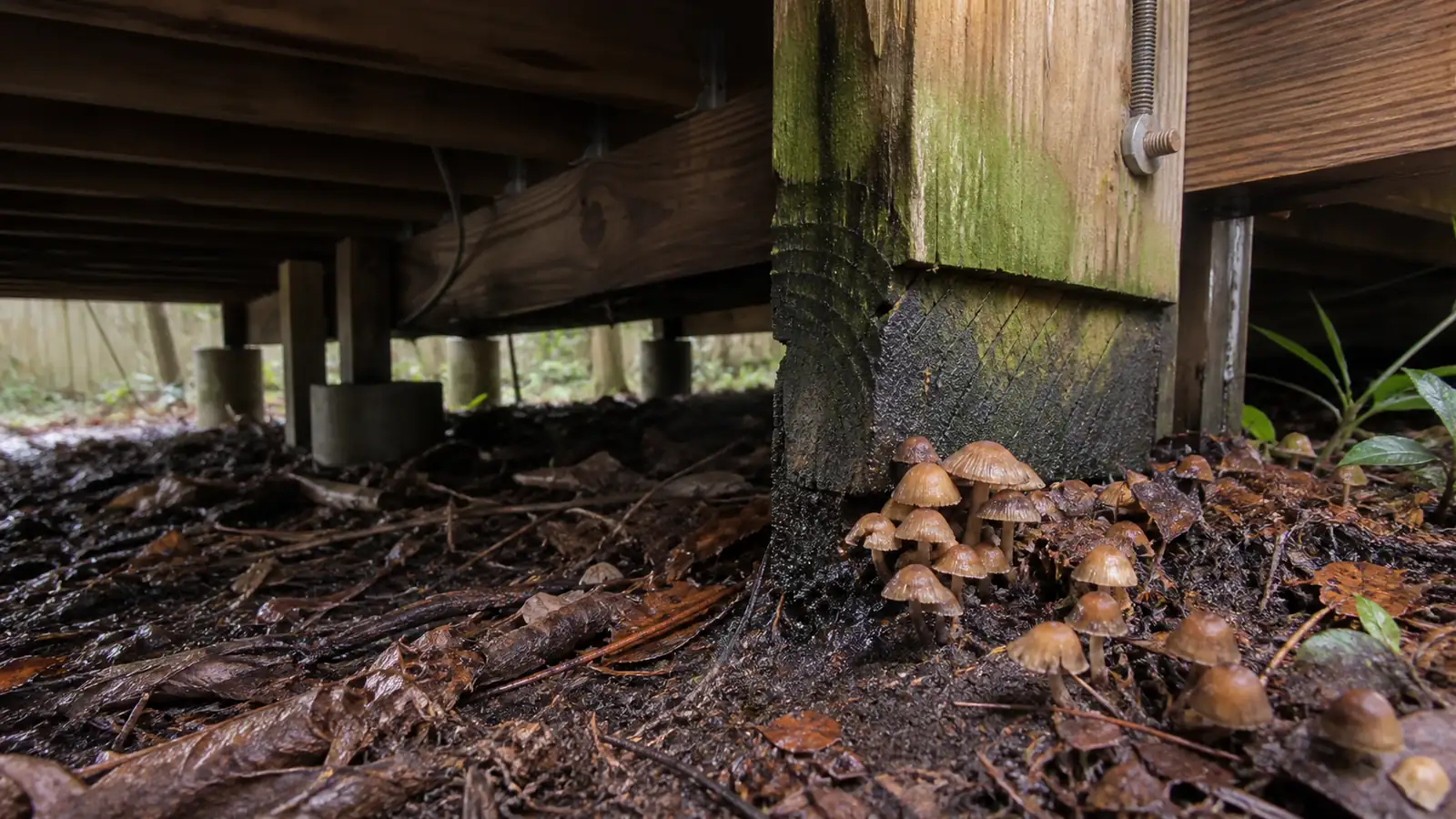
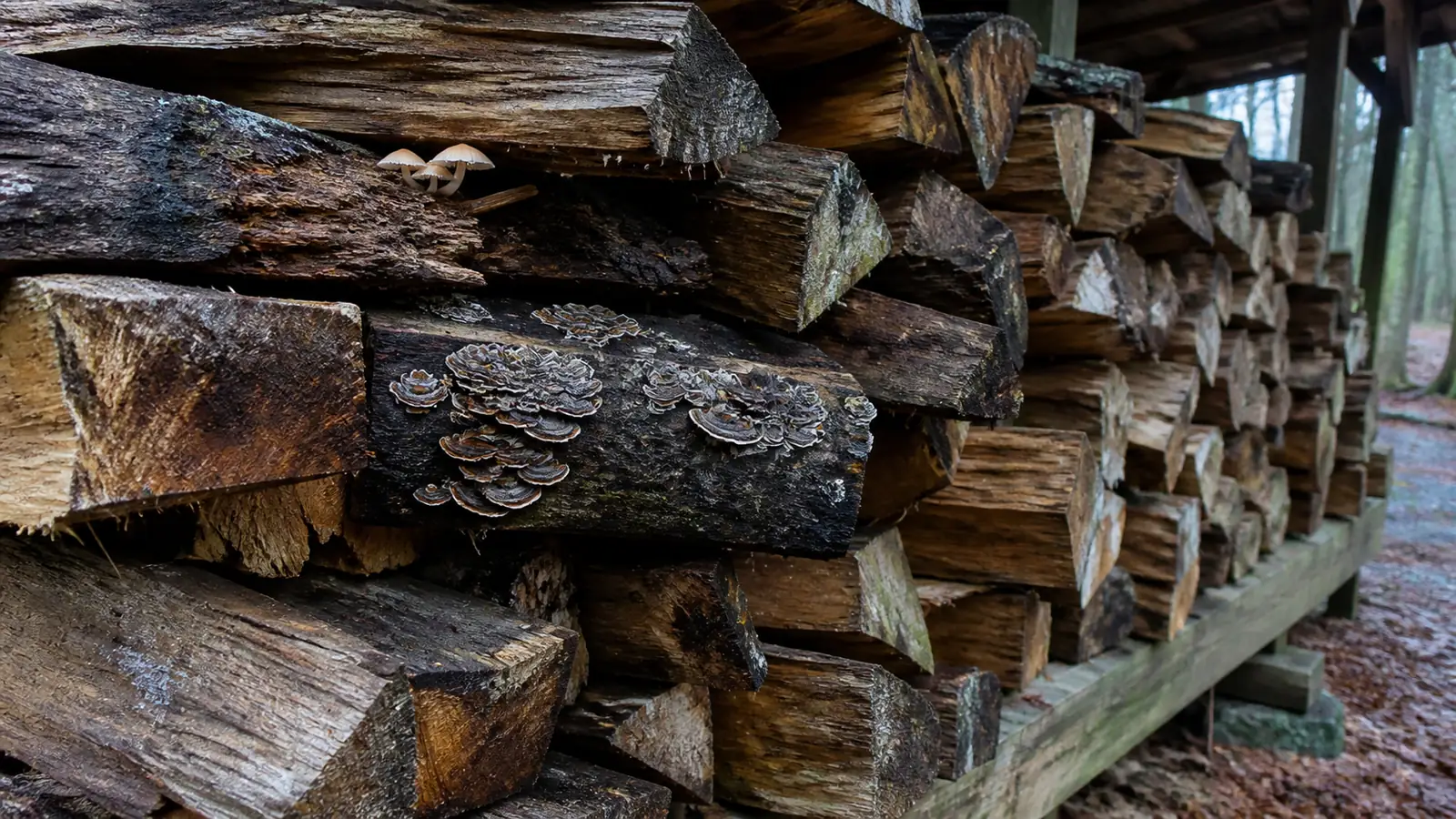
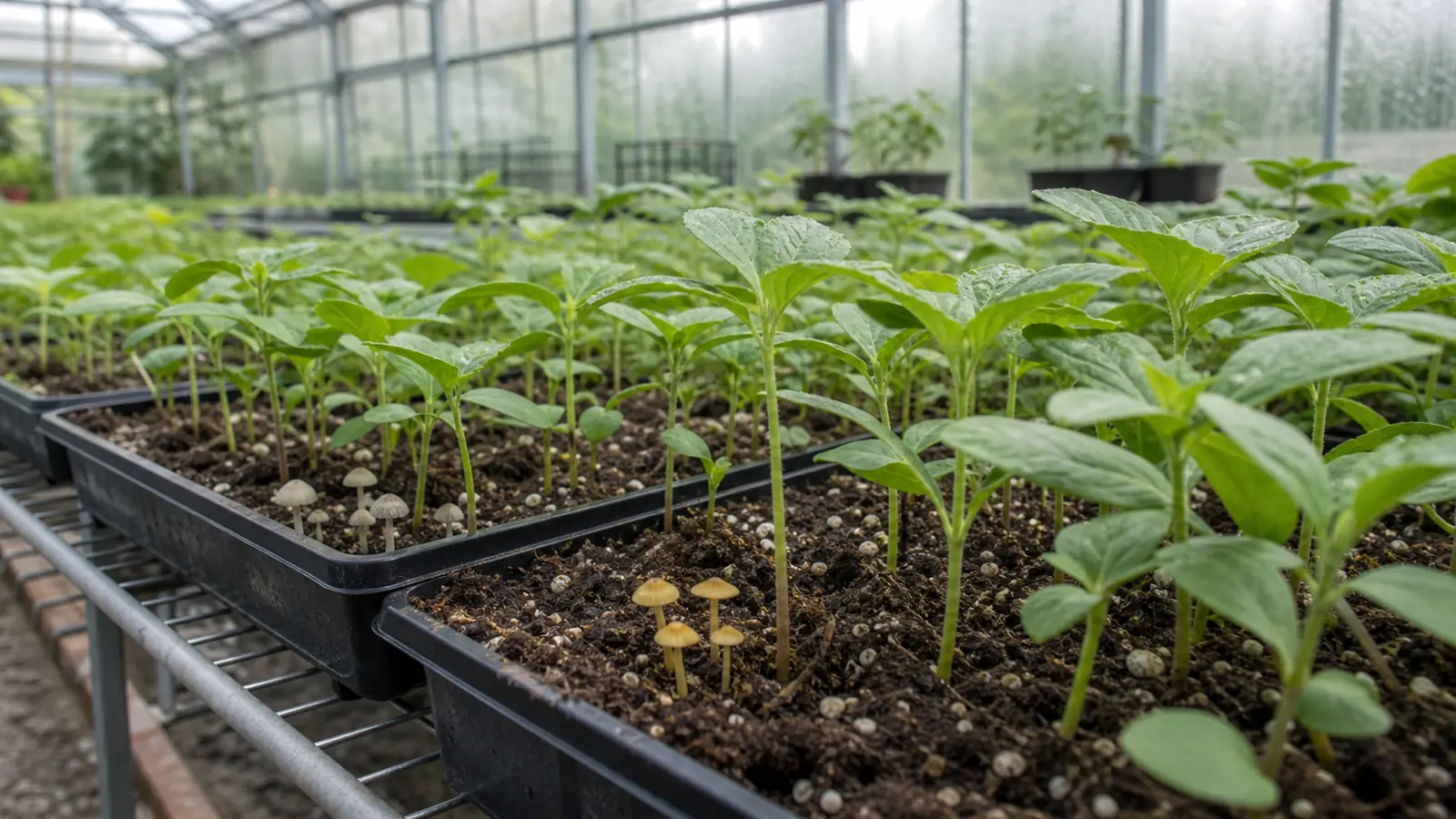
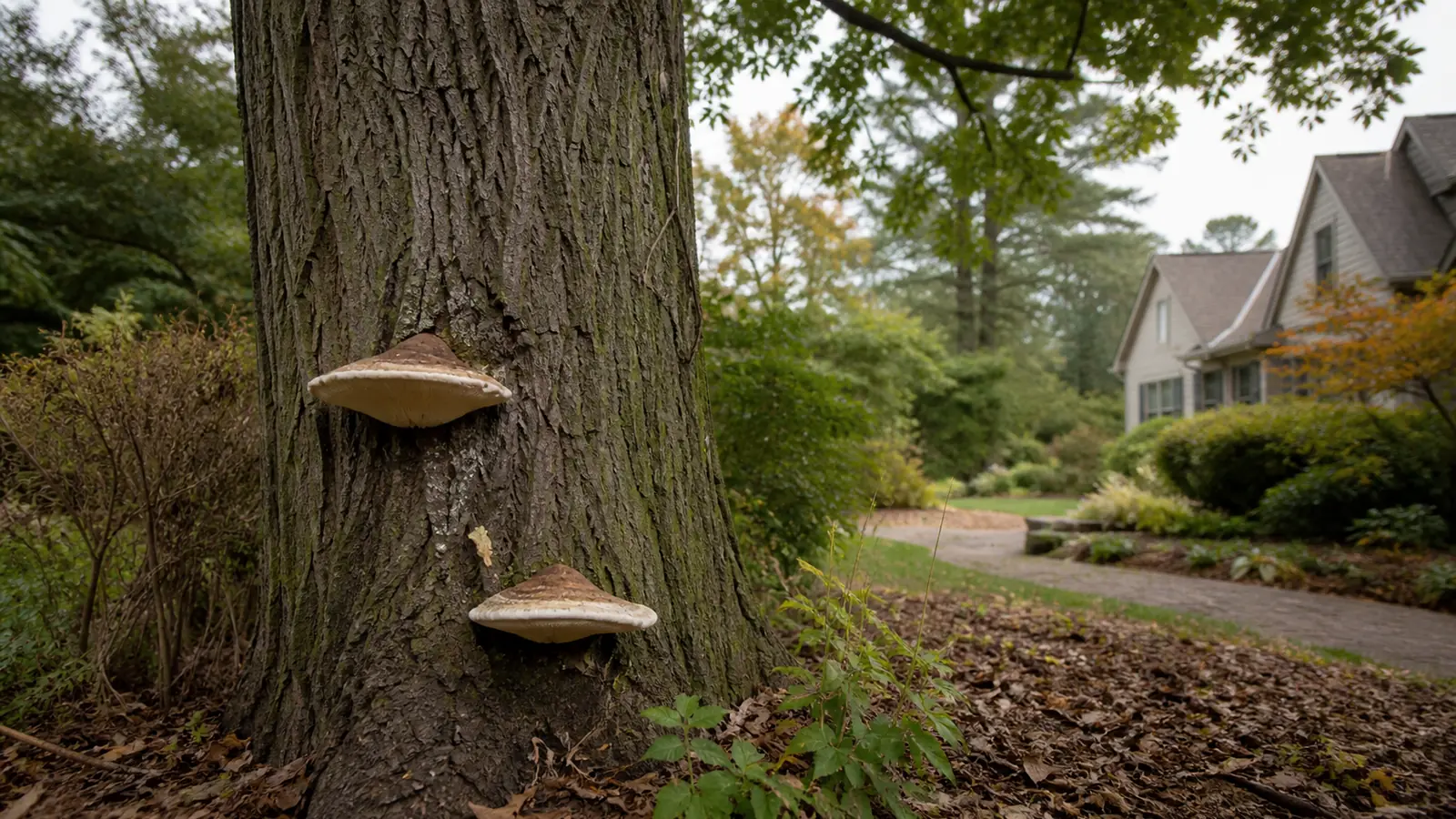
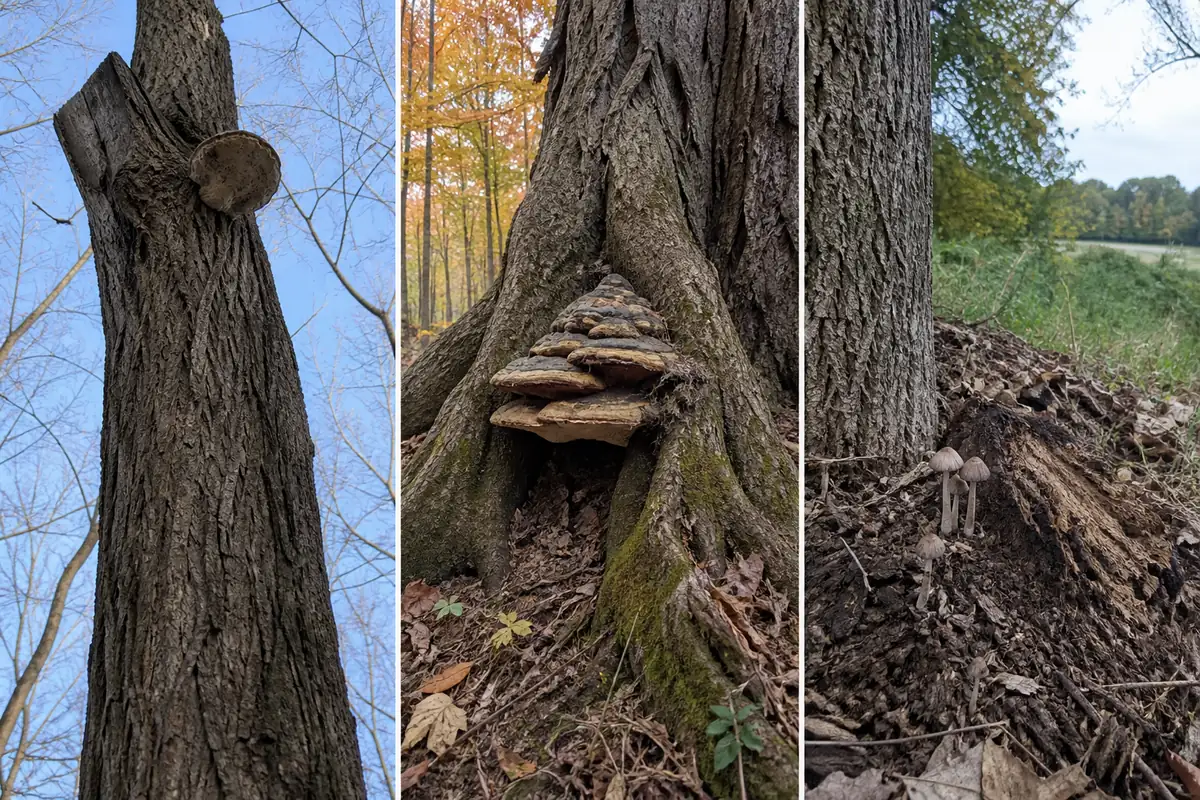
A broad shelf at a root flare raises a different structural question from tiny stemmed mushrooms emerging beside buried timber. Flat gray-green lichen presents another case because it uses bark as a surface without consuming the tree.
Treat the finding as evidence to investigate, not as a species name, an edibility verdict, or an automatic order to remove the tree.
A Trunk Mushroom Is Evidence, Not a Species Name
The mushroom, bracket, or conk is the spore-producing part of a fungus. Its feeding threads, called mycelium, may extend through dead or decaying wood far beyond the visible structure.
That relationship explains why a palm-sized shelf can matter even on a massive trunk.
Wood-decay fungi release enzymes that break down structural components of wood. The affected area may remain hidden behind intact bark while the tree continues moving water through living sapwood near the outside of the trunk.
A green crown therefore does not prove the trunk is structurally sound. It shows that enough living tissue is working at that moment, which is a different question from how much load-bearing wood remains.
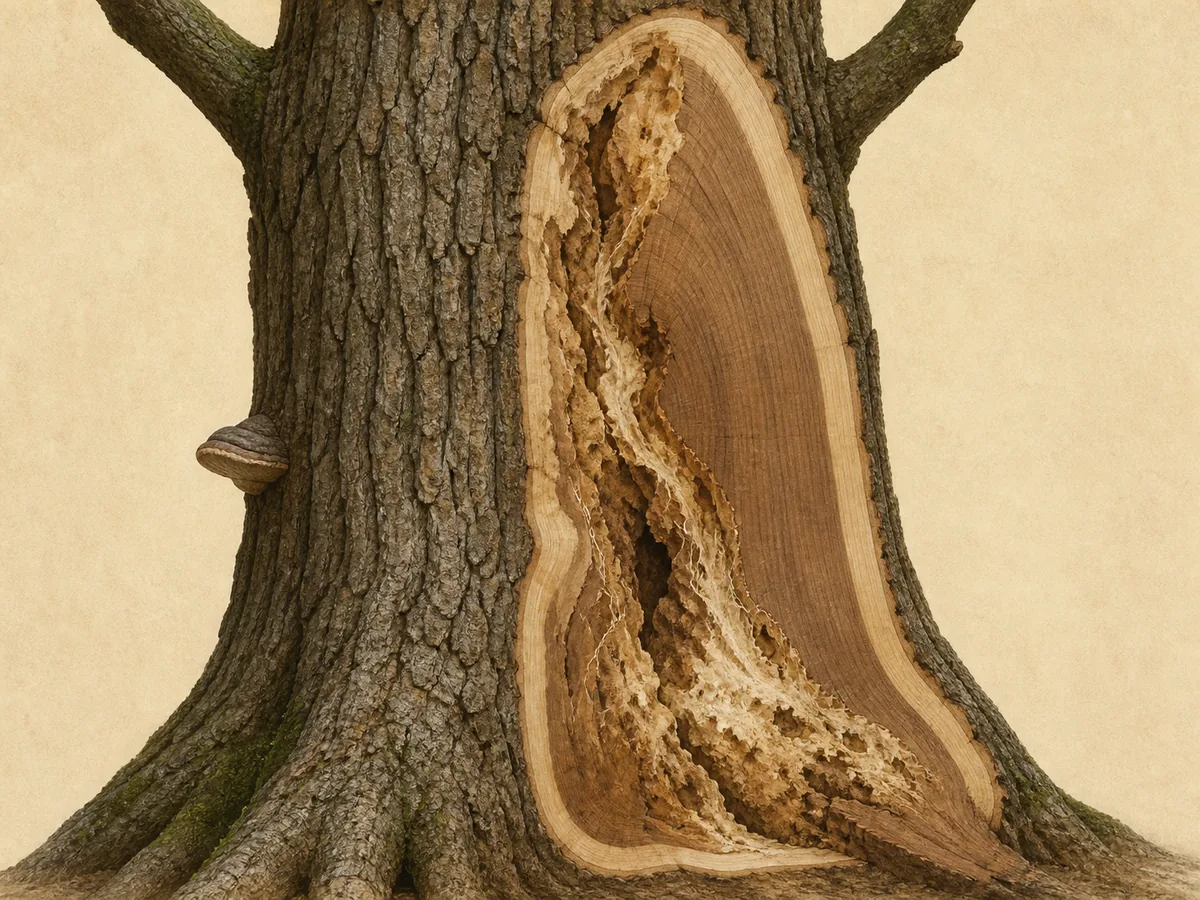
Trees do not replace decayed wood in the way skin closes a cut. They build chemical and physical boundaries around injured tissue, which can slow the spread while new wood grows outside the affected zone.
The strength of those boundaries varies with the tree, wound, fungus, and later stress.
Conks can appear years after infection begins, and some extensively decayed trees produce no visible fruiting body. A conk is a valuable positive sign, but the absence of one is not proof that decay is absent.
A photograph cannot measure the decay column because bark hides the geometry and thickness of the remaining sound wood.
Before assuming every unusual patch is a decay fungus, check whether it has three-dimensional structure. A projecting shelf, hoof, rosette, cushion, crust edge, or cluster of stems may expose a fresh fertile surface where spores form.
Lichen usually lies flat or forms small leafy lobes attached across the bark. It obtains moisture and nutrients from the atmosphere rather than the tree, so scrubbing or scraping it away can injure protective bark without helping the tree.
Moss and algae also coat surfaces rather than producing a substantial mushroom. Sunken bark, raised callus, cracks, dark wet streaks, and exposed dead wood may point toward a canker or injury that deserves its own diagnosis.
Location on the Tree Changes the Question
Record where the fruiting body actually enters wood before photographing it close up. The position does not identify the species, but it tells an arborist which structural zone and history need attention.
A bracket emerging from an old branch stub may follow the branch trace into the trunk. The visible shelf marks one exit point and does not reveal where the affected wood starts or ends.
Fruit bodies at the lower trunk, buttress roots, or root flare shift attention toward basal support. Root and butt decay can reduce anchorage even when the upper crown still appears full.
Mushrooms in soil beside the bark require a careful substrate check.
Their stems may lead to living roots, but they may also rise from a buried stump, an old landscape timber, mulch, or construction wood. Moving a little loose surface material by hand can clarify that distinction without cutting into the tree.
| Where the growth appears | What the position may involve | What to record next |
|---|---|---|
| High trunk or old branch stub | Heartwood reached through a dead branch trace, broken top, pruning cut, or other wound | Height, host species, old wound, number of fruiting points, crown condition, and branches below |
| Branch union or major limb | Decay or a canker affecting a load-bearing branch connection | Cracks, included bark, dead tips, hanging wood, and what lies under the limb |
| Main stem or cavity edge | Internal stem decay with a visible opening or fruiting route | Cavity position, exposed wood texture, trunk diameter, cracks, lean, and targets within reach |
| Lower trunk, butt, or root flare | Butt or root decay that may affect basal strength or anchorage | Root flare visibility, soil heaving, root injury, grade changes, canopy thinning, and recent movement |
| Soil immediately beside the trunk | Buried roots, a hidden stump, mulch, or unrelated dead wood | Follow several stems to their base and photograph the substrate without trenching around roots |
| Dead attached branch or broken stub | Decomposition may be limited to dead branch tissue or may extend into live structure | Boundary between dead and live wood, branch size, attachment, and signs of spread toward the stem |
Height can alter both diagnosis and consequence, but it is not a severity scale by itself. Some important stem-decay fungi fruit high on their preferred hosts, while others appear near the base or even from infected roots away from the trunk.
Several conks spaced along one trunk deserve careful documentation because they show more than one fruiting point. Their spacing still cannot be converted into a universal decay measurement without knowing the fungus and host.
Look for the event that may have opened a path into the wood.
Flush pruning cuts, torn limbs, mower scars, lightning injury, fire damage, bark loss, and long-standing cavities can expose tissue to spores. Soil piled over the root flare, a grade change, construction compaction, or saturated ground can add root stress and obscure the true attachment.
The attachment point is the useful field clue, not the nearest patch of bark in the photograph.
IdentificationWhat Are the Tiny Bird's Nest Fungi in Your Mulch?Read the Fruiting Body Before You Name It
Top color is one of the least stable characters on an old trunk fungus. Rain, sun, algae, frost, and age can bleach or darken a surface until unrelated species look similar.
Begin with overall form, then turn to the fertile surface where spores are produced.
Projecting Shelves and Hoof-Shaped Conks
A shelf may be thin and flexible, thick and corky, or hard enough to feel woody. Note whether it grows singly, overlaps in tiers, forms a rosette, or returns at the same point in later seasons.
Fresh annual brackets often have a soft growing margin and may collapse, dry, or bleach within months. Perennial conks can add layers over several years, leaving hard ridges or growth zones that survive winter.
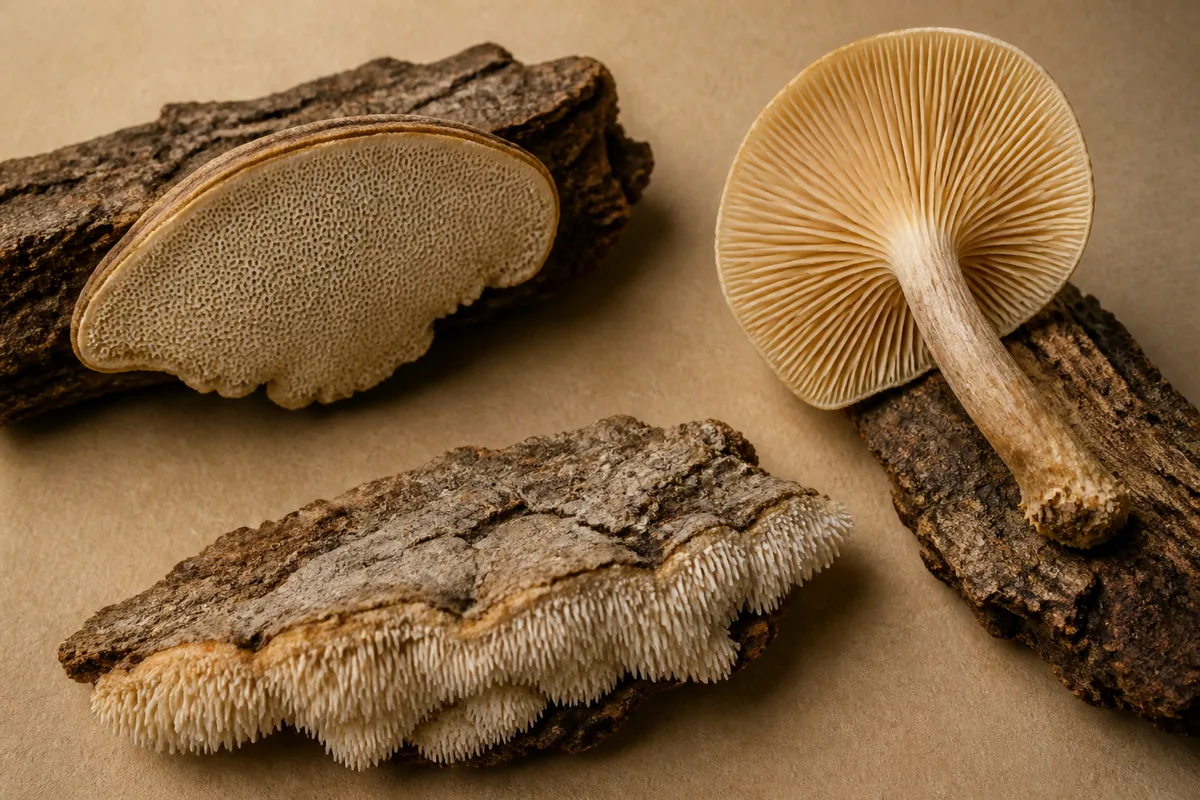
Examine the underside without breaking the structure. Fine round or angular pores support a polypore-type fruiting surface, while teeth, spines, folds, or a smooth surface lead to other groups.
The upper surface cannot substitute for that view.
Stemmed Clusters at the Base
Clusters of conventional cap-and-stem mushrooms at the root flare can be associated with buried roots or basal decay, but attachment must be proven. Photograph where several stems converge and whether they arise directly from bark, exposed wood, soil, or a buried woody source.
Gills, pores, or ridges under the cap provide the first form split. Add the stem base, veil or ring tissue, bruising, odor, spore deposit, cluster arrangement, and several maturity stages before considering a species name.
Some root-decay fungi fruit only briefly in favorable weather.
Their absence during a later visit does not erase the original evidence, which is why dated photographs and an accessible preserved specimen can matter.
Crusts, Cushions, and Bark-Like Growths
Not every wood-decay fruiting body projects as a shelf. Some form thin crusts with pores or teeth, dark brittle cushions, small disks, or patches that appear almost continuous with exposed wood.
Check for a defined edge, a fertile texture, a color change when fresh, and a connection to dead bark or a wound.
A flat leafy or branching lichen lacks the fleshy or woody body of a mushroom and does not feed from the tree. A canker instead involves killed bark and underlying tissue, often with a sunken center, raised wound wood, cracks, or small spore-producing dots.
Those distinctions determine which specialist and evidence path are useful, even when a species remains unresolved.
Use a hand lens if the surface is too fine to read in a phone image. Photograph straight across the texture and include a ruler or familiar scale without covering the attachment.
White-rot fungi can leave pale, stringy, soft, or spongy material after breaking down lignin and other wood components. Brown rot more often leaves dry brown wood that cracks into cubes because lignin remains while cellulose is lost.
Both can reduce strength, but rot color alone does not predict failure. The fungal species, tree species, location, cross-sectional extent, loading, and remaining sound wood all affect the outcome.
Do not taste a wood-growing mushroom or use growth on a trunk as an edibility rule. Identification for food requires a separate species-level standard, and this structural inspection does not provide it.
IdentificationWhat Should You Do About Mushrooms in a Horse Pasture?Does Trunk Fungus Mean the Tree Might Fall?
A trunk conk means the possibility of internal decay deserves attention. It does not supply a countdown, and nobody can calculate a reliable failure probability from one exterior photograph.
Tree risk combines a defect, the likelihood that part or all of the tree will fail, and the consequence if it does. The same conk has different consequences on a remote woodland tree and on a trunk that can reach a bedroom, road, school entrance, parked car, or play area.
Read the whole tree from a safe distance before approaching the fruiting body.
- Look for fresh cracks, split unions, hanging branches, or a recent limb failure
- Compare the current lean with older photographs and check for newly lifted soil or exposed roots
- Note cavities, loose bark, soft wood, open seams, and fruiting bodies at more than one height
- Inspect the crown for large dead branches, thinning, unusually small leaves, or one-sided dieback
- Record recent wind, saturated soil, heavy snow, ice, construction, trenching, or grade changes
- Mark homes, vehicles, paths, play areas, roads, and utility lines within reach of the tree or affected limb
One sign may have several explanations, but multiple aligned defects raise concern. A basal conk beside newly heaved soil and a changing lean is a different situation from an isolated old bracket on a remote tree with no occupied target.

Keep people and vehicles out of reach when you see active cracking, a newly moving root plate, hanging wood, recent structural failure, or a trunk in contact with a utility line. Do not stand beneath the suspect part to take a closer photograph.
Warning
During active failure, after fresh movement, or near electrical conductors, leave the area and contact emergency services or the utility provider as appropriate. Do not climb, cut, pull, or use a ladder to inspect the fungus.
Storm conditions increase loads and can soften soil around roots. Calm weather after a storm does not make a damaged tree safe to approach because partly detached wood can fall later.
An arborist can examine the tree in context and decide whether advanced assessment is needed. That may include species identification, sounding or probing by trained personnel, resistance drilling, sonic methods, root-zone inspection, or other tools selected for the actual defect.
The homeowner's job is to preserve observations and control exposure, not to choose an invasive test.
Removing the Mushroom Does Not Remove the Fungus
Breaking off a conk changes what you can see, not what is happening inside the wood. Purdue Extension notes that mycelium continues growing and feeding within the tree after the visible fruiting body is removed.
Removal can still serve a narrow purpose when the structure is safely reachable from the ground. It can preserve a specimen for identification or limit casual handling, but photographs should come first because the original attachment and orientation are easily lost.
Photograph the whole tree from more than one side
Include the crown, trunk, root flare, lean, nearby structures, and the fruiting body's height
Show the growth in place
Capture its upper surface, fresh margin, underside, attachment, scale, and any nearby crack, cavity, wound, or dead branch
Record the history
Note the date, host if known, prior pruning or storm injury, soil changes, previous fruiting, recent weather, and any recent movement
Control the target area
Move portable furniture, vehicles, or play equipment when this can be done without entering the fall zone, and keep people away from suspect parts
Seek the right assessment
Use a certified arborist, preferably with tree-risk assessment training when the tree can strike an occupied place
Preserve an accessible sample only if safe
Place a detached piece in paper, keep it separate from food, and never climb or cut the trunk to obtain it
A complete image set is more useful than a close shot of the cap. Photographing mushrooms for identification should show the whole form, fertile underside, attachment, tree, and surrounding site.
If the growth is high, leave it in place and use a zoom lens from outside the potential drop zone. No identification photograph is worth a ladder fall or exposure beneath a defective branch.
Do not paint or seal the attachment after removal.
Wound coatings do not rebuild wood, and fungicide sprayed on a conk does not reach an established internal decay column. Filling a cavity with concrete or expanding foam also fails to restore strength and can trap moisture, obstruct drainage, or create hazards for a future tree crew.
Assessment should choose the treatment, not the appearance of the fruiting body. Depending on the defect and target, a qualified arborist may recommend moving a target, pruning a defective branch, adding a support system, improving routine care, monitoring a documented condition, or removing the tree.
Support cables and braces reduce particular movement when properly designed, but they do not guarantee that a decayed tree cannot fail. Pruning can reduce load in some cases, while an incorrect cut can create another wound and make the condition worse.
Tree removal is appropriate when assessed risk cannot be reduced to an acceptable level. It is not the automatic consequence of every shelf fungus because species, host response, remaining structure, site use, and potential impact differ.
Keep the original photographs and inspection notes even if the fruiting body disappears. A recurring conk, a new crack, crown decline, or another branch failure then becomes a dated change rather than a vague memory.
Sources & References
- Penn State Extension: Understanding the Spread of Decay in Trees
- Penn State Extension: Tree Diseases that Create Hazards
- USDA Forest Service: Diseases of Trees in the Great Plains
- Purdue Extension: Symptoms and Signs for Plant Problem Diagnosis
- International Society of Arboriculture: Recognizing Tree Risk
- International Society of Arboriculture: Managing Hazards and Risk
- Penn State Extension: Lichens on Trees
- Oregon State University Extension: Conks and Internal Decay