What is turkey tail, and why is it everywhere?
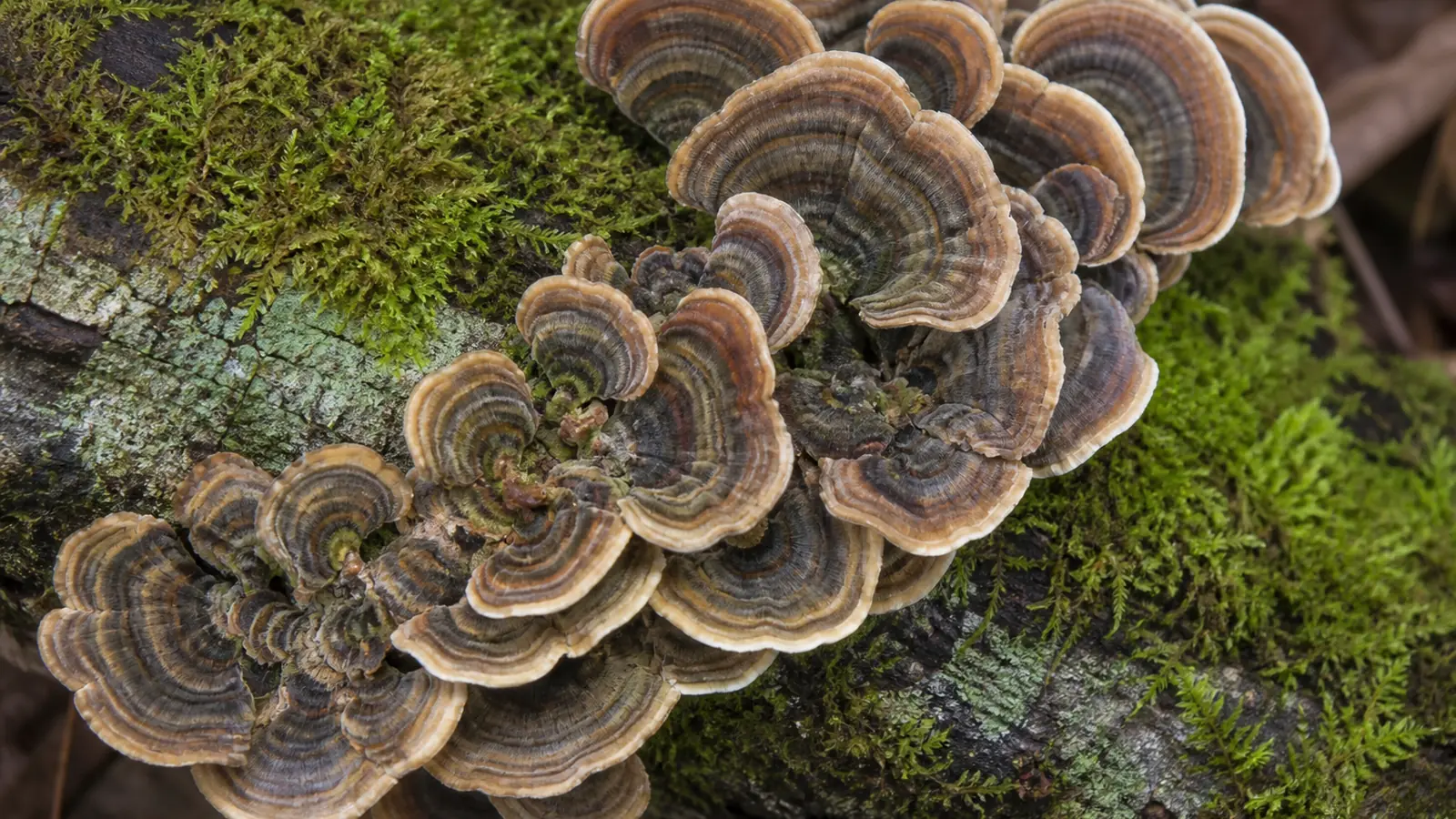
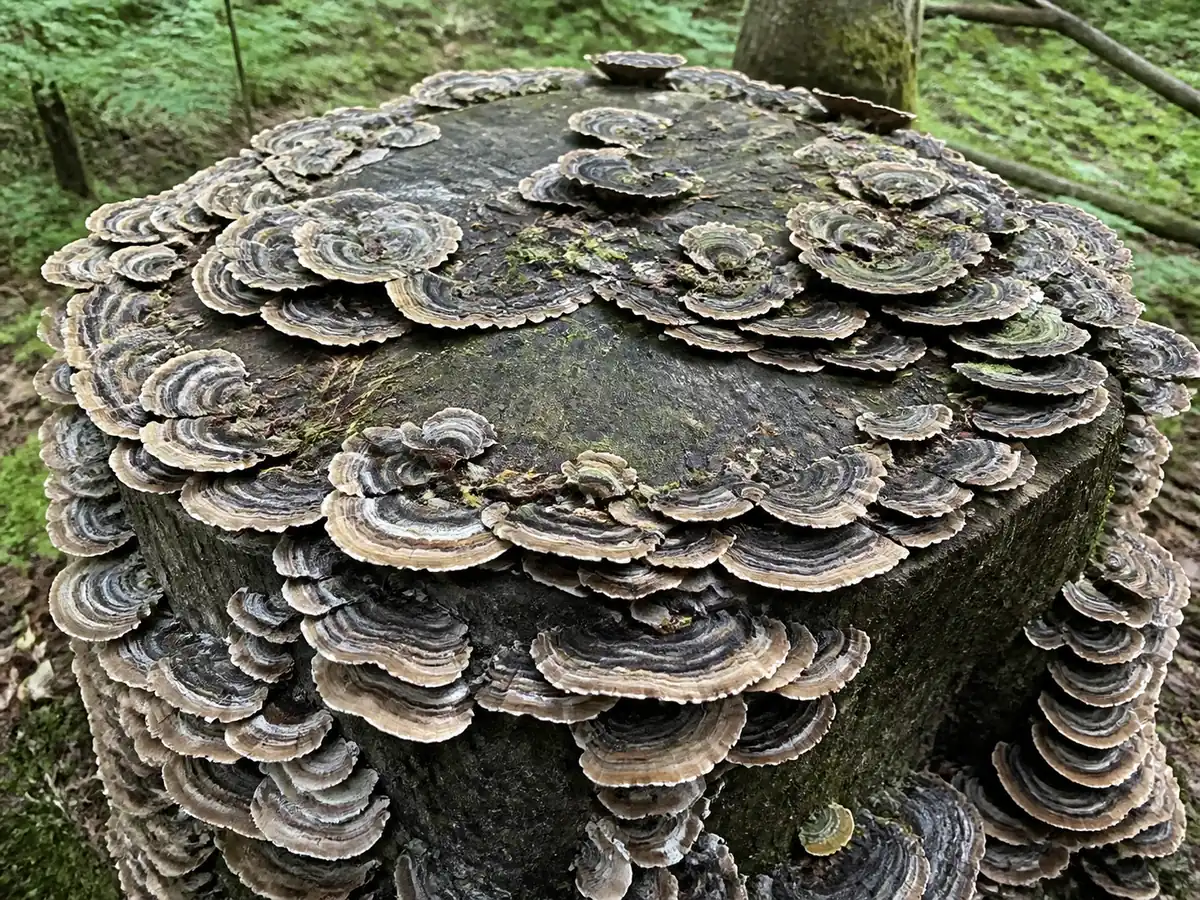
Turkey tail is a thin, tough bracket fungus that grows in overlapping tiers on dead hardwood across most of the temperate world. A single stump can carry several hundred fans, each one about as thick as a coin and rarely wider than a matchbox.
The name comes from the banding. Concentric zones of brown, rust, gray and cream run across the upper surface, and the fan shape with its stripes reads convincingly as the spread tail of a wild turkey.
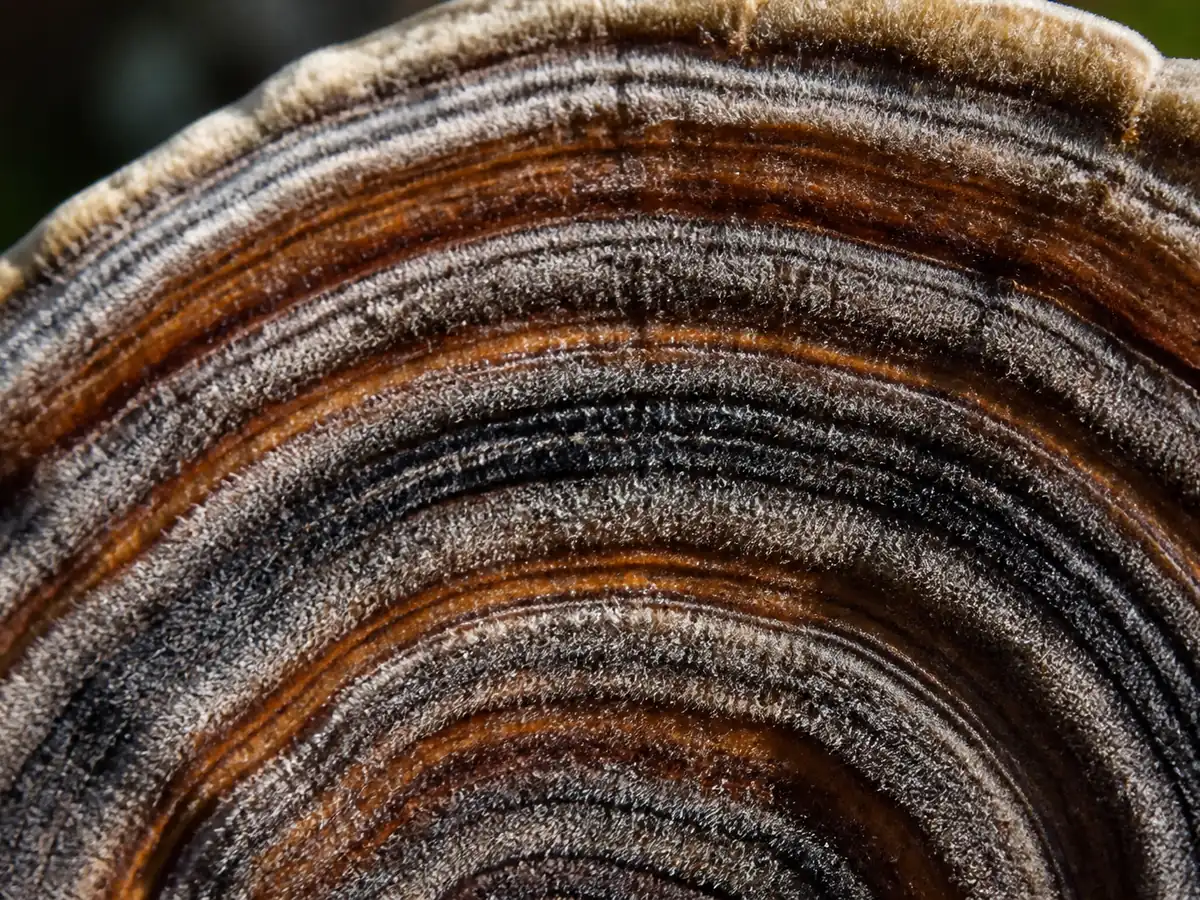
That banding is also the problem, because it is the feature people photograph, the feature guides lead with, and a feature that several unrelated fungi share, so a call made from above is only a guess.
- Thickness
- Usually 1 to 3 mm, thin enough to bend double when fresh
- Width
- Individual fans 2 to 8 cm across, growing fused in tiers rather than singly
- Substrate
- Dead hardwood above all, and stumps and fallen branches more often than standing trunks
Everything that settles the identification sits on the other side of the fan.
Why does the underside decide it?
Thin fan- or shell-shaped bracket, 2 to 8 cm wide and only 1 to 3 mm thick, banded in concentric zones of brown, rust, gray, cream and sometimes blue-green, with alternating velvety and smooth bands and a pale growing margin.
No gills. The underside is a white to pale cream pore surface with tiny round pores, roughly three to eight per millimeter.
No stem. Fans attach broadly along the wood and fuse into overlapping tiers and rosettes.
White, thin, tough and leathery, flexing double without snapping when fresh, with a faint fungal smell and no distinctive taste.
Turn the fan over. That is the whole method.
The underside of a true turkey tail is a pore surface, white to pale cream, covered in tiny round holes at roughly three to eight per millimeter. Held at an angle to the light it reads as a very fine sponge, and a hand lens turns the sponge into distinct circles.
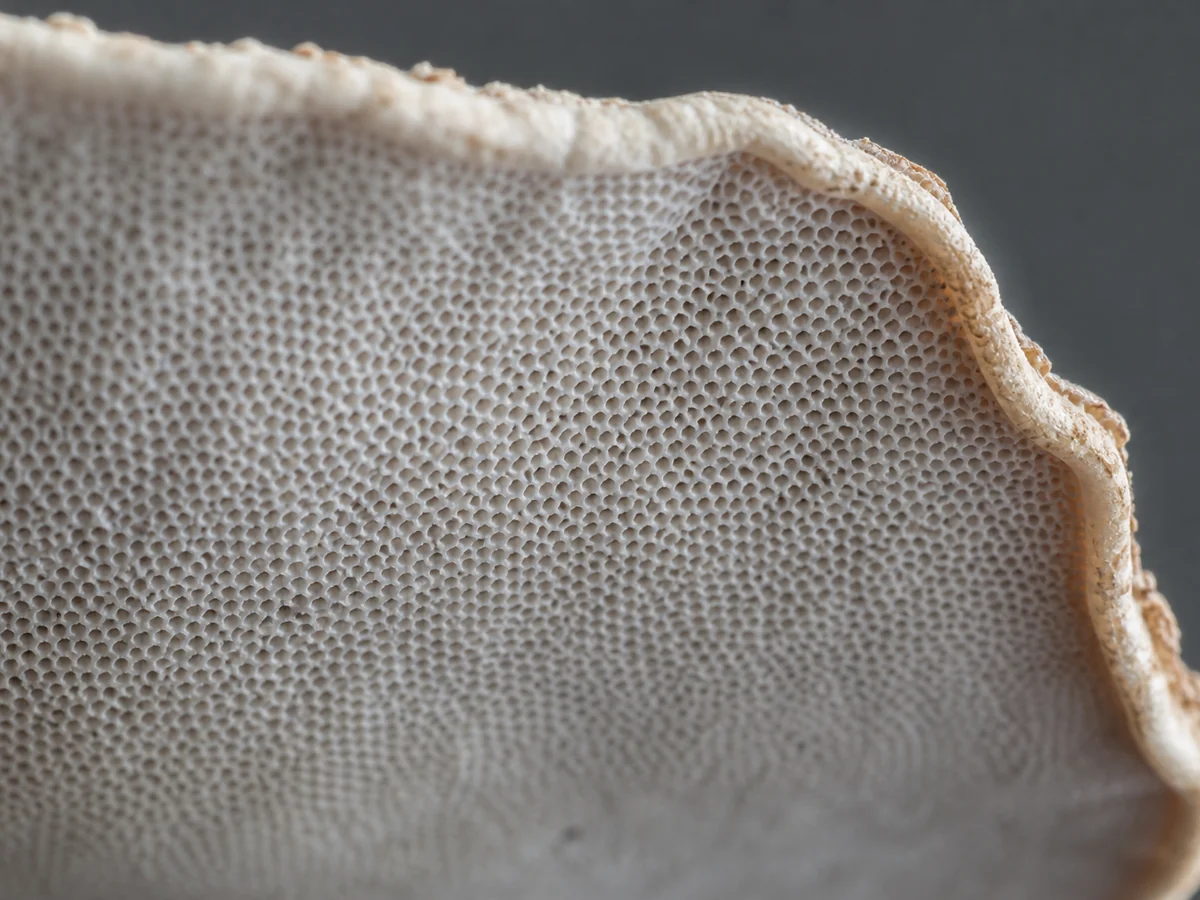
Four features together make the call, and none of them needs equipment beyond a lens.
The flex test is the second check and costs nothing. A fresh fan bends double and springs back, because the thin flesh is leathery rather than brittle.
A dried specimen will not do this, which is worth knowing before deciding a mushroom has failed. Soak a dry fan for a minute and the flex comes back.
Color is the least reliable feature of all, despite a Latin name that means many-colored. The same log can carry fans that are almost entirely gray beside fans banded in five shades, and blue-green tones usually mean algae growing on an old bracket rather than anything about the species.
What safety details matter for Turkey Tail?
The risks that exist are about products rather than picking. Supplements have caused digestive upset in some people, and turkey tail is not a substitute for medical treatment of anything.
Two situations call for a doctor first. Anyone on immunosuppressant medication or in active cancer treatment should not start a mushroom supplement without asking their own clinician, because the plausible mechanism runs through the immune system.
Do not collect brackets from wood that has been treated, painted or pressure-preserved. A white rot fungus concentrates what it grows in, and old fenceposts and pallet wood are poor sources.
What else wears a banded fan?
Nothing that resembles turkey tail will hurt you, which is the good news and also the reason people get careless.
The confusions are all with other thin banded brackets on wood, and none of them is poisonous. A mistake costs you a pot of tea made from the wrong fungus, not a hospital visit.
The one people meet constantly is false turkey tail, common enough that a fair share of turkey tail photographs online are actually of it.
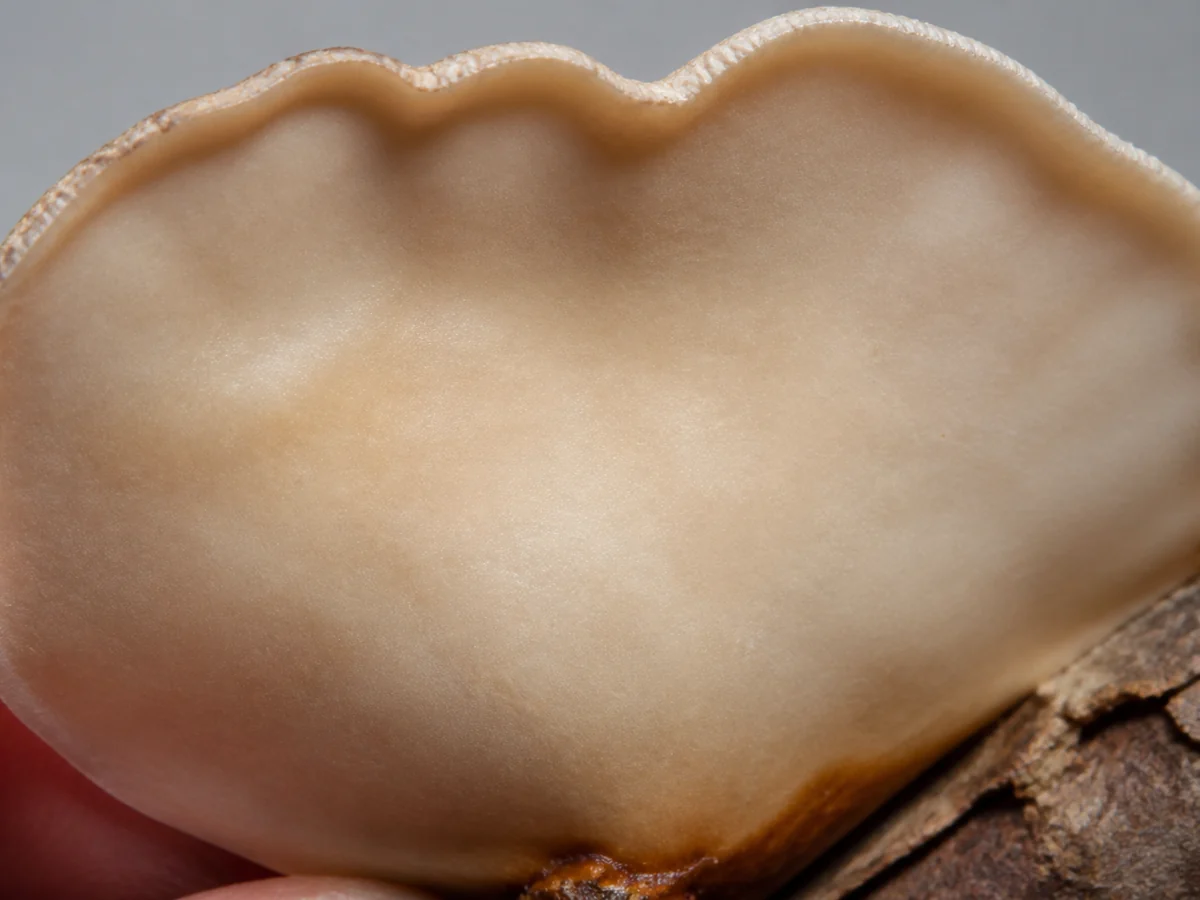
Side by side the two undersides are not close, whatever the tops are doing.
True turkey tailWhite porous underside, thin flexible flesh, fans fused in tiers
False turkey tailSmooth underside with no pores at all, often buff, tan or reddish brown
That single check settles it every time, which is unusual in mushroom identification and worth appreciating. There is no borderline case here, because either there are pores or there are not.
Two close relatives cause trouble less often. Hairy bracket wears a coat of coarse gray hairs you can feel with a thumb, and lumpy bracket has pores stretched into slots rather than circles.
The real risk with turkey tail is not misidentification in the wood.
It is that a bag sold as turkey tail may contain very little of the fungus. Products differ enormously in which part of the organism they use, and the difference is rarely stated in plain words on the front of the pack.
Warning
Powder made from mycelium grown on grain is harvested together with the grain, because the two cannot be separated once the fungus has grown through it. A capsule of that material contains an unstated fraction of starch, and the label will usually name the grain in the ingredients without saying how much is left.
One caution about that caution is fair. An in vitro study found that the fermented grain itself provoked immune cell responses alongside the mycelium, so the substrate is not simply inert filler, and that study was sponsored by a company selling mycelium products.
The practical response is to read what a jar declares rather than what it implies, and choosing a product gets much easier once you know which two forms you are choosing between.
What is it doing to the log?
Turkey tail is a white rot fungus, and that job description explains almost everything about where it turns up.
White rot means it can break down lignin, the rigid polymer that makes wood woody. Most organisms cannot touch lignin, so a fungus that can gets at the cellulose locked inside it.
The result is visible in the log itself. Wood attacked this way turns pale, soft and stringy, and a well-rotted piece pulls apart in fibers by hand.
That also explains the numbers. Hundreds of fans on one stump are not hundreds of individuals but one fungus fruiting everywhere it can reach the surface.
The species is genuinely everywhere, which is unusual for a mushroom with a reputation, and most people walking in temperate woodland pass it several times on any given walk.
Can you actually eat turkey tail?
Turkey tail is edible in the narrow sense that it will not poison you, and inedible in every sense that matters at a table.
The flesh is thin, tough and leathery, and cooking does not soften it. Chewing a piece is close to chewing a strip of bark, and no amount of simmering changes the texture.
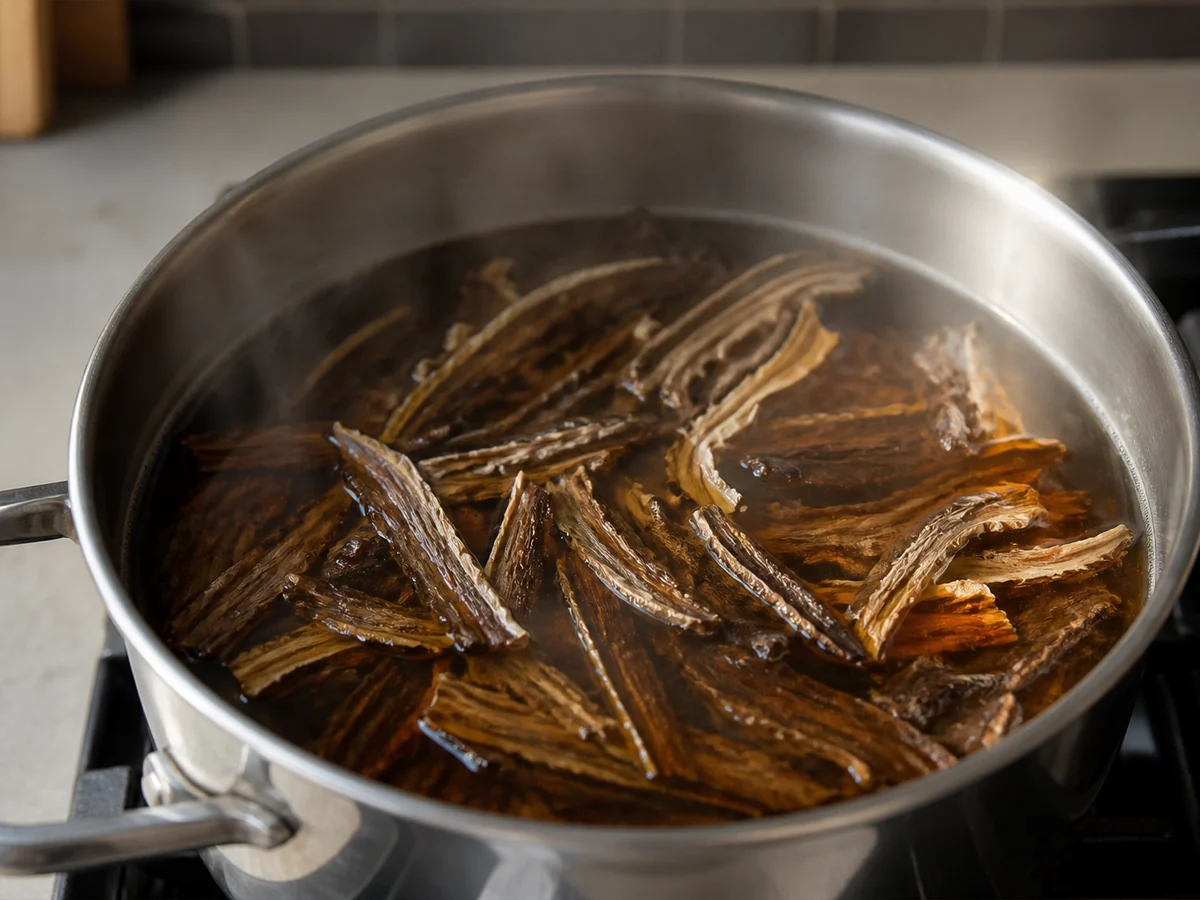
So the mushroom is made into tea rather than eaten. Dried fans go into water for a long simmer and the liquid is strained off.
1
Break dried fans into pieces roughly the size of a postage stamp
2
Simmer in water for at least 45 minutes, and up to two hours for a stronger extract
3
Strain, discard the solids, and drink the liquid warm or chilled
The result is mild, faintly woody and a little bitter, and most people blend it with something that has more character. It sits closer to a weak black tea than to a mushroom broth.
What was tested, and on whom?
Turkey tail carries more clinical evidence behind it than almost any other mushroom, and almost none of that evidence is about turkey tail in the form people buy.
The studied substance is PSK, a protein-bound polysaccharide extracted from cultured mycelium of one particular strain. It has been a licensed prescription drug in Japan since the 1970s, given at about 3 grams a day alongside chemotherapy after cancer surgery.
Two things about that record are easy to misread.
The first is what PSK actually is. It is a pharmaceutical fraction prepared from mycelium under controlled conditions and prescribed by an oncologist, and it is not the same material as tea simmered from brackets off a log.
The second is who was studied. Nearly all of these trials ran in Japan in patients who had already had surgery for cancer, so the finding speaks to that setting and says nothing about healthy people taking capsules.
Warning
Turkey tail is not a cancer treatment and nothing here should change a treatment plan. PSK was studied as an addition to surgery and chemotherapy and never as a replacement, and anyone in treatment should raise any supplement with their oncology team before starting it.
Read alongside what is known about mushrooms and cancer, the honest summary is that one refined extract has a real record in one narrow clinical setting.
Why is it easy to grow and hard to sell?
Turkey tail is one of the easiest fungi to grow and one of the least rewarding, which is an odd combination.
It colonizes hardwood aggressively and tolerates a wide temperature range, so a log or a bag of supplemented sawdust will fruit with very little skill. Growers use it as a beginner species for exactly that reason.
The catch is that you cannot eat the crop. A successful log gives you fans to dry and simmer, and that is the entire return.
It also explains why so much commercial material is mycelium rather than brackets. Growing fans takes many months, growing mycelium in a tub takes weeks, and only one of those is cheap.
That is the same split that separates a powder from an extract on a shelf, and it is worth understanding before comparing prices.
Why does a nutrition figure mislead here?
A nutrition panel for turkey tail is technically calculable and practically meaningless.
Nobody swallows the mushroom. The fans are simmered and thrown away, so whatever protein, fiber and mineral content the dried tissue holds mostly ends up in the compost.
What reaches the cup is whatever dissolves in hot water: polysaccharides, some amino acids, a little color, and not enough of anything to count as food.
Treat a cup of turkey tail tea as a drink with negligible calories. Anyone comparing it with other medicinal fungi is comparing extracts rather than foods.
How many species hide under one name?
Trametes versicolor means many-colored trametes, and the epithet is fair warning that appearance will not narrow things down.
The genus holds a dozen or so similar thin brackets, and separating them reliably takes pore size, surface texture and sometimes a microscope.
The more interesting mess sits on the other side of the comparison. False turkey tail has long been called Stereum ostrea throughout North America, and a study using DNA, morphology and ecology concluded that the North American material is at least three separate species, and that true Stereum ostrea, described from Java, does not occur there at all.
That study is a preprint that has not been through peer review, so treat the conclusion as well supported rather than settled. It changes nothing practical either way, because everything in the group has a smooth underside and the pore check still decides it.
The medicinal literature adds one more name to keep straight. Older papers and most Chinese sources call this fungus Coriolus versicolor, which is the same organism under a superseded genus.
Turkey tail identification and product questions
How do you tell turkey tail from false turkey tail?
Is turkey tail edible?
Does turkey tail treat cancer?
Is turkey tail tea the same as a PSK supplement?
What does mycelium on grain mean on a label?
When is the best time to collect turkey tail?
Sources & References
- Can polysaccharide K improve therapeutic efficacy and safety in gastrointestinal cancer? A systematic review and network meta-analysis, Oncotarget 2017 The 23 trials, 10,684 patients, the pooled one to five year survival odds ratios, and the authors own list of limitations
- The mycelium of the Trametes versicolor mushroom and its fermented substrate each show potent and complementary immune activating properties in vitro, BMC Complementary and Alternative Medicine 2019 That the fermented grain substrate itself activated immune cells in vitro, and that the study was sponsored by a company selling mycelium products
- DNA, Morphology, and Ecology Resurrect Previously Synonymized Species of North American Stereum, bioRxiv preprint That North American false turkey tail is at least three species and that true Stereum ostrea does not occur there
- Lignin-modifying enzymes from selected white-rot fungi: production and role in lignin degradation, FEMS Microbiology Reviews 1994 That white rot fungi break down lignin using laccase and peroxidase enzymes, which is what turns the wood pale and stringy