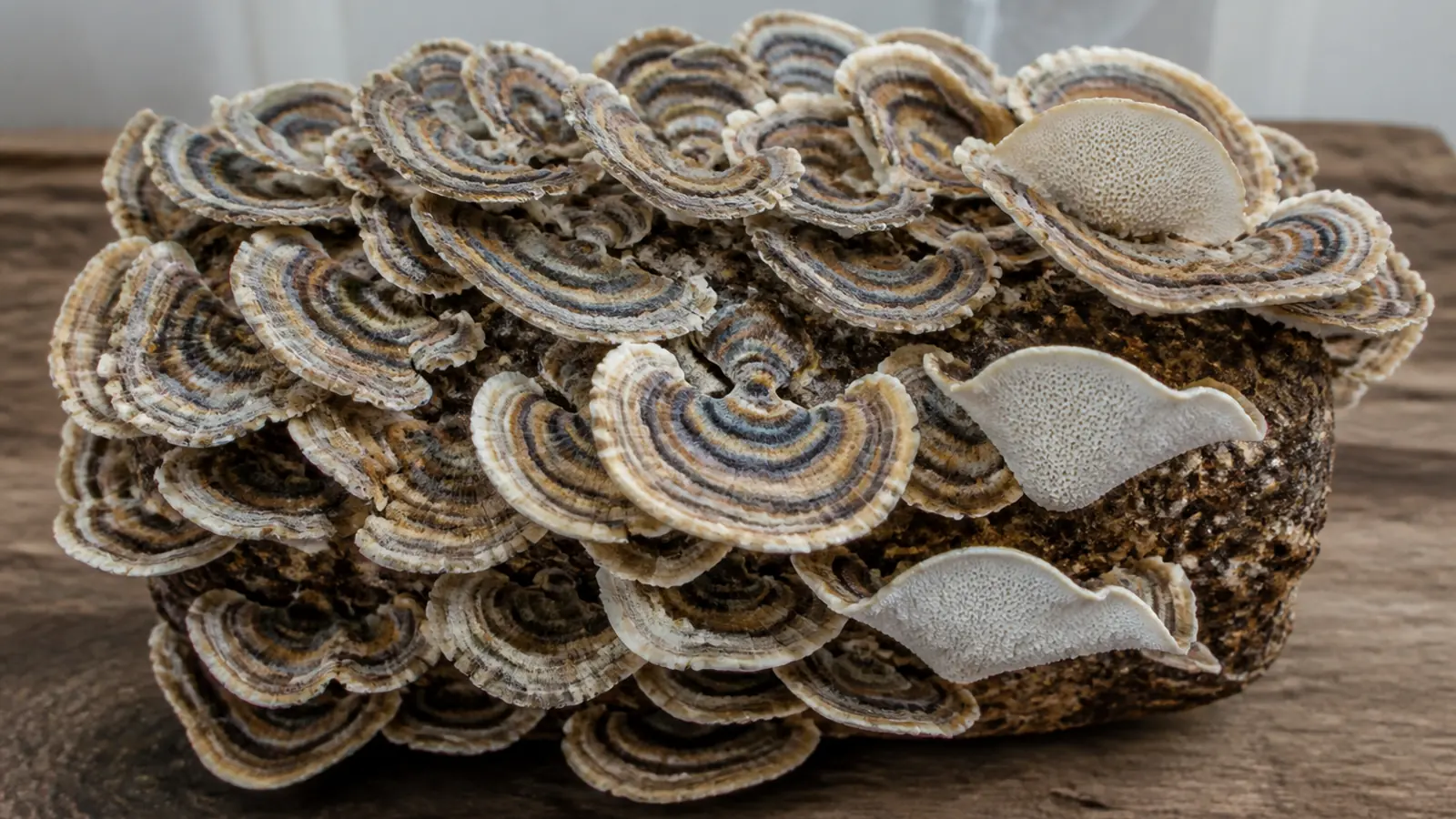
Grow supplier-verified Trametes versicolor on a dead-hardwood substrate. A mature crop forms thin overlapping zoned fans with a fine white pore surface, so inspect both faces before calling a crust or thick shelf turkey tail.
Turkey tail is a thin hardwood shelf crop, not a miniature oyster mushroom.
The crop becomes convincing only when the upper surface develops concentric color zones and the underside develops a fine pore layer.
Start with supplier-verified Trametes versicolor and dead hardwood substrate. The common name and striped cap alone cannot prove the species, so every inspection should include both faces of the developing shelf.
Which turkey tail culture belongs in the bag?
Key takeaway
Verify the culture before you build the crop | Use a scientific label, strain or lot record, and a supplier that identifies the material as Trametes versicolor.
Turkey tail is widely recognized by alternating tan, brown, gray, and bluish zones, but other thin brackets can produce similar bands.
A cultivated crop needs traceable spawn because color varies with strain, age, moisture, and light.
The underside supplies the second half of the identity check. Mature T. versicolor forms tiny round pores on a white to cream surface, while a smooth, toothed, or gilled underside sends the specimen outside this guide.
| Evidence | Supports the crop | Does not prove it alone |
|---|---|---|
| Culture record | T. versicolor with a lot or strain | The words turkey tail |
| Upper face | Thin flexible fan with concentric zones | Bright color bands |
| Lower face | Fine white to cream pores | A pale smooth surface |
| Substrate | Colonized dead hardwood | Growth on any log |
Do not use a wild bracket as the culture source for a first production run. That choice adds field identification, isolation, and contamination risk before the cultivation test has even begun.
Questions about extracts or health effects belong to a separate evidence review.
A correctly grown fruit body establishes the crop identity, not a dose or treatment outcome.
Growing MushroomsWhat Does a Mushroom Farm Actually Cost to Start?Should you start from spawn or a turkey-tail block?
A colonized block is the better first route when your goal is to learn fruiting. It transfers substrate preparation, heat treatment, inoculation, and most of the colonization period to the producer.
Spawn gives you control over hardwood, particle size, supplement, water, container, and inoculation rate. It also makes every sterile step and every early failure your responsibility, which is a larger commitment than opening a finished block.
These routes answer different questions.
A finished block tests your room and observation skills, spawn tests the entire sterile process, and logs test a slower outdoor system shaped by local seasons.
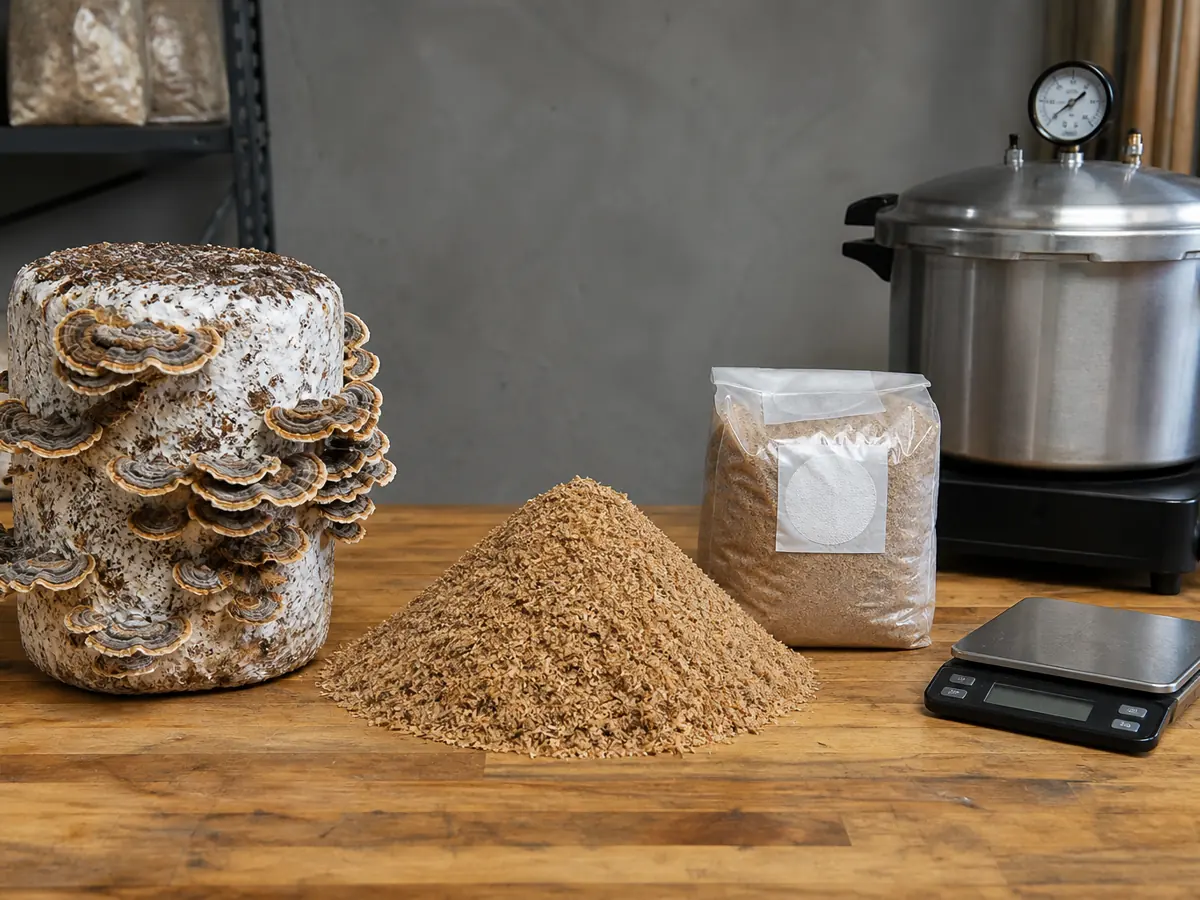
Buy one traceable block before scaling. A slow species can hide an upstream error for weeks, so several unverified bags do not create better evidence than one carefully documented unit.
Record the culture, substrate, receipt or inoculation date, bag mass, and supplier conditions. Those notes let you separate a slow strain from a room problem later.
What hardwood substrate supports turkey tail?
T. versicolor is a white-rot fungus adapted to lignocellulosic material.
Published work has grown it on birch sawdust, oak sawdust, and formulated agricultural byproducts, but those ingredients belonged to different strains and container systems.
Use one complete proven method instead of taking the fastest colonization result from one study and the highest yield amendment from another. Particle size changes air space, supplements change contamination pressure, and fill mass changes heat movement through the container.
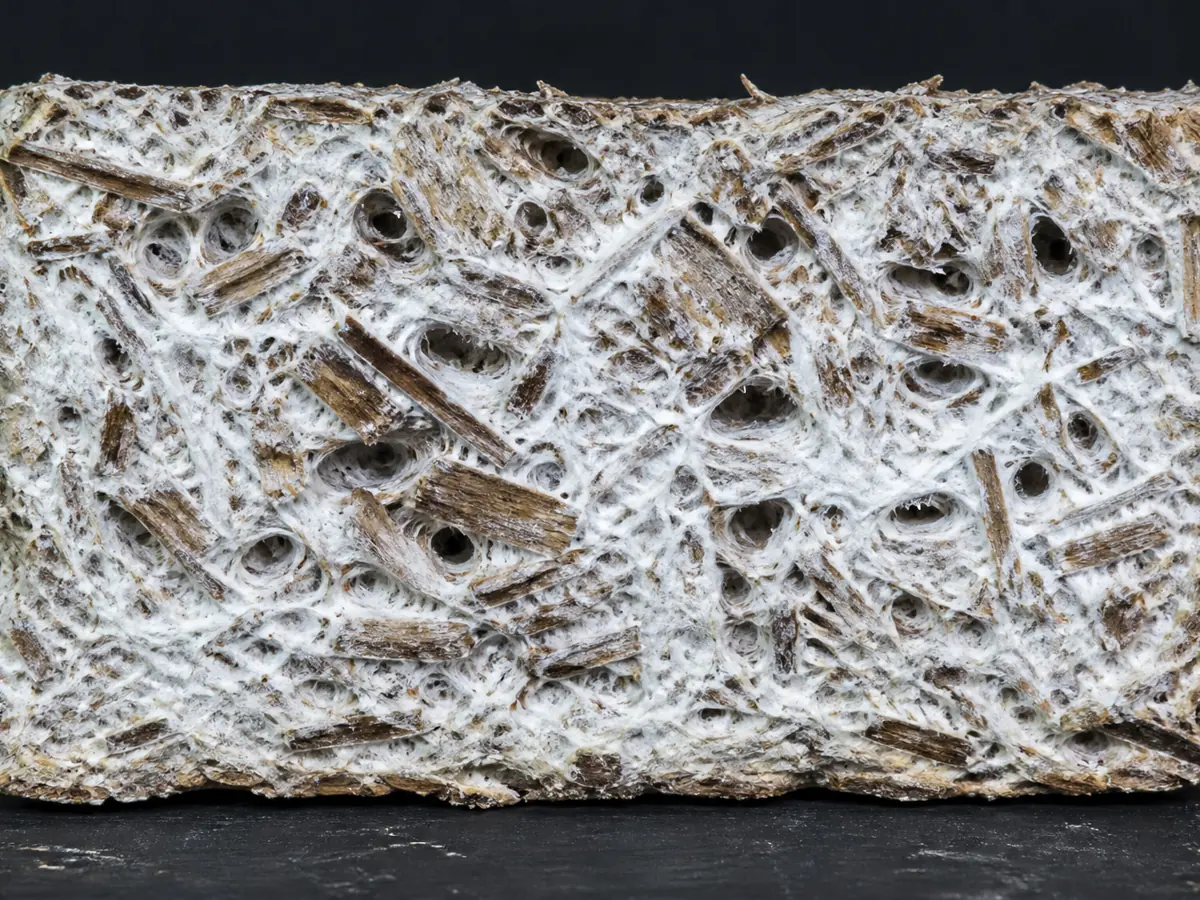
The cut face is useful during method development, not as a routine inspection that sacrifices production bags. Make one documented test block when you need to verify internal moisture and packing, then leave matched sealed blocks intact.
| System part | What to record | Why it matters |
|---|---|---|
| Hardwood | Species, particle size, and dry mass | Fine material packs more tightly |
| Supplement | Ingredient and dry percentage | Added nutrition also feeds competitors |
| Water | Measured addition and final method | Free water removes useful air space |
| Bag | Fill mass, filter, and closure | Geometry changes heating and exchange |
| Treatment | Full temperature, pressure, and time process | The center must receive the process |
One physiological study reported strongest mycelial growth near 25°C for its strain and attempted fruiting on 90 percent sawdust with 10 percent rice bran.
Treat those values as one documented system, not universal settings for every bag.
The mixed material should feel evenly damp and springy rather than muddy. Water should not collect at the bottom, and the filter must remain dry and unobstructed.
How long should the block stay closed?
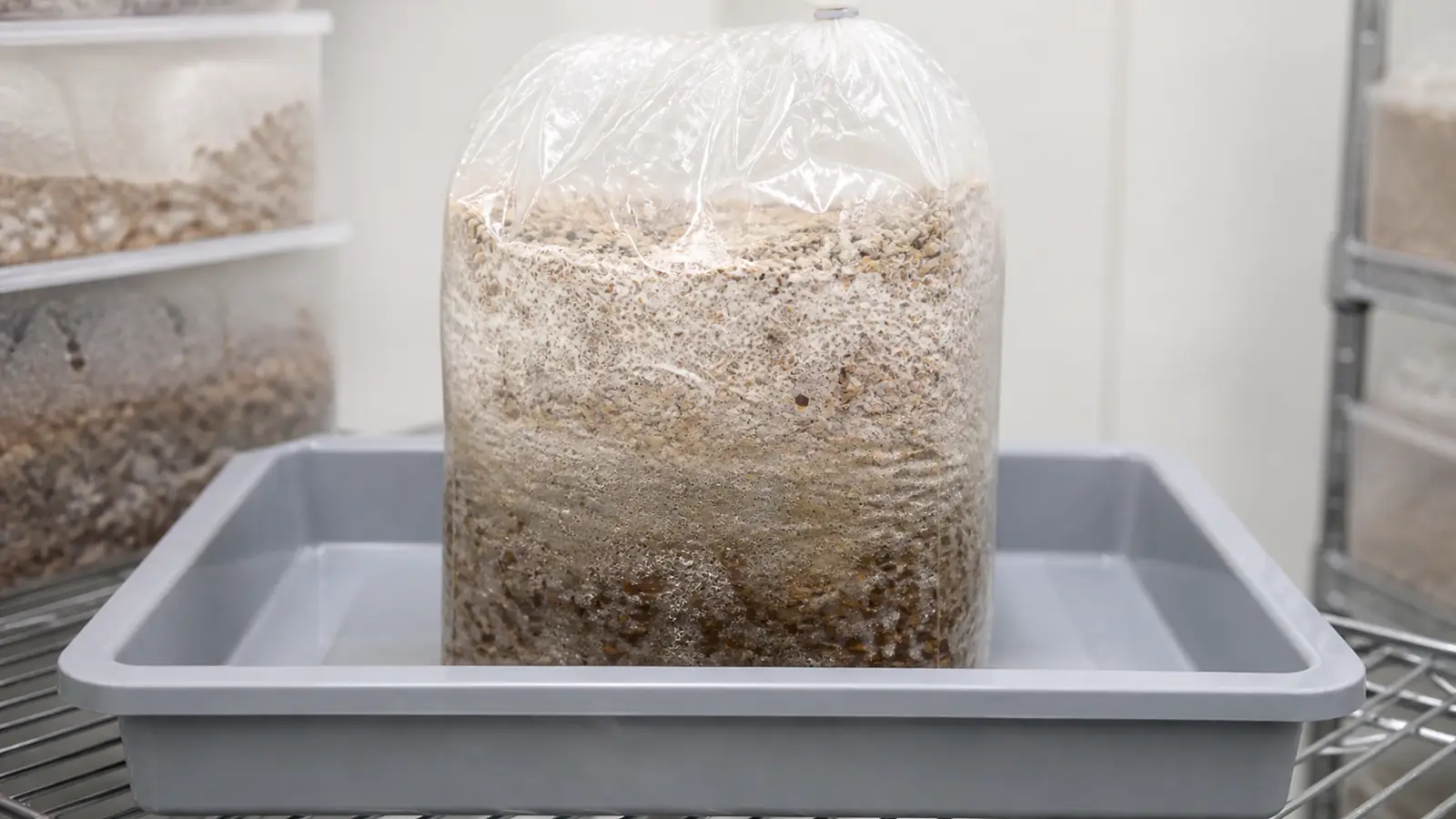
Healthy colonization advances as connected white mycelium through the wood particles.
The useful checkpoint is whole-block occupation and binding, not a white patch near the inoculation point or a date printed on the calendar.
Inspect the sealed bag from several sides under neutral light. A stable brown piece of wood surrounded by advancing white growth can still be unfinished substrate, while a green dusty island or wet translucent channel is a different organism or decay process.
- Active
- The white boundary advances between dated photographs
- Nearly ready
- Coverage is broad but one interior or base pocket remains loose
- Ready to assess
- The block is coherent, evenly occupied, and within the strain's maturation guidance
- Isolate
- A colored colony or wet collapse expands independently
Photograph the same broad face and the base at fixed intervals. A consistent view distinguishes a genuinely advancing white boundary from glare, condensation, or a patch that merely looks larger from a new angle.
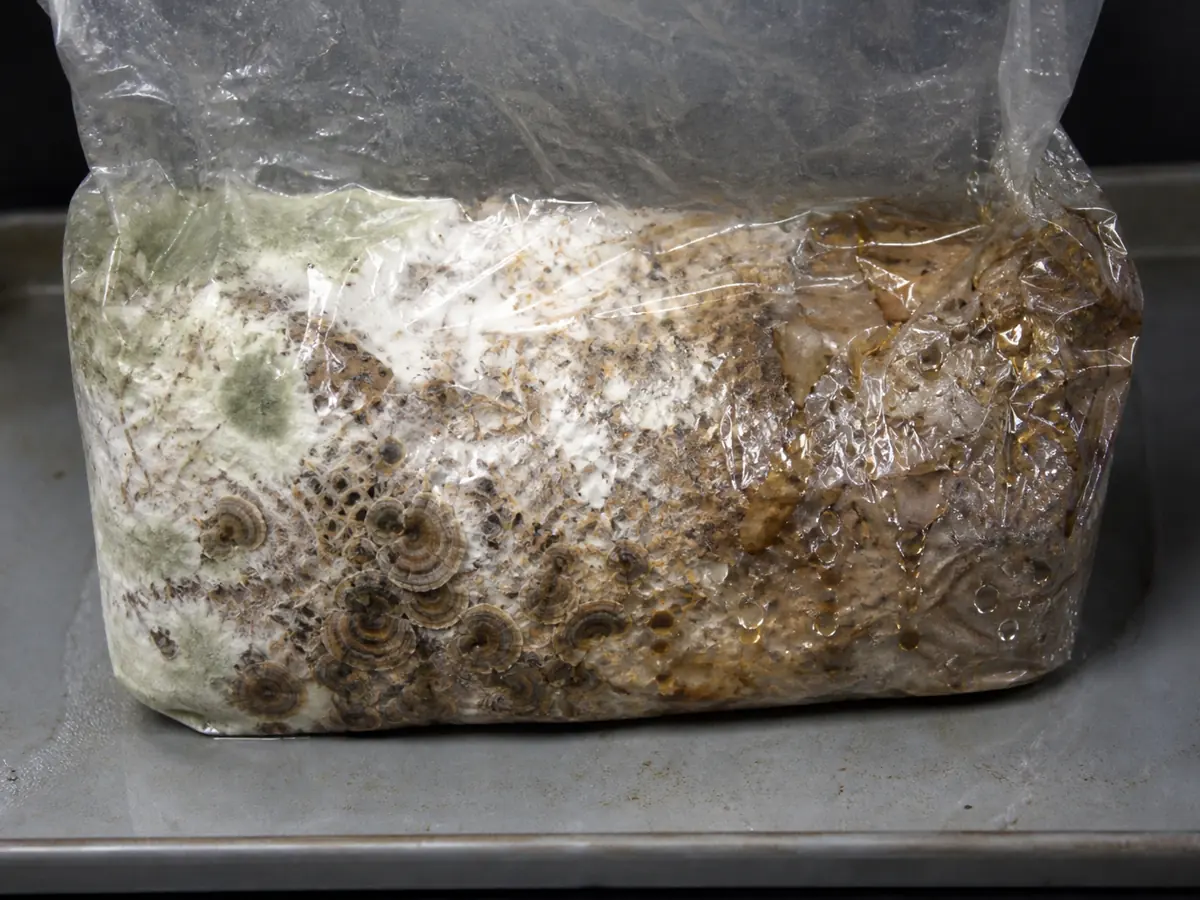
Several bags close together can warm their own shelf.
Leave space between containers and measure beside the substrate rather than assuming the room thermostat represents the block.
Do not squeeze a slow bag each day. Repeated handling breaks new connections and can pull room air through a weak seal without telling you whether the interior is clean.
Growing MushroomsHow Do Mushroom Sawdust Blocks Work from Mix to Fruit?When should a colonized turkey-tail block meet room air?
Keep the block closed until visible occupation, structural binding, and the culture supplier's supported maturation period agree.
Calendar age cannot replace those signs. A fast white surface may conceal loose material in the center or base, while a slower coherent block may simply reflect a denser hardwood mix or cooler incubation.
The opening should create one deliberate fruiting face while leaving most of the block covered. Turkey tail shelves need an attachment surface and room to project outward, but peeling off the whole bag creates unnecessary evaporation.
Clean the fruiting area
Wash the shelf, drainage surface, and enclosure before the block arrives
Inspect through the bag
Reject or isolate expanding foreign growth before cutting
Choose one face
Select a surface with clearance for overlapping fans
Make the supported opening
Follow the producer's opening geometry and keep the remaining plastic intact
Place and observe
Photograph the exposed face before changing another control
Before making the cut, press only as much as the supplier permits and compare the block with its earlier photographs.
A loose center, new wet pocket, or expanding colored boundary is a reason to keep the bag sealed and isolate it, not a reason to expose more surface.
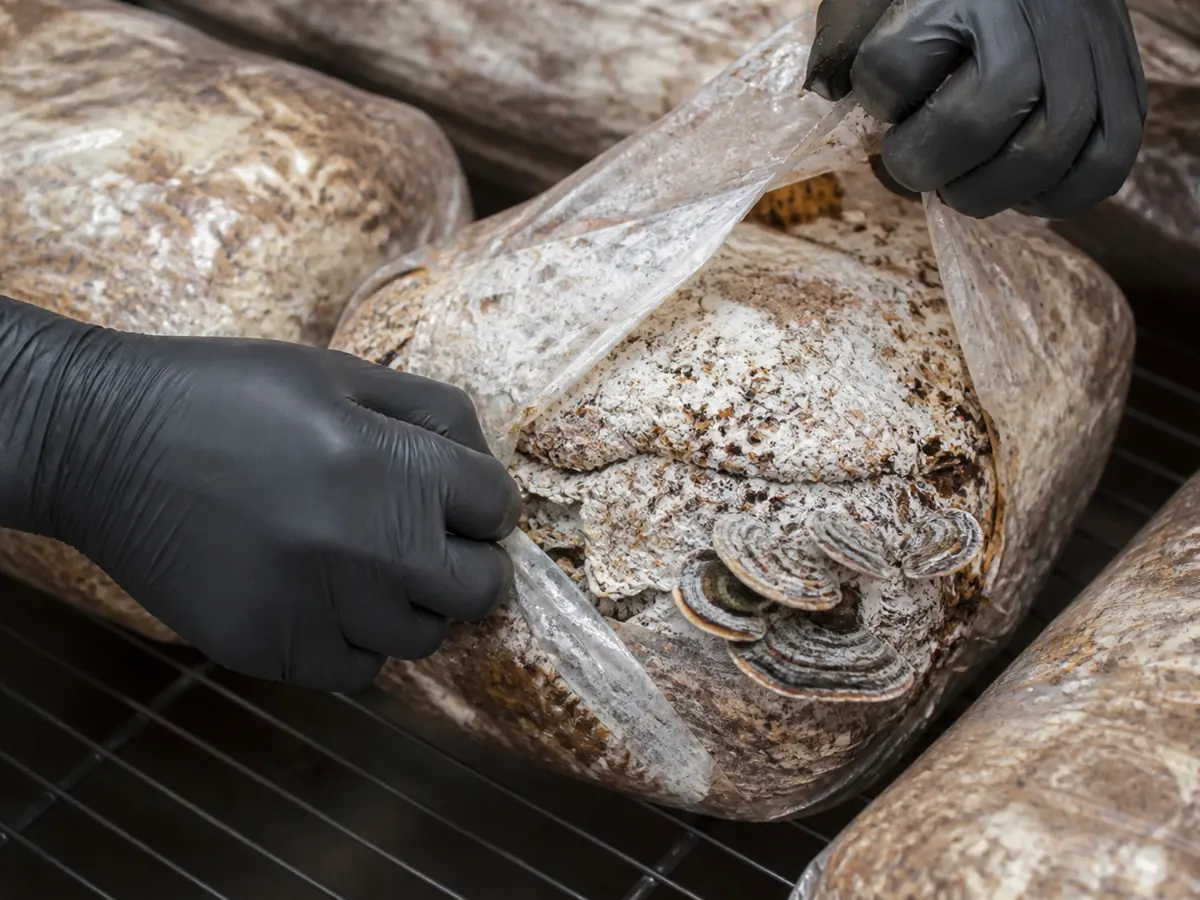
Place the opening away from a direct humidifier plume or fan. Moving humid air should replace stale air without drying the thin edge or leaving droplets sitting on it.
If the exposed face browns and hardens before organized fans appear, review surface drying and maturity first. Cutting several new holes usually multiplies the same problem.
How do thin shelves become recognizable turkey tails?
Early fruiting may begin as white ridges, bumps, or small fan edges on the exposed wood.
Those structures should organize into thin overlapping shelves rather than a thick fleshy cap or an indefinitely flat white crust.
As each fan expands, its upper surface develops texture and colored bands. The lower surface remains pale and later resolves into fine pores, so photograph the side profile and underside instead of judging the crop from above.
The two faces mature on different visual cues. Bands on top support recognition, but only a close underside view can show whether the fertile surface has become finely porous instead of remaining smooth or developing teeth.
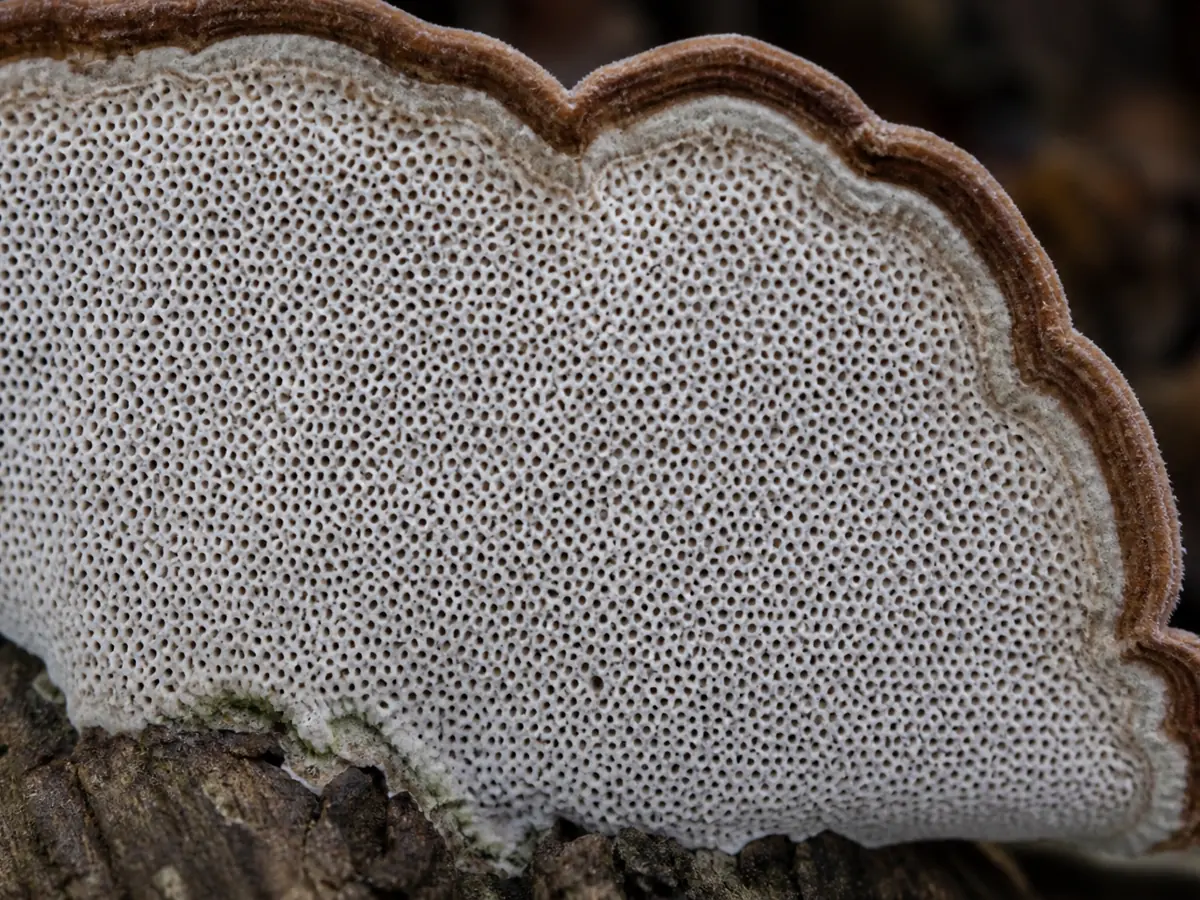
Inspect several fans because pore development can lag at crowded inner shelves. A zoned upper face remains incomplete identity evidence when the underside is smooth, toothed, damaged, or too immature to resolve under magnification.
| Visible state | Interpretation | Next decision |
|---|---|---|
| White raised ridge | Possible early organization | Hold stable conditions and compare growth |
| Thin projecting fan | Shelf formation | Preserve gentle humid exchange |
| Zoned top and fine pale pores | Characteristic crop development | Continue to firm maturity |
| Flat smooth underside | Identity or development problem | Recheck culture and morphology |
The advancing edge is usually paler and softer than the older center.
A healthy edge expands across repeated observations, while a dry rigid margin signals that the surface or airflow may be too harsh.
Pore formation is not a reason to handle every shelf. Use a mirror or camera to inspect the underside and avoid bruising the thin fruit bodies.
Growing MushroomsHow Do You Build an Outdoor Mushroom Bed That Lasts?How should air, humidity, and light be adjusted?
Turkey tail needs humid replacement air, diffuse light, and enough space for thin shelves to spread.
These controls work together, which is why raising humidity cannot compensate for stagnant air and stronger exhaust cannot compensate for a dry stream hitting the crop.
Read the organism before changing a device setting. Long pale growth with poor shelf definition suggests that exchange or light may be insufficient, while crisp edges and stalled fans point toward drying or excessive direct movement.
Thin expanding fansKeep the current balance and continue observing
Dry-firm older zones with a pale active rimNormal maturation pattern
Condensation sits on the fruit bodyRedirect droplets and improve gentle mixing
Edges curl hard beside a ventReduce direct flow and restore humid air around the crop
Use diffuse room-cycle light rather than heat-producing close lamps. Light helps orient development, but temperature and evaporation at the block still decide whether the margin remains active.
Change one control at a time and keep it long enough to produce a visible response.
Simultaneous changes to fan speed, humidity, and opening size destroy the comparison the next photograph should provide.
Map the air path with the crop in place rather than relying only on an empty-room reading. Overlapping fans and neighboring blocks can create a sheltered pocket, while a vent that clears the room average may dry the nearest pale margins before air reaches the back of the shelf.
Use crop-height observations from at least two positions when the enclosure holds several blocks. If one position repeatedly makes compact shelves and another produces thin expanding fans, correct placement or local mixing before increasing whole-room exhaust.
Which block changes require sealed isolation?
Expected crop colors occur in organized fruit tissue and stable woody substrate.
Green powder, black expansion, pink growth, wet collapse, or a foul odor through the filter forms a separate boundary and requires isolation.
Keep a suspect bag closed while moving it away from healthy blocks. Cutting around a visible colony cannot show how far another organism or its metabolites have moved inside the wood.
Use a washable tray and move the whole unit without passing it over healthy shelves. Record its batch, shelf position, first abnormal photograph, and neighboring units before cleaning the vacated area.
Warning
Contain a suspect block before diagnosis | Opening a sporulating bag in the fruiting room spreads material across shelves, tools, filters, and other crops.
The same rule applies to unproductive blocks. If a fully mature block repeatedly forms only an inactive crust under the supported conditions, confirm culture identity and process records before adding more cuts or soaking cycles.
Retire material that loses structure, develops wet decay, produces foreign sporulation, or completes the supplier-supported cycle without renewed active edges.
A long-lived hardwood block is not an indefinite project. Keeping a failed unit in the fruiting room increases exposure time without creating evidence that another soak or cut will restore organized shelves.
Document where the defect began and which nearby bags share the substrate batch. Several failures at the same age point toward preparation or inoculation, while one dried face beside a vent points toward local fruiting conditions.
Retirement also protects the next clean batch from ambiguous carryover. Remove spent or repeatedly inactive blocks before introducing new units, then clean the shelf, drainage surface, tools, and any container that contacted the old substrate.
When are turkey-tail shelves mature enough to harvest?
Harvest when the fans have developed their intended colored zones, fine pale pores, and a dry-firm texture, and when the pale advancing margin has narrowed across repeated observations.
Large diameter alone is a poor endpoint because strain and arrangement change fan size. Check several shelves across the cluster because crowded inner fans may retain moisture after the exposed outer fans feel ready.
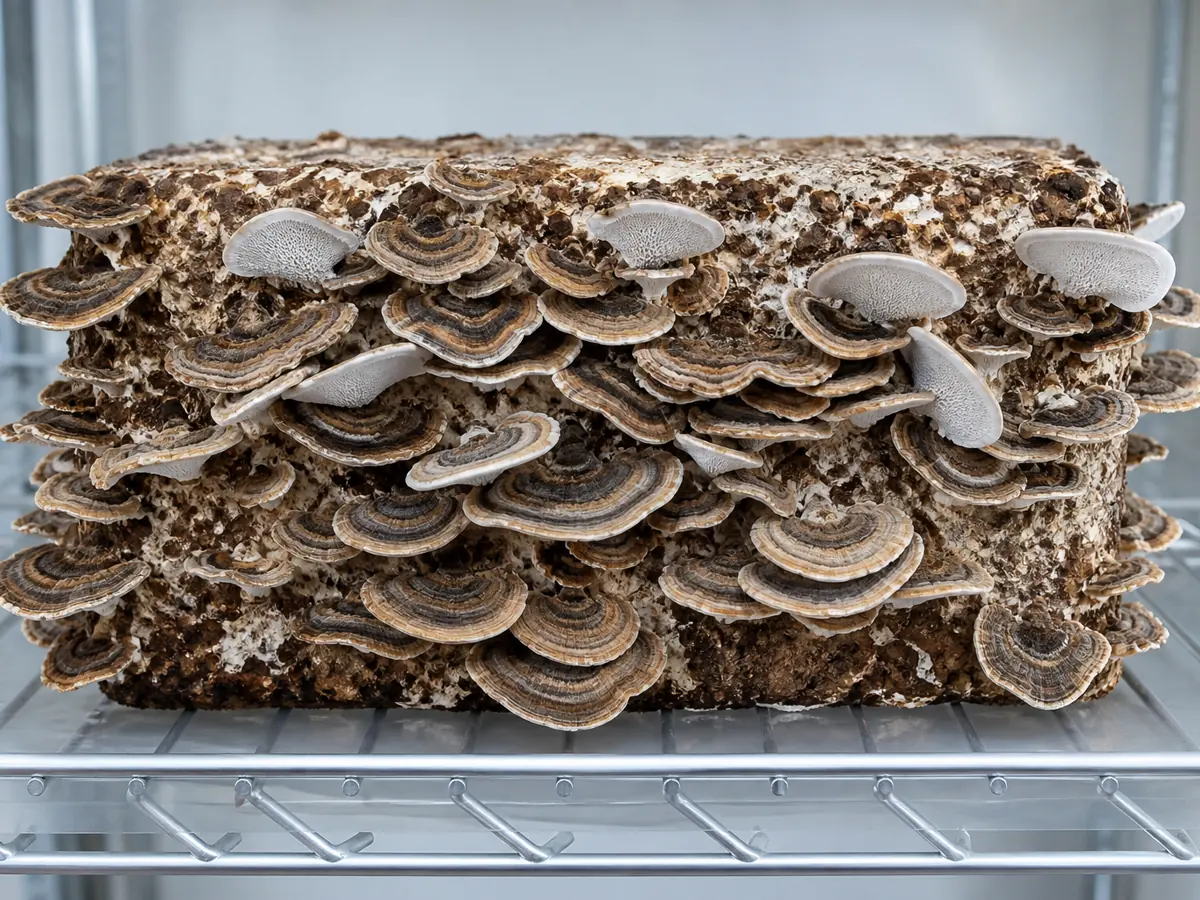
Cut the shelf cluster cleanly at its attachment while supporting it. Brush away loose woody material, reject soft waterlogged tissue, and keep each block's harvest separate until inspection is complete.
- Photograph the top, underside, and attachment before cutting.
- Record the first fruiting date and harvest date.
- Dry promptly if the material will be stored.
- Reject any batch that develops mold, musty odor, or renewed moisture in storage.
The final record should connect culture lot, substrate batch, opening date, room observations, and harvested condition. That chain is more useful for the next crop than a single yield number detached from how the fans developed.