A fruiting chamber manages moisture, fresh air, light and temperature around a substrate that has already finished colonizing, and the first two work against each other. This guide names that trade-off, gives the measured consequence of letting the stale side win, tells a reader honestly when a kit, an outdoor bed or a deep tub means they need no chamber at all, chooses between designs by substrate mass rather than sophistication, and separates the faults the chamber genuinely causes from the ones that arrived with the block.
A fruiting chamber has to hold moisture in and let stale air out at the same time, and those two jobs work against each other.
Almost every home fruiting problem is one of those two sides winning.
A fair number of growers reading this do not need to build anything at all, and that case is worth settling before any shopping list.
What the box is actually controlling
A fruiting chamber surrounds a substrate that has already finished its growing. It manages the air around a colonized block, and it cannot reach anything inside that block.
That distinction decides what the chamber can fairly be blamed for later.
There are four conditions in play, and they are not equally difficult to manage.
| Condition | What it needs | Who actually controls it |
|---|---|---|
| Moisture | A substrate surface that does not dry and crust over | The chamber, mostly |
| Fresh air | Stale air cleared from where the mushrooms sit | The chamber, and this is the hard one |
| Light | Enough to trigger pinning, not enough to matter for energy | The room, in almost every case |
| Temperature | A range the species will fruit in | The room, and the chamber barely shifts it |
Only one of those four is genuinely the chamber's problem to solve.

Light causes more anxiety than it deserves. Most cultivated species treat it as a signal that they have reached open air rather than as a food source, so indirect daylight or a few hours of ordinary room lighting does the job.
Temperature is mostly out of the chamber's hands, because a plastic box sitting in a room settles to that room's temperature within an hour. The practical control is which room you put it in.
That leaves moisture and fresh air, and species differ in how much slack they give you on each.
There is a second job hiding inside that list, and it is the one people miss.
A colonized block does not fruit because conditions are comfortable. It fruits because conditions changed, and the change is what tells the fungus it has reached open air and should stop spreading and start reproducing.
Those five arrive together the moment a block goes into a chamber, which is why the move itself often does more than anything you do afterward.
That also explains a common frustration. A block sitting comfortably in a warm room for weeks may be waiting for a change rather than for more time, and giving it one costs nothing.
A lion's mane block tolerates stiller air than an oyster block of the same size, which is one reason the same chamber suits one species and disappoints with another.
Growing MushroomsWhat Does a Mushroom Farm Actually Cost to Start?The trade-off every chamber has to solve
Holding moisture means restricting how fast air moves through the box, and clearing stale air means moving air through the box. There is no arrangement that gives you both at full strength.
Every chamber design is therefore a position on that trade rather than an escape from it, and knowing which position you have chosen is most of the skill.

The stale half of the problem is carbon dioxide, and a growing block produces it continuously. Because it is denser than the surrounding air it settles low, which is exactly where the substrate surface and the developing mushrooms sit.
That is why vent placement matters more than vent count.
Key takeaway
Penn State Extension puts the pinning target at a carbon dioxide content of 0.08 percent or lower, depending on cultivar. That is a small number, and a sealed box with an active block inside passes through it quickly.
What happens past that point has been measured rather than guessed.
Growers usually describe this failure as long stems, and in a crowded tub the crop does read that way. What the measurement supports without argument is the other half of the description: the caps do not develop.
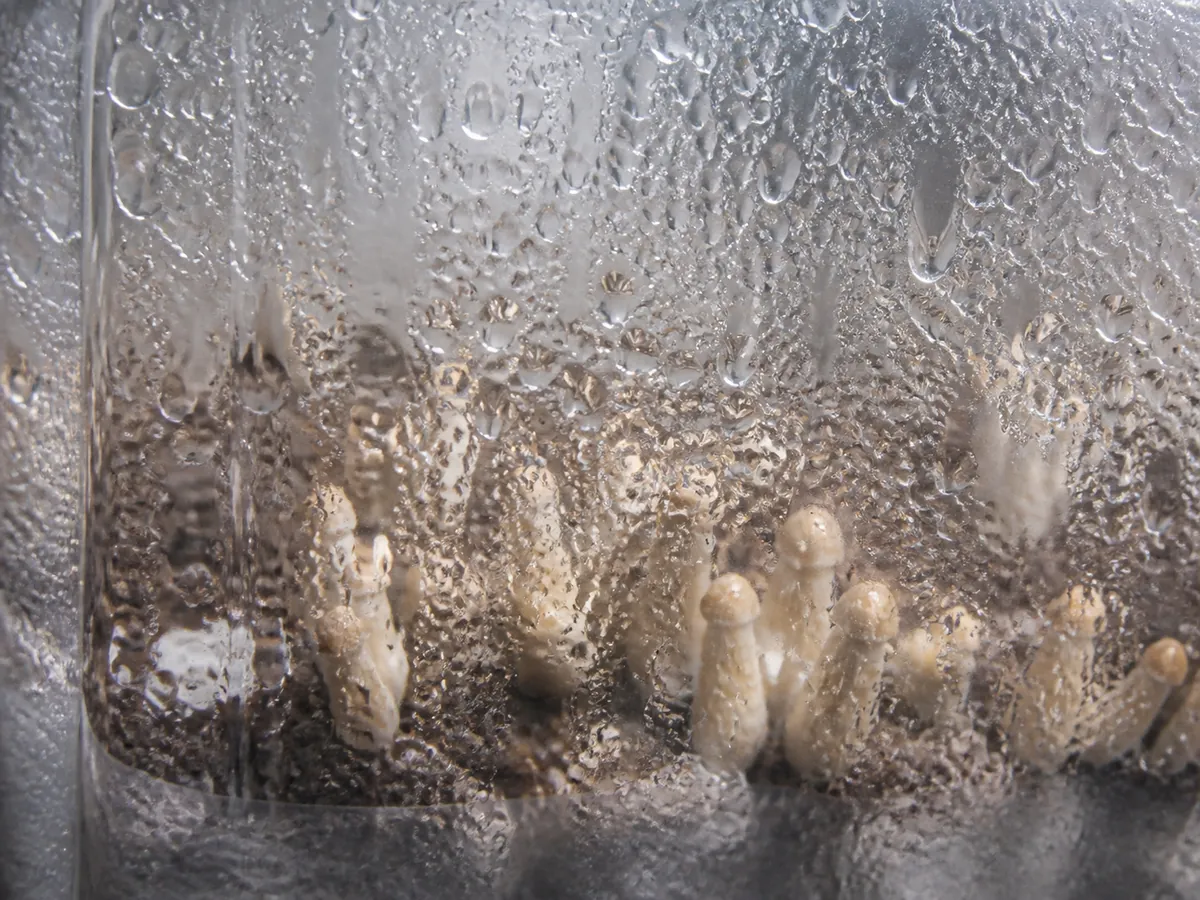
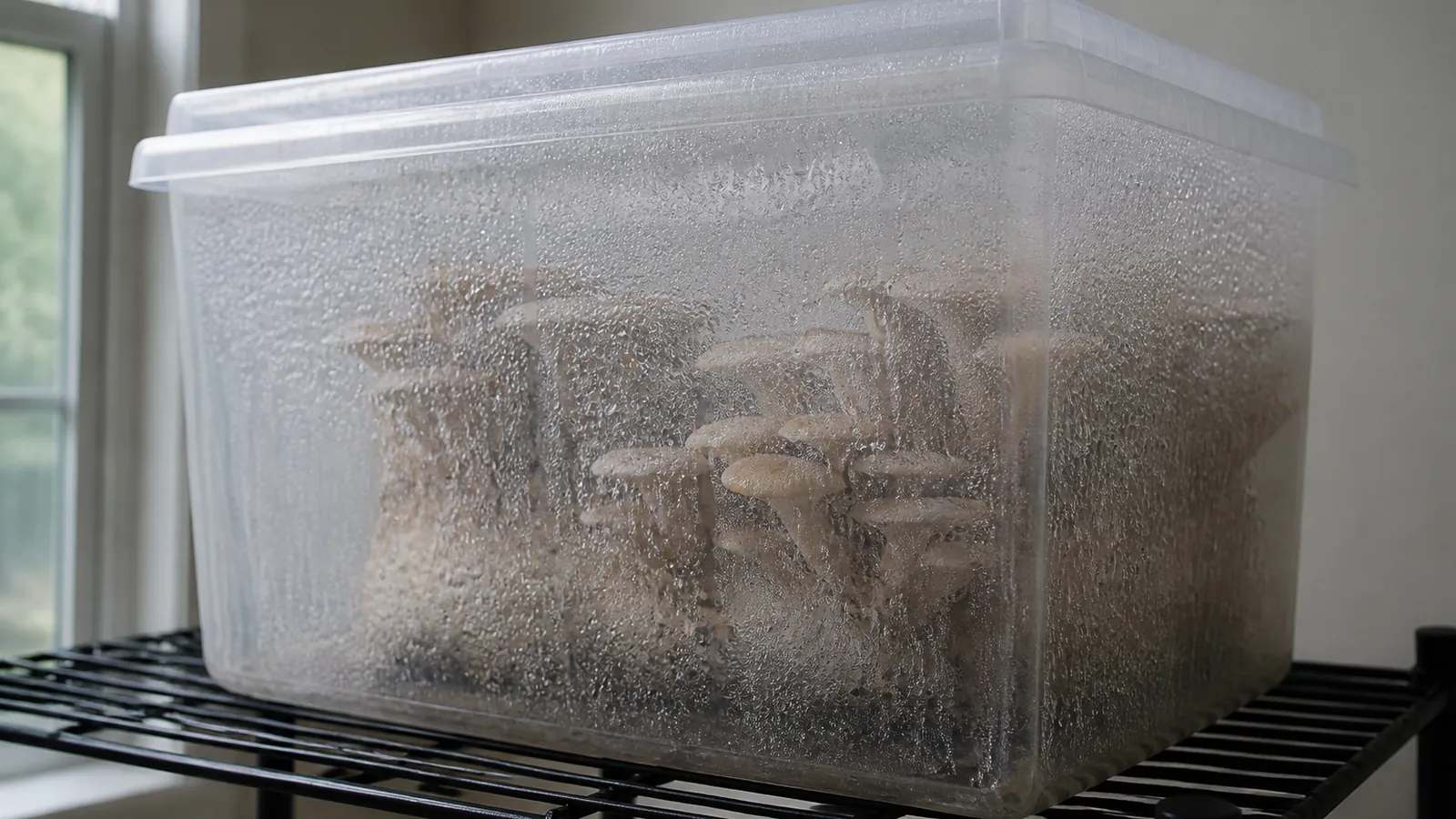
Condensation is a useful signal and a misleading one at once.
Beads on the wall tell you the air is saturated. They do not tell you the substrate surface is still damp, and those two can come apart within a day.
The strangest evidence that this trade-off is real comes from the supermarket. Commercial enoki are grown in tall bottles under deliberately stale, dark conditions, and the long stems and undeveloped caps that ruin an oyster crop are the entire product being sold.
Do you need one at all?
A large share of home growers do not, and the category rarely says so out loud.
The deciding factor is how much exposed surface there is compared with how much substrate sits behind it. A small block holds very little water in reserve and dries within hours, while a deep tub carries days of moisture in sheer mass.
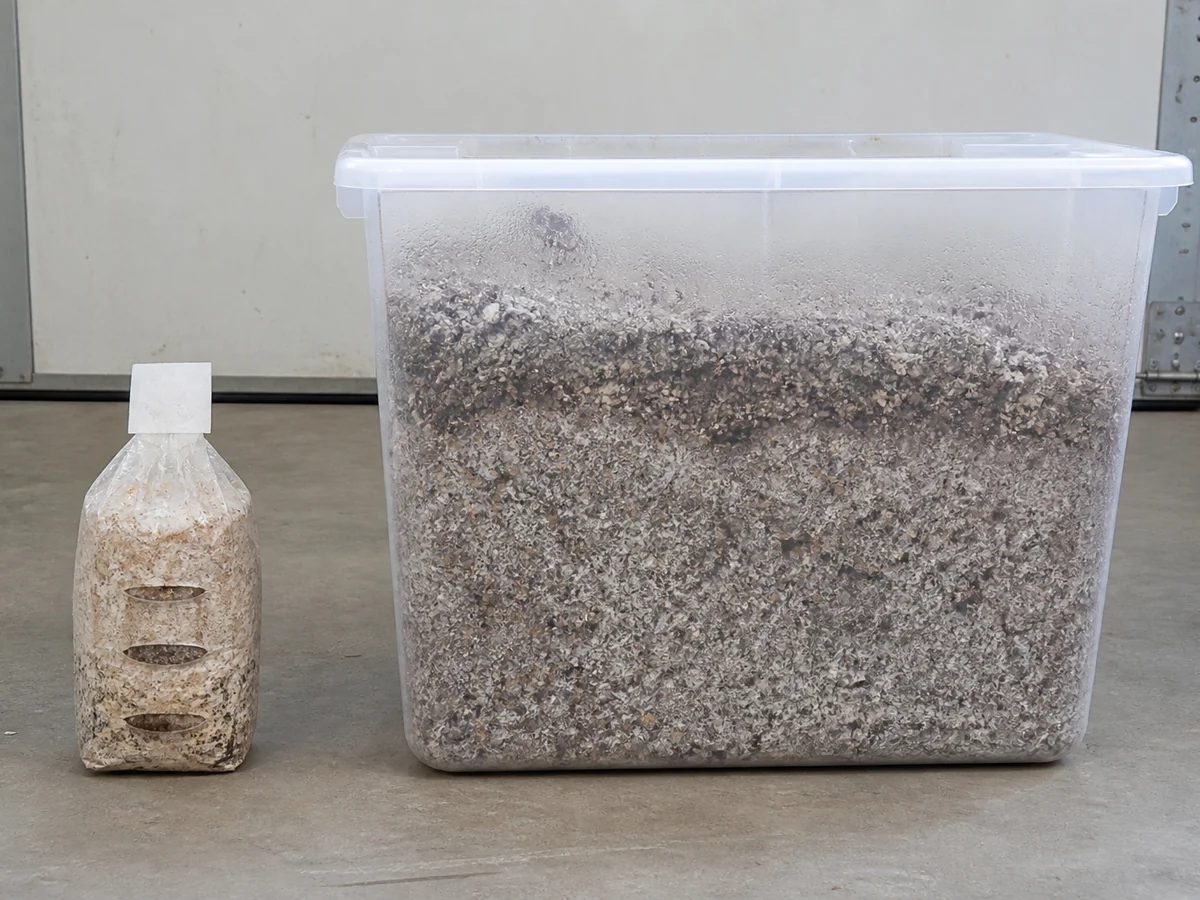
Sorted by that one factor, the common situations separate cleanly.
You bought a ready-made kit
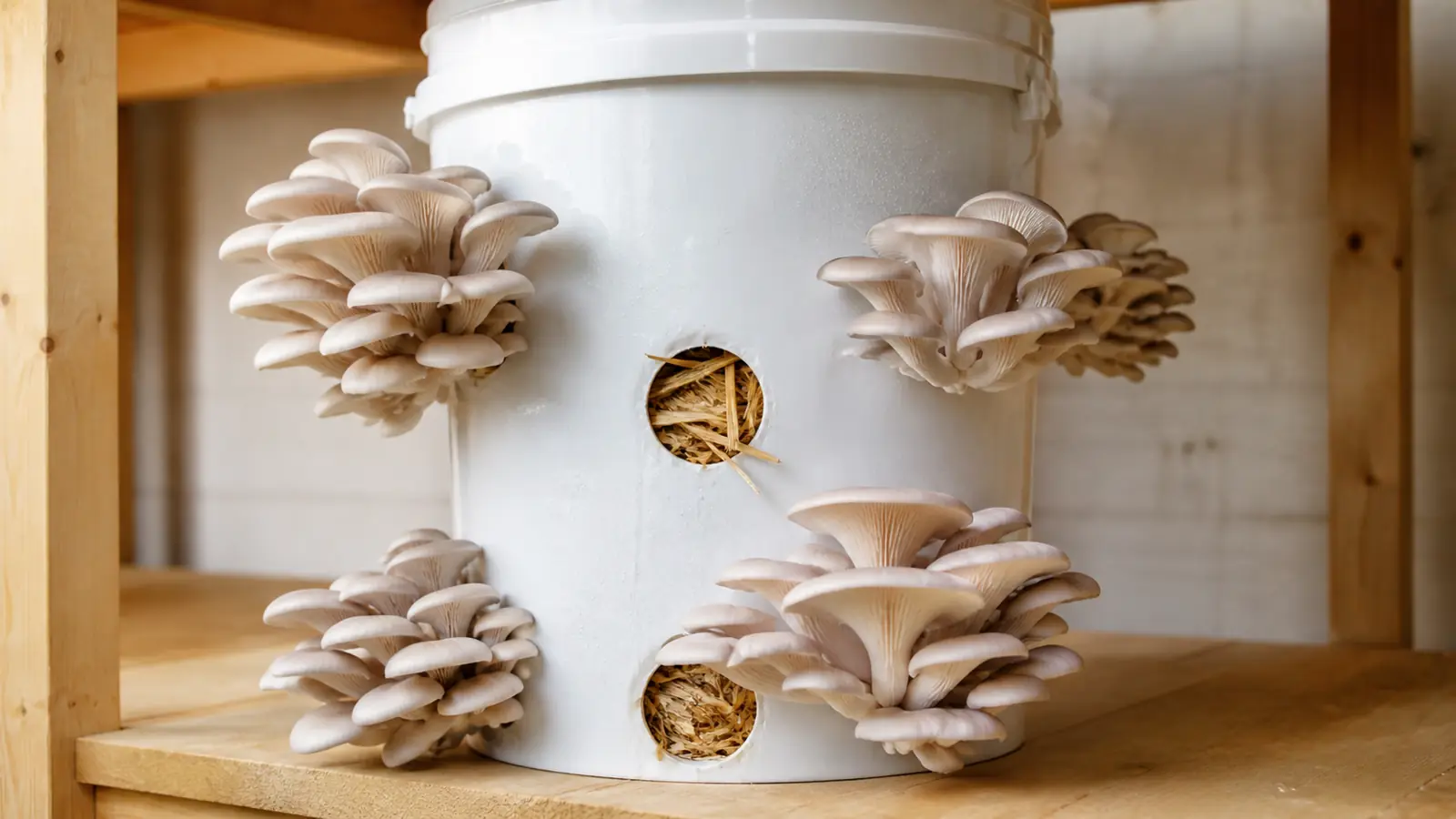
Build nothingThe bag it arrived in is already the chamber
You have a bed outdoors
Leave it aloneGround moisture and weather do the regulating for you
You have one deep tub of substrate
Manage the lidSubstrate depth buffers moisture without a second box
You have one small block indoors
Build something simpleThis is the case that genuinely needs help, because it dries fastest
You have several blocks at once
Build for the groupShared humidity is easier, and shared air is harder
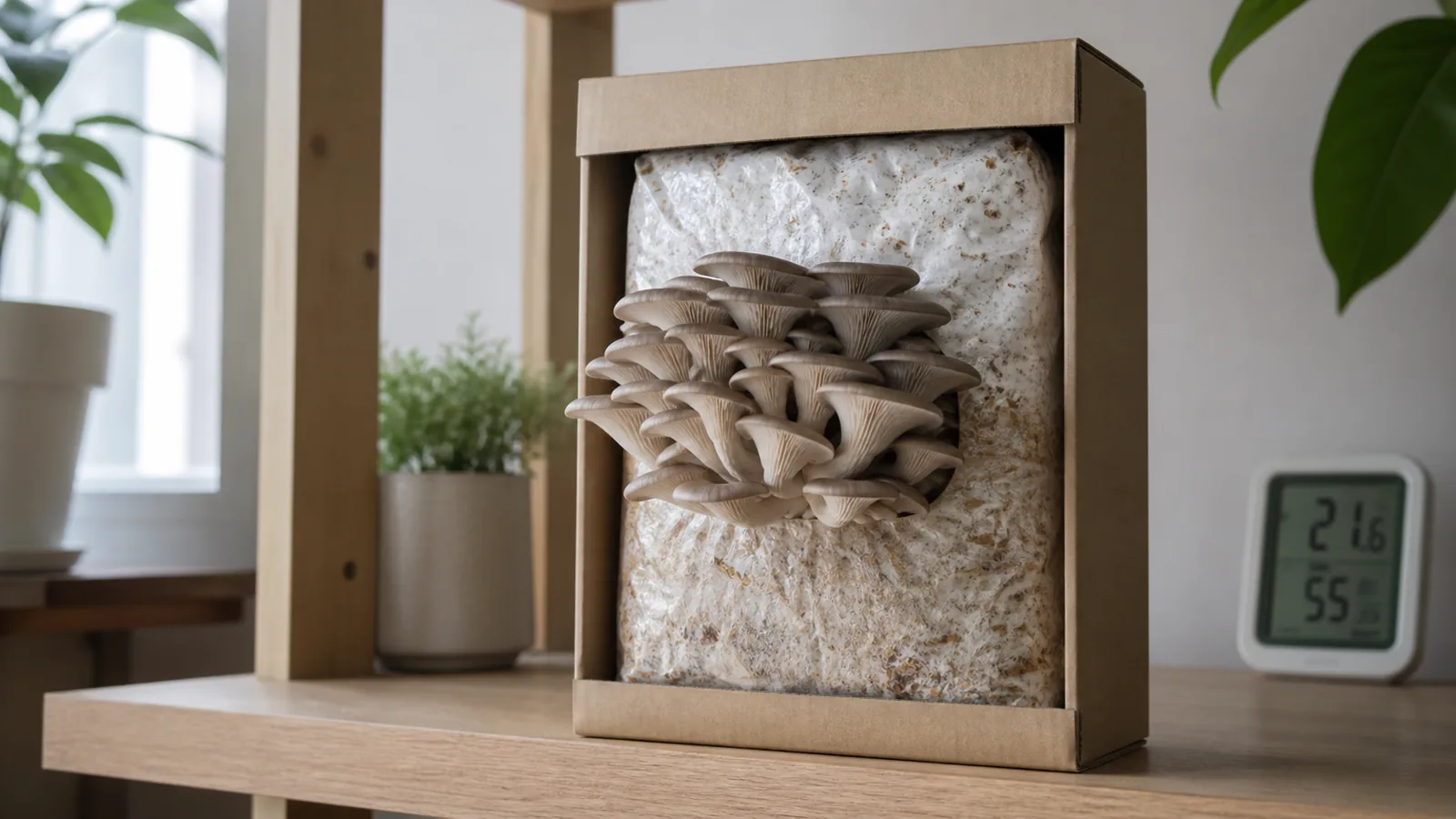
A growing kit is the clearest case of all.
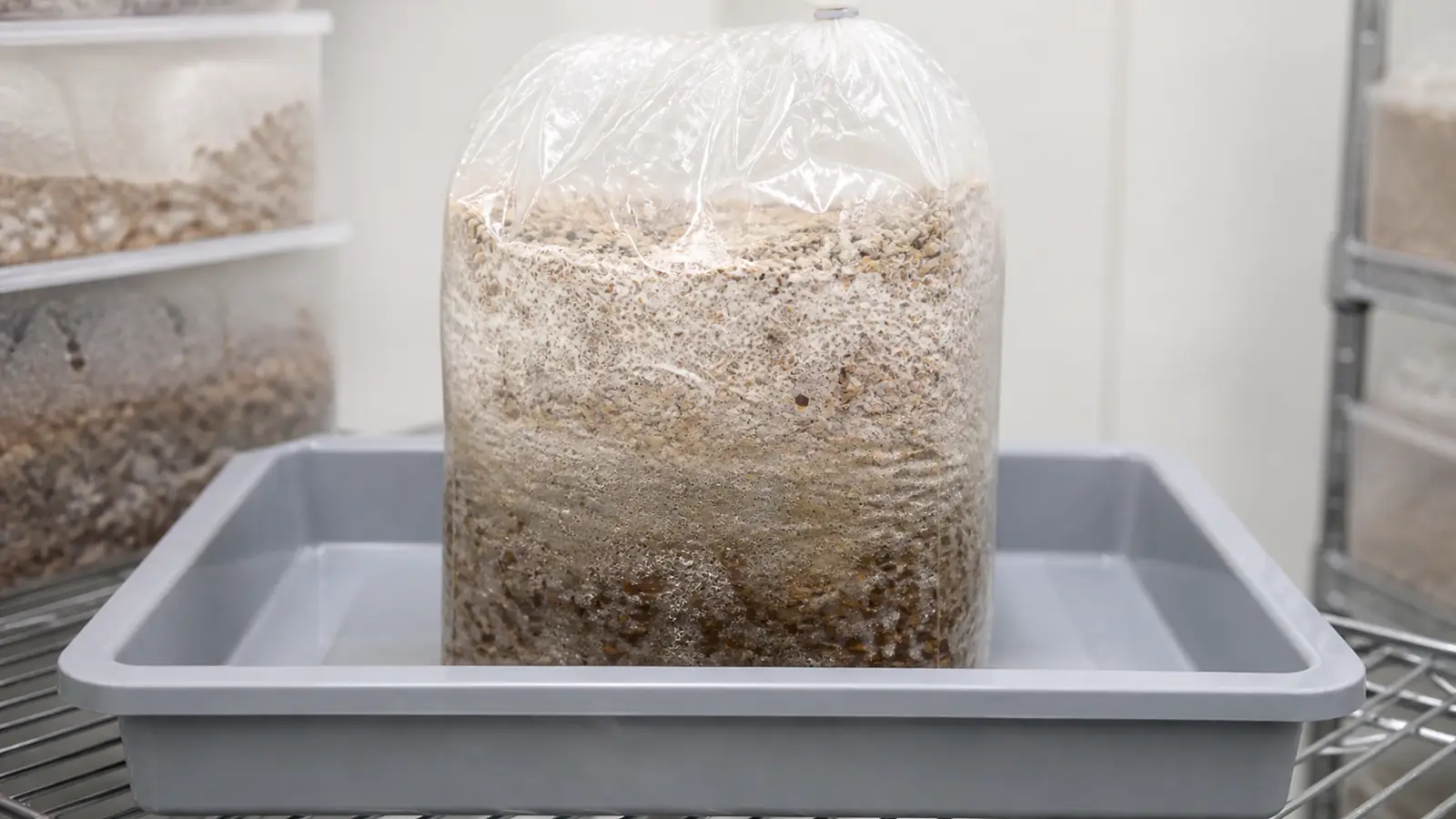
It arrives colonized in a bag that already restricts airflow and holds moisture, so cutting it open and standing it inside a second humid box usually causes more problems than it solves.
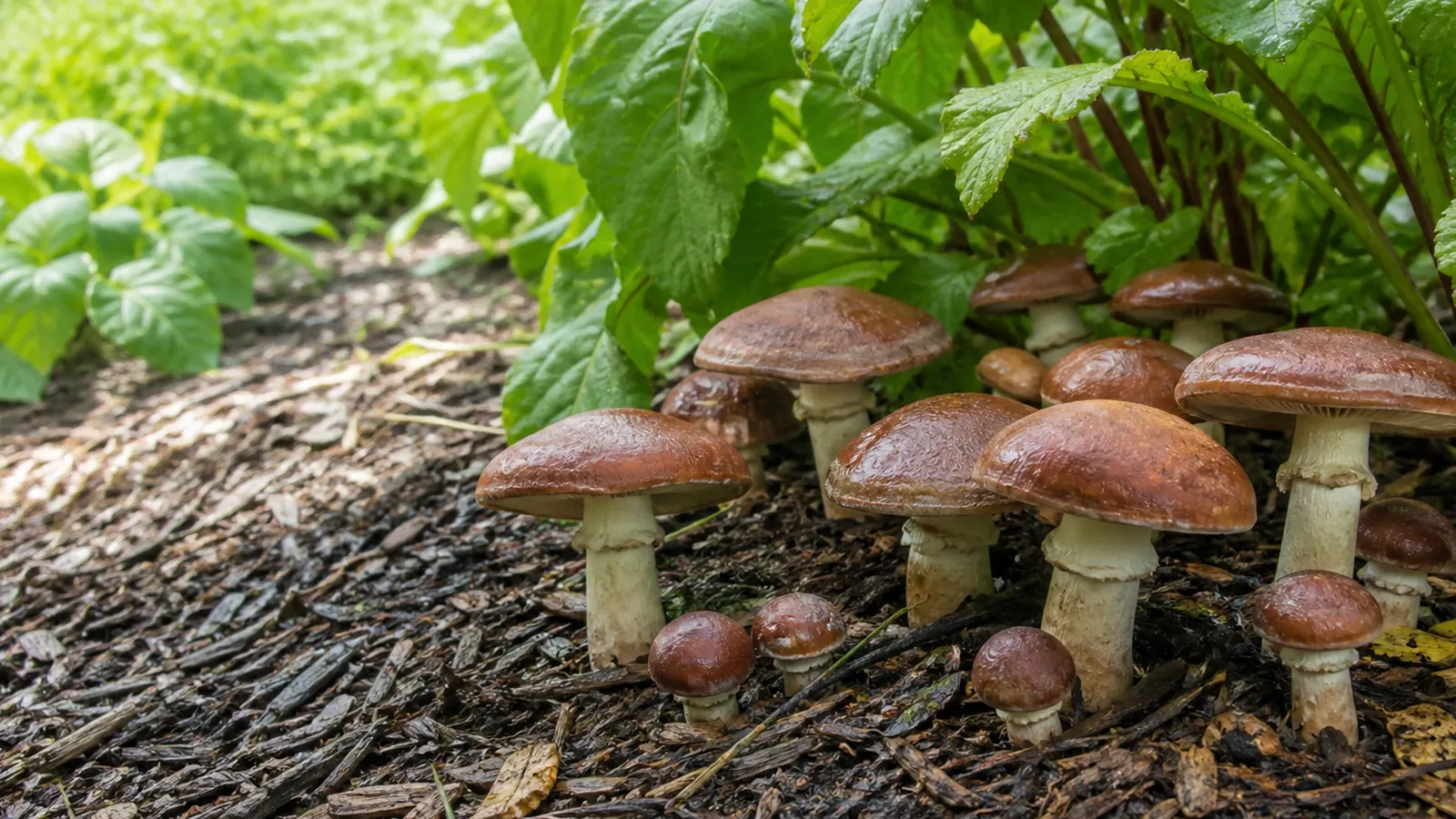
Outdoors the argument disappears entirely, because an outdoor bed sits on ground that supplies moisture from below and is vented by open air. That is a better chamber than anything a garage will hold.
The species you chose matters more than the box you build.
- A kit needs no chamber, and opening it into one is a step backward
- An outdoor bed needs no chamber, and cannot usefully be given one
- A deep tub is already most of a chamber, so treat the lid as the control
- A single small block indoors is the one case that clearly benefits
- Several blocks at once change the problem from moisture to airflow
If you are still deciding what to grow rather than how to fruit it, some of the easier beginner species forgive stale air and dry spells that would cost you a crop of something fussier.
Growing MushroomsHow Do Mushroom Sawdust Blocks Work from Mix to Fruit?Choosing by how much substrate you have
Order the options by substrate mass rather than by how serious they look. More substrate makes the moisture problem easier and the air problem harder, because more substrate means more carbon dioxide produced every hour.

Against that ordering, four situations cover almost everyone.
The single-block case is the one most people over-engineer.
A sawdust block with slits cut in the bag, kept out of a draft and misted around rather than onto, will often fruit without any box at all in a reasonably humid room. The tub case differs in kind rather than in degree.
A deep layer of substrate in a lidded container is close to self-regulating, which is why monotub growing is built around substrate depth rather than around humidity equipment.
Above three blocks, hand misting stops being realistic. That is the point where a humidifier on a timer earns its cost, and where a small fan turns useful rather than harmful, because there is finally enough moisture supply to survive the airflow.
Scale changes which problem you are solving, which is why copying a large grower's setup at small scale so often fails.
Tip
If you are adding a fan to a chamber that already dries out between checks, you are treating a symptom on the wrong side of the trade. Fix the moisture supply first, then add the air movement that the extra moisture can now afford.
Reading the crop for the chamber fault
The two sides of the trade-off leave different marks, and both are visible well before harvest.

Four shapes cover most of what a chamber does wrong.
| What you see | What it points at | What to change |
|---|---|---|
| Stems long, caps small or unopened | Stale air at substrate level | More frequent venting, and an outlet higher than the inlet |
| Fuzzy white growth over the surface, no pins forming | The same stale-air fault, earlier | Vent before the surface commits to that growth |
| Cap edges dry, cracked, or curling up early | Too much air for the moisture available | Mist the walls more often, or vent less |
| Substrate surface crusted and pale | The same drying fault, on the substrate | Restore surface moisture before adding any airflow |
The fuzzy white case fools people because it looks healthy and busy. It is the fungus growing outward as loose aerial mycelium instead of committing to fruit bodies, and it is the earliest visible sign that the air has gone stale.

The correct outcome is easy to recognize once you have both pictures side by side. Growth goes into the caps, the stems stay short and thick, and the cluster holds together rather than reaching.
One shape is not a chamber fault at all.
A block that never pins is usually telling you about something that happened before it ever entered the box.
Faults that get blamed on the chamber
Rebuilding a chamber to fix a substrate problem simply reproduces the problem in a nicer box. Knowing which layer a fault belongs to is what stops that cycle.
Warning
Green mold almost always arrives with the substrate or the spawn rather than through the chamber walls. Building a cleaner box does not remove a contaminant that was already inside the block when it went in.
The chamber genuinely causes two things, and it is worth knowing them precisely, because everything else on the list below arrived from somewhere upstream.
- Bacterial spotting, when water is allowed to sit on caps
- Drying, when the box vents faster than its moisture supply can keep up
- Neither of those explains green mold, a sour smell, or patchy colonization
- Slow colonization finished happening before the block was ever moved
- A nicer box does not revisit anything that went wrong upstream
There is one case in between that deserves separating out. Pins that form and then stall and shrivel can come from the chamber or from the block, and that has its own set of causes rather than the two on this page.
Before rebuilding anything, it is worth checking the order in which the trouble appeared.
- A fault visible on day one of fruiting usually traveled in with the block
- A fault that develops over a week of fruiting is more likely the chamber
- A fault that survives a rebuilt chamber was never the chamber
- A fault that follows a change you made is the change, not the design
Running one day to day
The routine is short, which is fortunate, because a routine that takes ten minutes gets skipped by the second week.
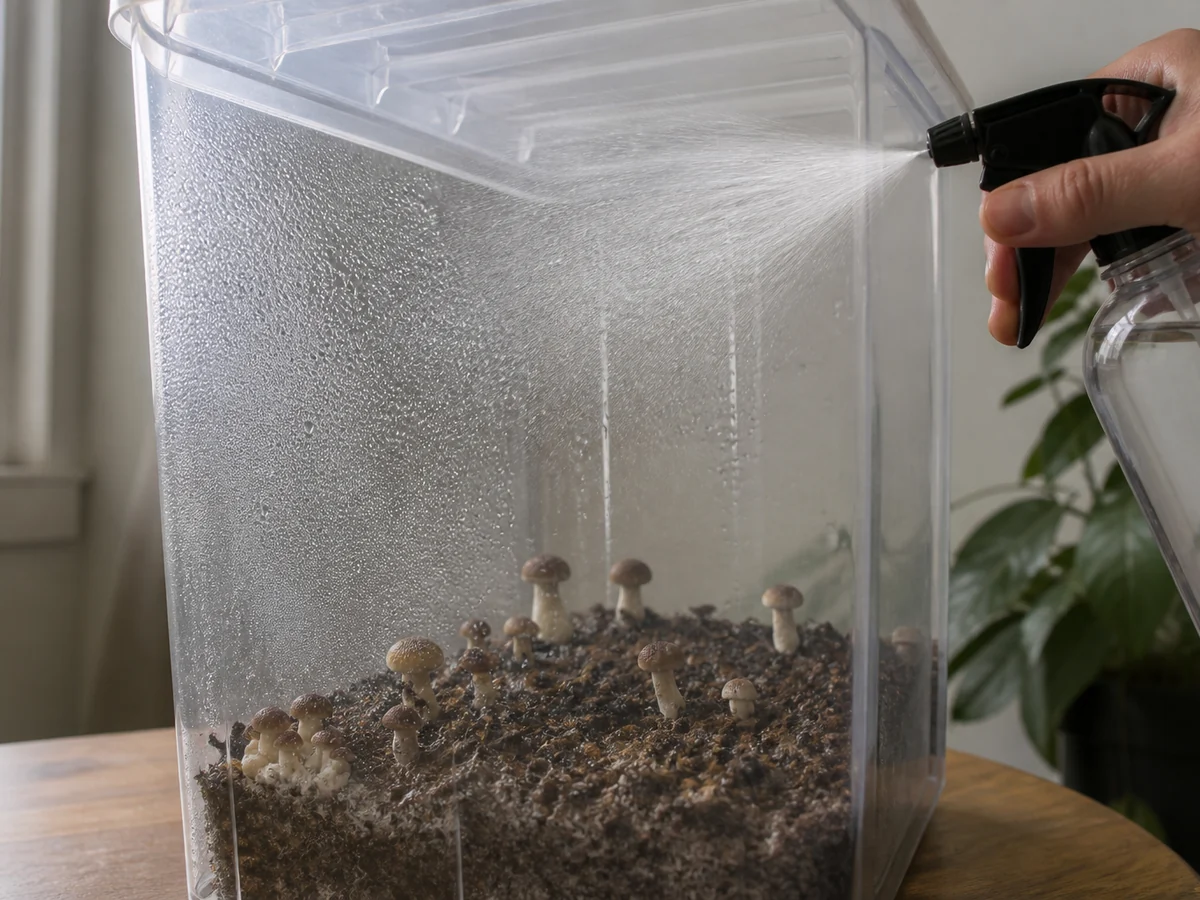
The most common daily mistake is spraying the mushrooms themselves, and water on a cap sits there, and a cap that stays wet is where bacterial spotting starts.
- Where the water goes
- On the walls and the floor of the chamber, never on the caps
- Venting a small sealed chamber
- Several times a day, fanning the lid rather than leaving it ajar
- Venting a large chamber
- Less often, since the volume of air buys you time
- A wall that has gone bone dry between checks
- Venting faster than the moisture supply can replace, so fix the supply
- When the flush is done
- Caps flatten and the edges start to turn up, which is before spores drop
Fanning beats propping the lid open, and the reason is worth holding onto. A short full exchange replaces the air that has settled at substrate level, while a permanently open gap bleeds moisture continuously for a fraction of the same air turnover.
Harvest timing sits at the end of the same logic. Once the caps flatten and the margins begin to lift, the crop has stopped gaining and is about to start dropping spores into the box you now have to clean.
Sources & References
- Mushrooms Production and Harvesting, Penn State Extension The pinning-stage target of 0.08 percent carbon dioxide or lower, depending on cultivar
- Journal of Fungi 2022, a comparative proteomic study of Pleurotus ostreatus grown under different carbon dioxide concentrations That at 1 percent carbon dioxide the caps failed to expand and released no spores, and that the stems came out thinner rather than thicker. The study compared two conditions in one experiment.
- High Carbon Dioxide Concentration Inhibits Pileus Growth of Flammulina velutipes by Downregulating Cyclin Gene Expression, Journal of Fungi 2025 That high carbon dioxide suppresses cap development in the enoki species, which is why the same conditions that ruin an oyster crop are used deliberately in commercial enoki production