A humidity controller reads one point and switches a socket, which means it has no information about air movement, temperature gradients or surface wetness. Mushrooms respond to evaporation rate rather than to humidity, and that rate is set by humidity, airflow and temperature together, so pins abort at a perfect reading when a fan is pointed at them. Place the probe level with the fruiting surface and away from the humidifier outlet, run pinning around 90 to 95 percent and fruiting slightly lower with more air, and set a hysteresis band of three to five points to avoid both short-cycling and swings.
The display reads ninety percent and the pins are drying out anyway.
That is not a broken controller but one doing exactly what it was built to do, which turns out not to be the thing the mushrooms care about.
What does a humidity controller actually do?
It reads one point in space and switches a socket.
None of those four lines is a limitation of a cheap unit. They are true of every humidity controller ever built, because that is what the category is.
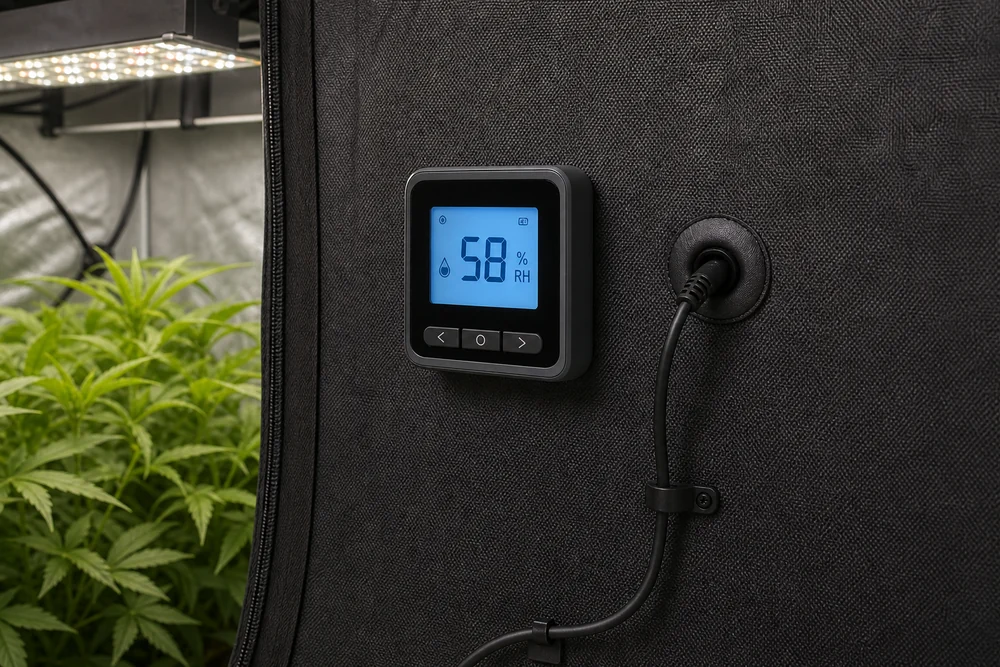
That is the entire mechanism. A setpoint, a reading, and a relay that closes when the reading falls below the setpoint and opens when it climbs back above it.
Everything people expect a controller to fix sits outside that loop, because it knows nothing about whether air is moving, whether one corner of the tent is colder than the other, or whether a cap has a film of water on it.
The probe deserves more suspicion than it gets, because these units use cheap capacitive sensors and capacitive sensors drift after months in an environment kept close to saturation.
Drift is testable at home for the price of a teaspoon of salt: seal the probe in a jar above a slurry of table salt and water, leave it six hours, and a healthy sensor reads 75 percent give or take a couple of points.
A sensor reading 82 in that jar is telling you that every decision you have made from its output was seven points optimistic. That is the difference between a pinning setpoint and a fruiting one.
Tip
Sensors that have spent a season in fog are worth retesting rather than trusting. The salt test costs nothing, takes an evening, and is the only way to find out whether the number you have been chasing was ever the number you thought.
Why do pins abort at the right humidity?
Because mushrooms respond to how fast water leaves their surface rather than to humidity.
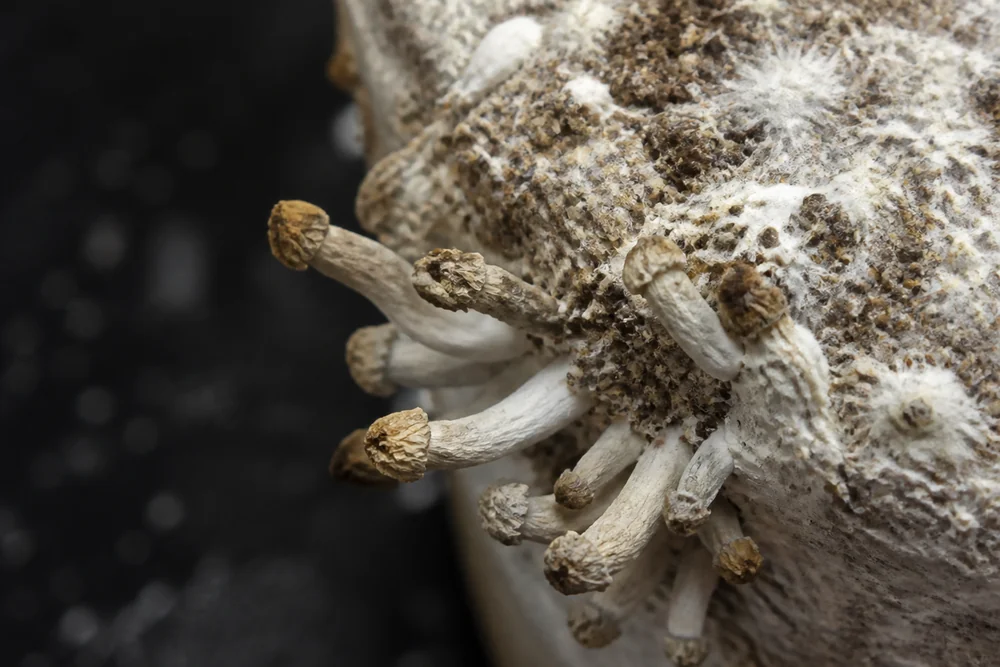
Evaporation rate is set by humidity, air movement and temperature working together, and any one of the three can dominate the other two.
Key takeaway
Air movement raises evaporation at constant humidity. A fan blowing directly on a pin set dries it out at ninety percent as readily as still air at seventy would, which is why the fan matters at least as much as the setpoint.
Temperature does the same thing more quietly. Warmer air holds more water before it saturates, so ninety percent at twenty-four degrees is drying considerably faster than ninety percent at sixteen.
Three combinations produce the same aborted pins:
- High humidity, strong direct airflow. The reading is right and the surface still dries.
- High humidity, no airflow at all. Water condenses instead of evaporating and the pins go soft and yellow.
- Correct humidity, warm room. The air has more capacity, so the same percentage pulls harder.
Work an example through and the arithmetic stops being abstract, because a tent warmed from 20 degrees to 25 without touching the humidifier moves the real drying pressure on a pin noticeably in the wrong direction.
The controller does not know any of that happened. It reads the same 90, holds the same 90, and reports success while the crop experiences a different environment entirely.
That is why raising the setpoint so rarely fixes anything, since the reader is adjusting the one variable that was already correct while the aborted pins keep arriving.
Where should the sensor go?
At the fruiting surface. Anywhere in the fog stream is worse than useless.
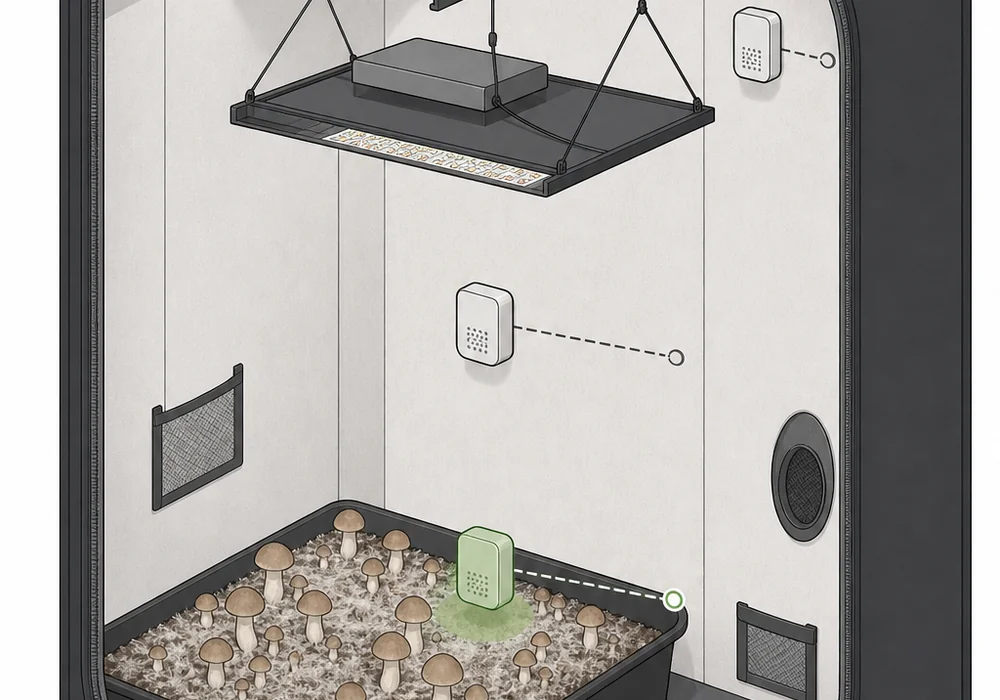
A probe clipped near the humidifier outlet reads the humidifier rather than the room. It will show ninety-five percent while the far end of the tent sits at sixty, and the controller will confidently switch off a device the crop still needs.
A probe at the top of a tent has the opposite problem, since warm moist air rises and a high probe reads the wettest layer in the enclosure while the blocks sit in something quite different.
- Best position
- Level with the fruiting surface, an arm's length from the humidifier.
- Worst position
- Directly in the fog stream or above the outlet.
- Common error
- Clipped to the tent roof because that is where the port is.
- Sanity check
- Move the probe and see whether the reading changes by more than five points.
- Second probe
- A cheap hygrometer at the far end will show you the gradient.
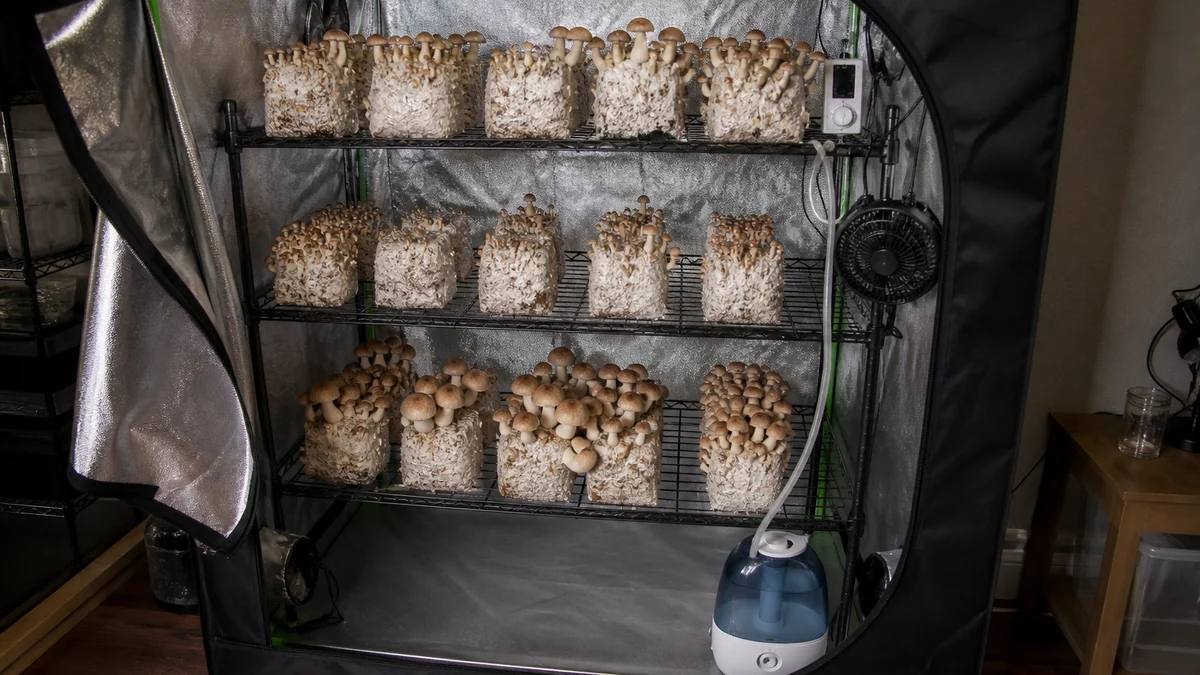
Enclosure size decides how badly placement matters. A small chamber mixes quickly and forgives a poorly placed probe, while a tall tent stratifies into layers that can differ by twenty points from floor to roof.
Shelving makes it worse again, because each shelf is both a barrier to airflow and a source of transpired moisture, so a five-shelf tent is really five environments averaged into a number nobody measured.
That last check is worth doing once. If moving the probe two feet changes the reading by fifteen points, you do not have a humidity problem, you have a mixing problem, and no setpoint will fix it.
Growing MushroomsHow Do Mushroom Sawdust Blocks Work from Mix to Fruit?What settings actually work?
Different numbers at different stages. That is the part single-figure advice gets wrong.
| Stage | Humidity | Air exchange | What you are aiming at |
|---|---|---|---|
| Colonisation | Not controlled | Minimal | Nothing evaporating, sealed container |
| Pinning | 90 to 95 percent | Low but present | Surface stays damp, primordia form |
| Fruiting | 80 to 90 percent | Higher | Caps develop without drying |
| Late fruiting | 75 to 85 percent | Higher again | Firm caps rather than soft ones |
Pinning wants the wettest conditions of the cycle, because primordia are almost entirely water with no skin worth speaking of and need a surface that stays damp for days.
Fruiting wants slightly less, and holding pinning conditions right through fruiting produces soft, pale, poorly formed mushrooms that never develop the firmness a little evaporative stress creates.
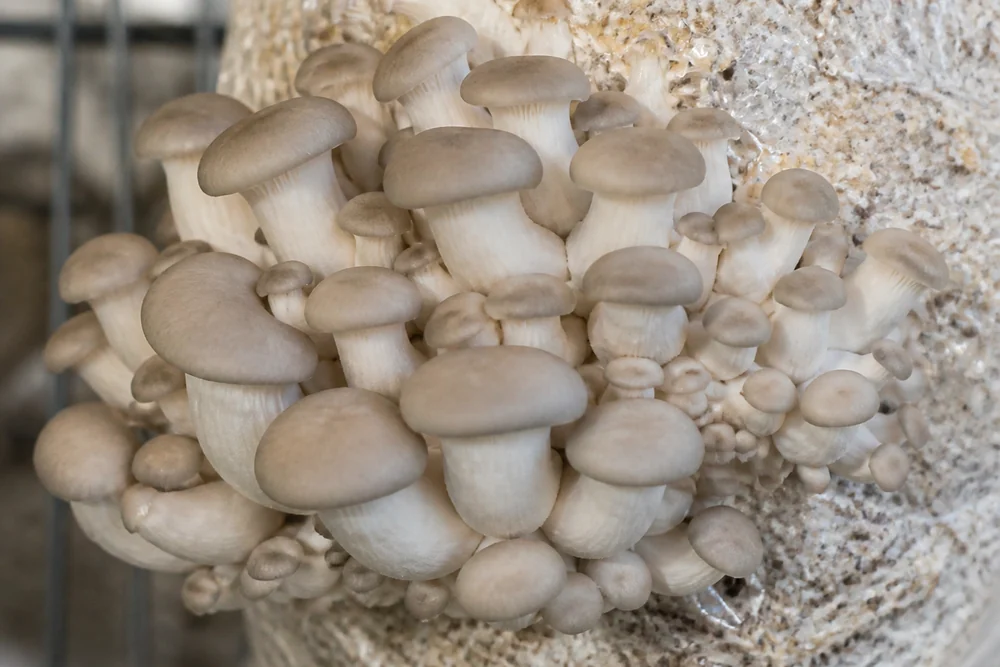
Species shift those ranges more than most guides admit. Blue oysters tolerate a wide band and are the reason so much beginner advice appears to work, while lion's mane wants consistently higher humidity and shows its displeasure by growing a coral rather than a head.
The species that punish a swing are the ones worth setting up carefully for, and with anything unforgiving the hysteresis section below matters more than the setpoint does.
The direction to move when something fails is more useful than any number. Dry, cracked or shrivelled tips mean evaporation is too fast, and soft, translucent or yellowing pins mean it is too slow.
What about temperature and CO2?
The controller measures one of three environmental variables. The other two usually run unsupervised.
Temperature is the one that quietly moves the whole system. Every degree changes how much water the air can hold, so a tent that drifts five degrees across a day is running a different evaporation rate morning and evening regardless of what the humidity display says.
Carbon dioxide changes what the mushrooms look like rather than whether they survive, producing long stems and small caps that growers routinely misread as a lighting problem.
| Variable | What it changes | Usually controlled by |
|---|---|---|
| Humidity | Evaporation, indirectly | A humidity controller |
| Air movement | Evaporation, directly | A fan, usually left running |
| Temperature | Air capacity, so evaporation again | The room, or nothing at all |
| Carbon dioxide | Stem length and cap size | Fresh air exchange on a timer |
Read that table down the third column. Three of the four variables are not controlled by the humidity controller. Check air movement, temperature, and fresh-air exchange separately.
The practical response is not to automate all four but to know which one you are looking at when something goes wrong, and stem length is the clearest signal because it points somewhere the humidity display never will.
Growing MushroomsHow Do You Build an Outdoor Mushroom Bed That Lasts?What is hysteresis and why does it matter?
The gap between switching on and switching off. Almost nobody adjusts it.
Set the controller to ninety percent with a differential of two, and it turns the humidifier on at eighty-eight and off at ninety. That two-point window is the hysteresis, and its width decides how the whole system behaves.
Too narrow a band produces short-cycling, and a humidifier clicking on and off every few seconds wears out an ultrasonic transducer far faster than continuous running would.
Lag is the reason a band that works in one tent fails in another. The probe reports a change only after the air around it has changed, and in a large enclosure the humidifier has already overshot by the time the reading catches up.
Small tents overshoot less and take a narrower band, while large ones need a wider one or a humidifier undersized on purpose so it cannot swamp the space between readings.
Too wide a band produces a swing. The crop gets soaked, then dries, then gets soaked again, and pins that formed during the wet phase abort during the dry one.
Warning
A short-cycling humidifier is not a sign that the controller is sensitive. It is a sign the band is too narrow for how quickly your enclosure responds, and the device will fail long before the crop does.
What should it be paired with?
A humidifier it can switch. Also a fan it cannot, which is the half people leave out.

Ultrasonic foggers are the usual pairing because they add water without adding heat. A warm-mist humidifier raises the temperature as well, which changes the evaporation rate in a direction you did not ask for.
The limitation is distribution, because fog is dense and cold and a tent with a fogger and no air movement ends up with a saturated floor and dry shelves.
Pair the controller with a cool-mist or ultrasonic humidifier
Run a small circulation fan continuously, not on the controller
Put fresh air exchange on its own timer
Blow a fan directly at the fruiting surface
Switch a circulation fan on humidity, which couples two systems that should be separate
Rely on the humidifier alone to move fog around a fruiting chamber
Water quality is the maintenance issue nobody warns about. Ultrasonic transducers accumulate mineral scale from hard tap water, and a scaled disc puts out a fraction of the fog it did when new while drawing the same power.
The symptom looks exactly like a controller problem. Humidity falls short of the setpoint, the humidifier runs constantly, and the obvious conclusion is that the controller or the setpoint is wrong.
Both problems have the same two habits behind them:
- Run distilled or filtered water if your supply is hard, which most municipal supplies are.
- Wipe the transducer disc with vinegar every few weeks, before output visibly drops rather than after.
Air exchange is the third system and it belongs on a timer. Fresh air removes carbon dioxide rather than water, and running it from a humidity reading means it stops exactly when the room is most humid and most in need of it.
When do you not need one?
More often than the equipment lists suggest.
A sealed monotub setup holds its own humidity because the bulk substrate underneath is a large body of water at field capacity. Evaporation from that surface saturates the headspace within minutes, and there is nothing for a controller to do.
Small chambers respond faster to a spray bottle than to any automation. A shotgun fruiting chamber misted twice a day tracks a crop more closely than a controller can, because a person looking at the pins is a better sensor than a probe.
Air movement can change evaporation even when the humidity setpoint stays the same.
Three questions settle the purchase better than any specification does:
- Can you mist this enclosure twice a day, every day, for the length of a fruiting cycle?
- Is anybody here to do that on the days you are not?
- Is the enclosure small enough that a spray bottle actually reaches all of it?
A yes to all three means the money is better spent elsewhere, and the obvious elsewhere is a second chamber, since two small ones beat a single poorly mixed large one.
The device earns its place when the enclosure is large enough that manual misting cannot keep up, or when you are away from it for long enough that nobody is there to mist. Those are real conditions and they are not the condition most first-time buyers are in.
Inspect the crop response as well as the sensor reading. Anything you do harvest still has to reach the kitchen in good order, and storing it is a separate discipline from growing it.
Caps that form well and then develop marks are not a humidity problem at all, they are a wetness problem, and the correction runs in the opposite direction from everything above.
If pins are aborting and the number looks right, the answer is almost never a better controller. It is the fan, the probe position, or the sawdust block drying out from underneath while the air above it reads perfectly.
Sources & References
- Mushroom growing environment and fruiting conditions (Penn State Extension) University extension material used for the relationship between air movement, transpiration and surface drying in a growing room, and for the principle that air removes moisture from a surface only when it has capacity to hold it.
- Oyster Mushroom Cultivation, fruiting conditions (FAO / MushWorld handbook) Reference handbook used for the humidity ranges given by stage, for the higher requirement during primordia formation than during fruiting body development, and for the effect of prolonged saturation on fruiting body texture.
- Psychrometrics and relative humidity fundamentals (ASHRAE Handbook of Fundamentals) Engineering reference used for the relationship between air temperature, moisture-holding capacity and evaporation rate, which is the basis for the claim that the same relative humidity dries faster in warmer air.