A mushroom grow cannot be pushed into fruiting safely until colonization is complete and clean. Once readiness is proven, compare the strain's required temperature, humidity, fresh air, light, surface moisture, and seasonal cues, then change one supported condition at a time.
A fully white mushroom substrate does not fruit merely because enough days have passed. Fruiting begins only after a clean culture reaches its method-specific endpoint and receives the right combination of temperature, fresh air, humidity, light, surface moisture, and time.
Start by proving readiness before applying a cold shock, soak, cut, or misting change. An unfinished or contaminated substrate exposed for fruiting gives competitors more surface and can turn a correctable incubation problem into a failed batch.
Is the block actually ready to fruit?
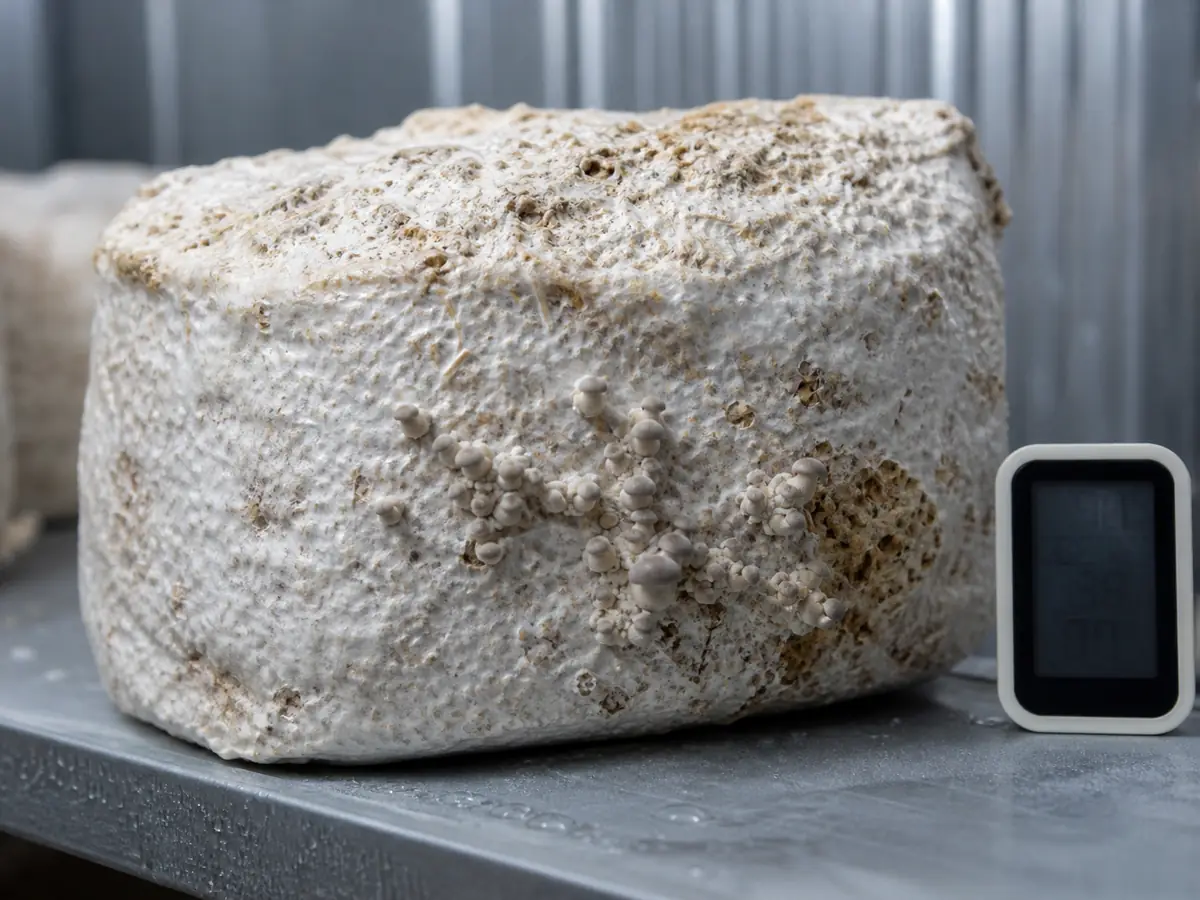
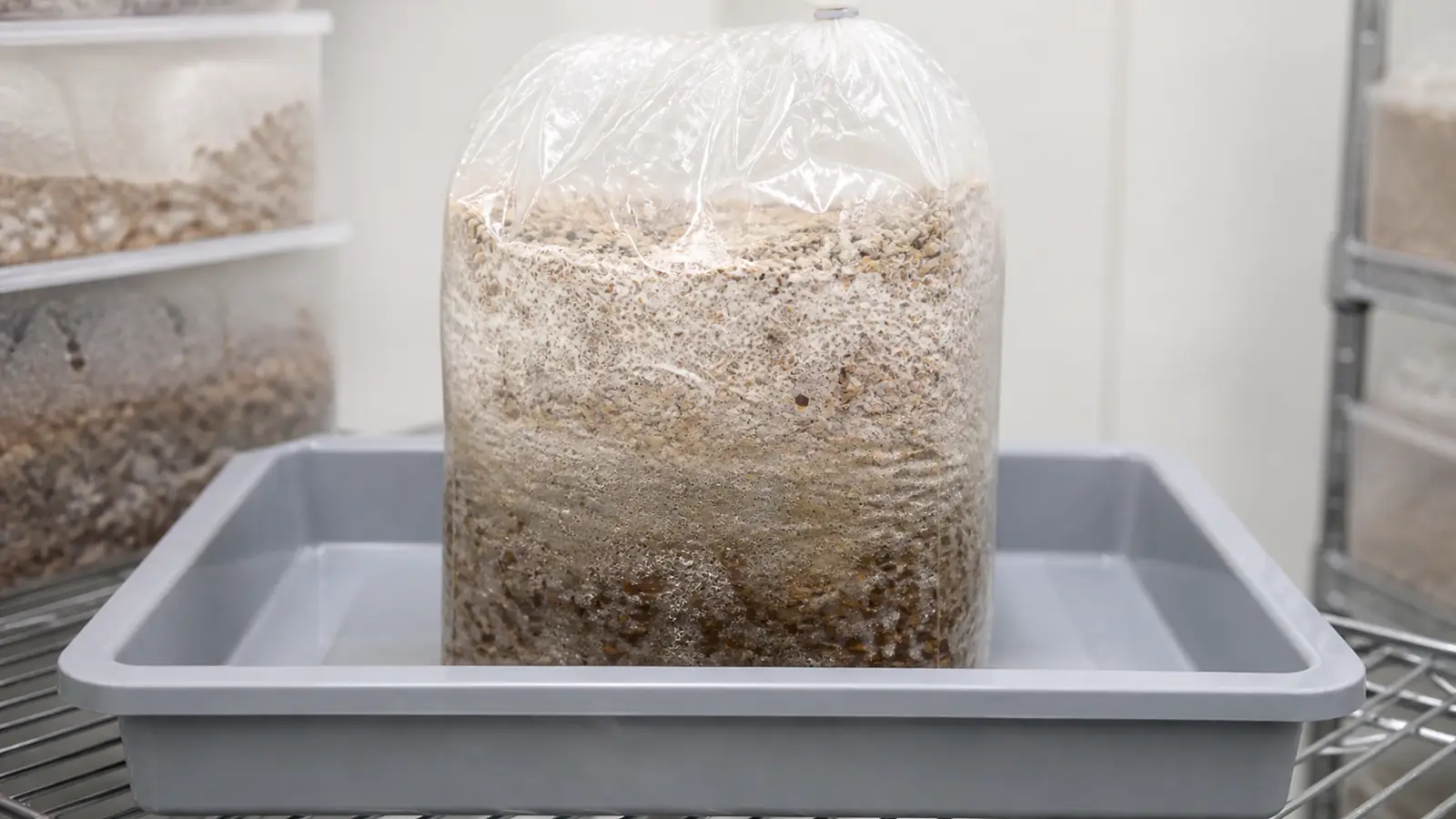
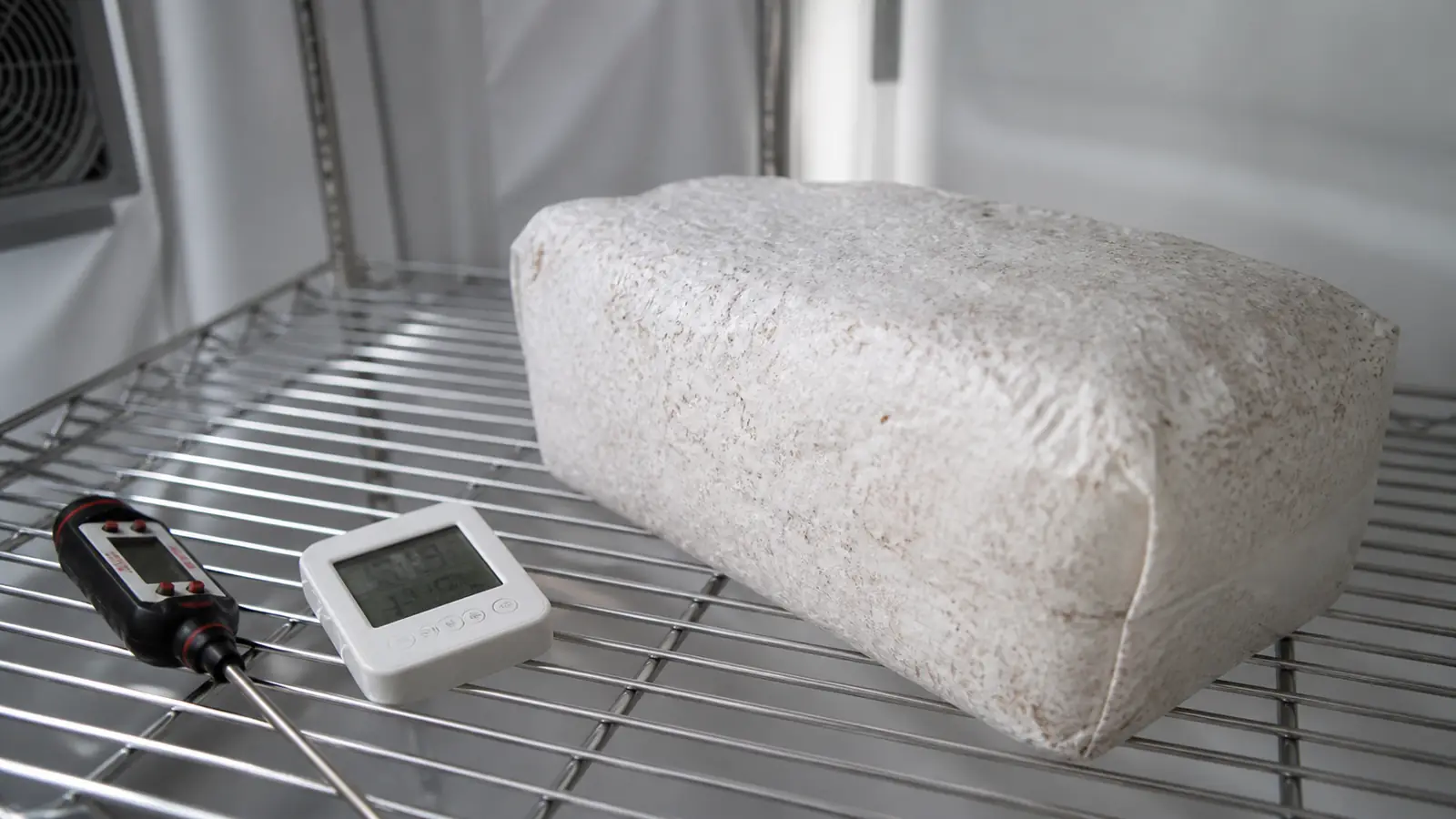
White growth connects through the expected substrate volume rather than covering only the visible outer surface.
The active heat surge has settled and the core remains inside the strain's acceptable range.
No uncolonized wet food, spreading color, slime, insects, or abnormal odor remains.
The method's consolidation or maturation period has been completed when the supplier requires one.
A white top with a loose brown, wet, or hot center.
Surface coverage can run ahead of the interior when a block is dense, a tub is deep, or spawn was concentrated near the wall.
Use transparent faces, expected weight and firmness, temperature history, and the supplier's endpoint rather than cutting a clean block open simply to look.
Cornell separates incubation from initiation because mycelium first occupies the food, then changes behavior under fruiting cues. If clean growth is still advancing, the correct action is to complete colonization rather than expose more substrate.

Which fruiting trigger does your species need?
A fruiting trigger is a method instruction, not a general stress test.
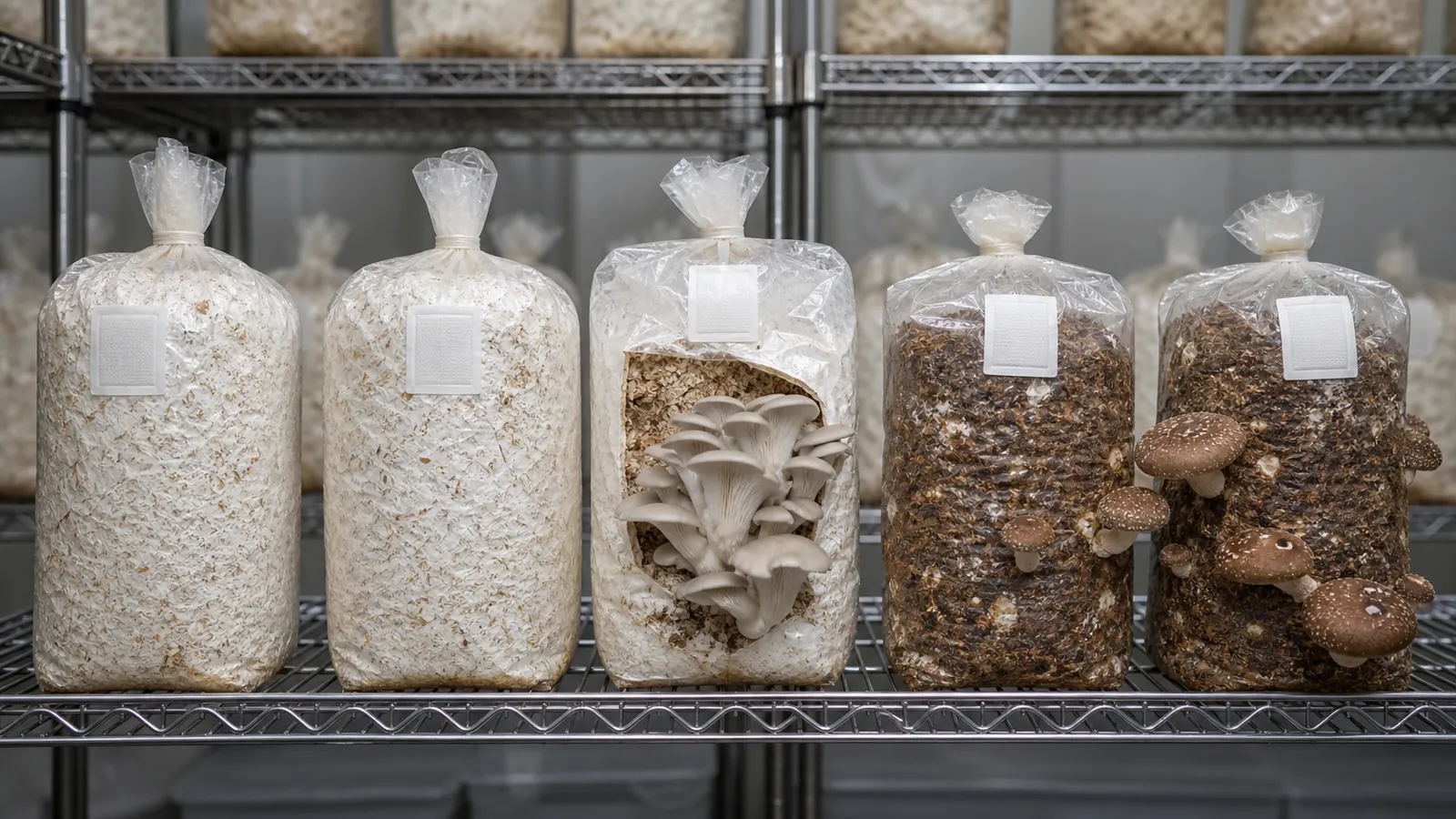
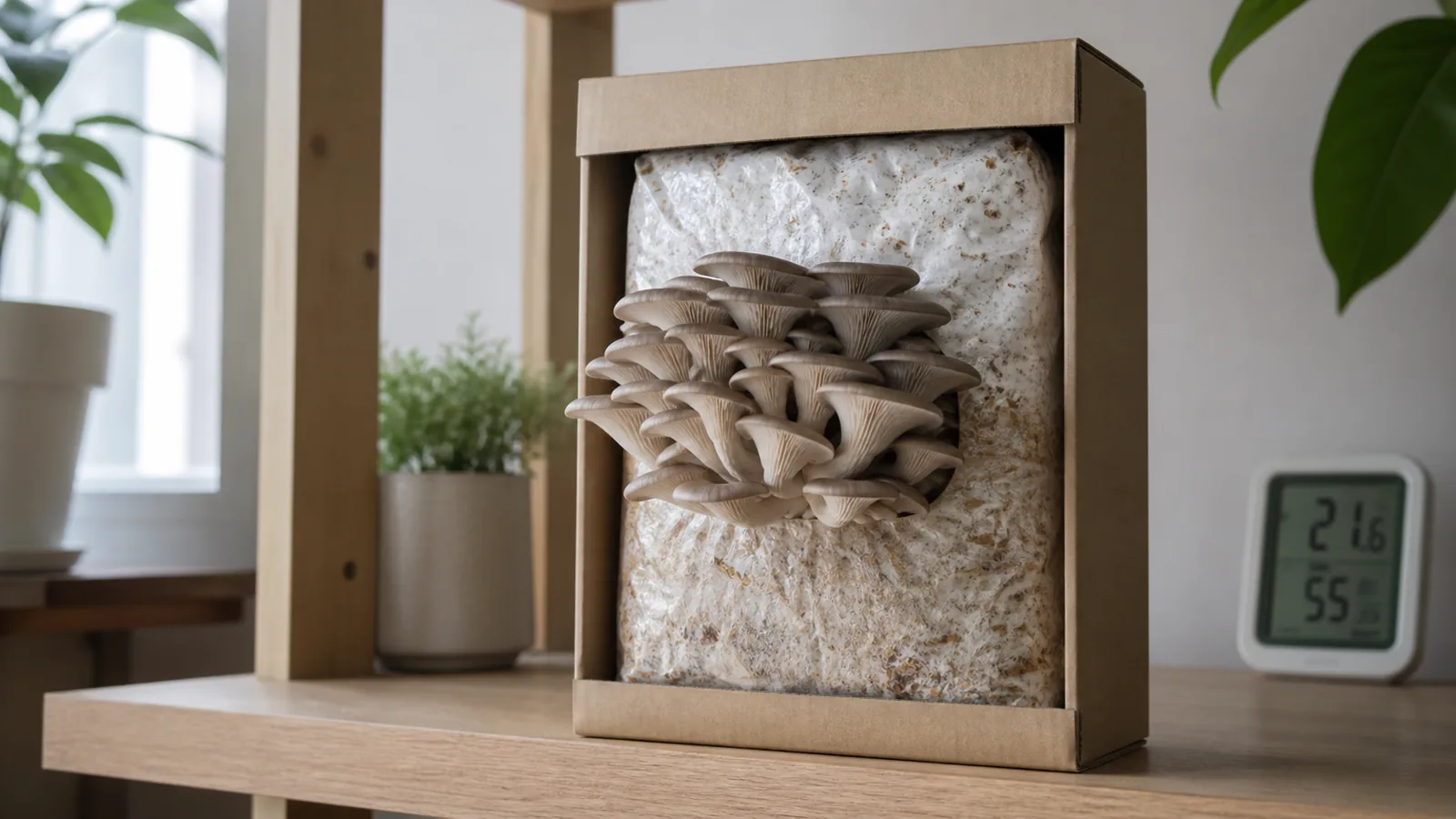
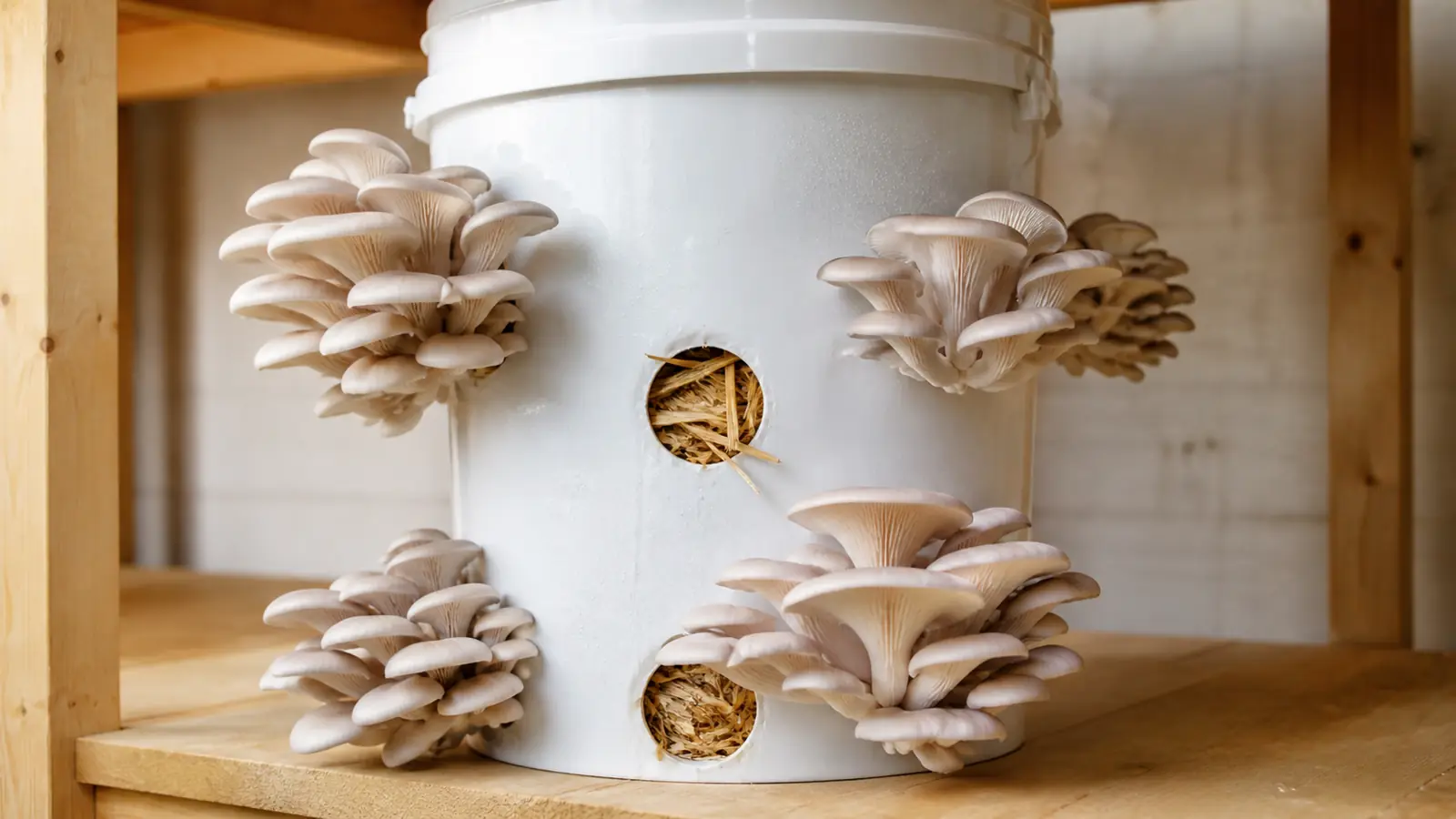
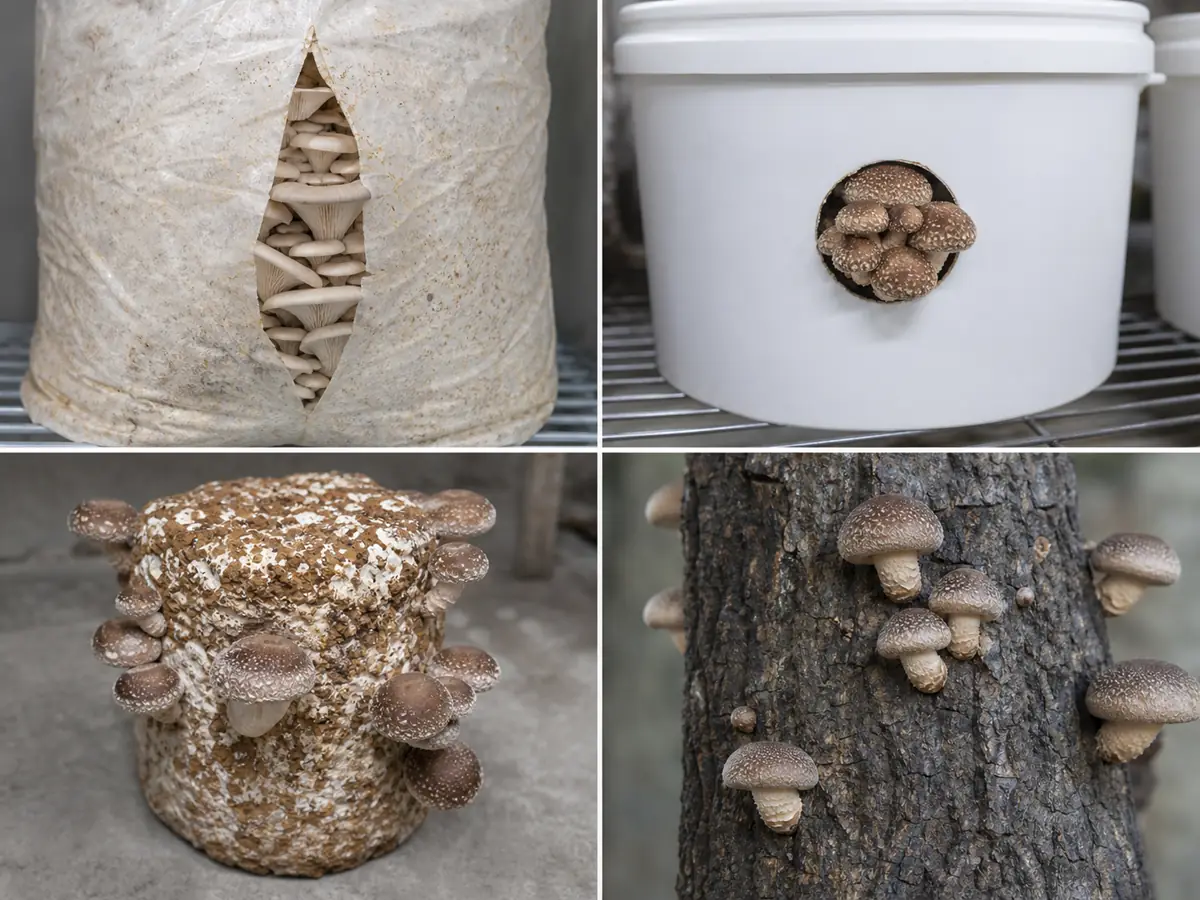
Oyster bags and buckets expose colonized material through slits or holes, supplemented blocks use a supplier-defined cut or removed bag section, and shiitake logs follow seasonal moisture and temperature cues.
Note
Use the opening, soak, casing, scrape, or temperature step documented for the exact cultivated species and format. Do not combine trigger techniques from unrelated grows because each one changes water loss, oxygen exposure, and contamination risk differently.
UF IFAS moves completely colonized oyster straw from spawn run into a fruiting environment with lower temperature, light, high humidity, and good air exchange. A sealed oyster bag left in incubation conditions can remain vegetative even though its food is fully occupied.
Button mushrooms use a casing layer and managed air changes, while log-grown shiitake must finish a much longer wood colonization period before a method-specific soak or seasonal change is useful. A cold-water shock copied from a log guide can waterlog an indoor block whose producer never instructed soaking.
Lion's mane often fruits from a small side opening so the developing teeth can hang without collecting water.
Top-opening the same block can create a wet bowl around the fruit body, which shows why even closely related indoor methods need different exposure geometry.
King oyster growers may use top fruiting and manage carbon dioxide differently to shape a thick stem, while other oyster species need broader fresh-air exchange for normal caps. A shape target from one oyster does not define the initiation conditions of another.
| Method | Readiness endpoint | Legitimate exposure or cue |
|---|---|---|
| Side-fruiting oyster bag | Straw or sawdust is clean and fully colonized | Open the planned slits and move to species-suitable fruiting conditions |
| Oyster bucket | Growth connects throughout the bucket and appears at many holes | Remove loose incubation cover and manage room humidity and air exchange |
| Supplemented block | Supplier endpoint and consolidation are complete | Cut or remove packaging only as directed for that species |
| Cased bulk substrate | Colonized substrate and casing development meet the method stage | Manage casing moisture, air, carbon dioxide, and temperature together |
| Shiitake log | Seasonal spawn run and bolt moisture requirements are complete | Follow strain-specific soak, shade, and temperature guidance |
The correct trigger follows the cultivated species and its container.
A method that exposes one format safely can damage or waterlog another.
Is the temperature wrong for fruiting?
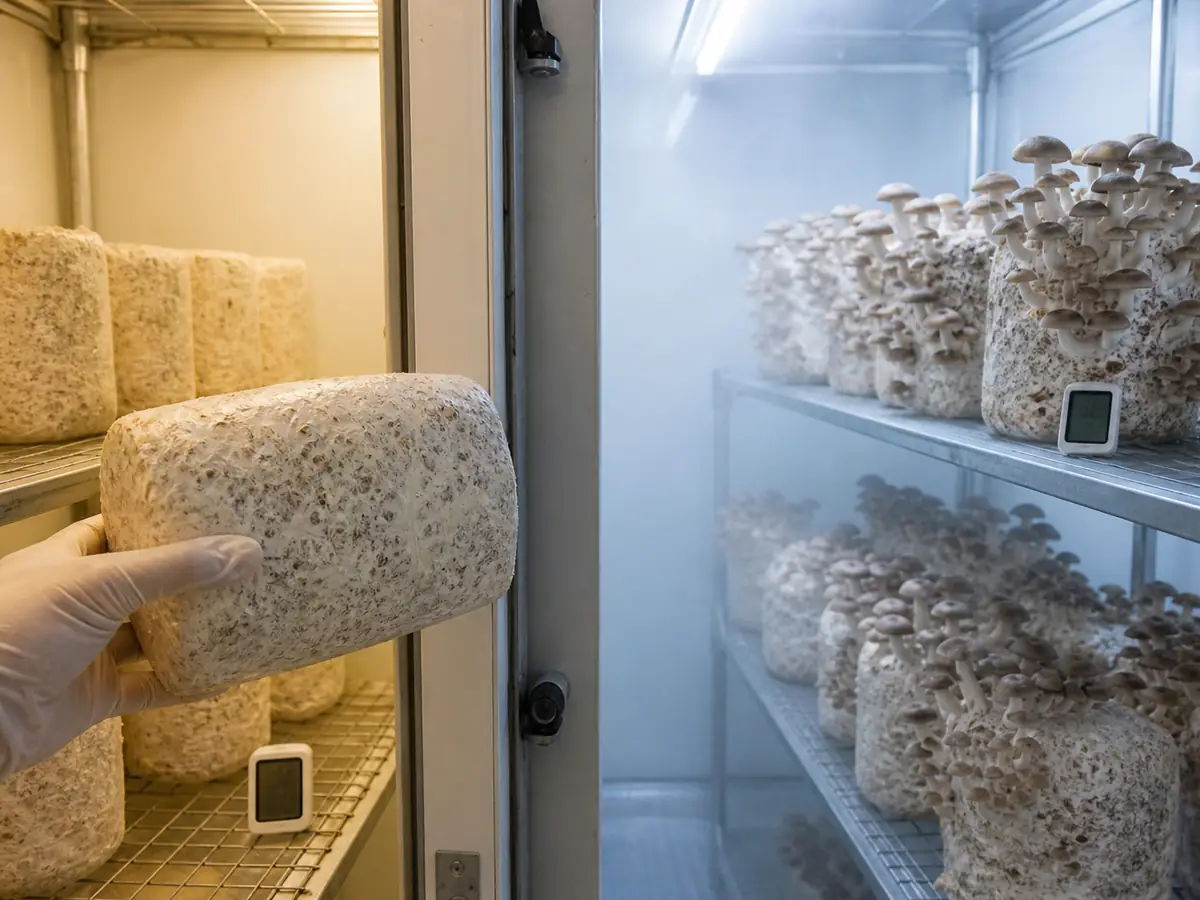
Many cultivated mushrooms fruit in a different temperature band from the one that supports fastest vegetative growth. UF IFAS uses about 68 F as an oyster fruiting example after incubation near 75 to 77 F, while Cornell describes broader species and seasonal ranges.
Those figures do not create a universal eight-degree rule.
Read the strain label, measure room air and substrate temperature, and account for the time a dense block needs to follow a room change.
Because small temperature differences can change the diagnosis, check the accuracy and placement of inexpensive sensors before trusting them. Two sensors placed together for several hours should report closely enough for the decision.
- Keep sensors off wet walls and other condensing surfaces.
- Place them away from lamps and heaters.
- Keep them outside the direct humidifier plume.
- Do not rest them against a cold window.
- Air reading
- Describes the room but can miss retained heat inside a large substrate mass.
- Core reading
- Shows whether metabolic heat or thermal lag keeps the culture outside its fruiting band.
- Surface reading
- Reveals direct sun, a heater, or a cold draft that affects primordia before the room sensor responds.
- Strain range
- Owns the decision, because warm-weather and cool-weather strains can react differently to the same shelf.
Move the culture gradually into the documented fruiting range and record the change. Direct sun, a refrigerator, or an uncontrolled outdoor night can create a stronger thermal and drying shock than the method calls for.
If the substrate stays unusually hot after colonization should be complete, reassess biological cleanliness.
Persistent heat paired with odor, wet collapse, or colored growth can indicate competing microbes rather than a fruiting delay.
Is fresh air or humidity the missing one?
Fruiting mycelium needs oxygen-rich air and removal of accumulated carbon dioxide, but tiny primordia lose water quickly. Increasing fan speed can improve room exchange while destroying the humid boundary at the exact surface where mushrooms should form.
Cornell identifies humidity above 85 percent as especially important during the first four days after initiation, and UF IFAS uses about 90 percent for its oyster protocol. Sensor readings are most useful when their location resembles the air around the fruiting surface rather than the wet output of a humidifier or a dry exhaust vent.
Use an exhaust or room-air path that replaces air gently across the space.
A small circulation fan can mix the room when it does not point at the crop, but opening a tent twice a day is a pulse rather than continuous control and may allow long stale intervals.
Long stems, small caps, and growth reaching away from the substrate support an air-exchange diagnosis once fruit bodies appear. A surface that becomes matte, cracked, or yellowed beside the fan supports excessive evaporation instead.

What is the fruiting surface telling you?
Relative humidity describes air, while the mycelial surface shows the result of humidity, temperature, airflow, and water supply acting together.
Inspect the fruiting surface under neutral light without touching it.
Fine beads that gradually shrink and return with the room cycle can indicate a moist surface with useful evaporation. Large standing pools, constant runoff, or a glossy flooded layer show that adding more mist is not the next move.
| Surface observation | Meaning to test | First response |
|---|---|---|
| Fine separate beads with no pooling | Moisture and evaporation may be balanced | Hold conditions and watch for knots or primordia |
| Matte or crusted patches | Local evaporation is too strong or water supply is depleted | Remove direct drafts and raise ambient humidity gradually |
| Large merged droplets or pools | Misting, condensation, or substrate water is excessive | Stop direct misting and improve gentle room exchange |
| Yellow-brown metabolites without other changes | Mycelium may be stressed | Check heat, age, water, and airflow before intervening |
| Slime, sour odor, collapse, or spreading color | Biological contamination is plausible | Isolate the closed culture and stop fruiting attempts |
Do not spray pins or an exposed block until water runs down the face.
Humidify the air when possible, and if the method permits misting, use a fine application that can evaporate before the next cycle.

Do mushrooms need light to fruit?
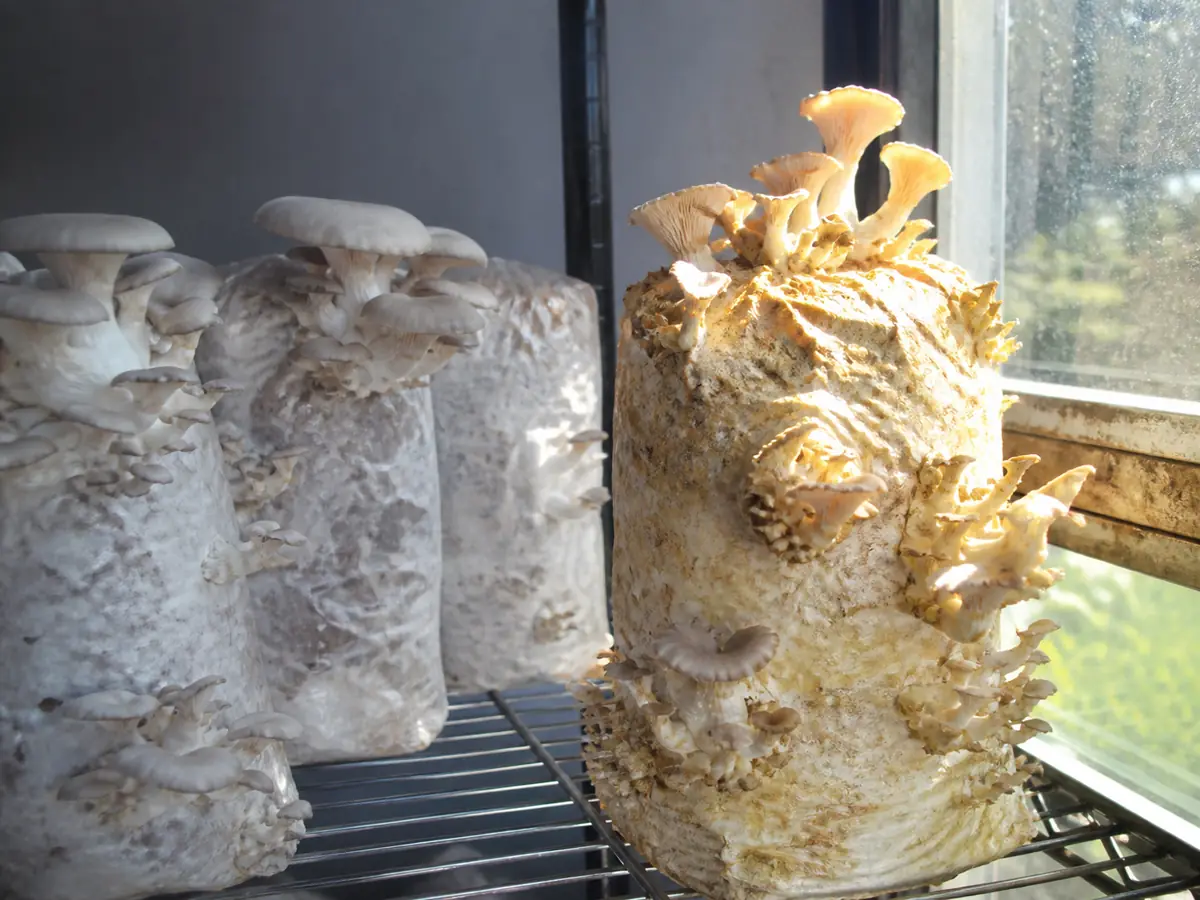
Mushrooms do not photosynthesize, but many culinary species use light for normal initiation, orientation, color, and form. UF IFAS includes light in its oyster fruiting protocol after the straw becomes fully colonized.
Diffuse room or grow light is enough for many home methods when it follows the supplier's schedule.
The lamp should not heat one face, and direct window sun should not create a hot dry zone that cancels the intended fruiting conditions.
Darkness advice often belongs to incubation, not every later stage. A colonized oyster bucket held indefinitely in a dark, warm, stale enclosure may receive none of the environmental changes associated with fruiting.
Light alone cannot correct the conditions that prevent initiation.
- An unfinished substrate core still needs more colonization time.
- A dry surface still needs protection from excessive evaporation.
- High carbon dioxide still requires suitable room-air exchange.
- An unsuitable strain temperature still requires a measured temperature correction.
Add light as the documented cue while continuing to measure the conditions that determine water loss and gas exchange.
No pins at all, or pins that stopped?
No-fruiting means stable primordia have not formed. Once small knots develop into recognizable pins and then darken, shrink, soften, or stop enlarging, the grow has crossed into an abort problem with a different evidence timeline.
Inspect at the same time each day with a close photograph. Hyphal knots may appear as tiny bright points on a healthy surface, while established pins develop a defined cap and stem or species-specific early form.
Do not scrape away every white knot to restart the surface. Handling can damage new primordia and introduces contamination, while the photographs already provide a non-destructive way to decide which stage is present.
Growing MushroomsHow Do You Build an Outdoor Mushroom Bed That Lasts?Is contamination stopping the fruiting?
Fruiting exposes colonized material to more air, moisture cycles, and handling.
It should never be used to test whether a questionable culture might recover.
Warning
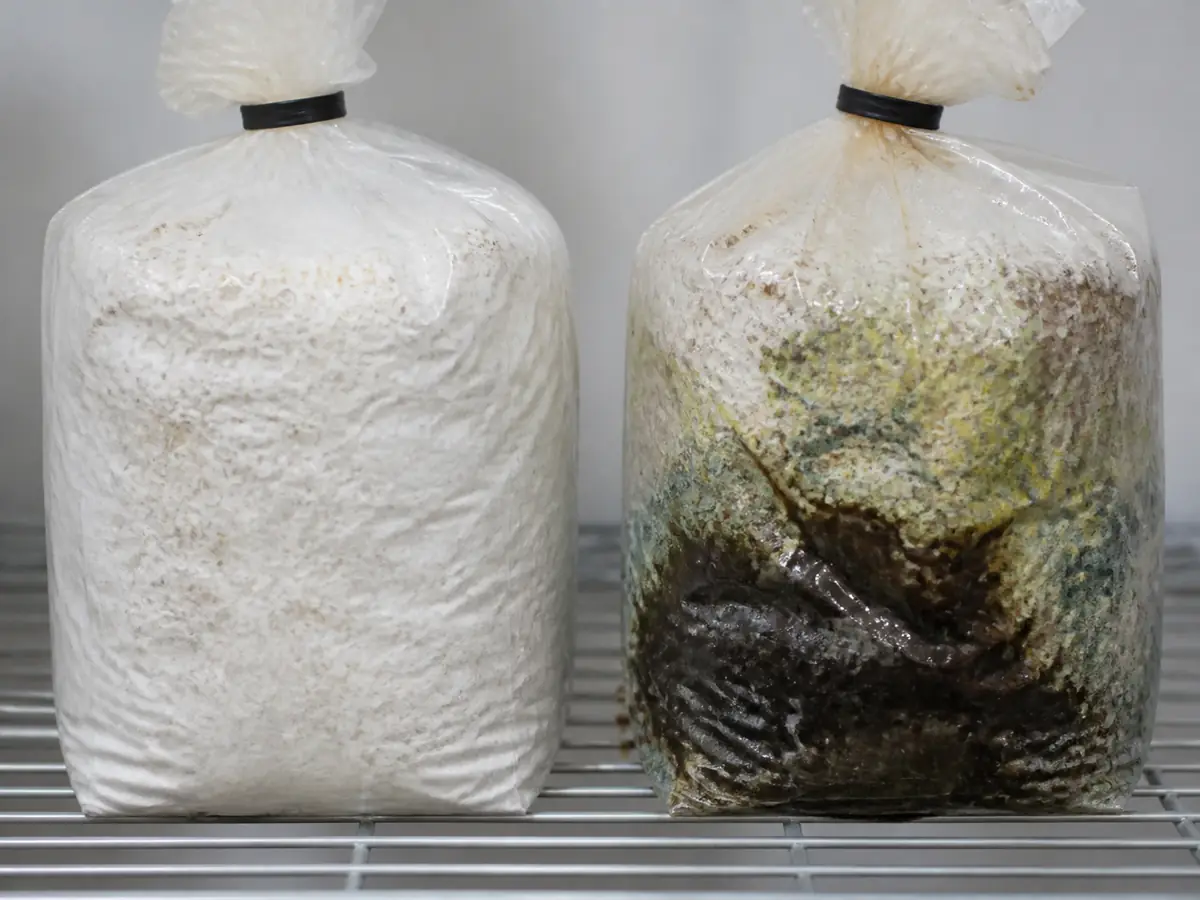
Keep any culture with spreading green, black, pink, or orange growth, slime, sour or rotten odor, insects, retreating mycelium, or unexplained wet heat closed and away from healthy grows. Do not smell it closely or cut it open in a food or fruiting area.
Some molds begin white and some stressed mycelium produces colored metabolites, so use the complete pattern instead of one color. Origin at spawn, directional growth, texture, odor, temperature, substrate integrity, and change over time must agree.
If uncolonized food remains after the normal window and conditions were appropriate, a small clean restart is safer and more informative than opening the batch to add spawn. Correct the preparation or inoculation problem before repeating the same method.
How do you test one change at a time?
Record the baseline before changing anything. Include species and strain, inoculation date, full-colonization date, opening method, air and core temperature, humidity location, surface condition, light schedule, and fresh-air setup.
- Select the strongest missing condition supported by the evidence.
- Make one change inside the supplier's allowed range.
- Keep the other controls stable and avoid opening the substrate again.
- Photograph the same surface daily through the method's initiation window.
- Stop if contamination, dangerous heat, or rapid surface damage appears.
If healthy primordia form, hold the balanced environment rather than celebrating with heavier misting or stronger fans.
The new structures are more sensitive to water loss and direct impact than the colonized surface that preceded them.
Use the supplier's initiation window from the moment all required conditions became stable, not from the first isolated change. A block moved to cooler air on Monday but given light and fresh air on Thursday did not begin a complete trial on Monday.
When no pins appear, compare the daily records for drift before starting another trial. Repeated humidity crashes, warm afternoons, or long stale intervals mean the culture never received one continuous documented window.
| Trial result | Next decision |
|---|---|
| Healthy knots and pins appear | Maintain the measured conditions and shift attention to pin survival |
| One area pins and another stays bare | Map the local air, light, temperature, and surface-moisture difference |
| Surface dries or floods after the change | Reverse the excessive adjustment and restore a gradual balance |
| No initiation appears but every clean condition fits | Confirm strain timing and allow the documented window before one new test |
| Contamination evidence appears | Isolate and discard the culture rather than continuing trials |
The trial succeeds when a healthy new structure answers one measured correction. A culture that develops failure evidence has reached a disposal decision instead.