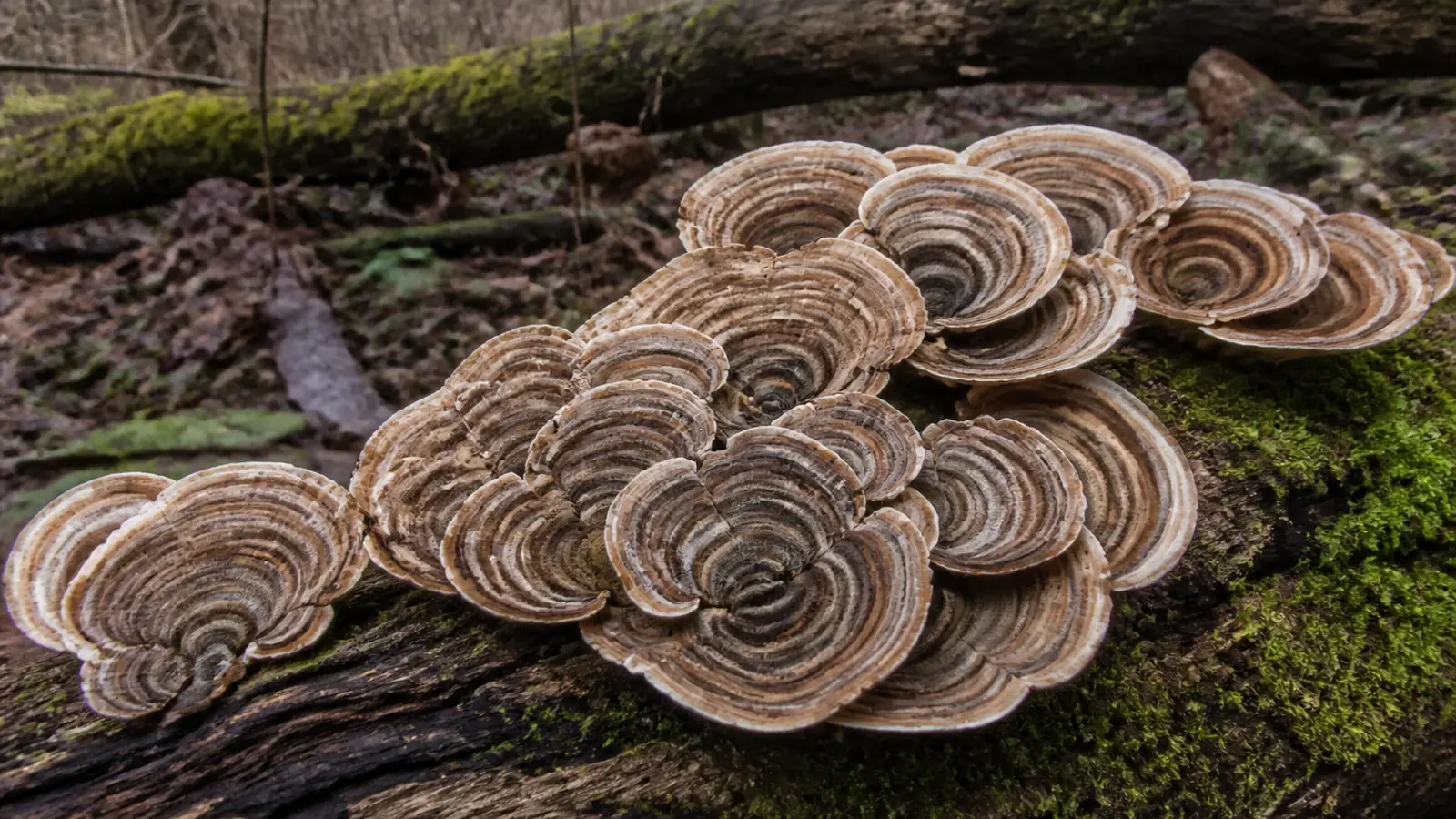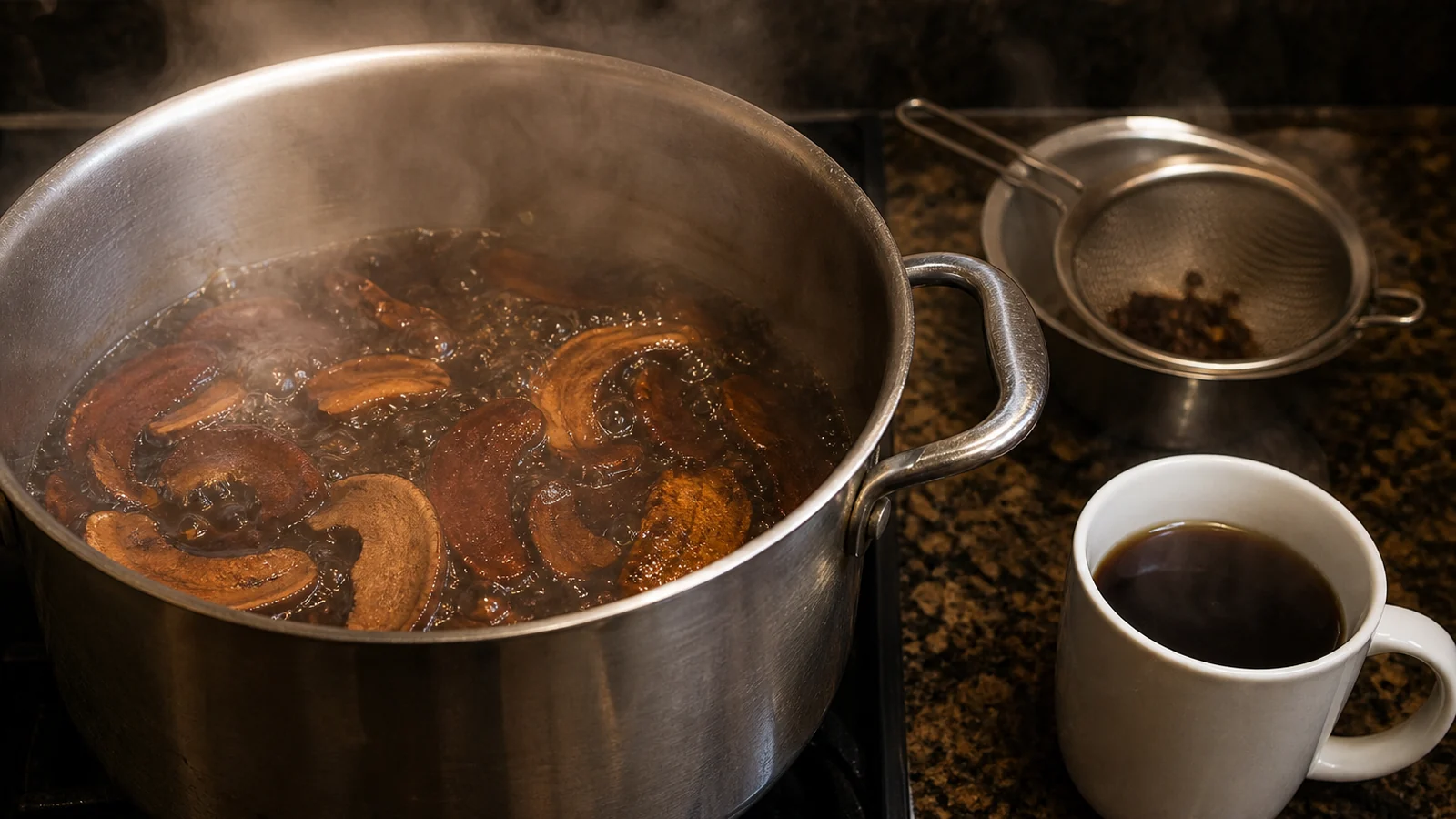
A method guide to making mushroom tea at home, covering why a five minute steep extracts almost nothing, how the texture of the dried material sets the simmering time, a full decoction procedure with ratios and temperatures, the compound class hot water cannot reach, the published oxalate kidney cases behind daily chaga, when a second extraction is worth running, and how to keep a batch.
The reason your mushroom tea tasted of almost nothing is that five minutes in a mug is not long enough to open anything.
What most packets describe is an infusion, which is what you do to a tea leaf. What the material in your cupboard needs is a decoction, which is a different operation with different numbers attached.
Preparation times and quantities vary by species. Check the limits of the evidence as well as reports of harm before using a mushroom tea regularly.
Can you steep mushrooms like ordinary tea?
An infusion pours hot water over material and waits. A decoction holds the material at temperature for long enough that something structural gives way.
The structure in question is a fungal cell wall, and it is not built like a leaf.
Fungal cell walls are largely chitin, the same polymer as an insect shell, with the polysaccharides bound into that framework rather than floating free. Chitin does not dissolve at any temperature a kitchen reaches, and no human enzyme opens it either.
So the job of a decoction is to hold the material hot for long enough that the soluble fraction migrates out through a structure that stays intact the whole time.
Those numbers come from one species and one laboratory, so treat them as scale rather than as gospel.
The scale is the point though. The answer is tens of minutes below boiling, not a few minutes at a rolling boil, and the gap between those two is most of the reason a home cup disappoints.
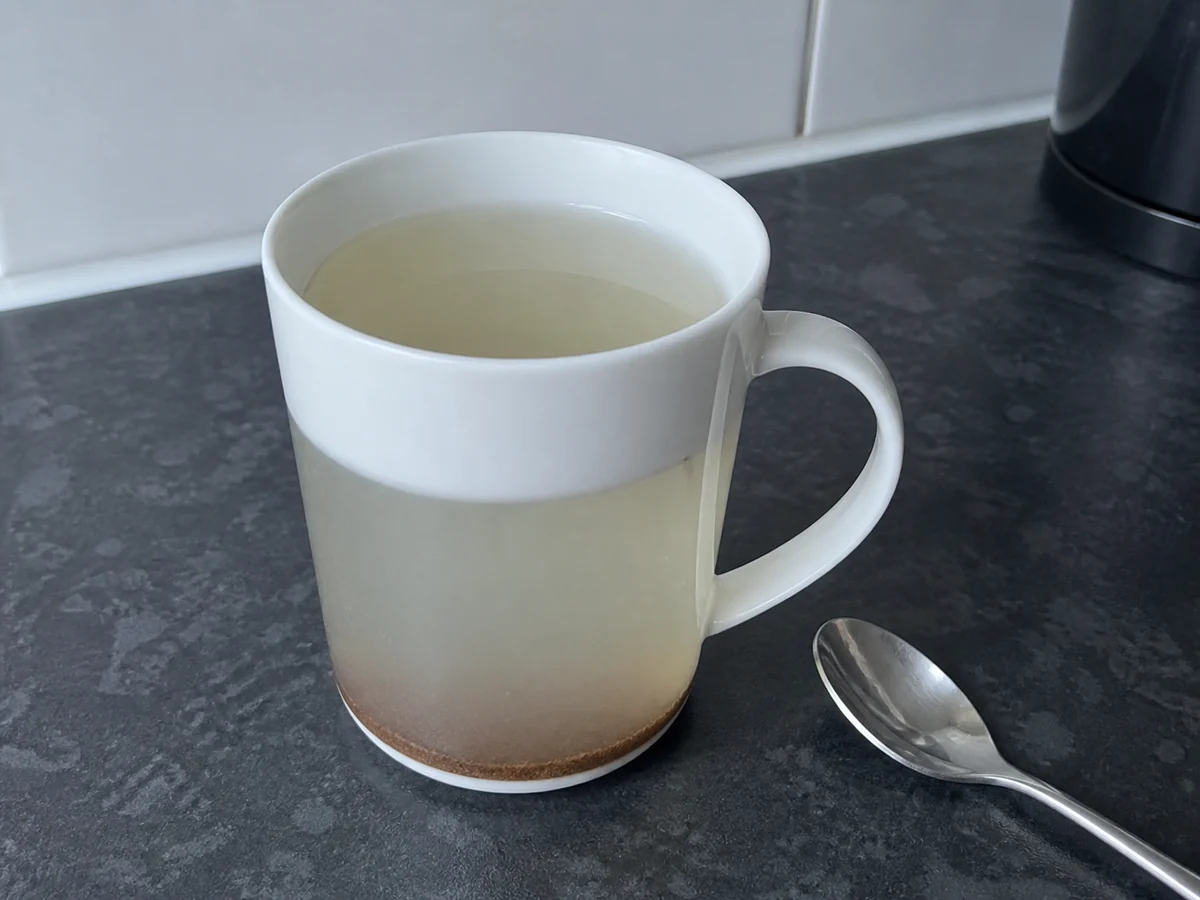
There is a related trap with powder specifically. Stirring powder into hot water makes a suspension, and drinking a suspension means swallowing intact cell walls, which is the thing extraction exists to avoid.
A suspension is not useless, because some of the material does dissolve while it sits there.
It is just that the cloudy part doing most of the visual work is undissolved solids, so the cup looks far stronger than the liquid actually is.
If you want to know what a commercial jar has already done to its contents before you buy it, that is a separate question and the beta-glucan content on the label is where it gets answered.
Medicinal MushroomsLion's Mane Benefits: What Human Trials Actually FoundWhich mushrooms need simmering rather than steeping?
You do not need to know what a bag of dried material is called to know how to treat it. You need to know how hard it is.
Press a piece between your fingers. What happens next sorts it into one of three groups, and each group wants a different amount of time in the pot.
- Hard and woody, like a bracket that will not bend at all, which needs breaking or cutting before it goes in and then wants the long end of any simmering range
- Leathery, which bends without snapping and tolerates a long simmer without falling apart
- Soft, which is food, and which a long boil ruins for no gain at all
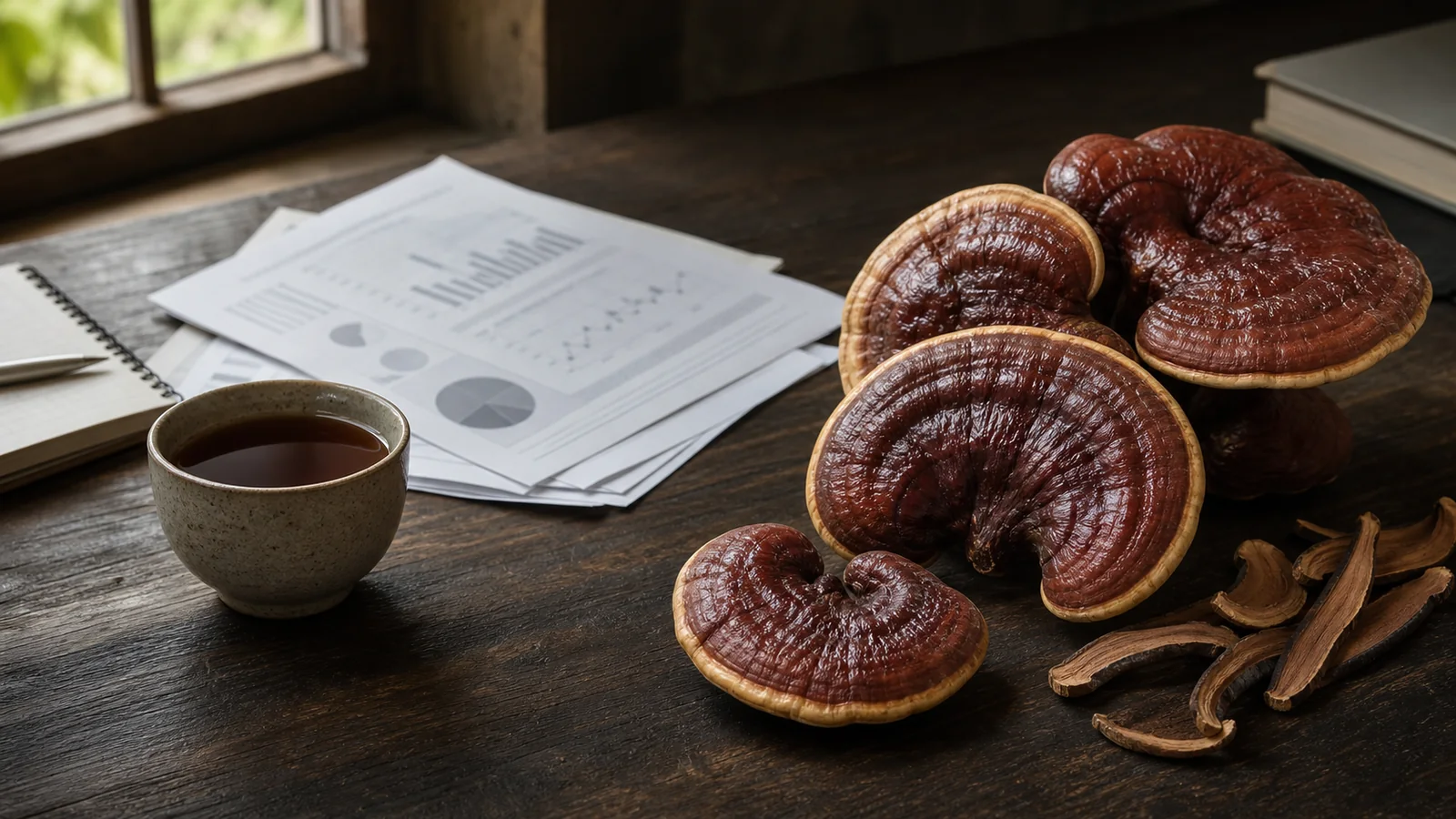
A woody bracket such as reishi is the extreme case, because a whole one has almost no surface area relative to its mass.

Cutting one into thin slices or snapping it into small pieces is not optional. It is the single largest lever on what ends up in the pot.
Key takeaway
Surface area is the variable, not the species. Two pieces of the same mushroom, one whole and one broken up, will give completely different results from an identical simmer.
Leathery species like turkey tail sit in the middle and are the most forgiving thing to practice on.
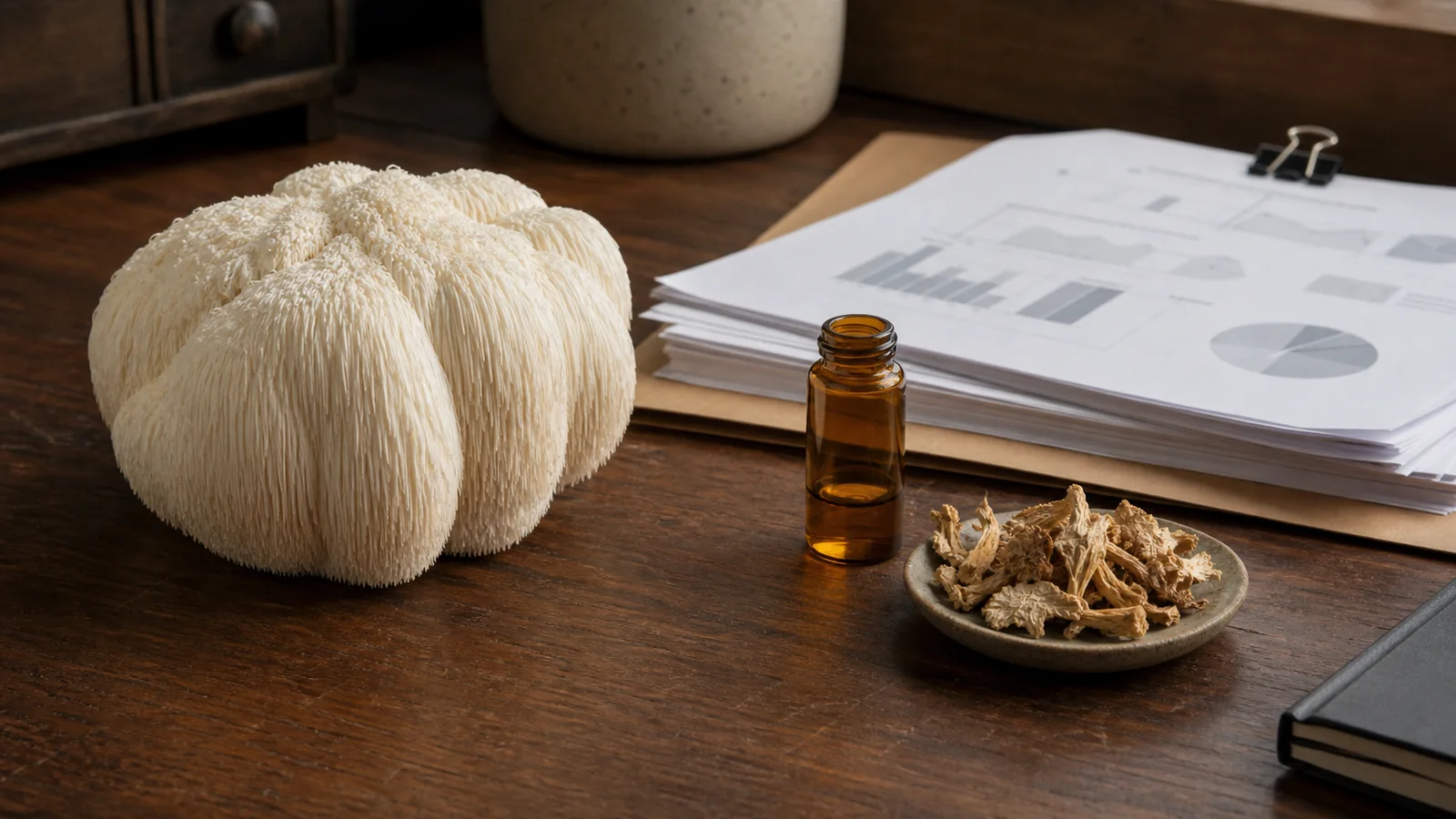
Soft species are a different case entirely. Something like lion's mane is a food that can be cooked and eaten, and boiling it for an hour destroys the texture people grow it for while adding very little.
Powder is its own category. It has enormous surface area, so it needs far less time, and it strains so badly that most of the effort moves from the simmer to the filtering.
Grinding woody material yourself sits between the two and is usually a mistake with a domestic grinder.
Dried bracket material is hard enough to damage a coffee grinder outright, and a coarse chop with a heavy knife or a snap with pliers gets most of the surface area benefit without wrecking anything.
Buying material whole or roughly broken rather than pre-powdered has a second benefit beyond your grinder. It leaves you something to look at.
You can see what you have, and once material is milled the only remaining check on what it is comes down to the seller's own paperwork.
How do you make a mushroom decoction?
Everything above turns into four decisions. Only one of them is fussy, and it is not the one most people worry about.
- Ratio
- Roughly twenty to thirty parts water to one part dried material by weight
- Heat
- A low simmer, held below a rolling boil, with visible steam and small bubbles
- Time
- Around thirty minutes for leathery material, an hour or more for woody, ten to fifteen for powder
- Lid
- On, because an open pot concentrates by evaporation rather than by extraction
Weigh the material rather than measuring it by eye, because dried mushroom is bulky and light and a cup of it is not a stable unit.
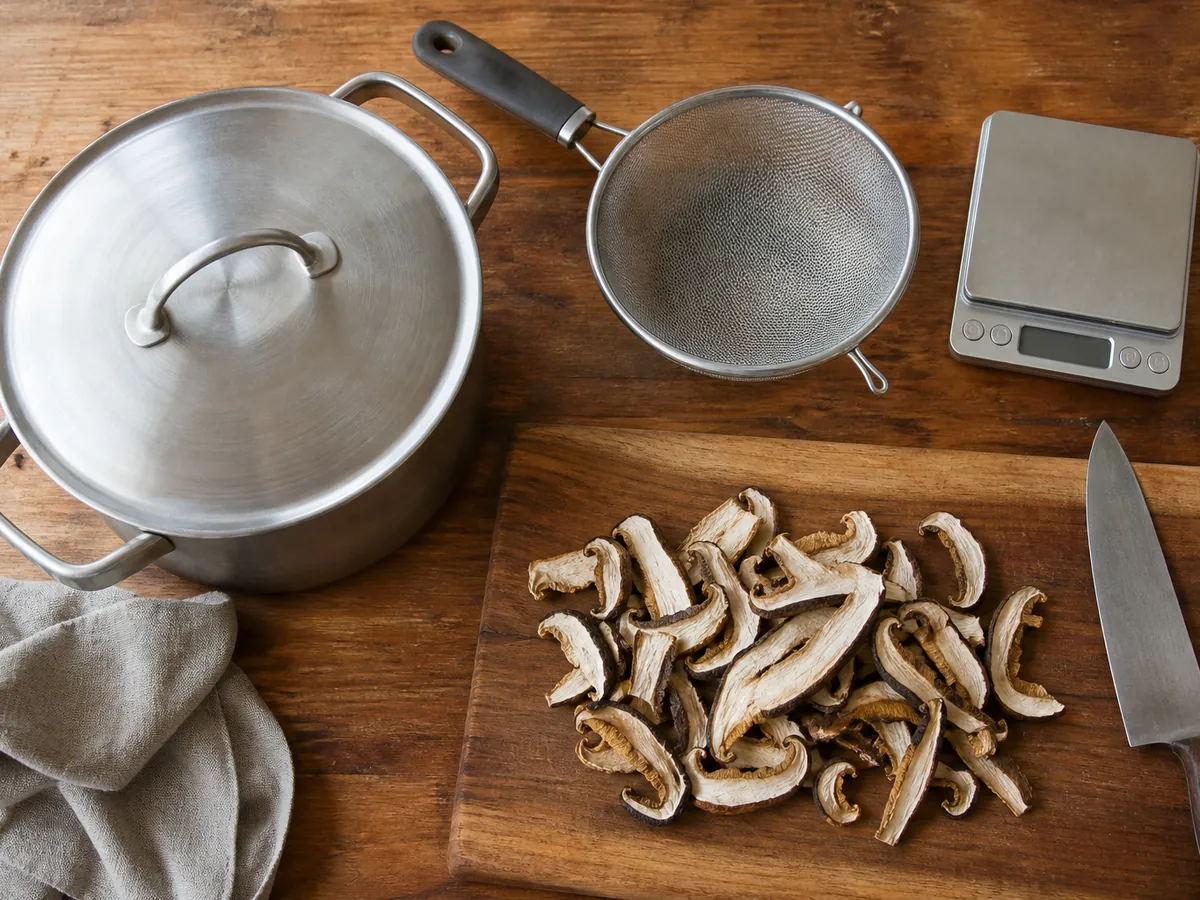
Soaking the material in the cold water for twenty minutes before the heat goes on is worth the wait. Dry pieces float and stay dry inside, and rehydrated pieces sink and start giving things up immediately.
Then bring the water and the material up together rather than adding material to boiling water.
A slower climb means more total time at useful temperature and costs nothing at all.
Then hold it. The temperature you want is the one where the surface moves and breaks occasionally without churning.
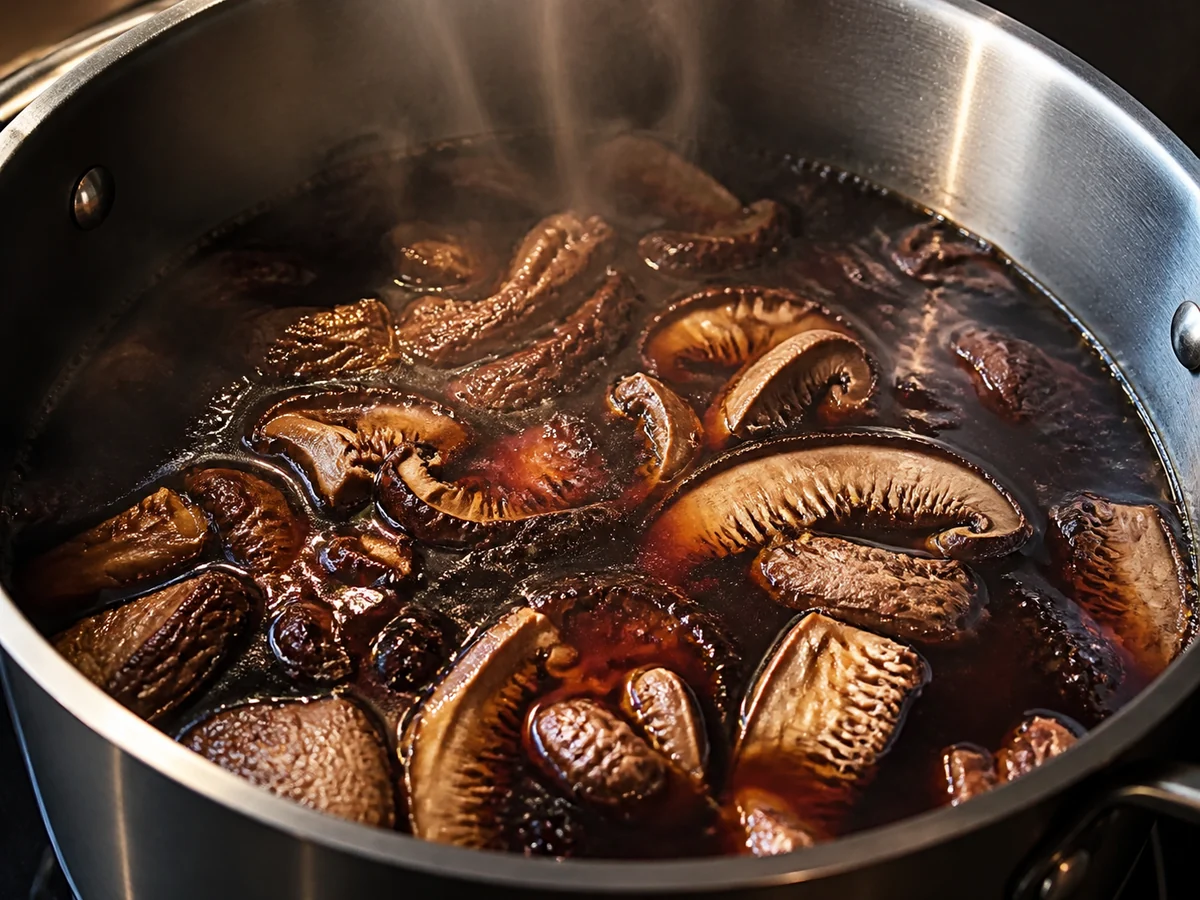
A hard boil is not a faster version of a simmer. It drives off volume, it agitates the material into fragments that make straining miserable, and it takes the liquid past the temperatures the published work found optimal.
Two pieces of kitchen equipment hold that temperature better than a stovetop does.
A slow cooker on its low setting sits close to the published range without any attention at all, which suits woody material that wants two hours. A pressure cooker does the opposite, since it works by going well above boiling, and shortening the time to compensate is guesswork rather than a translation.
Judging when it is done is easier by look than by clock. The liquid goes from tea-colored to genuinely dark, and it starts to coat the back of a spoon slightly rather than running off it like water.
Straining is the last step, and it decides whether the result is pleasant to drink rather than gritty, so use the finest mesh you own and go through it twice if you started with powder. The particles that get through are the ones that settle in the bottom of the cup and taste of sediment.
What you should end up with is liquid that is obviously dark, obviously not water, and noticeably thicker in the mouth than tea.
Collected in one place, the whole method is four rows.
| Material | Preparation | Simmer | Water to material |
|---|---|---|---|
| Hard woody bracket | Slice thin or snap into small pieces | 60 to 120 minutes | 25 to 30 to 1 |
| Leathery bracket or shelf | Break into pieces by hand | 30 to 60 minutes | 20 to 25 to 1 |
| Soft dried culinary | Use whole or roughly torn | 15 to 20 minutes | 20 to 1 |
| Powder | None, and strain twice afterwards | 10 to 15 minutes | 20 to 1 |
Those ranges are starting points rather than settings. The first batch tells you whether your material and your pan want the long end or the short one.
Medicinal MushroomsWhich Reishi Benefits Hold Up in Human Studies?What does water actually pull out of a mushroom?
Water is a real solvent and it is also a narrow one, which is worth knowing before you decide a decoction has got everything.
The published work on getting triterpenes out of a woody species is unambiguous about the conditions required.
There is a confusing consequence worth stating plainly. A decoction of a bitter species tastes bitter, and that taste does not mean the bitter compounds came across in any quantity.
Bitterness is a taste threshold rather than a concentration reading, and very small amounts of a very bitter compound register strongly on the tongue.
This is also the reason commercial products describe themselves as dual extracts. Two separate operations are run on the same material because neither solvent does the other job, and the results are recombined afterwards rather than produced together.
If the compound class you are after is the alcohol-soluble one, the preparation you want is a tincture rather than a longer simmer.
None of that makes a decoction pointless. It makes it a specific tool rather than a complete one, which is a more useful thing to know before you spend an hour at a stove.
Medicinal MushroomsMushrooms for Brain Health, Ranked by EvidenceIs chaga tea safe to drink every day?
Chaga requires particular caution because published injury reports involve prolonged use.
The species in question is the chaga conk, which is unusually high in oxalate. Oxalate is the compound that forms the crystals in the commonest kind of kidney stone.

Two published case reports give the shape of the risk. They are worth reading with their doses attached rather than as a headline, because the doses are what make them interpretable.
Two cases are not a population study and they do not establish how common this is. Case reports describe what has happened at least once, which is a different claim from how often it happens.
What they do establish is that the mechanism is real, that it has produced an irreversible outcome at least once, and that both cases involved gram-scale daily intake sustained over months or years rather than an occasional cup.
Warning
Anyone with a history of kidney stones, reduced kidney function, or a reason to be on a low-oxalate diet should treat daily chaga as a decision to raise with a clinician rather than a neutral habit. High-dose vitamin C alongside it appears in one of the two cases and is itself a known oxalate contributor.
Some people start from a higher baseline risk than others, and for them the calculation is not close.
- Anyone who has had a calcium oxalate kidney stone, which is the commonest stone type there is
- Anyone with reduced kidney function from any cause, since oxalate clearance is a kidney job
- Anyone already on a low-oxalate diet for a diagnosed reason
- Anyone taking high-dose vitamin C, which the body converts to oxalate and which appears in one of the two cases
The practical reading for everyone else is about frequency rather than prohibition. A cup now and then sits nowhere near the intakes in those reports, and a daily gram-scale routine sustained for years is a different thing wearing the same name.
Can you reuse the mushrooms for a second batch?
One pass does not remove everything water can remove, which is why a second decoction on the same material still comes out colored.
That is a genuine gain on expensive woody material and mostly an illusion on powder.
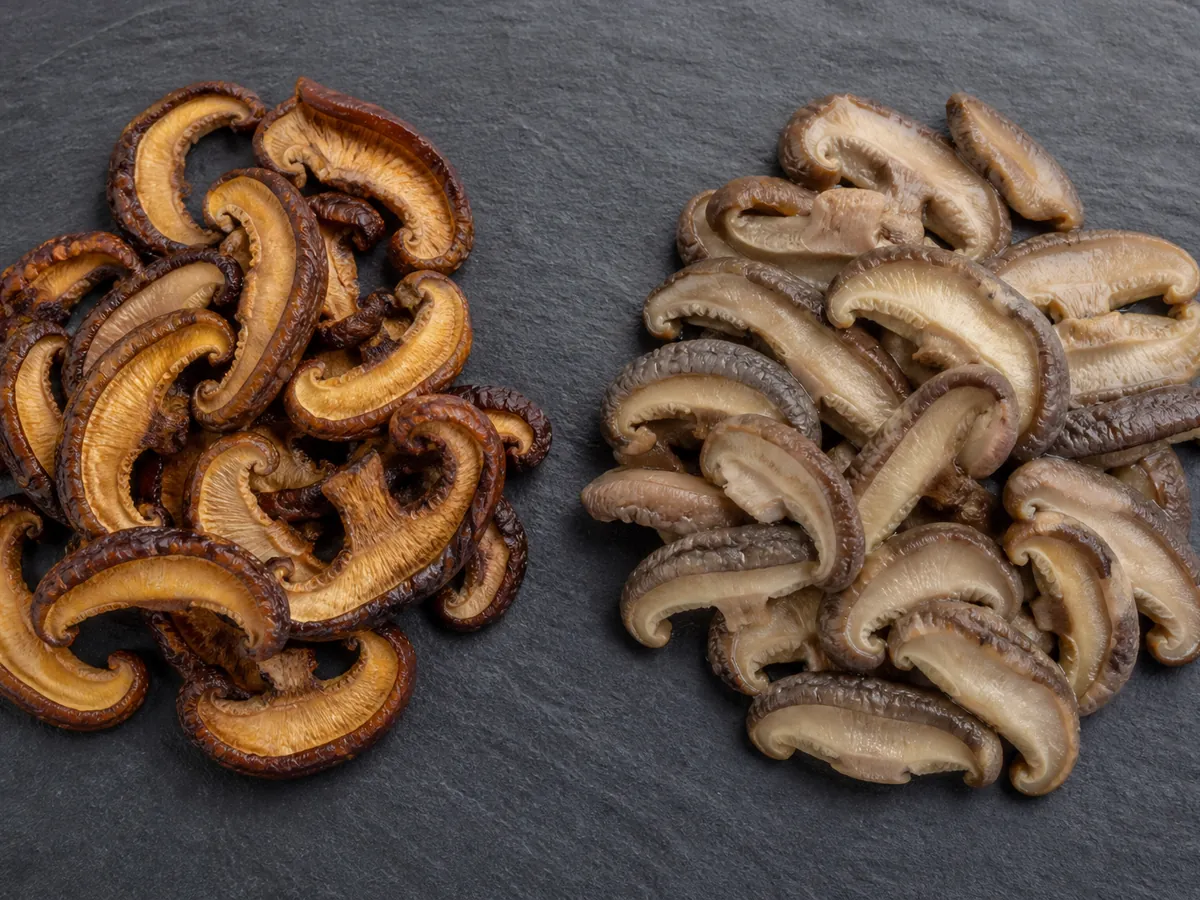
Each pass takes out less than the one before, and the drop-off is steeper than most people expect.
- The second run on woody material usually gives a lighter but still useful liquid, and is worth doing
- The third is thin, and is worth doing only if you were going to combine the passes anyway
- Powder is effectively spent after one run, because its surface area meant it gave everything up the first time
- Combining the passes and reducing them together produces a more consistent result than drinking each one separately
Judging spent material is easier than it sounds. Woody pieces go pale, lose their gloss, feel spongy rather than hard, and stop smelling of anything in particular.
When that happens, the pieces are compost. There is nothing left in them that water is going to find.
That is not quite the end of their usefulness. Chitin and the non-polar fraction are both still sitting in there, which is why spent decoction material is the standard starting point for a home alcohol extraction rather than something to throw away.
If you are not going that route, it composts like any other woody garden waste.
How long does mushroom tea keep?
An hour at a stove is only worth it if it produces more than one cup, which makes the batch rather than the mug the sensible unit.
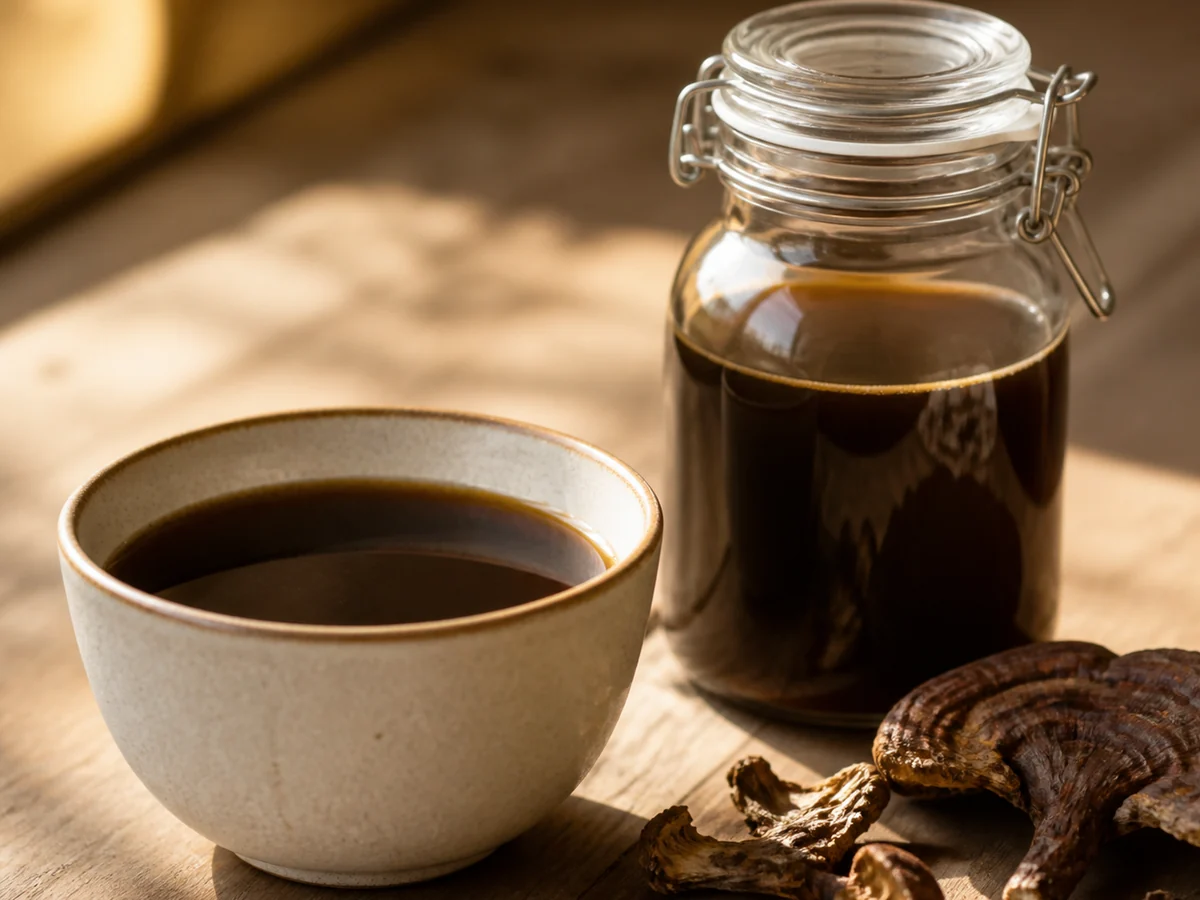
Cool it quickly rather than leaving the pot on the hob to come down slowly. A nutrient-rich liquid sitting warm for hours is exactly the thing that spoils.
Once it is cold, a sealed glass container in the refrigerator is all that is needed, and the honest keeping time is a few days rather than a few weeks.
Freezing solves the problem completely. Portions in an ice cube tray thaw in minutes and remove any pressure to drink a batch before it turns.
Write the date on whatever it goes into, because a dark liquid in a jar gives no clue about its age until it is too late.
Reducing the finished liquid down before storing is the other option worth knowing. It takes up less room, it keeps no longer, and it lets a small measured amount go into something else rather than being drunk as a mug of tea.
Cool it fast
Get the pan into cold water rather than letting it stand warm on the stove
Seal it cold
Decant into glass only once it is properly cold, since warm liquid sweats into the lid
Refrigerate or freeze
A few days cold, or portion it into a tray and stop worrying about it
Fix the taste at the cup
Dilute, add a little acid, or drink it hot, rather than shortening the simmer
That last line matters more than it looks. The most common way people ruin a decoction is by cutting the time to make it taste milder, which produces a weaker liquid that still tastes of mushroom.
How much of it to drink, and how often, is a separate question with its own evidence, and it is covered under how much to take rather than here.
Sources & References
- Optimization of extraction of antioxidant polysaccharide from Pleurotus ostreatus, PLoS ONE That the hot water optimum sat at 70.5 degrees Celsius for about sixty-two minutes at roughly twenty-six milliliters of water per gram.
- Extraction of triterpenoids and phenolic compounds from Ganoderma lucidum, Food and Function That optimized triterpenoid extraction required 62.5 percent ethanol with heat or 89.5 percent ethanol with ultrasound, conditions no water preparation reaches.
- Development of end stage renal disease after long-term ingestion of chaga mushroom, Journal of Korean Medical Science The case of sustained daily chaga intake leading to irreversible end-stage renal disease, with measured oxalate content of the powder.
- Chaga mushroom-induced oxalate nephropathy that clinically manifested as nephrotic syndrome, Medicine (Baltimore) The second case of acute kidney injury with calcium oxalate crystals in the tubules, and its full recovery after treatment.
- Edible mushrooms and beta-glucans, impact on human health That fungal beta-glucans are bound into chitin-based cell walls, which is why contact time in hot water is the variable that matters.