Why does chaga look nothing like a mushroom?
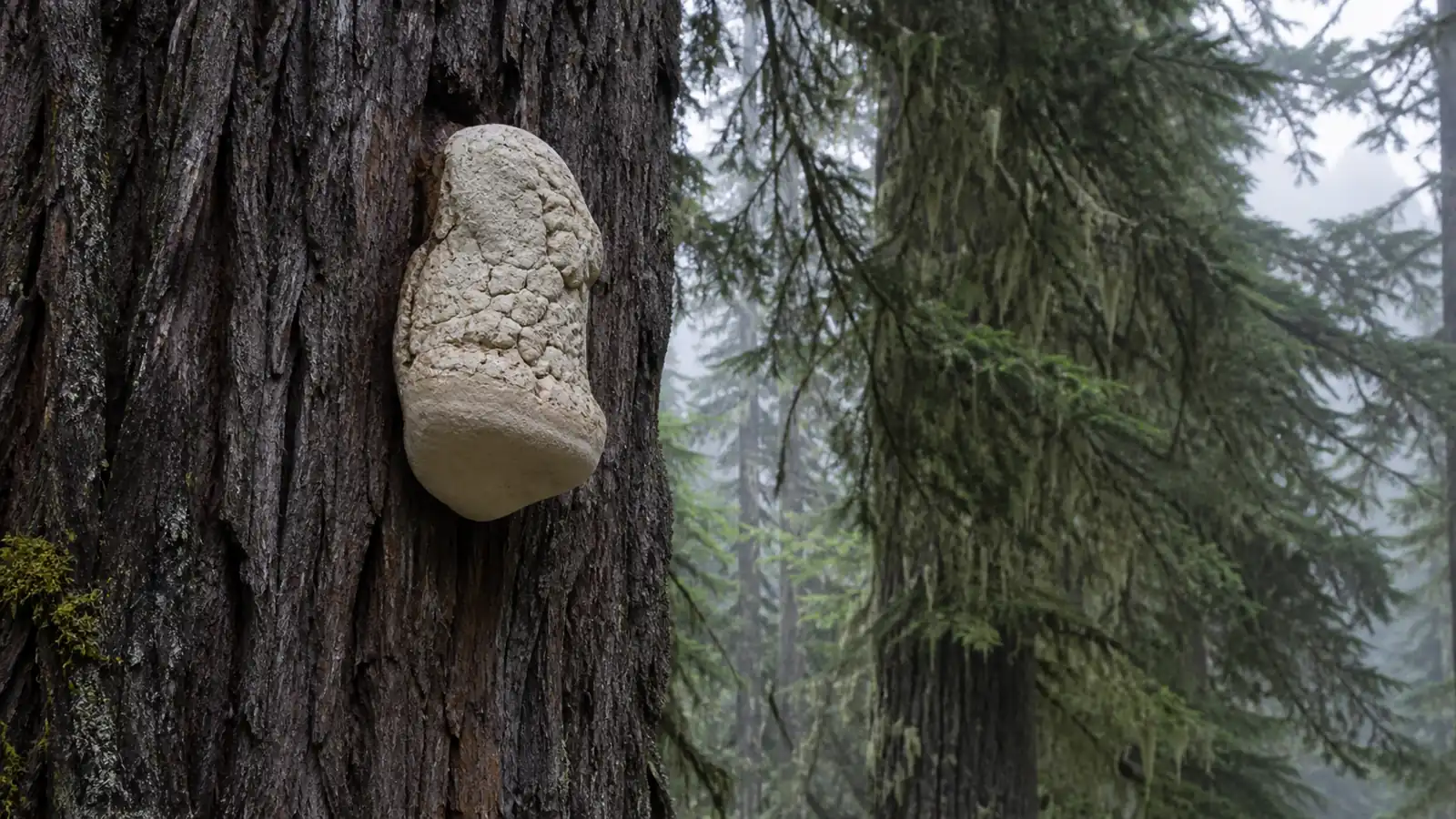
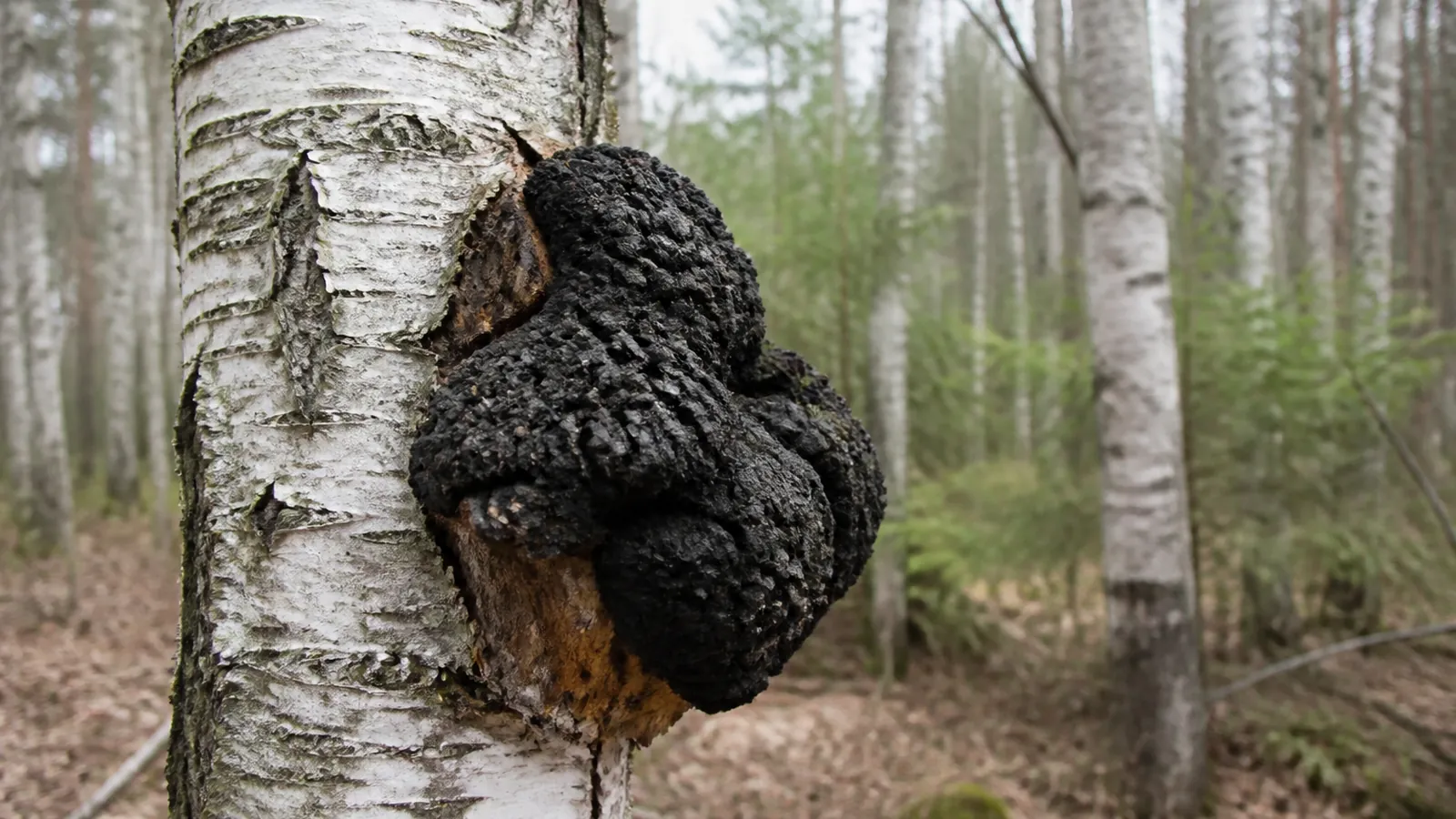
Chaga looks less like a mushroom than almost anything else people harvest. It is a hard black lump that bursts out of the side of a living birch, cracked all over like burnt charcoal.
Key takeaway
The black mass is a sclerotium, a dense body of sterile fungal tissue. It is not the fruiting body and it never produces spores, which is why no spore print can be taken from it.
The real fruiting body is something almost nobody sees. It forms under the bark of a dying or fallen tree, splits the bark open as a thin pore layer, and decays within weeks.
So the thing sold as chaga is the storage structure rather than the mushroom, which puts it in a different category from every gilled species on this site.
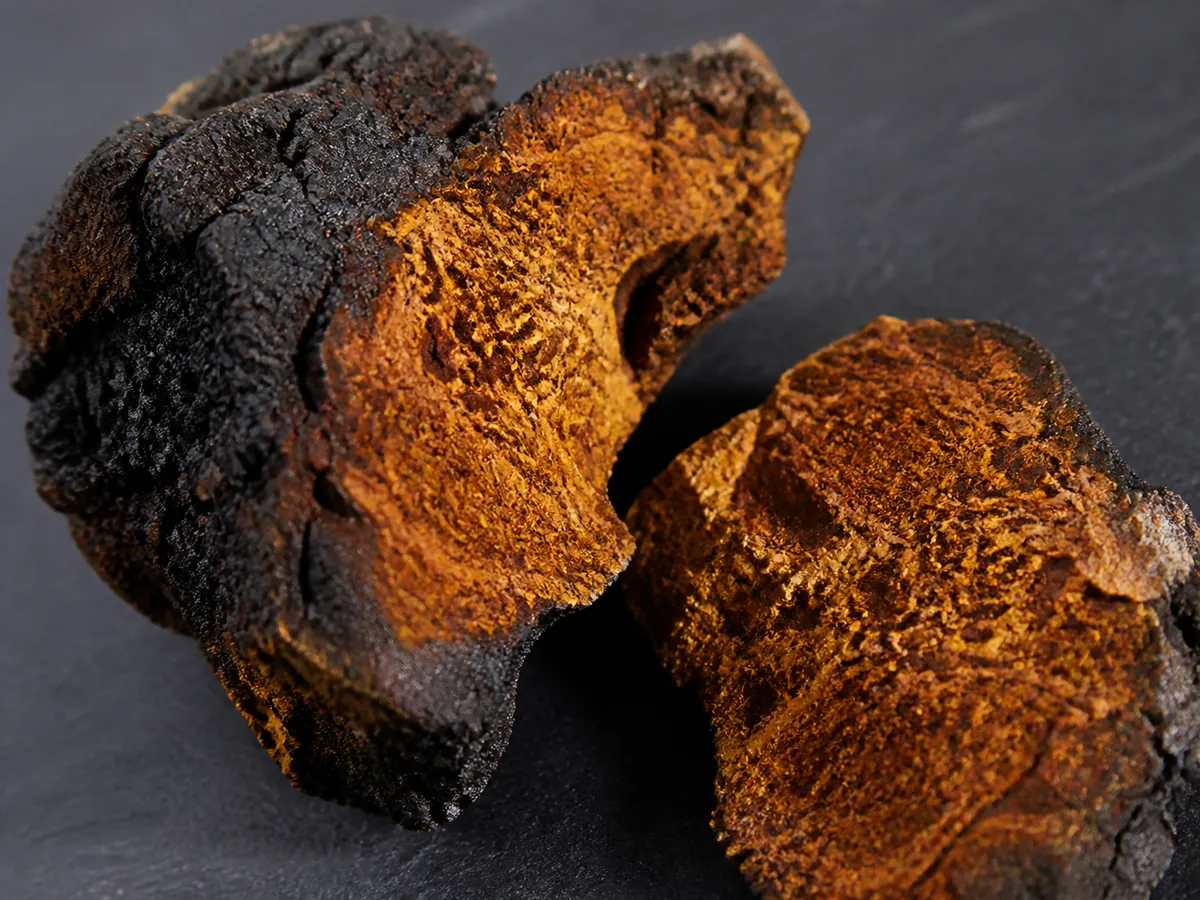
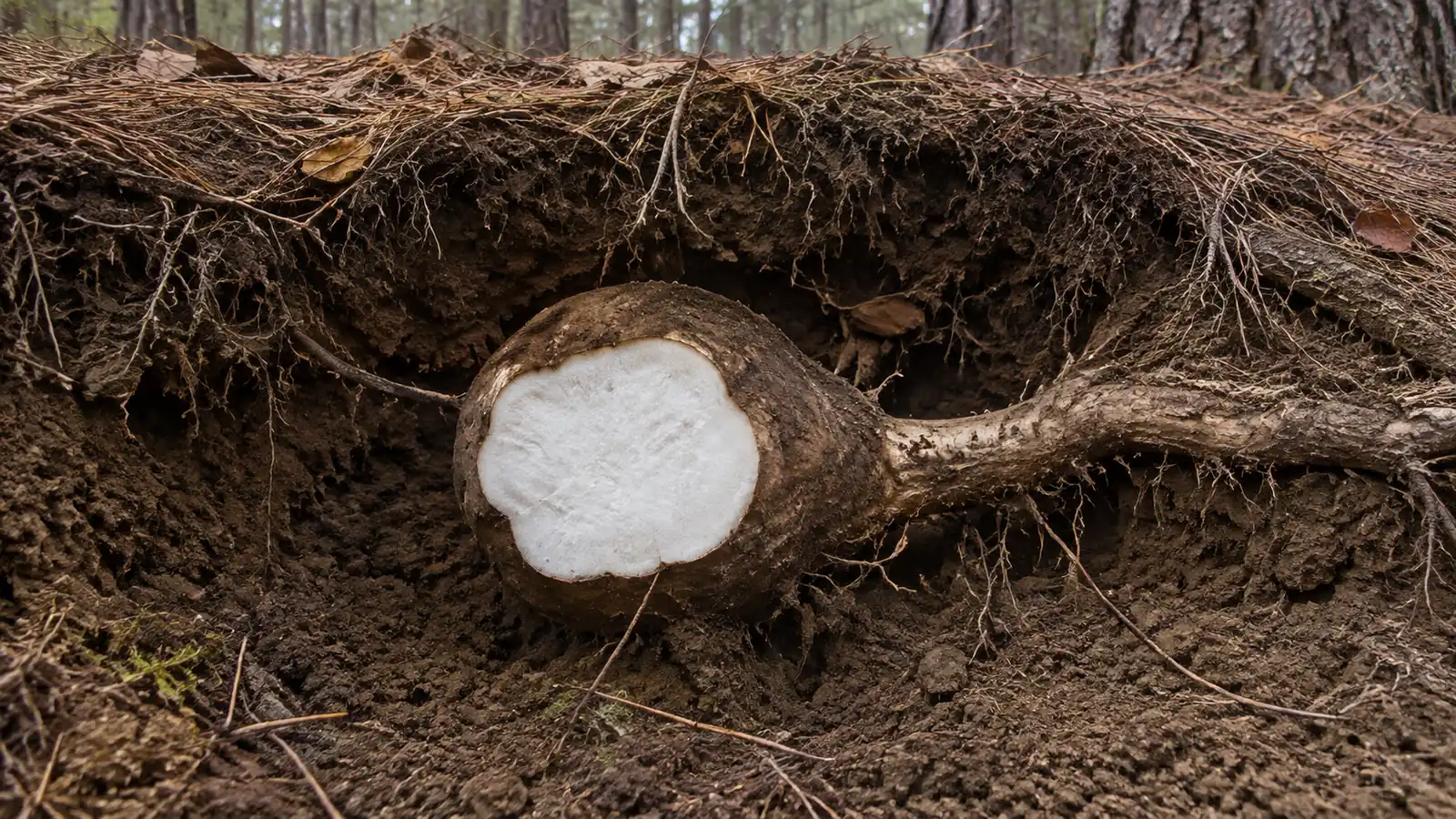
Breaking one open is what settles the identification. Under the black crust the tissue is rusty golden orange, corky, and marbled with paler veins, and no lookalike shares that combination.
The mass grows slowly. A conk of harvestable size represents many years of growth inside a tree, which is the reason sustainability is a live argument in the places where it is collected commercially.
How do the black crust and orange interior confirm it?
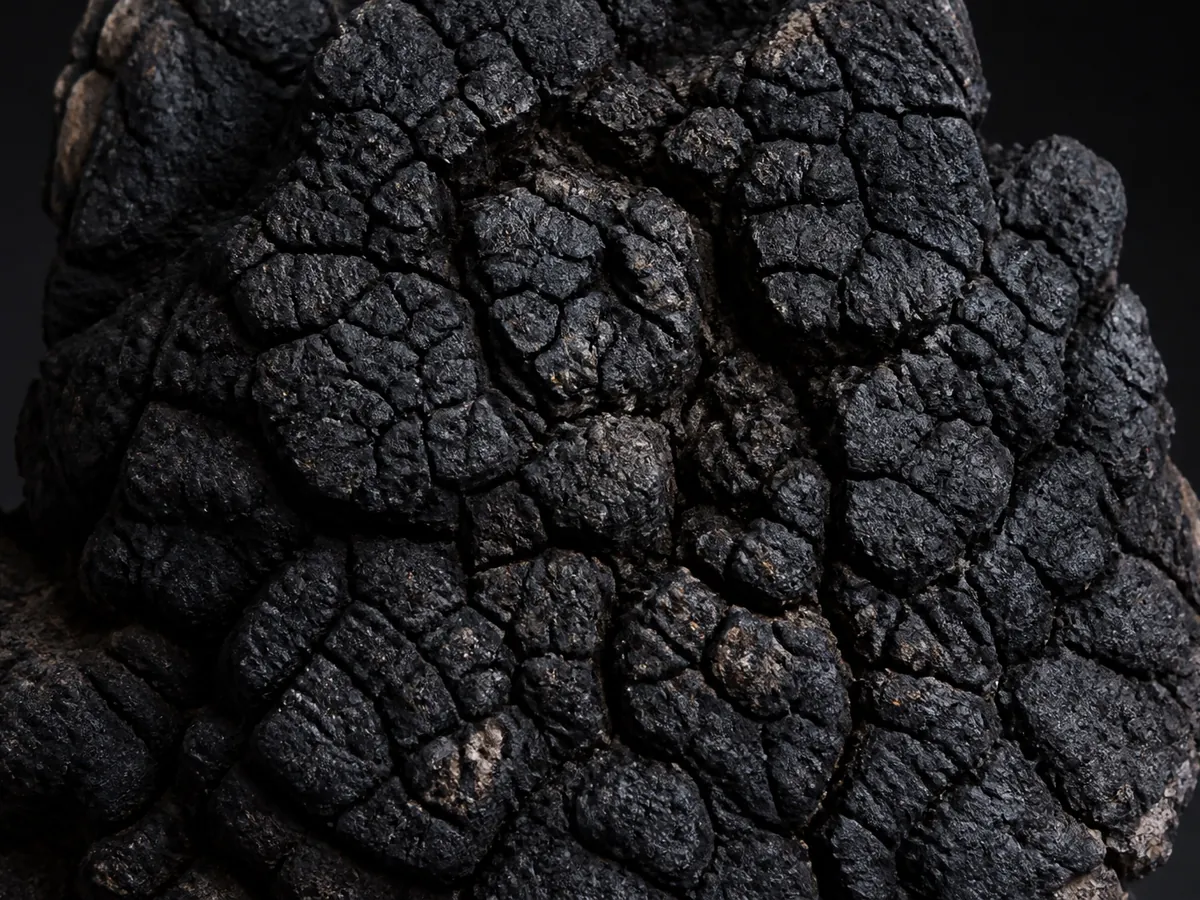
No cap. The visible growth is a hard irregular black mass bursting through bark, 10 to 40 cm, with a deeply cracked charcoal-like crust.
None, and no pores either on the black conk. The pore surface belongs to a separate fruiting body that forms under the bark and is rarely seen.
None. The mass emerges directly from a wound or crack in the trunk of a living tree.
Rusty golden orange brown inside, corky and marbled, snapping rather than cutting, with a faint woody smell.
Confirm the host first, because chaga on birch is the only version most people will ever meet.
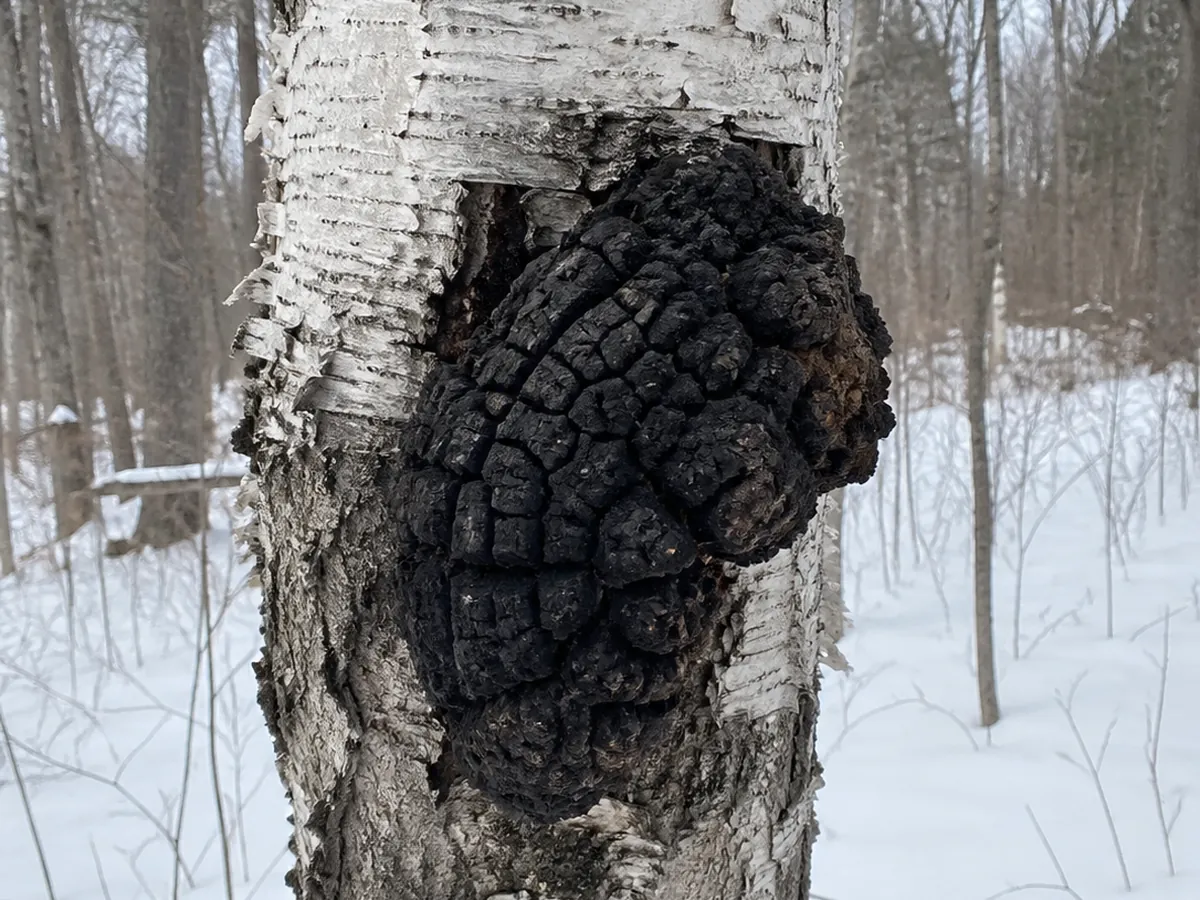
The color break is the decisive test. A black exterior with a rusty orange interior is chaga, and a black exterior with brown or white wood inside is something else entirely.
Note
Because the conk is sterile, none of the usual spore checks apply. A spore print cannot be taken from it, which removes a tool that works on most other groups.
Winter is when most people find it. Snow makes a black mass on a white trunk obvious from a distance, and the conk persists year-round rather than appearing in a season.
Condition is worth judging as carefully as identity, because a conk can sit on a tree for years.
A good specimen is heavy for its size, snaps rather than crumbles, and shows bright rusty orange straight through when broken. A poor one is light, powdery at the break, and dull brown rather than orange inside.
A conk that has fallen and lain on the ground is a different proposition again. Ground contact brings rot and soil organisms into something that was sterile inside a living tree.
What safety details matter for Chaga?
Two published cases describe kidney damage from sustained use, one ending in end-stage renal disease and one in acute kidney injury with nephrotic syndrome. Anyone with kidney stones, reduced kidney function, or on a low-oxalate diet should treat a daily chaga habit as a decision to discuss with a clinician.
How do you tell chaga from a burl or burnt wood?
Chaga has no poisonous lookalike, and the confusions are with woody growths on trees rather than with other fungi.
The one that catches people is a burl. A burl is the tree's own tissue, a rounded swelling of wood, and the giveaway is that bark grows over it in an unbroken skin.

Black knot and the various trunk cankers are the third group, and position separates them. Those sit on twigs and smaller branches rather than forming a large mass low on a trunk.
Burnt or charred wood is the other confusion, and it separates on the same test. Cutting into charcoal gives more charcoal, and cutting into chaga gives orange.
All of that assumes you are standing at a tree, and most people meet chaga as chunks in a bag.
At that point the burl test is gone and only the interior is left. Every piece should show the rusty orange cork through its broken faces, and a bag of uniformly black fragments is either crust alone or something else entirely.
The smell is worth using too, though it is soft evidence. Genuine material has a faint woody, slightly vanilla note when fresh ground, and charcoal or bark has none of it.
Correct identification does not remove the risks of long-term chaga consumption. Nothing here will poison you by misidentification, and the documented harm comes from taking correctly identified chaga in quantity over months and years.
There is a second consideration that is not about the person.
Chaga takes years to reach a harvestable size, it grows on a living tree, and removing it does not leave the tree as it was, so collecting pressure is a real conservation question in places where it is gathered for sale.
What does a chaga conk say about the birch it grows on?
Chaga is a parasite of living trees, which sets it apart from most fungi people collect.
It enters through a wound in the bark and colonizes the heartwood, causing a white rot while the tree is still alive. The black conk is the visible sign of an infection that has been running for years.
Birch carries nearly all of it. Other hardwoods including alder and beech are recorded as hosts, but the association with Betula is strong enough that host confirmation is a real identification step.
The fungus follows birch across the cold north, through northern Europe, northern Asia and North America. It is a fungus of cold forests rather than a widespread generalist.
The life cycle explains the strange anatomy.
The sterile conk persists on the living tree for years, and the actual fruiting body appears only when the tree dies, forming under the bark and rotting away quickly after releasing spores.
A conk therefore marks a tree with internal decay. As with any wood decomposer on a standing trunk, whether the tree is a hazard is a question for a qualified arborist rather than for a mushroom guide.
Why can chaga not be eaten?
Chaga is not eaten in any form, and this is not a matter of taste.
The tissue is corky and hard. It does not soften with cooking, it cannot be chewed, and there is no preparation that turns it into something a person swallows as food.
What people do is extract it. Chunks or powder are simmered for a long time to make a dark bitter drink that is often compared to coffee, and the solid material is discarded.
Long simmering is the traditional method and it is a genuinely different operation from swallowing powder, a distinction covered on the page about making mushroom tea.
That distinction matters here more than for any other species on this site, because the safety signal below is tied to how much material actually reaches the person.
What has actually been documented about chaga and the kidneys?
Chaga carries a large reputation and a small evidence base, and it carries the clearest documented harm of any commonly sold mushroom.
Warning
A 49-year-old man developed end-stage renal disease after taking chaga powder long-term for atopic dermatitis. Kidney biopsy showed chronic tubulointerstitial nephritis with oxalate crystal deposits. The investigators measured the oxalate content of his remaining chaga at 14.2 grams per 100 grams, and estimated his daily oxalate intake at twice a usual diet for four years and five times for one year. His kidney function did not recover.
A second case describes a 69-year-old man who took 10 to 15 grams of chaga powder a day alongside 500 mg of vitamin C for three months, and developed acute kidney injury presenting as nephrotic syndrome. Biopsy showed calcium oxalate crystals in the tubules.
He recovered after dialysis and high-dose steroids.
The vitamin C detail is worth carrying away. Ascorbate is metabolized to oxalate, so a supplement taken alongside chaga adds to the same load rather than sitting beside it.
Two cases do not establish how often this happens, and they do establish that it happens and what the mechanism is. Set against an efficacy literature that is mostly laboratory work, that asymmetry is the honest summary of chaga.
Why is chaga almost never cultivated?
Chaga is close to uncultivable in the form people want, which is why wild collection dominates supply.
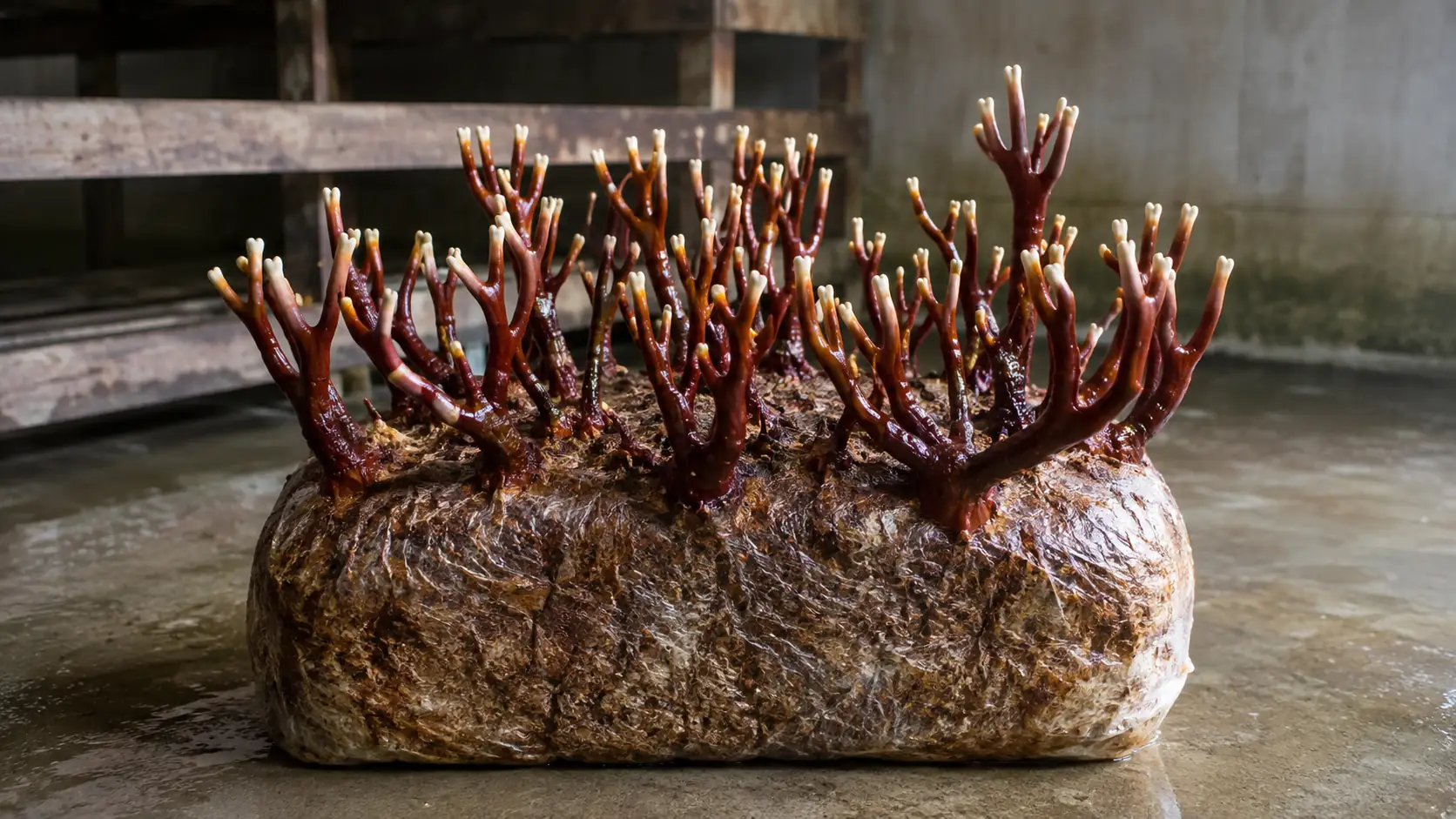
The black conk is a response to living inside a tree over years. Mycelium grows readily in a laboratory and on grain, but liquid or grain culture is not the sclerotium and does not have its composition.
Inoculating living birch is possible and slow. It means deliberately infecting a tree with a parasite and then waiting years, which is a forestry decision rather than a mushroom-growing project.
Anyone comparing products should notice which of those two materials they are buying, because cultured mycelium and wild conk are different things sold under one name.
Because supply is wild, what a buyer receives varies more than for any cultivated species.
The ratio of black crust to orange interior is the practical quality question. Crust is the outer sterile shell and interior is the tissue people are actually after, and a bag that looks uniformly black is mostly the former.
Harvest practice varies just as much. A conk cut away cleanly leaves the tree with an open wound and a fungus still inside it, so removal ends neither the infection nor the tree's exposure.
The collecting pressure question follows directly from the growth rate. A conk worth taking represents years inside a tree, so a stand can be stripped far faster than it can replace what was taken.
The practice most collectors settle on is to leave small conks alone, to take part of a large one rather than all of it, and to leave the tree with something still attached.
None of that is regulated in most places, which makes it a habit rather than a rule.
For a buyer the same question arrives as provenance. A supplier who can say which region and which season a batch came from is describing a supply chain, and one who cannot is describing a commodity.
Which number on a chaga analysis actually matters?
A nutrition table for chaga is misleading before it starts, because nobody eats it.
The conk is structural material. It is corky and largely indigestible, and what reaches a person is whatever hot water pulled out of it rather than the tissue itself.
One number does matter and it is not a nutrient. The measured oxalate content of 14.2 grams per 100 grams is extremely high for any consumed material, and oxalate is the compound behind both published kidney cases.
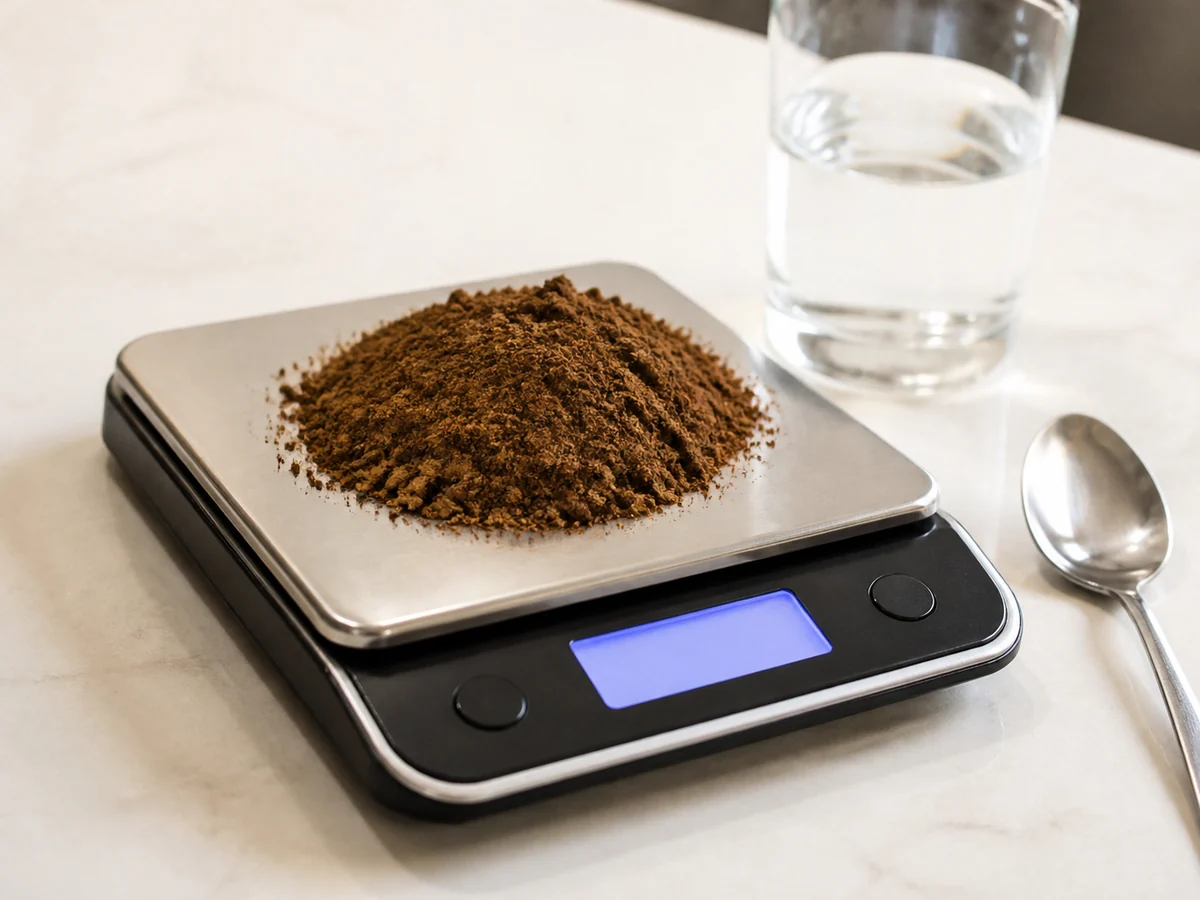
That is the figure to weigh against any nutrient claim. The compounds people take chaga for and the compound that damaged two people's kidneys come out of the same conk together.
Why is chaga called a polypore when it has no pores?
Inonotus obliquus sits in the Hymenochaetaceae, a family of wood-decaying fungi with a rusty brown flesh color that the broken conk shows plainly.
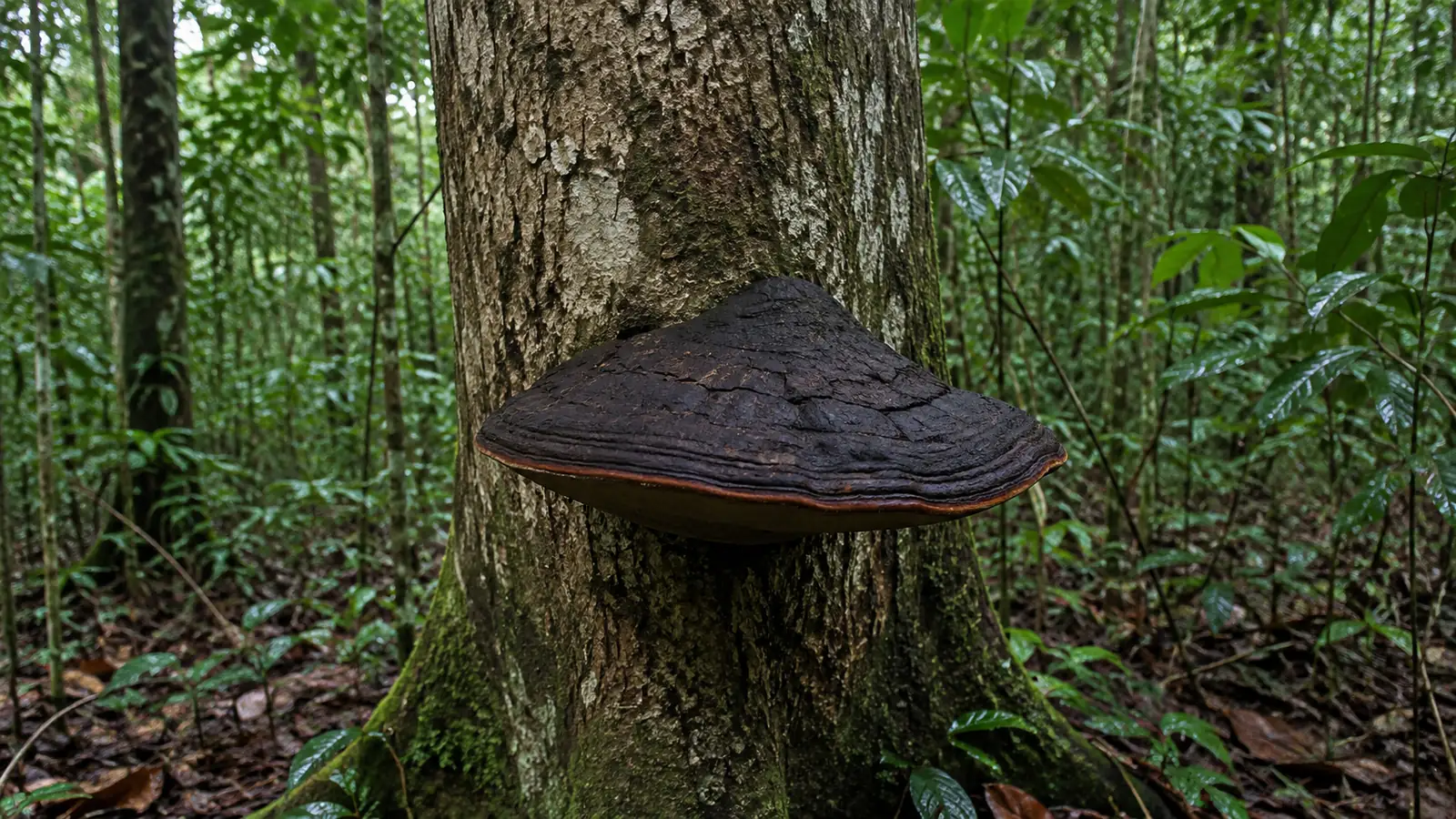
The naming confusion here is not between species but between structures. Older sources describe chaga as a polypore, which is correct for the fungus and misleading for the black mass, since that mass has no pores at all.
Note
When a source calls chaga a polypore it is naming the organism, not the object in the bag. The pore-bearing fruiting body exists, forms under bark on a dead or dying tree, and is not what anybody harvests.
The genus has been revised repeatedly and some sources still use older combinations. For a reader checking evidence, the accepted binomial Inonotus obliquus is the term that finds the literature.
Chaga identification and safety questions
Is chaga actually a mushroom?
How do you tell chaga from a burl?
Can you eat chaga?
Is chaga bad for your kidneys?
How much chaga is too much?
Who should avoid chaga?
Sources & References
- Development of End Stage Renal Disease after Long-Term Ingestion of Chaga Mushroom, Journal of Korean Medical Science 2020 The end-stage renal disease case, the biopsy finding of oxalate crystal deposits, the measured oxalate content of 14.2 grams per 100 grams, and the estimated daily intake against a usual diet.
- Chaga mushroom-induced oxalate nephropathy that clinically manifested as nephrotic syndrome, Medicine (Baltimore) 2022 The acute kidney injury case at 10 to 15 grams a day with 500 mg vitamin C, the calcium oxalate crystals in the tubules, the recovery after dialysis and steroids, and the family and host description.
- Lanostane-type triterpenes from the sclerotium of Inonotus obliquus, Journal of Natural Medicines 2019 That the harvested chaga mass is the sclerotium of Inonotus obliquus rather than a fruiting body.