What makes a varnished bracket recognizable as reishi?
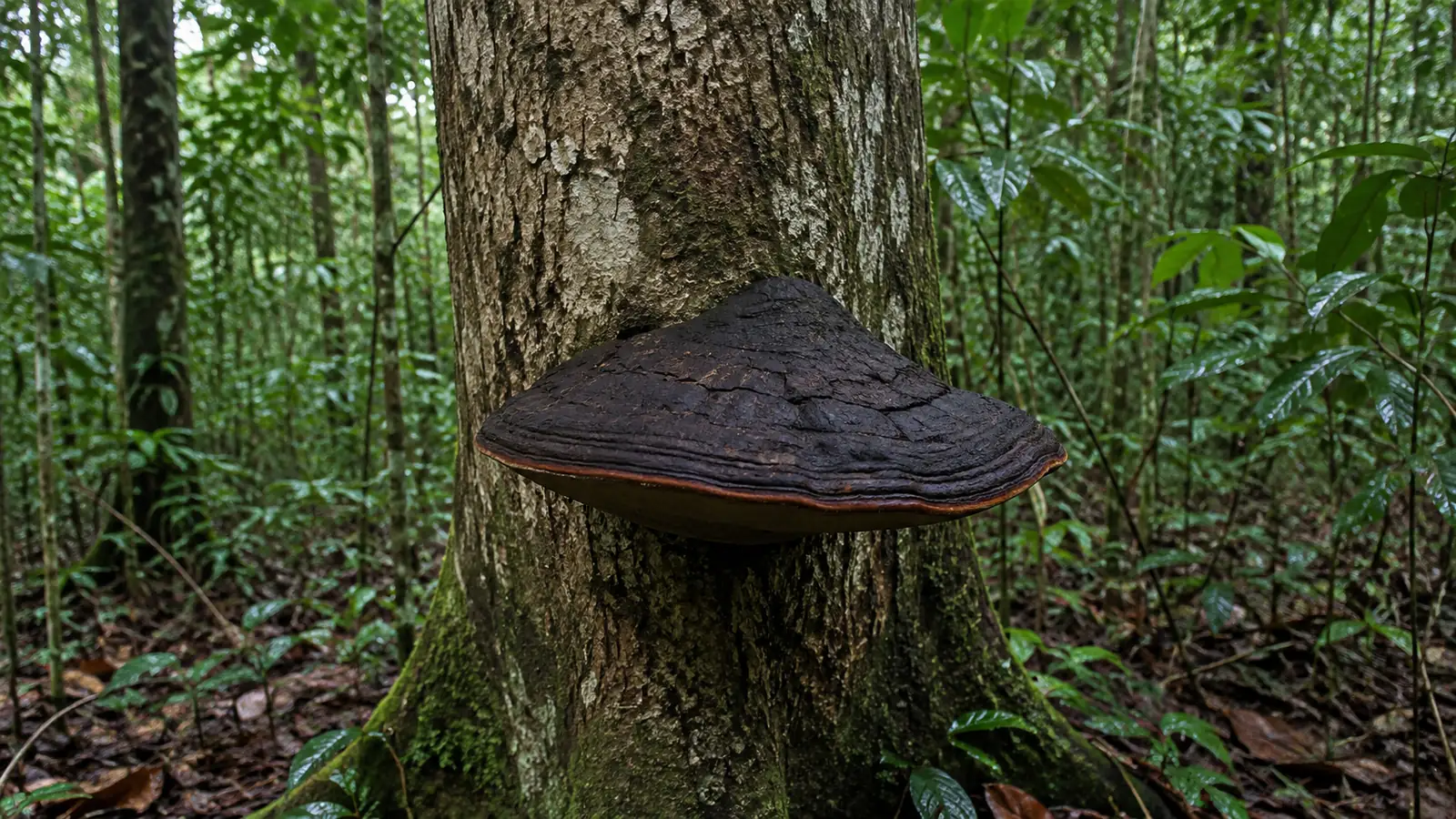
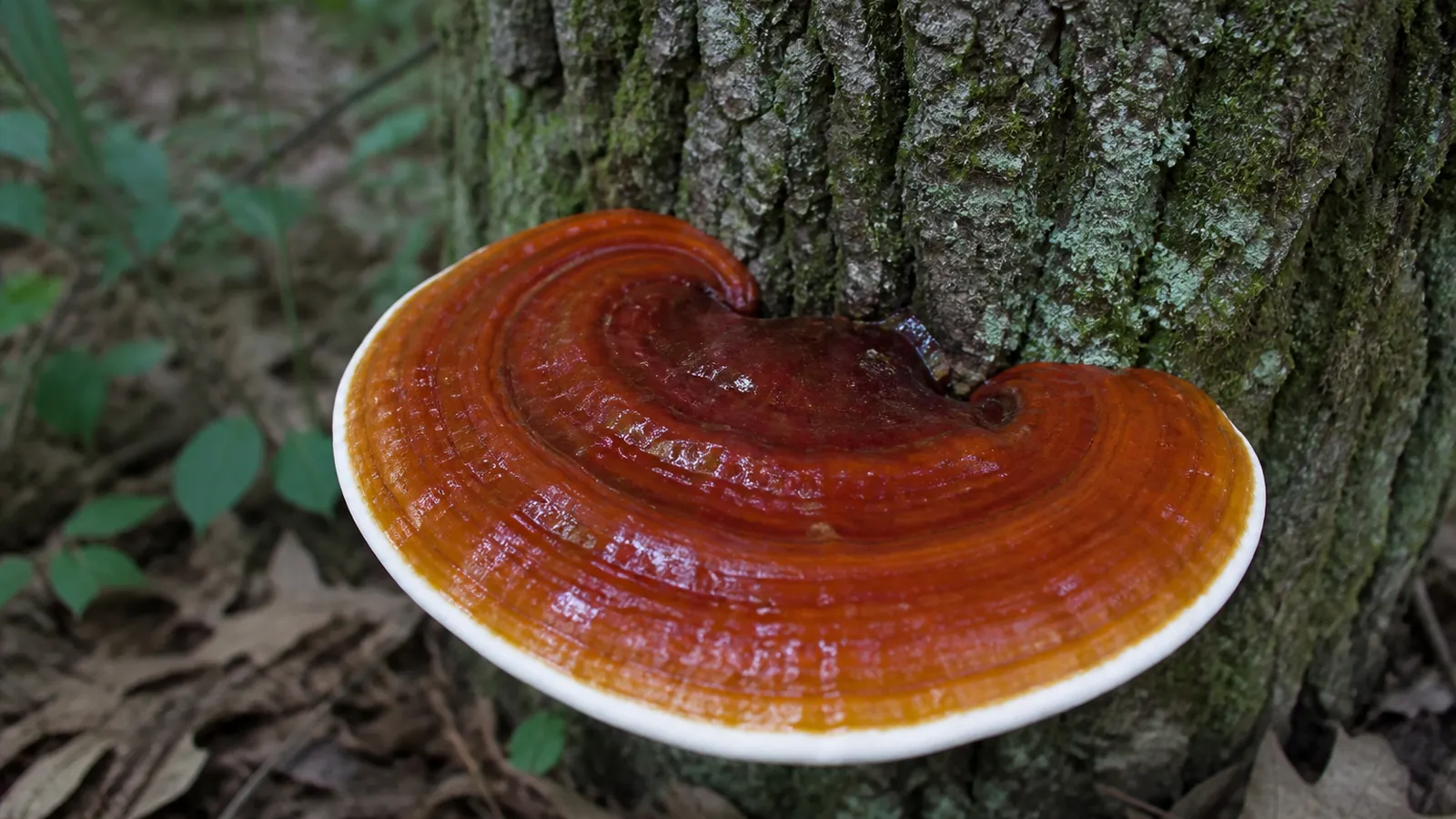
Reishi is the bracket most people have heard of and fewest have seen. It grows as a hard shelf at the base of hardwood trunks and stumps, and the surface looks as though somebody varnished it.
That crust is the first thing to notice. It is genuinely glossy rather than merely smooth, it holds a band of red brown to mahogany color, and a growing specimen carries a soft pale margin at the outer edge.

Key takeaway
A lacquered crust plus a pale pore surface plus hardwood is the whole field call. Reishi has no deadly lookalike, which makes it one of the safest brackets to name and one of the least useful to eat.
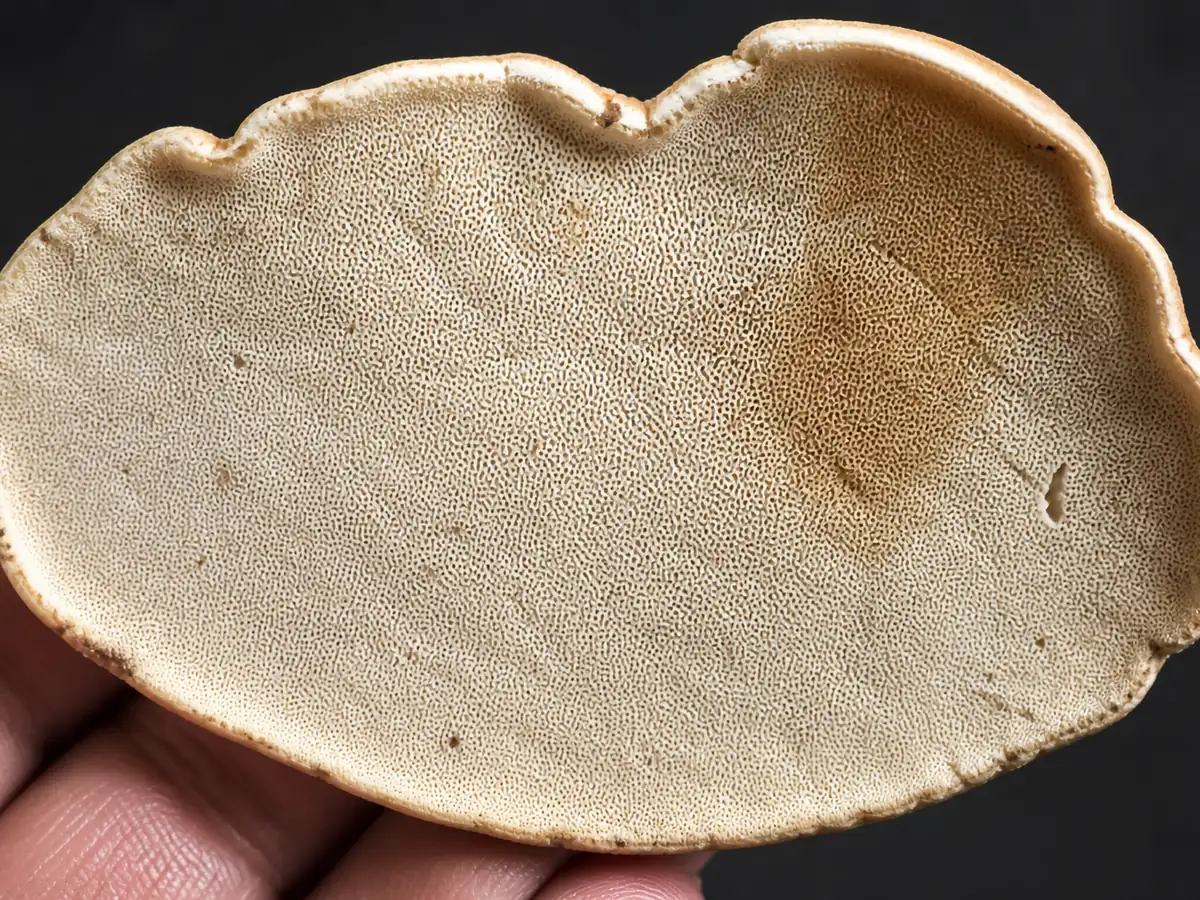
The underside carries no gills. It is a flat pore layer, cream to white when fresh, and it bruises to a dull brown wherever a finger touches it.
The flesh is the part that ends the food question. It is corky when young and woody when mature, it resists a knife, and it tastes bitter, so no amount of cooking turns it into a vegetable.
Wild brackets are annual. A new shelf forms in one season and then persists as a dry weathered object long after it has finished releasing spores, so a winter find is often last summer's growth.
Almost all of the reishi in commerce is cultivated on sawdust blocks or logs rather than collected. That matters for identification, because a cultivated specimen can be grown into shapes a wild one never takes.
How do the lacquered crust and pore surface confirm it?
Kidney- to fan-shaped shelf, 5 to 20 cm, with a hard glossy crust that looks varnished, banded in red brown to mahogany with a pale to white growing margin.
None. The underside is a flat pore surface, cream to white when fresh, bruising dull brown where handled.
Often a lateral or off-center stalk, sometimes long and slender, sometimes absent so the shelf attaches directly to wood.
Corky to woody, pale brown, tough enough to resist a knife, with little smell and a bitter taste.
Start with the shine, because it is the field mark that separates this group from every other bracket on a hardwood trunk.
A brown spore deposit supports the group. Ganoderma spores are brown and unusually thick-walled, and a mature bracket often dusts its own upper surface and the wood beneath it.

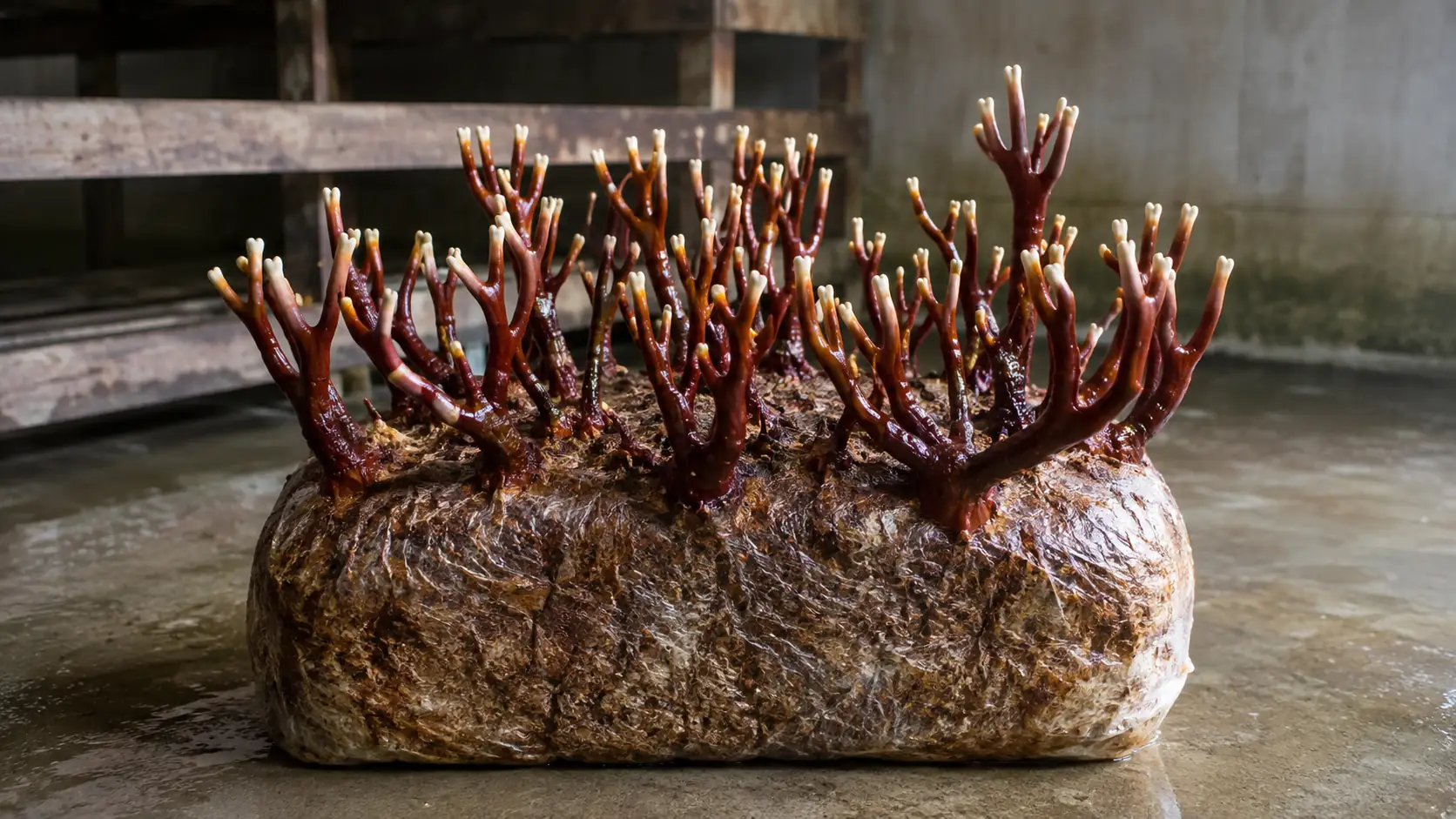
Cultivated material can look wrong to somebody expecting a shelf. Grown in a bag with limited air exchange, the fungus produces an antler form instead, a branching red orange stalk with pale growing tips.

Which brackets get confused with reishi, and does it matter?
Reishi is unusual among well-known mushrooms in having no dangerous lookalike. Nothing deadly closely resembles a hard lacquered shelf on hardwood, so a mistake here costs disappointment rather than harm.
The confusions that do occur are with other brackets, and two of them are worth knowing by sight.
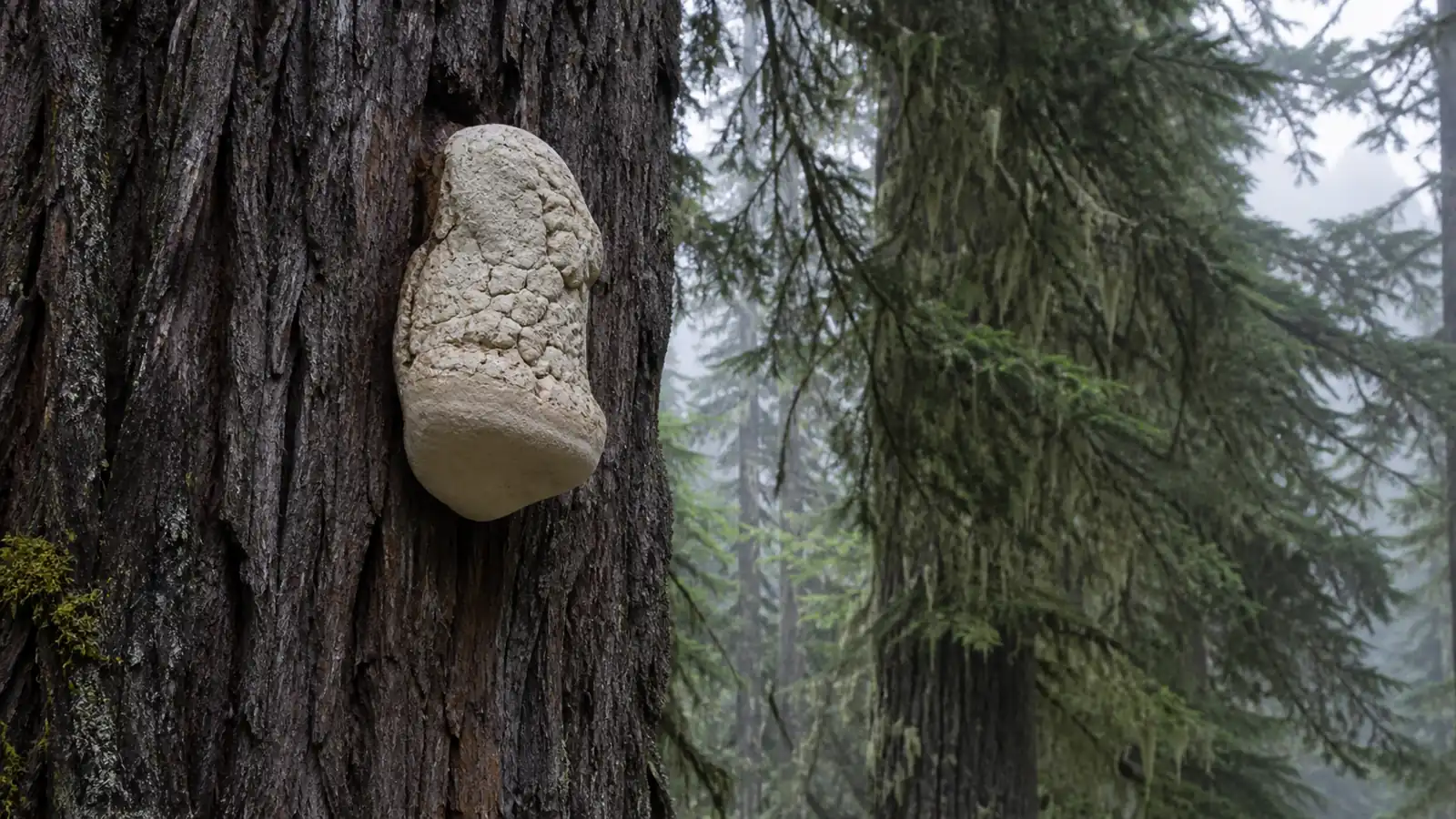
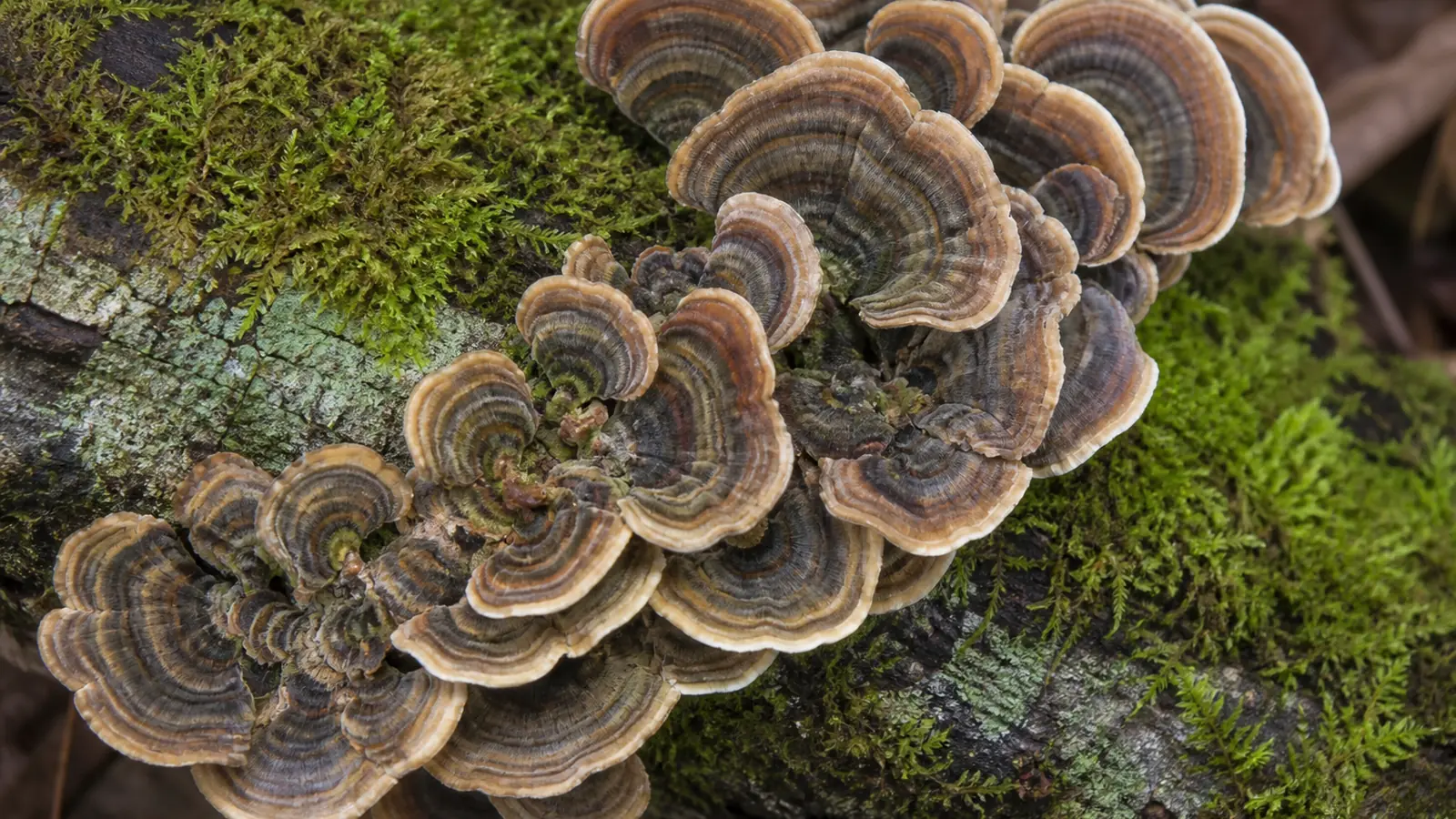
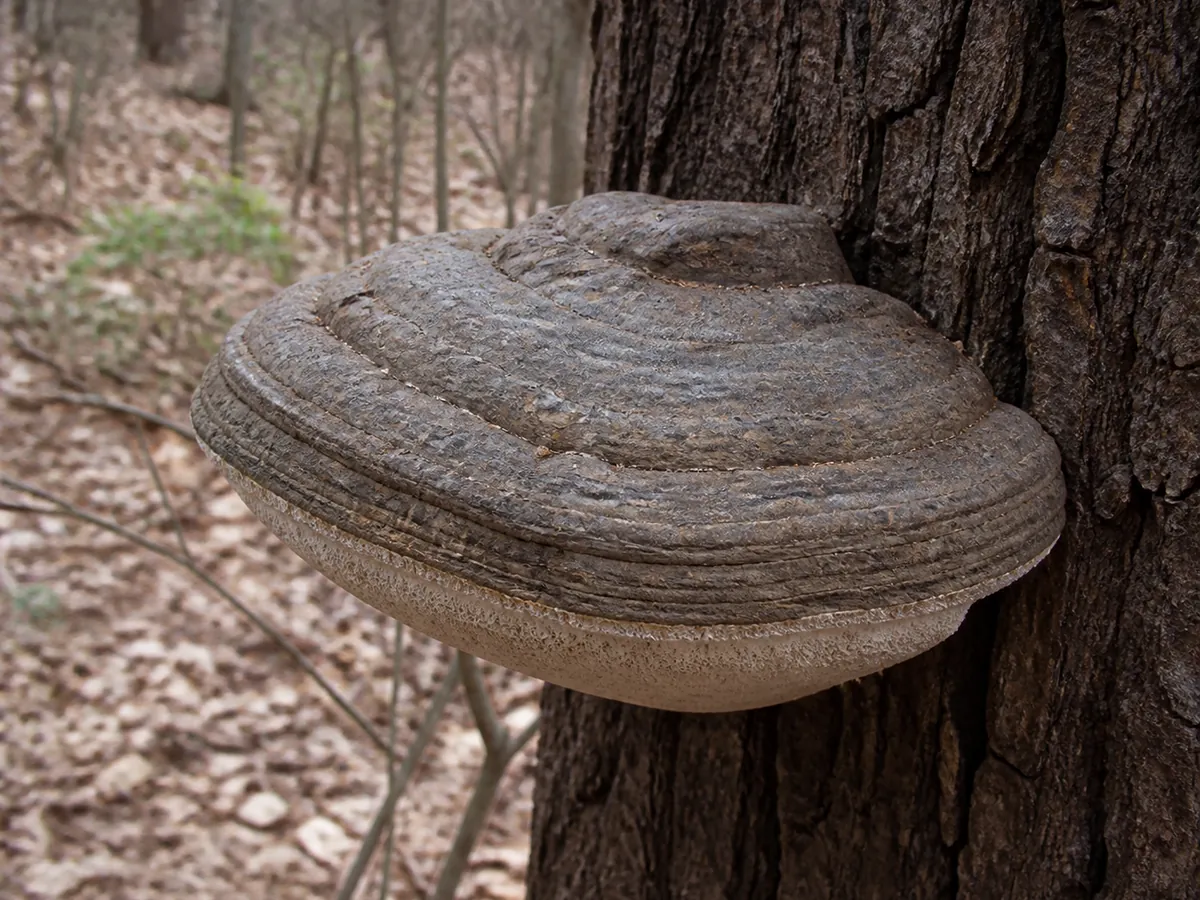
The artist's conk is the one people meet most often. It shares the genus and none of the varnish: the crust is dull, matte and gray brown, and the pore surface is chalky white and marks so readily that the mushroom is named for being drawn on.
A perennial bracket shows its history. Cut one and the pore layers stack in visible bands, one per season, which a single-season reishi never has.
The second confusion is with the other lacquered brackets in the genus, and there the host does the work. A varnished shelf on conifer wood, hemlock in particular, is a different species from the one on oak, even though both look polished.
The genuine risk with reishi runs the other way round, and it is worth stating plainly.
Because nothing deadly resembles the mushroom, people relax about the product instead. Every documented case of harm attached to reishi comes from a concentrated supplement rather than from anything picked in a wood, and the identification skill that keeps foragers safe does nothing about a capsule.
There is a second, quieter problem. A bracket that has been sitting on a stump for a year is weathered, algae-stained and cracked, and a weathered specimen is much harder to name than a fresh one, so a confident call needs a bracket with its growing margin still visible.
What does a reishi bracket say about the tree it grows on?
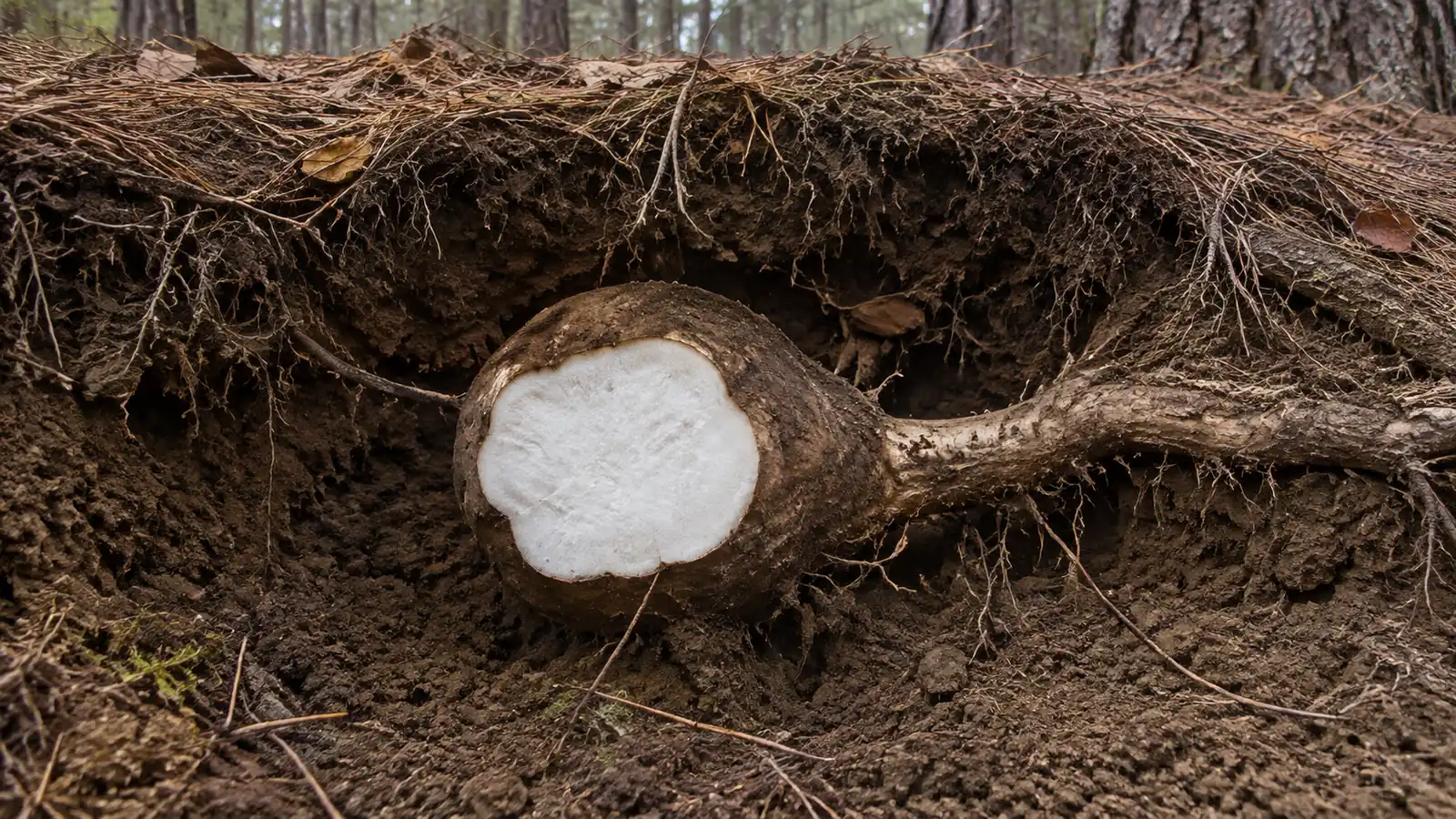
Reishi lives on hardwood. It fruits at the base of standing trunks, on stumps and on buried roots, and oak is the host named most often.
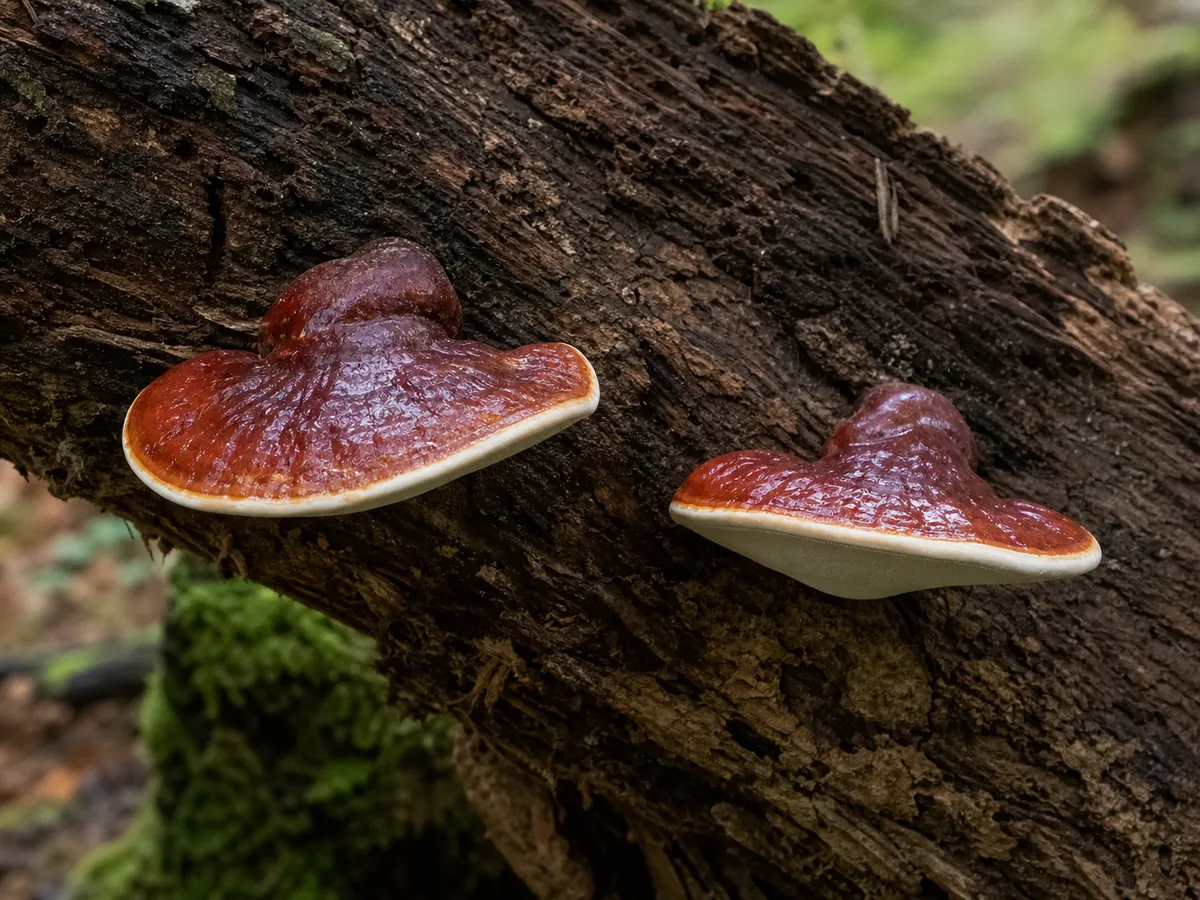
The fungus is mainly a wood decomposer, and it can also behave as a weak parasite on a tree already under stress.
A bracket at the foot of a living tree is therefore worth noticing. It indicates decay in the root plate or the butt, which is the part of a tree whose failure matters most, and that assessment belongs to a qualified arborist rather than to a mushroom guide.
The reishi group is spread across East Asia, Europe and North America, and the members are not interchangeable. What grows wild on European oak is not what is farmed in China, a point that turns out to matter for every claim made about the mushroom.
Cultivation dominates supply. Sawdust blocks and inoculated logs produce a crop in months, which is why a wild bracket is a curiosity and a farmed one is an industry.
Why can reishi not be cooked and eaten?
Reishi is not food, and this is the most common misunderstanding about it.
The flesh is corky when young and woody when old. It does not soften with cooking, it cannot be chewed, and it is bitter throughout, so it never enters a dish the way a shiitake or an oyster mushroom does.
What people actually do is extract it. Sliced dried bracket is simmered for a long time to make a bitter tea, and the solid material is discarded rather than eaten.
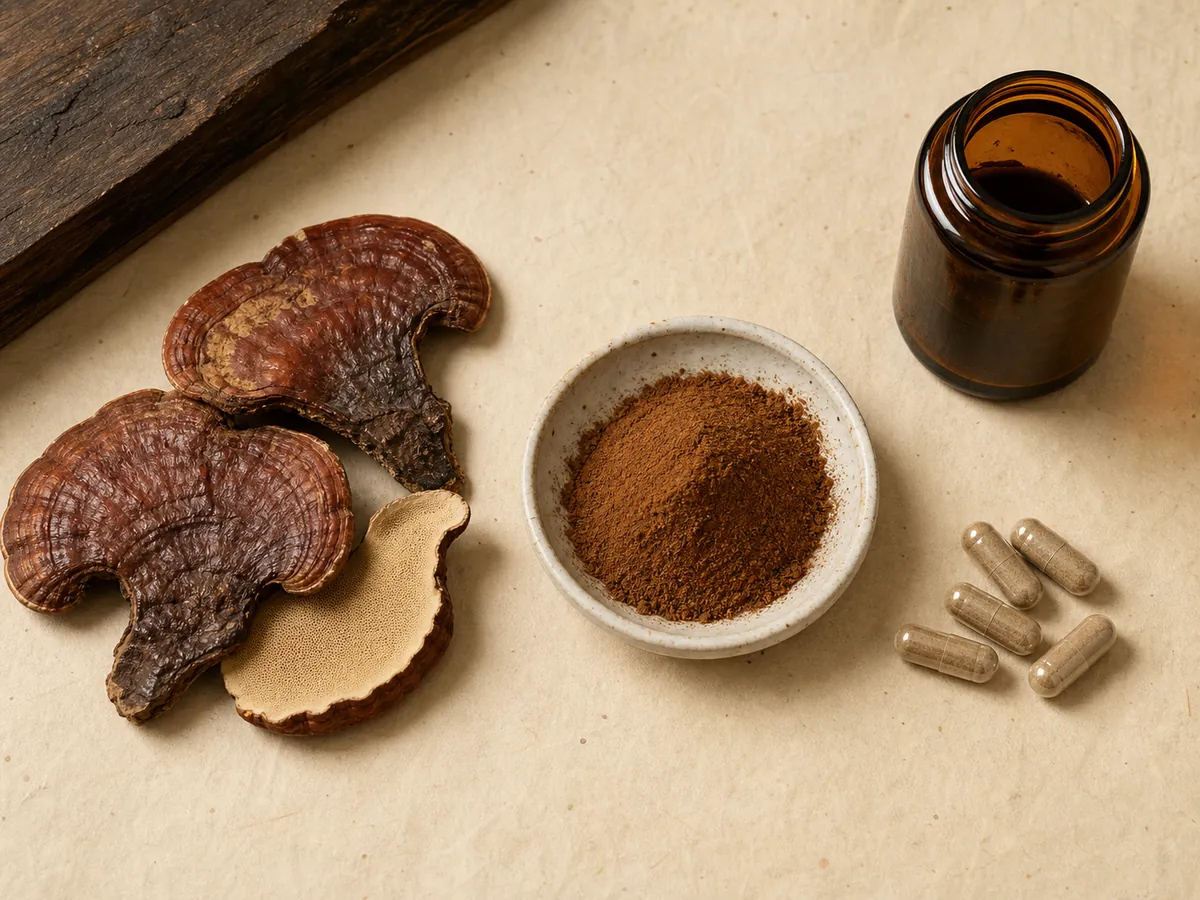
Long simmering is the traditional preparation and it is not the same operation as swallowing a powder, which is covered on the page about making mushroom tea.
What has actually been measured about reishi and health?
Reishi carries more medicinal claims than almost any other fungus, and the evidence behind them is thinner than the reputation.
A Cochrane review of Ganoderma lucidum for cancer treatment included five randomized trials with 373 participants. It judged the methodological quality generally unsatisfying, found that no trial had recorded long-term survival at all, and reported a tumor response relative risk of 1.50 with a 95 percent confidence interval of 0.90 to 2.51.
Warning
That interval includes 1.0, the value meaning no difference, so the data are compatible with a substantial benefit and with none. The authors did not find sufficient evidence to justify use as a first-line treatment for cancer, and said it remains uncertain whether it prolongs long-term survival.
The safety record has its own literature. Hepatotoxicity from a Ganoderma formulation was first reported in 2004, a fatal case of fulminant hepatitis associated with the powder was published in 2007, and a 2023 case of acute liver injury after reishi powder taken with alcohol resolved fully within two weeks.
The detail in the 2007 report is the useful one. Both that patient and the earlier one had taken traditionally boiled lingzhi with no toxic effect, and the injury arrived in each only after they switched to powder, within one to two months.
The wider evidence audit, including what the supplement is and is not, sits on the reishi benefits page rather than here.
Why does cultivated reishi sometimes grow antlers?
Reishi is one of the easier medicinal species to cultivate and one of the slowest to finish.
Sawdust blocks supplemented with bran are the usual substrate, and hardwood logs work for growers willing to wait. Colonization takes weeks and fruiting takes weeks more, so a crop is measured in months.
The interesting control is carbon dioxide. Left in a bag with poor air exchange the fungus produces the branching antler form, and given fresh air and light it produces the flat varnished shelf, from the same culture.
Harvest is judged by the margin. While a white band remains at the edge the bracket is still growing, and once that band hardens and colors the season's growth is finished.
Why is a nutrient table for reishi close to meaningless?
A nutrient table for reishi is close to meaningless, because nobody eats it.
The bracket is mostly structural material. Chitin and other cell wall polymers make up the bulk, which is exactly why it is woody, and none of it is digestible in the way a cooked cap is.
What gets measured instead are extractable fractions, mainly polysaccharides and triterpenes, and their amounts vary enormously with the strain and the growing conditions rather than sitting at a fixed value.
One comparison of Chinese industrial crops against three genetically characterized Iberian strains found differences in dietary fiber, protein, ash and sodium between them, and antioxidant content that varied by up to 78.5 percent depending on strain.
That variation is the real nutrition story. A figure printed for reishi describes one strain grown one way, and the page on powder against extract explains why a label rarely settles the question.
Is the reishi on the label really Ganoderma lucidum?
The name is the most confused thing about this mushroom, and the confusion reaches every claim made for it.
Chinese cultivated lingzhi was called Ganoderma lucidum for decades. A re-examination of the holotype of Ganoderma sichuanense, combined with a phylogenetic study of the genus, confirmed that the widely cultivated Chinese species is G. sichuanense, and that the name G. lingzhi is a later synonym.
True Ganoderma lucidum still exists as a European and North American species, and it is not the farmed East Asian fungus. Studies that compare the two find measurable compositional differences, so the two names are not interchangeable even though product labels treat them as one.
Note
This matters when reading evidence. A trial labeled Ganoderma lucidum may have used the East Asian cultivated fungus, the European species, or a product whose identity was never verified, and the label on a jar is not evidence of which.
The practical position is simple enough. Reishi is a name for a group rather than for one organism, and anybody comparing a study with a product should check which fungus each one actually contained.
Reishi identification and product questions
Can you eat reishi?
Does reishi have a poisonous lookalike?
How do you tell reishi from the artist's conk?
Is reishi really Ganoderma lucidum?
Why is my cultivated reishi growing like antlers?
What does the research actually show for reishi?
Sources & References
- Re-Examination of the Holotype of Ganoderma sichuanense and a Clarification of the Identity of Chinese Cultivated Lingzhi, Journal of Fungi 2023 That Chinese cultivated lingzhi was long misidentified as G. lucidum, and that the correct name is G. sichuanense with G. lingzhi a later synonym.
- Differences in Antioxidants, Polyphenols, Protein Digestibility and Nutritional Profile between Ganoderma lingzhi from Industrial Crops in Asia and Ganoderma lucidum of Iberian Origin, Foods 2021 The measured compositional differences between the East Asian cultivated fungus and genetically characterized European strains, and the strain-dependent variation of up to 78.5 percent in antioxidant content.
- Ganoderma lucidum (Reishi mushroom) for cancer treatment, Cochrane Database of Systematic Reviews 2016 The five trials and 373 participants, the quality assessment, the absence of any long-term survival data, and the response relative risk of 1.50 with its confidence interval.
- Fatal fulminant hepatitis associated with Ganoderma lucidum (Lingzhi) mushroom powder, Journal of the Medical Association of Thailand 2007 The fatal case, and the observation that both this patient and the earlier Hong Kong patient had taken boiled lingzhi without toxic effect before switching to powder.
- Hepatotoxicity due to a formulation of Ganoderma lucidum (lingzhi), Journal of Hepatology 2004 The first published description of liver injury attributed to a Ganoderma formulation.
- Ganoderma lingzhi (Reishi Mushroom)-Induced Acute Liver Injury in the Setting of Alcohol Use, Cureus 2023 The 2023 case of acute liver injury after reishi powder taken with alcohol, which resolved completely at two weeks.