Grow reishi from a supplier-labeled Ganoderma culture on a fully colonized hardwood block. Restricted exchange favors antlers, while lower carbon dioxide and broader exposure allow conk development, so choose the fruit form before opening the bag.
Reishi is slower than an oyster crop, but the long clock is not its hardest feature.
The grow becomes confusing when a kit labeled only “reishi†is treated as one universal species and when antlers and shelf-like conks are expected to appear under the same air conditions.
Start with a supplier-labeled culture and decide which form you want before exposing the block. Restricted exchange favors elongated antlers, while lower carbon dioxide and broader air contact allow a cap or conk to expand.
Which reishi culture are you actually growing?
Key takeaway
Let the culture label set the conditions | Reishi is a trade name used for several cultivated Ganoderma species, so record the scientific name, strain or lot, and supplied temperature range before changing the bag.
Commercial labels often use Ganoderma lucidum broadly, although DNA surveys have found Ganoderma lingzhi in many products and grow kits.
Other Ganoderma species also occur in commerce, and they do not all share one growth rate or fruiting response.
That uncertainty changes the first practical decision. A photograph of a shiny red fruit body can confirm the general product style, but it cannot authenticate unlabeled spawn or a wild conk.
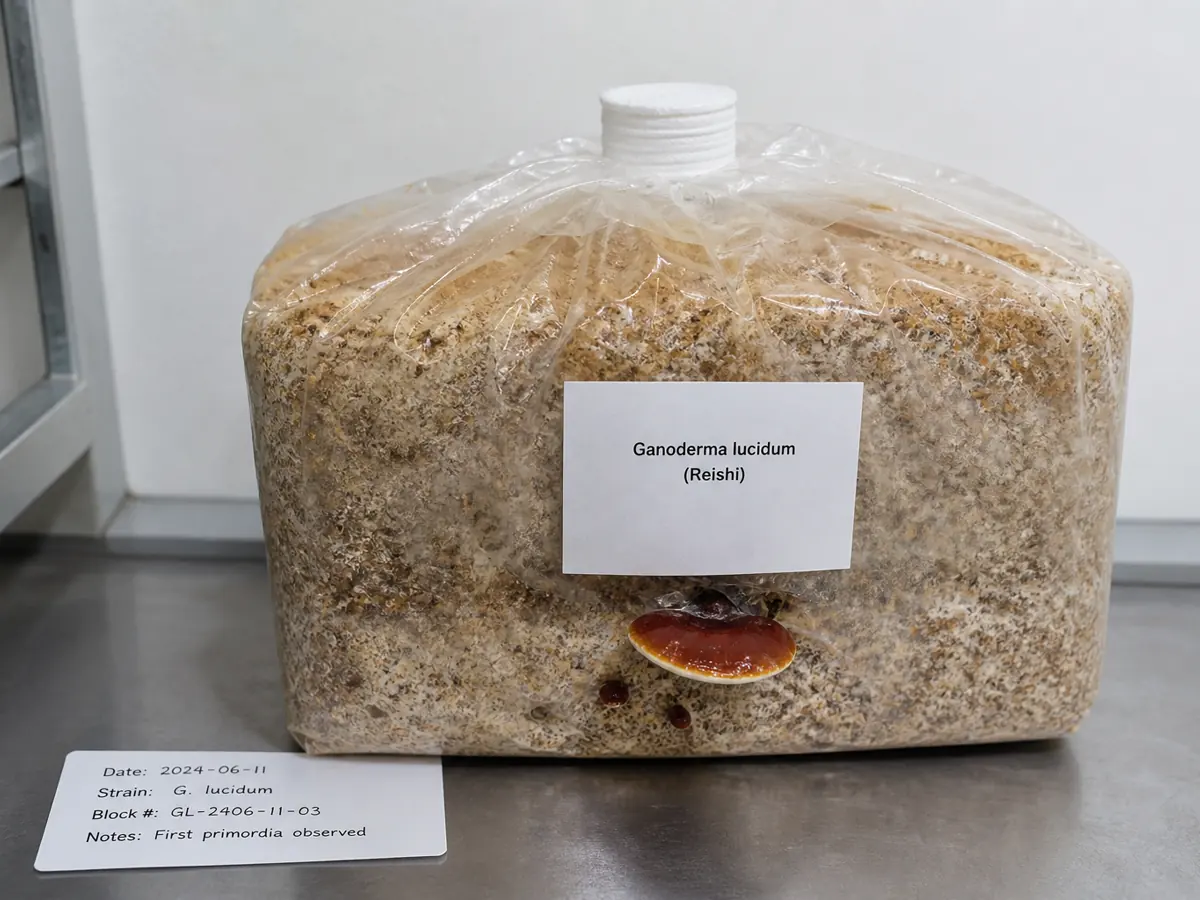
Photograph the label and the unopened block in one frame before the first stage change. That image keeps the visible crop tied to the supplier record even after the packaging is cut or discarded.
| Record before growing | What it controls | Stop condition |
|---|---|---|
| Scientific name | Which evidence and supplier ranges apply | “Reishi†appears with no taxon |
| Strain or lot | Expected speed, color, and morphology | The seller cannot trace the culture |
| Starting stage | Whether colonization or fruiting work remains | The bag stage is unclear |
| Intended form | Antler or conk air plan | No opening instructions exist |
Keep medicinal promises outside this decision.
Growing a correctly labeled fruit body does not establish a dose, treatment effect, or personal safety, and those questions require evidence beyond cultivation.
Do not clone a wild lacquered bracket for a first crop. That adds species identification, culture isolation, and contamination control to a process that already holds a block for several months.
Growing MushroomsWhat Does a Mushroom Farm Actually Cost to Start?Should you start with a block or reishi spawn?
A colonized block is the better first choice when you want to learn fruiting morphology.
It lets you practice placement, opening, humidity, replacement air, and harvest without making a supplemented hardwood bag under sterile conditions.
Starting from verified spawn gives you control over the substrate and container. It also makes pressure sterilization, cooling, clean inoculation, sealing, incubation, and every early failure your responsibility.
The two starting options have different clocks. A delivered block may still require maturation, while a spawn project must first build and colonize the entire substrate mass.
- Use one species-labeled block for the first environmental trial.
- Photograph and date the block before changing its bag.
- Keep the supplier instructions with the growing record.
- Prepare a washable isolation area before a suspect bag appears.
Reishi tolerates a long development period, which makes small upstream defects expensive.
Saving money on an unlabeled culture or an improvised filter bag can cost months before the failure becomes obvious.
Choose the amount of work you can verify rather than the option that sounds more advanced. A clean fruiting lesson from a finished block produces better evidence for a later spawn project than several untraceable bags started at once.
How should a reishi hardwood bag be built?
Hardwood sawdust supplies the lignocellulosic base used by many indoor systems.
Bran or another nutrient supplement can improve productive potential, but the added nutrition also supports molds and bacteria if heat treatment or transfer fails.
One published cultivation method combined sawdust and rice bran at four parts to one, adjusted the material, packed polypropylene containers, and sterilized them at 121°C. That is one complete experimental system, not permission to move the ratio into a larger bag with a shorter heating cycle.

Use a sacrificial test block when a new formula needs an internal packing check. Routine production bags should remain sealed because cutting them open to inspect moisture destroys the same contamination boundary the test is meant to evaluate.
| Part of the system | Evidence to preserve | Why it cannot be copied alone |
|---|---|---|
| Woody base | Species, particle size, and dry weight | Fine sawdust packs differently from coarse chips |
| Supplement | Ingredient and dry percentage | More nutrition raises contamination pressure |
| Water | Added weight and final moisture method | Free water changes gas spaces and heat movement |
| Container | Fill mass, shape, filter, and closure | The center heats and cools differently by geometry |
| Treatment | Temperature, pressure, and full cycle | A surface reading cannot prove the center was treated |
Cultivation literature often cites substrate water near 65 to 70 percent for Ganoderma systems.
Use that as bounded evidence and follow the strain method, because particle size and container volume determine whether the same percentage feels airy or becomes compressed mud.
Weigh the dry materials
Record the hardwood base and every supplement instead of estimating by scoop
Add measured water
Mix until moisture is even and no pocket releases a stream when compressed
Pack for structure
Fill evenly while preserving small air spaces and keeping the filter clear
Sterilize the complete mass
Use a validated pressure process and the equipment manufacturer’s safety instructions
Cool without opening
Wait until the center is safely below the culture’s transfer limit
Inoculate and seal cleanly
Distribute verified spawn, close the bag, and label the culture and date
Do not shorten cooling because the outside plastic feels comfortable. A warm center can injure spawn, while opening the bag early creates the largest contamination window in the process.
What proves that a reishi block has finished colonizing?
One experimental method incubated its sawdust and rice-bran culture near 28°C for about a month. Broader cultivation literature places full fruit-body production in a range of months, so neither number can date an unrelated home block.
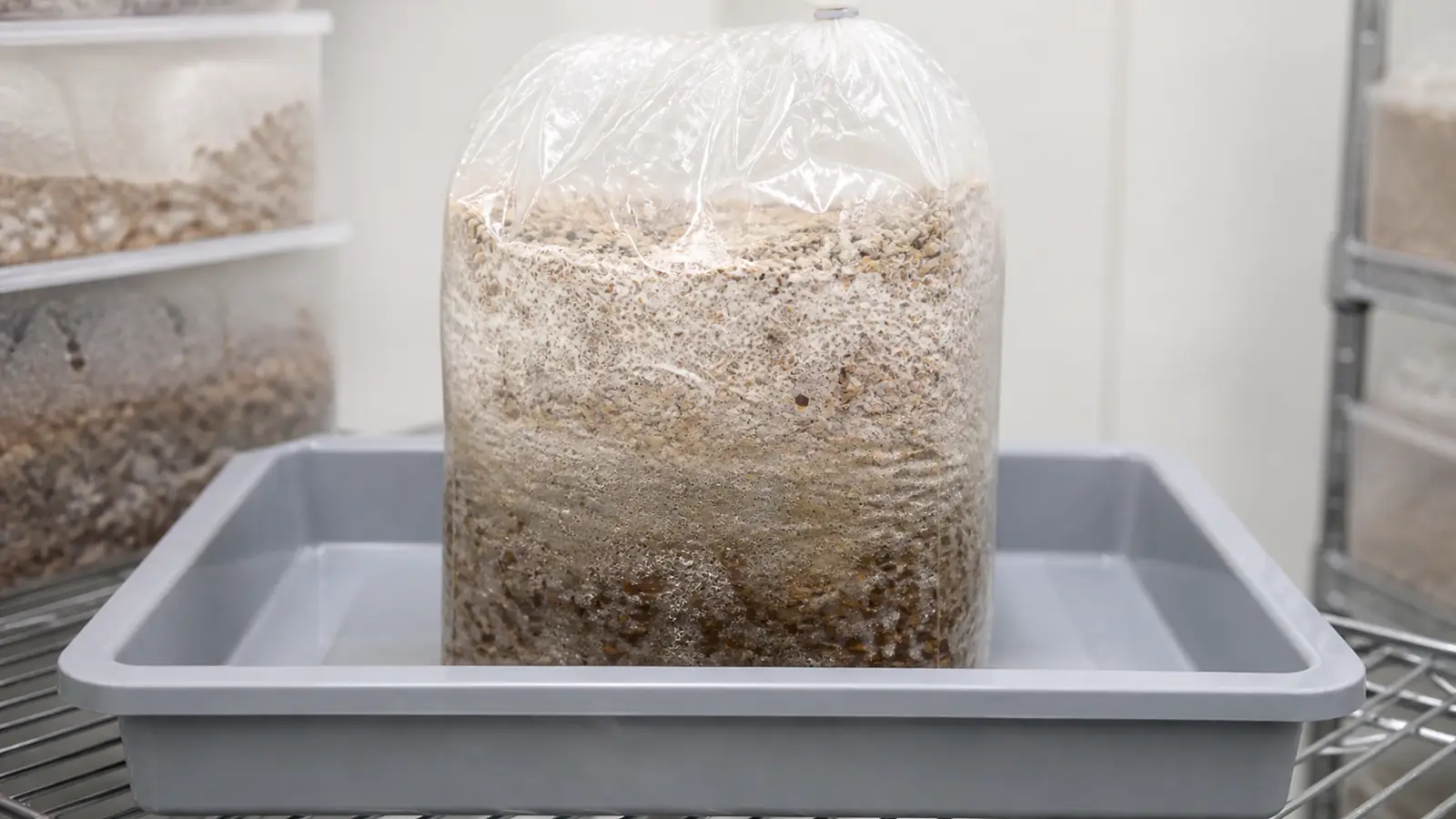
Complete colonization means white mycelium has occupied and bound the intended substrate without a persistent bare channel or expanding foreign boundary. Mature blocks may become dense and develop yellow droplets, but a single color is never enough to declare readiness or failure.
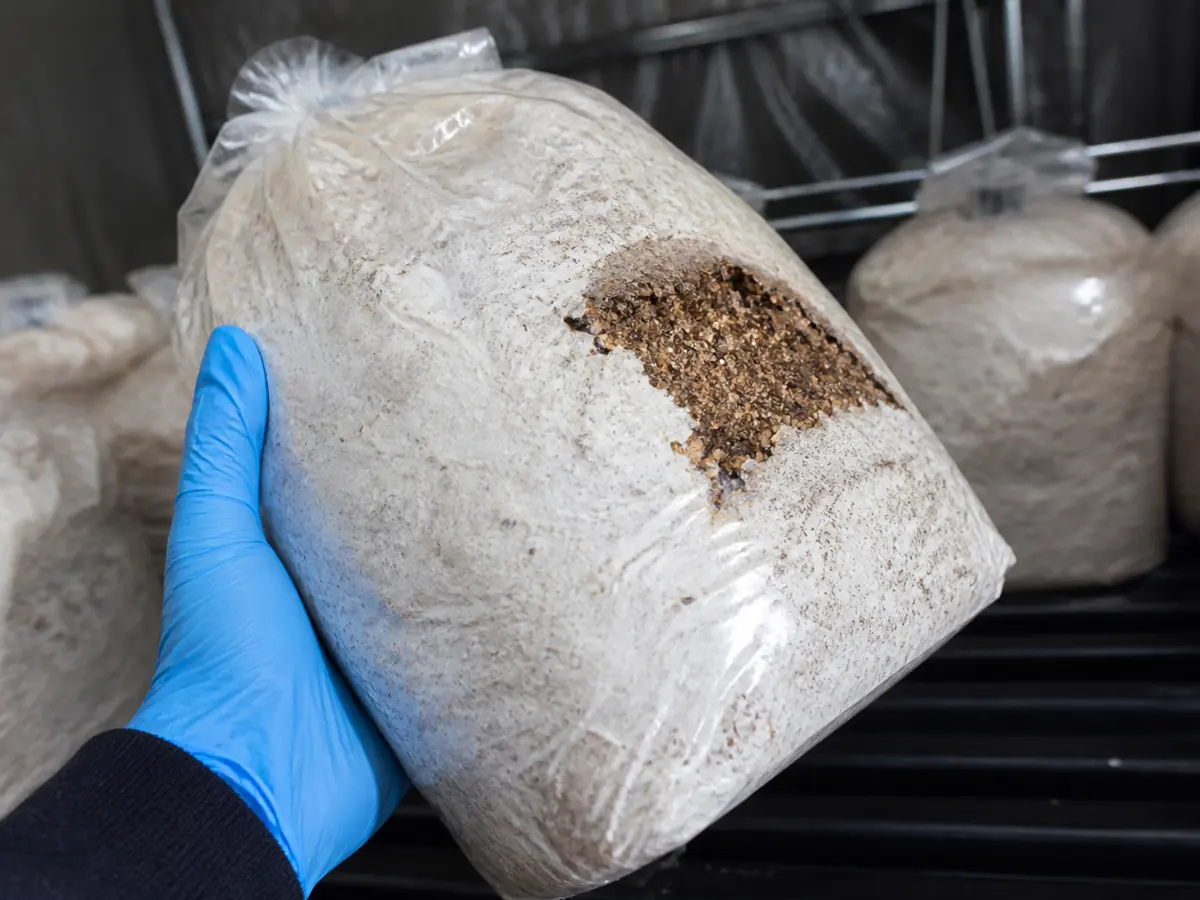
To verify that whole-block gate, compare the same face and base under steady light before assigning a stage.
Condensation and glare can make one inspection look more complete than the next even when the white boundary has not moved.
- Advancing normally
- White growth expands between dated observations
- Nearly complete
- The outside is dense while a stable brown pocket remains near the center or base
- Ready to assess for fruiting
- Coverage is coherent, the block is firm, and the supplied maturation period is complete
- Isolate
- Green, black, pink, or wet translucent growth expands across a new boundary
Several active bags can become warmer than the surrounding room. Measure near the substrate, leave space between containers, and respond to sustained internal heat rather than one brief ambient reading.
Yellow or amber metabolites can appear where mature mycelium meets stress or condensed moisture. They belong in a comparison over time, because an enlarging wet zone, sour odor through the filter, or colored sporulation changes the decision.
Avoid squeezing and rotating the bag during every inspection.
Repeated handling fractures new connections and can pull unfiltered room air through a weak closure.
The block advances only when the visible condition and the supplier’s maturation instructions agree. A white exterior does not prove that a large center has finished, and extra waiting cannot repair a foreign colony.
Growing MushroomsHow Do Mushroom Sawdust Blocks Work from Mix to Fruit?Why do antlers and conks need different air?
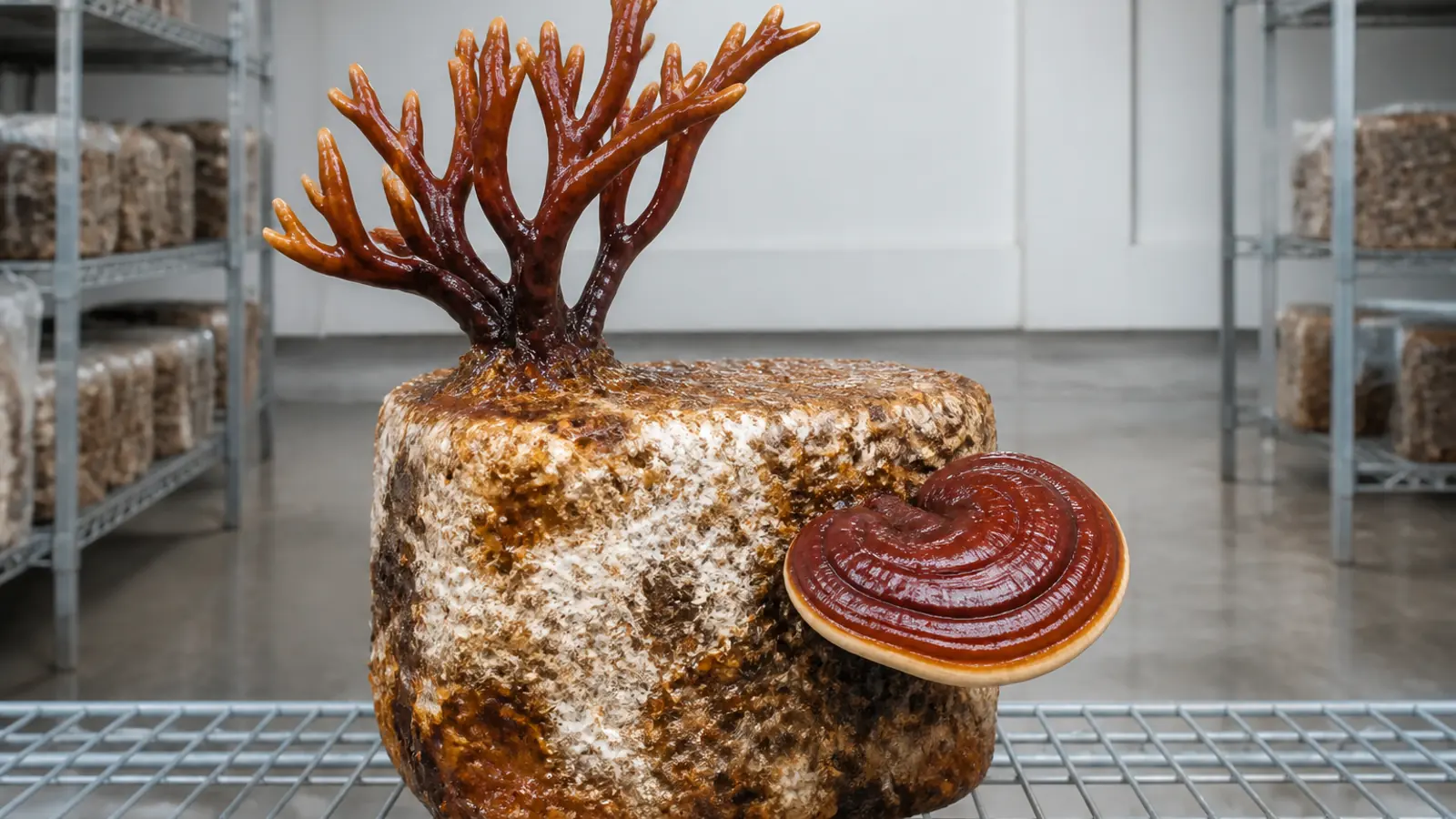
Antlers are elongated, often branched reishi fruit bodies with little or no expanded cap.
They form when the growing tissue continues extending under restricted exchange and elevated carbon dioxide instead of receiving the air conditions that support pileus expansion.
Conks develop a broader shelf or kidney shape with a lacquered upper surface and a pore-bearing underside. They require enough replacement air for the expanding edge to flatten rather than continue searching upward.
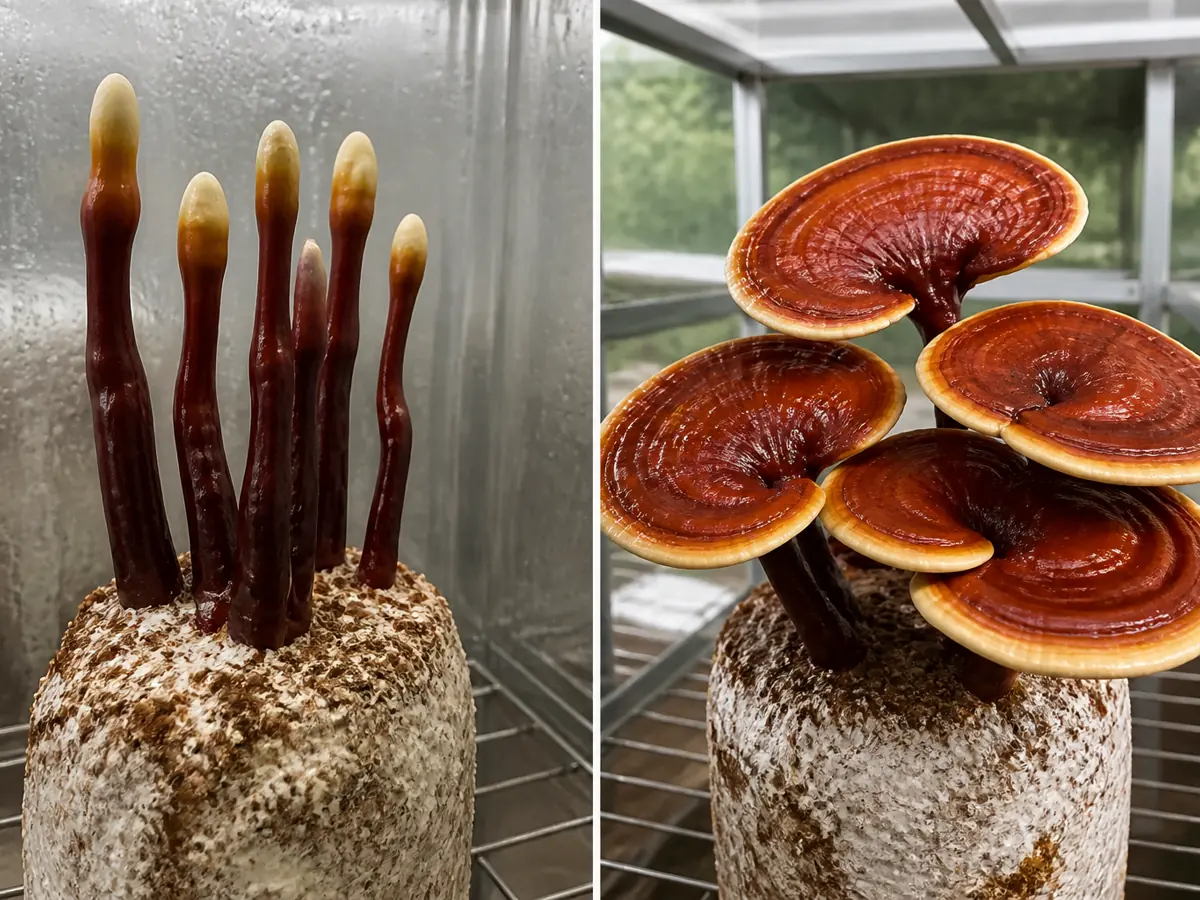
Read the active tips as well as the final silhouette. Upright extension, lateral widening, and a stalled pale margin describe different responses, so a single label such as good growth hides the decision the next room adjustment should support.
| Visible direction | Likely environment | Meaning for the grower |
|---|---|---|
| Long upright fingers | Carbon dioxide remains elevated around the tips | Continue only if antlers are the intended crop |
| Tips broaden into shelves | Replacement air reaches active tissue | Hold steady if conks are intended |
| Pale tips stop without browning | Growth has stalled before maturity | Check temperature, moisture, and exchange one at a time |
| Thin dry edges turn brittle | Evaporation outruns new growth | Remove direct draft before raising humidity broadly |
Controlled research has shown that elevated carbon dioxide suppresses normal cap development in the tested Ganoderma cultures.
Light and opening position also influence growth direction, so carbon dioxide is a major control rather than the only control.
Choose one morphology and document it. Maintaining antlers for weeks and then suddenly opening the entire container can produce uneven shelves, dry older branches, and an unclear maturity signal.
If conks are the goal, lower carbon dioxide gradually through gentle room exhaust and a path for replacement air. A fan pointed at the fruit body can lower local carbon dioxide while damaging the same tissue through rapid evaporation.
How much of the reishi bag should you open?
Opening geometry converts the fruit-form decision into a physical boundary.
A mostly closed filtered bag retains carbon dioxide and moisture around antler tips, while broader exposure gives a conk more air and horizontal space.
Do not copy side slits designed for oyster clusters. Reishi grows as firm woody tissue over a much longer period, and the opening must support the chosen antler or conk form without exposing unused substrate.
Confirm full colonization
Open only a sound mature block whose supplied schedule authorizes fruiting
Mark the intended fruiting site
Use an existing top growth point or the producer’s indicated opening
Clean the bag and tool
Reduce surface debris before cutting plastic
Expose only what the form needs
Keep an antler environment restricted or give a conk edge measured room contact
Reserve expansion space
Keep the opening away from walls, shelves, and direct equipment discharge
The cut cannot be undone. Stabilize the fruiting enclosure first, because exposed substrate begins losing water as soon as the plastic boundary changes.
Keep unused substrate covered
Let diffuse light reach the active tips
Peel the whole bag away to force faster fruiting
Direct a humidifier or fan at the opening
Condensation inside intact plastic is not automatically a problem.
Water pooled against exposed tissue, a wet collapsing base, or droplets that remain on growing tips are more useful signs that moisture is no longer controlled.
When the supplier provides a marked cut or a special collar, follow that design. The container and strain were developed together, and an improvised opening can change both gas exchange and surface water loss.
Growing MushroomsHow Do You Build an Outdoor Mushroom Bed That Lasts?How do you keep the growing edge active?
Healthy reishi growth usually shows a pale or white advancing margin ahead of the darker lacquered tissue.
The active edge lengthens or broadens between observations while remaining firm, clean, and free of standing droplets.

The lacquer develops behind that margin as tissue matures. Darkening on firm organized fruit tissue differs from a powdery colony spreading across substrate or from a soft translucent zone under pooled water.
- Check the same tip from the same angle each day.
- Measure temperature and humidity at fruit-body height.
- Confirm that exhaust has a clear replacement-air path.
- Keep bright indirect light regular without solar heating.
- Change one control, then compare the next growth interval.
A white tip that stops can reflect a temperature shift, a dry opening, stagnant air, or a spent local substrate reserve.
Changing humidity, fan speed, light, and temperature together removes the evidence needed to identify which pressure mattered.
Mist the enclosure or use controlled humidification instead of spraying the fruit body. A glossy wet surface can look healthy for a few hours while repeated droplets injure the active edge and encourage bacterial spotting.
Several fruiting blocks can change a small enclosure as they enlarge. Recheck local air movement after antlers branch or conks widen, because the crop itself can obstruct the path that worked during initiation.
Which reishi changes mean isolate the block?
Expected reishi colors include white mycelium, yellow or amber metabolites, cream active margins, and yellow-brown to red-brown lacquered fruit tissue.
Texture, location, and movement over time show whether that color remains part of organized crop growth.
Green powder on substrate, a black expanding boundary, pink growth, or a wet translucent collapse is a separate biological event. Keep the bag closed and move it away from healthy cultures before pressing, smelling, cutting, or attempting to fruit it.
Warning
Contain first and diagnose second | Opening a sporulating or foul bag in the fruiting room spreads material through a space that may hold other multi-month crops.
Classify the observation before choosing the next action.
Organized lacquer, a stable metabolite droplet, an expanding foreign boundary, and a wet structural collapse require different responses even when two of them share a similar color.
| Observation | Expected or foreign | First action |
|---|---|---|
| Firm red-brown lacquer behind a pale edge | Expected fruit maturity | Continue observing expansion |
| Small amber droplets on sound white mycelium | Possible metabolites | Compare size, odor, and surrounding structure |
| Green dusty colony that enlarges | Foreign sporulation | Isolate the sealed bag |
| Wet compressed zone with sour odor through filter | Possible bacterial decay | Isolate and retire |
| Dry inactive tip with no foreign boundary | Environmental or maturity question | Review one control and recent growth |
Do not cut around a contaminant and keep the remaining fruit body. The visible border cannot show the full extent of competing growth or metabolites within the substrate.
Record the culture lot, substrate batch, treatment, inoculation date, first abnormal observation, and nearby bags. Several failures at the same age point upstream toward processing or transfer, while one exposed tip drying near a vent points toward local fruiting conditions.
When is reishi ready to harvest?
Harvest maturity is a growth-state decision.
The intended antler or conk should be firm and lacquered, and its pale advancing margin should have narrowed greatly or stopped expanding across repeated observations.
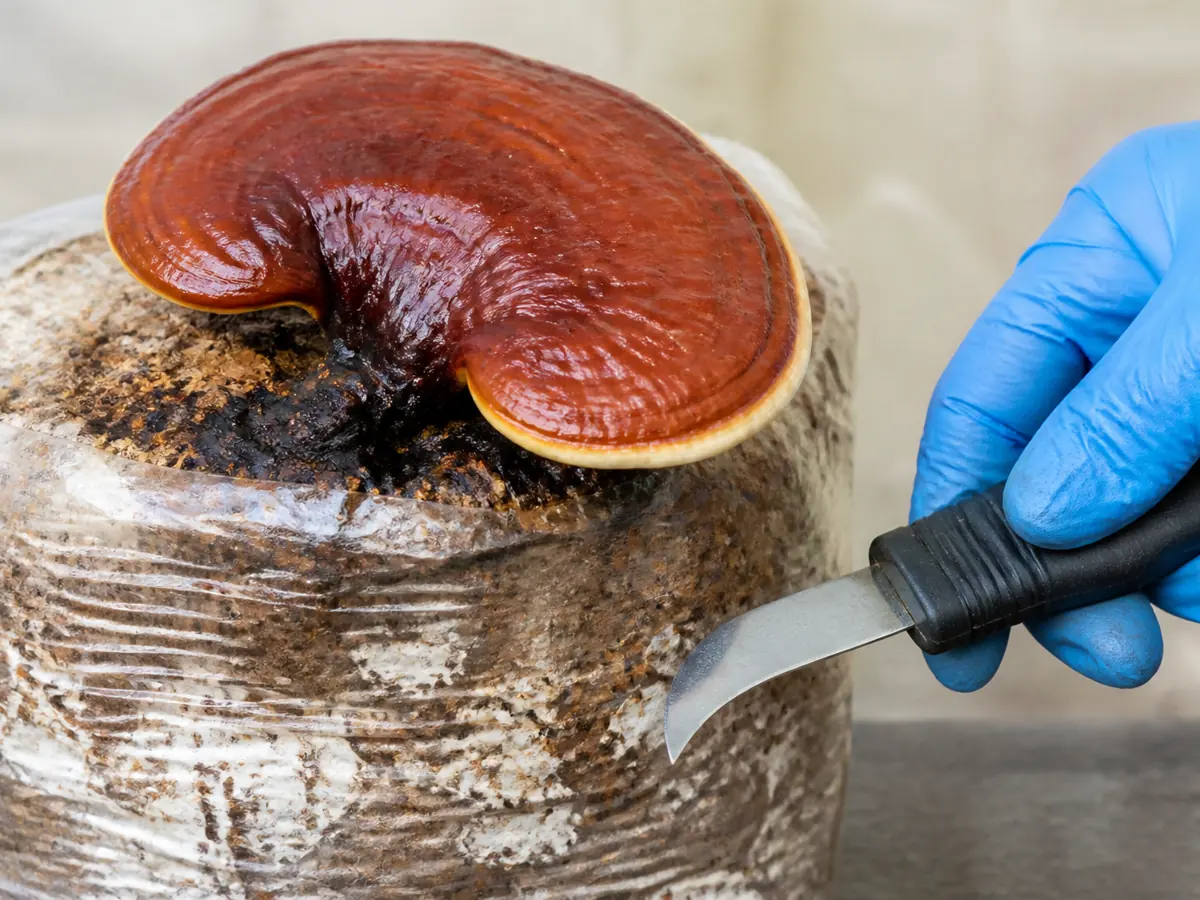
A large fruit body with a broad active white rim is still adding tissue. A smaller fruit whose rim has closed can be mature for that strain and block, which is why size alone is a poor endpoint.
Cut the base with a clean sturdy tool while supporting the fruit body. Avoid tearing a crater from the block, then inspect the remaining surface without digging into it.
- Brush away loose substrate rather than washing a fruit body that will be dried.
- Slice thick tissue when needed so the center can dry completely.
- Use moving clean air and verify that no cool flexible center remains before storage.
- Discard stored material that softens, smells musty, or regains moisture.
Personal use is a separate safety decision, especially during pregnancy, with medicines, or when liver, bleeding, or allergy concerns exist.
A successful crop does not remove those cautions.
A clean block may continue only when its producer supports another fruiting attempt and the substrate remains cohesive. End the cycle when the block is spent rather than repeatedly soaking woody material that no longer produces an active margin.