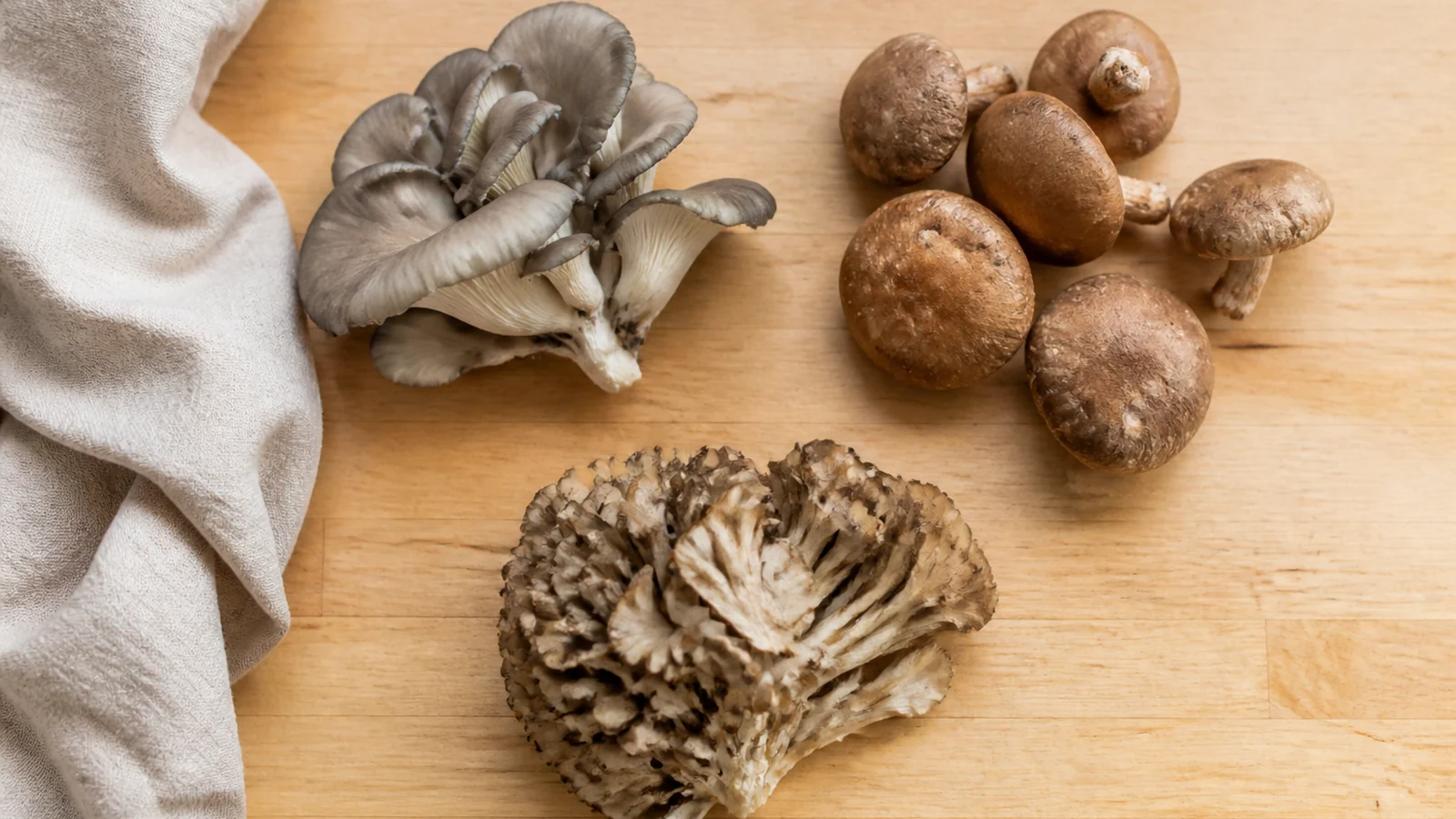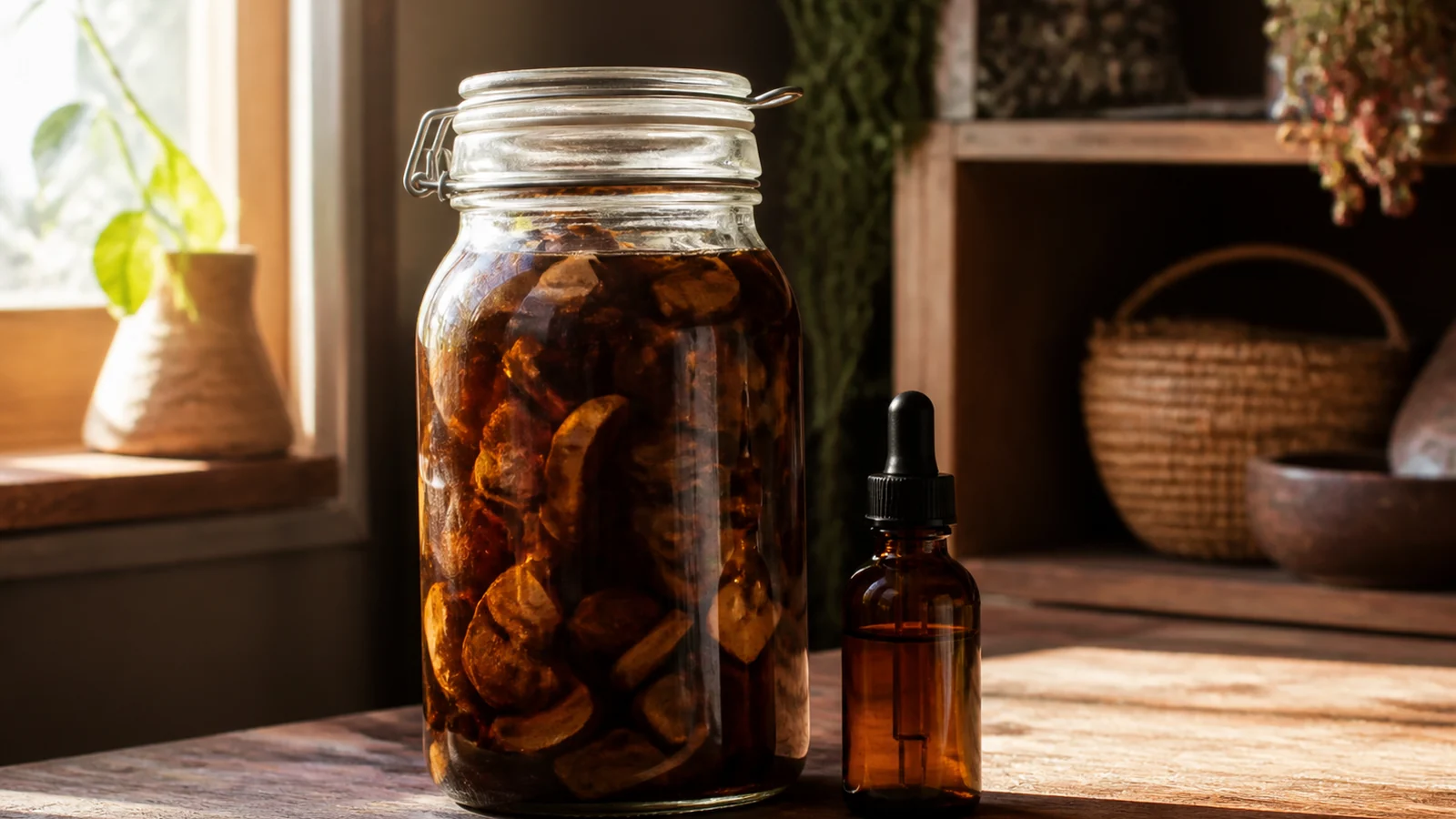
A method guide to making a mushroom tincture at home, covering why alcohol carries a different compound class than water, how a standard vodka compares with the ethanol percentages published extraction studies used, which species have an alcohol-soluble fraction worth chasing, what a dual extraction actually involves, the maceration ratio and duration, the three alcohols that must never be used, bottling and keeping times, and who the finished product is unsuitable for.
The bottle of vodka in most tincture recipes is doing about half the job the published extraction work was doing.
That is not a reason to skip the method. It is a reason to know which variable you are leaving on the table before you commit six weeks to a jar.
Alcohol strength, mushroom species, and the intended user all affect whether a tincture is an appropriate preparation.
Why alcohol at all
The common assumption is that a tincture is a stronger version of a decoction. It is a narrower one.
Solvents carry what matches them. Water carries polar compounds and alcohol carries non-polar compounds, and fungal material contains both in separate places.
- What water carries
- The soluble polysaccharide fraction, including the beta-glucans bound into the cell wall
- What alcohol carries
- The non-polar fraction, including the triterpenes that make woody species bitter
- What neither carries
- Chitin, which stays in the material whatever you do to it
- What alcohol adds beyond extraction
- Preservation, which is why a tincture keeps for years and a decoction keeps for days
So a jar of high-strength spirit is an operation aimed at a different set of molecules than a pot of hot water.

That matters for expectations. A tincture will not give you the polysaccharide fraction, and a product sold as one that claims a beta-glucan figure has had a water stage run into it somewhere.
If you are comparing what you are about to make against something on a shop shelf, the fields that describe a commercial version are covered separately in powder against extract.
The preservation point is worth holding onto as well. Alcohol above a certain share of the final volume stops anything growing in the bottle, and that share becomes a design constraint later on.
It also explains why almost every method starts with dried material rather than fresh.
Fresh mushroom is mostly water, and putting it in a jar of spirit dilutes that spirit by an amount nobody can calculate. A batch that started at 40 percent can finish somewhere in the twenties, which is low enough to lose both the extraction and the preservation.
Medicinal MushroomsLion's Mane Benefits: What Human Trials Actually FoundWhat strength the published work actually used
Here is the part almost no home recipe mentions.
A standard vodka is 40 percent. That is not close to either figure, and the published runs were also heated and mechanically assisted in ways a jar on a windowsill is not.
Compare those figures before assuming that a longer extraction or stronger alcohol produces a better result.

None of that makes a 40 percent maceration pointless. It extracts, and it extracts more the longer it sits, which is exactly what the weeks are for.
What it does mean is that the finished liquid carries a smaller share of the available fraction than the laboratory figures suggest, and that anyone promising equivalence is guessing.
There is a straightforward way to close some of the gap. High-strength neutral spirit, sold at 95 percent in many places, can be diluted with water to a target percentage, and mixing roughly two parts of it with one part water lands near the sixty percent range the heated work used.
The arithmetic for that is simpler than it looks. To hit a target percentage from a stronger spirit, the volume of spirit you need is the target divided by the starting strength, and the rest is water.
So a liter of 60 percent from a 95 percent neutral spirit is 632 milliliters of spirit topped up to a liter with water, and anybody who prefers round numbers can call it two parts spirit to one part water and land at 63 percent.
Higher is not automatically better either, and there is a real ceiling on it. Past a point the solvent starts working against itself.
Above about 70 percent the water content gets low enough that the material barely swells, and swelling is part of how the solvent gets inside it in the first place.
Which species are worth the six weeks
The honest first question is whether the material in front of you has an alcohol-soluble fraction worth chasing.
Bitterness is a rough guide. Species that taste sharply bitter usually have a substantial non-polar fraction, and species that taste of nothing much usually do not.
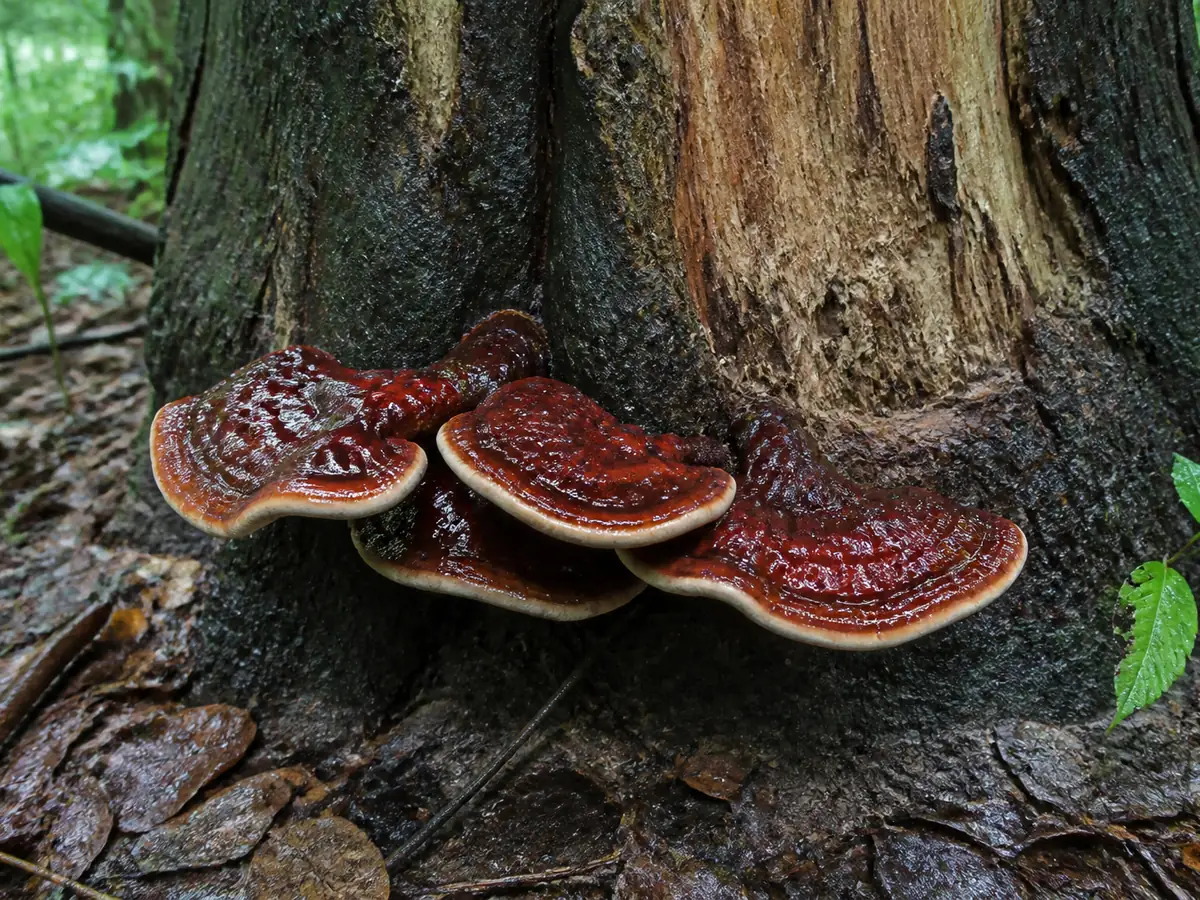
- Woody and bitter, like reishi, which is the standard case for an alcohol stage and the species most of the published work was done on
- Woody and mild, like chaga, which has a non-polar fraction but a smaller one, and which is more commonly prepared in water
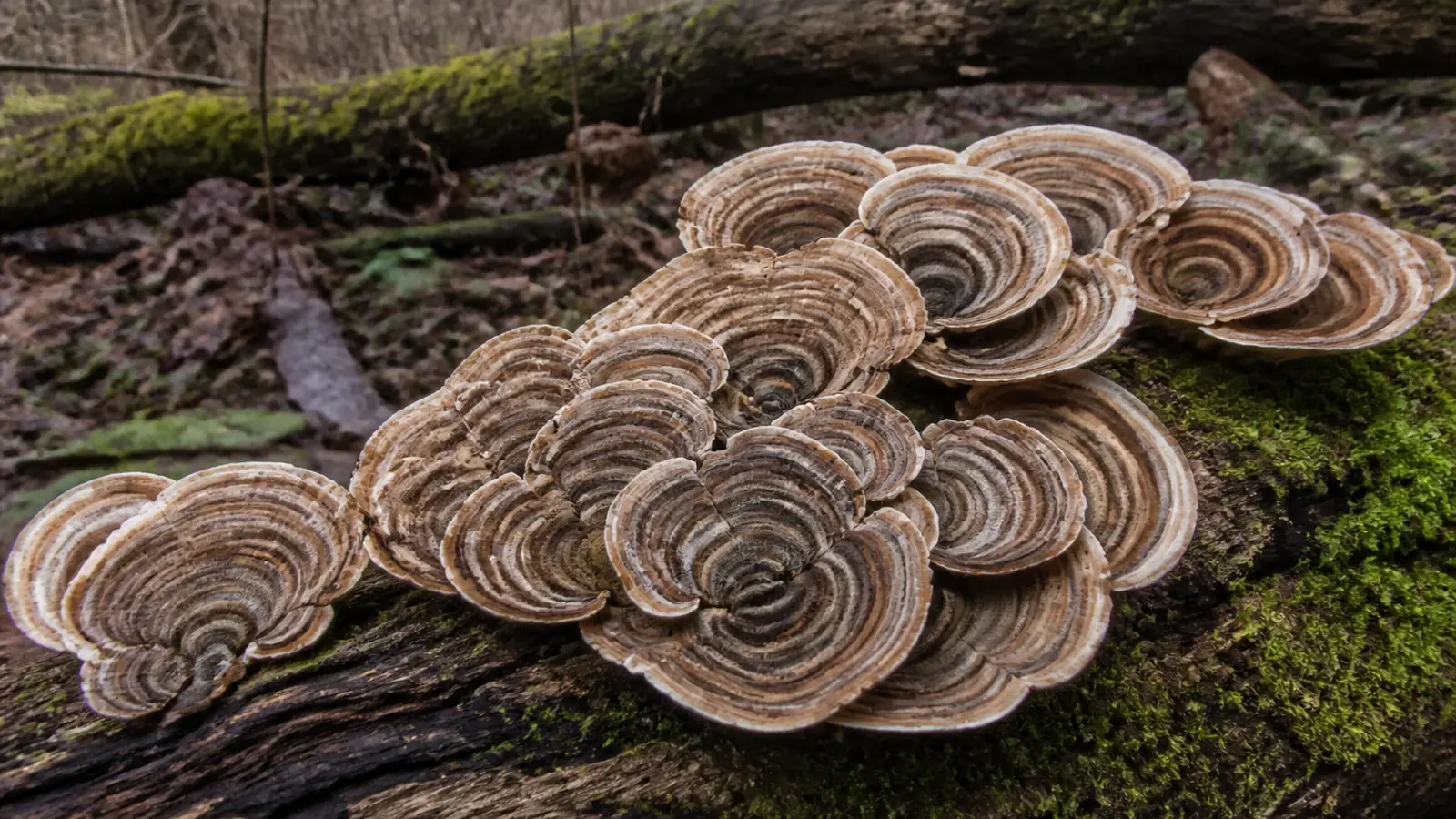
- Leathery, like turkey tail, whose interest is largely water-soluble and which gains very little from a jar of spirit
- Culinary and soft, like lion's mane, which is food and which tincturing converts into an expensive bitter liquid
The pattern running through that list is worth stating on its own.
Key takeaway
If a species is normally sold as a hot water preparation, that is usually because the interesting fraction is water-soluble. Running an alcohol stage on it produces something, but not the something anyone wanted.
Surface area governs the rate here just as it does in a pot. A whole dried bracket in a jar of spirit will still be a whole dried bracket in six weeks.
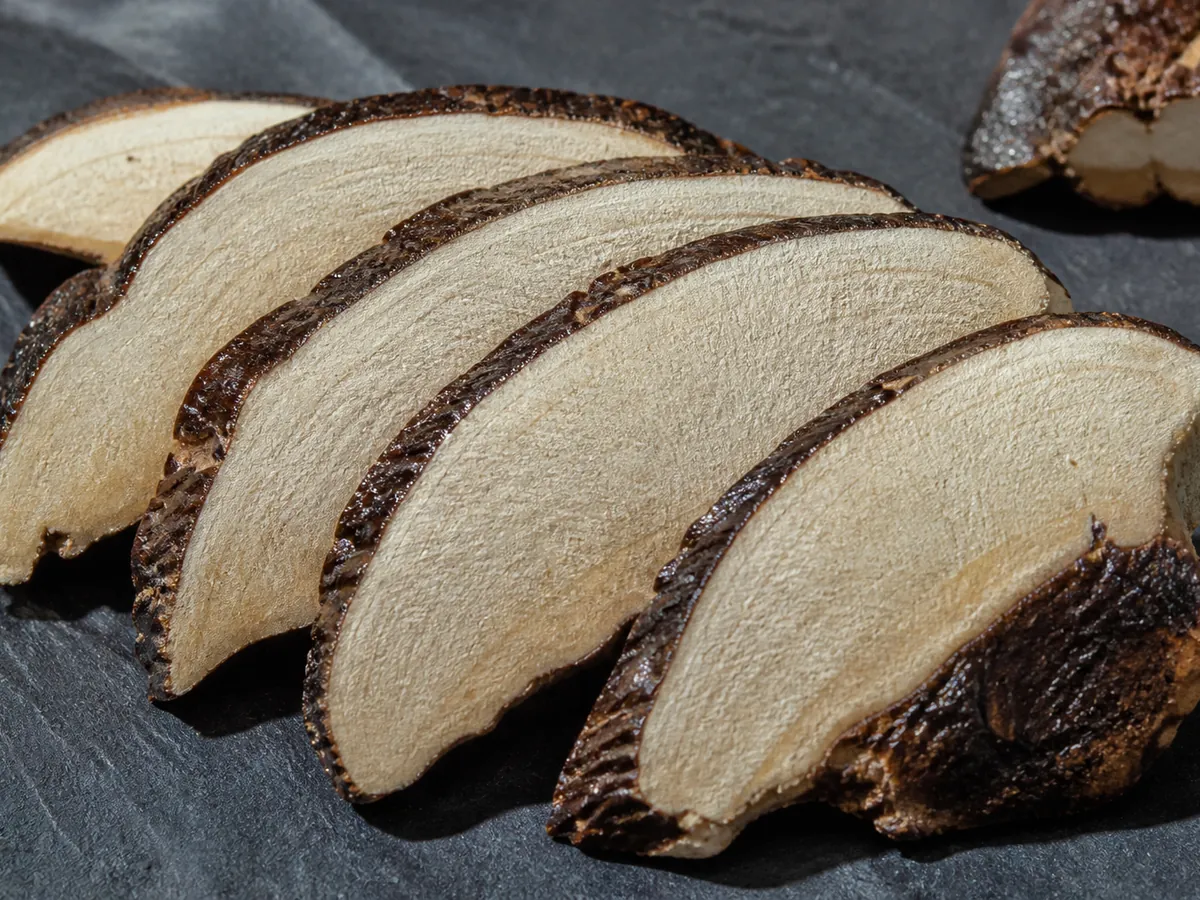
Slice it thin, or break it into pieces small enough that no fragment has an unexposed center.
Medicinal MushroomsWhich Reishi Benefits Hold Up in Human Studies?Dual extraction is two operations, not one jar
The phrase gets used as though it described a single procedure, and it does not.
A dual extraction is two separate runs on the same material, combined at the end. One run uses alcohol and one uses hot water, and they cannot happen simultaneously because each works at a strength that would ruin the other.
The order usually runs alcohol first. Straining the material out of the spirit leaves it wet with alcohol, which the water stage then carries into the second liquid rather than wasting.
The water stage has its own parameters and its own failure modes, and it is covered in full on the decoction page rather than here.
What matters at this end is the arithmetic of combining them. A liter of 60 percent tincture blended with a liter of water-based decoction gives two liters at 30 percent, and blending in more water than that pushes the result into refrigerator territory.
There is a reason the alcohol stage goes first rather than second.
Material that has already been boiled for an hour comes out of the pot saturated with water, and dropping that into spirit repeats the dilution problem that made fresh material a bad idea.
Running it the other way means the material enters the alcohol dry, and the water stage afterwards is happy to receive material that is already wet with spirit.
The maceration itself
The alcohol stage is four decisions and then a long wait. Only the first two of them are reversible.

Weight for the mushroom and volume for the spirit is the convention, and mixing the two units is how batches drift.
Weigh and measure
One part dried material by weight to five parts spirit by volume, which is the common working ratio
Pack and cover
Material in the jar, spirit poured over it until everything is fully submerged with liquid above the top piece
Seal and wait
Four to six weeks somewhere dark at room temperature, shaken every few days
Strain and press
Coarse strain first, then press the material hard, because the pressed liquid is the most concentrated part of the batch
Of those four steps, only the pour is worth watching closely.
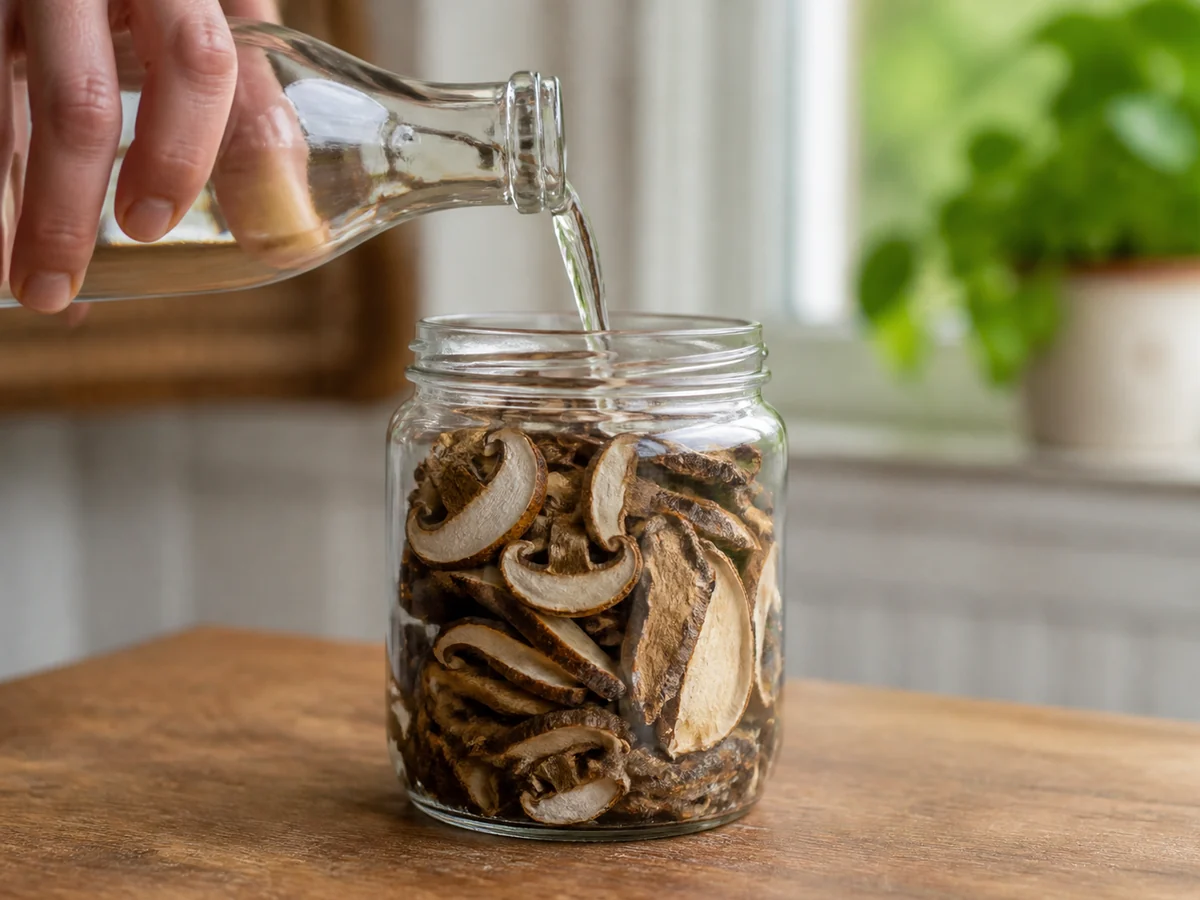
The submersion rule is not fussiness. Anything above the liquid line is damp organic material in a warm jar, and it will spoil rather than extract.
Two things make submersion easier. A wide-mouth jar lets you push floating pieces back under with a spoon, and packing the material down before pouring stops it rising as it wets and swells.
Leave a small amount of headspace rather than filling to the rim, because there has to be somewhere for the liquid to move when the jar is shaken.
Shaking matters more than it sounds like it should. Liquid immediately against the material saturates first, and moving it away is the only way to keep the concentration gradient working.
- Dark matters because light degrades the compounds you are trying to collect
- Room temperature is fine, and a warm airing cupboard is slightly better than a cold garage
- A metal lid will corrode over six weeks of alcohol contact, so use a plastic-lined one or put a layer of parchment under it
- Top up the spirit if evaporation drops the level below the material, which happens with a poor seal
When you strain, expect the material to have given up less volume than you think and to hold more than you expect.
Pressing is where a noticeable share of the batch is recovered. A potato ricer, a nut milk bag or simply twisting a cloth by hand will all pull out liquid that a passive drip never would.
Do not press so hard that fine particles come through with it, because those are the fines the filter pass later has to deal with.
Medicinal MushroomsMushrooms for Brain Health, Ranked by EvidenceWhat goes wrong, and the three alcohols that are not optional
Check the alcohol-related precautions before preparing or using a tincture.
Warning
Only food-grade drinking alcohol is usable. Isopropyl alcohol, denatured alcohol and methylated spirits are toxic, and denatured alcohol is deliberately poisoned precisely so that it cannot be drunk. Methanol poisoning causes blindness and death, and it cannot be detected by taste. There is no dilution, no straining and no waiting period that makes any of them safe to swallow.
The substitution happens because those products are cheap, high-strength, and shelved near things that look similar. A high percentage on a bottle is not the property that matters, and the label on a hardware-store solvent is not describing something drinkable.
With that settled, the ordinary failures are all recoverable except one.
Material above the liquid line is the commonest, and it usually shows up as a fuzzy patch on the exposed piece. A jar left on a sunny windowsill for six weeks loses color and, with it, the compounds that color represented.
A poorly sealed lid lets alcohol evaporate faster than water, which quietly lowers the strength of the whole batch over a month and a half.
It is worth separating spoilage from the things that look alarming and are not.
Fine sediment at the bottom is normal, and so is a batch that darkens steadily over the weeks. A cloudy layer that appears after straining is fines rather than growth, and a filter pass removes it.
The unrecoverable one is growth. If anything visible has established itself on the surface or on an exposed piece, the batch is finished, and there is no straining or reheating that makes it otherwise.
Bottling, labeling and how long it keeps
After the coarse strain the liquid will still be cloudy, and one more pass fixes it.
Run it through a cheesecloth or a paper coffee filter. That removes the fines that would otherwise settle out over the next few weeks and make every dose look different from the last.
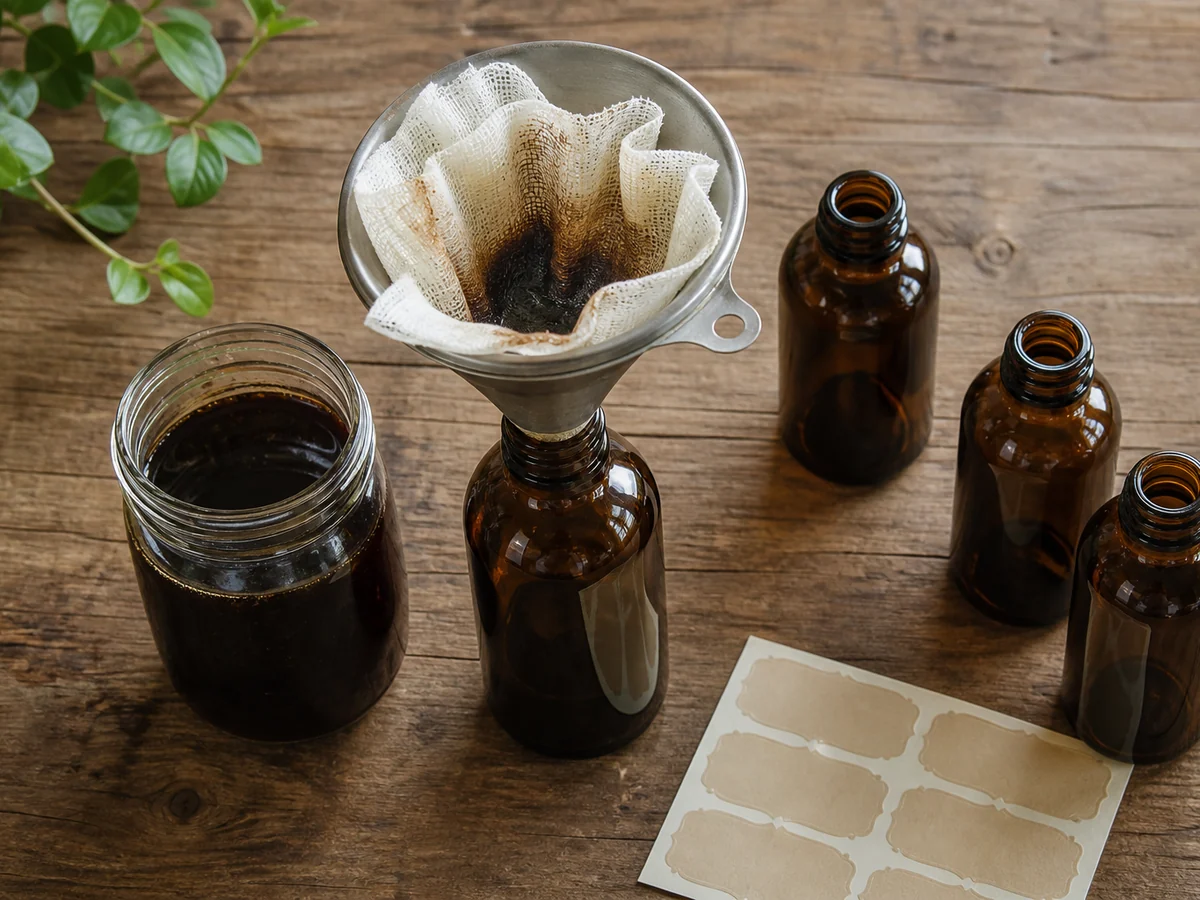
Amber glass is not decoration. The same light that faded the jar on a windowsill will work on the bottle, and a year on a bright shelf in clear glass costs a batch a visible amount of its color.
Four things belong on the label, and none of them are optional if you make more than one batch.
- The species, because two dark liquids are indistinguishable after a month
- The spirit strength you started with, which is the only way to reconstruct what you made
- Whether a water stage was combined in, since that changes both the strength and the keeping time
- The date it was bottled
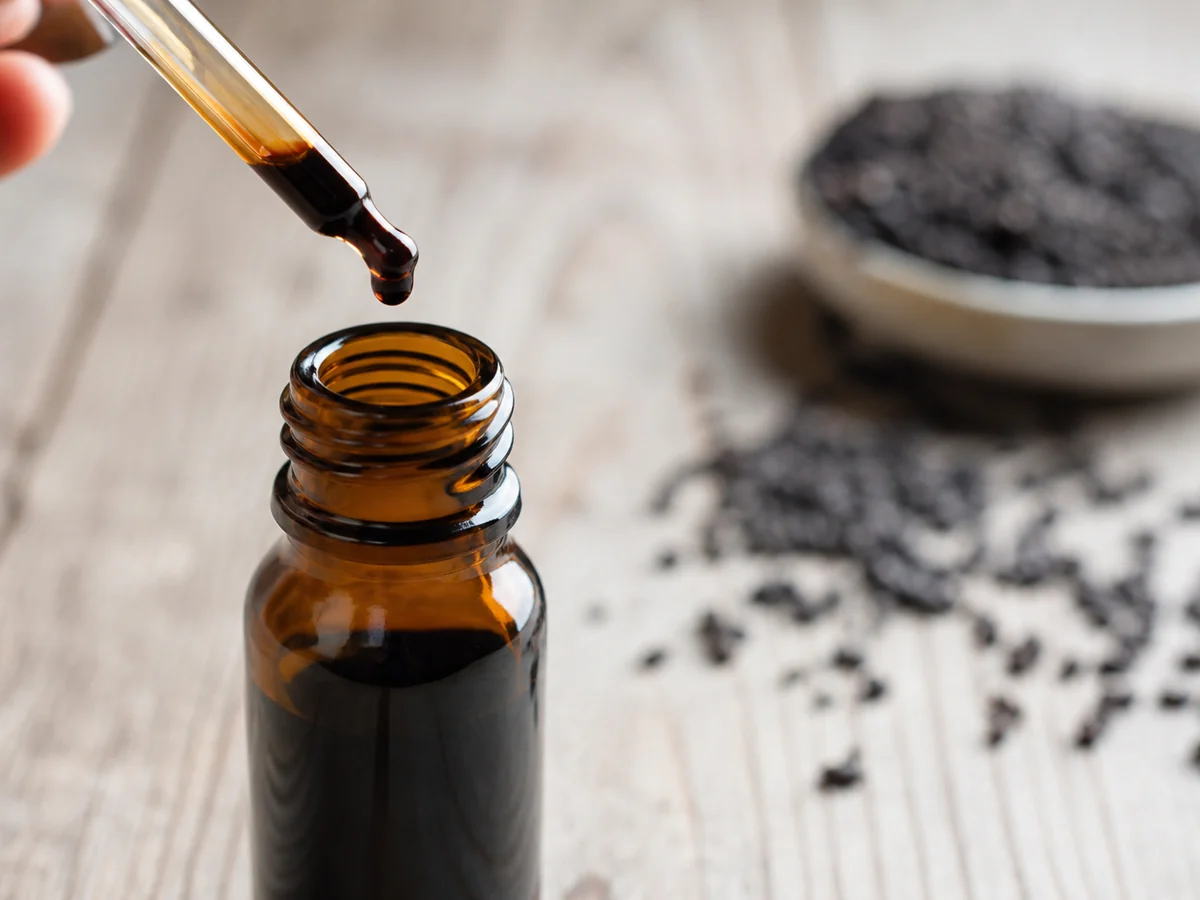
Keeping time follows the alcohol content directly. A straight tincture at drinking strength or above, with no water stage, is stable at room temperature for years.
A dual extract carrying a large water fraction is a different product. It behaves more like a preserved food than a spirit, and it belongs in the refrigerator with a keeping time measured in months.
| Preparation | Rough alcohol by volume | Storage | Keeping time |
|---|---|---|---|
| Straight tincture from a neutral spirit | 55 to 65 percent | Amber glass, cool cupboard | Several years |
| Straight tincture from a drinking spirit | 35 to 40 percent | Amber glass, cool cupboard | A year or more |
| Dual extract, small water fraction | 25 to 35 percent | Amber glass, cool cupboard | Around a year |
| Dual extract, large water fraction | Under 25 percent | Refrigerator | Months, not years |
Judging an older bottle is mostly a matter of comparing it against what you wrote down.
A high-alcohol tincture that has gone noticeably pale has lost potency to light rather than turned dangerous, while anything cloudy, gassy or sour belongs in the sink regardless of what the label claims about its strength.
Who should not take one
The property everybody forgets is the obvious one. A tincture is an alcoholic preparation, and taking it in drops from a small bottle disguises that rather than changing it.
The volume is genuinely small, which is why the point gets waved away, and the reasons it matters are not about volume.
A dropper of a 60 percent preparation carries roughly the alcohol of a very small sip of spirit. For most people that is trivial, and for a few it is not.
The distinction worth drawing is between people for whom that quantity is a health question and people for whom the presence of alcohol is the question regardless of quantity.
Anyone avoiding alcohol
Choose a water preparation or a dried capsule insteadThe format is the problem, not the amount, and a smaller dose of the same thing does not address it
Pregnancy and children
Do not use an alcohol preparationThe same reasoning that applies to any alcoholic product applies here regardless of the volume
Taking a medication with an alcohol warning
Ask a pharmacist before startingInteraction warnings are written against the substance, and a dropper does not exempt anybody from them
Everybody else
Treat it as what it isAn alcoholic preparation of a bitter woody fungus, with a shelf life and a strength you wrote on the label
How much of it to take, and how often, is a separate question with its own evidence and belongs under how much to take.
The same is true of anything that goes wrong afterwards, which is covered under side effects rather than here.
Sources & References
- Extraction of triterpenoids and phenolic compounds from Ganoderma lucidum, Food and Function That optimized heat-assisted extraction used 62.5 percent ethanol at 90 degrees for about seventy-nine minutes, and the ultrasound route used 89.5 percent ethanol for forty minutes.
- Reviews of extraction methods for fungal polysaccharides and triterpenes That hot water solubilizes cell wall polysaccharides while non-polar compounds require an alcohol stage, which is the reason a dual extraction exists.
- Edible mushrooms and beta-glucans, impact on human health That beta-glucans sit in chitin-based cell walls and are water-soluble rather than alcohol-soluble.
- Optimization of extraction of antioxidant polysaccharide from Pleurotus ostreatus, PLoS ONE That the water-soluble fraction requires its own separate operation with its own parameters.