Why does birch polypore form one smooth bracket?
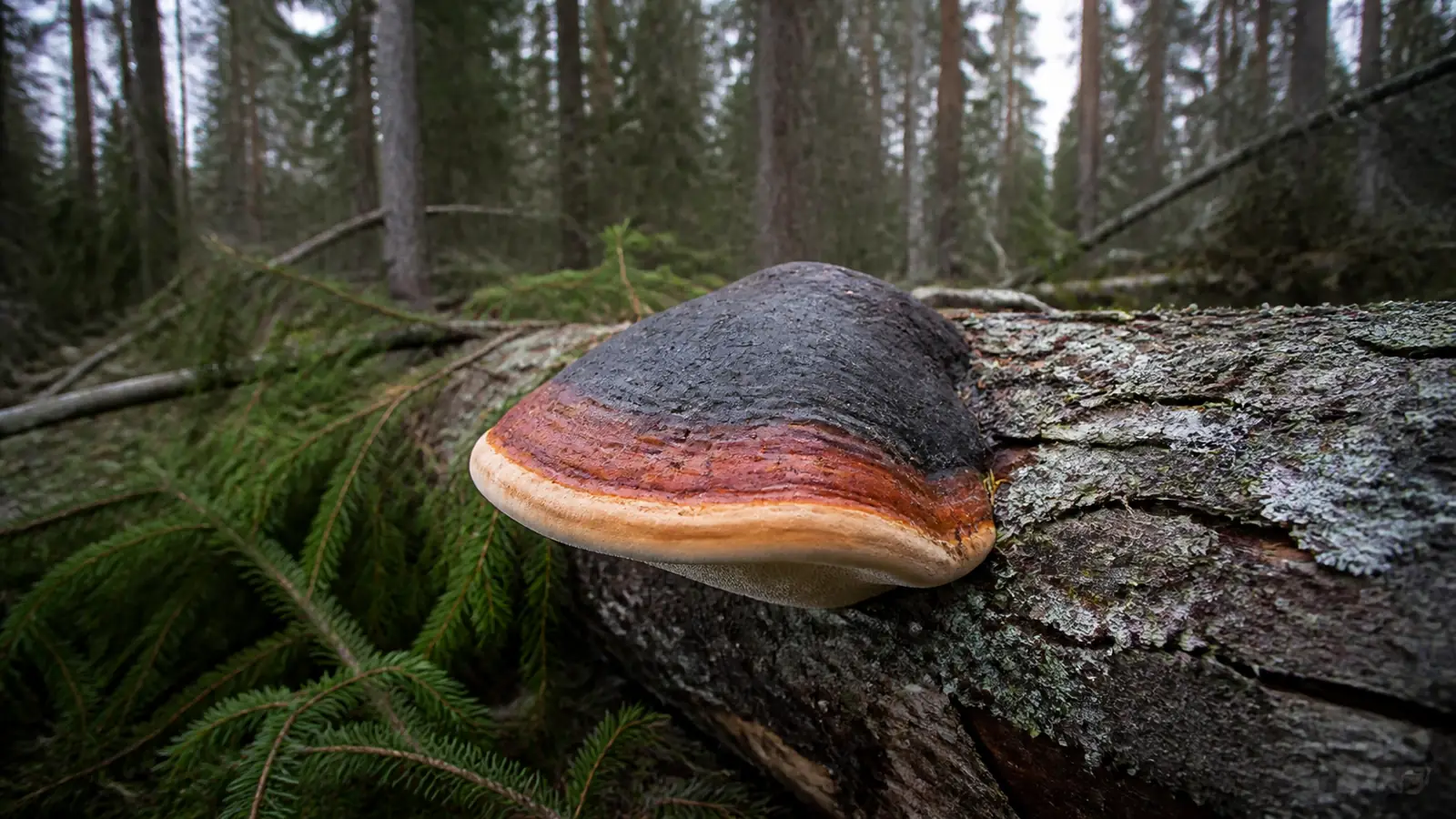
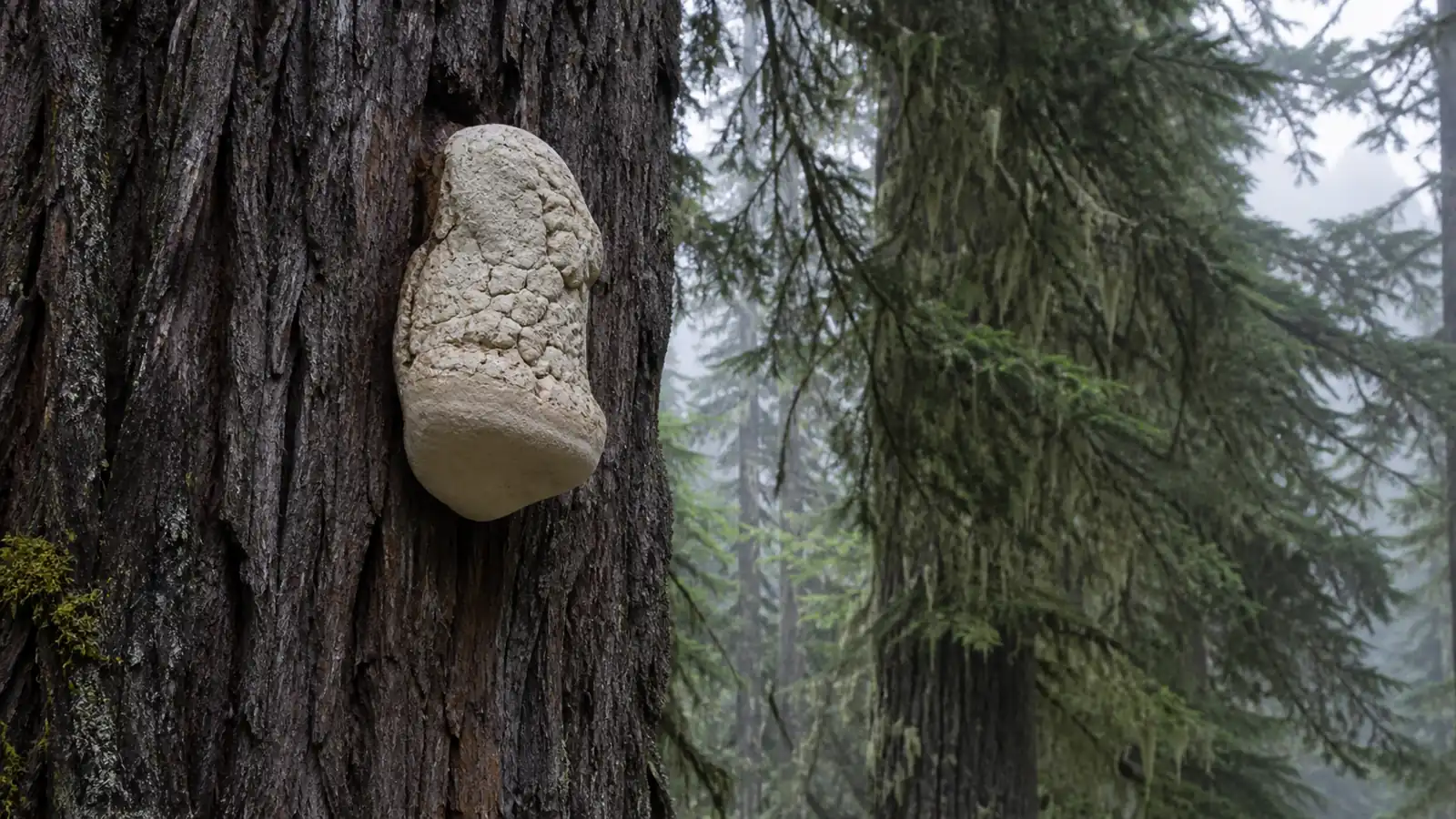
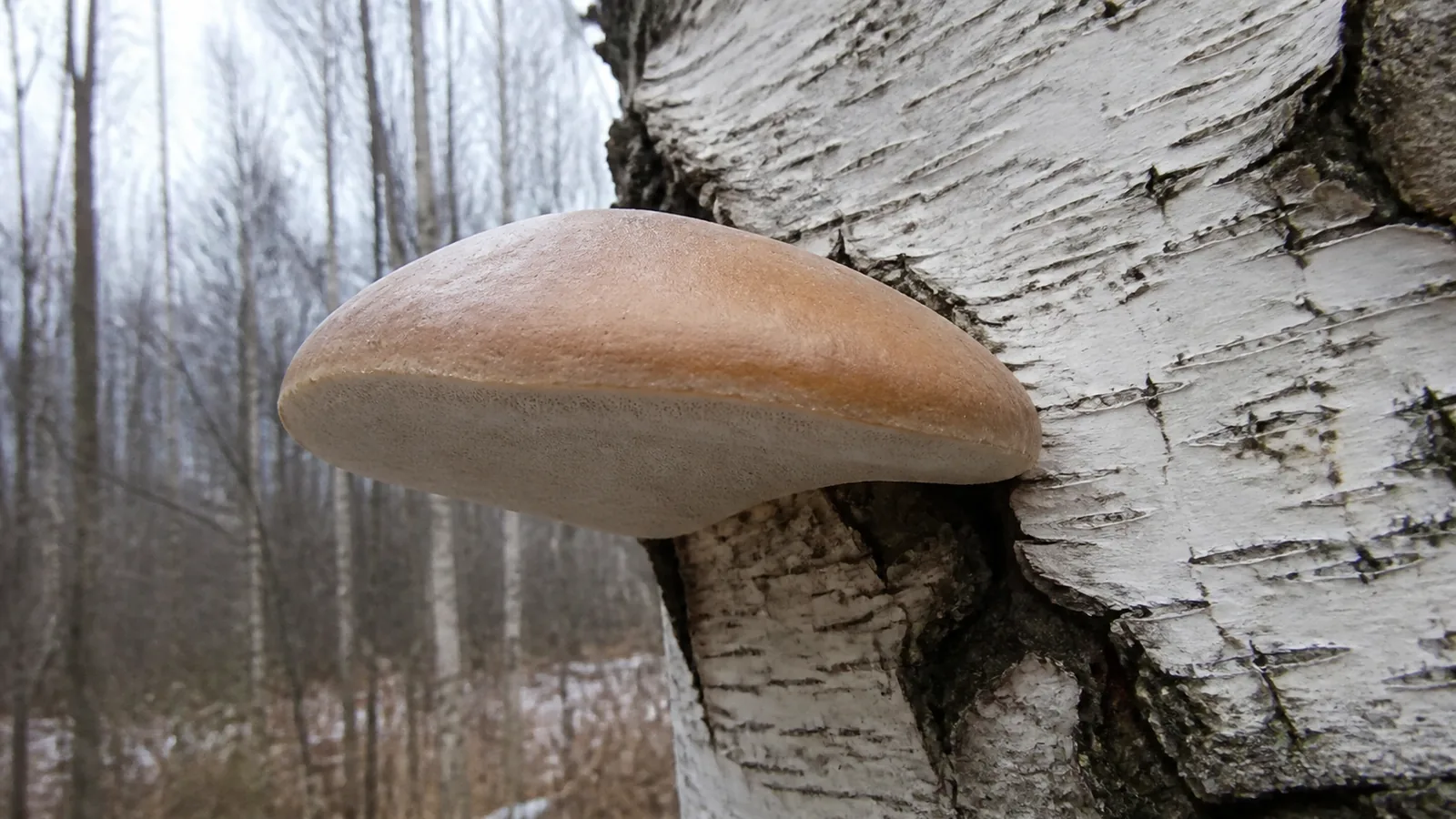
Birch polypore produces one-season brackets on birch trunks and fallen stems. Young fruiting bodies are rounded and pale, then expand into hoof- or kidney-shaped shelves whose upper surface becomes ochre, tan, or gray-brown.
The underside carries fine pores instead of gills. Its white flesh changes from corky to woody as it ages, and cutting an old specimen takes real pressure.
The fungus decomposes cellulose and leaves cubical brown rot. It can colonize weakened living birch, but most visible brackets occur after the host is dying or dead.
Key takeaway
A pale bracket is only a candidate. Confirm Betula wood, an unzoned smooth cap, fine pale pores, and thick bitter flesh together.
Its annual life cycle separates it from many hard perennial brackets. A new bracket begins soft enough to mark, then firms as the pore layer matures and finally persists as a dry weathered shell after spore release.
The old name Piptoporus betulinus appears throughout field guides and medicinal research. It refers to the same species now accepted as Fomitopsis betulina, so both names must be checked when evidence is compared.
The bracket is an annual fruiting body even though the fungus can persist in the tree. A fresh white margin and soft corky context belong to the current season, while an old darkened body may remain attached after spore production has ended.
Its host range is unusually narrow for such a familiar bracket.
Confirming Betula through papery bark, horizontal lenticels, twigs, buds, and nearby living trees adds more identification value than matching a hoof silhouette on an unknown log.
The fungus can colonize weakened living birch and continues rapidly after wood dies. Brown rot removes strength-giving cellulose, leaving brittle cubical blocks that explain both the easy breakage of fallen trunks and the ecological value of decaying birch.
Historical uses included tinder, razor strops, dressings, and bitter infusions. That record shows material versatility and cultural interest, but it does not establish the safety or effectiveness of a modern tea, tincture, or concentrated extract.
How do the birch host and pore surface confirm it?
Annual hoof- to kidney-shaped bracket, white when young, then tan to gray-brown, with a smooth unzoned upper crust.
No gills. The white to tan underside has small round pores.
No true stem; the bracket attaches broadly or by a narrowed lateral base to birch wood.
White, corky then tough flesh with a mild fungal odor and strongly bitter taste.
Begin with the tree. Birch bark, fine horizontal lenticels, papery peeling layers, and attached twigs can confirm the host when a fallen trunk has lost its leaves.

Ganoderma and Fomes brackets can share a hoof shape, but they usually develop a harder perennial context, visible growth zones, darker pore bruising, or a different host range. A white spore deposit supports the polypore group without proving this species.

Older brackets crack, darken, and collect algae, so use a fresh specimen when documenting color and pore form. Microscopy shows smooth cylindrical hyaline spores when a difficult collection needs confirmation.
Work from substrate to surface rather than matching a cap photograph. If the bark is missing, inspect retained twigs, papery bark fragments, lenticels, and surrounding birches before treating the host as confirmed.
Then compare the attachment and cap zoning.
Birch polypore usually forms one thick shelf with a narrowed lateral attachment and a smooth unbanded crust, unlike thin overlapping Trametes fans or strongly zoned perennial conks.
Pore condition changes the reading. Fresh pores are pale and even, while rain, insects, frost, or handling can stain and erode an old surface, so damaged color should carry less weight than pore structure and host.
Attachment is a useful structural clue. Birch polypore often narrows where the bracket meets the trunk, creating a kidney or hoof outline without the layered shelves and broad fused bases seen in many thin fan-forming polypores.
Inspect pores at several points.
Fresh surfaces are evenly white to cream with small openings, while insects, frost, pressure, and age can enlarge or discolor patches without changing the fact that the underside is poroid rather than gilled or toothed.
A center cut connects the outer crust, thick pale context, and single tube layer. Repeated tube layers indicate a perennial conk, while a thin flexible body or strongly zoned context pushes the collection toward another polypore group.
| Bracket evidence | Supports birch polypore | Points elsewhere |
|---|---|---|
| Host | Birch trunk or fallen birch stem | A confirmed non-birch host |
| Cap | Thick, smooth, pale, and mostly unzoned | Thin flexible fans or strong colored bands |
| Interior | One tube layer below thick white context | Repeated tube layers from several years |
| Pores | Fine, pale, and even when fresh | Coarse, maze-like, toothed, or dark-bruising surface |
Bitterness supports historical descriptions but should not be tested by mouth. Texture, host, pores, unzoned crust, and annual context already provide safer evidence.
When bark is missing, retain a piece of the log with diagnostic twigs only when collection is allowed, or photograph the wood and every nearby birch. A bracket on beech, poplar, willow, or an unidentified pale-barked trunk needs a different starting hypothesis.
Which pale brackets can be mistaken for birch polypore?
Host identity does much of the first sorting because birch polypore is restricted to Betula. Other pale brackets on hardwood still require comparison of pores, attachment, zoning, and flesh texture.
Do not identify a bracket from a pale cap alone. Confirm birch wood, a smooth unzoned crust, small pale pores, and a single thick annual bracket before applying the name.
Fomes fomentarius can share birch and a hoof shape, but it builds a hard perennial body with visible growth zones and a gray crust. Its context and tube layers survive as a dense long-lived conk rather than the single annual structure expected here.
Ganoderma species vary, so a varnished red surface is not a universal requirement. Hard context, darker mature pores, layered growth, and a wider host range can still conflict with birch polypore when a dull Ganoderma lacks the familiar shine.
Trametes and related thin polypores often form overlapping rosettes with obvious cap zoning. A single thick bracket can be weathered into an irregular edge, but it does not become a stack of flexible fans.
Host mistakes remain the biggest shortcut. A pale bracket on a fallen aspen or beech can resemble a birch-associated specimen from above, which is why the bark and pore/cross-section evidence must agree before naming it.
Pore size and context should be read together. A pale bracket with coarse labyrinthine pores, tooth-like projections, a very thin flexible body, or colored bruising conflicts with the fine even pores and thick white context expected from a fresh birch polypore.
The tree can fail as evidence when a bracket grows on stacked firewood or a fallen log moved from another site. Record where the wood came from when possible, and do not use nearby standing birches to assign the identity of transported wood.
A weathered specimen may be impossible to settle macroscopically. Leaving it at polypore or submitting a small documented sample to a local expert is more accurate than forcing the familiar birch-polypore name onto a damaged bracket.
What does a bracket reveal about the birch?
Fomitopsis betulina follows birch across northern forests, parks, and woodland edges. Recorded hosts include silver, downy, paper, and other Betula species.

The fungus is mainly a wood decomposer but can begin as a parasite in stressed trees.
Once established, it produces brown rot that removes cellulose and leaves brittle brown blocks of wood.
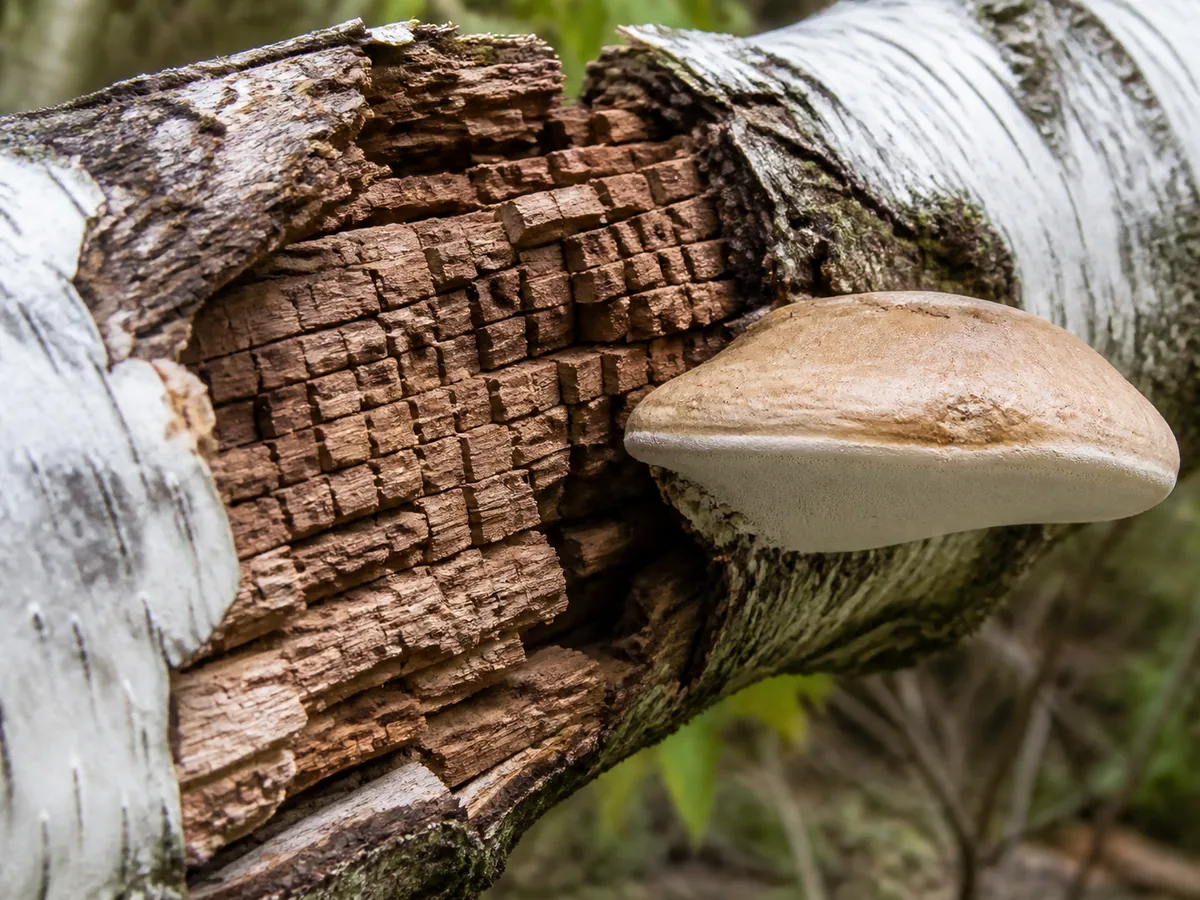
Brackets commonly appear from summer into fall. The durable bodies can remain after sporulation, so a winter find does not necessarily mark fresh growth.
A bracket on a standing birch can indicate internal decay and falling-wood risk.
Leave tree-risk assessment to a qualified arborist rather than using the mushroom alone to predict failure.
Brown rot changes the engineering properties of the wood because the fungus removes cellulose and leaves brittle lignin-rich blocks. A bracket therefore identifies an active decay process, but it cannot reveal how much sound wood remains inside the trunk.
On a fallen birch, that decay creates cavities and friable wood used by insects and other forest organisms. On a standing tree near people or structures, the same finding calls for a tree-risk inspection rather than a prediction based on bracket count.
Brown rot changes wood chemistry and structure rather than simply making it soft.
The fungus removes much of the cellulose and hemicellulose, and the remaining lignin-rich wood fractures into brown blocks with little bending strength.
On a fallen trunk, those fractures admit moisture, insects, and other decomposers. Cavities and softened sections become feeding and shelter sites, so removing every decaying birch from a woodland can erase habitat as well as a perceived mess.
A standing bracket deserves proportionate attention. The fruiting body confirms decay at that point, but it cannot show the length of the internal column, the thickness of sound residual wood, root condition, crown load, or likelihood of striking a target.
Near a home, path, vehicle, or play area, ask a qualified arborist to inspect the whole tree. In a low-target woodland, retaining a decaying standing birch may be appropriate when local management and safety allow it.
What does the medicinal research actually establish?
Laboratory research has identified polysaccharides, triterpenes, and other compounds in F. betulina extracts. Those experiments describe chemical or in vitro activity, not a clinically proven treatment.
No standardized human dose or established therapeutic indication follows from that evidence. People who are pregnant, take medicines, or have liver, kidney, bleeding, or allergy concerns should not self-treat with wild extracts.
Separate three evidence levels before judging a claim.
Chemical analysis can identify compounds, cell or enzyme studies can show laboratory activity, and controlled human trials must still establish a useful dose and clinical outcome.
Birch polypore research remains concentrated in the first two levels. Historical wound dressings or bitter infusions document human use, but they do not supply modern sterility, dosing, interaction, or efficacy evidence.
Reviews describe polysaccharides, triterpenes, polyporenic acids, piptamine, and other constituents from fruiting bodies or cultured material. Researchers have reported antimicrobial, anti-inflammatory, cytotoxic, antiparasitic, and other activity in laboratory systems.
The verbs matter.
Inhibiting a microbe in a dish or affecting a cell line does not show that a tea reaches the same concentration in human tissue, improves symptoms, or produces more benefit than harm.
Most preparations are not standardized across strain, substrate, age, extraction solvent, temperature, and dose. A result from one crude extract cannot certify a differently made powder or tincture sold under the same species name.
No established clinical dose follows from the current literature. Pregnancy, bleeding risk, immune treatment, liver or kidney disease, allergies, and medicine interactions should be discussed with a clinician before using a concentrated product.
The evidence supports further research, not replacement of antibiotics, cancer care, or other diagnosed treatment. A wild bracket also brings identity, contamination, and condition questions that a chemical assay on authenticated laboratory material does not address.
Why did Piptoporus betulinus change names?
The species was widely published as Piptoporus betulinus. Molecular work placed it closer to Fomitopsis, and the accepted combination Fomitopsis betulina was published in 2016.
Older books and research papers remain searchable under the former name. This profile uses the current name while retaining Piptoporus betulinus as a literature synonym.
Why is birch polypore not table food?
Birch polypore is not a normal edible mushroom. Young tissue remains bitter, while mature tissue becomes too corky or woody to eat.
Historical use as tinder, a strop, dressing material, or bitter infusion does not establish food safety. Avoid home teas and tinctures when identity, dose, interactions, and contaminants are unknown.
Can birch polypore be cultured responsibly?
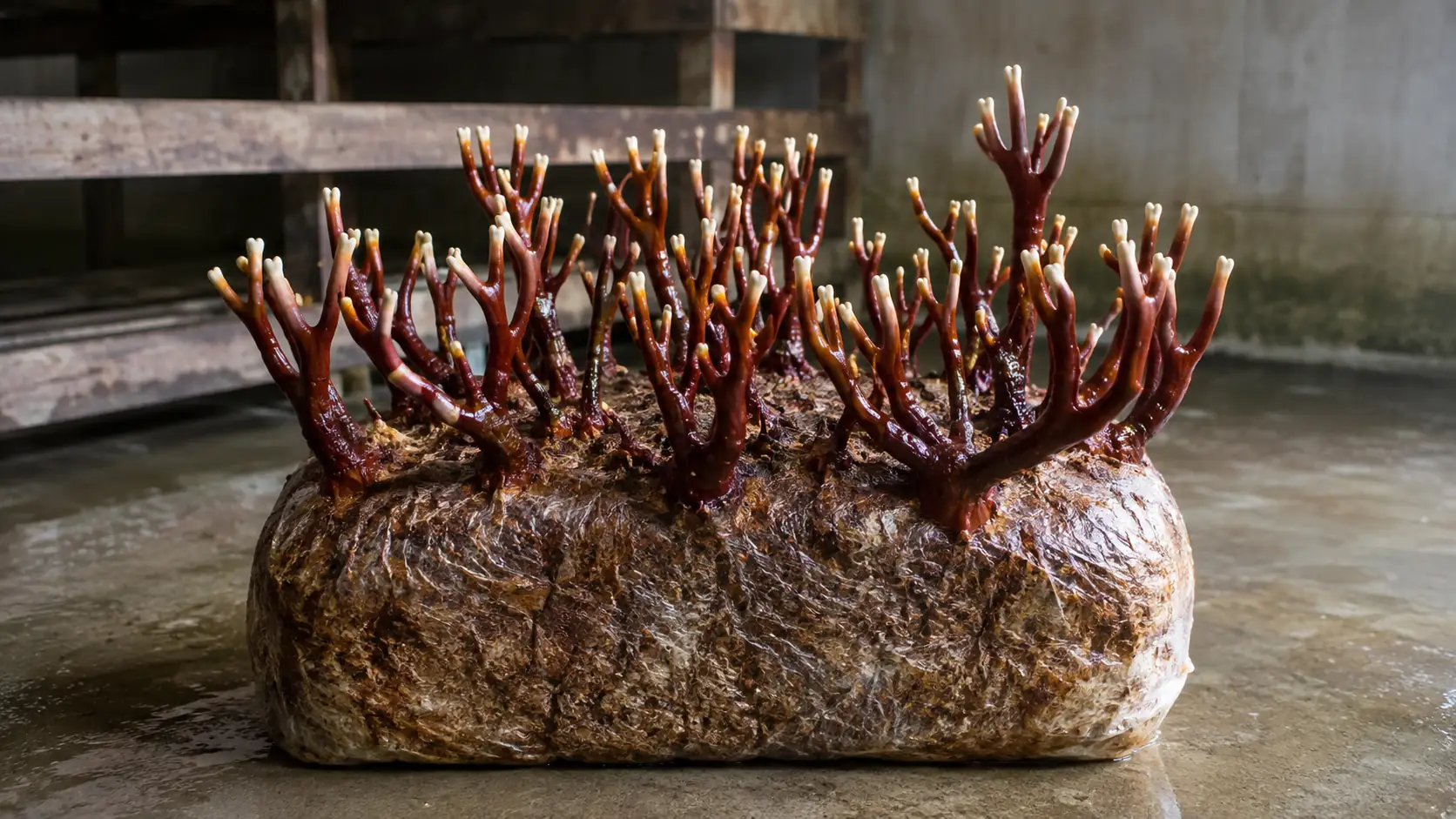
Birch polypore can be cultured on birch-based media and researchers have produced fruiting bodies on birch sawdust. It is not a beginner food crop because the result is tough and bitter.
Do not inoculate living birches.
The species is a wood-decay fungus, so cultivation belongs on contained dead substrate with strain documentation and responsible disposal.
A contained research culture starts with authenticated material and a birch-based sterile substrate. Fruiting success depends on strain, moisture, temperature, gas exchange, and time, so the appearance of mycelium alone does not confirm a usable crop.
Because the species decays birch wood, spent blocks and cultures should stay away from living birch roots and vulnerable nursery stock.
The practical value of cultivation is research and observation, not producing a food mushroom.
Researchers have maintained mycelium and produced fruiting bodies on controlled birch-based substrates. Moisture, strain, supplements, temperature, and aeration affect growth, which makes a published culture result a starting condition rather than a universal home recipe.
Use authenticated culture and contained dead substrate if the purpose is observation or research. Inoculating a living birch creates a decay risk and gives no reliable path to a medicinally standardized harvest.
A clean culture also does not prove the final fruiting body or extract matches a study.
Record strain source, substrate batch, incubation conditions, contaminants, and fruiting identity so the result can be interpreted rather than marketed from the species name alone.
Spent substrate can still contain active mycelium. Keep it away from wounded living birches, bag or heat-treat it as local rules allow, and do not move it into woodland where the introduced strain and substrate could complicate local records.
Birch polypore identification questions
Does birch polypore grow only on birch?
Is birch polypore edible?
Does it have gills?
Is Piptoporus betulinus the same species?
Can it cure disease?
Does a bracket mean a birch is unsafe?
Sources & References
- PeerJ review of Fomitopsis betulina Taxonomy, birch-restricted ecology, morphology, cultivation, and compound research.
- Frontiers in Microbiology Fomitopsis diversity review Host, distribution, fruiting-body form, and modern genus context.
- MycoBank record MB 812646 Accepted combination and nomenclatural record.