
 Poisonous

Why a small brown mushroom carries a death cap toxin
People usually think of amatoxins as a large-mushroom problem, and deadly galerina breaks that picture. It is a small brown mushroom, a few centimeters across, growing in clusters on rotting wood. Nothing about it looks dangerous, yet it carries the same class of toxin as the death cap.
Warning
Symptoms usually begin six to twenty-four hours after the meal, long after anyone connects the illness to a mushroom. Call Poison Control at 1-800-222-1222 on suspicion; do not wait for the pattern to become obvious.
Three different groups of people run into it, and none of them is looking for it. Honey mushroom foragers meet it because both species cluster on dead wood at the same time of year. People hunting small brown psilocybin species meet it because it grows in the same places at the same scale. European foragers meet it through the sheathed woodtuft, an edible clustered wood mushroom with the same habit and season.
All three groups collect clusters, not single mushrooms. Pickers take a cluster as a unit, so one intruder in a handful goes into the pan with everything else. The same habit points to the fix: break every cluster apart and check it cap by cap.
The illness follows the amatoxin course: severe stomach symptoms, an apparent recovery, and liver injury underneath. The staged pattern is laid out under amatoxin poisoning. The apparent recovery is part of the poisoning, not the end of it.
How do you separate deadly galerina from honey mushrooms?
Small brown mushrooms are the hardest group in the woods, and spore color separates this one from honey mushrooms better than looks do. The cap runs honey yellow to cinnamon or brownish orange, and it feels sticky when fresh. As it dries it fades unevenly, leaving a two-toned cap with a darker center and a pale rim. That fading marks the genus and proves nothing about the species.
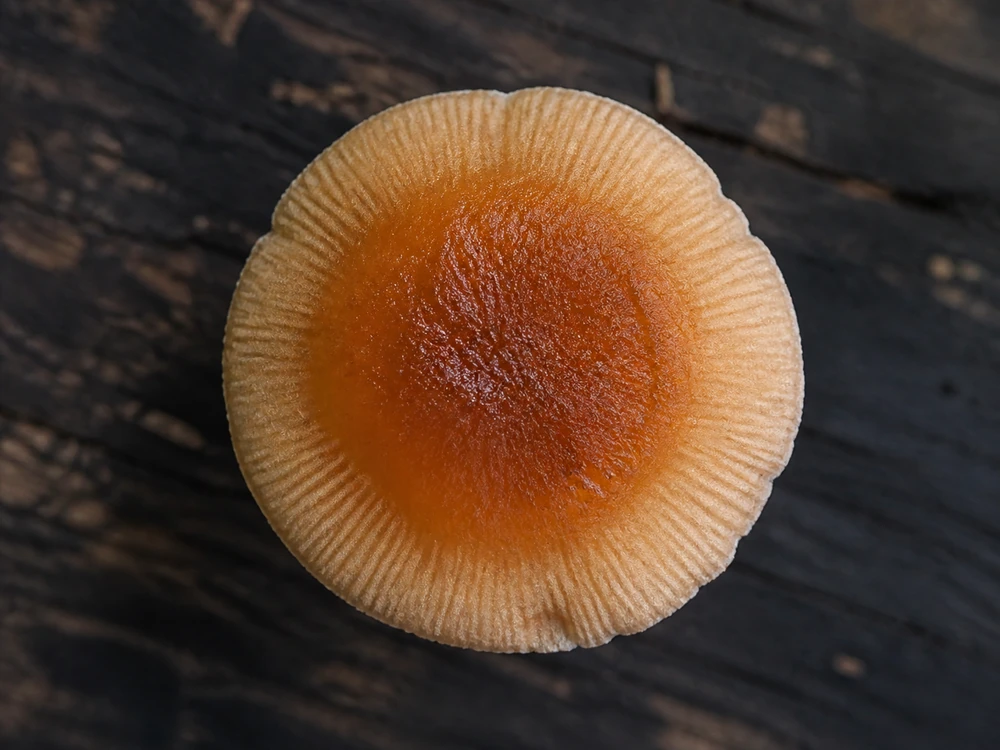
The spore print is the first check a beginner can run, and it takes one night. Honey mushrooms leave white spores on the paper. Deadly galerina leaves rusty brown ones, and no amount of cap color argument overrides that difference.
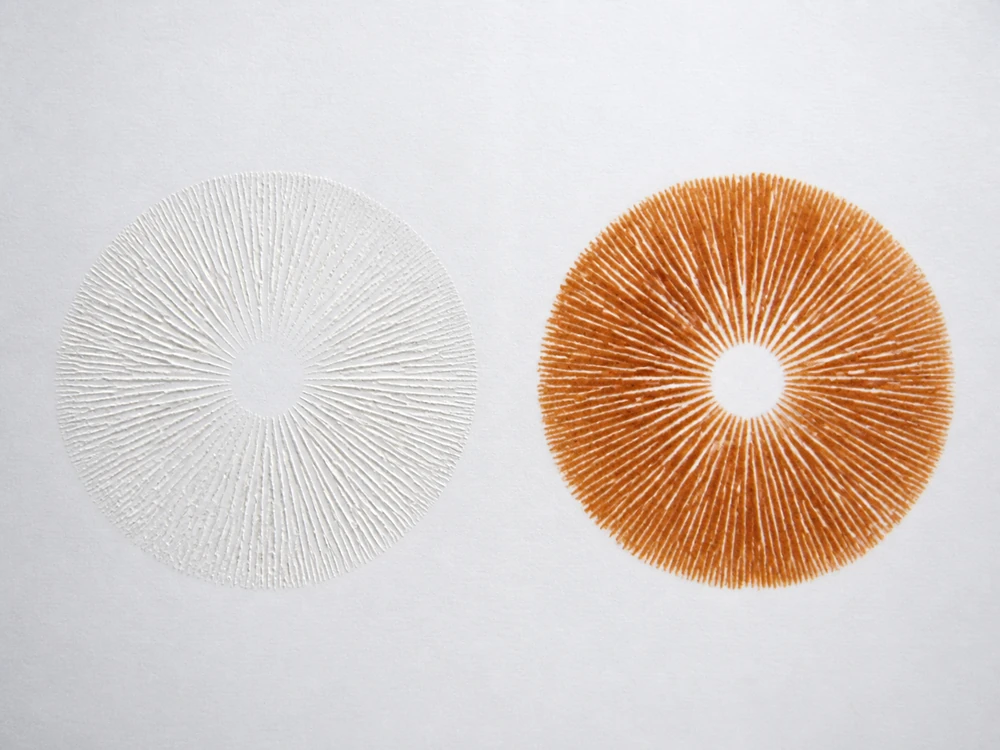
Use white paper and read the print in daylight, because contrast counts for more than whichever paper color someone recommends. Print the whole cluster, never just one cap, since a mixed cluster is exactly the situation this species creates.
A white print and a rusty print are two different mushrooms, whatever the caps looked like.
The check that ends the argument
| What you may be holding | Spore print | Gills | Where it grows |
|---|---|---|---|
| Deadly galerina | Rusty brown | Yellowish to rusty brown | Clustered on rotting wood |
| Honey mushroom | White | Whitish to pale cream | Clustered on wood and roots |
| Sheathed woodtuft | Brown, too close to rusty brown to separate by print | Pale to cinnamon | Clustered on hardwood stumps |
| Small Psilocybe species | Purple-brown to black | Grayish to dark | Wood chips, dung, or grass |
Scale is the other thing to notice, because these mushrooms are easy to miss entirely. Mature caps are often smaller than a fingernail and sit low among larger ones. In a cluster of honey mushrooms, one can vanish completely.
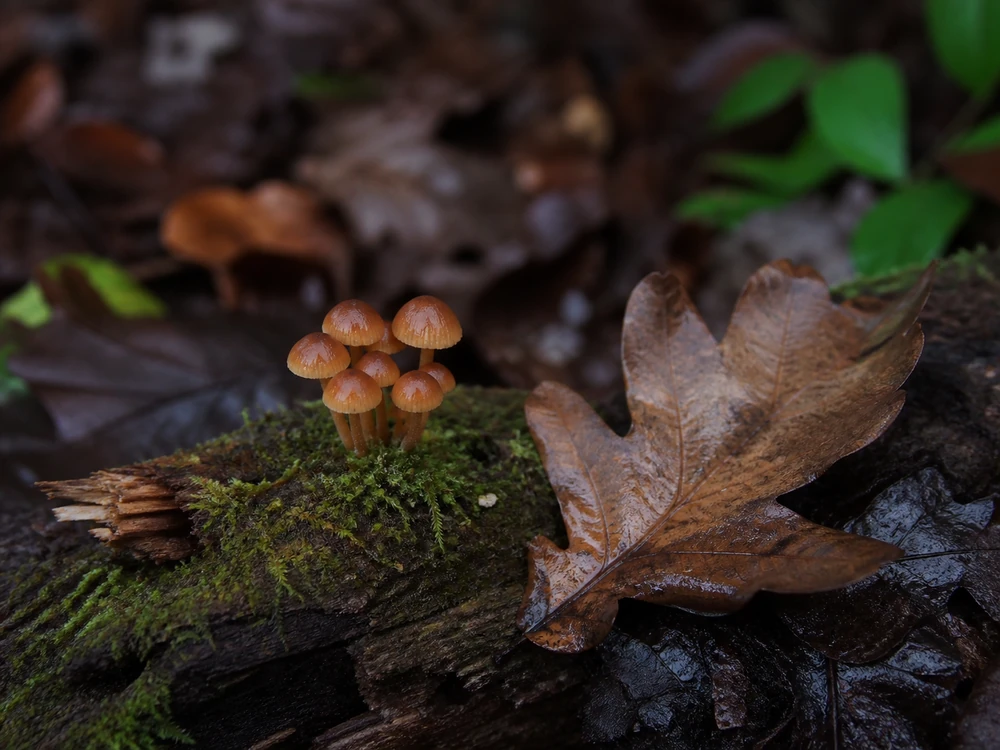
Sorting a cluster that size on a table takes longer than picking it did. Beginners do better to leave small brown mushrooms out of the basket altogether.
Note
No reliable field method separates small brown mushrooms on cap features. Any wood-growing brown cluster you intend to eat needs a spore print first.
Where deadly galerina grows, and why it shares logs
Deadly galerina is saprobic: it feeds on dead wood and forms no partnership with a living tree. It causes a stringy white rot in fallen hardwoods and conifers and fruits directly from that decaying material. Logs, stumps and buried debris all produce it.
Buried wood is the detail that catches people out. Clusters rising from what looks like bare soil often grow from a root or a fragment below the surface, so they pass for ground mushrooms. Brushing the litter aside usually finds the wood.
- Substrate
- Rotting hardwood and conifer wood, including buried pieces
- Habit
- Usually clustered, sometimes scattered or single
- Season
- Spring and fall mainly, with fruiting possible year-round
- Range
- Widespread and common across North America and Europe
Its season overlaps almost exactly with honey mushroom season, and that is no coincidence. Both species work the same dead wood under the same autumn conditions, so they can fruit within a meter of each other on the same log. Sharing a log is the normal case, not the unlucky one. Year-round fruiting also puts it among the winter mushrooms, and a mild spell can bring clusters onto a log in January, well outside anyone's mental picture of mushroom season.
Why one cap can ruin an entire pan
No preparation makes deadly galerina safe, and no amount of it counts as a tasting portion. Amatoxins survive frying, boiling, drying and freezing. Even a handful of small caps can deliver a serious dose, which surprises people used to judging risk by mushroom size. The realistic risk is contamination, not a deliberate meal.
Warning
One deadly galerina in a pan of honey mushrooms poisons the whole pan. Sorting has to happen before cooking, because nobody can pick it back out of a finished dish.
Sort a clustered collection cap by cap on a table, not in the woods. Good light, a flat surface and a spore print from the batch catch what a hurried field check misses. Print any cluster that arrives home unsorted before you cook any of it. If that sounds like more work than the meal is worth, that is a reasonable conclusion.
Deadly galerina in mulch and outdoor mushroom beds
Nobody cultivates deadly galerina, but it turns up on cultivated ground more often than people expect. Garden beds offer it wood chip mulch, landscape timbers and stump grindings, all of which suit it, so it can fruit with no woodland nearby. Outdoor mushroom beds built on hardwood chips fall in the same category. Take that last case seriously if you grow wine caps or oysters outdoors.
Outdoor beds invite wild wood decomposers to colonize the same chips, and a small brown cluster at the edge of a bed is not automatically the species you planted. Harvest only what matches the species you inoculated.
Removing the clusters does not clear the wood, which stays colonized until it breaks down. Replacing heavily colonized mulch is the only reliable way to end the fruiting, and even then the fungus can arrive again with the next delivery of chips. Remove clusters with gloves or a tool, bag them, and wash hands and tools afterward, then check the area again after the next wet spell. Touching an intact mushroom carries far less risk than eating it, and clean handling keeps fragments away from mouths and food.
Warning
If a child or pet may have swallowed any part, yard cleanup can wait. Call Poison Control at 1-800-222-1222 or a veterinarian immediately and keep a specimen.
The decision to make about small brown mushrooms
The decision here covers a whole category of mushrooms, not any single species. Small brown mushrooms on wood are the hardest group to identify and one of the most dangerous to get wrong. Treating the entire category as off limits costs a beginner almost nothing.
If you do collect a clustered wood mushroom, follow the same sequence every time. Take the cluster whole, keep it apart from everything else, print it overnight, and only then decide. Rusty brown spores end the discussion, however the caps looked.
Key takeaway
No cap feature separates these species reliably in the field. The print is no formality here, and it can only reject: a rusty brown print ends the discussion, and a white one still leaves every cap in the cluster for you to check.
The habits that make this workable are the ones in the foraging safety rules. This species shows that danger does not scale with size. Mushrooms smaller than a thumbnail can carry what a death cap carries.
Three old names, one species
Deadly galerina sits in the genus Galerina and the family Hymenogastraceae, among small brown mushrooms of wood and moss. Mycologists now treat Galerina marginata as a species complex that absorbs several names once kept separate, including Galerina autumnalis, G. venenata, G. oregonensis and G. unicolor. Older guides split them on features that DNA work showed vary within the group.
In a 2021 study that combined DNA with toxin testing, researchers found substantial amatoxins in every tested collection from the complex. Expert morphology could usually recognize the complex as a whole, while the names applied to its smaller genetic lineages were inconsistent. Keep that merge in mind when you read an older book. Guides that describe autumn skullcap and funeral bell as different mushrooms are describing the same one, and the toxin does not vary between the old names. Treat every entry in that cluster of names as the same hazard.
Not every Galerina carries amatoxins, and in practice that fact gives no help. Separating the toxic members from the harmless ones takes microscopy, so anyone without a laboratory treats the genus as a whole. The same reasoning runs through the other dangerous lookalikes: the safe move is to reject a group in the field, never to split it.

 Caution


 Edible
