Wild velvet shank and retail enoki are different records
The name velvet shank belongs to a wild field-identification problem, while the long white enoki mushroom sold in shops is generally the East Asian species Flammulina filiformis. Older books and retail explanations often place both under Flammulina velutipes, so the common name can hide a taxonomic boundary that matters.
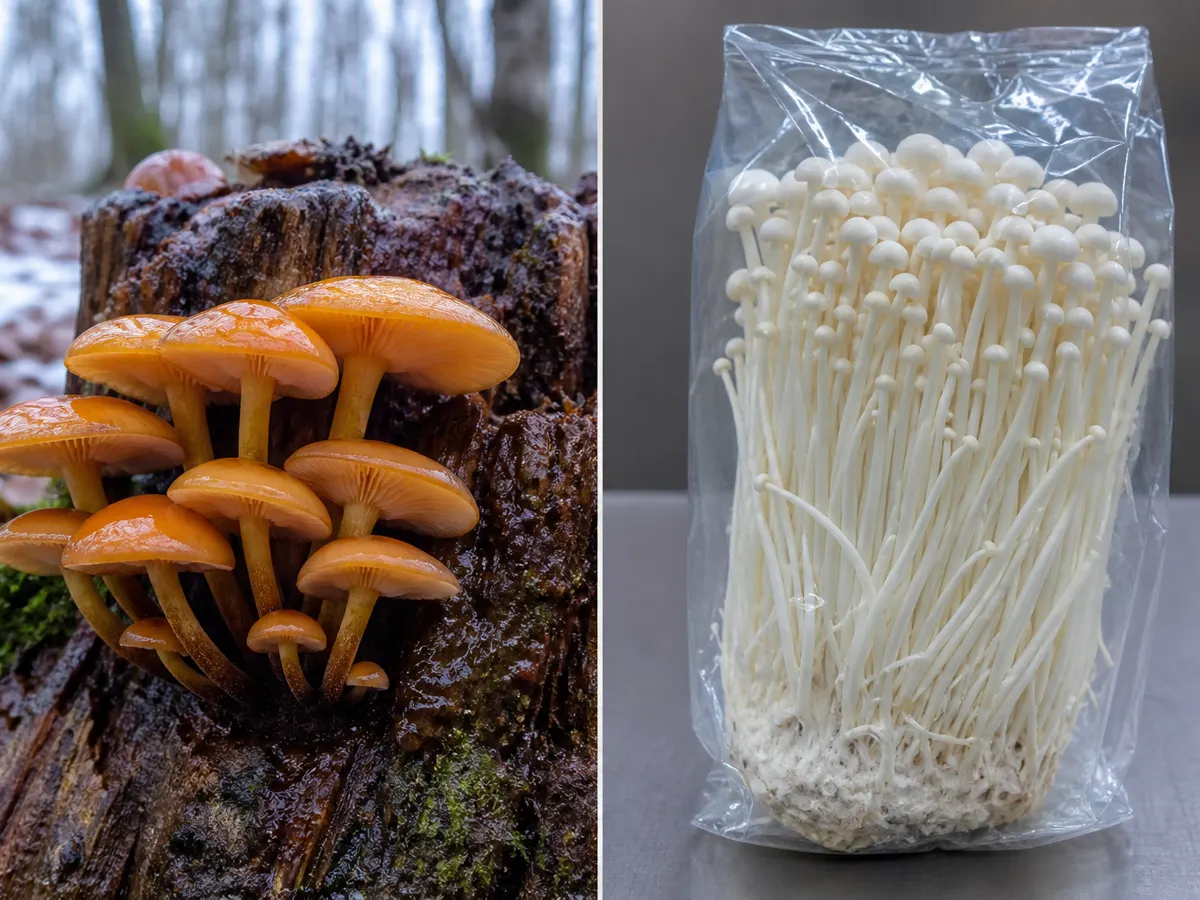
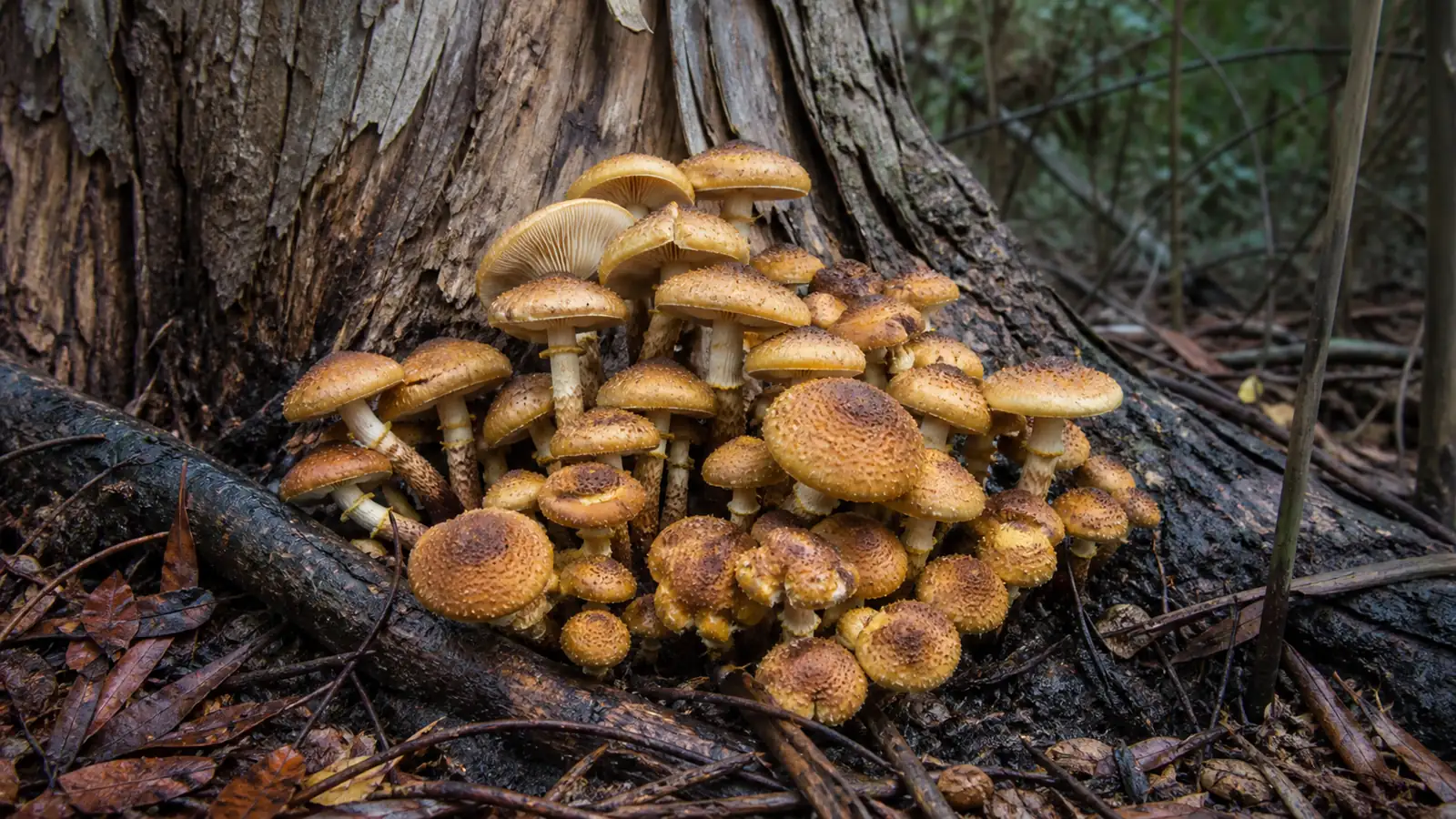
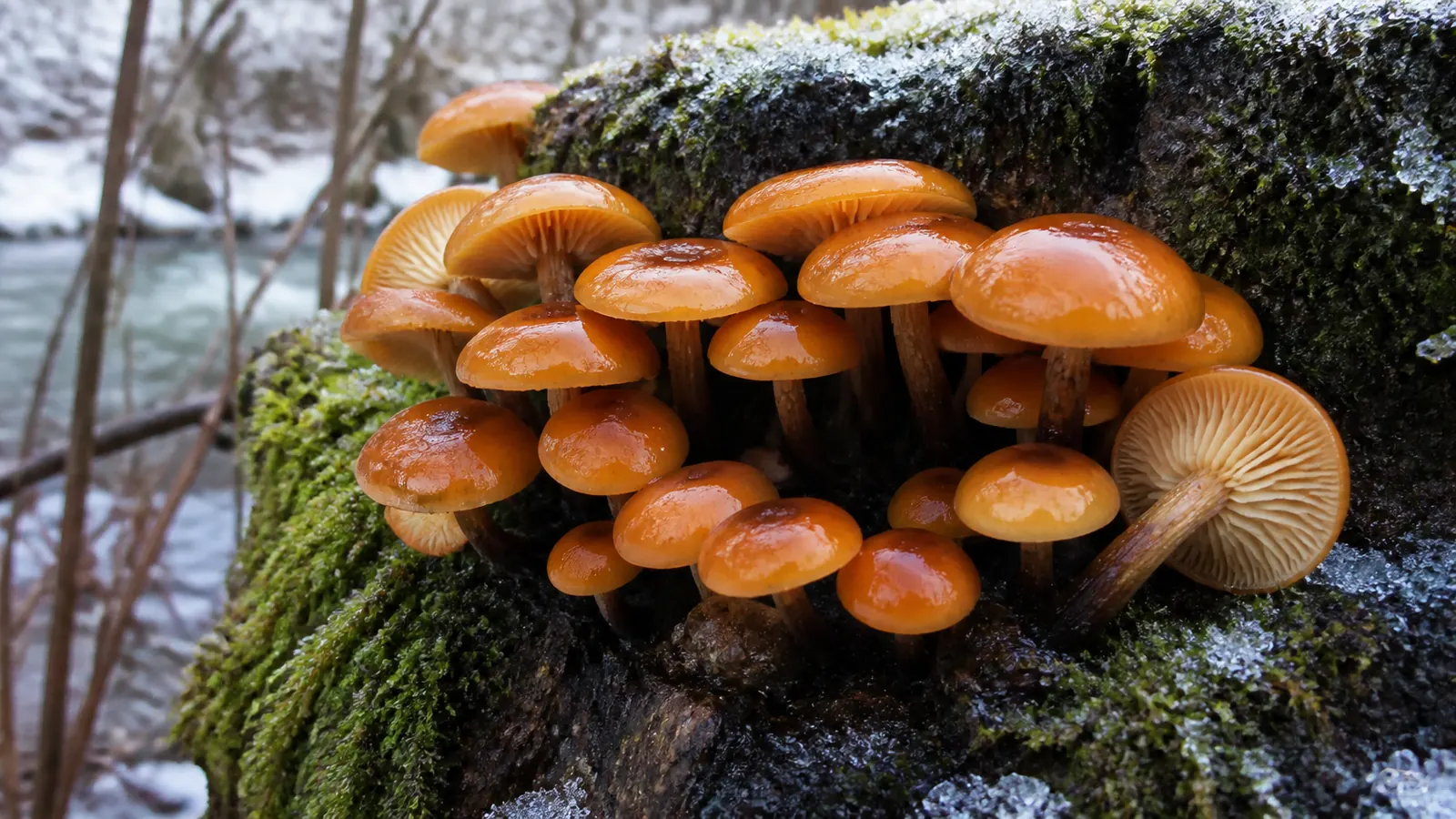
A wild cluster typically has amber to tawny caps, pale gills, and short stems whose lower halves darken and develop a fine velvet. Packaged F. filiformis has its own production and food-safety chain, so its appearance, edibility, and cultivation record cannot be transferred to an unidentified woodland collection.
White deposit
Continue the field assessmentKeep the same numbered specimen and compare every remaining Flammulina character
Rusty deposit
Reject velvet shankAssess the specimen as possible Deadly Galerina and keep it out of food
Purple-brown deposit
Redirect the identificationCompare other dark-spored wood mushrooms rather than forcing a Flammulina name
No usable deposit
Leave it unidentifiedRecord the failed print instead of guessing a color or borrowing evidence from another cap
The word velvet describes the lower stem. Side light reveals dense, dark hairs rather than soil staining, while the upper stem stays paler and the entire stem lacks a persistent ring.
A white print supports the genus-level assessment, but never proves a meal is safe. Geography and microscopic characters can still be necessary to separate members of the velvet shank group.
Build the identification from one intact cluster
Smooth and sticky when moist, 2 to 8 cm wide, orange-yellow to tawny brown with a darker center and a paler margin.
White to pale cream, broad, crowded to moderately spaced, attached or slightly notched, and never rusty brown from the mushroom's own spores.
Ringless, tough, 2 to 8 cm long, pale near the cap and dark brown to nearly black toward the base, with a dense velvety surface below.
Thin pale cap flesh with a mild mushroom odor; the stem becomes tough and fibrous, especially toward the dark base.
Document the wood attachment before removing anything. A photograph should show whether every stem belongs to one cluster on a stump, fallen branch, buried root, or wound in deciduous wood, because a single log can fruit more than one species.
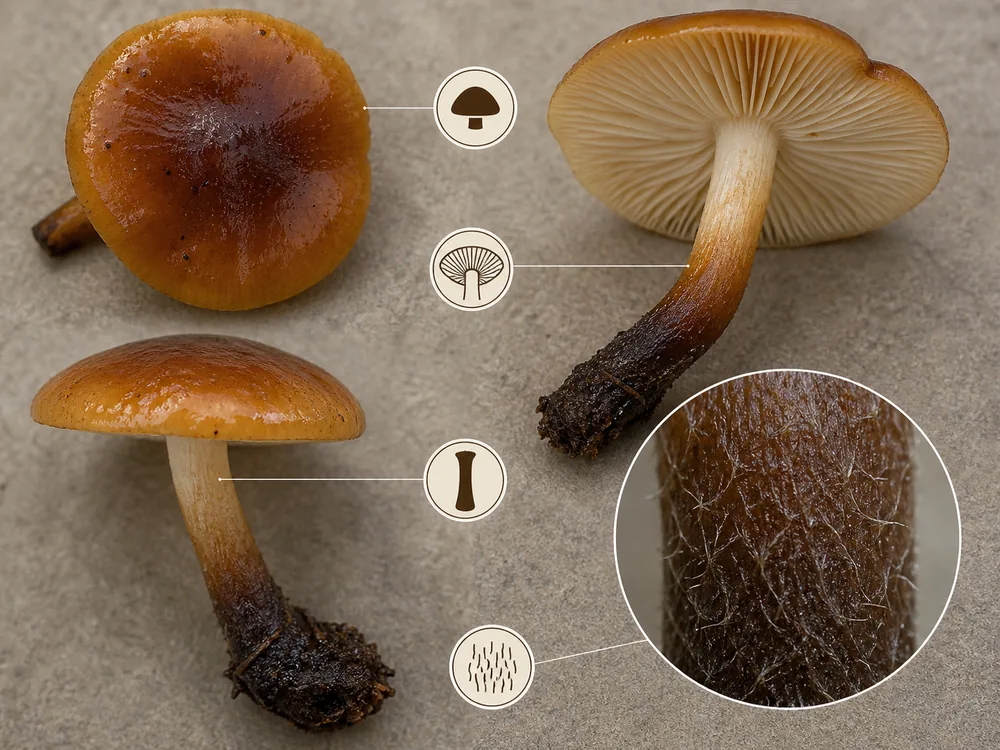
- Record smooth amber to tawny caps while their natural sticky surface is still visible.
- Turn several mature caps over and confirm pale cream gills without a rusty dusting.
- Preserve each stem to its attachment and inspect the upper portion for a ring, a ring zone, or veil remnants.
- Light the lower stem from the side to distinguish dense dark velvet from mud or decay.
- Assign one field number before taking a cap for spore printing.
Rain can make several brown wood mushrooms glossy, so a wet cap is weak evidence by itself. The stronger pattern is a pale upper stem that grades into a tough, brown-black, finely hairy base without a ring.
Take the print from one mature cap on a clean surface, away from neighboring clusters. A clean white deposit supports Flammulina and helps exclude rusty-spored Galerina, but a sparse deposit, mixed colors, or spores fallen from another cap cannot settle the question.
Microscopy can compare spore dimensions, cystidia, and cap-surface tissues against a regional key. DNA may be needed when closely related Flammulina lineages overlap in visible characters or when the collection lies outside the well-documented European range.
Keep adjacent clusters separate from the first photograph onward. Mixing stems and caps can manufacture a false character set that no single mushroom possessed.
Use the print to reject Deadly Galerina
Cold weather and dead wood narrow the search, but they do not separate a velvet shank group from every dangerous brown mushroom. Deadly Galerina can occupy the same log, and an old specimen may have lost much of its ring.
Deadly Galerina produces rusty spores and can contain amatoxins that cause fatal liver injury. Velvet shank produces white spores, but that result counts only when a mature cap from the recorded cluster makes the deposit by itself.
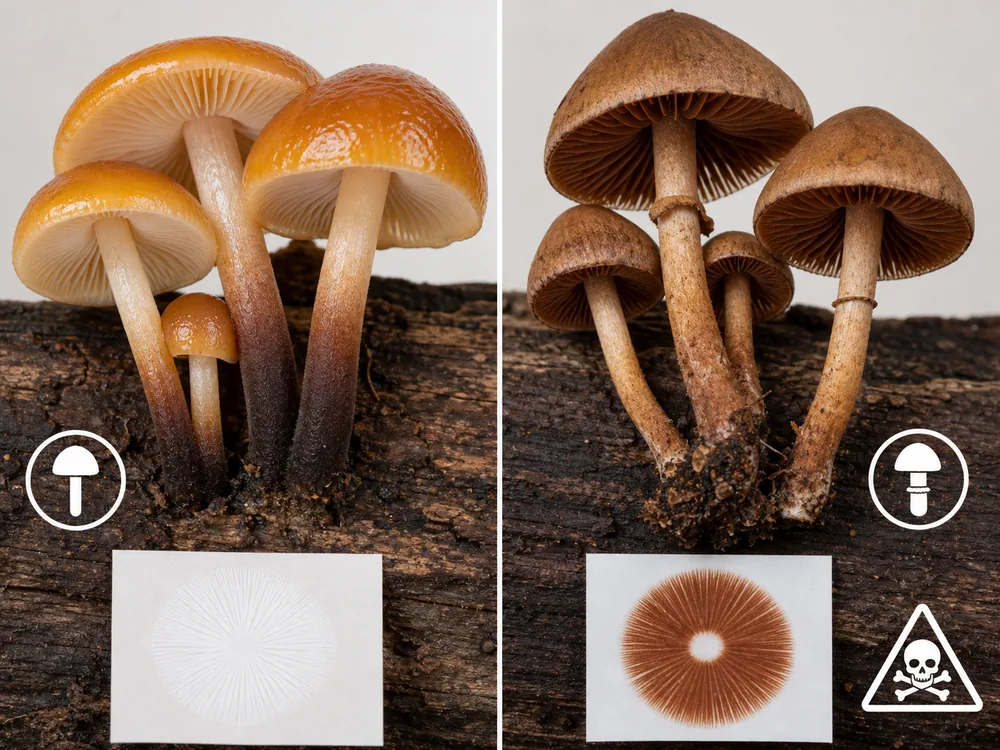
A missing ring cannot clear a specimen because rain, age, or handling can erase fragile veil tissue. Yellow-brown or rusty gills, a rusty deposit, or a ring zone ends the velvet shank assessment.
Hypholoma species also form crowded clusters on wood. Their maturing gills and purple-brown spores redirect the identification, even when the cap color resembles a wet velvet shank.
Warning
Cooking does not destroy Galerina amatoxins. If the collection is mixed, incomplete, brown-spored, or cannot be tied to its own print, discard it and seek qualified local identification.
One intact cluster, one field number, and one isolated print must stay together from the log to the final decision.
Why this wild profile stops before cooking
This profile does not provide preparation instructions for a wild collection. Missouri conservation guidance specifically advises against eating wild velvet foot because confusion with Deadly Galerina carries a fatal risk.
A white print is useful evidence, but it does not establish a narrow species name or food safety on its own. Retail F. filiformis enoki comes through a separate commercial identification and handling chain, and its edible status cannot be transferred to a woodland Flammulina candidate.
Heat cannot repair an identification error. Galerina amatoxins remain dangerous after cooking, so a doubtful or mixed collection stays out of the kitchen.
Cold hardwood habitat narrows the search
Velvet shank is a wood decomposer associated mainly with deciduous trees. Naturalis records it on stumps, trunks, and fallen branches of alder, ash, poplar, and elder, while local records can add other hardwood hosts.
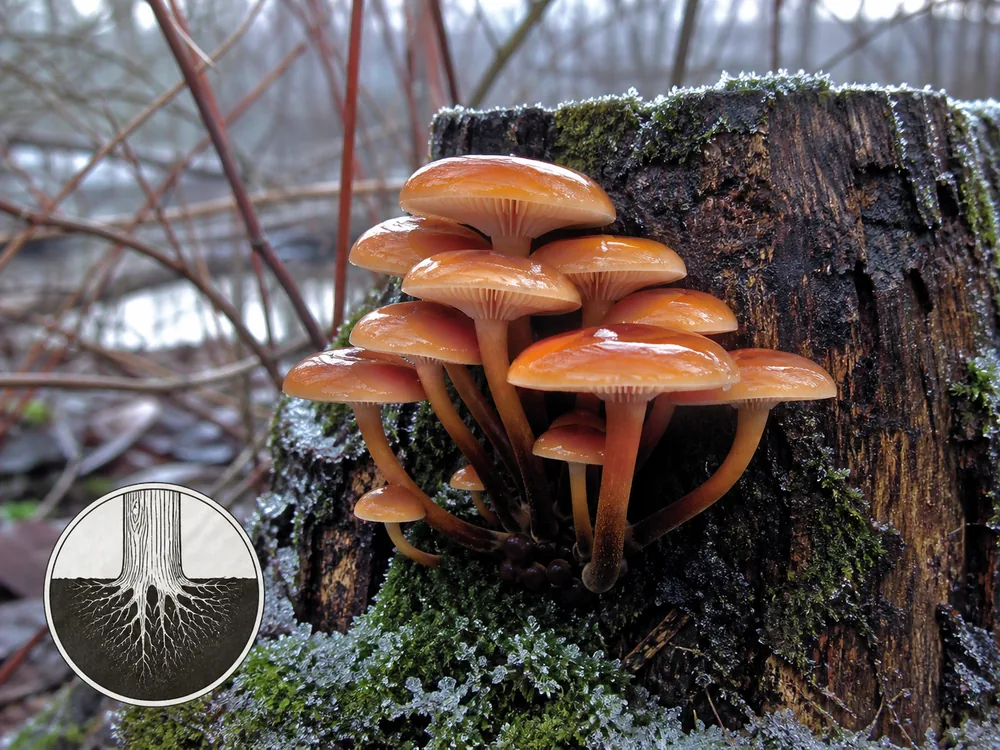
Clusters can appear from autumn into early spring and may resume development during a mild spell. That timing makes the group conspicuous among winter mushrooms, although Deadly Galerina is not confined to one short season.
- Photograph bark, buds, retained leaves, and surrounding trees before naming the host.
- Trace apparently terrestrial stems to buried roots or wood.
- Inspect old fruit bodies and neighboring clusters for a second species.
- Record frost, waterlogging, mold, and decay because damaged structures weaken identification.
A wound on a living tree can expose wood that supports fruiting, so the presence of living bark does not make the fungus mycorrhizal. The feeding relationship remains decay of woody tissue.
Rebuild the record every time a stump fruits. The same piece of wood can support different fungi in different weeks, and last month's identification does not transfer to a new cluster.
Keep group-level and species-level names separate
Flammulina velutipes was historically applied broadly to velvet shanks across the Northern Hemisphere. Sequence studies recovered geographically structured lineages and multiple northern species, which limits what a photograph and a few field marks can establish.
Wang and colleagues separated East Asian Flammulina filiformis from European F. velutipes using morphological and phylogenetic evidence. This is why packaged enoki should not be described as merely an environmentally altered specimen of the wild species covered here.
The practical field label is the Flammulina velutipes group until locality, microscopy, and where necessary DNA support a narrow assignment. That restraint preserves information because it distinguishes a well-supported group identification from certainty the evidence did not earn.
Velvet shank field questions
How can you tell velvet shank from Deadly Galerina?
Is wild velvet shank the same as grocery-store enoki?
When does velvet shank grow?
What color is a velvet shank spore print?
Can velvet shank grow from the ground?
Can you eat wild velvet shank after cooking it?
Sources & References
- Naturalis, Interactive Guide to Mushrooms: Flammulina velutipes Morphology, ecology, and identification description.
- Missouri Department of Conservation, Deadly Galerina Rusty print, ring, wood habitat, poisoning risk, and comparison with white-spored velvet foot.
- Missouri Department of Conservation, Velvet Foot Regional field marks, white print, deciduous wood, cold season, and recommendation not to eat wild collections.
- Wang et al., Phylogeny and taxonomy of the Flammulina velutipes complex Morphological and phylogenetic separation of East Asian F. filiformis from European F. velutipes.
- Hughes et al., Patterns of Geographic Speciation in Flammulina Northern Hemisphere clades and the limits of an overly broad F. velutipes label.