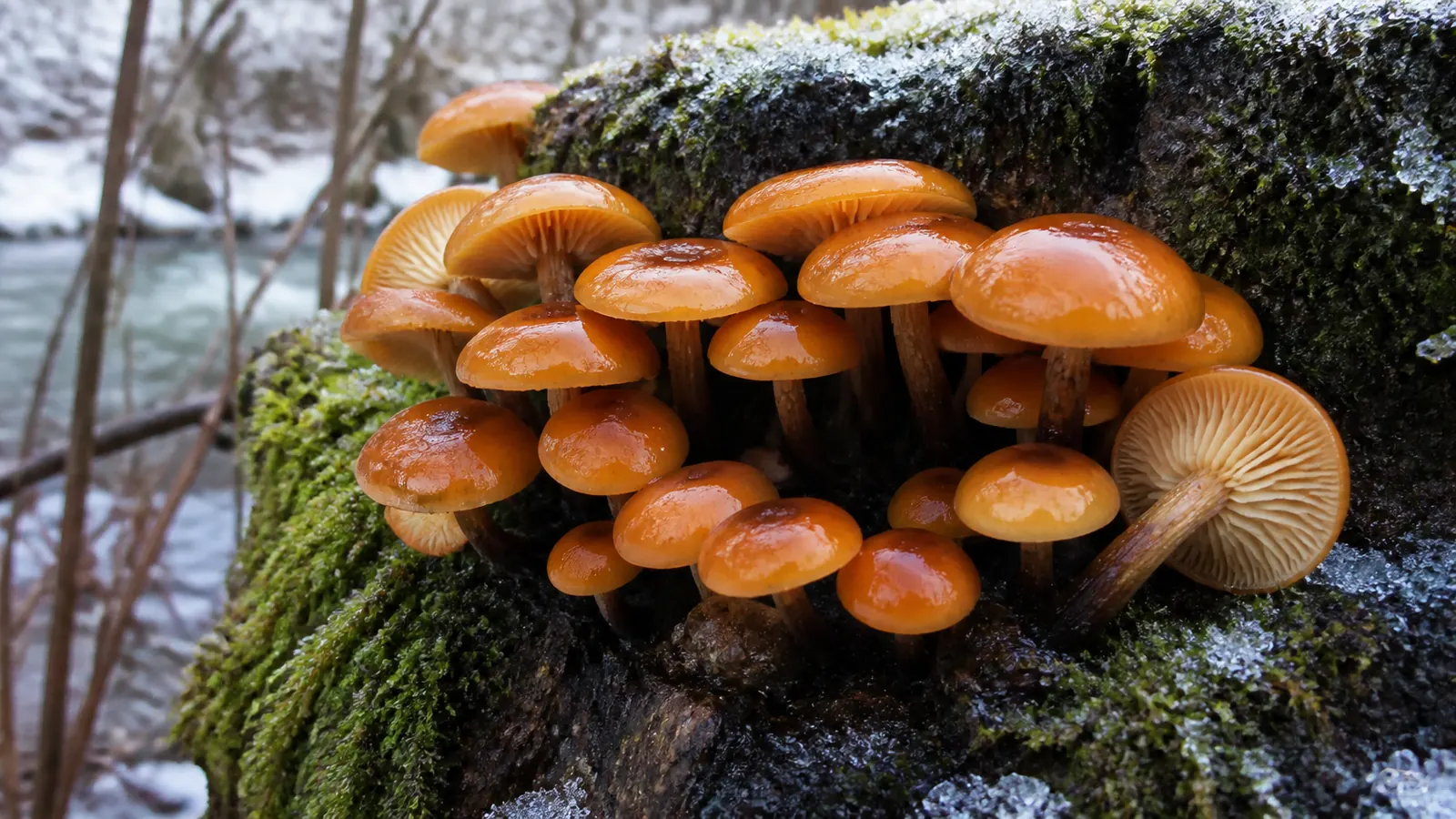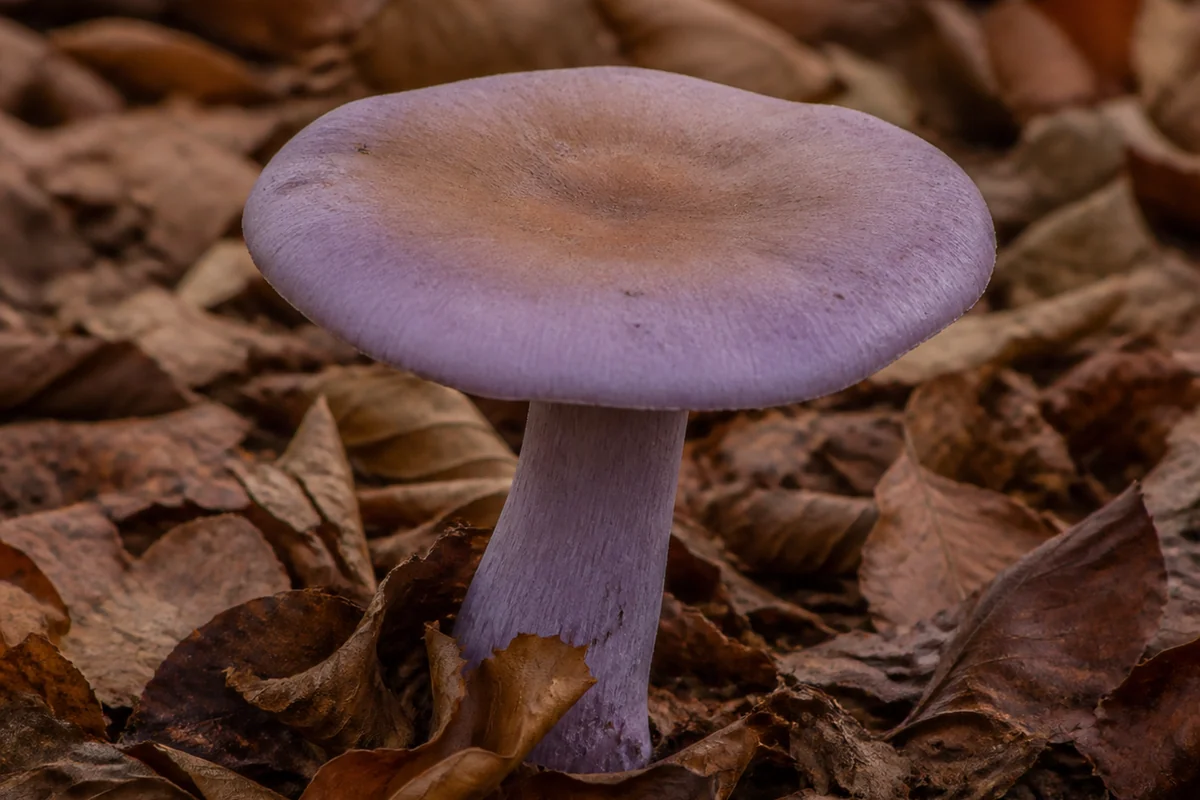
What is Australian honey fungus?
Armillaria luteobubalina has two identities that matter to readers. It is the Australian honey fungus seen in dense autumn clusters, and it is a serious native root pathogen capable of killing stressed or healthy plants.
The mushroom is not simply an Australian form of European Armillaria mellea. Australian collections carried that older name for years, but modern taxonomy recognizes A. luteobubalina as a distinct species restricted to Australia in current global treatments.
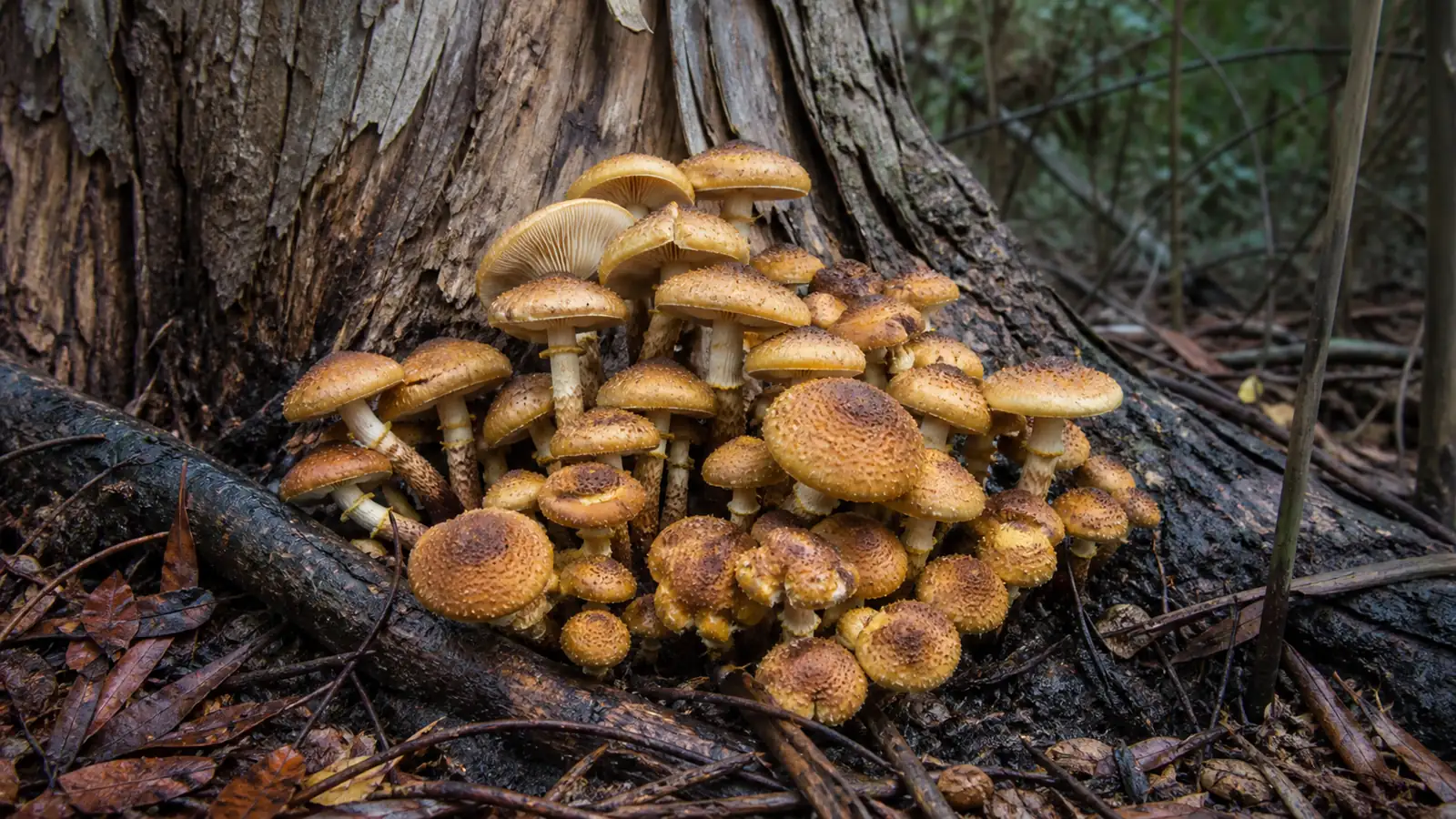
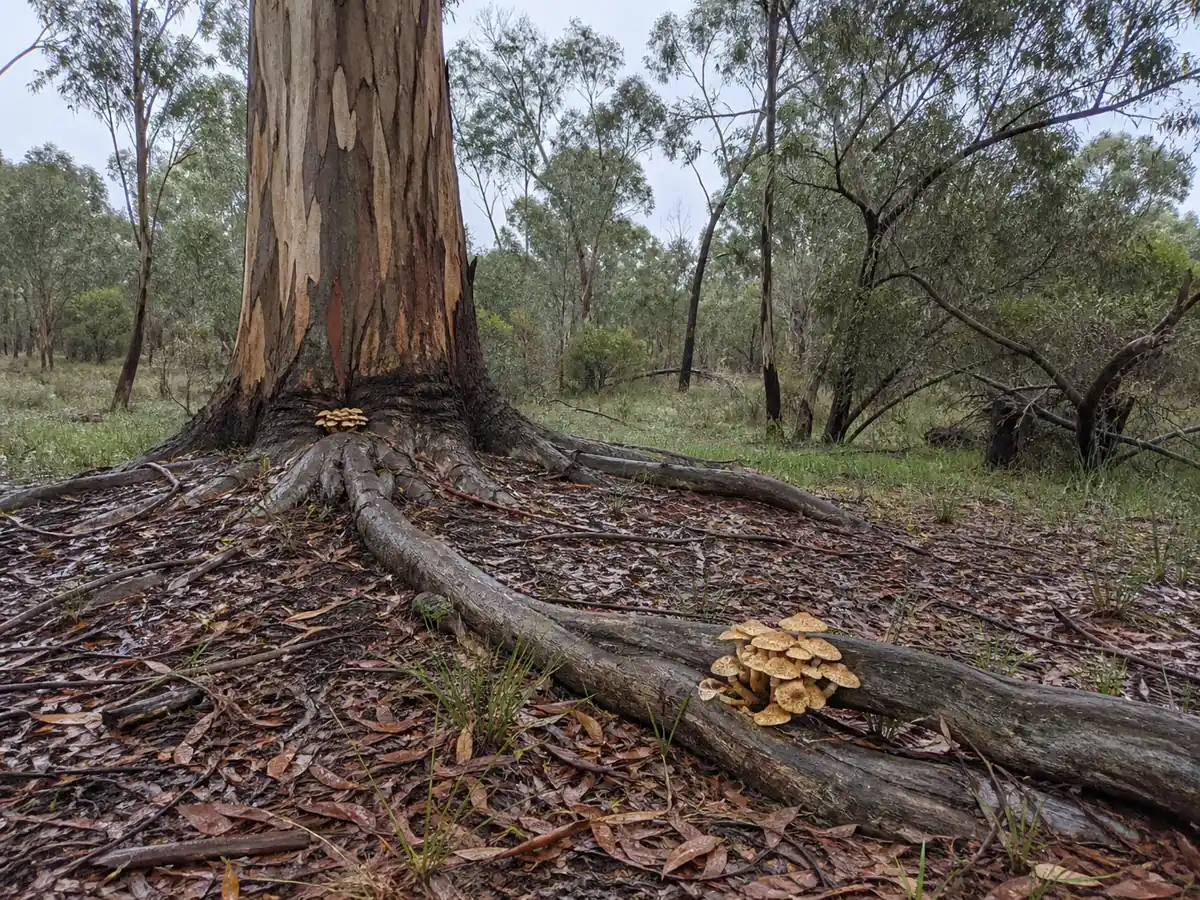
Fruiting bodies appear around trunks and major roots, sometimes tracing buried roots away from the tree. Caps are lemon-yellow to honey-brown with small dark scales over the center, while cream-white spores may dust lower caps in a cluster.
The underground signs are equally important.
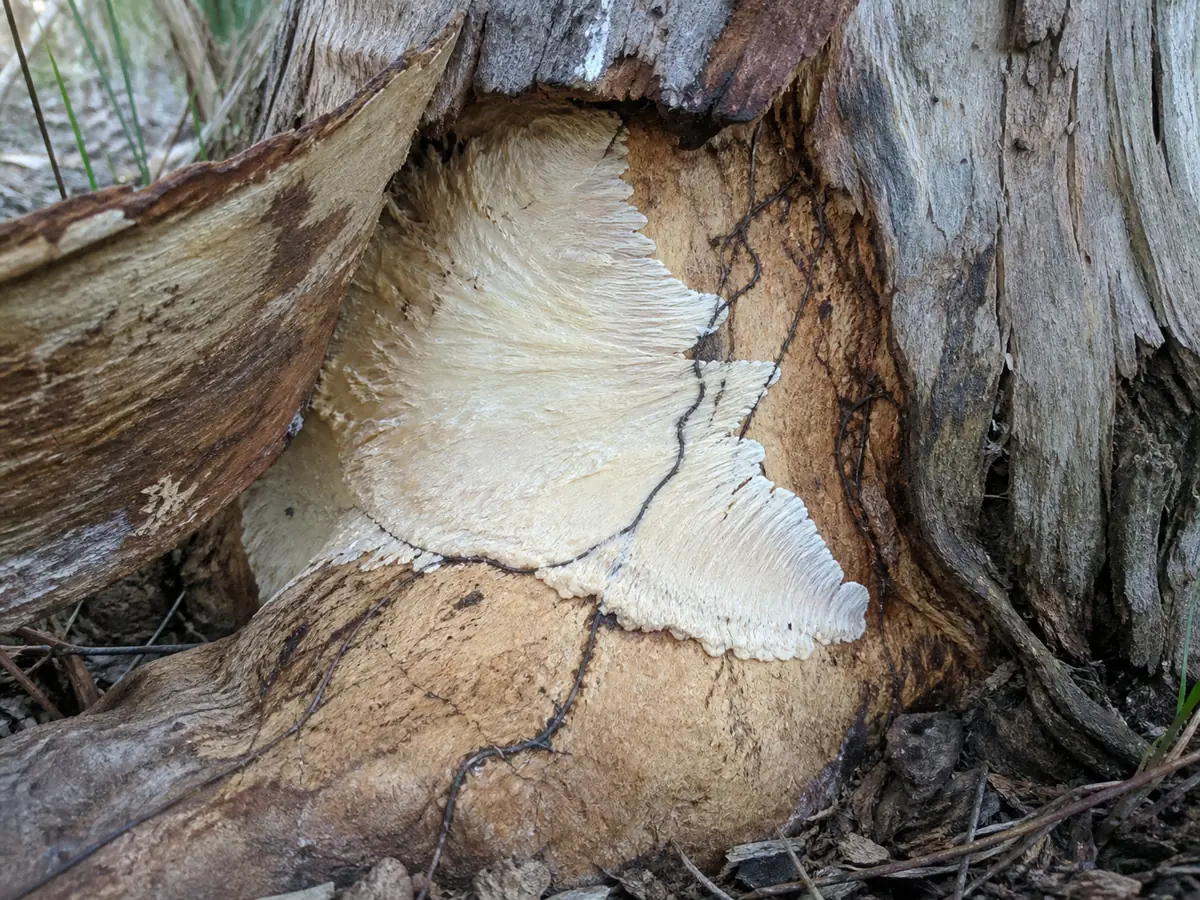
White mycelial fans spread beneath bark at the root collar, and dark cord-like rhizomorphs can move through woody material. Infection can persist in dead roots and stumps for decades.
Key takeaway
A cluster can support the diagnosis of root disease without being safe to eat. Food identification must also resolve every specimen, spore color, ring, stem texture, and lookalike.
Edibility evidence remains conservative. One evidence-based global review lists the species as edible with conditions, while clinical experience with Armillaria shows that correctly identified and cooked mushrooms can still cause acute gastrointestinal symptoms.
Genomic research uses this fungus to study plant infection, wood degradation, and Armillaria evolution rather than consumer medicine. Findings from another Armillaria species cannot be transferred automatically because metabolites, host range, and ecology differ.
Roy Watling and Glen Kile described A. luteobubalina in 1978 after older Australian records had been assigned to the European A. mellea.
Modern treatments restrict the name to Australia and separate related New Zealand and South American taxa.
The mushroom is only the reproductive stage of a larger root and wood infection. White mycelial fans can spread beneath bark, dark cordlike rhizomorphs can follow roots, and infected woody tissue can remain after a visible cluster collapses.
In native ecosystems the fungus participates in turnover, including the death of stressed plants. In disturbed forests, plantations, gardens, and parks, the same native organism can act aggressively against susceptible native and exotic hosts.
Australian restriction matters for identification.
Calling every honey-colored cluster A. mellea imports a northern-hemisphere name and can hide the biology of local Armillaria lineages.
Food and tree health are separate questions. A cluster can support a root-disease investigation while still lacking the complete evidence needed to identify and eat an Armillaria species.
How do you identify Armillaria luteobubalina?
Firm honey-yellow to brown, 4 to 10 cm wide, convex then flat, with dark brown scales concentrated over the center.
Crowded, broadly attached, white to cream when young, aging pink-brown with rusty spots.
Central, 4 to 10 cm long, thickening downward, with a persistent ring and soft scales below it, darkening toward the base.
White stringy flesh with a lingering bitter taste; tasting is not recommended for identification.
Start with the whole cluster and the tree base.
Fruiting bodies often emerge tightly packed from infected roots, stumps, or the root collar during early autumn. Follow stems to wood rather than assuming they grow from soil.
Caps commonly span 4 to 10 cm.
They begin convex and flatten with age, carrying fine brown-black scales most densely over the central disc and more sparsely toward the margin.
| Field character | A. luteobubalina pattern | Reject or investigate further |
|---|---|---|
| Cap scales | Small dark scales concentrated centrally | Smooth orange cap or very different scale structure |
| Ring | Persistent and close beneath the gills | No ring on every intact young specimen |
| Lower stem | Floccose, darker toward the base | Bright uniform stem without texture |
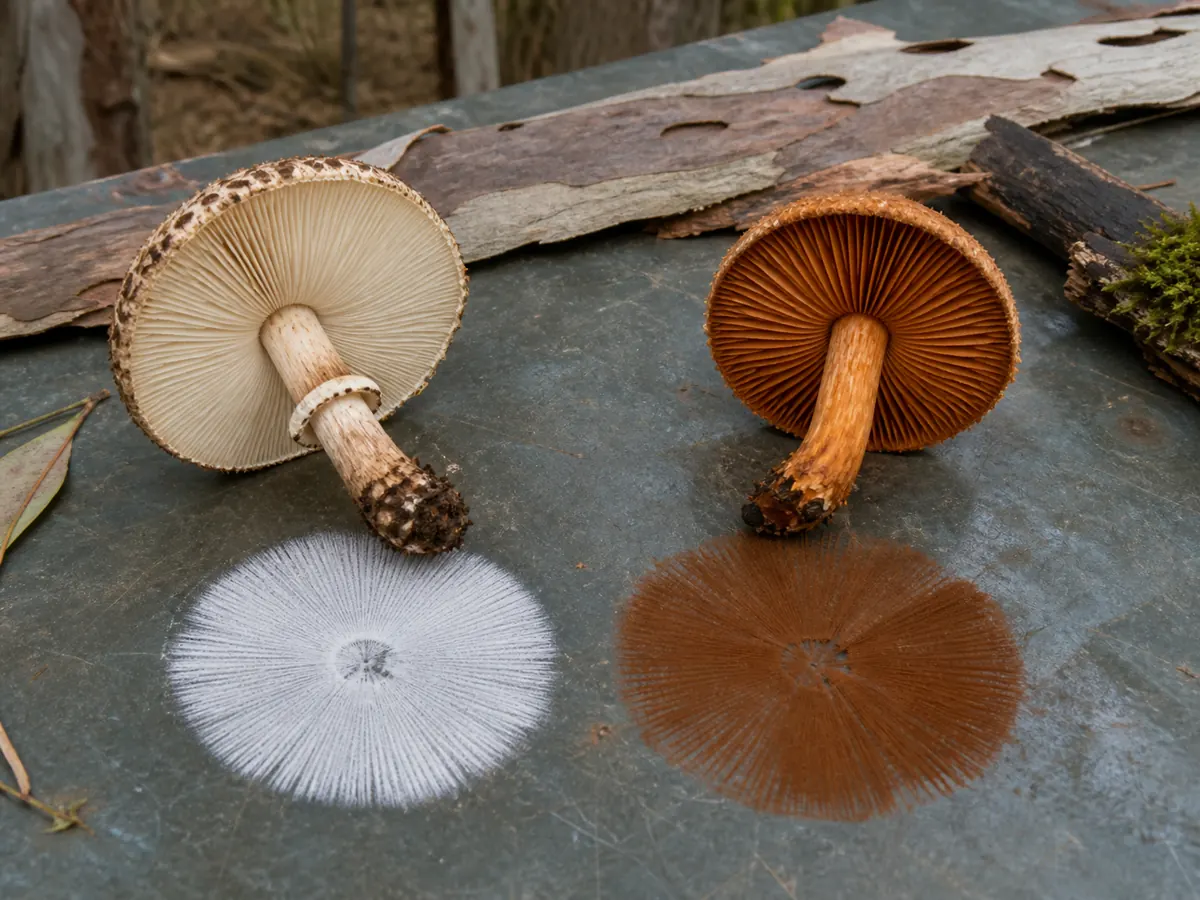
| Spore print | Cream to white | Rusty orange, rusty brown, or dark print |
| Root signs | White fans beneath bark and root disease | No woody connection found |
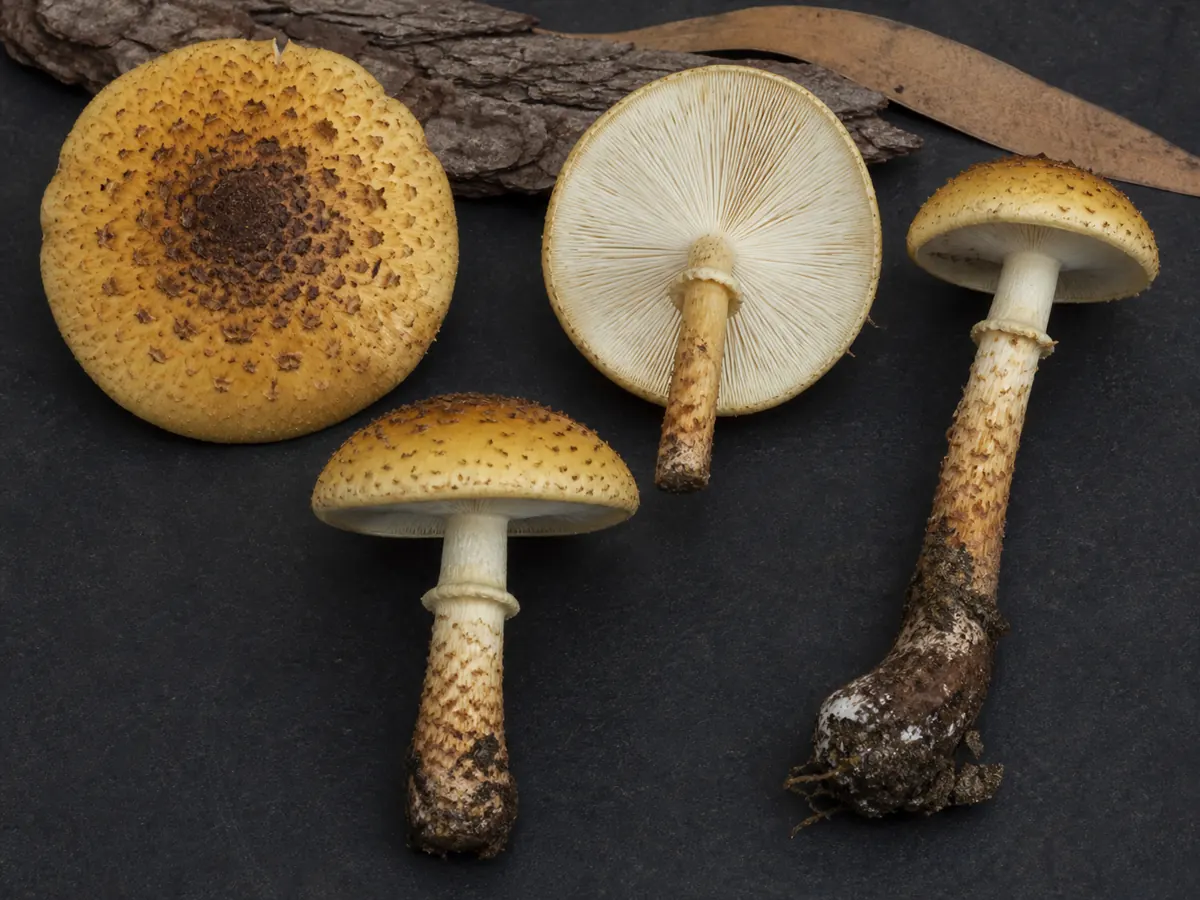
Take a spore print from more than one cap if ingestion is being considered. A white print supports Armillaria and rejects rusty-spored Gymnopilus, but it cannot separate every pale-spored mushroom.
At the tree, lift loose bark only when land rules and tree care allow. Cream-white mycelial sheets with a fan-shaped margin support Armillaria root disease, although laboratory culture or DNA may be needed to confirm the species.
Examine the cluster before separating its bases. Fruiting bodies often rise together from roots, stumps, or buried woody tissue, and the joined origin helps connect the mushrooms with the host rather than proving any one Armillaria name.
Cap scales can be densest near the center and become less obvious after rain.
Pale gills, a ring, a fibrous stem, and a white print support the genus-level pattern, while rusty or purple-brown spores point toward dangerous alternatives.
Now inspect the plant. Remove only a small loose piece of bark where appropriate and look for a firm white fan against affected wood, dark rhizomorphs, resin or gum, and a transition between sound and decayed tissue.
Aboveground yellowing, sparse leaves, reduced shoot growth, and dieback are not specific. Drought, Phytophthora, construction injury, and other root disorders can create the same canopy pattern, so host symptoms require root-collar evidence or laboratory confirmation.
A plant pathologist may culture the fungus from the margin of affected tissue or use molecular methods. That step is more defensible than naming an old cluster after cap color has faded and the ring has broken down.
How should you respond to symptoms after eating it?
Root decay can reduce tree stability, so an infected tree near a home, path, parked vehicle, or play area needs assessment by a qualified arborist. Infected bark, rhizomorphs, and mixed clusters may also carry soil organisms, pesticides, heavy metals, or another mushroom.
Which clustered mushrooms resemble Australian honey fungus?
Australian honey fungus can resemble other clustered brown mushrooms at tree bases. Confirm the cream-white spore print, persistent ring, dark cap scales, white mycelial fans under bark, Australian range, and direct connection to roots or buried wood.
A cluster name is not a species identification. Gymnopilus, Galerina, and other wood-growing mushrooms can share the same tree and season while carrying different risks.
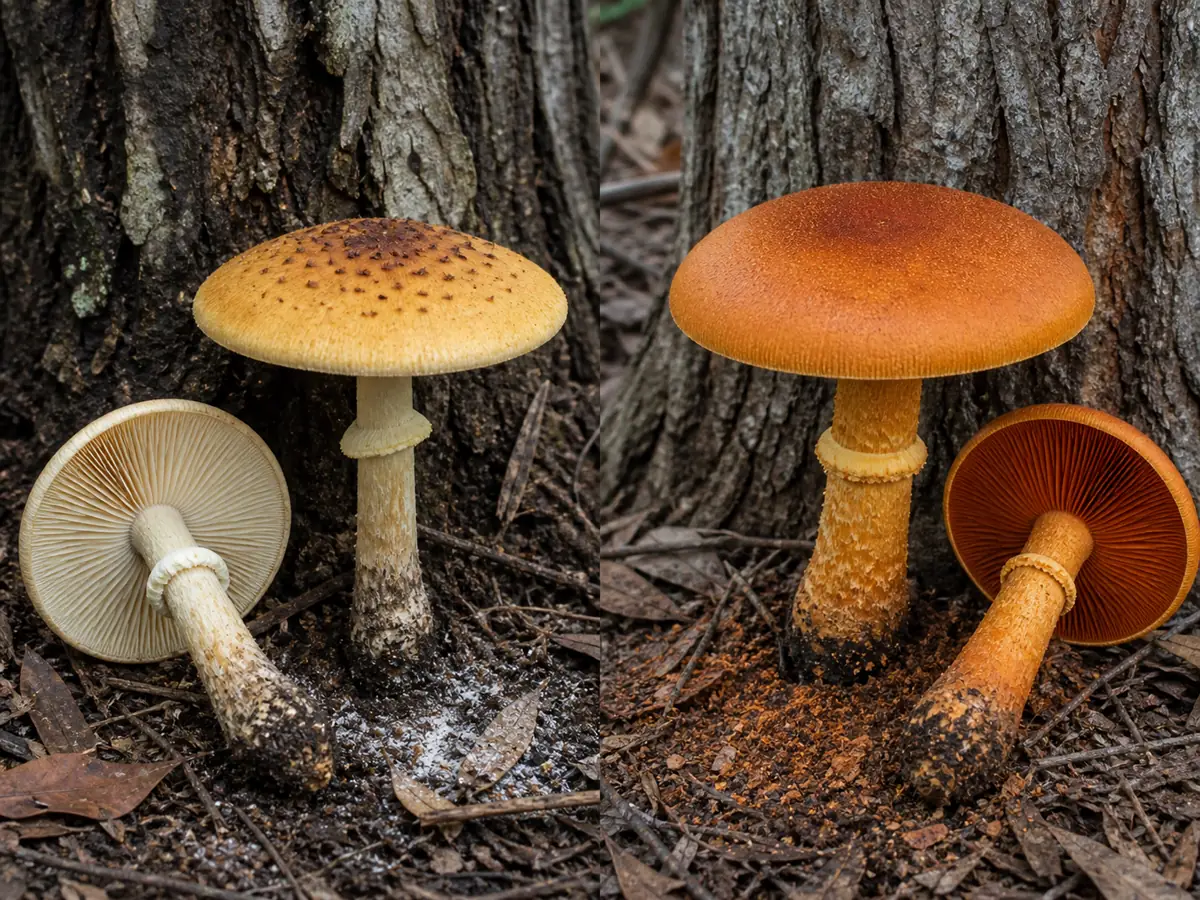
Do not eat a honey-brown tree-base cluster until rusty-spored Gymnopilus and deadly Galerina have been excluded. Spore color is an important split, but a mixed collection can contain more than one species.
Gymnopilus junonius often has orange-brown tones and a rusty-orange to brown print. Galerina marginata is smaller and rusty-spored, yet its amatoxin risk makes any uncertain little brown companion an emergency concern.
Northern Hemisphere honey fungus names should not be assigned to an Australian collection by appearance alone. A. luteobubalina is a distinct southern lineage and an Australian native pathogen.
Deadly Galerina can fruit from wood with brown caps and a ring zone, but it produces rusty spores rather than a white deposit. A mixed stump can support both fungi, so a print from one cap cannot certify every cluster at the base.
Hypholoma species also grow in dense woody clusters. Darkening gills, a purple-brown print, cap color, and bitter taste descriptions can help a mycologist, but tasting an uncertain cluster is unnecessary and unsafe.
Pholiota can combine scales, rings, and wood growth with brown spores. Other Australian Armillaria share white spores and honey-fungus form, which is why geography, vegetative structures, and laboratory work matter for a species record.
Keep the tree diagnosis and meal decision separate. Evidence strong enough to say a root disease may be present is not automatically strong enough to serve the mushrooms.
Where does Australian honey fungus grow and spread?
Australian honey fungus occurs through south-western and south-eastern Australia in wet and dry sclerophyll forest, eucalypt woodland, coastal systems, plantations, parks, orchards, and gardens.
It can act as both a primary and secondary pathogen. More than 200 native plant species are recorded as hosts, and stressed trees are particularly vulnerable after drought, fire, competition, waterlogging, or disturbance.
Infection advances through roots toward the collar.
Once lesions girdle conductive tissue, the crown may thin, branches die back, and the tree can fail. Nearby plants become exposed through root-to-root contact.
After a host dies, the fungus continues as a decomposer in roots and stump wood. That food base allows the colony to persist for decades and infect new roots that contact it.
Autumn fruiting is visible but temporary. A tree can carry active root disease without mushrooms, so diagnosis also uses basal lesions, mycelial fans, crown symptoms, and sometimes laboratory isolation.
Introducing infected wood or culture can establish a long-lived disease source near gardens, orchards, nurseries, or native vegetation.
Diagnosis may combine crown decline, collar lesions, white mycelial fans, dark rhizomorphs, root examination, culture, or DNA because fruiting bodies alone do not show the full infection.
Once roots are colonized, there is no simple chemical cure. Removing diseased stumps and large infected roots reduces woody food bases, while barriers or trenching may slow root-contact spread in some managed landscapes.
Infection centers can enlarge as the fungus moves through connected roots or reaches new roots from colonized woody material. That produces a patch of declining and dead plants rather than one isolated crown when site conditions and host susceptibility allow continued spread.
Old stumps and large roots can hold viable inoculum after a tree is removed. Their importance varies with size, decay, soil, moisture, and contact with new roots, so a site inspection should map affected plants and woody remnants before recommending excavation.
A. luteobubalina has been recorded from roots of many Australian plant families, with strong impacts documented in eucalypt forests.
A host list shows breadth, not equal risk, because plant species, age, stress, and disturbance change the outcome.
Fruiting is seasonal and unreliable as a survey method. A diseased root system may show no mushrooms during an inspection, while a healthy-looking canopy can stand over an early infection.
How should Armillaria root disease be managed?
Cultivating A. luteobubalina is not recommended because it is a broad-host root pathogen. Introducing infected wood or culture near gardens, orchards, nurseries, or native vegetation can create a long-lived disease source.
Management starts with confirmation. An arborist or plant pathologist can examine crown decline, collar lesions, white mycelial fans, rhizomorphs, roots, and culture results before major removal work.
No simple chemical cure is available once the fungus occupies roots.
In managed sites, removing infected stumps and as much diseased root as practical reduces woody food bases. Root barriers or trenching may slow contact spread in specific landscapes.
Tree work must also address safety. Root decay can reduce stability, so a qualified arborist should assess infected trees near homes, paths, vehicles, and play areas.
Management starts by confirming the causal organism and assessing targets. A declining tree beside a home, road, or path needs an arborist to evaluate structural risk, while a spreading disease center may need a plant pathologist to sample roots and map infection.
Picking mushrooms does not reduce the established root infection. Removing infected stumps and major roots can reduce woody inoculum in some landscapes, but complete excavation may damage neighboring roots and still miss colonized material.
Replanting decisions should consider the size of the infected zone, retained roots, drainage, irrigation, and susceptibility of candidate plants.
Moving the new trunk a short distance without addressing colonized wood can place fresh roots into the same risk area.
Tools that cut infected tissue should be cleaned before moving to other plants, and excavated wood should be handled according to local plant-health guidance. Soil fumigation or fungicide promises deserve skepticism because established woody inoculum and root contact are difficult to reach uniformly.
Monitoring records should include canopy condition, new fruiting, root-collar changes, and neighboring hosts. A stable photograph taken from the same point each season reveals change better than a memory of whether the tree looked thin last year.
Can you eat Australian honey fungus safely?
Armillaria luteobubalina is reported as edible with conditions, but it is not a low-risk beginner mushroom. Similar clusters include toxic species, and Armillaria itself can cause gastrointestinal illness.
A 25-year poison-center series found symptoms in 83 percent of reported Armillaria exposures, most often vomiting, diarrhea, abdominal pain, and nausea.
Illness occurred despite reported cooking, although some cases involved misidentification.
If a qualified local identifier confirms the species and local guidance supports eating it, use young fresh caps, cook thoroughly, and start with a small portion. Do not serve a new wild mushroom to a group, because individual tolerance varies and a shared meal multiplies the exposure.
Eat raw or undercooked Armillaria
use old, waterlogged, or bitter mature specimens
mix caps from separate clusters before identification
assume cooking corrects a wrong species
retain an uncooked voucher from the exact batch
record collection location and meal time
stop eating and seek poison advice if symptoms begin
A long boil-and-discard method appears in some traditions, but no preparation guarantees tolerance. If vomiting or diarrhea follows a wild mushroom meal, contact a poison service and report all species that may have entered the pan.
Reject fruiting bodies beside treated timber, roads, mine waste, or contaminated soil even after the species is confirmed.
Nutrient measurements from another Armillaria cannot describe this meal because species, tissue age, substrate, moisture, and preparation all change the result.
Some references classify this species as edible with conditions, while poison-center experience with Armillaria includes gastrointestinal reactions and confusion with toxic lookalikes. That combination supports caution rather than a universal recipe.
Thorough cooking is commonly advised for correctly identified Armillaria because raw or undercooked material can cause illness. Heat does not correct a wrong species name, remove spoilage, or guarantee that an individual will tolerate the meal.
Old caps and fibrous stems become tough and may already carry insect or bacterial damage. A tree-disease investigation often involves weathered clusters that are poor food candidates before edibility is even considered.
Anyone choosing to eat a locally verified species should keep the first portion small and avoid serving it to people with a history of mushroom reactions.
The safer choice is abstention when the regional species, condition, or lookalike check is incomplete.
Why is it not Armillaria mellea?
Armillaria luteobubalina was described by Roy Watling and Glen Kile in 1978. It belongs to Physalacriaceae and sits within a southern Armillaria lineage that includes several related species with different geographic ranges.
Older Australian records often used the European name Armillaria mellea. Australian botanical guidance now treats that historical application as a naming error and recognizes A. luteobubalina as a distinct native species.
A global species-boundary review reports A. luteobubalina as restricted to Australia, while similarly named or closely related Armillaria occur in New Zealand and South America. This profile follows that narrower modern boundary.
Australian honey fungus questions
Is Armillaria luteobubalina edible?
Does cooking prevent poisoning?
What color is its spore print?
Where is it found?
Can it kill healthy trees?
How does it spread?
Sources & References
- Western Australia DBCA, Armillaria root disease Native range, host breadth, primary and secondary pathogenicity, and management context.
- DBCA urban Armillaria recognition guide Detailed cap, gill, stem, spore-print, and lookalike morphology.
- Plant Pathology, global Armillaria species boundaries Southern lineage, species relationships, and Australian geographic restriction.
- Clinical Toxicology, Armillaria poison-center series Symptom frequency, timing, cooking history, and toxic-lookalike concern.
- Comprehensive edible mushroom classification Evidence-based edible-with-conditions classification for A. luteobubalina.