
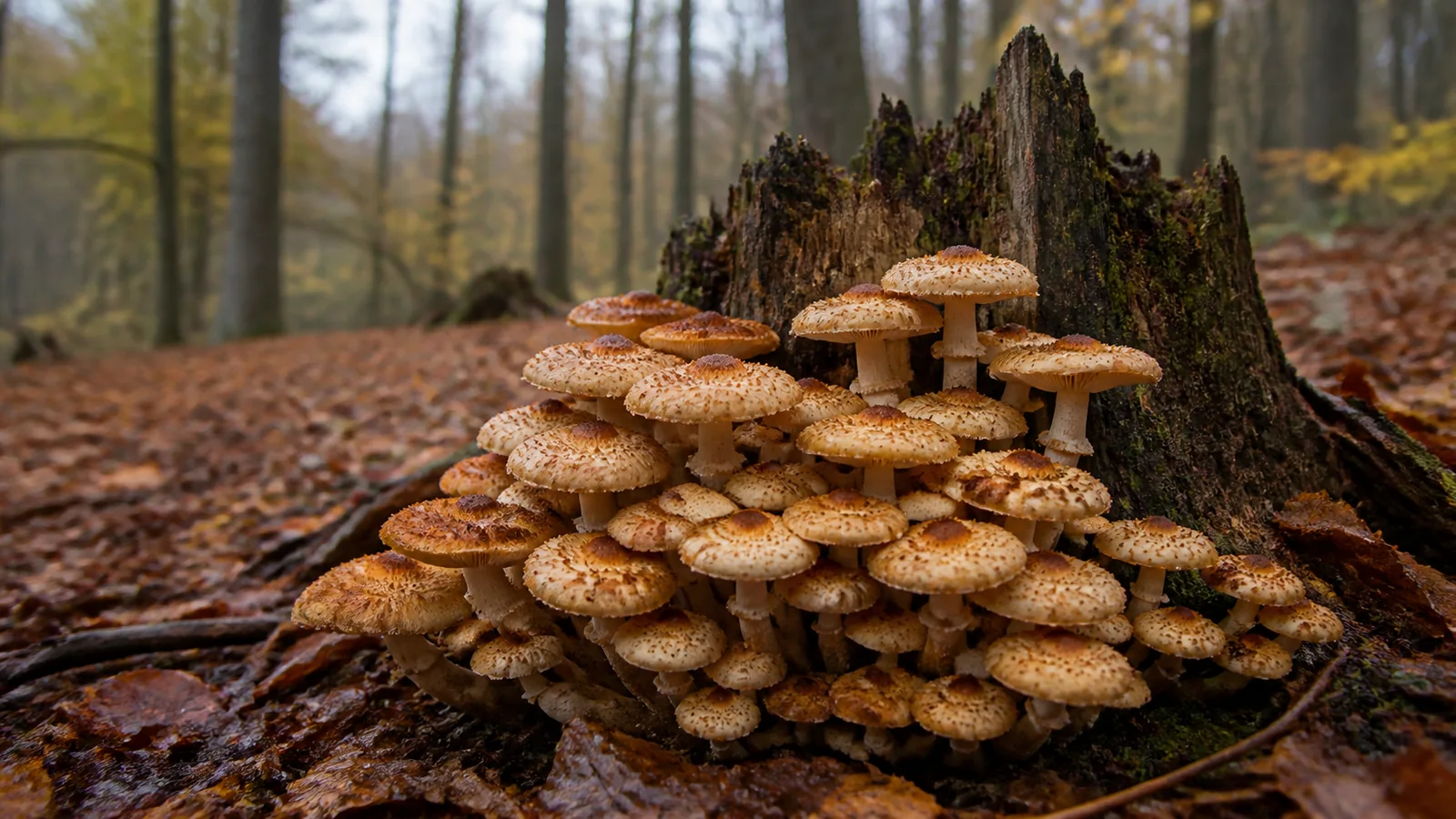
Honey fungus does not arrive one at a time. It comes in tufts of forty crowded around a stump, which is why the question of what to do with it becomes urgent rather than academic.
Two things about a stump like that have to be settled before any of it reaches a plate, and only one of them is about cooking.
It also arrives on a schedule, which helps. The season runs from July into November, with most of the fruiting in autumn, so a stump worth watching is worth watching at a predictable time of year rather than continuously.
Can you eat honey fungus raw?
No, and this is one of the few pages here where raw is genuinely toxic rather than merely unwise.
| Raw or undercooked | Boiled then cooked | |
|---|---|---|
| What is present | Heat-labile hemolysins and gut irritants | Broken down |
| What happens | Nausea, vomiting, cramps and diarrhea | Widely eaten |
| Onset | Thirty minutes to three hours | |
| Still contested | Some people react anyway |
The first three rows here are settled and the fourth is not, which is unusual and worth being straight about.
Most of this series ends once the mushroom has been cooked properly. Here the cooking answers the raw question completely and leaves a second question standing, which is whether this species suits the person eating it at all.
It helps to know why this mushroom is so easy to find.
Honey fungus is a parasite on living broadleaf trees as well as a decomposer on stumps and dead roots, which is why it turns up in gardens, orchards and parks rather than only in woodland. Gardeners generally meet it as the thing killing an apple tree long before they meet it as food.
That double life explains the quantity.
A single infected stump can carry a colony that fruits year after year in the same spot, so this is not a mushroom anybody finds once. It is one people find repeatedly and have to make a standing decision about.
What raw honey fungus does
The compounds have names, which is more than most pages in this series can say.
Warning
Raw and undercooked honey fungus carries heat-labile hemolysins, which break down red blood cells, alongside compounds that irritate the gut directly. Reported symptoms are nausea, vomiting, stomach cramps and diarrhea, arriving between thirty minutes and three hours after the meal. All of it is destroyed by prolonged cooking, so this is a preparation failure rather than a property you have to live with.
Heat-labile is the word carrying the weight there, and it is what makes these compounds tractable.
It means the compounds are destroyed rather than reduced, so a properly boiled honey fungus is not a safer version of a raw one but a different thing entirely. That is the same mechanism as several other pages here and the dose behind it is larger.
A hemolysin is worth a plain description rather than a dramatic one.
It is a protein that ruptures red blood cells, which sounds far more dramatic than the reported outcome is, because eating one and injecting one are very different routes. What people actually report from undercooked honey fungus is a violent stomach rather than anything systemic.
This is the same shape as several other pages in this series and the dose is what differs.
Plenty of mushrooms carry something heat sensitive in small quantities. Honey fungus carries enough of it that undercooking is a reliable way to have a bad night rather than a theoretical concern.
The onset window is short enough to be useful.
Thirty minutes to three hours means anybody who gets this wrong will know exactly which meal did it, which is a small mercy and also the reason the reports are so consistent. Nobody has to guess at the cause.
There is a sensible response if a meal goes wrong.
The reported reaction passes on its own and the main risk in it is dehydration, so fluids and rest are the ordinary answer. What changes that is symptoms lasting beyond a day, or anything arriving much later than three hours, because neither is the pattern undercooked honey fungus produces and both are reasons to get advice.
SafetyCan You Eat Beech Mushrooms Raw? Not Poisonous, Just BitterThe reference that says leave it alone
Here the sources stop agreeing, and the disagreement is not a detail.
- One field reference
- Recommends that this species is not collected for the pot
- Its reason
- Cases of poisoning have been linked to eating these fungi
- Other sources
- Publish recipes for it without qualification
- What sits behind the split
- Individual tolerance varies in a way cooking does not fix
- What that means
- Correct preparation is necessary and is not a guarantee
One of those lines is a direct quotation, and it reads strangely in a book whose job is identification.
We therefore recommend that this species is not collected for the pot.
A field reference, on a mushroom other sources publish recipes for
That is an uncomfortable thing to find in a reference and it deserves to be reported rather than averaged away.
The position is not that honey fungus is poisonous. It is that a proportion of people react to it however carefully it has been prepared, and that a cautious reference would rather point them elsewhere than explain the odds.
It is worth knowing how a sentence like that gets into a reference.
A reference aimed at identification carries a duty to the least experienced person who will read it, and the calculation there is different from the one a recipe writer makes for an audience that already forages. Neither is wrong about the mushroom.
Reasonable sources land in different places on that.
A page giving recipes is not being careless, and a page saying do not collect it is not being alarmist, because they are weighing the same fact with different tolerances for risk. What neither of them usually does is tell you the disagreement exists.
The deadly one on the same wood
There is a species that also grows on dead wood and it is in a different category from an upset stomach.
One of those rows needs a caveat about the other species, because leaving it out would be the dangerous kind of tidy.
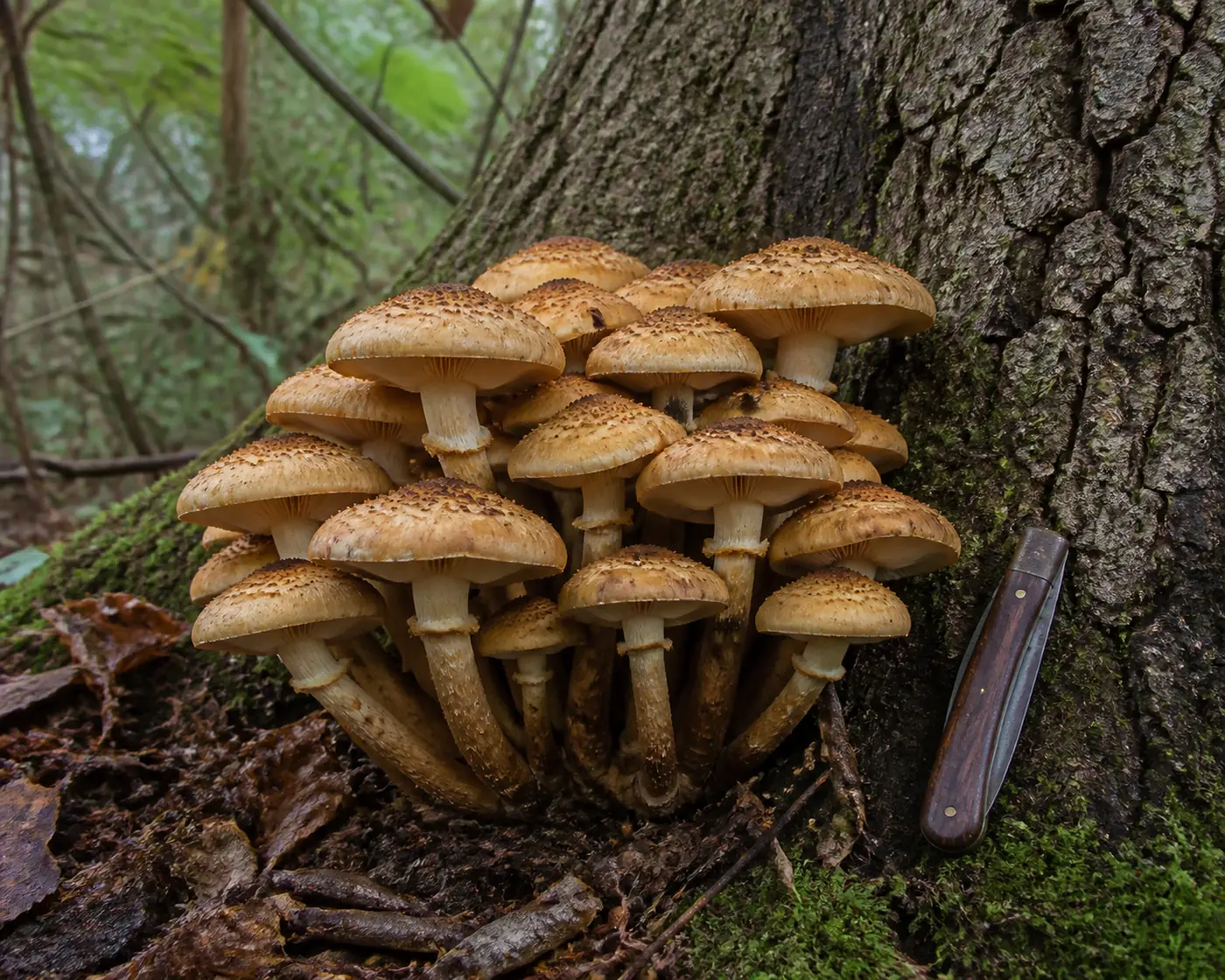
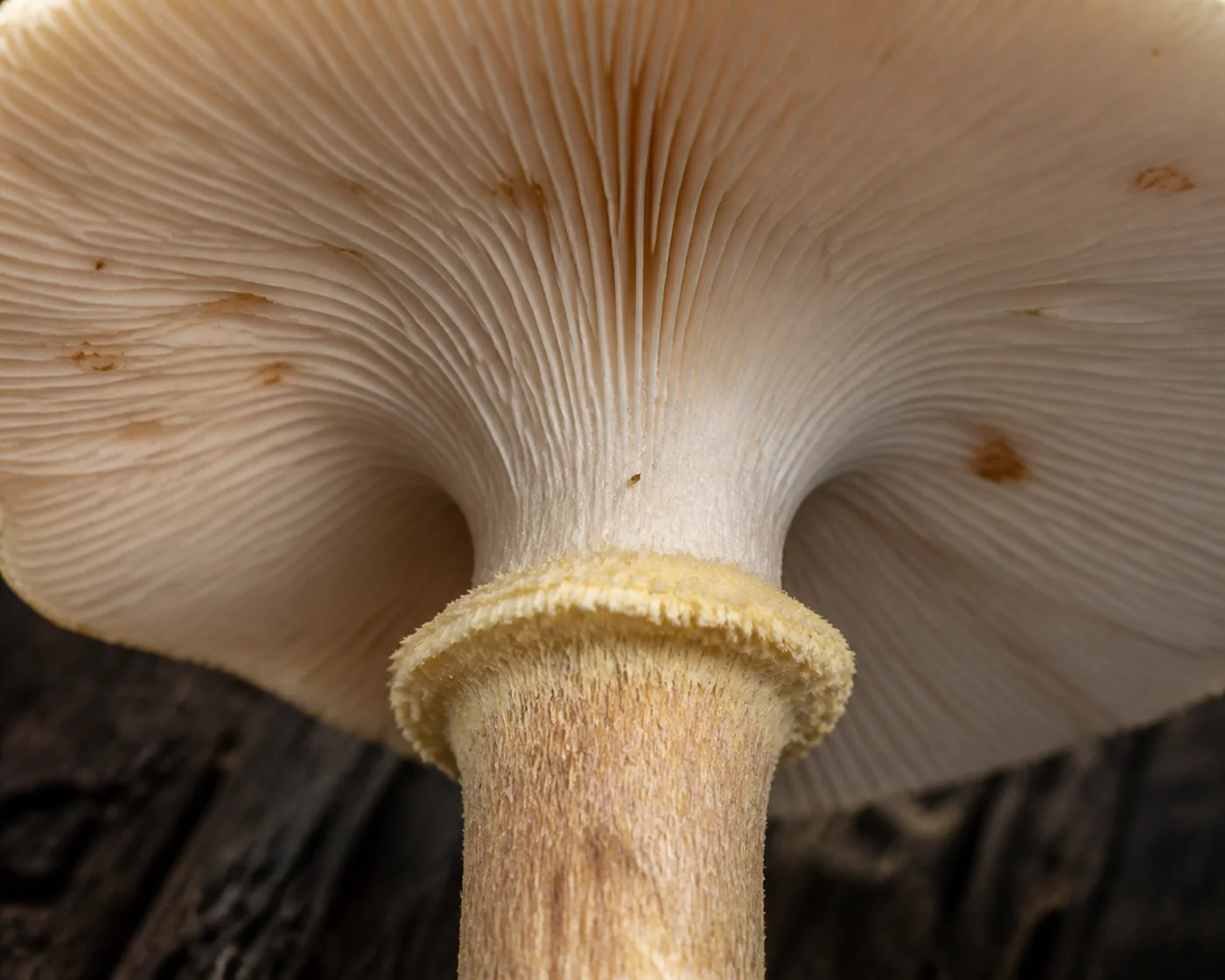
The lookalike carries a ring too. A ring on the stem tells you the mushroom is not one of the ringless species and it does not separate these two from each other, so it belongs on the list as a description rather than as a test.
The three that do separate them are the habit, the gills and the print.
The growth habit does most of the work before anything else is checked.
A dense crowded tuft of forty fruit bodies sharing one base at the foot of a tree is not what the dangerous species does, and a scatter of individual small brown mushrooms along a fallen log is not what honey fungus does. That is a difference visible from standing height.
The habit check has one awkward edge.
A tuft that has spread along a buried root can put up fruit bodies that look scattered from above, so a mushroom at the edge of a colony is not always obviously part of it. Following it down to the base settles that, and a mushroom you cannot trace to a tuft is a mushroom to print.
The spore print settles anything the habit leaves open.
Creamy white against brown is not a close call, and on a species that produces in this quantity there is no shortage of caps to spare for a print. It costs one mushroom and a few hours.
The boil the recipes skip
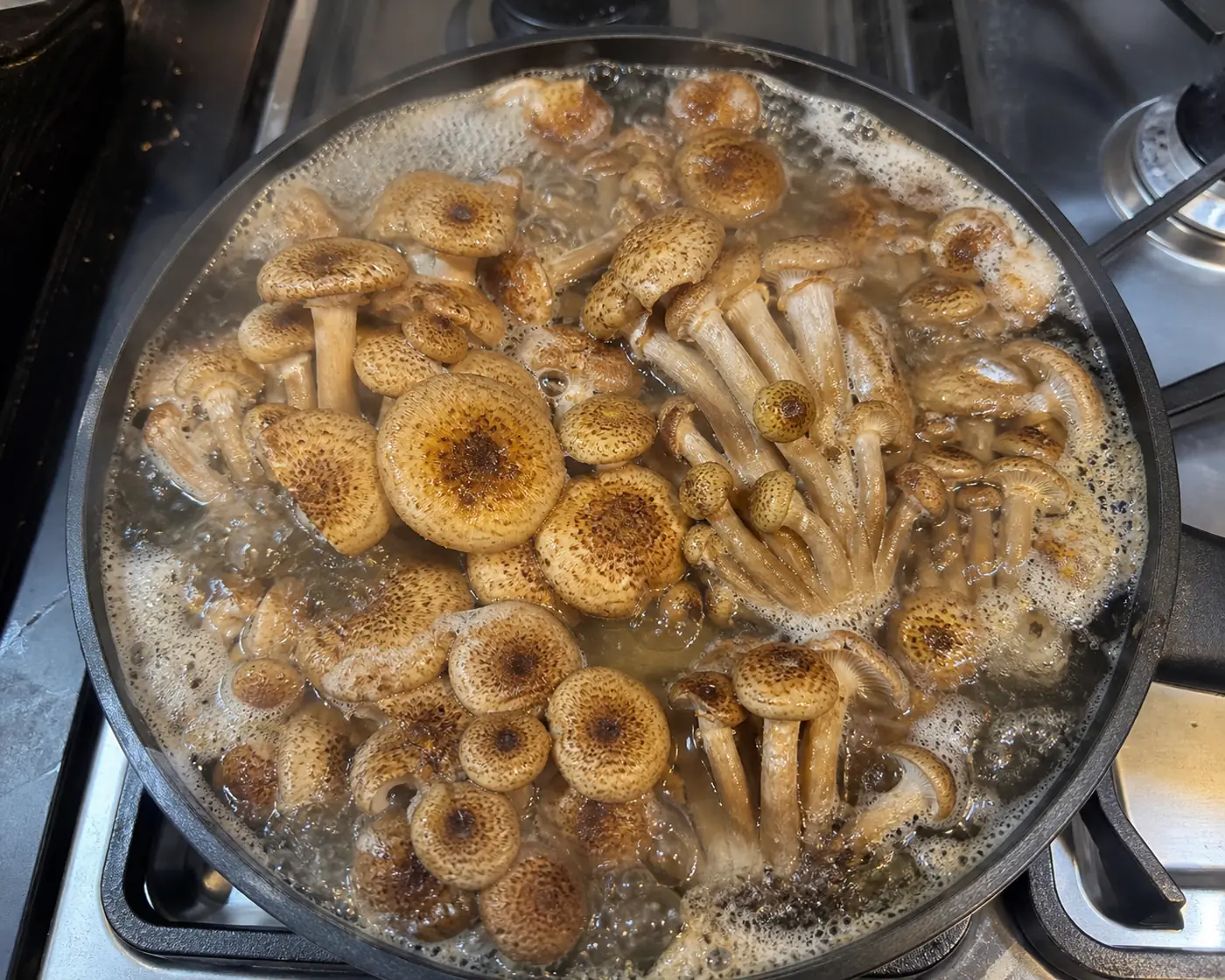
One cited recipe collection gives four dishes without explaining a boiling step.
The spread in the timings each source gives is worth explaining rather than splitting the difference.
Ten minutes is the shortest figure any source gives and twenty five is the longest, and none of them explains the range. Taking the longer end costs nothing except time you were going to spend at the stove anyway, and it buys certainty rather than a guess.
Boiling rather than frying is a deliberate choice.
Water pulls the compounds out of the flesh and carries them away, where a frying pan simply heats them in place and leaves whatever survives in the mushroom. Frying is what happens after the boil rather than instead of it.
Use more water than looks necessary.
A crowded pan of mushrooms in a little water will not hold a hard boil, and the whole point is a rolling one for the full time. Plenty of water and a pan with room in it is the difference between boiling them and stewing them.
Discarding the water is the part people resist.
It looks like stock, it smells like stock, and it is carrying the compounds you just spent twenty minutes removing from the mushrooms. Everything the boil achieved goes back into the dish if that liquid does.
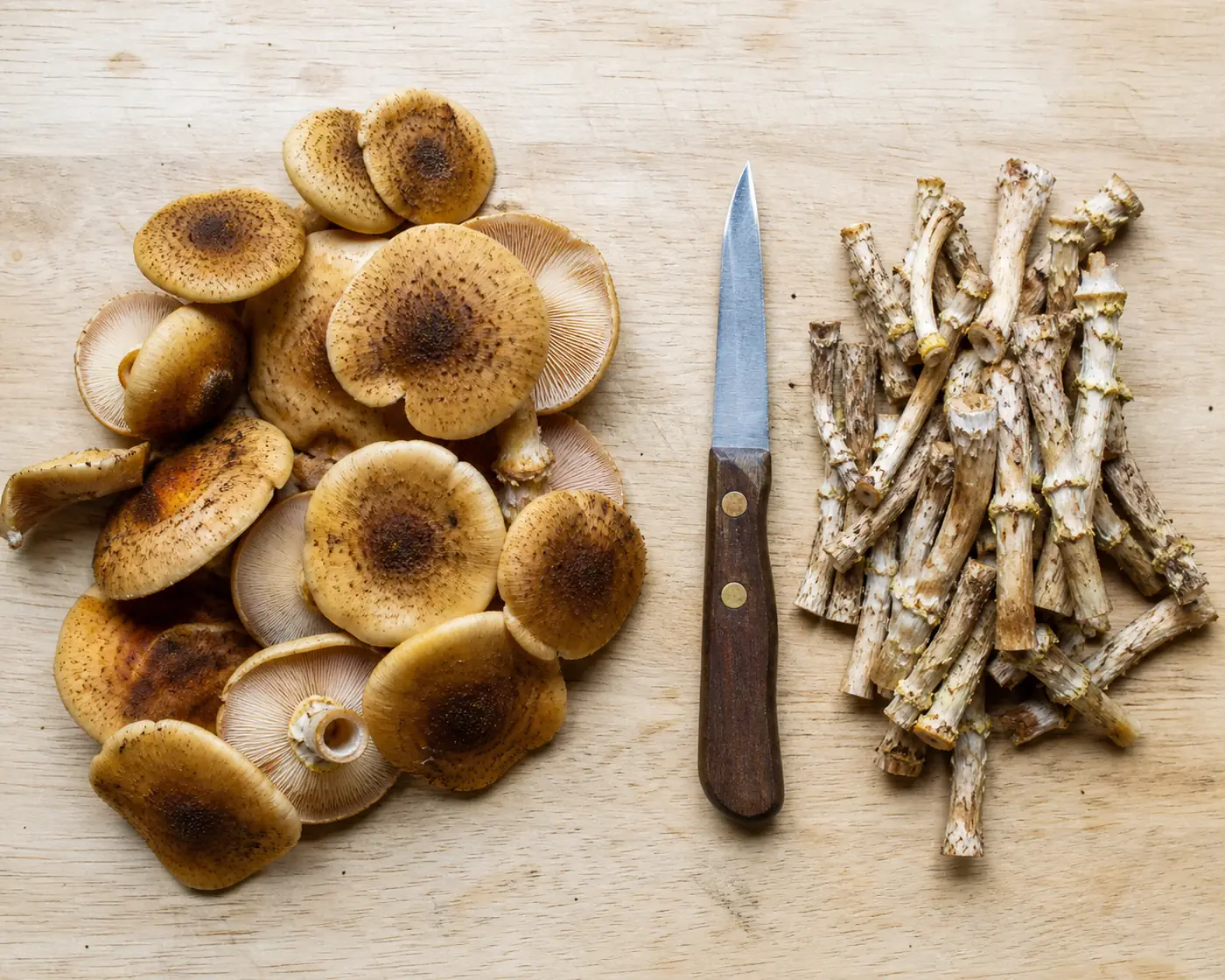
The stems are a smaller point about the same mushrooms, with a practical payoff.
They stay tough however long they are cooked, so trimming them turns a bucket of mushrooms into something like a third of a bucket of usable ones. That is worth knowing before you carry the whole tuft home.
Seasoning the boiling water is wasted effort.
That water exists to carry compounds away and it is going down the sink, so anything the dish needs belongs in the pan afterwards with the butter. Salting it early does nothing except season a liquid nobody is going to taste.
Whether it is worth the trouble
Having laid all that out, the honest answer is that it depends on what you want from it.
Mucilaginous is a polite word and it is the accurate one.
Honey fungus goes slightly slippery in a way that works in a soup or a cream sauce and works much less well as the centre of a plate. Anybody expecting the texture of a field mushroom will be disappointed by it.
Set against that, the quantity of mushroom is genuinely remarkable.
A single stump can give more mushrooms in one visit than most species give in a season, and for somebody who wants volume for a stockpot that is a real argument. It is the reason this mushroom has a following despite everything above.
Some people should skip this species without troubling over it.
Anybody who has reacted to it before, anybody cooking for people who cannot report a reaction clearly, and anybody who does not want to spend twenty five minutes boiling before dinner starts, all have perfectly good reasons to walk past a stump. Nothing about honey fungus is compulsory.
A glut from one stump is best dealt with on the day.
Boiled, drained and cooled, the caps freeze well and go straight into a soup later, which turns a stump that produces faster than anybody can eat into something manageable. Raw in a fridge they go soft quickly, and the boil was going to happen anyway.
The small first portion is not a formality for anybody here.
It applies to somebody who has eaten honey fungus before, because the reactions people report are individual rather than dose-dependent and they turn up in people who have eaten it happily for years. Trying a little and waiting a day is the only way anybody finds out which group they are in.
The flavor of honey fungus is better than the texture, which is the redeeming detail.
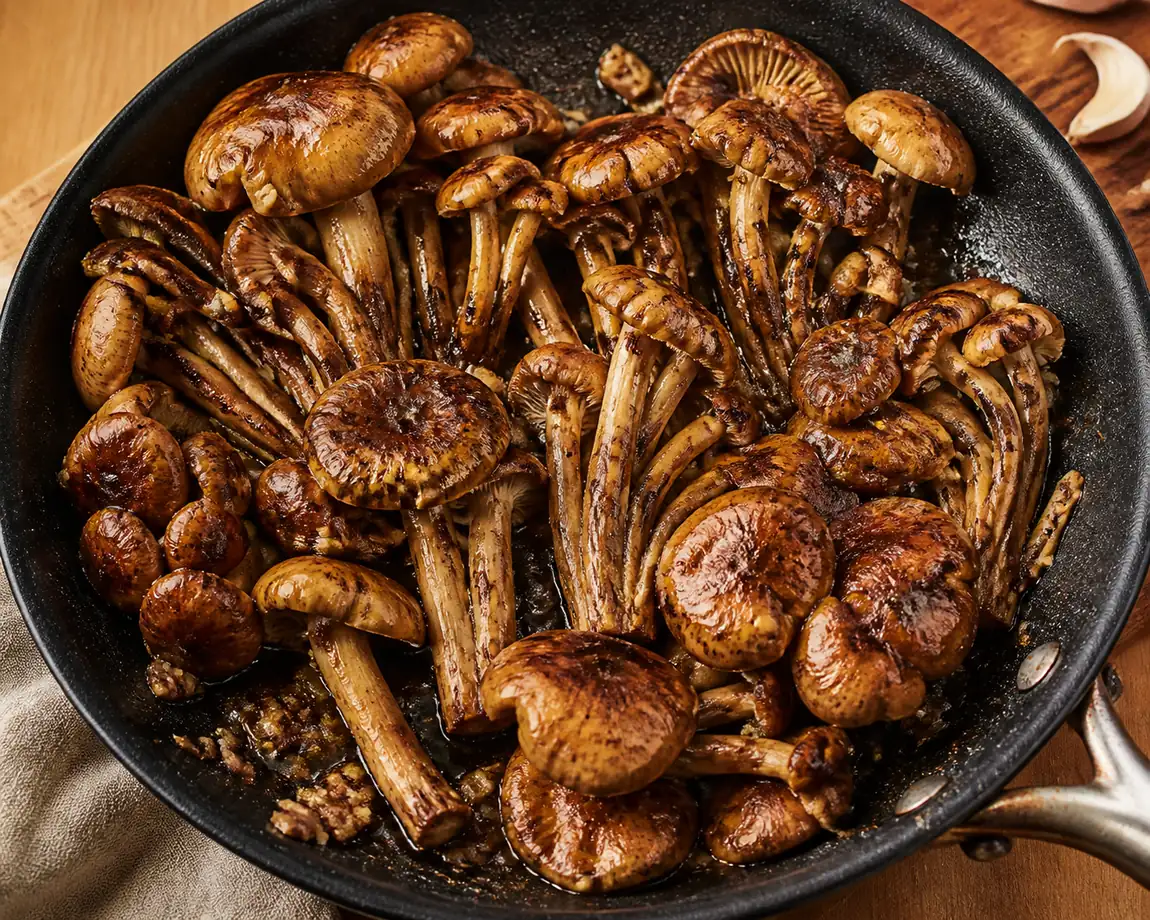
Cooked honey fungus is nutty and quite strongly mushroomy, enough to carry a soup on its own, and people who like it are usually responding to that rather than to the mouthfeel. It rewards being an ingredient rather than the point of a dish.
One more thing is worth saying about what people usually do with the quantity.
A tuft this size tempts people into carrying home far more than they will process, and the trimming and boiling then turn into an evening rather than a task. Taking a quarter of what is there and leaving the rest is usually the better decision.
So the answer to the raw question is a flat no, and the answer to the larger one is yours.
Nothing here says avoid honey fungus. It says boil it properly, throw the water away, try a little the first time, and accept that one careful reference would rather you picked something else.
Sources & References
- Armillaria mellea, Honey Fungus, First Nature The source for the dissenting position, stating that members of the honey fungus group are considered by some to be suspect as cases of poisoning have been linked to eating these fungi, and recommending that this species is not collected for the pot. Also gives the 5 to 15 cm honey-yellow to red-brown cap with a darker center, the crowded flesh-colored gills developing rusty spots, the persistent pale yellowish ring, the very pale creamy white spore print, the July to November season, and the parasitic and saprobic habit on broadleaf trees and stumps.
- Armillaria mellea, The Ultimate Mushroom Guide, Ultimate Mushroom States it is edible when cooked and reported poisonous when raw, and gives four recipes with no boiling step.
- Armillaria mellea, Honey Mushrooms, Eat The Planet States that raw and undercooked honey mushrooms are toxic and that cooking is mandatory. Gives the dense clusters at the base of stumps and trees, the tough fibrous stems usually discarded, the advice to eat only a small amount the first time because some people experience gastrointestinal upset, and the Galerina marginata separation by scattered habit, brown gills, brown spore print, smaller size and thin dark stem.