What is a big laughing gym mushroom?
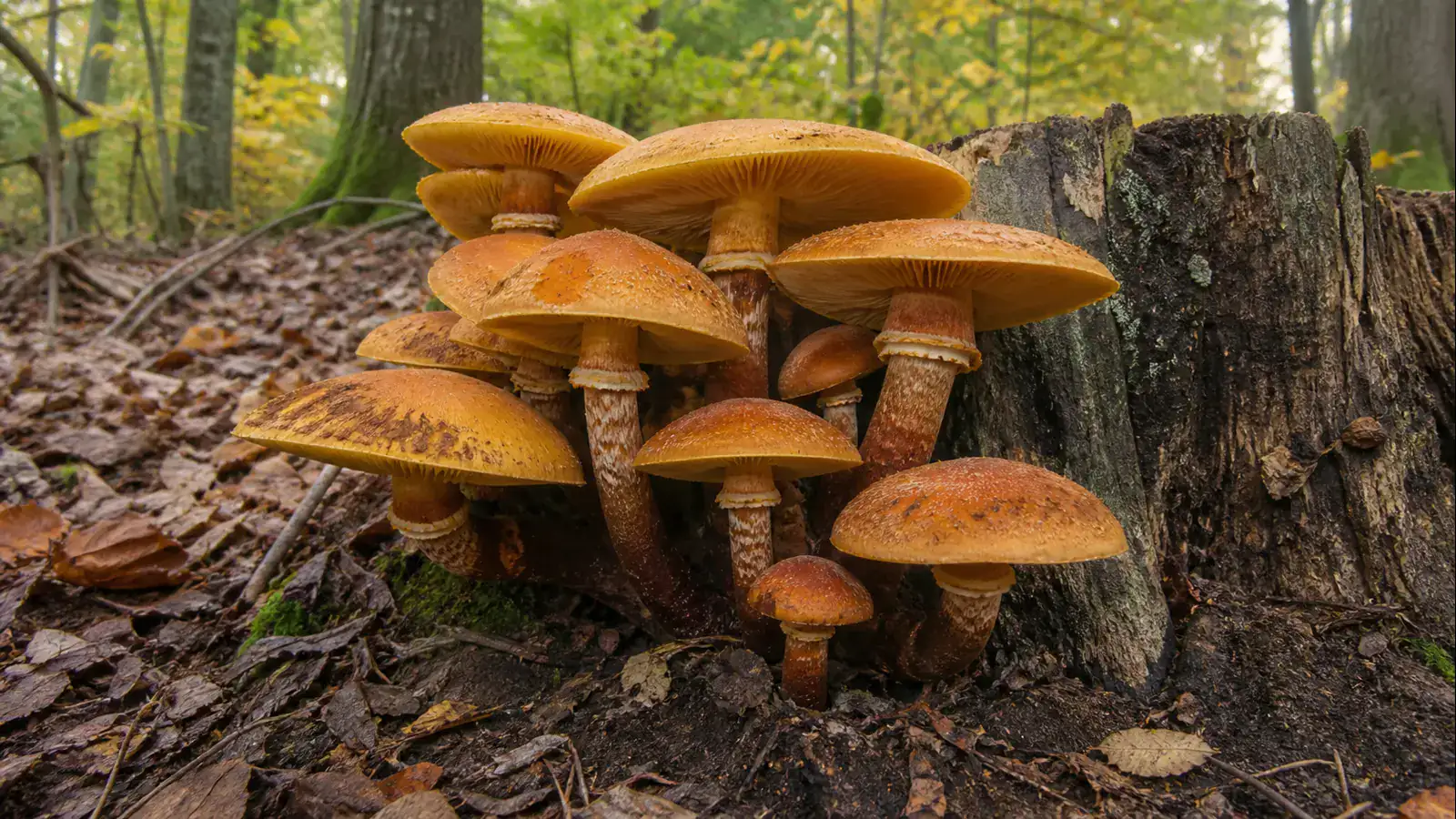
Gymnopilus junonius forms imposing orange to tawny clusters on decaying wood. Young gills begin yellow and become rusty orange as ornamented brown spores mature, while a veil usually leaves a substantial ring around the stout stem.
The fruiting bodies may emerge from a visible stump or appear terrestrial when they are attached to buried roots. That hidden wood connection is one reason a habitat photograph should include the base and surrounding ground.
Key takeaway
Read the mushroom as a wood-growing, rusty-spored, ringed Gymnopilus before trying to assign a species name. The species decision then depends on geography and microscopic or molecular evidence.
The word laughing has encouraged unreliable claims about predictable psychoactive effects. Chemical reports differ across named species, collections, and regions, and a common name cannot establish dose, contents, or identity.
Gymnopilus flesh is often bitter, but tasting an unidentified poisonous candidate is unnecessary. Bitterness also fails as a clean species test because several members of the genus share it.
A mature cluster can be visually dramatic without being taxonomically simple. Caps within one group may range from smooth yellow-orange to dry, spotted, or fibrillose brown-orange as weather removes surface fibers.
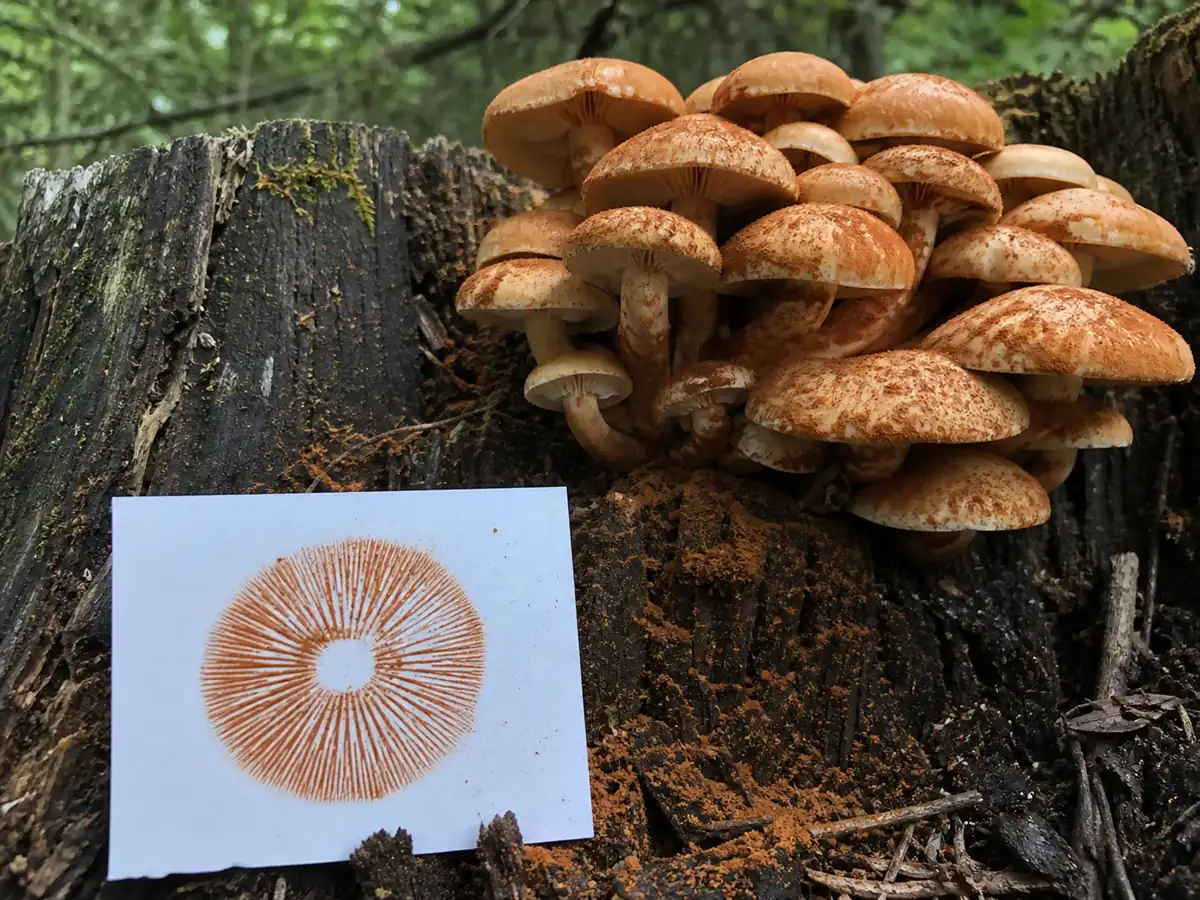
The orange-rust spore deposit often dusts lower caps in an overlapping cluster.
That natural deposit is useful evidence because it connects the spore color to the fruiting group without requiring the observer to scrape or damage every cap.
The practical task therefore has two parts. First recognize the hazardous Gymnopilus pattern, then avoid stretching the European name across every large North American laughing gym.
Spore color can be observed in two ways.
A formal print creates a clean reference, while natural rusty dust on lower caps shows that the deposit came from the same overlapping cluster.
Neither method resolves the species group. A good field record pairs the deposit with cap surface, gill development, ring, substrate, geography, and a dried specimen.
Claims about psychoactivity should be treated as a separate evidence problem. A collection reported to contain psilocybin in one paper does not establish the chemistry of a visually similar species from another continent.
The common name carries no dose information. It cannot predict concentration, effect, onset, duration, or contamination, and it should never be used as a recreational-use instruction.
When a cluster appears at a living tree base, its value may be structural rather than culinary or chemical. Repeated fruiting from buried roots can justify an arborist inspection for decay while the exact Gymnopilus species remains under review.
How can you recognize the Gymnopilus pattern?
Broadly convex to nearly flat, commonly 6 to 20 cm, yellow-orange to tawny orange, dry to finely fibrillose, and sometimes spotted or scaled.
Crowded and attached, yellow at first, then orange-rust as the spores mature.
Stout, often 6 to 20 cm long, yellow to orange-brown, usually with a persistent membranous ring and a thickened base.
Firm yellowish flesh with a mild to radish-like odor and a distinctly bitter taste that should not be tested on an unknown specimen.
Begin with the growth site. Photograph where the stems enter a stump, root, buried timber, or damaged living tree, then collect one young and one mature fruiting body so the veil and spore development are both represented.
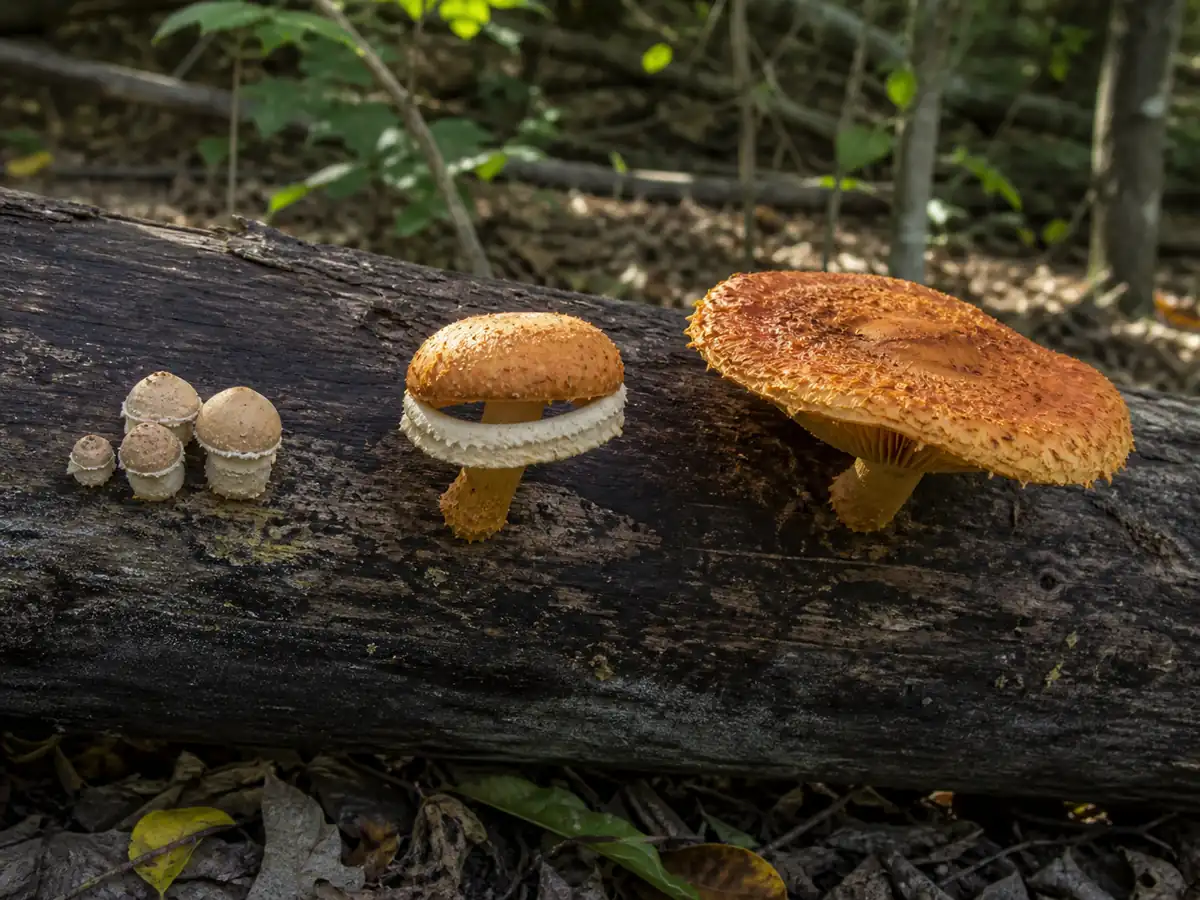
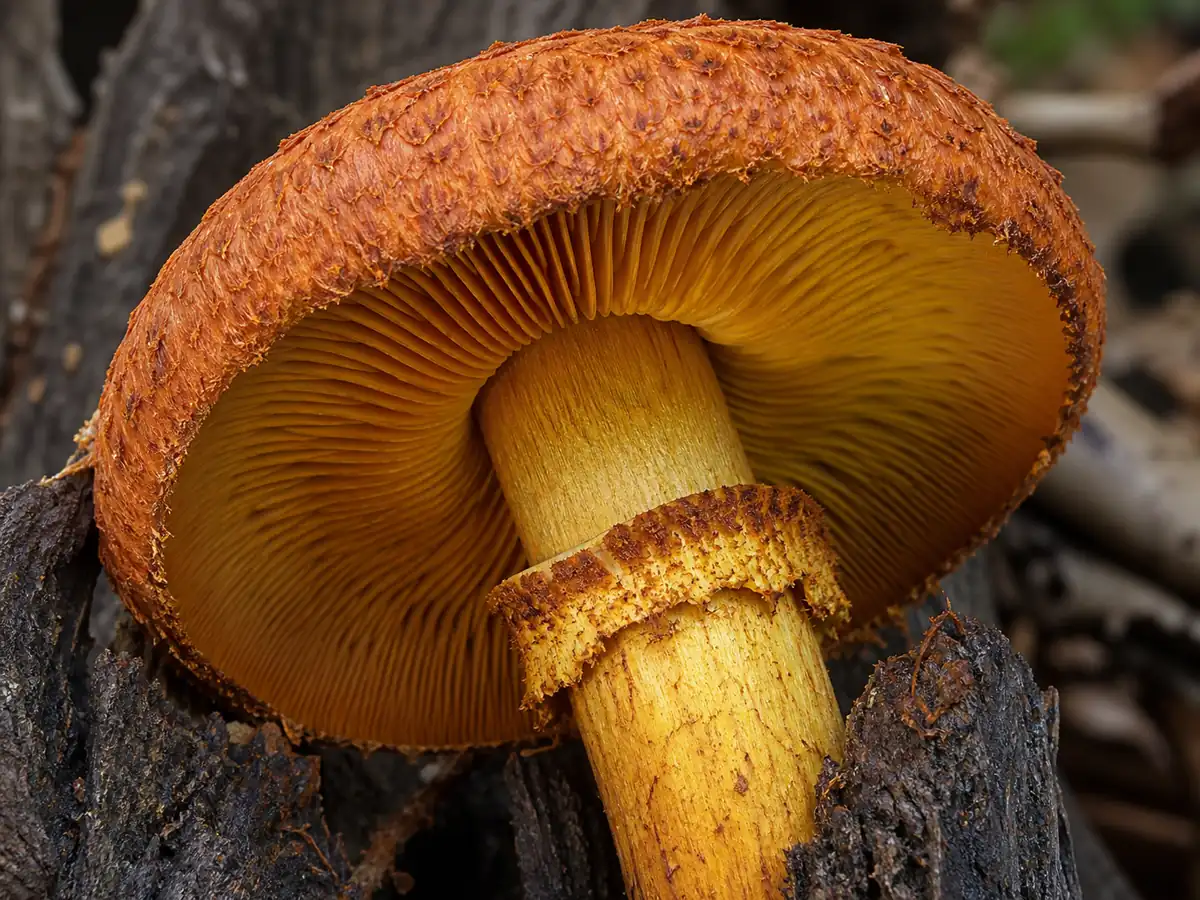
The ring is easiest to study on a young specimen. In an old cluster it may collapse, stain with spores, or tear away, so the absence of a perfect skirt on one stem does not exclude the group.
Place a mature cap gill-side down on half white and half dark nonabsorbent material. A rusty deposit supports Gymnopilus and rejects white-spored Armillaria, though it does not separate the closely related large Gymnopilus species.
Map the cluster
Document the intact cluster and the exact wood connection before lifting a specimen.
Record changing structures
Photograph young yellow gills, a mature rusty gill face, and the complete ringed stem.
Isolate the spore print
Produce a spore print without mixing caps from nearby mushrooms.
Resolve the species group
Compare the specimen with a current regional Gymnopilus key and retain a dried voucher when a species record matters.
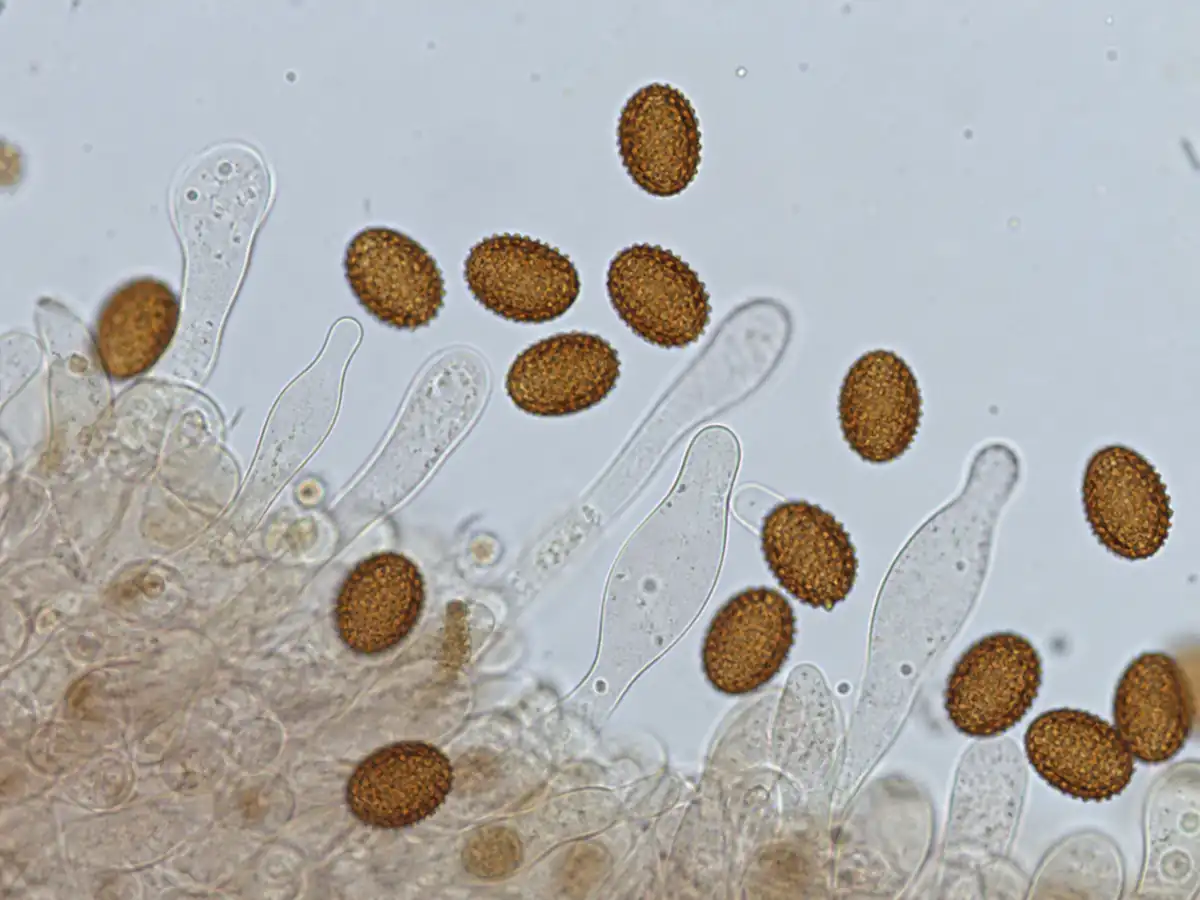
Microscopy examines the roughened brown spores, basidia, cystidia, and tissues of the cap and veil. Measurements need multiple mature spores because an isolated small or large spore can sit outside the usual range.
A blue-green mark is sometimes discussed in connection with psychoactive Gymnopilus, but bruising is inconsistent and can be confused with mold, age, or dark handling stains. Its presence does not prove chemistry, and its absence does not settle the species.
The cap surface also changes as fruiting bodies expand. A tight young cap may carry more visible fibers or small scales than a rain-washed mature cap from the same cluster, which makes stage-matched comparison more useful than one idealized photograph.
When the location is North America, stop at the regional species group unless microscopy or sequencing supports a narrower name.
That restraint produces a better biological record and a safer public identification than forcing G. junonius onto a familiar orange cluster.
Spore ornament needs oil immersion and a calibrated scale. Describe whether the wall is finely roughened or more strongly warted and measure a representative set from the print rather than selecting the most convenient spore.
Cystidia on the gill face and edge can separate close taxa when their shapes, wall thickness, and contents are recorded. A crushed gill mount may mix the two locations, so take material from a known face or edge.
The ring should be sectioned with the attached stem when a voucher is prepared. Its thickness, surface fibers, and spore staining remain easier to interpret when the tissue relationship is preserved.
A complete voucher connects every clue. Dry cap, gills, ring, stem base, and a piece of identified substrate under one field number, then store the print and photographs with that record.
If someone may have eaten this mushroom, act now. Call Poison Control at 1-800-222-1222 (US) or emergency services before symptoms appear, and save a piece of the mushroom for identification.
Which orange wood-growing mushrooms look similar?
Large orange mushrooms growing in a cluster can resemble jack-o'-lanterns, honey mushrooms, pholiotas, and several members of the Gymnopilus junonius group. Region, gill attachment, ring structure, spore color, substrate, and microscopy all matter.
Warning
Do not eat a large orange wood-growing mushroom based on cluster shape or the common name laughing gym. Reports of psychoactive chemistry vary among species and regions, while poisonous and gastrointestinally active mushrooms occupy the same visual range.
| Candidate | Features that overlap | Evidence that changes the identification |
|---|---|---|
| Gymnopilus junonius | Large orange caps, ringed stems, rusty spores, clustered wood growth | European or southern-hemisphere range, bitter flesh, microscopic characters |
| Gymnopilus subspectabilis group | Large ringed clusters in eastern North America | North American range and DNA or regional microscopy |
| Omphalotus species | Orange clusters on wood or buried roots | Strongly decurrent gills, no rusty-brown print, different cap and stem structure |
| Armillaria species | Dense clusters, stem ring, wood decay | White spore print rather than rusty orange-brown |
| Pholiota species | Scaly orange-brown caps and brown spores | Often sticky caps, different veil and microscopic characters |
A North American collection should not be called G. junonius simply because an older field guide uses that name. A 2020 molecular study found no North American sequences representing true G. junonius and separated several regional species, including G. subspectabilis, G. ventricosus, G. voitkii, and G. speciosissimus.
Jack-o'-lantern mushrooms are a practical food-safety comparison because they also form bright orange clusters from wood or buried roots. Their gills run farther down the stem, and their spore deposit is pale rather than rusty, but a damaged specimen can hide both clues.
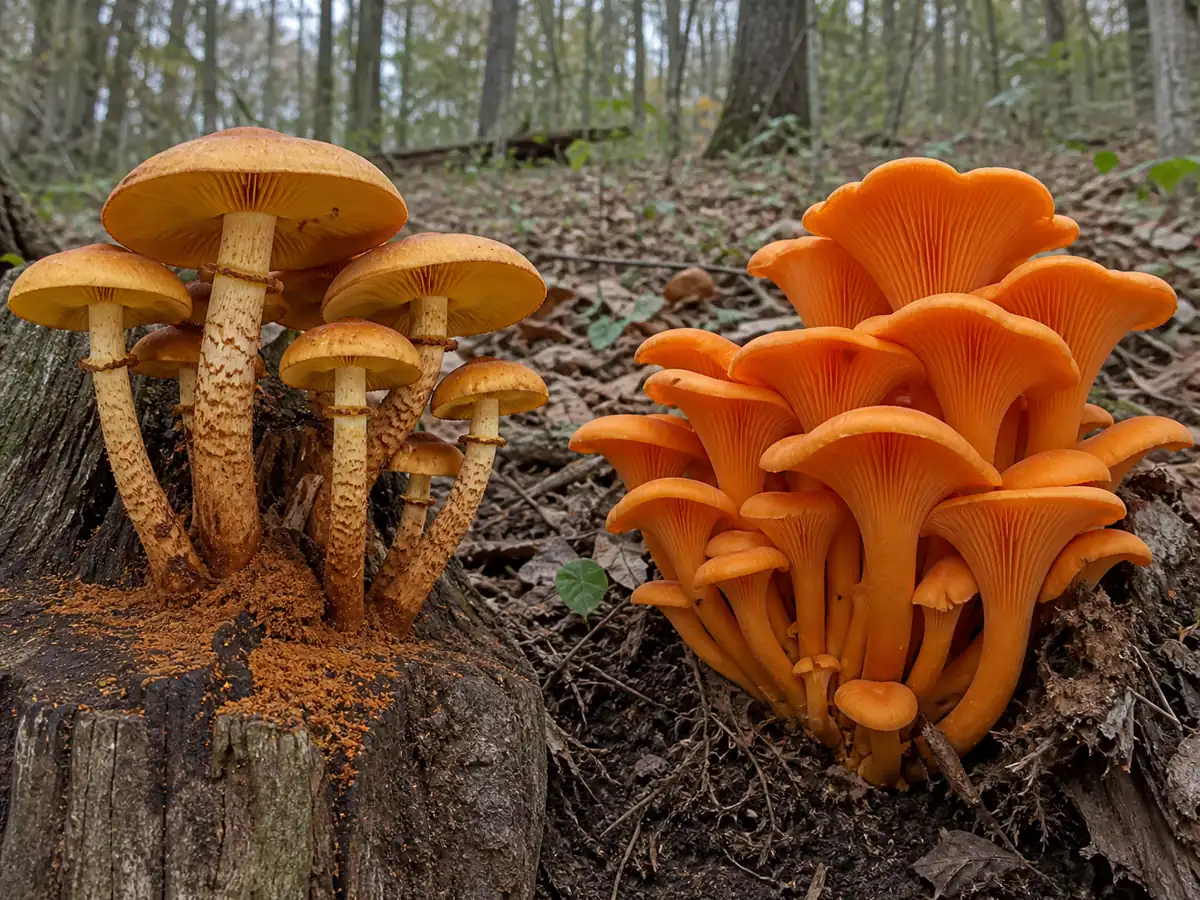
Honey mushrooms add another trap around stumps.
They may carry a ring and grow in large groups, yet a white print immediately conflicts with Gymnopilus. Do not rely on cap color because both groups change with rain, age, and exposure.
Cap color aloneOrange, gold, and tawny tones occur in several unrelated wood-decay mushrooms.
A photograph of the clusterIt cannot show print color, microscopic spores, or the buried substrate.
Complete collectionKeep cap, gills, ring, stem base, substrate, and habitat photographs together.
Regional treatmentUse a current key that recognizes the local Gymnopilus species group.
Pholiota makes the brown-spore comparison more difficult than Armillaria because both Pholiota and Gymnopilus can deposit warm brown spores. Check whether the cap was sticky before collection, whether coarse scales cover cap and stem, and whether the veil forms a different ring structure.
A cluster can contain more than one species when separate fungi fruit from the same stump. Match each cap to its own stem base and do not assume a small smooth mushroom belongs to the large ringed fruiting beside it.
Geography is a blocking character for the species name. In eastern North America, an observer should compare G. subspectabilis, G. luteus, G. speciosissimus, and G. voitkii rather than forcing a European label.
Chemical reputation cannot solve the taxonomy. A blue-green stain, bitter taste, or story about laughter does not replace spores, cystidia, substrate, voucher, and sequence evidence.
Why are North American laughing gyms different?
Gymnopilus junonius was long reported under names such as G. spectabilis, and older North American literature applied those names broadly to large ringed Gymnopilus. Modern sequence evidence has shown that this common-name group contains several distinct lineages.
True G. junonius is supported in Europe, South America, and Australia. The limited North American sequences analyzed in the 2020 revision represented other species, so regional records need reassessment rather than an automatic name transfer.
The genus now sits in Hymenogastraceae. Its rusty, ornamented spores and wood-decay habit remain useful genus-level evidence even when the exact species requires DNA.
- Common-name continuity
- Big laughing gym remains useful for communication, but it does not erase the molecular boundary between G. junonius and North American relatives.
- Older synonymy
- G. spectabilis appears throughout poisoning, chemistry, and field literature, so research should search both names and then verify the geographic concept used.
Taxonomic caution also affects chemical claims. A paper that tested material under an older broad name may not describe the same lineage found in a different continent, and its results should not be generalized into a public dose or expected effect.
Why does it fruit from stumps and buried roots?
Big laughing gyms decompose lignified wood. They fruit from stumps, buried roots, large fallen trunks, and wood within the base of a declining tree, returning locked carbon and nutrients to the forest system.
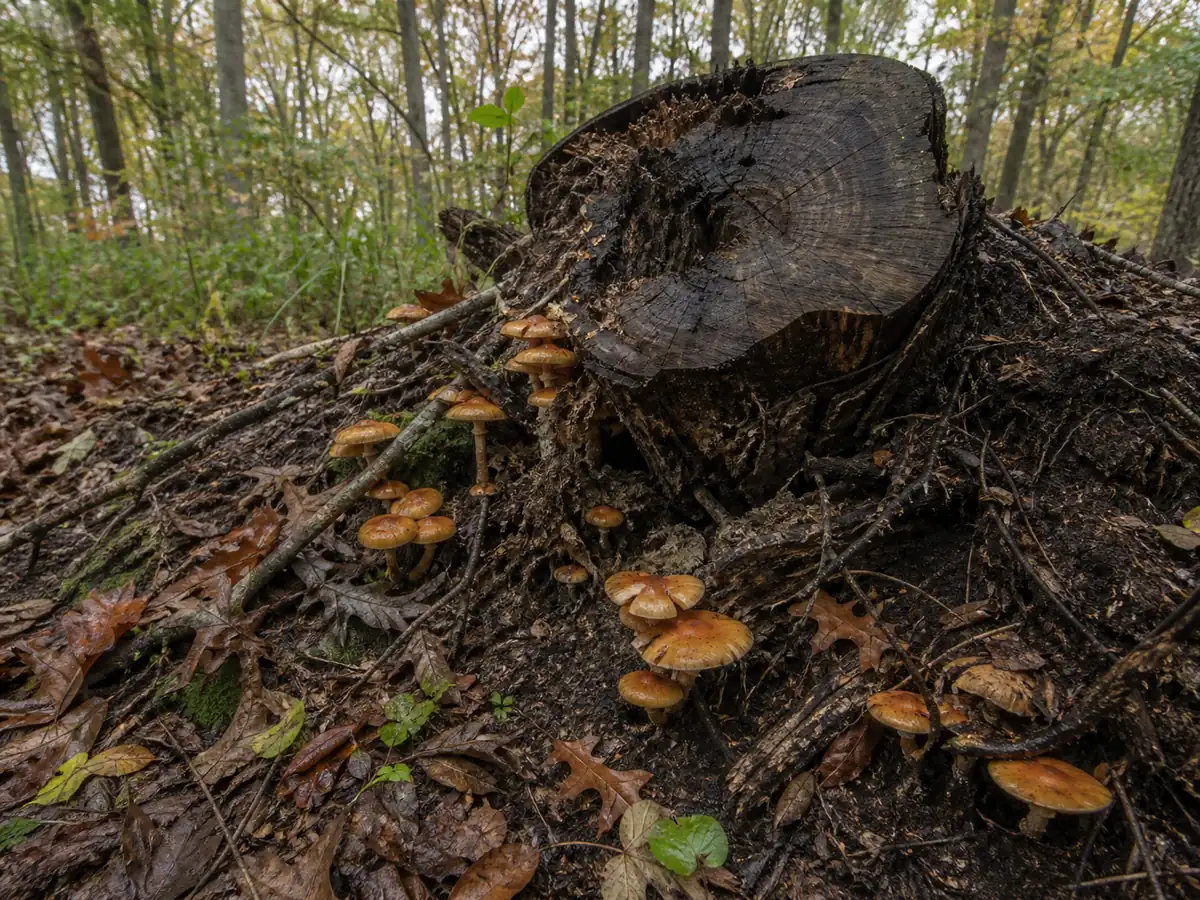
The apparent host should be recorded as substrate rather than a living root partner. A cluster at the foot of an oak may be feeding on dead root or heartwood even while part of the tree remains alive.
Rust-colored spore dust can collect on leaves, bark, and lower caps around a large fruiting. The temporary fruiting body is only the reproductive stage of a mycelium already established inside the wood.
Note
Do not cut into a living tree to prove the substrate. Photograph the point of emergence and let an arborist assess structural decay when a large cluster appears at the base of a valued tree.
Moist late-summer and autumn conditions commonly trigger fruiting. The same colonized stump may produce again in later years, but rainfall, temperature, wood moisture, and remaining food alter the timing and size of each flush.
Removing caps does not remove the fungus from the timber. If the concern is a tree or building, the useful response is an inspection of the wood and its structural condition rather than repeated picking.
Hardwood is frequent for G. junonius, while members of the broader group also occupy conifer wood. This substrate difference helps within a regional key but does not override microscopic or sequence evidence.
A field record gains value from naming the tree or wood when possible, showing whether bark remains, describing whether the timber is standing or fallen, and noting whether the cluster returns. Those details let later reviewers distinguish ecological patterns that a close cap photograph cannot show.
Repeated fruiting should be mapped against the same stump or root zone. A returning cluster documents persistent decay activity, while a one-time fruiting offers less evidence about the remaining wood and its structural condition.
Do not seal a wet cluster in plastic for a property assessment.
Photograph it fresh, retain one specimen in paper if requested, and let the arborist evaluate the tree rather than the mushroom alone.
Can you cook a big laughing gym?
This mushroom has no responsible culinary use. Its bitterness, uncertain chemistry, and difficult separation from other large wood-growing mushrooms make experimental cooking inappropriate.
Do not parboil, dry, ferment, or pickle it in an attempt to remove risk. Processing destroys identification evidence while offering no validated method that makes a collection safe.
If pieces enter a mixed basket, separate the entire affected group from food and preserve representative intact specimens. A rusty spore coating on neighboring caps can also make later color-based sorting unreliable.
Big laughing gym identification questions
Is big laughing gym edible?
What color is its spore print?
Does Gymnopilus junonius grow in North America?
How is it different from jack-o'-lantern mushroom?
Does blue-green bruising prove it contains psilocybin?
What should I do after accidental ingestion?
Sources & References
- Thorn et al., Botany Molecular separation of G. junonius from five North American species in the group.
- NCBI mitochondrial genome study Genome and poisonous-status context for an authenticated Korean G. junonius collection.
- Hatfield and Valdes, Lloydia Historic chemical screening of Gymnopilus material, including G. spectabilis.
- Missouri Department of Conservation Field characters and public-safety context for the common-name group.