
 Poisonous

What does the name poison pie mean?
People have used the common name poison pie far more loosely than the modern scientific species. In practice, a pale cap and weeping gills first raise a sorting problem inside Hebeloma, and only later, if ever, a confident H. crustuliniforme. Young caps look rounded and have an inrolled margin. They expand while staying smooth, and in damp weather the pale cream or buff surface feels distinctly sticky around a darker ochre center.
Its gills start pale and pass through clay brown toward the rusty-brown color of the spores. In wet spells, small droplets form along the edges and leave brown marks as they dry. The pale stem has no lasting ring, and the white flesh smells like radish. Those features add up to a coherent field description, while the species boundary may still depend on spores and cystidia under a microscope.
Which field marks point toward poison pie?
Start with a complete, fresh specimen and its original setting. Cap-only photos lose the gill edge, stem surface, base and tree partner that a modern Hebeloma key may ask for. The Naturalis species account gives the European cap about 4-10 cm across. It runs whitish to buff or pale ochre, usually darker in the middle, and turns sticky when damp with no obvious scales or warts.
Young margins roll inward. Older caps broaden and can turn wavy, so your flat mature specimen does not have to keep the tidy round outline of a young one. The gills crowd together and attach to the stem or meet it with a notch. They start pale and darken as the brown spores ripen, so you always read gill color alongside the mushroom's age.
Fresh droplets along the gill edges stand out in humid weather. Once they dry, small brown spots may stay behind, and the wet bead and the dry spot can be two stages of the same feature. Seeing either one tells you to look closely at the gill edge, and neither one names the species.
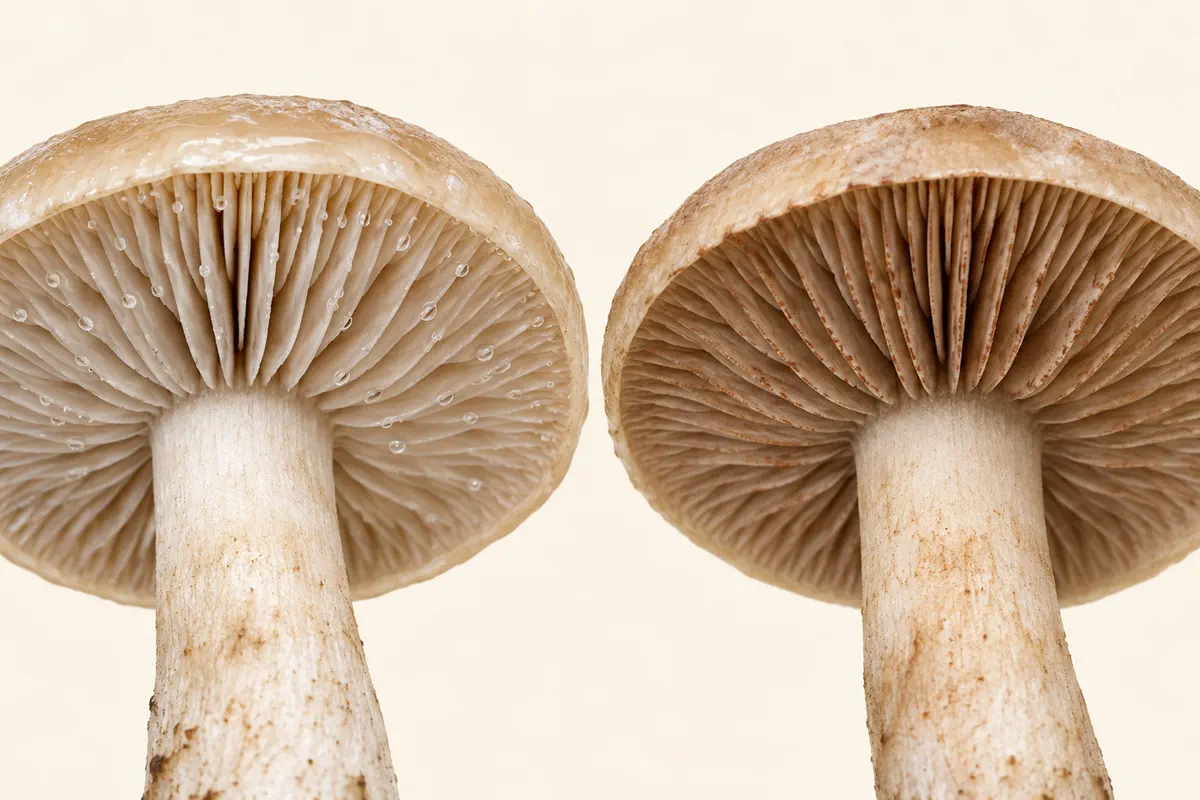
Its stem is pale and fibrous or finely floccose, especially near the top. In the narrow species concept it has no lasting ring and no cortina, the cobweb-like veil some brown-spored mushrooms carry. On a different, weathered mushroom, though, you could easily miss faint veil traces. The flesh stays white, and most people compare the smell to radish.
Do not taste the mushroom to check it. Its recorded bitterness comes from expert descriptions, it is no field test, and it cannot tell apart every poisonous relative. Its rusty-brown spore deposit points to Hebeloma over a white-spored lookalike. The deposit still cannot show the spore ornamentation, wall reactions or measurements that separate close species.
Your honest identification can stop at Hebeloma or at a species complex. Stopping there describes your evidence more accurately than forcing a narrow name onto a field pattern that other species share, according to the primary taxonomic research. Experts with a microscope and DNA work can take the name further.
What happens after poison pie is eaten?
Possible effects include abdominal pain, nausea, vomiting and diarrhea. Those losses can drain the body's fluid and electrolytes. Their timing also cannot tell you which mushroom someone ate with enough certainty to handle the case at home.
If someone may have eaten poison pie, call Poison Control in the United States at 1-800-222-1222 or the local poison service, as the Poison Control advice on wild mushrooms recommends. Do not wait for vomiting and diarrhea to start, and do not induce vomiting unless a specialist tells you to. Keep any remaining mushrooms, meal leftovers and photos, but do not delay the call to collect them. The poison service then chooses which clinical assessment and treatment fit the person's symptoms and the chance of a mixed collection.
Call emergency services immediately for collapse, seizure, trouble breathing, severe confusion or a person you cannot wake.
Which trees and soils fit poison pie?
Poison pie forms ectomycorrhizae with living trees. Below ground, the fungus trades nutrients with tree roots, and the cap and stem only show up for a short time when the weather suits fruiting. Naturalis places it near deciduous trees in woods, avenues and roadsides, often on clay or loam. So you can meet this woodland species beside a managed path or under a street tree.
Finding a deciduous tree nearby fits its ecology without proving the name. Several brown-spored mushrooms that partner with tree roots can share the same host patch, and fine roots spread beyond the edge of the canopy. In temperate Europe it fruits mostly in late summer and autumn. Rain and soil moisture shift the timing, so a calendar match cannot stand in for the mushroom's features.
Treat old records from other continents with care, because the name once covered a broader complex. Verified local voucher specimens and modern regional treatments outweigh any broad worldwide range statement.
Can cooking make poison pie safe?
Poison pie has no place in the kitchen. Its bitter taste and radish odor are field-guide records, never an invitation to sample it, and no verified cooking method removes the gut hazard. Old collections add another problem, since the species name itself may be uncertain. That doubt does not make a related Hebeloma fit for food; it means the remaining material may not identify to species at all.
Do not use a small bite as a tolerance test. One person's reaction to one amount tells you nothing about the identity, toxin content or safety of another collection. Whatever you learn from a bite, the next batch may hold a different Hebeloma.
Warning
A mixed basket changes the exposure
Separate unknown pale brown mushrooms from anything intended for food. Broken caps and detached stems can make it impossible to reconstruct which structures belonged together.
After an accidental meal, medical advice comes before any identification work. For the poison service, the useful kitchen history covers the amount eaten, the cooking method, the meal time and which diners ate which pieces. Give those details when you call, and let the specialists ask for more.
Why does the species name need a narrow boundary?
Hebeloma crustuliniforme once served as a catch-all name for several medium or large pale Hebeloma species. The 2014 epitypification study chose a modern reference specimen and used DNA and mating-compatibility evidence to give the name a narrower meaning. That correction changes how you read old poisoning or distribution reports. Some of those records may describe the broader complex, and dropping that caveat would make the claim stronger than its evidence.
The modern species still works as a name, but you cannot always reach it from a photograph. Microscopic and DNA work can separate lineages whose caps, gills and smells overlap in the field. Until someone does that work, a group-level name keeps your record honest.
Can poison pie be cultivated as food?
Poison pie depends on living tree roots, which sets it apart from food mushrooms that grow on a bag of sterilized sawdust by breaking down dead material. Watching it fruit under a tree outdoors gives you no cultivation recipe. Nobody has a reason to raise this poisonous species as a food crop. Lab cultures or root-partnership experiments, where researchers run them under controlled conditions, answer scientific questions and have nothing to do with home eating.


