
 Poisonous

The federal and medical boundaries around liberty cap
In the United States, the clearest legal statement names the compounds inside the mushroom. Federal regulations list both psilocybin and psilocin in Schedule I. Federal law also prohibits knowing or intentional possession of a controlled substance unless an authorization applies.
Note
This is a U.S. federal-law boundary. State, local, and non-U.S. rules can differ, so this page does not generalize about picking, spores, cultivation, or possession outside the cited federal provisions.
The medical boundary carries equal weight. In the body, psilocybin converts to psilocin, which produces its central effects mainly through serotonin 5-HT2A receptor activity. NIDA's overview of psychedelic drugs describes how perception and mood can change acutely. Studies document headache, nausea, anxiety, dizziness, and elevated blood pressure. Swallowing a poisonous mushroom picked by mistake adds a separate risk.
Controlled studies answer narrow questions under a protocol. Researchers screen each person, define the study drug, watch the session, and record side effects. None of those safeguards exists when someone picks a mushroom from a field.
Controlled evidenceA trial can measure adverse effects from a defined psilocybin intervention in selected participants under observation
Supported conclusionAcute effects can include headache, nausea, anxiety, dizziness, and increased blood pressure
Wild inferenceA trial does not identify a mushroom found outdoors or establish the contents of an unknown specimen
Personal-use inferenceA research result does not supply a safe amount, suitable setting, or treatment recommendation for a wild mushroom
The meta-analysis by Yerubandi and colleagues, published in 2024, examined therapeutic-dose psilocybin in six randomized trials with 528 participants. Its findings belong to those controlled conditions. They say nothing about unidentified wild mushrooms, where nobody knows the species or its contents.
If someone may have swallowed an unknown mushroom, do not wait for a symptom pattern to name it. In the United States, contact Poison Control online or at 1-800-222-1222 for case-specific advice. Call emergency services immediately for unconsciousness, severe breathing trouble, or another life-threatening condition.
- Keep remaining mushroom material and packaging
- Record the possible time and amount swallowed
- Report symptoms and relevant medical history to the poison specialist
- Follow the specialist's instructions and call emergency services for life-threatening symptoms
Build the identification from several independent characters
You name a small brown mushroom from many features at once. Size, cap surface, color change, gills, stem, spore deposit and the ground under the base all count. The pointed cap is memorable, yet the papilla alone proves nothing. Every feature has to agree with the rest before the record means anything.
The cap usually measures 0.5 to 2.5 cm across and is narrowly conical to bell-shaped. Its distinct pointed umbo, or papilla, often persists as the cap expands, and the moist margin may look translucent-striate. E-Flora BC documents these cap characters along with the spore deposit.
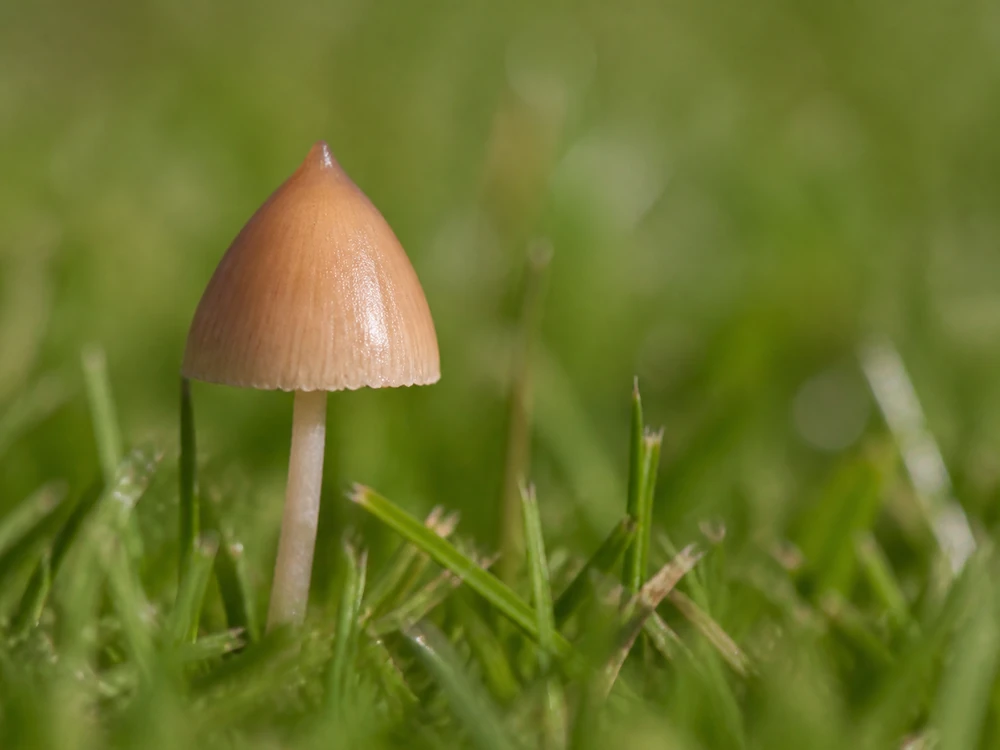
Moist caps can be chestnut, brown, or olive-brown and feel a little sticky. As they dry, they fade toward tan, buff, or yellowish tones. That drying change, called hygrophanous, can make mushrooms from one patch look unlike one another.
Young caps may show thin veil threads. They soon vanish and never form a lasting ring. Blue or blue-green staining can be slight or absent. Bruising therefore cannot confirm or exclude the species.
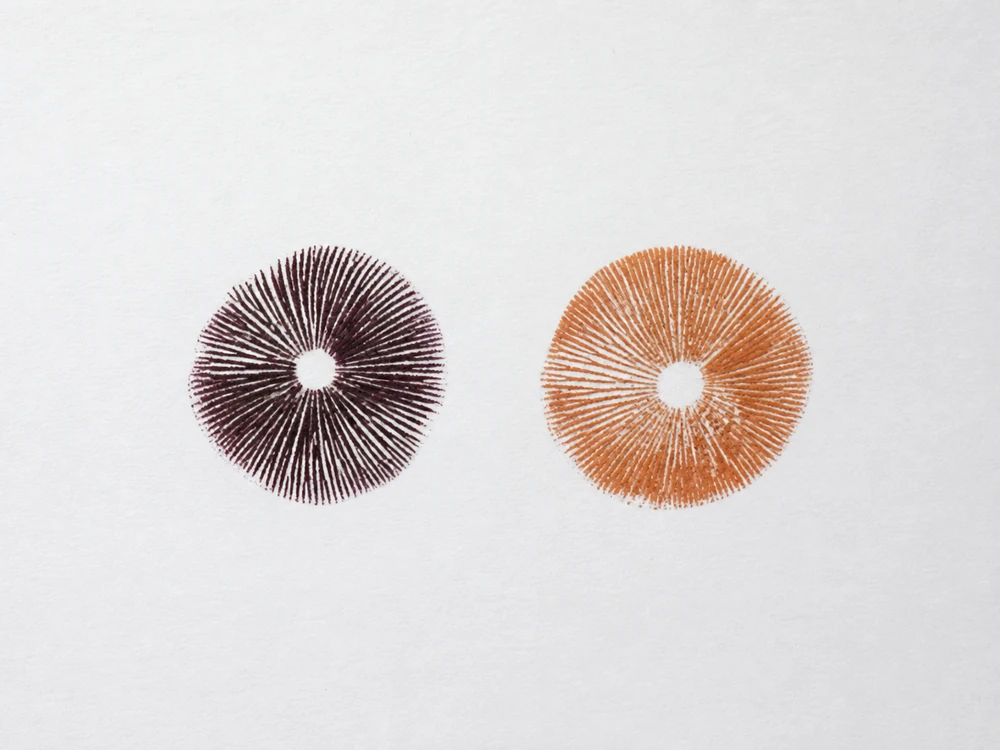
Spore prints give you one useful way to reject a mushroom. They never give you leave to eat one. Immature caps may release too few spores to read. Many unrelated mushrooms also produce dark deposits.
Deadly Galerina belongs in the safety comparison, because small brown mushrooms are easy to misread once you lift them from their setting. Liberty cap and Galerina split on substrate. Galerina marginata fruits from decayed wood, wood chips, or buried wood. Liberty cap grows with grass roots and root remains.
Mushrooms standing among grass can still rise from buried wood. Dig out the base and look at what it grows from before you write down the habitat. Reject any specimen whose complete character set does not agree.
Grass roots, grazing, and the substrate boundary
Liberty cap is a saprobic grassland fungus, and the label pasture mushroom can hide its real biology. Laboratory work by Keay and Brown found it living in dying outer cells of grass roots. Several grasses and another grassland plant hosted it. That work ties it to grass roots and root remains. It gives no support to the familiar claim that the fruit bodies grow directly from dung.
Grazed pasture offers the right grass and plenty of dead roots. Fruit bodies may therefore appear where livestock graze without emerging from their droppings. Rough meadow and other established grassland can also support the species.
Substrate outranks scenery when you separate it from a wood-associated lookalike. Grass growing over buried timber does not turn the timber into a grass-root substrate. No field label replaces an inspection of the mushroom's base.
The recent draft-genome paper on Psilocybe species places it in temperate grasslands across Europe, Australia, and North and South America. That broad range has better support than a narrow Europe-and-North-America one. Records commonly cluster in the cool, wet part of late summer and fall, though timing varies with local climate. Neither timing nor geography supplies an identification, so both stay as context.
Why this is not a food mushroom
KnowTheSpore files liberty cap with the poisonous species, and it has no culinary role. Its small size, thin flesh, and familiar common name do not make it a food mushroom. Drying also strips away evidence. The moist surface, the color change, the gill attachment and the link to the soil all fade or blur. Dried scraps cannot carry a reliable field identification.
The danger reaches beyond the known effects of psilocybin. Mixed or misidentified collections can contain a different mushroom with a different toxin profile. Taste, odor, or a trial bite cannot resolve that uncertainty, so never taste one.
What controlled psilocybin studies can actually tell us
Psilocybin research is drug research. It offers no evidence for treating yourself with liberty caps. FDA guidance on psychedelic drug trials treats these drugs as products still under test. It stresses study design, participant safety, monitoring, data collection, and results that researchers can interpret.
The 2024 Yerubandi review pooled controlled trials for depression and anxiety. It found raised risks of headache, nausea, anxiety, dizziness, and elevated blood pressure. The authors reported that the acute adverse effects assessed in those studies resolved within 48 hours. They also called for better evaluation of adverse-effect management.
Wild mushrooms bring back questions the trial design had already removed. The name may be wrong and the collection may mix several kinds. Nobody can read the chemical content of a particular fruit body from its appearance. So this profile gives no dose, use, preparation, or procurement guidance. If you want treatment, talk with a qualified clinician about approved care and real clinical research.
The type species in a reorganized genus
Psilocybe semilanceata sits in the family Hymenogastraceae and is the type species of Psilocybe. As the type, it anchors the genus name to itself. Phylogenomic work by Bradshaw and colleagues sampled dozens of fungarium specimens and resolved two major lineages within Psilocybe. It also found old specimens filed as Psilocybe that belonged in Deconica. Old labels cannot stand in for modern evidence.
Family membership gives no field shortcut either. The family name predicts no single cap shape, habitat, or toxin. It cannot name a small brown mushroom in your hand. The 2025 draft-genome resource adds a high-quality genome for P. semilanceata and records its temperate grassland distribution. That genome aids lab comparisons, yet the field checks above stay the same.


