
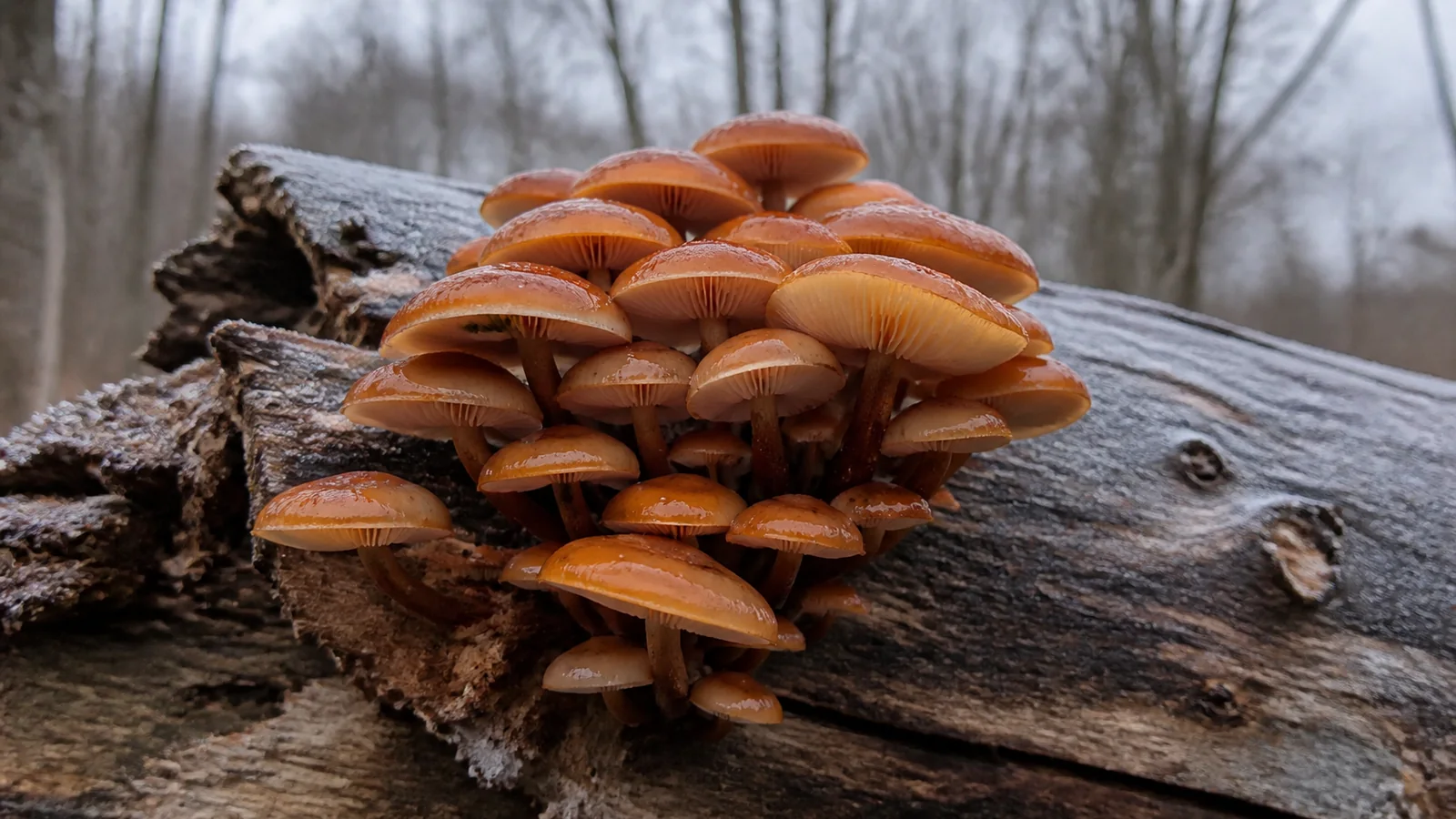
Velvet shank is one of the few wild mushrooms that experienced foragers eat raw off the log. It is also one of the few that fruits on the same dead wood as a mushroom that will destroy a liver.
Check both freshness and identification before preparing a winter collection.
Can you eat velvet shank raw?
Yes, once one thing is settled, and the answer is worthless until it is.
| The mushroom in your hand | Raw answer | What decides it |
|---|---|---|
| A young dry velvet shank, identification closed | Yes, and references call them exceptionally good that way | A white spore print and no ring on the stem |
| An older wet velvet shank | Not worth it | Slime, and a texture that wants a pan |
| A stem of any age | No | Fibrous enough that most people cut them off and discard them |
| Anything you have not spore printed | No | The mushroom it could be instead has no antidote |
Keep each of those checks separate when deciding whether to use the mushrooms.
Everything under it is either the reason the top row is real or the reason the bottom row is not negotiable. Neither half of it works without the other.
Young dry buttons are described in foraging references as exceptionally good raw, very sweet and aromatic, and one forager quoted there says they taste like toffee. Nothing about that recommendation is careless.
It comes from people who close the identification before they pick anything, and who treat that as an unremarkable part of the job rather than as a precaution.
Velvet shank is also worth the walk in a month when almost nothing else is out. It fruits in dense overlapping tufts on standing and fallen dead wood, so a single find is usually a meal rather than a garnish.
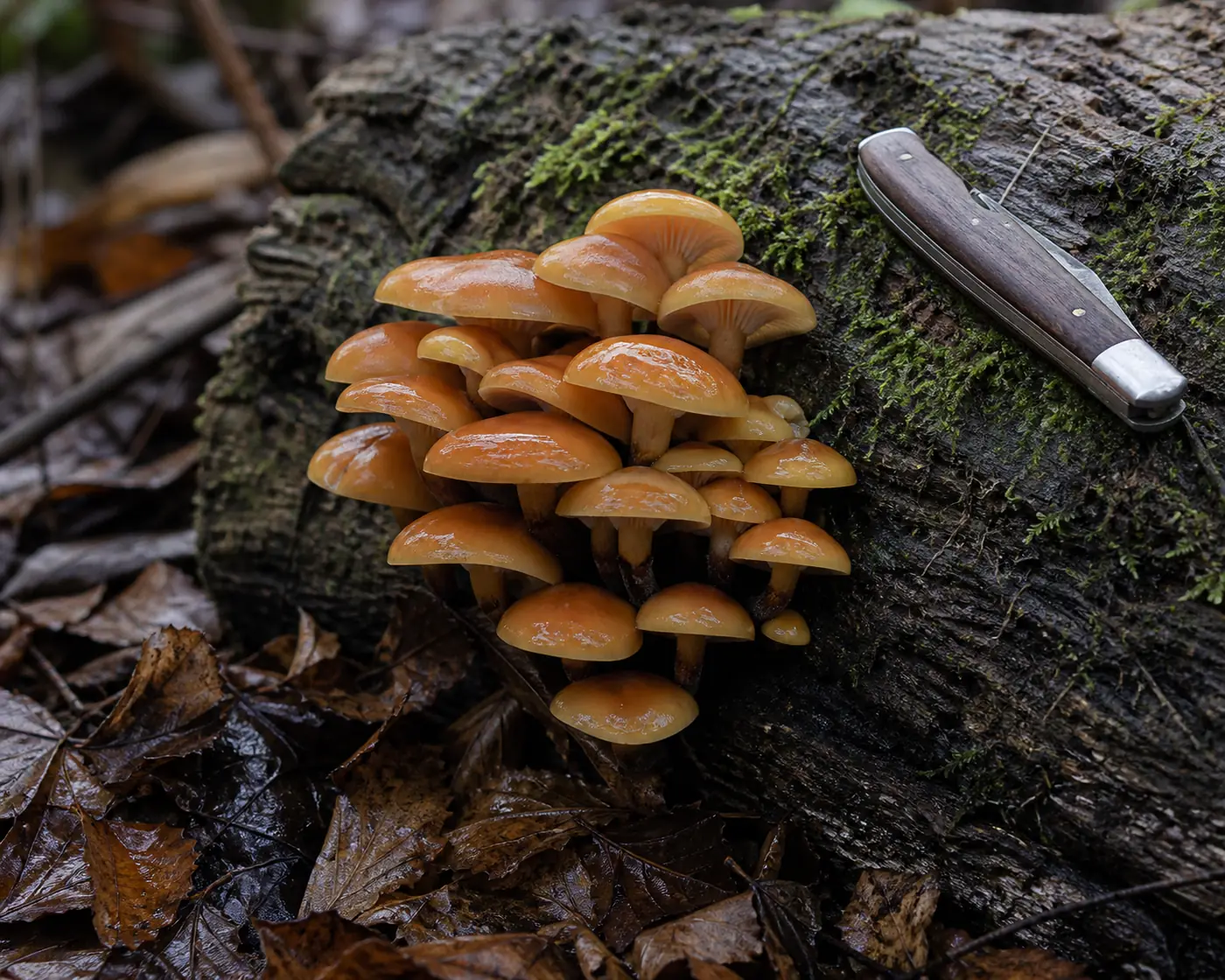
The lookalike is the whole reason to hesitate
The mushroom that shares this habitat is called the funeral bell, and the name is not decoration. It grows in tufts on dead wood in the same orange-brown range and at a similar size.
Warning
Galerina marginata contains amatoxins, the same class of compound that makes the death cap lethal. There is no early warning, no unpleasant taste to spit out, and by the time anything feels wrong the damage to the liver is already under way. This is the only species in this series where a raw mistake cannot be taken back.
Season gives a little protection and not enough of it to rely on. The funeral bell is an autumn species that should be finished before January, and in a mild year it carries on into November, which is when velvet shank is starting.
For a few weeks both species can be on the same fallen trunk.
That overlap is the specific reason velvet shank does not belong on a beginner's raw list. Every other species in this series can be misidentified into something unpleasant, and this one can be misidentified into a liver transplant.
SafetyCan You Eat Beech Mushrooms Raw? Not Poisonous, Just BitterHow to close the identification
There is one test that settles this, and everything else is supporting evidence.
- The spore print
- White on velvet shank, snuff brown on the funeral bell
- The ring
- Velvet shank has none, the funeral bell has a ring zone that can rub off
- The stem
- Pale at the top, deepening to dark brown or black and finely velvety at the base
- The stem of the lookalike
- Silvery streaking rather than velvet
- The cap
- Caramel to orange, three to seven centimeters, greasy or slimy in wet weather
Take the print and the question is closed. Lay a cap gills down on a sheet that is half white paper and half black card, cover it with a glass, and leave it for a few hours.
White spores show against the black half and brown spores show against the white half, which is why the two-tone sheet is worth the trouble. Neither result is ambiguous once it is on the paper.
A faint deposit of spores is the one thing that goes wrong with this.
The glass stops a draught carrying the spores off before they land, and a few hours somewhere warm gives a deposit you can read without leaning into it. If it comes out thin, leave it overnight rather than squinting at it and deciding.

The velvet itself is the field check that gets you as far as the kitchen. Run a thumb down the stem of a mature specimen and it is dark and finely furred, where the funeral bell is streaked and smooth.
If you see any sign of a ring on the stipe, and a spore print is not white, then you are not holding a velvet shank.
A foraging reference on the two things that settle this species
That is the whole rule, and it is put as two conditions because either one on its own is enough to stop you.
The velvet gets a mushroom as far as your kitchen, and the print is what gets it onto a plate.
Which ones are worth eating raw
The picking rule follows from the weather more than from the calendar. Wet caps and dry caps off the same log are different propositions.
That last line is one of the more useful facts about this species. Velvet shank withstands snow and very low temperatures, and thawing actively stimulates it to release spores.
So a frozen tuft is not a spoiled tuft, and it is one of very few wild mushrooms worth walking out for in February.
Host wood is worth as much to a search as the season is.
It fruits on most dead or dying deciduous trees, with elm, oak, ash and willow named most often, and it turns up on gorse as well. A dead elm on a field edge is worth checking every winter for years.
The slime is what decides between raw and cooked, more than age does. A dry cap picked in cold clear weather is pleasant to bite, and the same one after two days of rain is unpleasantly greasy.
That is a texture problem rather than a safety one.

How much of it is too much
There is one piece of evidence on quantity and it deserves careful handling. It is a feeding study in mice.
Those are mice, and that is a great deal of mushroom. Two hundred grams of fresh velvet shank every day for five days is a serious quantity of any wild fungus, and nothing in the study says a handful of raw buttons will do anything at all.
What the study does say is worth carrying anyway. The authors wrote that some caution is warranted about marketing this species as a medicinal mushroom and functional food.
They also noted that their experiment did not include a group eating well-cooked mushrooms.
That leaves the effect of cooking on those markers genuinely unanswered rather than reassuring. It is the kind of gap that gets quoted as a finding in whichever direction the person quoting it prefers.
Treat velvet shank as a mushroom rather than as a supplement and none of this reaches you.
The same species in a supermarket pack
The long white bundles sold as enoki are this mushroom, grown in the dark. Nothing about them looks like the orange tuft on a log, and the whole difference is how they were raised.
The white color is not a different variety. Enoki is raised in the dark so the caps never color and the stems draw out long and pale, and the same fungus grown in daylight would look like the tuft on the log.
Two pages on one species with opposite reasoning looks like a contradiction and is not. A wild velvet shank has no supply chain and a cultivated pack has no lookalike, so each form carries the risk the other one does not have.
In practice that looks like this.
Print the wild one before you taste it, and cook the packed one whatever it looks like.
Sources & References
- Velvet Shank Mushrooms, Edibility, Identification and Distribution, Galloway Wild Foods Gives young dry buttons as exceptionally good raw, very sweet and aromatic, the November to March season and the tolerance of snow and freezing, the caramel to orange caps at three to seven centimeters going greasy in wet weather, the ringless velvety stipe as the key to identification, the instruction to wipe or scrape rather than wash, the removal of fibrous stems, the host trees including elm, oak, ash, willow and gorse, and the rule that a ring on the stipe or a print that is not white means it is not a velvet shank.
- Mustonen A, Maattanen M, Karja V, Puukka K, Aho J, Saarela S, Nieminen P. Myo- and cardiotoxic effects of the wild winter mushroom (Flammulina velutipes) on mice. Exp Biol Med, 2018 The feeding study. Gives the doses of zero, three, six and nine grams per kilogram of body mass daily for five days, the rises in plasma creatine kinase and its MB fraction at six and nine grams, the human equivalent of one hundred and ninety to two hundred and eighty grams of fresh mushroom daily for five days, the authors' caution about marketing the species as a medicinal mushroom and functional food, and their note that no well-cooked group was included.