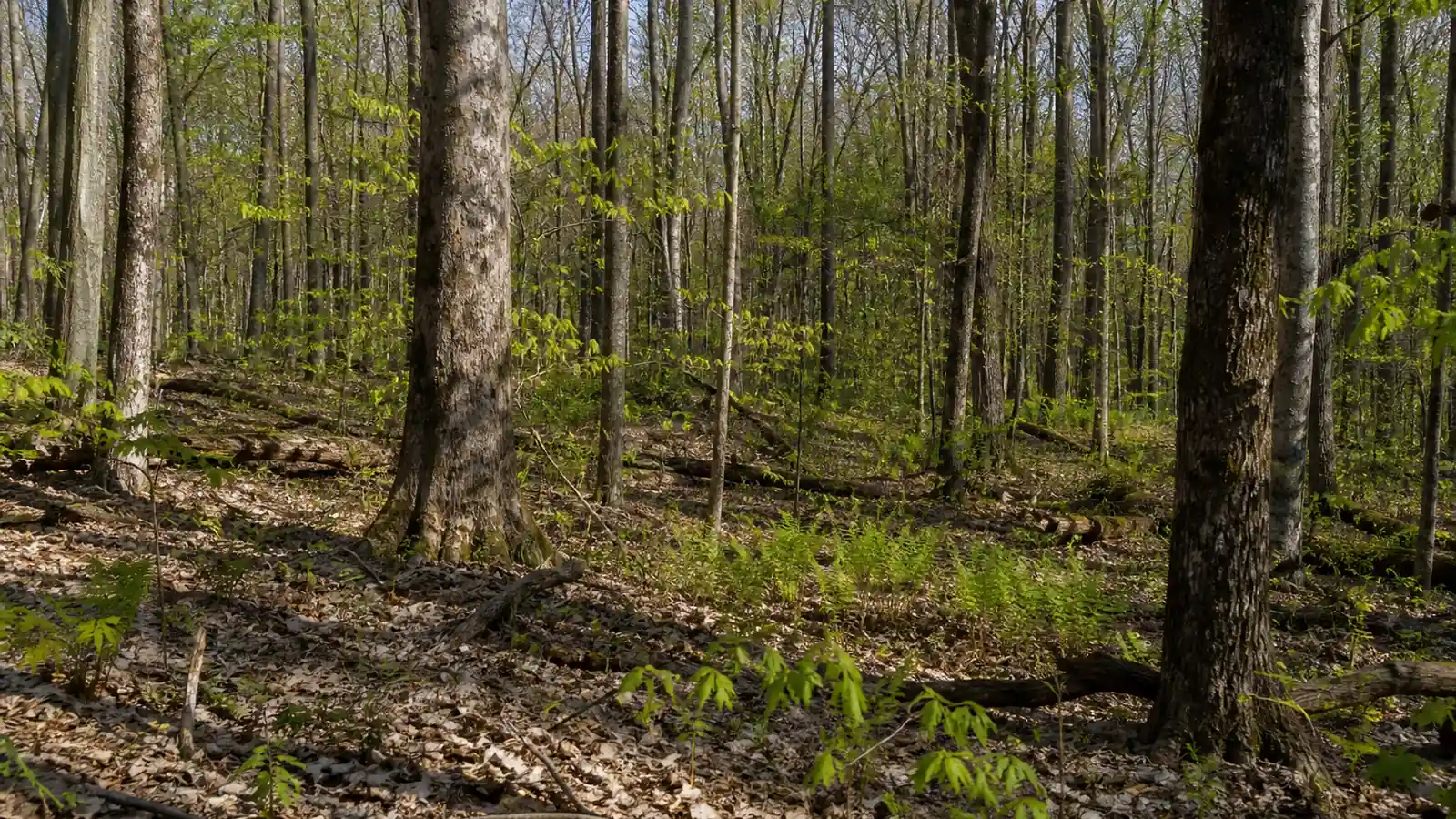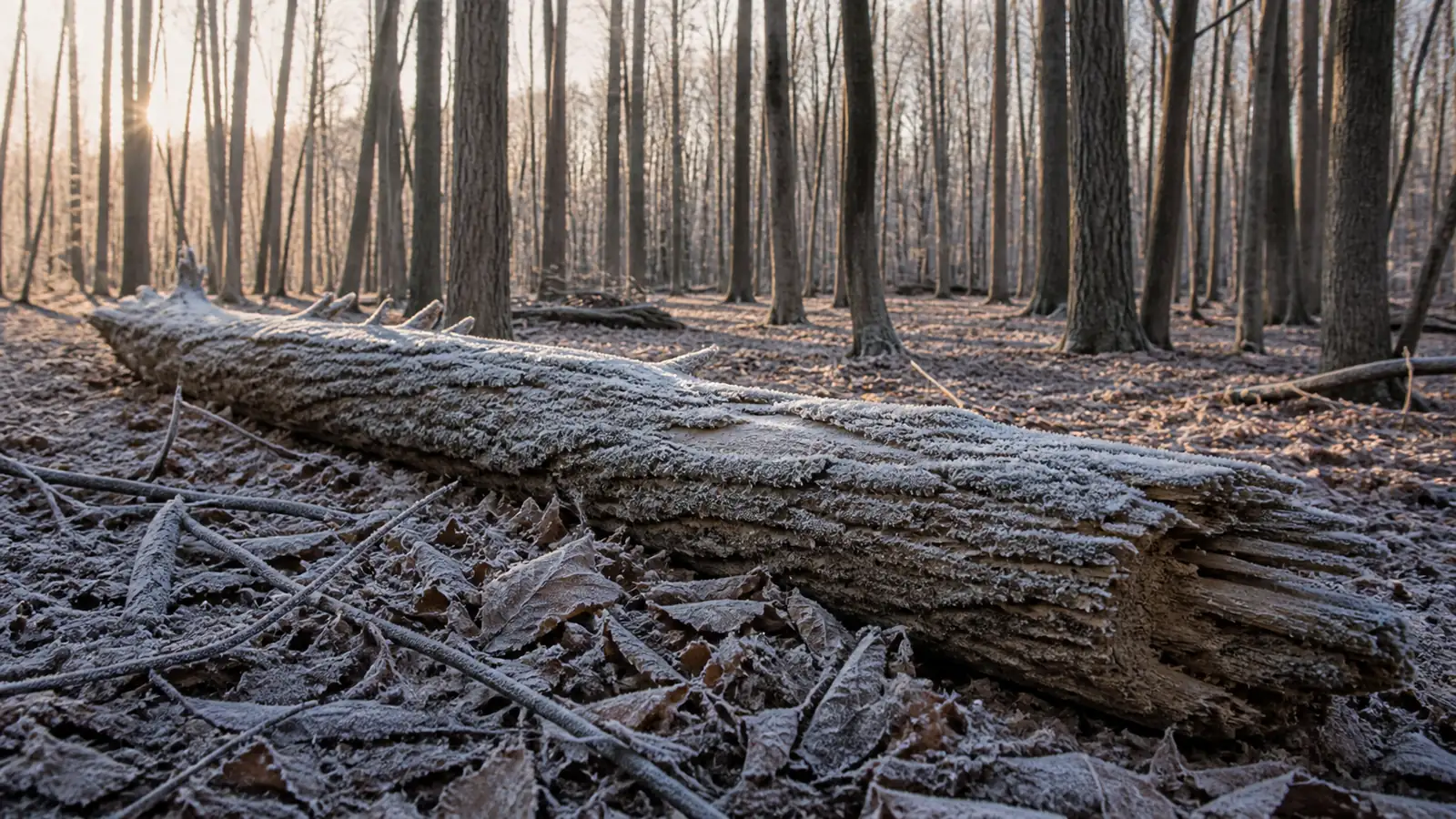
Winter has the shortest species list and the least competition. Almost everything that fruits then grows on wood rather than from soil, because a log holds warmth and water that open ground loses.
Winter foraging is a smaller activity than the rest of the year and a more reliable one.
The species list is short, the mushrooms that do fruit are distinctive, and almost nobody else is out looking. What changes is where to look rather than how hard.
Wood is the answer to almost every winter question.
Why winter mushrooms grow on wood
Soil freezes and thaws, and it loses water to wind and cold air.
A log holds moisture and buffers temperature swings, so the fungus inside it keeps working at temperatures that stop soil species entirely. That is why a winter walk should follow fallen trunks rather than scan the ground.
| Species | Substrate | Winter note |
|---|---|---|
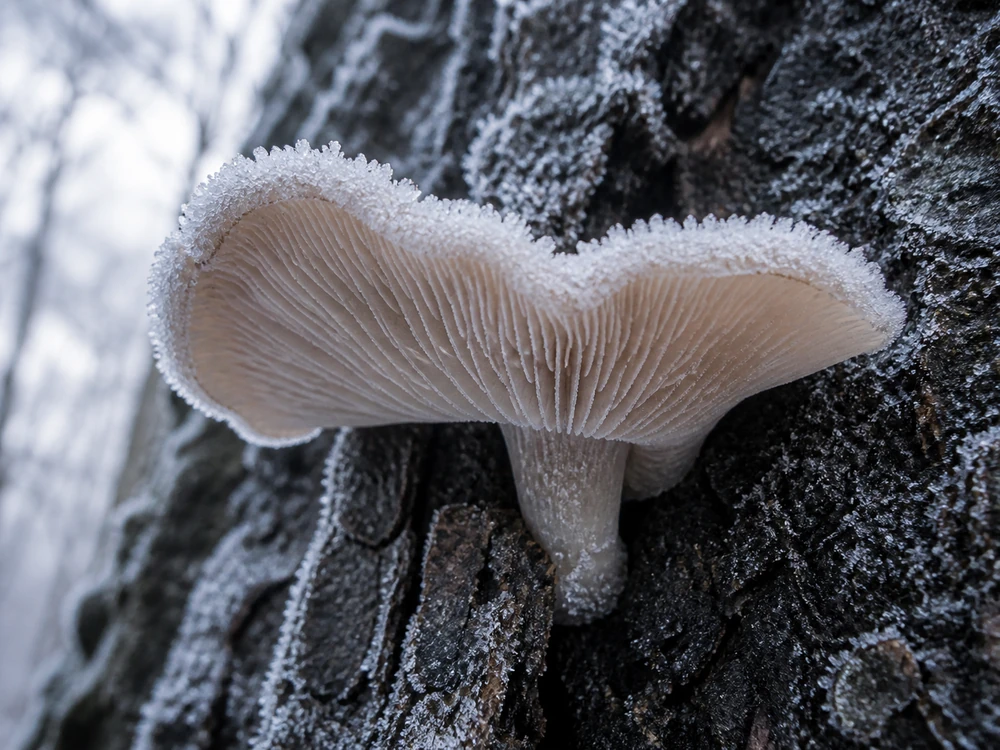
| Oyster mushroom | Dead and dying hardwood | Fruits in cold snaps, often after a freeze |
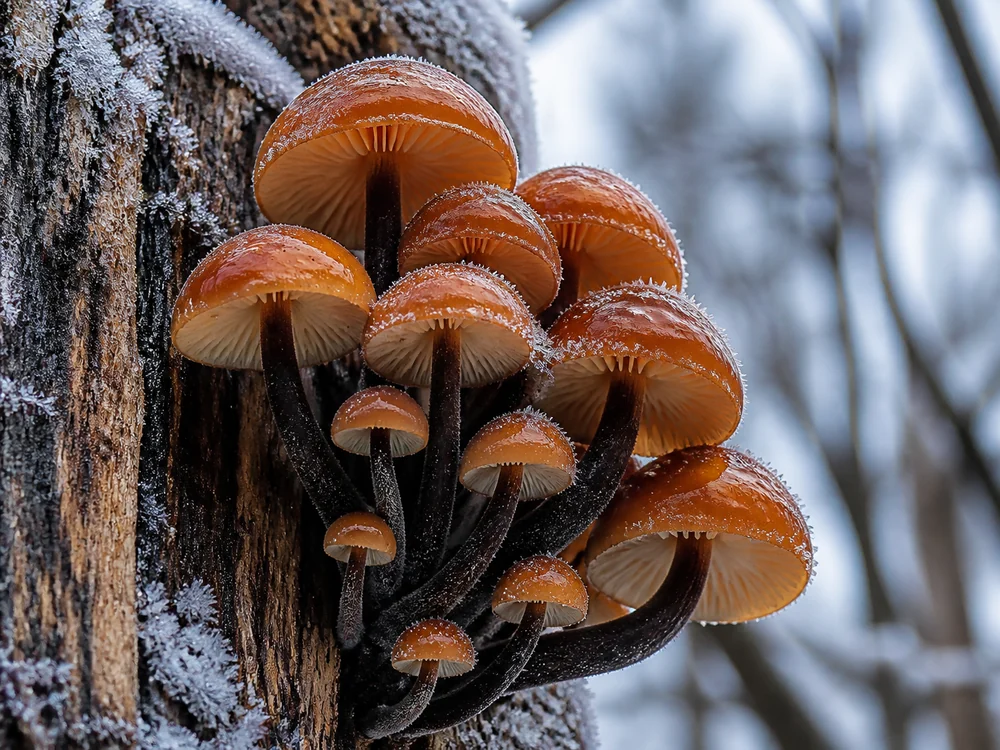
| Velvet shank | Hardwood, especially elm and willow | Fruits through frost, sticky orange caps |
| Wood ear | Dead hardwood branches | Rehydrates after freezing and looks fresh again |
| Turkey tail | Dead hardwood | Persists all winter, not a food species |
Several of these are perennial or persistent rather than newly fruiting.
Turkey tail and other bracket fungi stay on the wood through the season, which means a winter find may have been there for months. That matters for anything intended for the pot.
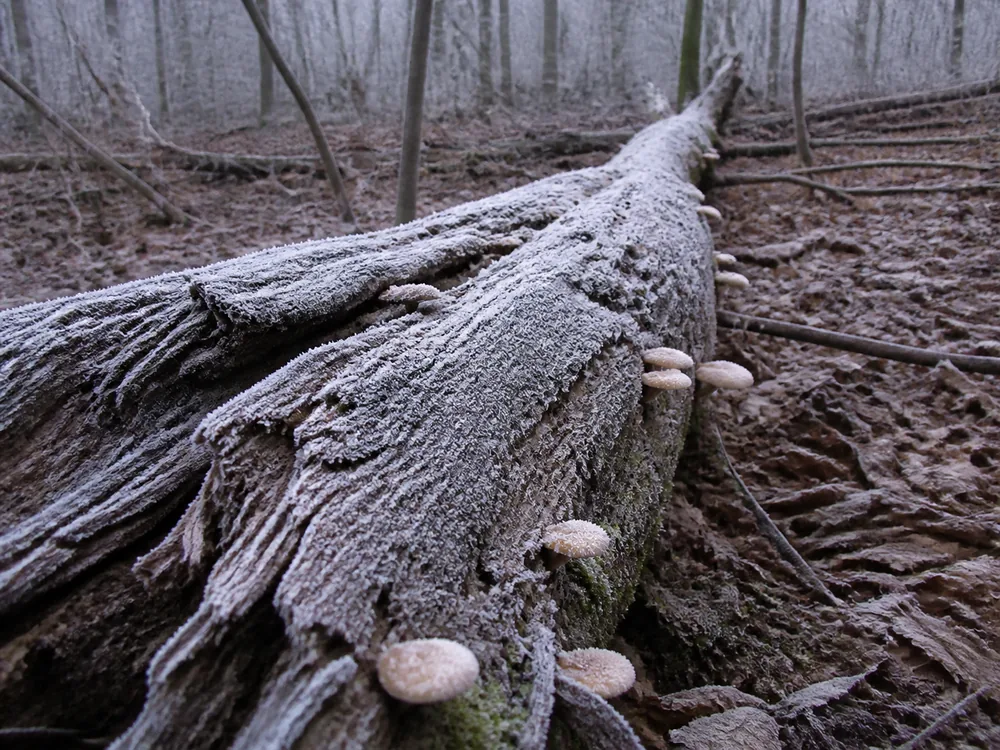
Freezing does not necessarily ruin them
A frozen mushroom on a log is not automatically spoiled, which surprises people.
Several winter species tolerate freezing and thawing repeatedly, and an oyster mushroom that froze solid can still be firm and good when it thaws. What ruins them is repeated freeze and thaw over a long period, which turns the flesh to mush.
Reading those states takes practice, because frost changes a mushroom's look before it changes its condition.
Warning
Cold does not make identification easier. Frozen specimens change texture and color, and a frost-damaged cap can look like a different species entirely.
What is not in the winter woods
Knowing what cannot be there is useful, because it removes a set of worries.
The soil-fruiting mycorrhizal species, including the deadly Amanitas, are largely finished by hard winter in cold regions. That does not apply on the mild Pacific coast, where several of them fruit through winter.
Note
In mild coastal regions the winter list is much longer and includes species that are dangerous. This section describes cold-winter regions, not the whole continent.
Regional difference matters more in winter than in any other season.
A winter walk in Minnesota and one in coastal California are different activities with different species and different risks. The species pages set out where each one fruits.
ForagingMushroom foraging laws in Germany: protected species and small quantitiesPractical winter collecting
Cold changes the practicalities more than the identification.
Frozen specimens are brittle and break when handled, so a rigid container beats a bag. Gloves make base-digging awkward, which is a real problem for anything that needs a whole specimen.
A cold specimen is also harder to photograph well, since condensation forms the moment it comes indoors.
Winter rain and thaw cycles trigger fruiting the same way rain does in warmer months. Frozen ground is the exception, since water runs off it rather than soaking in.
A mild spell after a freeze often produces a flush within a few days on wood, and the mechanism is set out under mushrooms after rain.
The rest of the year is covered under spring mushrooms, summer mushrooms, and fall mushrooms.
Velvet shank and the confusion that matters
Velvet shank is the winter species most worth learning, and it is also the one with a genuinely dangerous lookalike. Both fruit on wood in the cold.
It has a sticky orange-brown cap, pale gills, and a stem that darkens to nearly black and velvety toward the base. It fruits in clusters on hardwood through frost, which is exactly when little else does.
The problem is that deadly galerina also fruits on wood in cold weather.
| Feature | Velvet shank | Deadly galerina |
|---|---|---|
| Spore print | White | Rusty brown |
| Ring | None | A thin ring, often lost with age |
| Stem base | Dark brown to black and velvety | Brown, darkening upward, not velvety |
| Cap | Sticky orange-brown | Tawny, drying two-toned |
The spore print settles it and nothing else reliably does.
Warning
A white print and a rusty print are two different mushrooms whatever the caps looked like on the log. Any clustered wood mushroom intended for the pot needs a print first, in winter as much as in autumn.
Velvet shank rewards the wait, because it holds condition on the log for weeks in cold weather.
Winter as a learning season
The quiet months are the best time to practice identification, and that is an argument for going out even without a basket.
Bracket fungi persist on wood all winter, which means the same specimen can be visited repeatedly. Watching one change over weeks teaches more than a single encounter in a busy autumn.
Tree identification is the underrated part of that list.
Most mushrooms are tied to particular trees, and winter is when the trunks and branch structure are visible without leaves in the way. A forager who learns their local trees in January finds more in July.
Wood ear and the cold
Wood ear is the winter species that behaves most strangely, and the behavior is worth knowing before judging a specimen.
It dries to a hard dark shell on the branch and rehydrates to soft rubbery flesh when it rains, repeatedly, through the whole season. A dried-out specimen is not dead and often becomes usable again after the next wet spell.
That cycling is why the same branch can be checked all winter.
It also means a specimen that looks poor on a dry day is worth returning to rather than dismissing, which is the opposite of the rule for most mushrooms.
Cold weather does slow everything, including the fungus.
Winter fruiting is genuinely slower rather than simply rarer, so a cluster that appears in November may still be growing in December. That is part of why a winter log rewards repeat visits more than an autumn one does.
Dressing for it changes what you find
Winter trips end early for the wrong reasons more often than for the right ones.
Cold hands make base-digging and photography clumsy, and a forager who is uncomfortable stops looking properly long before the light goes. Thin gloves that come off easily do more for a winter walk than heavy ones.
Light is the real constraint rather than temperature.
Short days and low sun under a canopy make winter woodland darker than the hour suggests, and a mushroom on the underside of a log is easy to walk past. A headlamp is worth carrying even for an afternoon walk.
Snow cover changes the search rather than ending it.
A few inches of snow hides ground-level fruiting entirely while leaving mushrooms on standing trunks and the undersides of fallen logs visible. That is another reason a winter walk should follow wood.
Melt at the base of a trunk is worth checking.
Dark bark absorbs enough sun to clear a ring of snow around a trunk on bright days, and that thawed collar is often where the first winter fruiting on a tree appears.
Sources & References
- North American Mycological Association General reference on seasonal species and their substrates.
- MushroomExpert Species reference for oyster mushrooms, including cold-weather fruiting.