Is eastern flat-top Agaricus poisonous?
Eastern flat-top Agaricus answers a practical question for eastern North American foragers. What should you do with a white Agaricus whose cap has a nearly black, flattened center and whose stem base smells chemical?
Leave it out of the meal.
Agaricus placomyces belongs to section Xanthodermatei, a group known for phenolic odor, yellow bruising reactions, and gastrointestinal toxicity. Chemical analysis found a high phenol content consistent with the mushroom's reported unpleasant odor and mild poisoning.
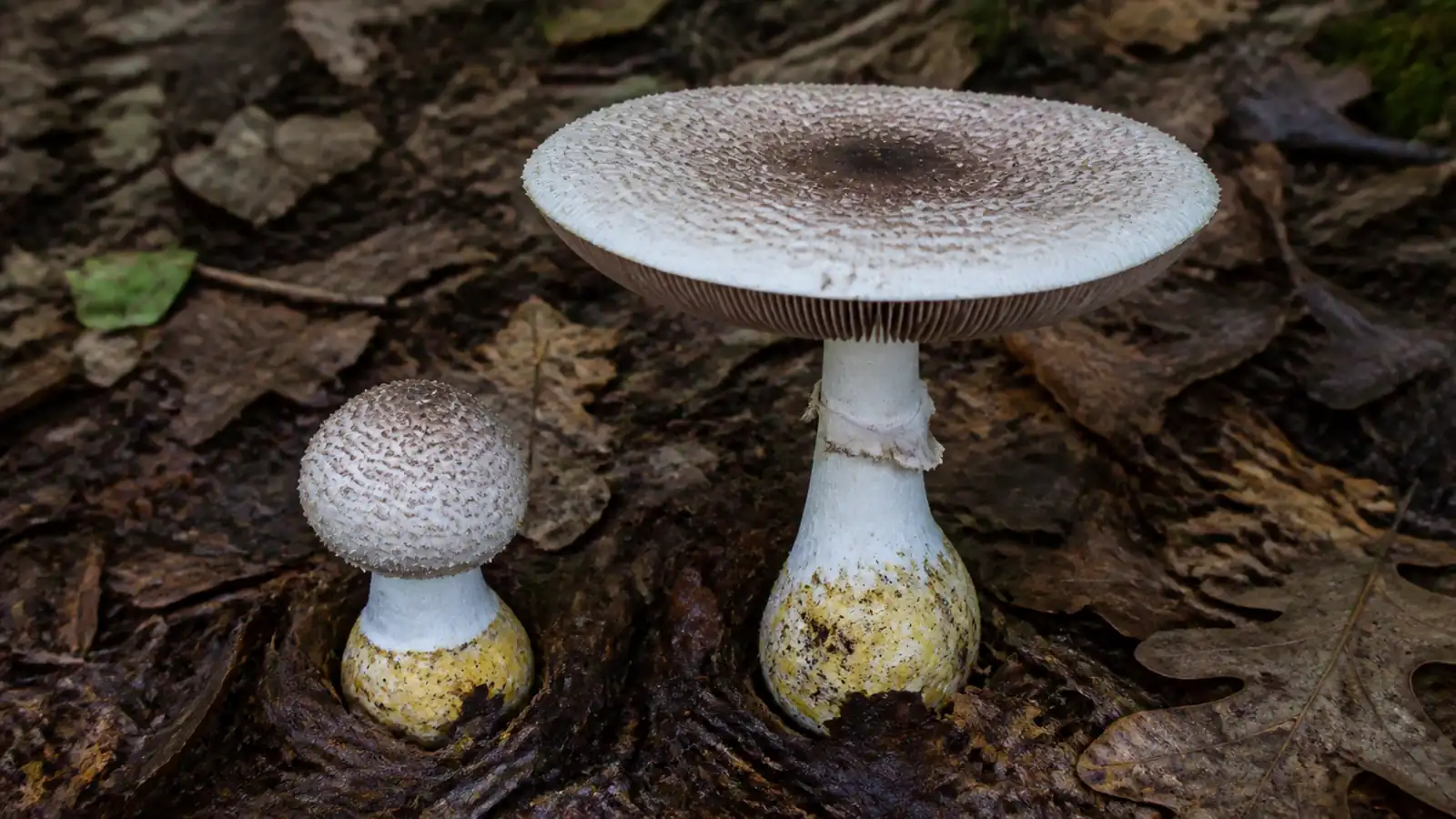
The cap creates the first visual clue.
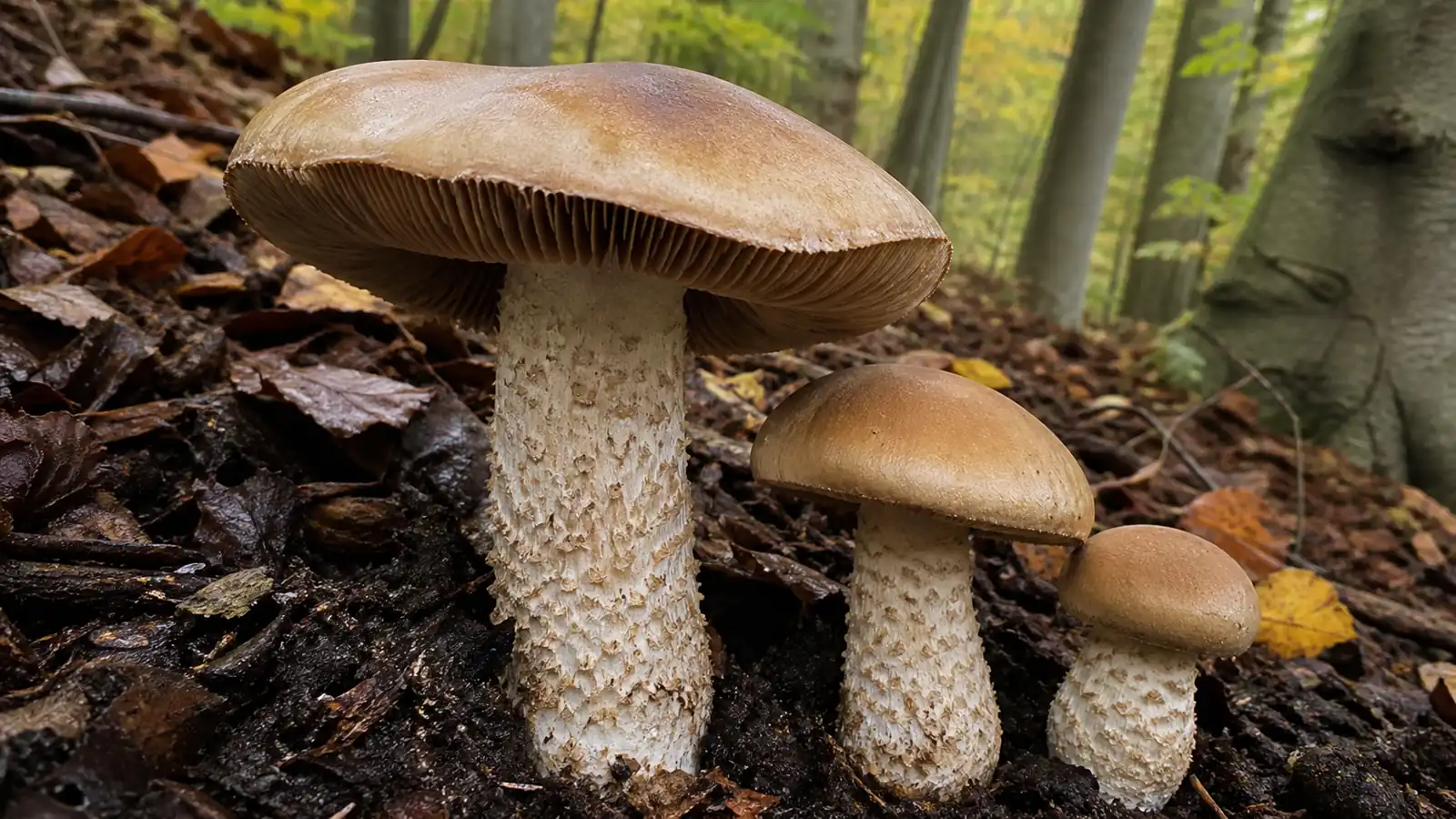
Fine gray to brown scales spread across a white background and concentrate into a dark disc, while the overall cap often becomes broadly convex or nearly flat. That scaled center can resemble an edible woodland Agaricus from above.
The underside tells the genus story rather than the species.
Gills stand free from the stem and change from pale to pink, then chocolate brown. A chocolate spore print supports Agaricus, but it does not separate edible members from this toxic one.
Key takeaway
A dark-scaled flat cap plus a phenolic odor and yellow staining at the bulbous stem base should end the food decision. Do not keep testing a suspect specimen for the kitchen.
Agaricus placomyces is the North American species described by Charles Horton Peck. Similar European mushrooms are generally treated under Agaricus moelleri, and western North America contains additional dark-scaled taxa.
Analytical work connects high phenol concentrations with the mushroom's chemical odor and reported gastrointestinal effects. That chemistry explains toxicity rather than a medicinal use.
Charles Horton Peck described the species in the nineteenth century, but later type studies narrowed the name.
European Agaricus moelleri and several western North American taxa should not be folded into every older A. placomyces record.
The field decision is stronger than the exact name. A dark-scaled woodland Agaricus that develops a chemical odor or a yellow basal reaction belongs outside the food basket even when regional taxonomy remains unresolved.
Chemical analysis found phenol to be a major volatile component in studied A. placomyces material. That result helps explain the ink, disinfectant, or hospital-like odor and the history of gastrointestinal reactions, but a person cannot measure phenol by smelling one cap.
Symptoms reported from toxic Agaricus exposures usually center on nausea, cramps, vomiting, and diarrhea.
Severity varies, and a meal can include more than one species, so save specimens and call poison services rather than using the expected syndrome to identify the mushroom after the fact.
The flat dark disc also creates a visual bias. Once a collector decides the cap resembles a familiar edible Agaricus, pink gills and a ring can feel confirmatory, even though those are genus-level characters shared by both edible and toxic members.
How do you identify Agaricus placomyces?
White beneath fine gray-brown scales, usually darkest over the flattened center, commonly 5 to 12 cm wide.
Free from the stem, pale when very young, then pink and finally chocolate brown as spores mature.
White, slender, often bulbous at the base, with a membranous ring and yellow staining near the base when rubbed or cut.
White flesh with a phenolic, ink-like, or chemical odor, often strongest at the stem base.
Examine the mushroom before it is handled repeatedly. Note the cap surface, photograph the intact ring and base, then rub or cut the lower stem and watch for a color change.
The cap begins convex and expands toward flat, commonly reaching 5 to 12 cm. Its white background carries small gray-brown fibrillose scales, with the scales packed most densely into a dark central disc.
| Field character | Supports A. placomyces | Reason to stop or reconsider |
|---|---|---|
| Cap surface | Fine dark scales concentrated at the disc | Smooth cap or coarse removable patches suggest another group |
| Mature gills | Chocolate brown and free from the stem | White mature gills point away from Agaricus |
| Basal reaction | Yellow after rubbing or cutting | No reaction does not prove edibility |
| Odor | Phenol, ink, iodine, or disinfectant | A mild almond odor suggests a different Agaricus but still needs full ID |
| Setting | Woodland litter and shaded rich soil | Open grassland favors other species but does not clear them |
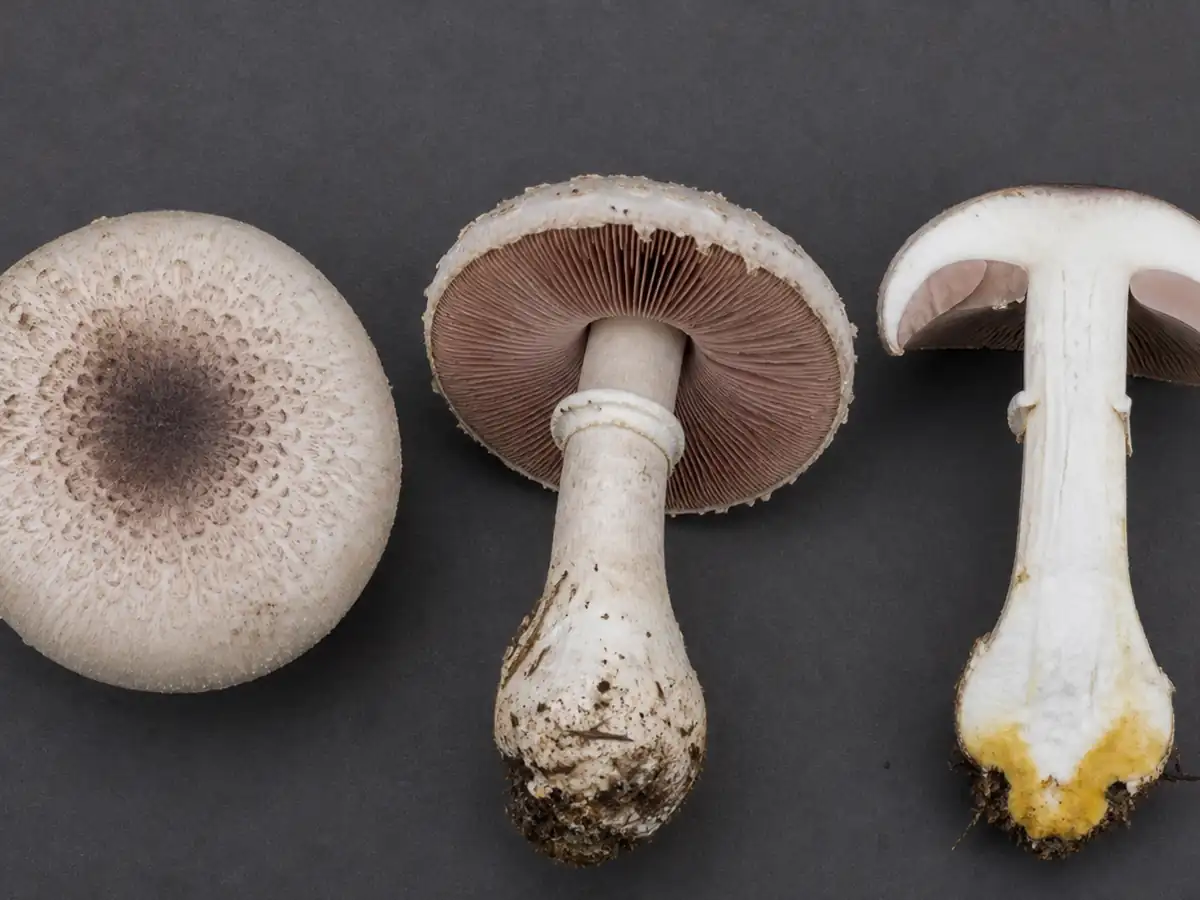
A spore print should be chocolate brown. It helps reject white-spored Amanita and green-spored Chlorophyllum, but several edible and toxic Agaricus species share the same print color.
Young specimens can hide the gills behind a partial veil.
Do not confuse that enclosed cap with a white puffball. A lengthwise cut reveals the developing cap, gills, stem, and veil, while a true puffball has uniform interior tissue without a hidden mushroom.

Agaricus identification often needs more than macroscopic characters. Closely related dark-scaled species overlap in stain, odor, and cap pattern, so a field photo may support the toxic-group decision without proving the exact species.
Time the basal reaction instead of recording only yellow or not yellow. Scratch and cut a small area at the lower stem, watch it immediately, then check again after several minutes because intensity can fade and old or waterlogged tissue may react weakly.
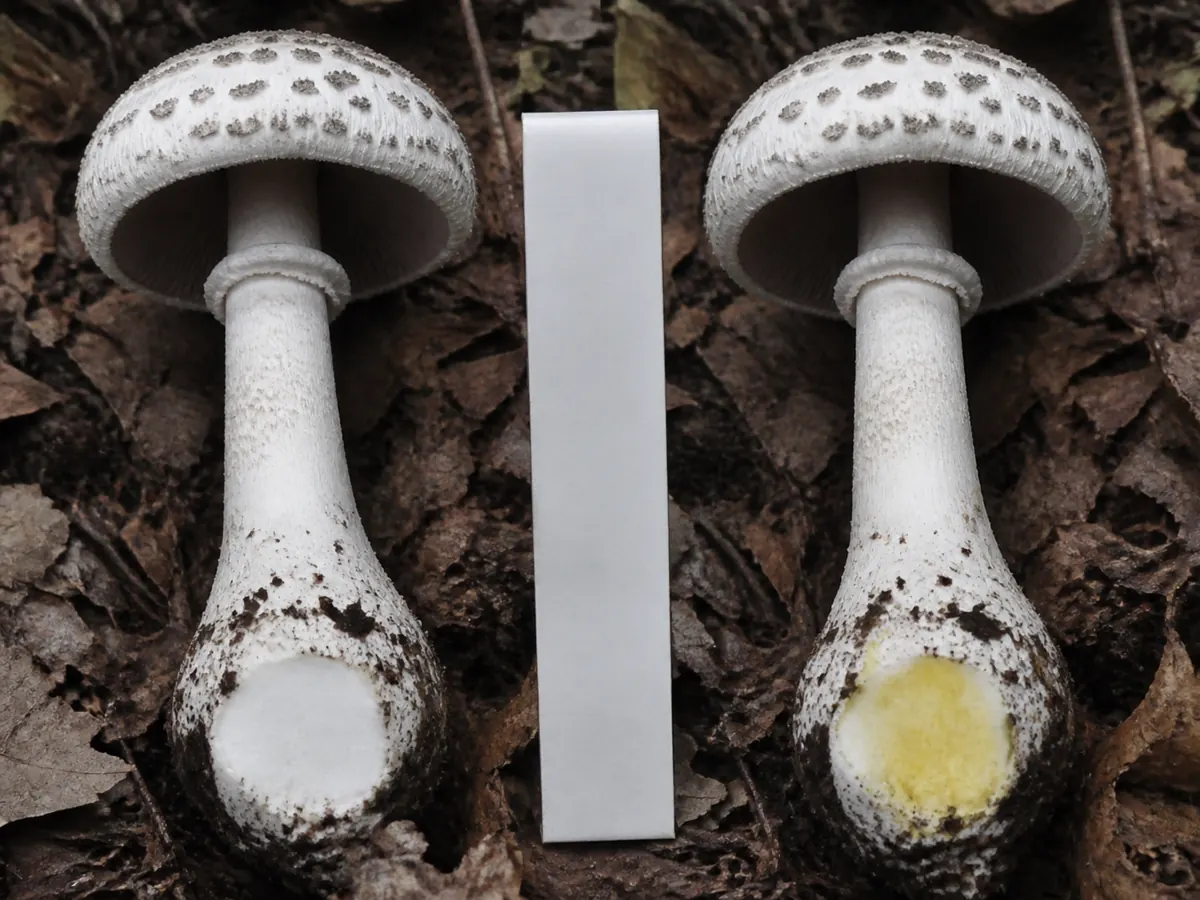
Odor should be assessed from intact cap flesh and freshly damaged basal tissue. A pleasant almond or anise note can support a different group, while phenol, iodine, hot plastic, or ink strengthens the rejection, but weak smell in cold weather does not certify edibility.
Keep the entire swollen base. Trimming it in the field removes the most useful staining and odor tissue, and it can also hide a volva if the specimen is not an Agaricus at all.
The free-gill sequence provides a developmental check.
Young gills are pale behind the veil, then turn pink and finally chocolate brown without attaching to the stem, while the veil remains as a ring and the cap spreads toward its flat mature form.
When the dark scales, slender build, stain, odor, and eastern woodland context do not all agree, stop at a toxic Agaricus group identification. Microscopy and DNA can resolve records that a meal decision does not need resolved.
If someone may have eaten this mushroom, act now. Call Poison Control at 1-800-222-1222 (US) or emergency services before symptoms appear, and save a piece of the mushroom for identification.
When should suspected Agaricus poisoning get medical help?
Animal bites and insect tunnels do not establish human edibility. Evidence from a cultivated Agaricus species also cannot be transferred to this wild toxic species merely because both share a genus.
A missing chemical odor does not reverse the warning when the specimen is old, cold, waterlogged, or incompletely collected. The safest response is to reject the collection when the basal tissue, stain timing, or regional identity cannot be checked.
After a possible meal, record when the mushrooms were collected, how they were prepared, how many people ate them, and when each symptom began. Keep raw specimens and cooked leftovers because poison specialists may need to distinguish a toxic Agaricus from an Amanita or another mushroom with a different clinical course.
Do not test another portion to confirm the cause. Individual reactions and portions differ, and a second exposure adds risk without improving the evidence already available from the remaining material.
Which edible Agaricus species resemble it?
Eastern flat-top Agaricus resembles edible Agaricus species because it begins with pale gills, develops a ring, and ends with the same chocolate-brown spores. The safety split comes from the complete pattern of a dark-scaled flat cap, chemical odor, yellow staining, woodland habitat, and a slender bulbous stem.
No single character clears an Agaricus for eating. Yellow staining varies, odors fade, and closely related species may require microscopy or DNA data.
Reject a wild Agaricus that smells of phenol, ink, iodine, or disinfectant. The odor may be strongest after the stem base is crushed or warmed, but deliberately cooking a suspect mushroom to intensify the smell is unsafe.
Edible field and horse mushrooms can yellow slightly, while toxic members of section Xanthodermatei often yellow more clearly at the stem base. Use staining as one warning in a full identification, never as a universal rule.
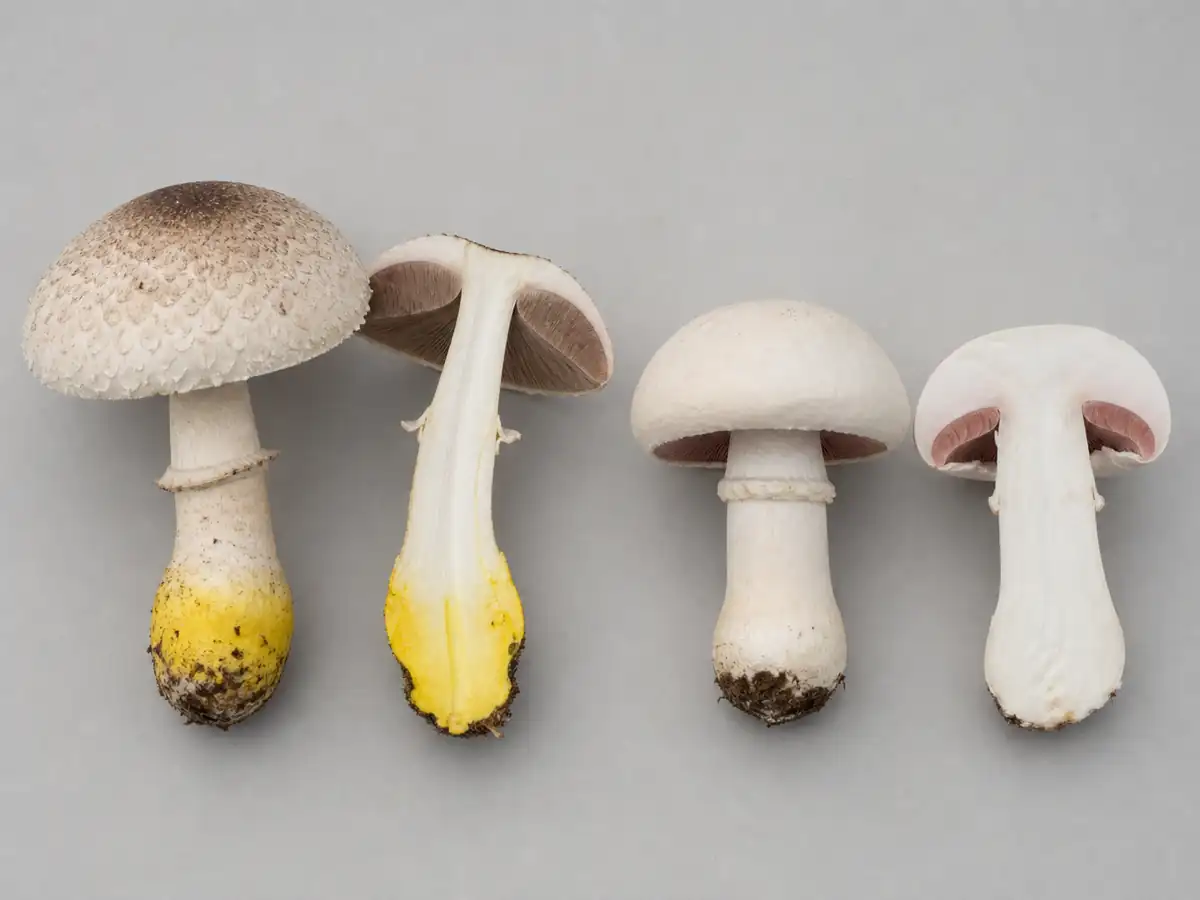
Western North American and European dark-scaled Agaricus have been called A. placomyces in older sources. Modern work separates several regional species, so location belongs in the identification.
Agaricus campestris and other edible field mushrooms attract attention because they also have free pink-to-brown gills and a ring. They more often favor open grass, lack the dark placomycetoid cap pattern, and do not produce the same phenolic basal warning, yet variable weathered specimens still demand a regional key.
Almond-scented woodland Agaricus can be edible, but odor descriptions are subjective and a damaged old mushroom may smell only stale. Use the scent as one branch in the identification rather than a reason to ignore a yellow base or dark central scales.
Young white mushrooms require a different safety check. Cut them lengthwise before assuming Agaricus because a developing cap and gills distinguish a button from uniform puffball flesh, while a basal cup or white mature gills can point toward an Amanita.
The practical threshold stays conservative. If the stem base was discarded, the odor was never checked, or the regional name is uncertain, the collection lacks the evidence needed for food.
Can you cook eastern flat-top Agaricus?
Do not cook or eat eastern flat-top Agaricus. Reports associate it with nausea, vomiting, cramping, and diarrhea, and laboratory work found a high phenol content that helps explain its unpleasant chemical odor.
Cooking is not an identification test.
Heating a suspect Xanthodermatei mushroom may intensify its phenolic smell, but bringing it into the kitchen creates an avoidable exposure and does not prove a species.
If it was mixed with edible mushrooms, discard the meal rather than sorting cooked pieces by appearance. Preserve an uncooked specimen and photographs if anyone ate from the batch.
Symptoms from gastrointestinal irritant mushrooms can begin within a few hours, but timing varies and mixed collections can contain a more dangerous species. The guide to mushroom poisoning symptoms explains why the full timeline and remaining specimens matter.
Warning
A supermarket-style shape does not make a wild Agaricus safe. Free gills, a ring, and brown spores identify a broad genus that includes both food species and poisonous species.
If illness follows a mixed Agaricus meal, record the number and size of mushrooms, preparation method, meal time, symptoms, and whether every specimen came from the same collection. Keep uncooked specimens and clear photographs for the poison specialist.
Where does eastern flat-top Agaricus grow?
Agaricus placomyces decomposes organic material in soil and litter rather than partnering directly with living tree roots. It appears on rich ground in deciduous or mixed woods, along shaded paths, and in planted areas where leaf litter accumulates.
Freeman's North American type studies described a placomycetoid stature.
The cap is narrower than the long stem, and the fruiting body is relatively thin-fleshed with a slender bulbous base. That build fits a woodland mushroom better than the thick, squat form often associated with open-field Agaricus.
Summer and fall provide the usual fruiting window, especially after warm rain. A lawn edge beneath trees can still suit the species when buried litter and organic soil reproduce woodland conditions.

The name should not be stretched across continents.
North American type material anchors A. placomyces, while European records formerly assigned to it are now commonly interpreted as A. moelleri. Regional context prevents a familiar photograph from becoming a false species claim.
Fruitings are favored by organic soil, leaf litter, buried wood, and steady moisture.
Reducing heavy thatch, removing buried woody debris, and correcting constant irrigation may reduce recurrence, although the underground mycelium can remain after visible mushrooms are picked.
The fungus uses carbon already present in litter and organic soil. It does not need to attach to a living root, which is why fruiting can appear in a mulched bed after the original woodland vegetation has changed.
Rain after warm weather can produce a short flush with several ages at once. Photographing young, open, and mature specimens together shows the gill-color and cap-shape sequence more reliably than treating each age as a different mushroom.
Yard recurrence usually reflects moisture and buried organic material rather than a dangerous tree disease. Picking caps removes the visible exposure, while adjusting chronic irrigation or removing decaying woody debris can reduce favorable fruiting conditions without sterilizing the soil.
Location also controls the name.
The eastern North American type concept should not be exported automatically to western collections or European A. moelleri, even when a dark disc and yellow stain look familiar.
Which region does the name Agaricus placomyces cover?
Agaricus placomyces Peck is a North American species in Agaricaceae and section Xanthodermatei. Peck published the name in the nineteenth century, and Freeman later re-examined North American Agaricus type material to clarify the species concept.
Older field literature applied A. placomyces broadly to dark-scaled mushrooms in Europe and western North America. Modern regional and molecular work separates European A. moelleri and several western taxa rather than treating every flat dark-centered cap as one species.
The name A. placomyces should remain within its eastern North American boundary rather than being applied to a European or western collection.
Photographs alone also cannot establish species-level certainty.
Agaricus placomyces is best used for material that fits the eastern North American concept. Older field guides sometimes applied the name broadly to dark-scaled, phenolic woodland mushrooms across continents, but modern regional treatments separate several close taxa.
European material with a similar flat dark-scaled cap is often called Agaricus moelleri.
Western North American collections can fall among other placomycetoid species, so a photograph from one region is not a universal reference standard.
This naming limit does not weaken the safety decision. A collection can be rejected confidently as a phenolic yellow-staining Agaricus even when microscopy or sequencing would be required to print an exact species name on a voucher.
The regional boundary also affects image searches. Photographs labeled A. placomyces may show European or western taxa under an older broad usage, so compare a candidate with voucher-backed records from the same region instead of relying on a high-ranked gallery image.
Eastern flat-top Agaricus questions
Is Agaricus placomyces edible?
What does it smell like?
Does it stain yellow?
What color is the spore print?
Where is it found?
Is the European flat-top Agaricus the same species?
Sources & References
- Mycotaxon, Agaricus in North America type studies Type-based North American taxonomy and the woodland placomycetoid stature.
- Chemistry Central Journal, two inedible Agaricus species GC-MS analysis linking high phenol content with odor and reported mild toxicity.
- Journal of Fungi, review of Agaricus poisoning Poison-control evidence for gastrointestinal syndrome involving Agaricus placomyces.
- NCBI Taxonomy, Agaricus placomyces Current database lineage and North American species name.