Overview
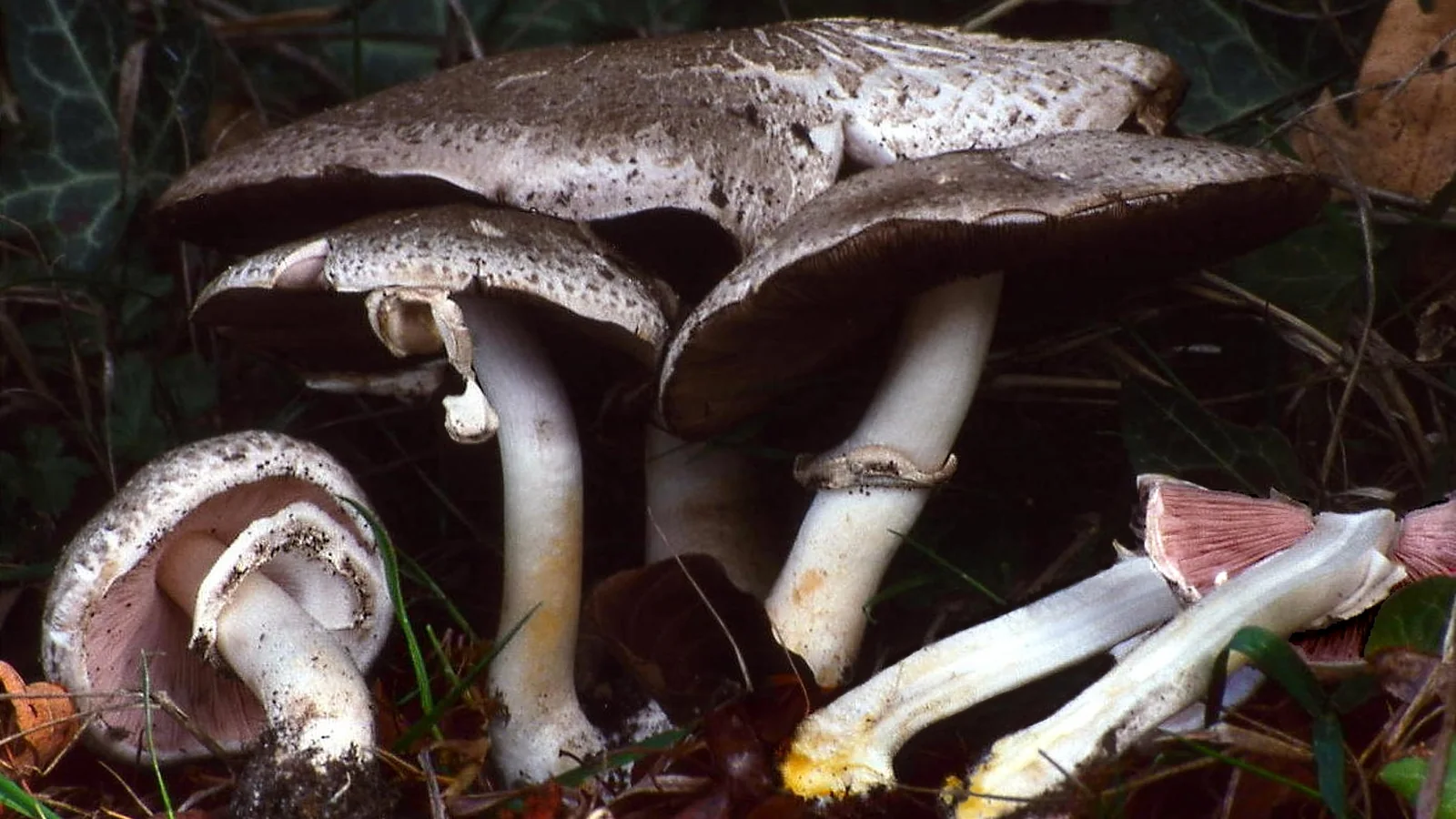
The inky mushroom belongs to the yellow-staining group of Agaricus, the same broad group that contains several species responsible for mushroom-poisoning cases. Its field combination is a pale cap patterned with dark gray or blackish scales, free gills that mature from pink to dark brown, a broad ring, and a base that flashes bright yellow when cut.
Do not use the name as an edibility shortcut.
Gray-scaled Agaricus species overlap in appearance, and a regional collection may belong to a closely related taxon even when an older field guide calls it A. moelleri.
- scientific name
- Agaricus moelleri Wasser
- family
- Agaricaceae
- edibility
- Poisonous and capable of causing gastrointestinal illness
- strongest field clue
- Rapid yellow staining in the lower stem and bulbous base
- spore deposit
- Dark chocolate brown to purplish brown
The common name comes from the dark cap pattern and the ink-like or chemical odor reported from damaged flesh. Odor varies with age, temperature, and the observer, so an absent smell does not clear a specimen for food.
How do you identify an inky mushroom?
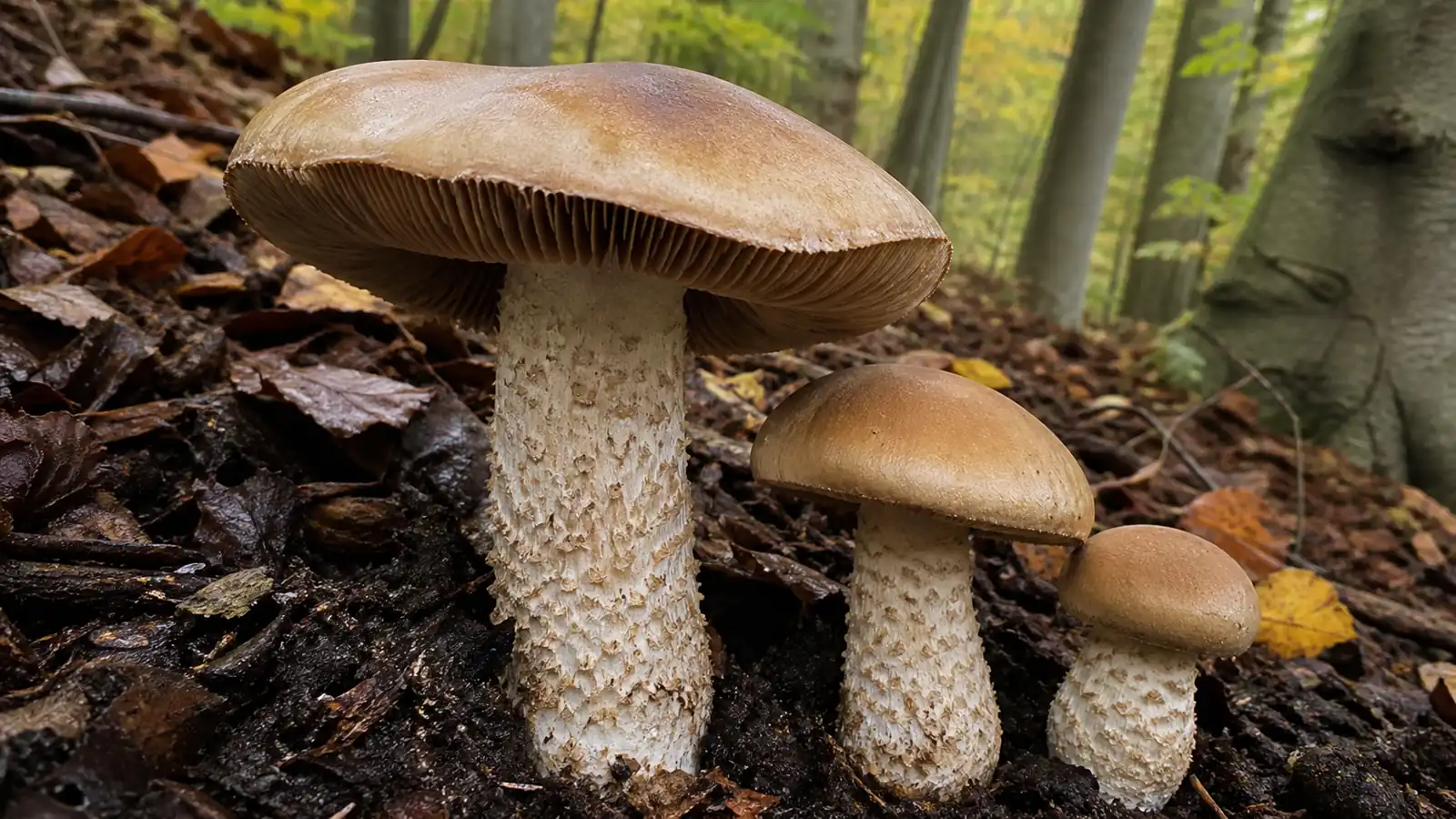
Usually 5 to 12 cm across, initially rounded and then broadly convex to flat. The pale gray background is covered with smoke-gray to nearly black fibrils or scales that are densest at the center and may split into patches toward the margin.
Free from the stem and crowded. They begin pale gray-pink, deepen through pink and brown as spores mature, and finish dark chocolate to purplish brown.
White, smooth to slightly silky, commonly 6 to 15 cm tall, with a swollen or bulbous base and a broad persistent skirt-like ring. Cutting or firmly bruising the lower stem and base produces a rapid chrome-yellow stain that later dulls.
White flesh that yellows strongly at the stem base. The odor is phenolic and has been compared with ink, iodine, disinfectant, or library paste, especially when the base is rubbed or warmed.
Start with the whole fruit body. Mature caps are commonly 5 to 12 cm wide, with a pale gray surface under fine charcoal fibrils that crowd together over the center and become looser scales toward the margin.
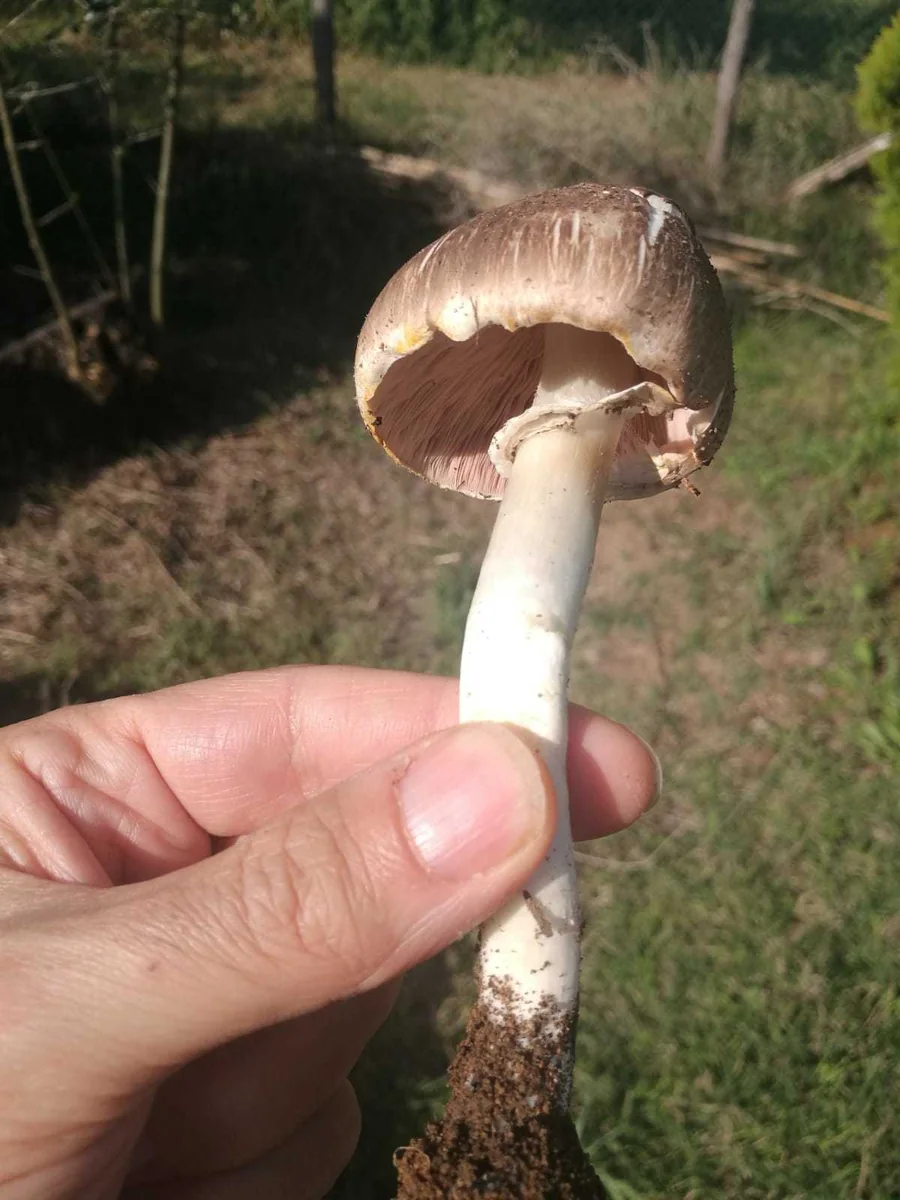
The gills are free, which means a narrow gap separates them from the stem. Young gills may look pale or gray-pink, but they turn pink, brown, and finally dark chocolate as the spores mature.
The white stem carries a broad membranous ring and often expands into a bulb at the bottom. The lower stem and base provide the most useful stain test, because a fresh cut there develops a strong chrome-yellow color much faster than ordinary age-related discoloration.
A field identification should use all of those characters.
Rain can wash or flatten cap scales, old mushrooms can lose their ring, and yellow staining can fade before a photograph is taken.
If someone may have eaten this mushroom, act now. Call Poison Control at 1-800-222-1222 (US) or emergency services before symptoms appear, and save a piece of the mushroom for identification.
Is the inky mushroom poisonous?
Research has found that phenol concentration changes with tissue, maturity, and growing substrate. That variation may help explain why one meal causes marked illness while another reported exposure seems milder, but a weak odor or mild previous reaction does not make the mushroom safe.

Warning
If someone has eaten a suspected inky mushroom, call Poison Control at 1-800-222-1222 in the United States or the local poison center immediately. Do not wait for symptoms, do not induce vomiting unless a clinician tells you to, and keep uncooked specimens, scraps, and clear photographs for identification.
- Record when the mushroom was eaten and how much may have been consumed.
- Keep every remaining specimen in a paper bag in the refrigerator.
- Photograph the cap, gills, ring, whole stem, base, habitat, and any color change.
- Call emergency services for collapse, trouble breathing, confusion, seizure, or severe dehydration.
The mushroom-poisoning symptoms guide explains what information to collect while professional help is being arranged. Home cooking, soaking, drying, or freezing should never be used as a detoxification test.
Which mushrooms look like the inky mushroom?
Several Agaricus share pink-to-brown gills, a ring, and a brown spore print, so the cap pattern and base reaction carry much of the comparison. The table below separates the most useful field tendencies, but no single row proves a meal is safe.
| Possible confusion | Cap and stain | Odor and safety decision |
|---|---|---|
| Inky mushroom | Gray to black scales concentrated over the center, strong yellow at the lower stem and base | Phenolic or ink-like, poisonous |
| Yellow stainer | Usually smoother and paler, often stains strongly yellow around the cap edge and stem base | Phenolic, poisonous |
| Field mushroom | Mostly white and may bruise faintly, without the same dark central scaling and vivid basal yellow | Pleasant mushroom smell, edible only after a complete expert identification |
| Horse mushroom | Pale to yellowish with a large ring, usually without the inky mushroom's black-gray center | Anise or almond odor is typical, but regional lookalikes still require full separation |
The yellow stainer, Agaricus xanthodermus, is the closest practical safety comparison because it shares the phenolic odor, rapid yellow reaction, and gastrointestinal risk. The inky mushroom usually has a much darker, more obviously fibrillose-scaled cap center.
Field and horse mushrooms are often sought for food, which makes a mistaken collection consequential. A pleasant odor can be weak or masked, and cap color changes with weather, so the comparison must include the intact base and mature gills.
Never clear a wild Agaricus for eating from a phone photograph or one stain test. Collect the whole base, compare several specimens at different ages, make a spore print, and use a current regional key.
In western North America, specimens once labeled A. moelleri or A. praeclaresquamosus may fall in the Agaricus deardorffensis group. That naming problem does not make a dark-scaled yellow-staining collection edible, but it does mean a European name should not be forced onto it without regional evidence.
Why does the scientific name vary by region?
The accepted name used here is Agaricus moelleri Wasser. Literature and older field guides may place similar material under names such as Agaricus praeclaresquamosus, so a synonym search is often needed when checking historical records.
North American naming needs extra care. The Electronic Atlas of the Flora of British Columbia notes that Pacific Northwest collections formerly called A. moelleri or A. praeclaresquamosus belong to the A. deardorffensis group, and that true A. moelleri is not known from that region.
A current regional key owns the species-level decision.
This profile explains the European concept and the safety pattern, while local taxonomic work determines which related name fits a collection elsewhere.
Can you cook an inky mushroom?
There is no safe culinary use for a suspected inky mushroom.
Frying can make its phenolic smell stronger, but using heat as a kitchen identification test exposes people to fumes and creates a risk that the cooked material will be tasted.
Do not mix unknown Agaricus into a basket of edible field mushrooms. Keep each uncertain collection separate until a qualified local identifier has examined the intact specimens, then discard any batch that cannot be resolved confidently.
Why might it appear in a garden?
This species is not a food-cultivation target. Its saprotrophic ecology explains why it can appear in compost-rich lawns, garden beds, and disturbed ground, but encouraging an unidentified yellow-staining Agaricus near children or pets adds avoidable exposure risk.
Remove fruit bodies with gloves or washed hands and dispose of them where they cannot be eaten. The underground mycelium may fruit again when moisture and temperature become suitable, so removal is a short-term exposure control rather than eradication.
Does it have a medicinal use?
No medicinal use justifies consuming a wild specimen identified as Agaricus moelleri. Chemical studies of yellow-staining Agaricus help toxicologists examine phenol and related compounds, but that research does not turn the mushroom into a treatment or supplement.
Claims based only on the genus name Agaricus are especially weak because the genus includes cultivated foods, sought-after wild edibles, and poisonous species. Evidence for one species or extract cannot be transferred to another mushroom that merely shares the genus.
Does nutrition matter for a poisonous species?
A nutrition panel is not appropriate for the inky mushroom because it should not be eaten. Protein, mineral, or fiber measurements would not offset the poisoning risk and could give a false impression that the species is a food.
If a meal contains an unknown Agaricus, the useful questions concern identification, amount eaten, timing, and symptoms. Nutrient estimates do not help a poison specialist manage the exposure.
Where and when does it grow?
The inky mushroom decomposes dead organic matter rather than forming a root partnership with a tree. It fruits from rich soil, leaf litter, buried woody debris, and other organic material in woodland, parks, gardens, verges, and disturbed grass.
Fruiting is most often reported from summer into late autumn. Rain and mild soil temperatures can produce scattered mushrooms or loose groups, while dry weather may leave only cracked, faded caps that are harder to read.
Habitat supports the identification but cannot settle it. Edible and poisonous Agaricus can fruit within the same park or woodland edge, so record nearby trees, substrate, growth pattern, and recent weather without treating location as proof.
Questions about the inky mushroom
Is the inky mushroom edible?
Why is it called the inky mushroom?
How quickly does the stem turn yellow?
Can cooking remove the toxin?
What should I do if someone ate one?
Does Agaricus moelleri occur in North America?
Sources & References
- NCBI Taxonomy: Agaricus moelleri
- EPPO Global Database: Agaricus moelleri
- Queensland Mycological Society Agaricus key
- Electronic Atlas of the Flora of British Columbia: Agaricus deardorffensis group
- Phenolic compounds in Agaricus section Xanthodermatei
- First Nature: Agaricus moelleri
- Poison Control wild mushroom warning