Overview
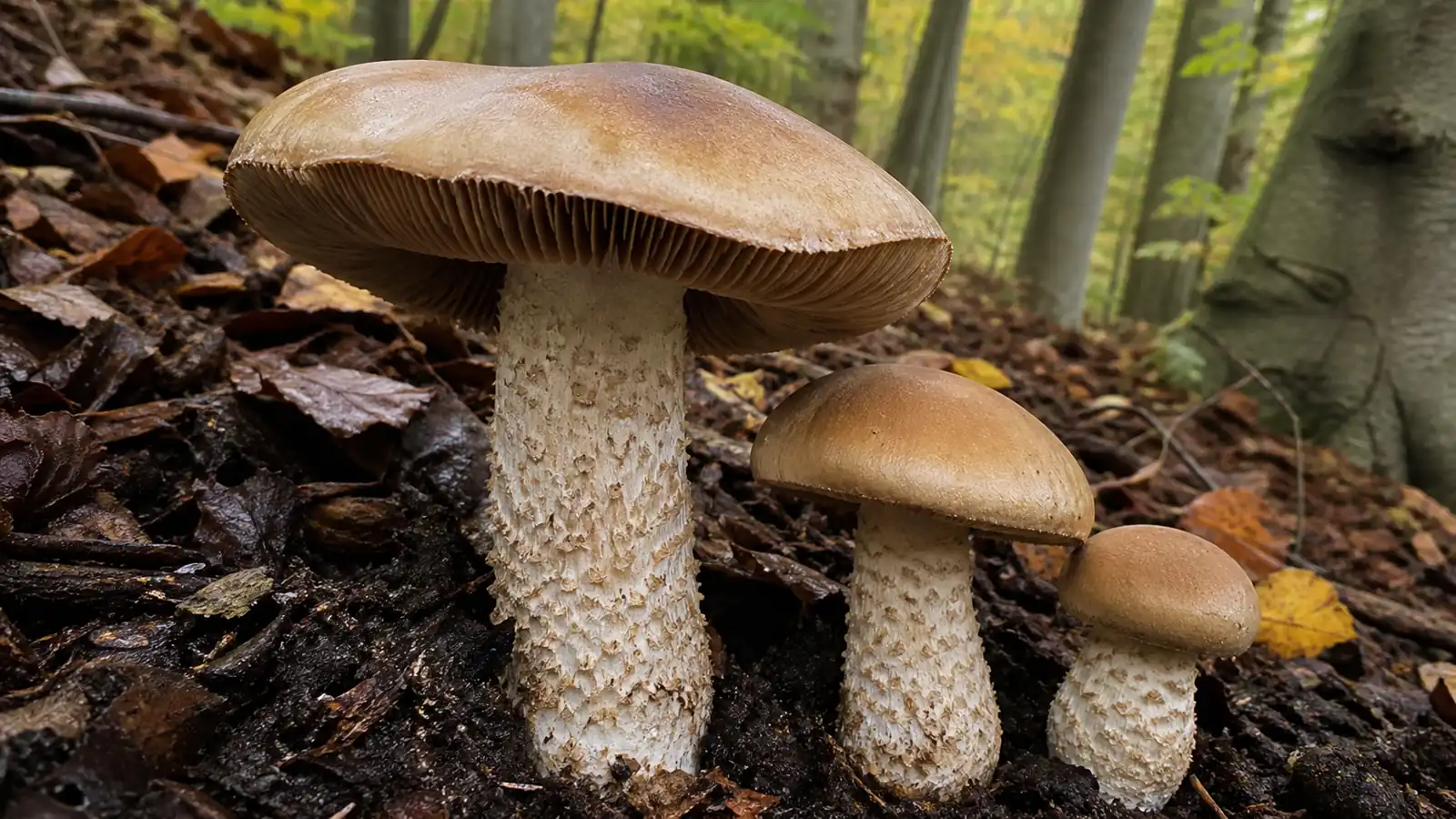
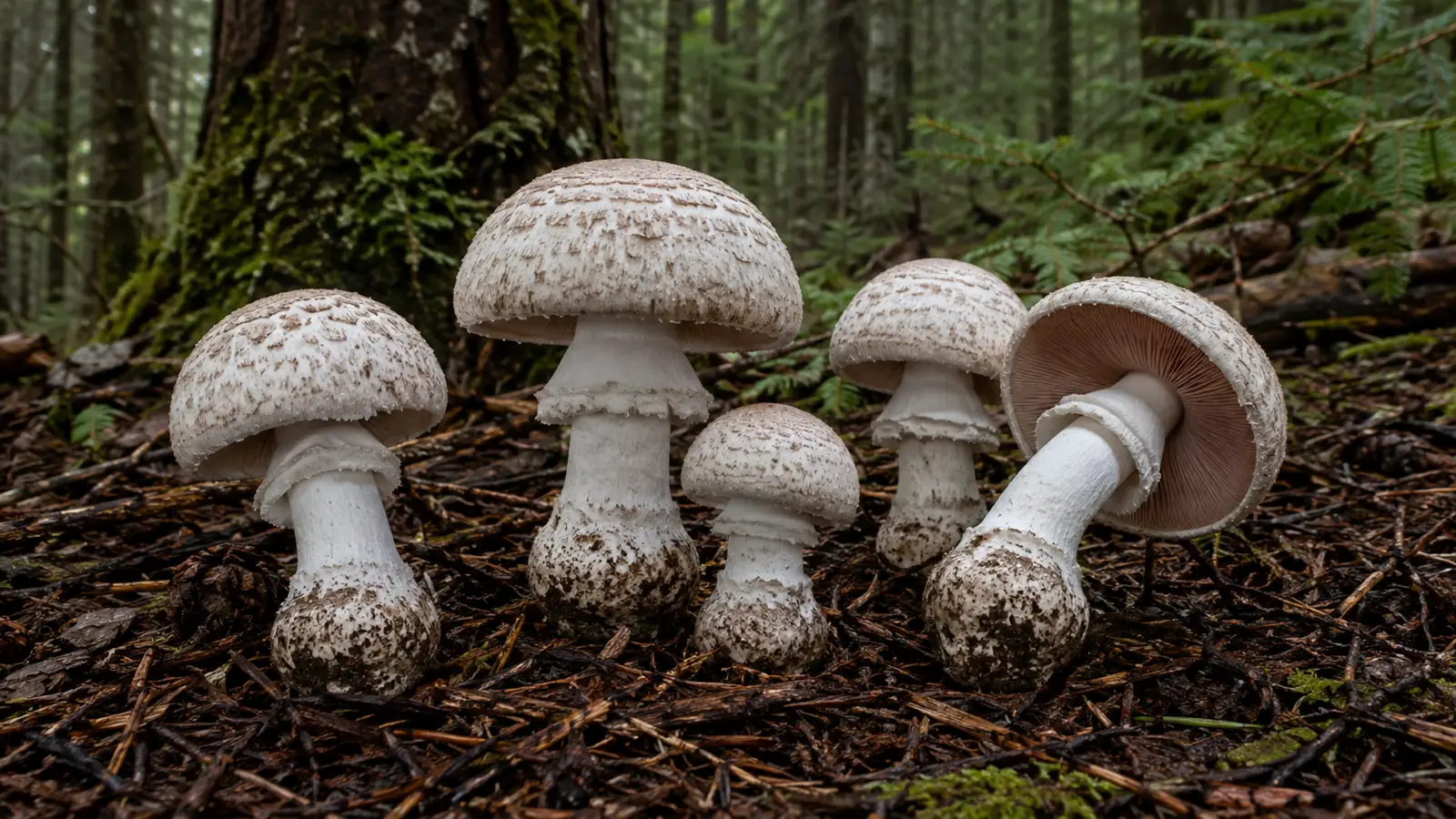
At first glance, felt-ringed agaricus resembles a robust store-bought mushroom that has wandered into a conifer forest. Its pale cap, pink-to-brown gills, central stem, and ring all fit the genus Agaricus, but the woodland setting and thick woolly ring begin a more specific assessment.
The cap opens from rounded to broadly convex and may flatten with age. Brownish fibrils break into fine scales over a cream background, while handling can add yellow or brown discoloration that varies among specimens.

Free gills stop just short of the stem and become progressively darker as spores mature. A chocolate-brown spore deposit supports Agaricus, although it does not separate the poisonous species from edible relatives.
Every useful character changes on its own schedule. This is why a collection of young and mature specimens gives more evidence than one perfect-looking cap.
How do you identify Agaricus hondensis?
Usually 4 to 15 centimeters broad, convex then flatter, dry, whitish to pale buff with gray-brown or brown fibrils and fine scales that may be denser toward the center.
Free from the stem and crowded, beginning pale or pinkish, becoming pink-brown, and finally dark chocolate brown as spores mature.
About 4.5 to 15 centimeters long, white, stout, often enlarged or bulbous at the base, with a thick persistent skirt ring whose underside is conspicuously felted or woolly.
White flesh may yellow weakly, especially at the cut or bruised stem base. The odor can be phenolic, medicinal, creosote-like, or unpleasant, but it may be faint until the basal tissue is crushed.
Excavate the mushroom rather than snapping it at ground level. The enlarged base carries staining and odor evidence, and a broken stem can hide the feature most likely to warn against eating the collection.
Inspect the cap dry and in natural light, then turn the specimen to confirm that the crowded gills are free from the stem. Note the current gill color because a closed button may not yet show the brown spores expected from a mature Agaricus.

The thick skirt-like ring persists on the upper stem, and its underside has coarse cottony or felted patches. Cut the stem base lengthwise and watch the exposed flesh, because the yellow reaction may be modest rather than instant or dramatic.
A phenolic odor may resemble ink, library paste, creosote, iodine, or medicinal chemicals. Smell from normal distance in fresh air, and do not inhale deeply or repeatedly from crushed tissue.
Do not let one weak stain overrule the rest of the collection. Temperature, age, dryness, handling, and the exact tissue tested can change how quickly color appears.
If someone may have eaten this mushroom, act now. Call Poison Control at 1-800-222-1222 (US) or emergency services before symptoms appear, and save a piece of the mushroom for identification.
What happens if you eat felt-ringed agaricus?
Symptom timing does not prove the species or guarantee a mild course. A mixed meal, mistaken specimen, underlying illness, and delayed effects from another mushroom can change the risk.
Do not eat this mushroom, and do not use a cooked taste test to identify it. Heat does not supply a reliable detoxification method for a collection that has been identified only by field appearance.
If someone ate a possible felt-ringed agaricus, contact a poison center or medical service rather than waiting for symptoms. Keep uncooked mushrooms, cooked leftovers, clear photos, collection location, amount eaten, and time of ingestion.
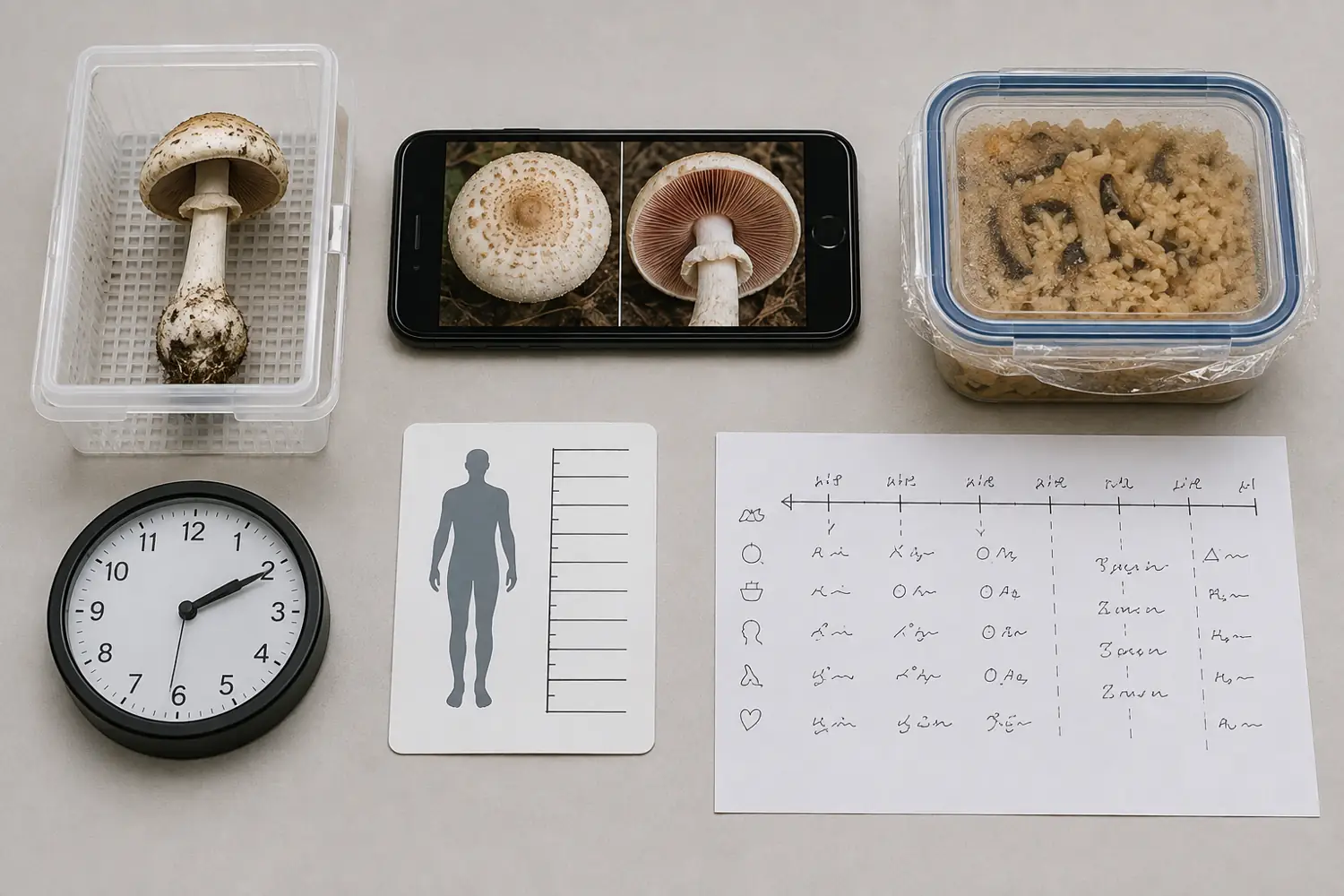
Use the mushroom poisoning symptoms guide to record timing without self-diagnosing. The hospital treatment guide explains why clinicians may use history, fluids, laboratory monitoring, and supportive care according to the actual case.
Which edible mushrooms resemble felt-ringed agaricus?
The prince, Agaricus augustus, can share woodland habitat, a large scaly cap, free brown-maturing gills, and a prominent ring. It usually has coarser tawny scales and a pleasant almond or anise odor rather than a phenolic basal odor, but neither impression is safe by itself.
Agaricus subrutilescens has a wine-brown fibrillose cap and can grow in western conifer forests. Horse-mushroom relatives may yellow and smell of anise, while members of the toxic yellow-stainer group can smell phenolic and yellow strongly.

Young destroying angels have white gills that remain white and a white spore print, and they may have a sac-like volva at the base. An immature specimen can hide those differences behind an unbroken veil.
An intact base and mature gill evidence are non-negotiable. A snapped white button with covered gills should remain unidentified and uneaten.
Edible and poisonous Agaricus can grow close together, so do not assume every mushroom in a patch belongs to the same species. Check each fruit body before grouping a collection.
A normal supermarket-mushroom smell does not cancel a suspicious habitat, felted ring, or yellow basal reaction. Odor perception differs among people and can fade in cold, dry, or old specimens.
How should yellow staining and phenolic odor be checked?
Test fresh tissue from more than one part of the specimen. Scratching the cap may produce little color, while cutting or crushing the bulbous base can reveal a clearer yellow reaction and a stronger chemical odor.

Record the immediate color and check it again after several minutes under the same light. A laboratory reagent belongs in trained identification work, not in a kitchen or an improvised edibility test.
Where does felt-ringed agaricus grow?
Felt-ringed agaricus is a saprotroph that feeds on decomposing organic material in soil and forest litter. It does not need to emerge from visible wood, even when roots, needles, bark fragments, and buried woody debris contribute to the substrate.
Western conifer forests supply thick litter and a cool wet fruiting season after autumn rains. Fruiting can also occur in disturbed woodland edges, gardens, or parks when the soil contains suitable organic material.
The mycelium remains below ground after the mushrooms collapse. Fruit bodies mark a temporary reproductive event, not the full boundary of the organism.
Documenting habitat helps distinguish a woodland collection from lawn-dwelling yellow stainers, but it cannot establish edibility. Several edible and toxic Agaricus species share trees, litter, and the same rainy weeks.
Can cooking make felt-ringed agaricus safe?
Felt-ringed agaricus has no safe culinary role because it can cause gastrointestinal poisoning. Removing the stem base, peeling the cap, parboiling, drying, or cooking it with other mushrooms does not create a verified edible ingredient.
The greatest kitchen hazard is mixing one poisonous specimen into a basket of edible Agaricus. Once sliced and cooked, the ring, gill attachment, base, odor, and staining record may be lost.
Sort and identify mushrooms outdoors or at a dedicated work surface before they enter food-preparation areas. Clean knives, boards, baskets, and hands after handling an uncertain collection so fragments do not migrate into a meal.
Which evidence confirms Agaricus hondensis?
Agaricus hondensis was described from western North America and belongs to a genus whose members share free gills, dark brown mature spores, and a partial veil that often leaves a ring. Those genus characters do not settle edibility.
Species identification uses a matrix of field and laboratory evidence, including cap covering, ring anatomy, staining, odor, habitat, spore size, chemical reactions, and DNA. Older regional names and changing sectional treatments can complicate record comparison.
A current regional key is more useful than a global photo gallery. Preserve locality and voucher evidence so a record can be revisited when taxonomy changes.
Does felt-ringed agaricus have medicinal uses?
There is no established medicinal use that justifies ingesting Agaricus hondensis. Detecting a compound or antioxidant response in a laboratory assay would not cancel the known poisoning risk or establish a human treatment.
The name Agaricus also appears on supplements made from other species, especially cultivated material. Genus-level labeling should never be assumed to refer to felt-ringed agaricus or to transfer safety evidence between species.
A poisonous field species is not made therapeutic by extraction. Concentration can increase exposure to unknown constituents, and self-made tinctures lack identity, dose, contaminant, and adverse-event controls.
Should felt-ringed agaricus be cultivated?
Felt-ringed agaricus is not a home food crop. Its saprotrophic biology makes culture possible in a laboratory, but reproducing mycelial growth is different from establishing a safe or useful production system.
Researchers who culture a poisonous Agaricus need authenticated material, containment, unambiguous labels, and disposal procedures that prevent it from entering edible culture work. Fruiting records should preserve the cap, gill, ring, base, stain, odor, microscopy, and sequence evidence.
For edible mushroom cultivation, use a verified commercial strain of the intended species. Do not clone a wild agaric because it smelled pleasant or grew beside mushrooms that someone previously ate.
Does nutrition change the poisoning decision?
Nutrition is not a meaningful reason to consume felt-ringed agaricus. Protein, fiber, mineral, or antioxidant measurements cannot turn a gastrointestinal poison into food.
A composition result from button mushroom or another cultivated Agaricus does not apply automatically to A. hondensis. Species, substrate, maturity, analytical method, and preparation all change the measurement.
If a poisoning exposure occurred, estimating nutrients distracts from the useful information. Record the amount, preparation, time eaten, symptom onset, patient details, and specimen evidence for the poison center.