
 Poisonous

What is a freckled dapperling mushroom?
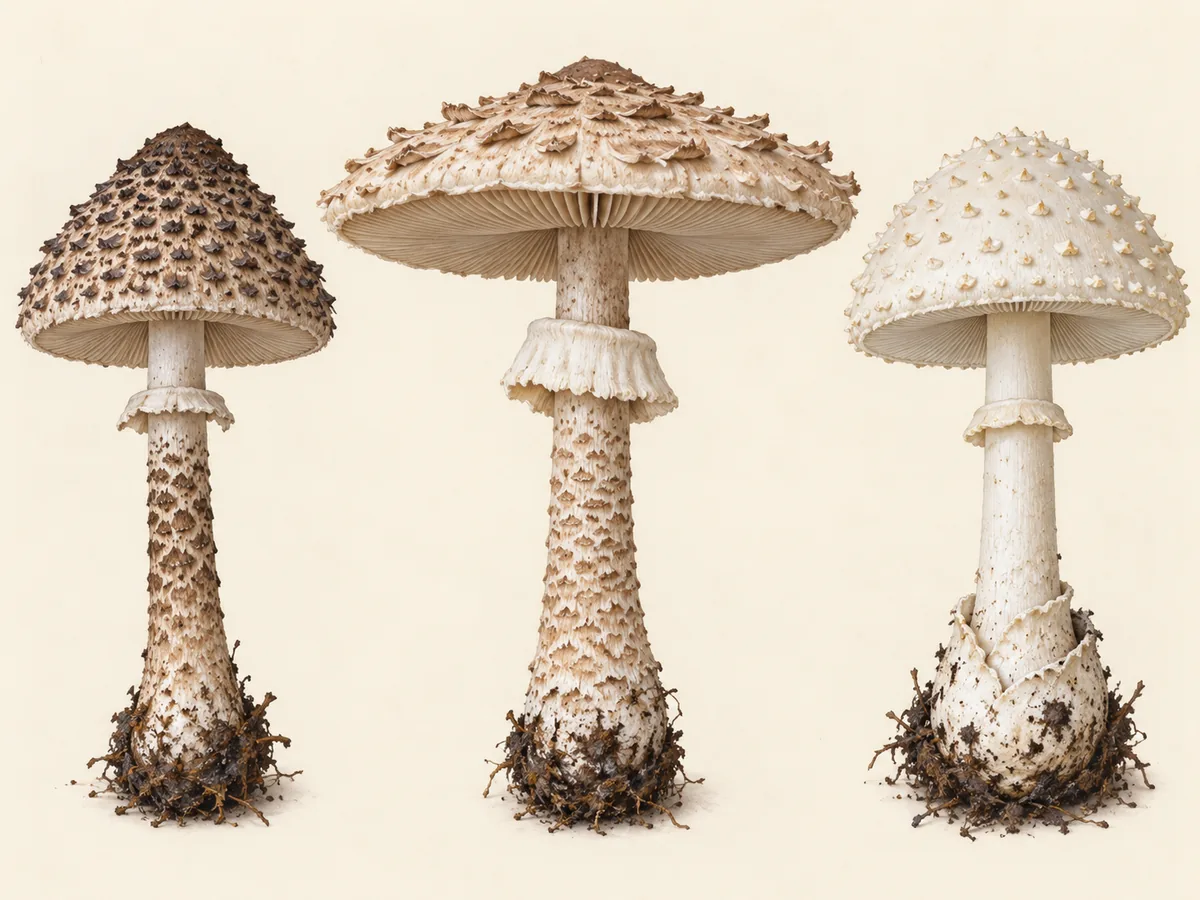
Freckled dapperling is a pale mushroom covered with dark pointed scales that can make the cap look studded or bristly. Its species name asperum refers to that rough surface, while the older name Lepiota aspera still turns up in field literature. When you meet one in leaf litter, keep the whole mushroom in view. Together, the scales, free gills, broad ring, two-textured stem and intact base tell you far more than the showy cap does alone.
Your complete field identification should also keep habitat and region with the specimen. The name now covers several genetic lineages, and similar ringed mushrooms grow in other genera. The sharp scales tempt you to call it from the scales alone, one of the beginner errors that put deadly dapperlings in baskets. Rain can flatten them, age can darken the cap, and other dapperlings or Amanita species carry warts or scales of their own.
The name E. asperum now covers at least four genetic clades, according to a 2025 phylogenetic reassessment. So describe your find honestly, and never treat one photo as proof. The safety picture is clearer than the lineage name, because published human cases support avoiding this mushroom, especially with alcohol.
Which features identify a freckled dapperling?
Start with the cap, before rain, handling or washing changes its texture. Photograph it from above and from the side so the cap shape and scale height stay visible. The cap begins rounded or convex and can flatten with age. Its cream, tan or brown surface carries dark brown upright scales shaped like cones or pyramids. They are usually smaller near the edge and packed tighter toward the center.
Those scales stand up from the surface like tiny pyramids, and flat color spots do not count. Dirt, cracking skin and flattened fibers can imitate a freckled pattern without forming the rough pyramids you expect here. The side-view photo is the quickest way to tell raised scales from flat staining.
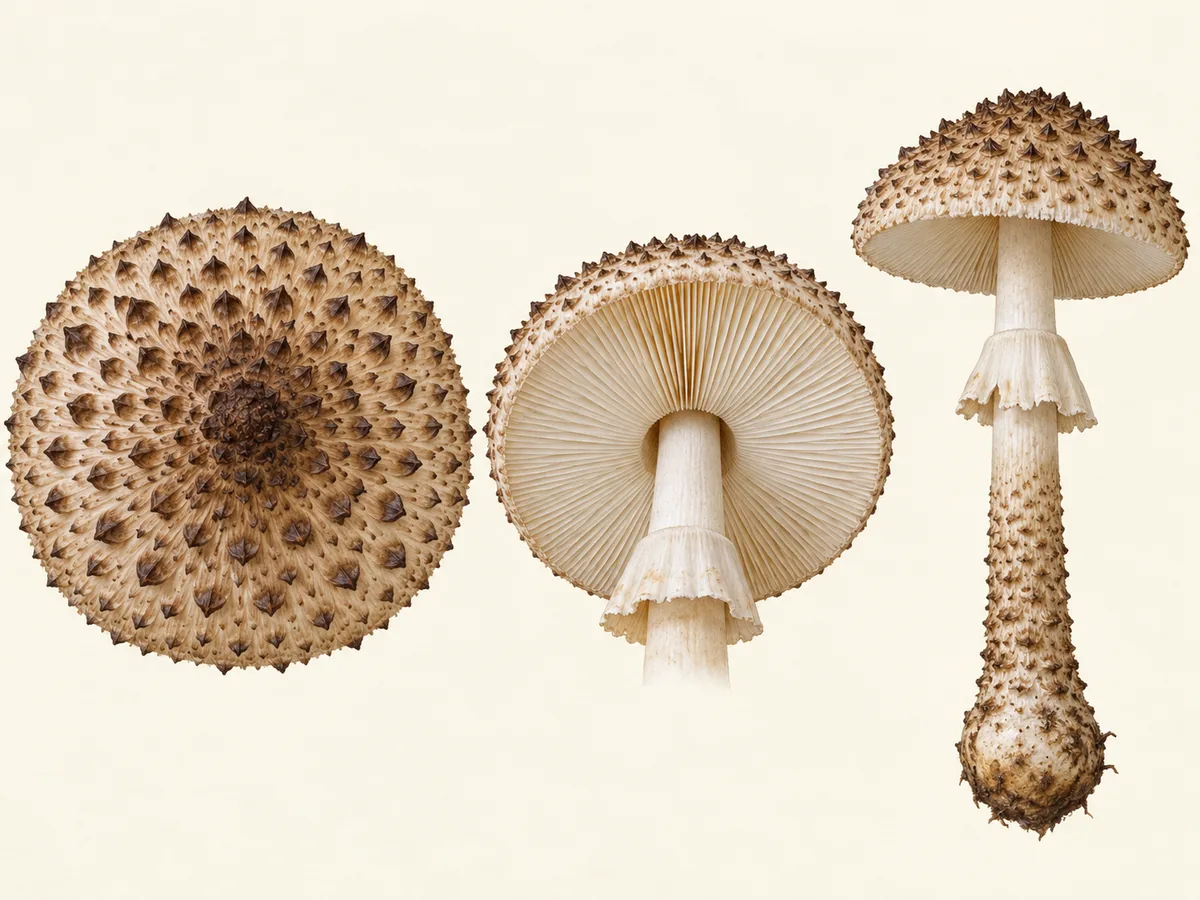
Under the cap, crowded white to cream gills stop short and leave a gap at the stem. Look for that clean ring-shaped gap, though poor angles or damaged gills can hide it in a photo. The stem carries a broad hanging membranous ring. Above the ring the stem is pale and smooth. Below it, brown scales or coarse fibers form a stocking-like zone that is part of the identification.
Dig out the base instead of snapping the stem at soil level. Freckled dapperling can have a slightly swollen base. Any real cup, rim or layered bulb points toward Amanita instead. Field accounts describe white flesh and an often sharp or unpleasant odor. Sniff gently and never taste it, because odor varies and a poisonous candidate gives no reason for a taste test.
Its white spore print agrees with Echinoderma and with many other gilled mushrooms. Under the microscope, the small smooth spores and the build of the cap scales narrow the choice among close species. The exact lineage may still need DNA, so the print narrows the field without naming the mushroom.
One specimen may be too old to show every feature. Young and mature mushrooms from one patch can fill each other's gaps, provided you keep them apart from every other collection.
Safety notes on Freckled Dapperling
That report rests on a small case series, and its authors did not identify the responsible toxin. So far it is an observed reaction to alcohol. Calling it confirmed coprine poisoning goes beyond the evidence, and so does promising that every case runs the same way. Possible acetaldehyde-syndrome features after alcohol include flushing, headache, nausea, vomiting, palpitations and blood-pressure changes. Do not treat the absence of alcohol or early symptoms as a reason to wait for help.
After any suspected ingestion, contact a poison service promptly and review mushroom poisoning symptoms. Poison Control explains that wild-mushroom lookalikes are unreliable and that symptoms can start late. In the United States, call Poison Control at 1-800-222-1222; elsewhere, use the local poison center or emergency service. Call emergency services for collapse, trouble breathing, seizure, severe confusion, chest pain or inability to wake the person.
Keep remaining mushrooms, the meal and photographs if they are already available. Do not delay the call while deciding whether alcohol caused the reaction or which Echinoderma clade the person ate. Those questions can wait for the poison service and the clinicians.
Where and when does freckled dapperling grow?
Freckled dapperling is saprotrophic. It feeds by breaking down dead organic matter and does not trade nutrients with living tree roots. You often find it on rich soil and decomposing litter in woodland, woodland edges, gardens or disturbed ground. Its feeding body lives on as mycelium through soil and litter. Caps appear only when moisture, temperature and available substrate allow reproduction.
Temperate field records place fruiting mainly from late summer into autumn. The autumn mushroom season guide explains how rainfall and cooling soil shape that window. Season alone cannot separate a scaly dapperling from its relatives. Rich or disturbed ground can include nettle beds, path edges, compost-influenced soil and woody litter. Record what the mushroom actually comes up from, and do not assume that nearby wood is the substrate.
Its geography remains unsettled because the current name spans Northern Hemisphere, Southeast Asian or Hawaiian, Central American and European genetic clades. With that much diversity, you cannot treat every historical record as one uniform species.
Key takeaway
Habitat supports the name while geography limits it. Soil and litter explain the ecology, and region narrows which lineage or close species is plausible.
What should you do after a possible ingestion?
Freckled dapperling has no culinary role. Do not cook or serve it, and do not test whether leaving out alcohol changes the risk. If someone may have eaten it, start care before any symptoms show and call a poison service. Report the mushroom, meal time, possible amount, alcohol timing, symptoms and number of people exposed.
Do not give more alcohol, induce vomiting or improvise a home antidote unless a medical professional directs you. The clinical report supports an aldehyde-dehydrogenase interaction but names no toxin you could neutralize at home. Save raw mushrooms, cooked leftovers and clear photographs if doing so does not delay the call. Keep each collection separate, because mixed dishes can contain several species and more than one toxic syndrome.
The precise Echinoderma name can come later, once medical advice has begun. Exposure care should not wait for a species-complex debate.
Why can freckled dapperling be a species complex?
Echinoderma asperum belongs to Agaricaceae. Index Fungorum records the current combination and traces it to Agaricus asper, while many field guides still use Lepiota aspera. The move from Lepiota to Echinoderma reflects the distinctive rough cap covering and later taxonomic work. The 2025 phylogenetic analysis supports Echinoderma as a lineage separate from Lepiota.
That analysis also found at least four clades inside Echinoderma asperum, which bears more directly on this profile. Collections named by their looks come from several regions. Looking alike does not prove they share one genetic species. The name still works for the established field concept, as long as you attach that limit to distribution and identification. Precise-looking Latin labels should not erase a demonstrated species complex.
This uncertainty leaves the no-food decision untouched. Human toxicity reports concern material identified under the traditional concept, and the close small dapperlings include species with severe toxins of their own. Whichever clade a collection belongs to, it stays out of the kitchen.


 Caution


