
 Poisonous

What makes scaly inkcap different from other inkcaps?
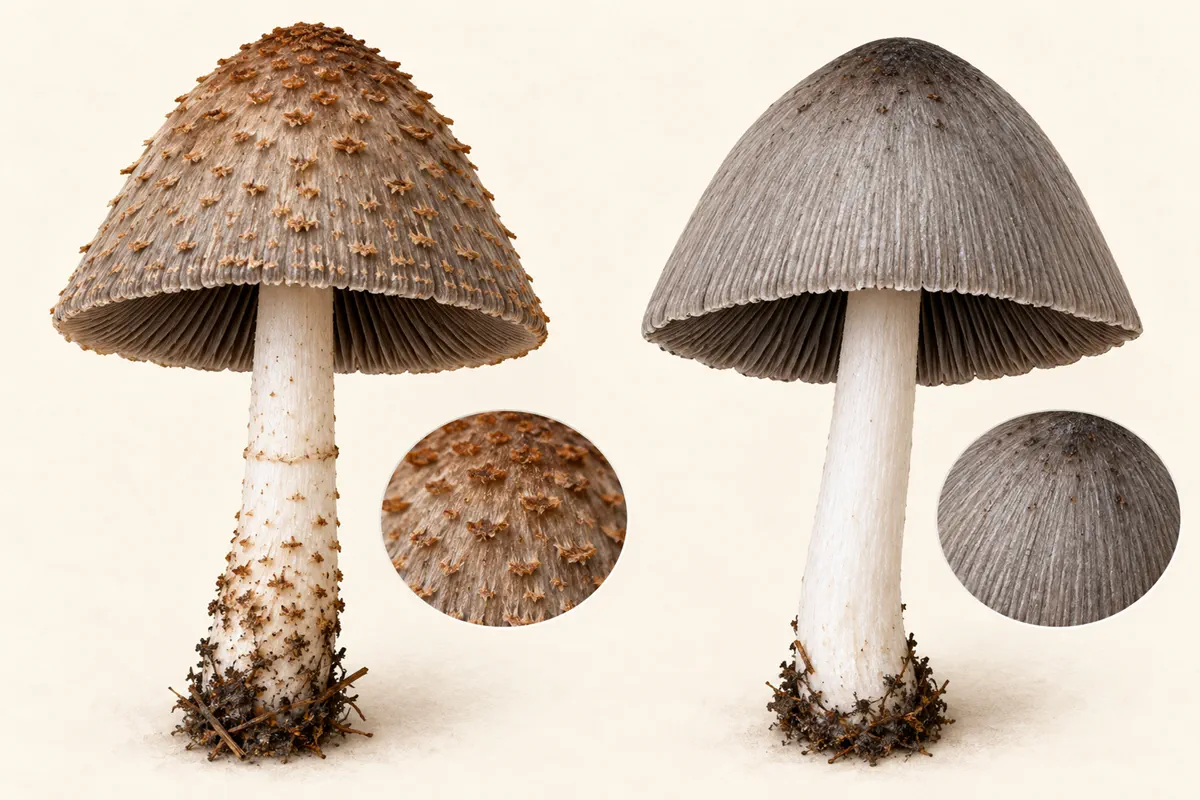
Scaly inkcap makes most sense as a close, more heavily veiled relative of common inkcap. Fresh specimens show colored scales that an older, blackening cap may already have lost. The cap starts oval or almost egg-shaped, then opens into a bell and can spread further. Fine radial grooves show up as the surface stretches, while the orange-brown or reddish-brown veil remnants stay thickest near the center.
Its gills follow the classic inkcap path from pale through gray-brown to black. As they deliquesce, the tissue breaks down into dark liquid, and the mushroom loses the very structures you need for a careful identification. The pale stem carries brown scales on its lower part and may show a faint ring-like zone. That zone is not the movable ring of shaggy mane, which belongs to a different genus and a separate comparison.
How does scaly inkcap change as it matures?
Work with the youngest intact mushrooms in a cluster, and photograph a mature one beside them. Together they show how the surface changes, so you never have to read a cap from a collapsed black remnant. Closed caps look oval or nearly round before they open into a bell. In the detailed species treatment by Kees Uljé, mature caps reach about 9 cm across, though that size overlaps with common inkcap.
The background color runs from beige or pale brown to gray-brown. What you are looking for sits on top: orange-brown to red-brown scales, sometimes with slightly raised tips and usually densest around the center. Fine radial grooves form as the cap opens. Grooves and colored scales come from different structures, so a lined cap does not automatically mean the smooth common inkcap.
The crowded gills start white, turn gray-brown and then nearly black. Its black spore deposit fits the group, yet dark liquid from rotting gills can stain paper, and you should not mistake that stain for a clean print. The stem is white and often slightly clubbed at the base. Brown scales, especially below a faint ring-like zone, support the species when they grow from the stem itself and are not loose soil or wood debris.
Scaly inkcap has no large lasting ring and no volva, the cup some mushrooms keep at the base. Keep the full base so you can tell a real stem zone from a break, a buried wood fiber or missing lower tissue. Deliquescence is a stage of growth, and black does not count as a separate cap color. Once the margin liquefies, missing scales mean missing evidence, and they no longer point to a smooth cap.
You may still need a microscope to sort species within section Atramentariae. Comparing a fresh surface can support C. romagnesiana, but a photo never becomes a final species certificate. Keep the specimen until someone with the right key has checked it.
Why is alcohol dangerous after an inkcap meal?
The review of mushroom toxins places C. romagnesiana among the coprine-containing species. Your body turns coprine into a compound that blocks aldehyde dehydrogenase, the enzyme that clears acetaldehyde, so acetaldehyde builds up after you drink. That build-up drives coprine poisoning, with flushing, headache, palpitations, nausea, dizziness and blood-pressure changes. The sources behind this profile give no harmless mushroom dose, alcohol amount or waiting time for any one person.
If someone may have eaten scaly inkcap, stop all alcohol and call Poison Control in the United States at 1-800-222-1222 or your local poison service. Report every alcohol-containing drink, food, medicine and product used around the meal. Call emergency services immediately for collapse, severe breathing difficulty, a seizure or a person you cannot wake. Do not induce vomiting unless a poison specialist tells you to.
Why can scaly inkcap appear to grow from soil?
Scaly inkcap is a wood decomposer. The cluster you see takes nothing from the grass; its fungus feeds on rotting woody material in or under the ground. The detailed species account records it growing in clusters on tree stumps. Distribution data and regional sheets also place it on buried wood, dead roots and woody debris in woodland, parks and gardens.
That habit means a cluster can appear to come up from a lawn where a tree once stood. The old roots stay below the grass and feed the fungus even when no stump shows. Visible wood fits the ecology without naming the species, because common inkcap and other decomposers use the same material. Substrate narrows your search; it does not finish it.
Regional records cover much of the growing season, and one French field sheet from the Charente mycological society notes finds from April through December. Read that wide window against your own area, since frost, rain and temperature shift when the mushrooms appear. The species has records in Europe and North America. When close members of its section overlap, a regional key and a kept voucher specimen outweigh any broad range map.
Can scaly inkcap be eaten without alcohol?
Older descriptions sometimes call scaly inkcap edible as long as you skip alcohol. That claim leaves three questions open: whether the species is right, how much coprine the mushrooms hold and how long one person stays sensitive. The official safety guide and the toxin review both tie the alcohol reaction to C. romagnesiana. Neither one offers a household dose or waiting schedule that makes a meal safe.
Cooking softens the delicate cap until it collapses, but nobody has shown that it removes coprine. So planning to cook it thoroughly solves neither the alcohol problem nor the identification problem. The same goes for every other kitchen step you might try.
Warning
Do not use alcohol avoidance as a recipe
Avoiding a drink is prudent after an accidental exposure while you obtain specialist advice. It is not a method for preparing scaly inkcap as food.
If mushrooms went into a mixed dish, note which pieces came from which cluster, if you know. Dark cooked fragments cannot show the scales, gill stage or stem zones you could see before cooking. Give the poison service what you remember about the raw mushrooms, along with any photos taken before the meal.
Why do older sources call it Coprinus?
Scaly inkcap first received the name Coprinus romagnesianus. The 2001 nomenclatural study broke up the broad old Coprinus group and set up the modern combination Coprinopsis romagnesiana. You may also meet names that treat it as a scaly variety of common inkcap. That history shows how closely the two resemble each other, and why veil abundance and microscopic features carry weight in their classification.
Old synonyms let you connect earlier evidence to the current species. They cannot confirm a fresh find, though, unless the actual mushroom matches. Keep the old name when you cite an old source, and use the current name for the modern profile.


 Caution