What makes a Périgord truffle valuable?
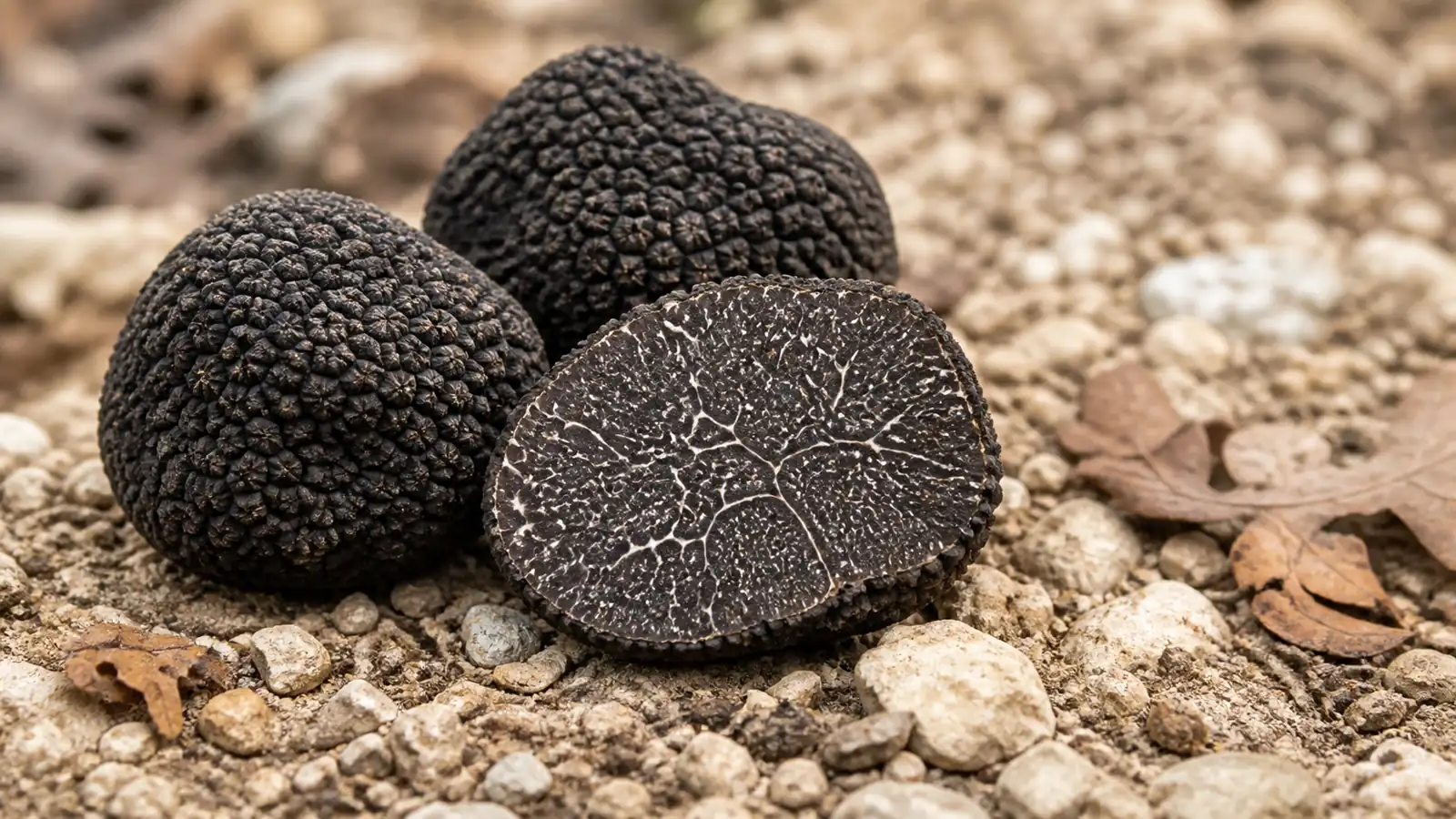
Tuber melanosporum forms belowground fruiting bodies rather than caps and stems. A ripe truffle has a black warty exterior and a firm brown-black interior threaded by narrow branching white veins.
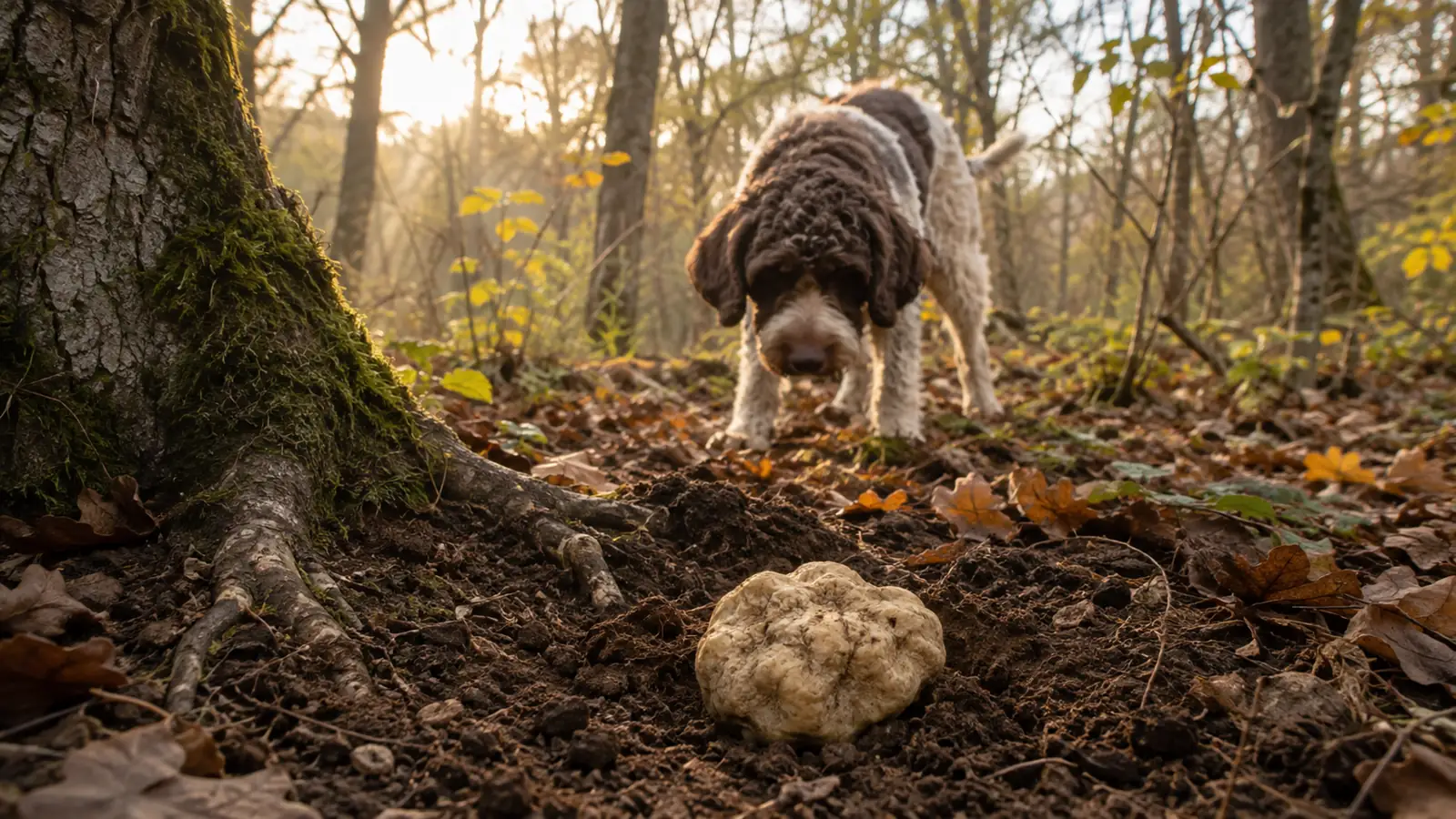
Its aroma is the reason for its culinary value. Harvesters use trained dogs because ripe truffles remain buried and do not advertise themselves with a visible cap.
The fungus exchanges nutrients with living tree roots. Oaks and hazels are the familiar orchard hosts, but climate, alkaline soil, drainage, competing fungi, and years of root development all influence production.
Key takeaway
A black exterior proves little. The fine interior marbling, microscopic spores, host record, harvest season, and traceable origin establish the Périgord species more securely.
The phrase black truffle is a market category as well as a description, and it may refer to several Tuber species with very different prices. A seller should name Tuber melanosporum explicitly and provide harvest origin rather than relying on the words Périgord style or winter truffle.
Ripeness changes both aroma and internal color.
An immature truffle can have pale flesh and weak scent, while overripeness brings soft tissue, fermentation, or ammonia notes that make even an authenticated specimen unsuitable.
Value begins with biological identity, then changes with maturity, aroma, condition, origin, size, and market scarcity. A large black truffle with weak aroma, soft gleba, or uncertain provenance can be worth less than a smaller ripe specimen with a clean documented chain.
The fruiting body develops underground and does not release a conventional spore print. Animals are attracted to ripe aroma and move spores, while harvesters use trained dogs to locate mature truffles without relying on surface shape.
Species substitution matters because several black Tuber species have dark warted rinds.
Tuber brumale is a legitimate edible truffle with different sensory value, while Asian black truffles can resemble T. melanosporum closely enough that commercial laboratories use DNA or spectroscopic methods.
Condition is a separate inspection. Sour or ammonia-like odor, slime, mold, extensive larvae, a waterlogged center, or a very light dry body can reject a genuine specimen even when the species is correct.
What does a genuine black truffle show inside?
No cap. The underground fruiting body is rounded or lobed, commonly 2 to 8 cm, with a black surface of small polygonal warts.
No gills or pores. Spores mature inside asci embedded in the marbled inner gleba.
No stem; the entire ascocarp develops below the soil surface.
Firm black-brown flesh crossed by fine branching white veins, with a powerful earthy, musky aroma when ripe.
Weigh, photograph, and cut a clean specimen through the center. The section should show dark firm gleba crossed by numerous narrow white veins rather than a uniform interior.
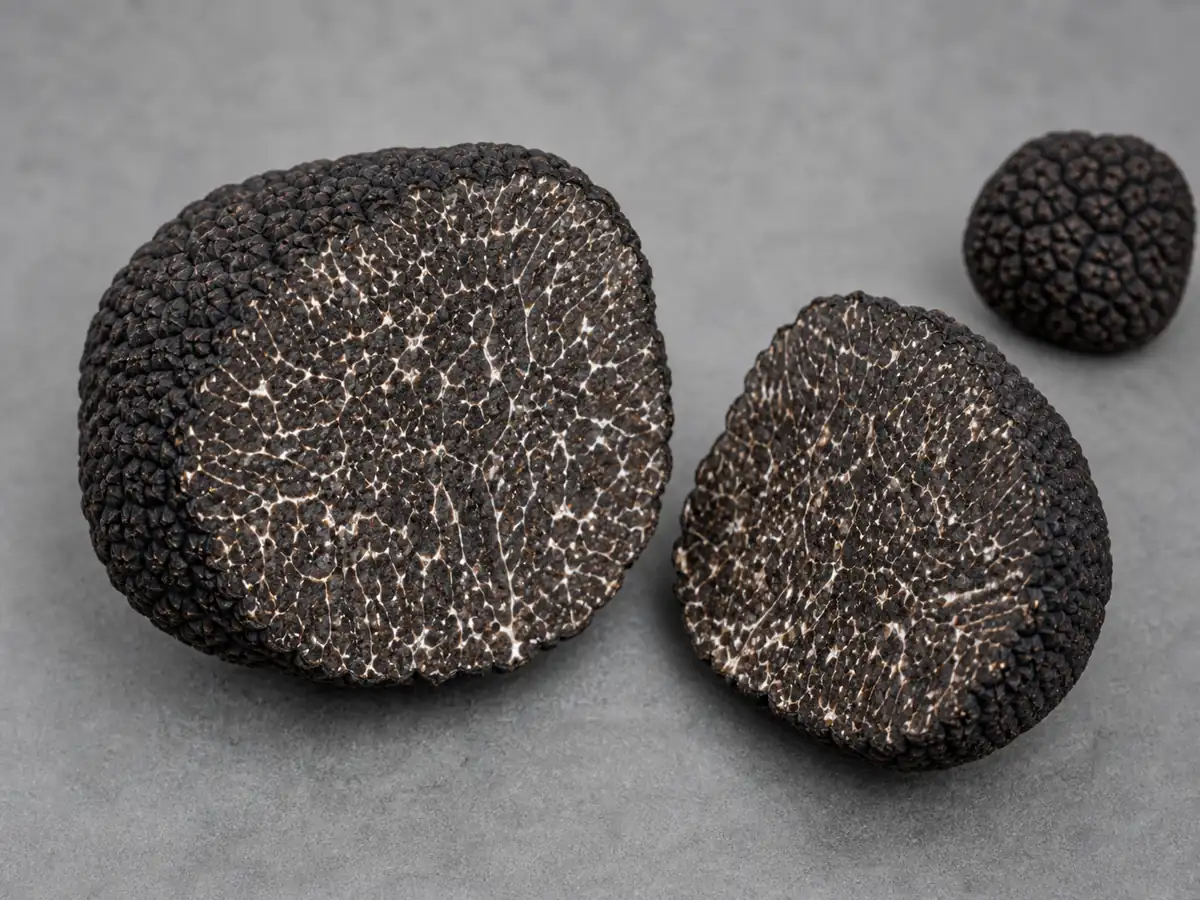
Tuber brumale can share a black warty surface but differs in vein pattern, odor, and microscopic characters. Asian black truffles in the T. indicum complex may resemble T. melanosporum closely enough that DNA tests are used in commerce.
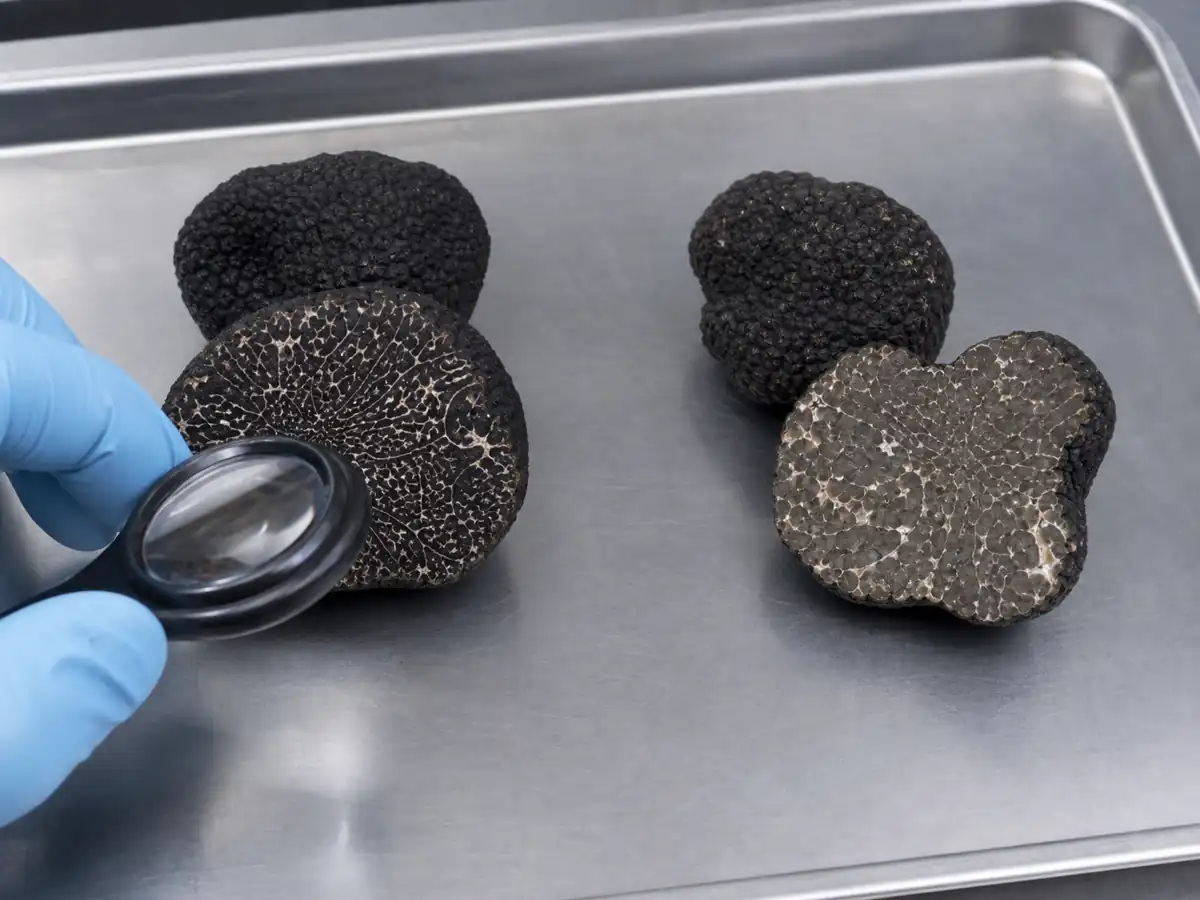
A conventional spore print is impossible because the spores remain inside the enclosed fruiting body. Microscopy examines mature asci and ornamented brown spores from the gleba.
Inspect more than one cut face when a valuable lot is involved because veins and insect damage are unevenly distributed. Fine white veins should branch through firm dark gleba and reach the rind without becoming a few broad empty channels.
Microscopy looks for asci and mature ornamented spores, but commercial disputes increasingly use DNA because closely related black truffles can overlap in exterior form.
Testing is most useful when provenance is weak, price is high, or the lot has already been sliced or processed.
Authentication and condition are separate decisions. A genuine T. melanosporum can still be rejected for slime, sour odor, extensive larvae, mold, or a soft waterlogged interior.
Clean only enough soil to inspect the rind, then weigh and photograph the intact specimen before cutting. Size, weight, firmness, scent, and the pattern of polygonal pyramidal warts establish a condition record that a sliced piece cannot recreate.
Make a fresh center cut with a clean knife.
Mature gleba should be dark brown to nearly black with many fine branching white sterile veins, while immature tissue is paler and a few broad empty channels do not create the expected marbling.
Inspect more than one face in a valuable lot. Insect galleries, bruising, and uneven maturity can distort one section, and a seller can choose a flattering cut that hides soft or poorly veined areas.
Microscopy examines asci and ornamented mature spores retained inside the gleba. DNA becomes more useful when the material is processed, the vein pattern overlaps another black truffle, or the price and provenance justify laboratory confirmation.
| Material being checked | Useful first evidence | When stronger authentication matters |
|---|---|---|
| Whole ripe Tuber melanosporum | Firm black rind, fine white veins, clean mature aroma, documented origin | High value, disputed origin, or conflicting interior features |
| Tuber brumale | Its own odor, vein pattern, spores, and named provenance | When sold as T. melanosporum rather than under its correct name |
| Asian black Tuber | Cut pattern, origin, and seller documentation | Close exterior overlap or a commercial species claim |
| Oil, paste, or shavings | Latin name, percentage, ingredient list, and batch traceability | Processed material hides most visual characters |
Aroma supports ripeness and condition but cannot prove species. Storage, soil, geography, genetics, and handling all change the volatile profile, and added flavor compounds can make a processed product smell stronger than its truffle content warrants.
How can you distinguish black truffle lookalikes?
The market name black truffle covers several species. Surface warts and dark flesh are not enough to separate Périgord truffle from Tuber brumale, T. indicum, and other black truffles.
Buy from a traceable specialist or use microscopy and DNA for valuable wild material. A dark underground fungus can also be a false truffle outside Tuber, so aroma, vendor wording, or a cut photograph cannot authenticate it.
Tuber brumale can share a black warted surface and winter harvest. Its odor, vein pattern, spores, and rind structure differ, but a consumer should treat it as a distinct edible product rather than a counterfeit simply because its market value is lower.
The Tuber indicum complex creates a harder visual problem. Dark rind and gleba can approach the Périgord appearance, which is why research laboratories developed PCR primers and multiplex tests for fruiting bodies, canned preparations, mixtures, and inoculated roots.
Processed products remove evidence. Oil, paste, sauce, or preserved shavings may contain another species, a small percentage of truffle, or added aroma, so the ingredient list, Latin name, percentage, origin, and producer traceability carry more weight than a picture on the jar.
Whole specimens offer the best consumer inspection because rind, weight, center cut, texture, and aroma remain connected. When a high-value lot lacks provenance or has already been sliced, laboratory authentication may be the only defensible species answer.
How do you preserve the aroma in the kitchen?
Use ripe black truffle as an aromatic seasoning rather than a bulk mushroom. Thin shavings or fine grating spread aroma through eggs, butter, cream, potatoes, pasta, and mild poultry.
Gentle warmth releases aroma, while prolonged high heat drives volatile compounds away. Add most of the truffle near the end and let it rest with a fat-rich food when practical.
Brush away soil under cool running water only as needed, dry thoroughly, and refrigerate in a clean covered container. Use promptly and inspect daily because trapped moisture accelerates decay.
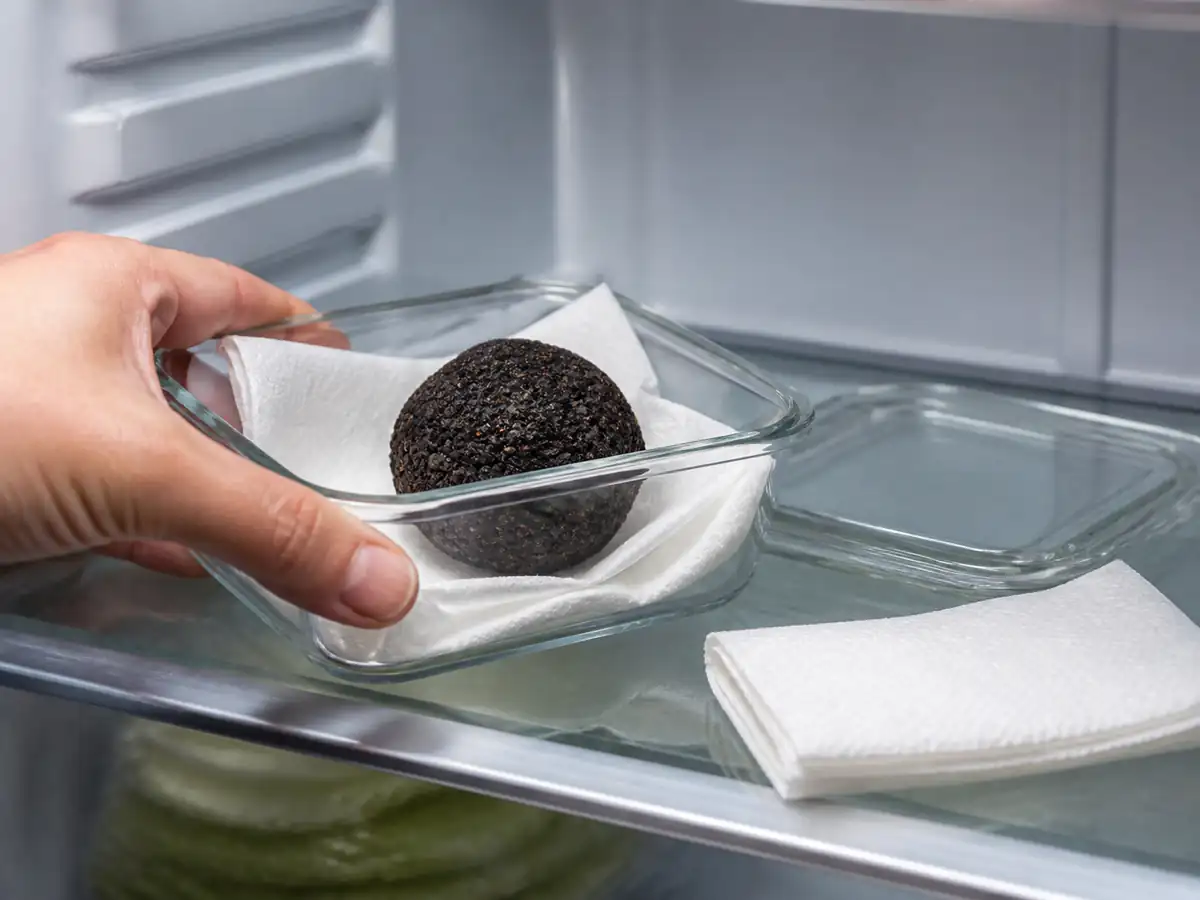
Buy whole truffles when possible because the intact rind, weight, aroma, and a fresh center cut provide more evidence than preserved shavings. A sealed jar labeled truffle may contain another species, aroma compounds, or only a small percentage of truffle, so read the ingredient list and Latin name.
For short storage, wrap the dry truffle in clean absorbent paper inside a covered refrigerator container and change damp paper daily.
Rice can dry the truffle and absorb aroma, while raw eggs stored in the same container create a food-safety complication, so neither shortcut improves the specimen.
Slice only what the dish needs and return the remainder to cold storage promptly. Freezing changes texture but can preserve aroma for cooked applications when immediate use is impossible.
Aroma begins changing as soon as the truffle is cut. Greater surface area exposes more volatile compounds, which is why keeping the specimen whole until service preserves more sensory information than pre-slicing it for convenience.
Cold storage slows change but does not stop metabolism, moisture movement, or microbial decay.
Keep the truffle clean and dry in a covered refrigerator container, replace damp absorbent paper, and inspect odor, firmness, and surface condition each day.
A controlled storage study found that time, temperature, salt, heat treatment, and sample form changed the volatile profile. The experiment explains why handling matters, but its small sealed samples do not establish one guaranteed household shelf life.
Use thin shavings or fine grating to distribute aroma through eggs, butter, cream, potatoes, pasta, or mild poultry. Add most of it near the end because prolonged high heat alters the volatile balance that justifies the ingredient.
Rice can dry the truffle and absorb aroma, while raw eggs stored in the same container add a separate food-safety issue.
Use dry paper and a clean container instead of turning valuable aroma and moisture into an uncontrolled storage experiment.
Freezing trades fresh texture for longer holding and can suit later cooked applications. Freeze clean portions with minimal exposed air, then grate or slice while still firm rather than repeatedly thawing the remainder.
Why do oak roots and limestone soil matter?
Black truffle is ectomycorrhizal. Its hyphae wrap fine feeder roots and trade soil-derived water and minerals for carbon supplied by the host tree.
Productive sites usually have alkaline, calcium-rich, aerated soil and a Mediterranean-influenced seasonal climate.
Oaks and hazels are standard orchard hosts, with hornbeam and other compatible trees also used.
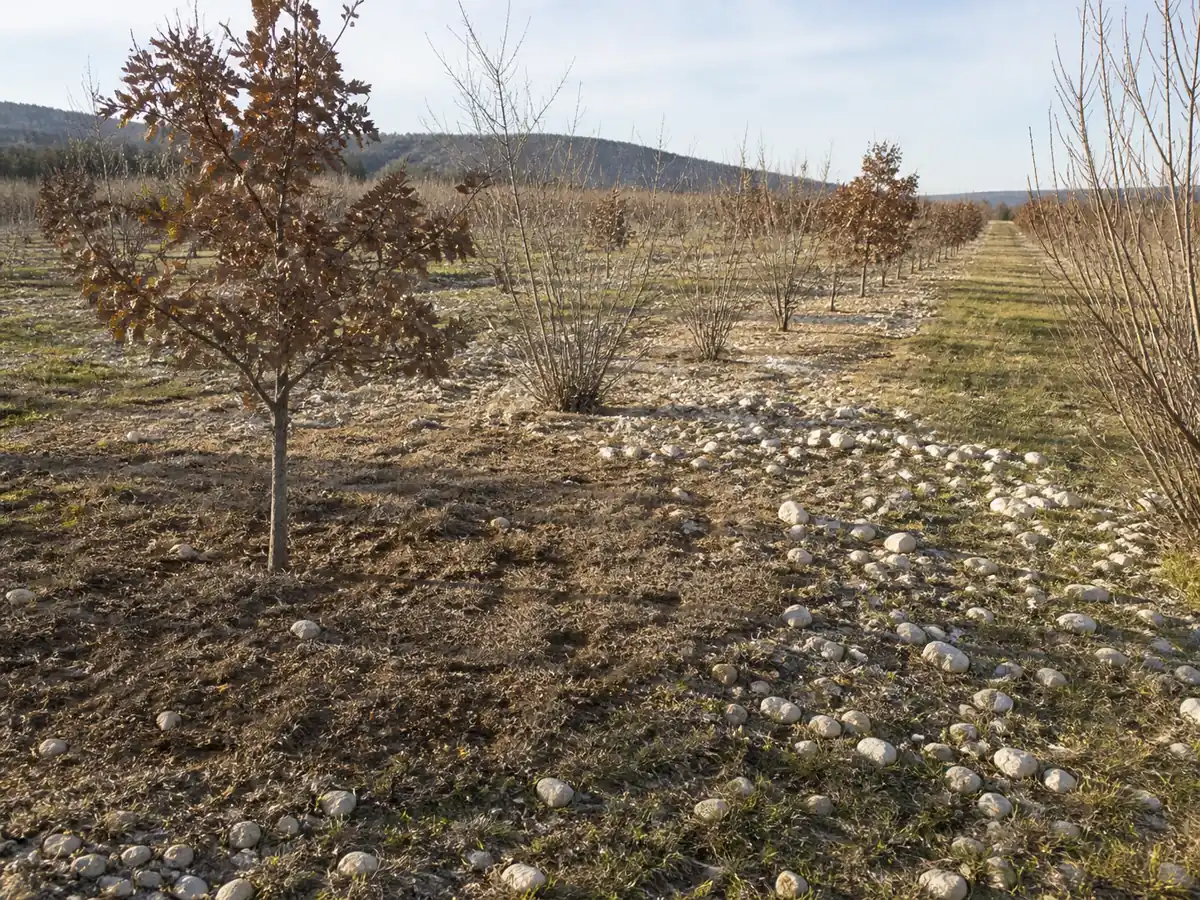
Vegetation may thin around a productive host, forming the brûlé associated with truffle mycelium and orchard management. That feature is not proof of fruiting or species identity.
Native production centers on southern Europe. Inoculated orchards have extended cultivation to Australia, New Zealand, North America, South America, and other suitable regions.
Tuber melanosporum forms ectomycorrhizae on fine feeder roots. Fungal tissue extends the root's contact with soil water and minerals, while the tree supplies carbon made through photosynthesis.
Oak and hazel are common orchard hosts, with other compatible trees used under local conditions.
The presence of a suitable host does not guarantee the target fungus because roots can carry competing ectomycorrhizal species before or after planting.
Productive soils are generally calcareous, aerated, and well drained, but pH alone is not a site prescription. Texture, free carbonate, summer moisture, winter cold, heat stress, compaction, waterlogging, and irrigation capacity interact over years.
Sparse vegetation around a colonized host can form the visible brûlé. That surface pattern can support orchard monitoring, yet management, drought, or other soil processes can also thin plants, and the patch does not prove that truffles are present underground.
Native production is associated with Mediterranean Europe, while inoculated orchards operate in several southern- and northern-hemisphere regions. Local success depends on matching the complete climate, soil, host, and management system rather than copying one European soil number.
What does a truffle orchard actually require?
Cultivation begins with nursery trees whose roots are inoculated and verified with T. melanosporum. The orchard then needs suitable alkaline soil, drainage, irrigation strategy, weed and host management, and protection from competing ectomycorrhizal fungi.
First harvest can take several years and remains uncertain.
Planting an inoculated tree does not guarantee that the target fungus will persist or fruit.
Commercial orchards monitor roots and soil, then use trained dogs for harvest. This is a long-term tree-crop system, not an indoor kit or buried piece of market truffle.
Before planting, orchard planning tests pH, free carbonate, drainage, soil texture, climate, water supply, and existing ectomycorrhizal competitors. Correcting one soil number cannot compensate for waterlogging, severe summer stress, or an unsuitable host.
Root certification matters at purchase and after establishment because nursery contamination may introduce another Tuber species. Monitoring cannot guarantee fruiting, but it can reveal whether T. melanosporum persists while canopy, irrigation, pruning, and ground vegetation are adjusted.
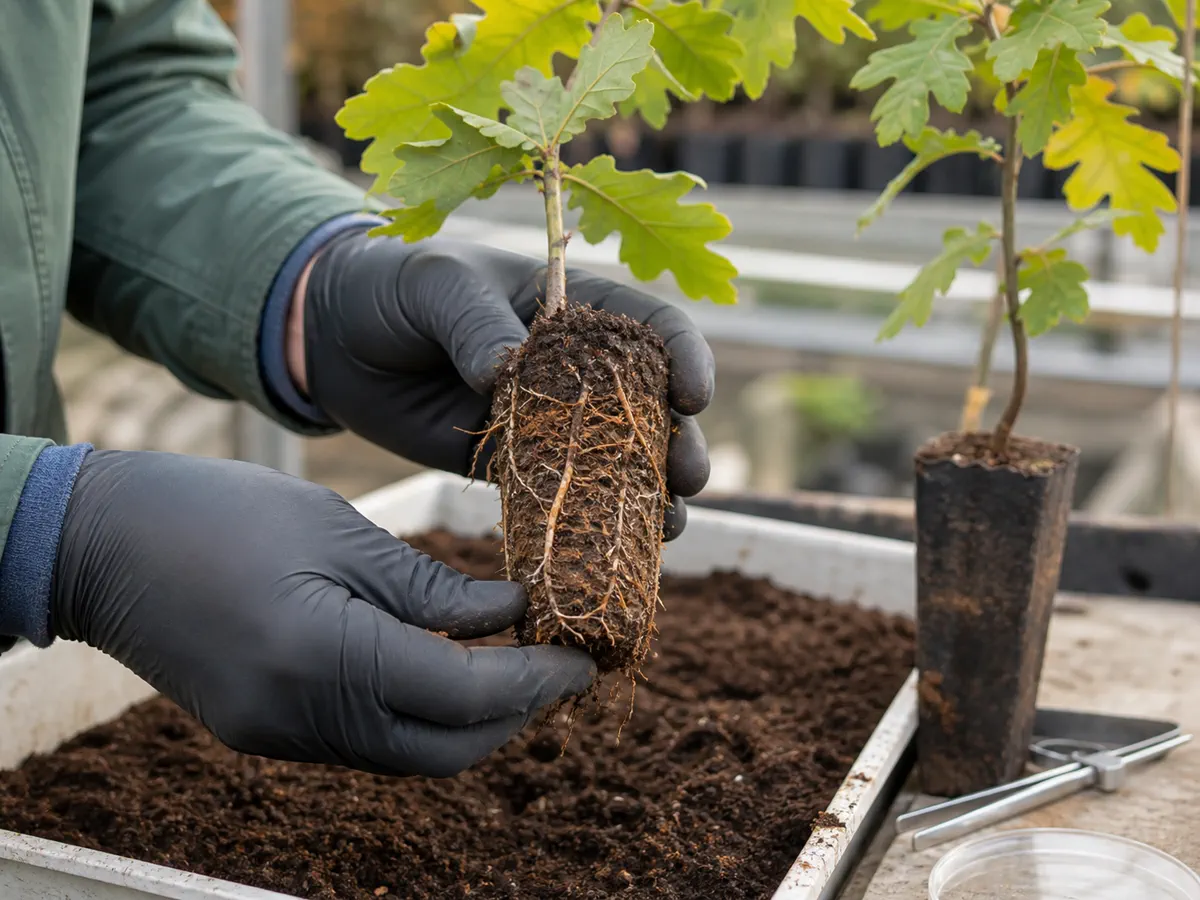
Buy nursery trees from a supplier that documents the host, inoculum, method, and root-testing standard. A healthy canopy and visible root tips do not prove T. melanosporum because other Tuber or unrelated ectomycorrhizal fungi can occupy the same root system.
Molecular tools can test mycorrhizal root tips before planting and later monitoring can ask whether the target persists. A positive result confirms sampled tissue at that time, not future fruiting across the whole orchard.
Site preparation begins before trees arrive.
Soil profile, drainage, texture, carbonate, pH, water supply, existing hosts, competing fungi, slope, and climate determine whether irrigation, cultivation, or amendment is practical.
After planting, canopy development, weed competition, soil disturbance, irrigation timing, pests, and host health require coordinated management. Heavy watering can create waterlogging, while insufficient summer moisture can stop development, so one fixed schedule cannot fit every soil and season.
The first crop can take years and is not guaranteed. Orchard monitoring should distinguish tree survival, root colonization, brûlé development, and actual fruiting rather than presenting them as one milestone.
Trained dogs allow selective harvest of ripe truffles with less soil disturbance than blind digging. Harvest records tied to tree, date, weight, maturity, and condition help the grower learn which management decisions produced a marketable result.
How is Tuber melanosporum authenticated?
Tuber melanosporum is an ascomycete in Tuberaceae, described by Carlo Vittadini in 1831. Its enclosed fruiting body contains asci rather than the exposed basidia of familiar cap mushrooms.
Black-truffle authentication is an active taxonomic and commercial problem. DNA markers help separate T. melanosporum from morphologically similar Asian and European species.
Does nutrition explain the price?
Fresh truffles are more than 80 percent water and are eaten in small amounts. Their practical contribution is aroma, with modest protein, fiber, and minerals per 100 grams but little consumed in a normal garnish.
Nutrition does not explain the price. Species, ripeness, aroma, condition, provenance, and scarcity drive market value far more than macronutrients.
A normal serving is measured in grams rather than 100-gram portions, so label-style nutrient comparisons exaggerate its contribution to a meal. The buying decision is better informed by species, maturity, aroma, condition, and price per usable gram.
Black truffle buying and storage questions
Is black truffle a mushroom?
How can I recognize Périgord truffle?
Why are dogs used to find it?
Can black truffles be cultivated?
How should fresh truffle be stored?
Is Chinese black truffle the same species?
Sources & References
- EPPO Global Database Preferred scientific name and common-name record.
- Italian National Truffle Study Centre Truffle anatomy, symbiosis, identification characters, and composition.
- CNR TuberID External morphology and molecular identification literature.
- New Phytologist, Tuber melanosporum genome Ectomycorrhizal biology, genome, and life-history context.