Is common earthball poisonous?
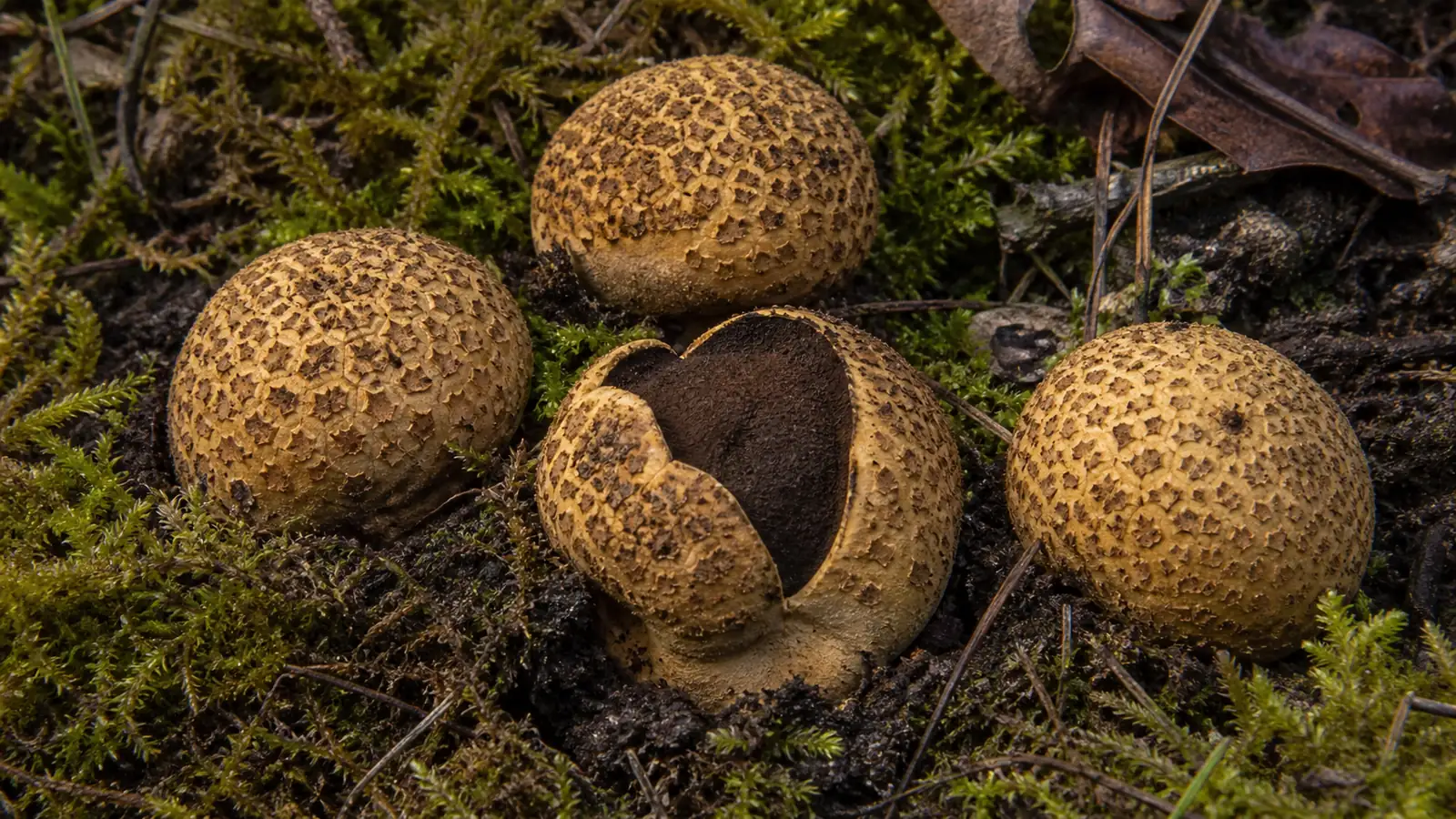
Common earthball does not build a cap, gills, or stem in the familiar mushroom arrangement. Its spores develop inside a closed ball protected by a thick outer wall called the peridium.
The outer surface is ochre, yellow-brown, or dirty tan and patterned with coarse polygonal warts. Those warts can crack into irregular scales, giving the rind a texture compared with pigskin.
A very young interior can appear nearly white, which creates the dangerous overlap with edible puffballs. It soon develops gray or purple marbling, then becomes a solid purple-black mass before drying into dark brown spore powder.
The base narrows rather than forming a proper stem.
Thick white cords anchor the fruiting body to soil and connect it with the underground mycelium.
At maturity, the top splits irregularly and spores escape through the opening when rain, animals, or footsteps compress the shell. The interior is then dusty rather than fleshy.
External roundness never proves a puffball edible. Earthballs, immature Amanita buttons, stinkhorn eggs, and true puffballs can all begin as pale enclosed forms, but their cut interiors tell different anatomical stories.
How do you identify common earthball?
A rounded or irregular fruiting body about 2 to 10 cm wide, yellow-brown to ochre, covered with coarse dark warts or cracked scales rather than a separate cap.
No gills, pores, or cap underside. Spores mature inside an enclosed gleba that turns purple-black to dark brown.
No true stem, only a short narrowed base attached to soil by thick white mycelial cords.
Young interior begins pale but soon becomes marbled gray-purple, then purple-black and powdery, with a rubbery or metallic odor in some specimens.
Use a clean vertical cut through the entire fruiting body and base.
Do not rely on one shallow slice that misses developing structures or a dark center deeper inside.
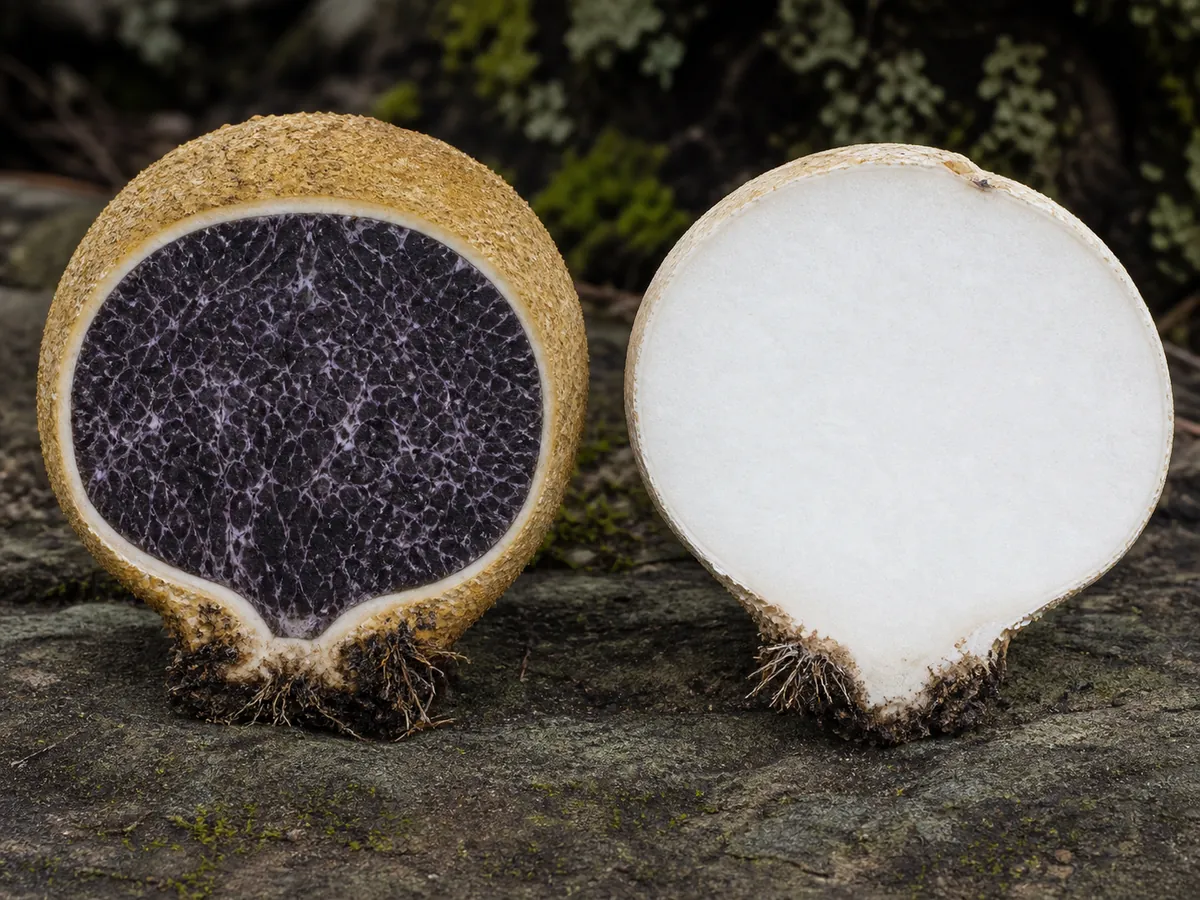
The outer wall of common earthball is several millimeters thick, firm, and tough. A knife meets more resistance than it does in the thin skin of many true puffballs.
The interior changes in a useful sequence. A very young earthball can be pale, but its firm tissue soon develops gray-purple color from the center instead of remaining one clean white mass.
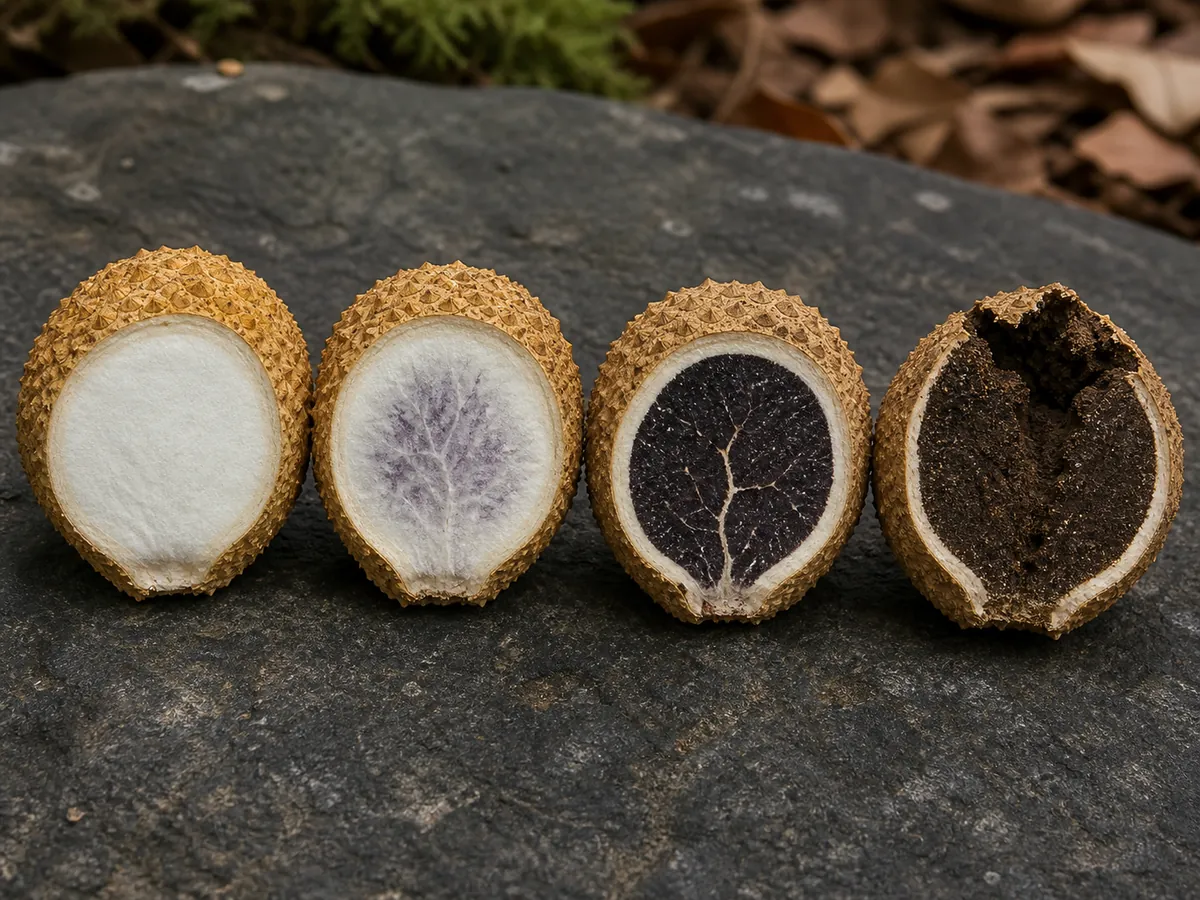
White veins can remain visible as the gleba becomes compact and purple-black. At full maturity the interior turns powdery, and the upper wall splits irregularly to release the spores.
Any gray, purple, black, marbled, or powdery interior ends the puffball decision. A pale center in one young specimen cannot clear a mixed collection, so cut every enclosed fruiting body from top to base.
A dark brown spore deposit appears when the mature shell opens, but waiting for spore color is unnecessary when a cross-section already rejects the mushroom.
Immature Amanita mushrooms can show the outline of a cap, gills, and stem inside an enclosing veil. Any internal structure or non-white tissue means the specimen fails the edible-puffball test.
Handle mature earthballs gently and avoid inhaling concentrated spores. A cloud of dust is not a field trick and adds no identification value once the internal color is documented.
If someone may have eaten this mushroom, act now. Call Poison Control at 1-800-222-1222 (US) or emergency services before symptoms appear, and save a piece of the mushroom for identification.
What happens if you eat common earthball?
If someone swallowed an earthball or an unidentified puffball-like mushroom, contact Poison Control or local medical services. Save uncut and cut specimens because the interior can distinguish earthball poisoning from a potentially more dangerous immature Amanita exposure.
Do not wait for the center to darken before seeking help. Young earthballs can be pale, and the original identification may be wrong.
Make one full central cut and leave at least one specimen intact. A mycologist may need the outer wall, attachment cords, surface warts, internal pattern, and nearby mushrooms rather than a photograph of loose dark tissue.
An animal may crush or swallow the entire fruiting body, leaving no cross-section at the exposure site.
Neighboring specimens from the same patch are valuable only when their position, appearance, and connection to the original location are documented.
A uniformly white center does not close an exposure call. It can represent a young earthball, true puffball, Amanita button, or another enclosed fungus, and each possibility carries a different risk.
Keep mature spore dust away from the face and eyes. People with respiratory disease should avoid deliberately squeezing or kicking dry earthballs, and any breathing difficulty needs medical attention.
Spores released outdoors are part of normal fungal reproduction, but a dense cloud placed directly at the mouth or nose is an avoidable concentrated exposure. Rinse irritated eyes with clean water and contact a clinician or poison service when symptoms persist.
Do not apply bleach, fungicide, salt, or boiling water to a lawn patch as first aid. Those treatments can damage soil and plants without addressing a mushroom already swallowed.
Warning
A child or pet can bite a lawn earthball before it looks mature. Remove accessible fruiting bodies, photograph a cross-section, and monitor the site after rain because the underground fungus remains.
Which enclosed fungi can imitate a puffball?
The central comparison is anatomical rather than cosmetic. True puffballs and earthballs are both rounded, but the thickness of the wall and the development of the interior separate their life histories.
A young specimen creates the hardest case because both groups can start pale. Cut several fruiting bodies of different sizes and reject the entire collection if any identification evidence conflicts.
Common puffballs usually have a thinner skin and a uniformly white, marshmallow-like interior when edible.
As soon as their centers yellow, olive, or brown, they are past the usable stage even when they are correctly identified.
Amanita buttons are more dangerous. Their cut interiors reveal miniature gills, a folded cap, and a stem, sometimes faint at first, so the slice must pass exactly through the center.
Uniform white interior
Continue species-level identificationWhite tissue with no hidden structures passes only the first rejection screen.
Yellow, olive, marbled, or dark center
Reject the specimenAging puffballs and poisonous earthballs both fail the edible-stage test.
Folded cap, gills, stem, or gelatinous layers
Treat it as a different mushroomAmanita buttons and stinkhorn eggs can hide complete structures inside a round exterior.
Key takeaway
The white-interior rule is a rejection screen, not a complete identification. Passing it does not prove species, freshness, habitat suitability, or freedom from contamination.
Why should every enclosed mushroom in a patch be cut separately?
A patch can contain different ages of one earthball species, several earthball species, true puffballs, or an unrelated enclosed mushroom. One clean white cut surface therefore describes one fruiting body, not the whole collection.

Start with the smallest and largest specimens, then cut examples from separate parts of the patch. Slice each one vertically through its center and base because an off-center cut can miss the cap, gills, or stem developing inside an Amanita button.
Every specimen stays white and featureless
Continue species-level identificationThe collection has only passed the internal rejection screen, so rind, surface, habitat, and maturity still need agreement.
One specimen is marbled, dark, or powdery
Reject the whole food collectionEarthballs and overmature puffballs can occur beside younger pale fruiting bodies.
One specimen contains a cap, gills, stem, or layered structure
Treat the collection as mixed and potentially dangerousAn immature gilled mushroom or stinkhorn egg changes both the identification and the medical risk.
Keep one specimen intact and match every cut half to its outer surface. Loose slices remove the rind thickness, attachment cords, and patch position that an identifier may need later.
Patch-level consistency never proves edibility, but one contradiction is enough to stop. This asymmetry matters because a mixed basket can hide the single specimen carrying the greatest risk.
What do poison-center cases reveal about earthball poisoning?
A 2026 review examined 134 Scleroderma ingestion cases reported to French poison centers from 2000 through 2022. Confusion with another mushroom accounted for 43 percent of cases, most often an edible puffball and less often a truffle.
Most patients had no symptoms or only minor effects, but nine cases were rated moderate or severe. Digestive illness dominated, while a smaller group developed vertigo, altered consciousness, abnormal heart rate, or low blood pressure.
The study included several earthball species, and the compounds responsible for the broader symptom pattern remain uncertain. It therefore supports caution around the whole genus without proving that every symptom came specifically from Scleroderma citrinum.
The practical decision does not depend on predicting severity at home. Call a poison center after ingestion, preserve the specimen and meal remains, and report neurological or cardiovascular symptoms as well as vomiting and diarrhea.
Why is an earthball related to boletes?
Scleroderma citrinum belongs to Boletales despite lacking the cap-and-pore form associated with typical boletes. Molecular and anatomical relationships place earthballs closer to that lineage than to true puffballs.
The genus name means hard skin, describing the tough peridium, while citrinum refers to yellowish coloration. Older sources may use Scleroderma aurantium for the same or a closely interpreted taxon.
True puffballs belong to other families and develop a thinner outer wall and different spore-bearing tissue. The everyday word puffball describes a shape, not one safe taxonomic group.
Why can a bolete grow from an earthball?
Common earthball commonly forms ectomycorrhizal relationships with trees, exchanging soil nutrients and water for plant sugars. Oak, beech, birch, and conifers can all occur near fruiting sites.
It tolerates acidic and nutrient-poor ground and appears in woods, heaths, moss, banks, path edges, gardens, and compacted disturbed soil.
Fruiting bodies may be partly buried, which makes the thick warty surface look like a stone.
A remarkable ecological clue is the parasitic bolete Pseudoboletus parasiticus, which fruits directly from living earthballs. Its small cap and pore-bearing stem can emerge from the side or base while the earthball still contains a dark gleba.
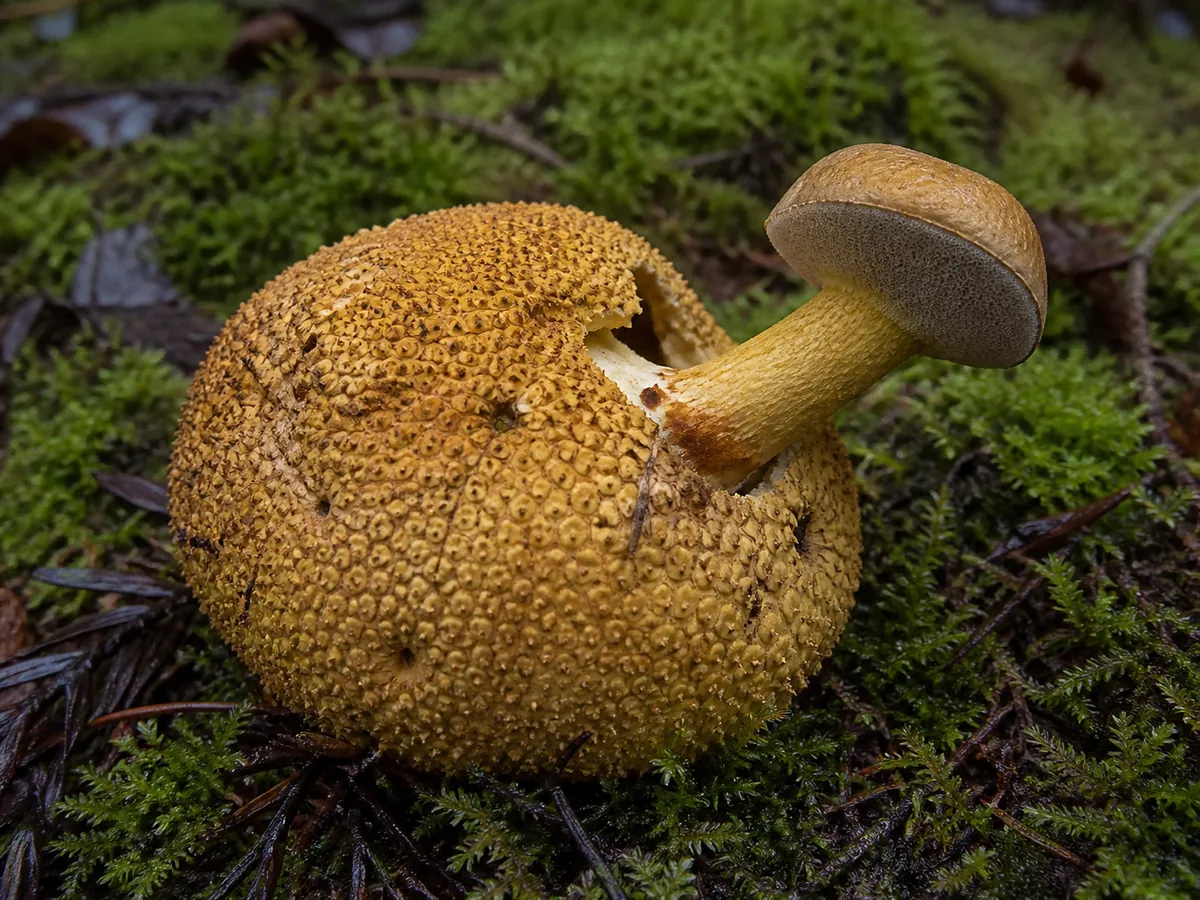
The fruiting body releases millions of spores after the rind ruptures. Raindrops and animal pressure help eject the powder, while the underground mycelium continues its root associations.
A garden occurrence does not mean the soil is poisoned. The hazard is ingestion of the fruiting body, and removal reduces immediate access without requiring chemical treatment of the lawn.
Can any part be used as food?
Common earthball has no culinary use. Its folk name pigskin poison puffball is a useful warning because the tough rind and dark gleba are the opposite of the tender white interior sought in true puffballs.
Some older accounts mention thin slices used as a truffle-like adulterant or seasoning. That practice is unsafe and should not be revived, especially when the mushroom is poisonous and species identity can be uncertain.
Do not trim away a dark center and cook the remaining rind.
The entire fruiting body is rejected, and a dark or structured interior also disqualifies any puffball-like collection from the kitchen.
Cut specimens outdoors before they touch other food. This keeps spore dust and fragments out of a basket while preserving the anatomy needed for identification.
What symptoms have earthballs caused?
Earthball poisoning is generally associated with gastrointestinal irritation, but reported cases can include dizziness, weakness, visual disturbance, or loss of consciousness. The exact toxic compounds and individual susceptibility remain incompletely defined.
Clinical management depends on the amount, timing, symptoms, and confidence in the species identification.
Hydration, vital signs, electrolytes, and neurologic status may need monitoring.
A mistaken immature Amanita carries a different and potentially fatal toxicology, which is why saved specimens matter. The medical question is broader than whether one dark-centered earthball causes stomach upset.
Common earthball has no established medicinal use. Antimicrobial or chemical findings from laboratory extracts do not make the whole mushroom safe to consume or apply as a home remedy.
Common earthball questions
Is common earthball edible?
How do I tell it from a puffball?
Can a young earthball be white inside?
What is the small bolete growing from it?
Are the spores dangerous to breathe?
Will removing earthballs cure a lawn?
Sources & References
- First Nature Identification, distribution, taxonomy, and toxicity.
- Mushroom poisoning review Clinical assessment and specimen preservation.
- Missouri Poison Center Poisoning timing and urgent response framework.
- Studies in Fungi Gleba color progression from white through purple-black to a powdery mature spore mass.
- French Poison Control Center study of Scleroderma poisoning Clinical patterns, confusion causes, severity, identification limits, and study limitations across 134 cases.