Overview
Poria is the common commercial name for the sclerotium of Wolfiporia cocos, a wood-decay fungus associated especially with pines. A sclerotium is a compact reserve of fungal tissue that can survive underground after the nearby wood has changed or disappeared.
The name causes confusion because older sources use Poria cocos or Wolfiporia extensa. Current nomenclature may vary by database, so a useful label includes the accepted name it follows, the fungal part, and enough supplier information to trace the material.
The white interior is the main reason poria looks unlike most mushroom profiles. Whole commercial pieces resemble light brown stones or potatoes until they are cut, while sliced fu ling appears as chalky white cubes or slabs.
| Object | Visible structure | What it tells you |
|---|---|---|
| Whole sclerotium | Dark thin rind around a dense irregular mass | Consistent with the harvested storage structure, not proof of species |
| Cut sclerotium | Uniform white to cream interior | Useful condition check for processed material |
| Fruiting crust | Thin pore layer spread across wood | Reproductive structure that is rarely the marketed product |
| Powder | Structure removed by milling | Requires supplier identity and batch testing |
A photo of powder cannot establish species, purity, or whether the product contains rind, inner sclerotium, starch, or another filler. The evidence chain has to survive processing.
How do you identify a poria sclerotium?
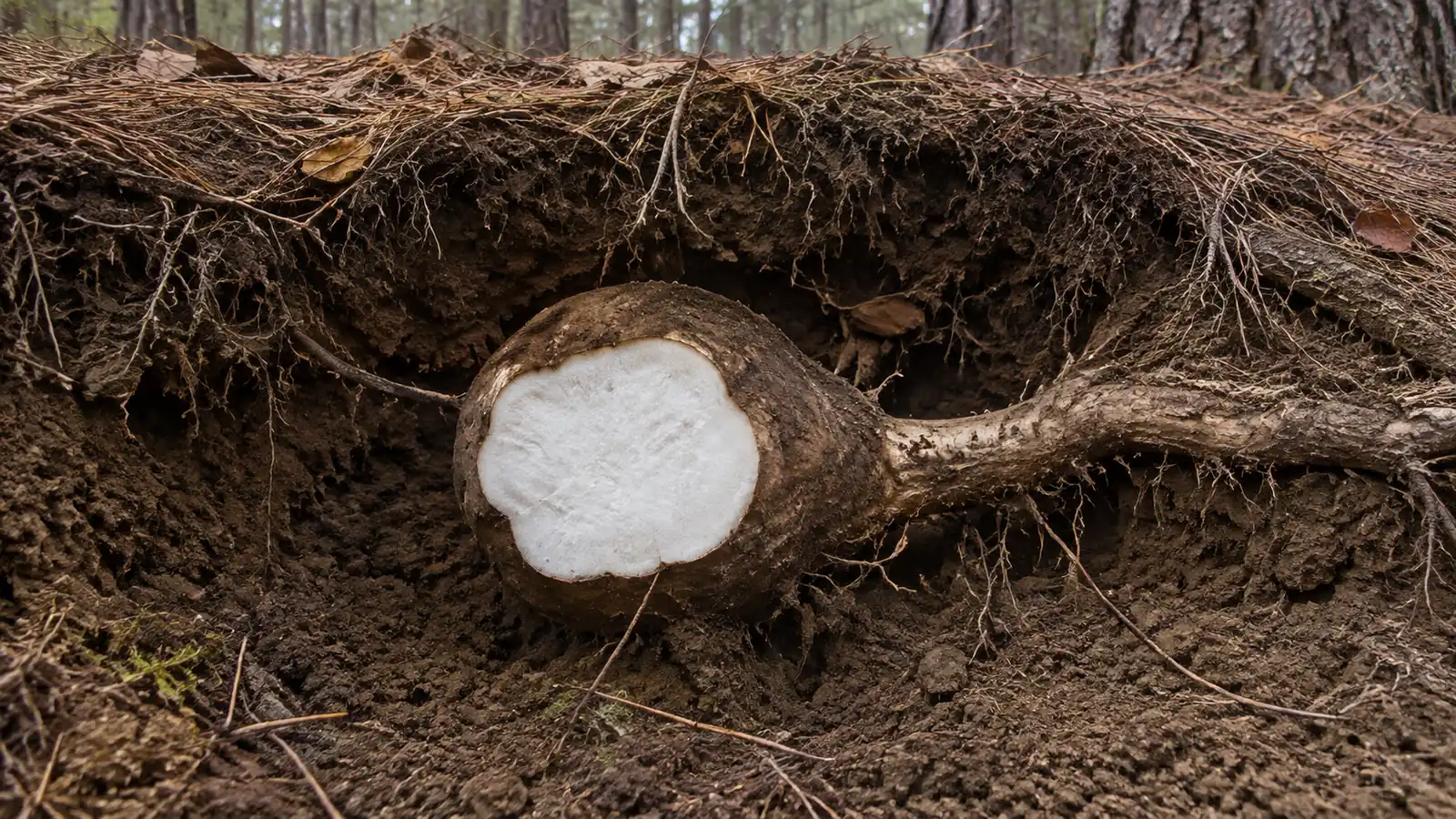
The familiar harvested structure is not a cap. It is an underground sclerotium, often rounded or irregular, with a brown to black rind and a firm white interior.
No gills. The rarely seen fruiting body forms a thin pore-bearing crust on wood, with angular pores rather than blades.
No stem on the sclerotium. The buried mass develops around or beside pine roots and decaying pine wood.
Fresh cut sclerotium is white, dense, and only faintly scented. Pink, wet, hollow, insect-riddled, or strongly sour tissue indicates damage or a different object.
Begin by establishing where the object came from. Poria sclerotia develop below ground beside pine roots or buried pine wood, so an exposed ball on a lawn or a bracket attached above ground begins with a different identification problem.
A whole sclerotium may reach 10 to 30 centimeters and can weigh close to a kilogram, although size varies widely. Its outer rind is brown to nearly black, uneven, and relatively thin compared with the pale interior.
When a documented specimen is cut, the inside should be firm and white to cream rather than arranged in gills, tubes, or marbled veins. Color alone cannot separate poria from roots, plant galls, other fungal sclerotia, or manufactured material.
The sexual fruiting body is a separate form. It spreads as an annual crust on wood, with a pale ochre to pinkish pore surface and roughly one or two angular pores per millimeter, so finding the marketed sclerotium does not mean a visible mushroom will be present.
Is poria edible or poisonous?
Powders remove the rind, texture, attachment, and section characters used to assess the raw material. A product therefore needs a named species, declared fungal part, contamination testing, and a lot number that connects the package to its certificate.
Do not use poria to replace prescribed treatment or to self-treat fluid retention, kidney disease, cancer, or another medical condition. People who are pregnant, breastfeeding, preparing for surgery, or taking medicine should discuss the exact product with a qualified clinician.
If someone becomes ill after eating an unidentified wild growth, contact the regional poison center and keep the remaining material. Do not wait for an online identification before seeking help.
What can be mistaken for poria?
The most dangerous error is assuming that any buried brown lump with a pale interior is poria. Roots, woody burls, plant tubers, insect-damaged wood, puffballs, and sclerotia from other fungi can overlap in color or shape.
A true field record needs the pine association, rind, solid section, and ideally microscopic or molecular confirmation. Earthballs and puffballs form above or partly below the soil but develop a spore mass that darkens with age.
A common earthball shows why cutting an intact object matters. Its darkening spore interior is a reproductive structure, while poria's white sclerotium is stored fungal tissue.
Never identify processed cubes by whiteness or powder by taste. Bleached plant starch, unrelated fungal material, and exhausted extracted solids can all lose the characters needed for recognition.
A commercial name is not a specimen voucher. For medicinal or analytical use, require records that connect the lot to authenticated starting material.
What does a sound poria sclerotium look like inside?
The rind and interior answer different questions. The dark outer layer shows the protected boundary of the sclerotium, while a clean section exposes whether the mass is solid, pale, and reasonably uniform.
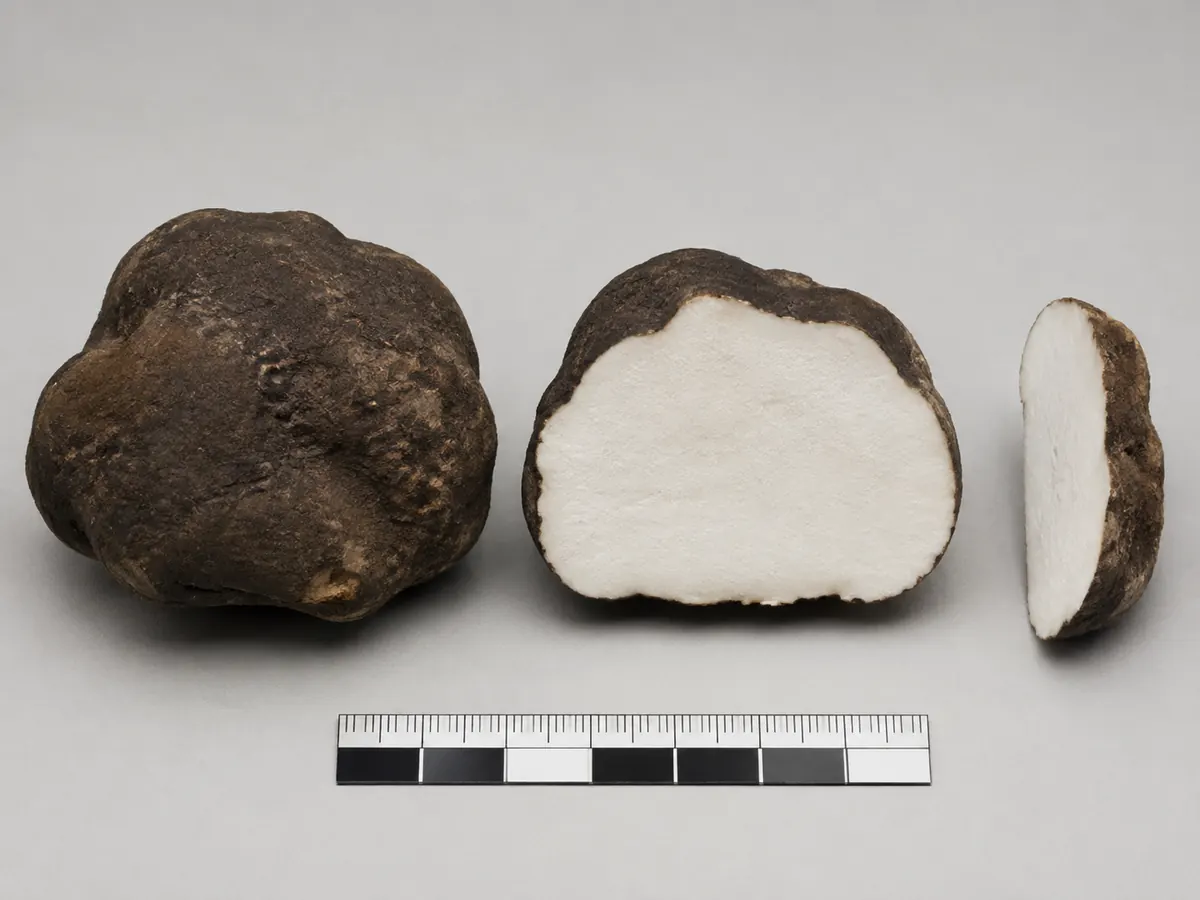
Cavities, wet discoloration, insects, or a developing spore mass change the assessment. A white cut face supports a condition check, but it cannot prove the species by itself.
Where does poria grow around pine roots?
Poria is a brown-rot fungus associated with pine wood. It removes cellulose and hemicellulose while leaving modified lignin behind, which can turn affected wood brown, brittle, and blocky.
The underground sclerotium stores water and nutrients in a protected mass. This lets the fungus persist through conditions that would dry a thin fruiting body, and it explains why the sclerotium can be found after the original root or wood is badly decayed.
Cultivation commonly places an authenticated strain with pine wood in prepared soil beds. Temperature, moisture, substrate condition, and the timing of sclerotial initiation affect whether the fungus makes marketable masses instead of only vegetative mycelium.
The pine connection is ecological evidence, not an identification shortcut. A buried mass beside a pine still needs its attachment, section, and specimen record documented.
How does poria move from culture to an underground crop?
Poria's ecology explains the production method. The fungus first occupies pine wood, causes brown cubical decay, and then builds protected storage masses in the surrounding soil.

Cultivation separates four jobs that disappear in a bag of powder. The strain establishes biological identity, pine wood supplies the substrate, the soil bed permits sclerotial development, and the retained sample preserves a link to the harvested lot.

Contamination or a mislabeled culture introduced at the first stage cannot be repaired by clean packaging at the last. That is why producers test the finished material as well as preserve the strain record.
How is poria cultivated underground?
Poria cultivation starts with an authenticated culture and resinous pine substrate rather than a random wild mass. Producers inoculate prepared pine wood, bury or bed it under managed conditions, and wait for dense sclerotia to develop around the substrate.
The invisible crop makes records unusually important. A large white sclerotium proves successful growth, but it does not by itself prove strain identity or chemical equivalence.
Can poria be used as food?
Processed fu ling appears in traditional porridges, cakes, soups, and starch-like preparations, usually as dried slices, cubes, or powder rather than as a fresh mushroom. Its flavor is mild, and its value in a recipe comes more from texture and cultural use than from a strong mushroom aroma.
A packaged food ingredient is different from a wild-collected sclerotium. Food-grade processing controls cleaning, drying, particle size, and contaminants that cannot be judged in a home-dug specimen.
Do not treat an extraction instruction as identification. Boiling an unknown underground mass neither removes every hazard nor proves it is Wolfiporia cocos.
What does poria research actually support?
Poria research focuses mainly on polysaccharides and lanostane-type triterpenoids from the sclerotium. Laboratory studies report immune, inflammatory, metabolic, and tumor-related effects, but the result belongs to the tested fraction, dose, model, and organism.
| Evidence level | Useful conclusion | Boundary |
|---|---|---|
| Composition study | Identifies compounds in one sample | Does not prove another powder matches |
| Cell experiment | Tests a pathway under controlled conditions | Does not establish a human dose |
| Animal study | Shows activity in one model | Does not demonstrate clinical benefit |
| Human evidence | Can assess a defined preparation and outcome | Remains product-specific and limited |
Traditional use supplies history and questions worth studying, but it is not a substitute for controlled human evidence. Reviews describe substantial preclinical work and much thinner clinical evidence for standalone poria products.
Match every claim to the exact preparation that produced the evidence. Whole sclerotium, purified polysaccharide, triterpenoid fraction, fermented material, and a multi-herb formula cannot be treated as one intervention.
What evidence survives when poria is sliced or powdered?
An intact sclerotium retains its rind, section, shape, and collection context. Cubes preserve part of the interior texture, while powder removes nearly every macroscopic character.
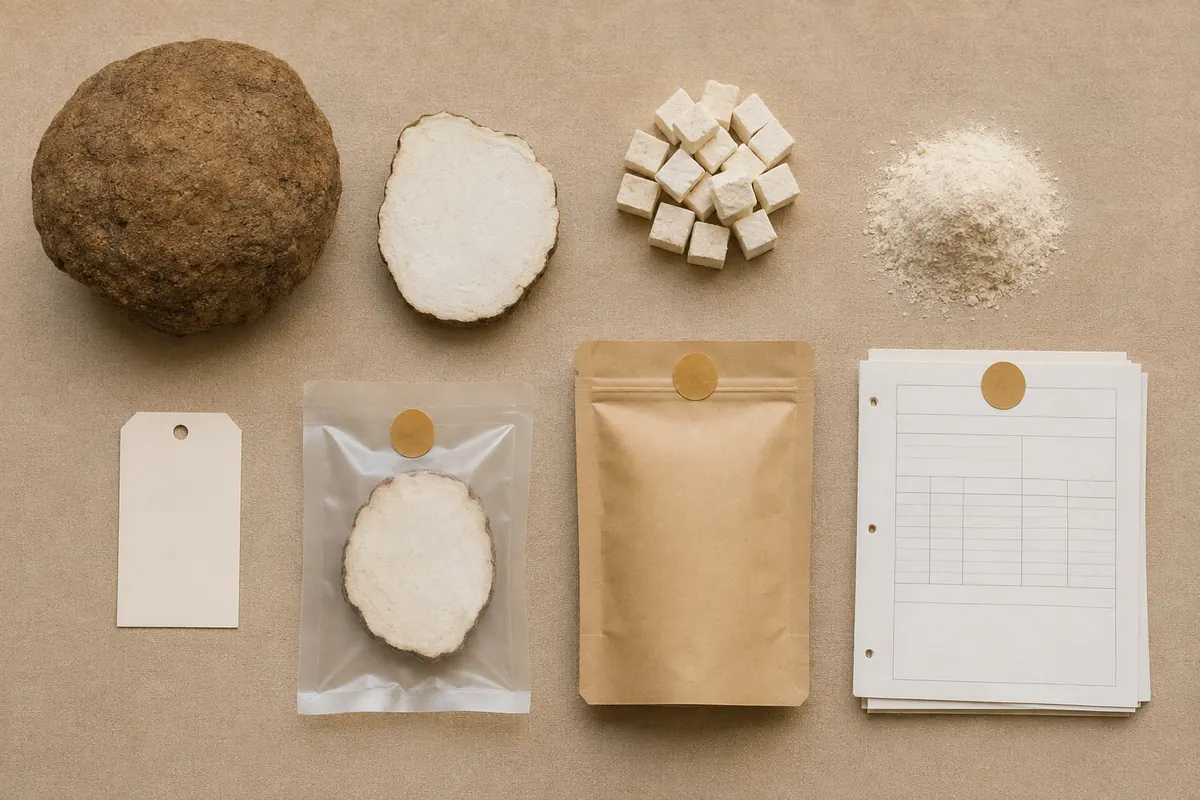
A certificate is useful only when it matches the package and names the analytical method. Processing increases the need for traceability because it steadily removes the structures a buyer could inspect.
What is measured in poria powder?
Poria is usually consumed in small processed amounts, and composition changes when the rind is removed or the sclerotium is extracted. General mushroom nutrition tables therefore do not describe a particular cube, powder, or capsule accurately.
The dried sclerotium contains abundant fungal polysaccharides, but total polysaccharide percentage is not the same measurement as beta-glucan content. A result also says nothing about clinical effect unless the analytical method and tested lot are disclosed.
For a food product, use its serving-specific label and ingredient list. For an extract, evaluate identity, extraction ratio, carrier ingredients, moisture, microbes, heavy metals, and the method behind any marker claim.
Why do poria sources use different scientific names?
The underground form was named Sclerotium cocos, the fungus became widely known as Poria cocos, and later combinations included Wolfiporia extensa and Wolfiporia cocos. One-fungus-one-name rules and typification work changed which name authors prefer.
When comparing papers, search the synonyms but verify the organism and material in each methods section. Poria also survives as a broad historical form-genus name for pore fungi, so the word in an old field guide does not always mean the medicinal sclerotium.