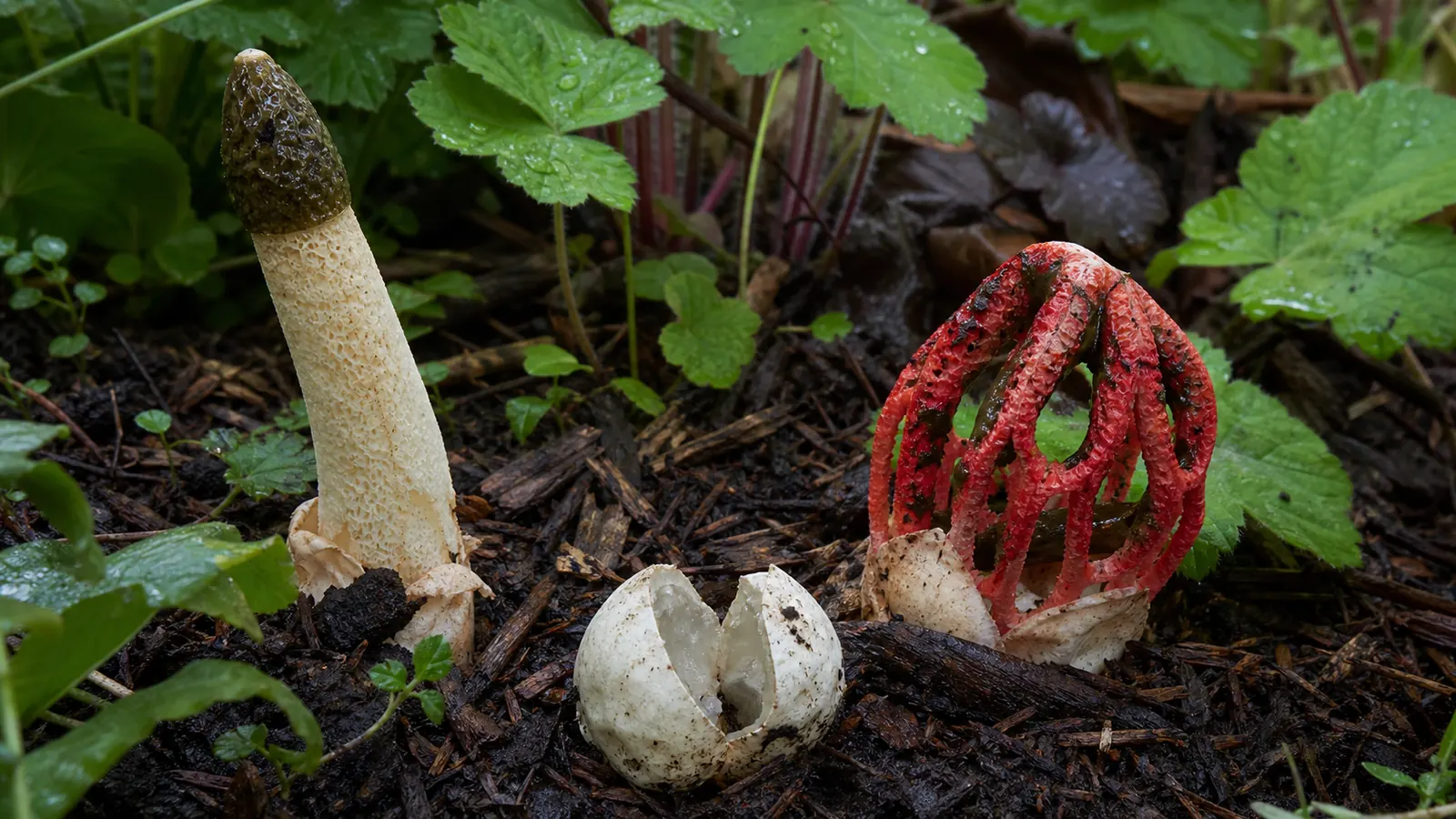
Garden stinkhorns are short-lived decomposer mushrooms that emerge rapidly from gelatinous eggs and use carrion odor to attract spore-carrying insects. They do not harm healthy plants, while egg removal and correction of persistently wet organic material can reduce the nuisance.
A foul-smelling horn, cage, or red star that appears in garden mulch within hours is probably a stinkhorn.
The combination of a split egg at the base, spongy tissue, sticky dark gleba, carrion odor, and visiting flies is more useful than color alone.
Stinkhorns decompose dead organic material and do not infect healthy garden plants. If odor is the problem, the most useful time to act is while the fruiting body is still an unopened egg.
What Is the Foul-Smelling Mushroom in the Garden?
Stinkhorns are members of the fungal order Phallales. Their visible bodies vary dramatically, but most develop from an egglike structure and expose sticky spores on an odor-producing surface called the gleba.
The mature body can be a hollow stalk, a lattice, a group of arms, or a veiled structure.
Its tissue often feels light and spongy because it must expand rapidly from the compact egg.
Carrion odor attracts flies, beetles, and other insects. Those visitors contact the gleba, carry spores on their bodies, and move them away from the original garden bed.
The fruiting body is only the reproductive stage.
Fine mycelial threads remain in mulch, dead roots, sawdust, buried wood, or rich soil after the visible structure collapses.
That hidden network explains why one mature stalk can be removed in the morning and another can emerge nearby the next day. Removal changes the current smell, but it does not erase all colonized material below.
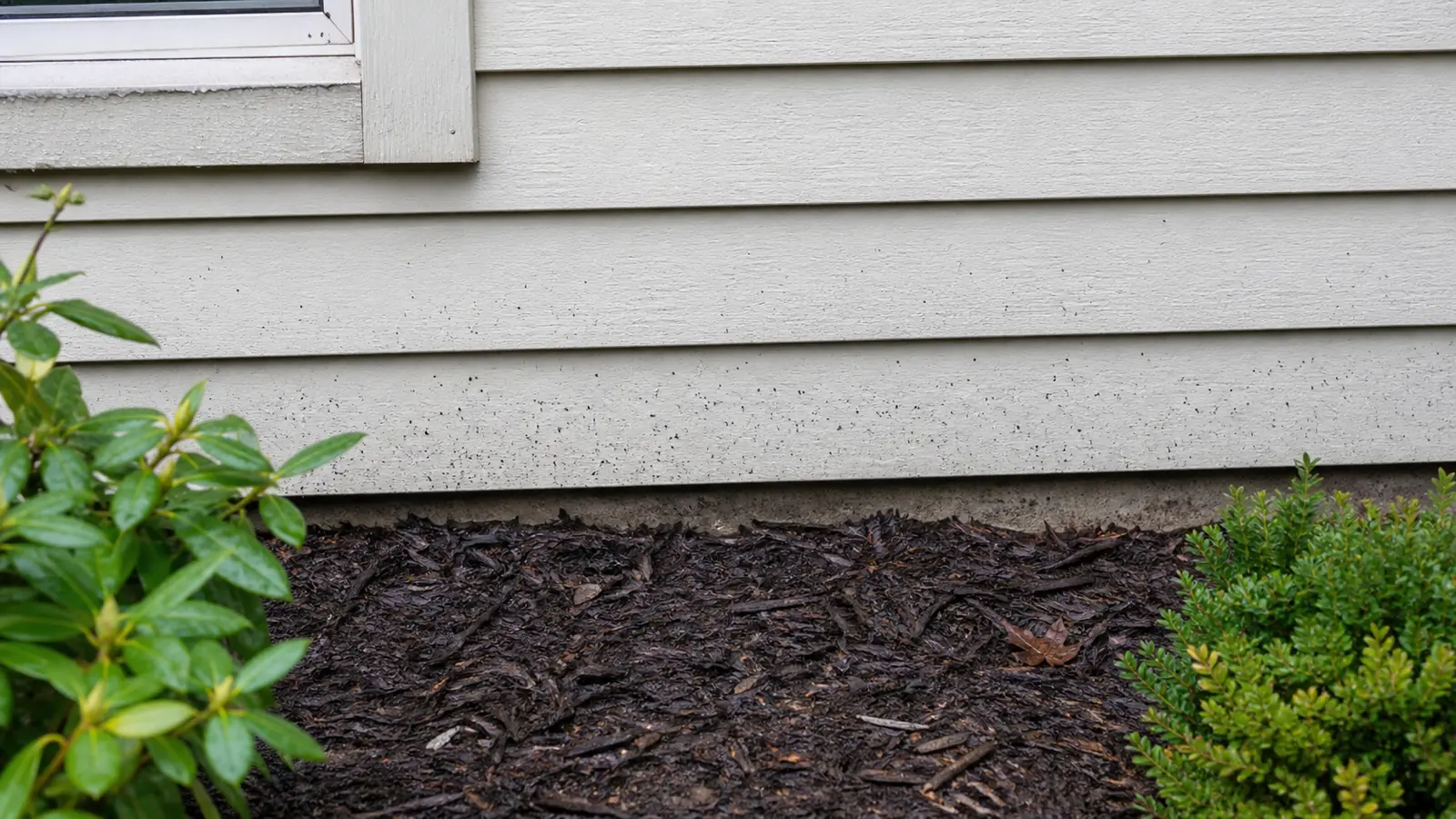
IdentificationWhat Are the Black Artillery Fungus Spots on Siding?Which Stinkhorn Shape Did You Find?
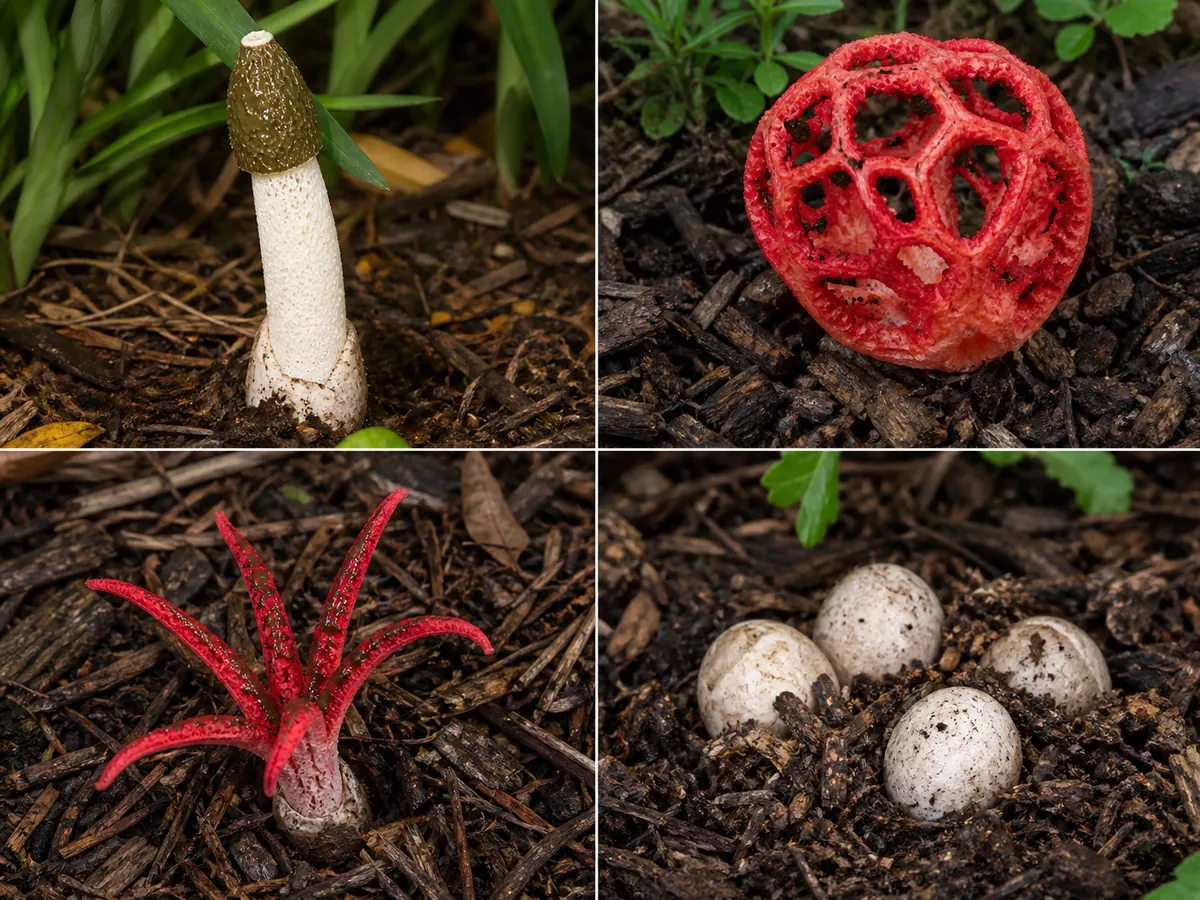
Do not reject a stinkhorn identification because the body is not shaped like one straight horn. Several architectures produce the same sticky gleba, strong odor, rapid growth, and egg remnant.
Use several field marks together before narrowing the identification.
- Photograph the whole body from the side and directly above.
- Include the split egg or cup at the base without cutting it away.
- Show where olive, brown, or black gleba coats the body.
- Record height with a ruler and the time between first notice and full expansion.
- Photograph nearby eggs, mulch type, dead roots, and visiting insects.
- Note region, season, recent rain, and whether several forms emerged from one patch.
Exact species can depend on the arrangement of arms, cap texture, veil, color, egg anatomy, and geographic range.
Weathered specimens lose gleba and collapse quickly, so a fresh complete record is much stronger than one dry fragment.
An orange root, plant shoot, or piece of plastic lacks the spongy hollow tissue and gleba. A carrion-scented mushroom without an egg base still deserves careful documentation because several unrelated fungi and decaying materials can share one odor.
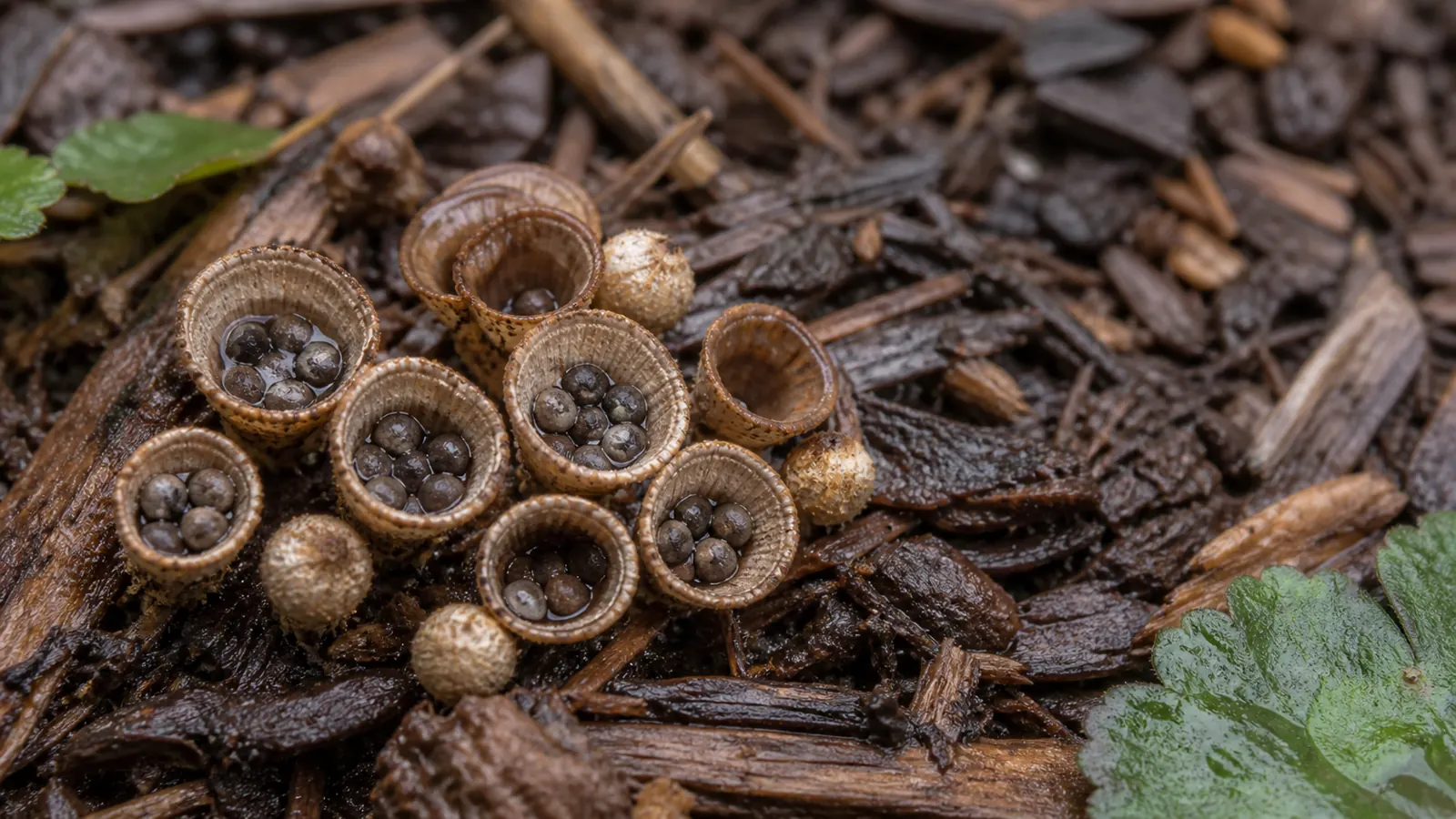
IdentificationWhat Are the Tiny Bird's Nest Fungi in Your Mulch?What Is a Witch's Egg, and What Is Inside It?
A stinkhorn egg is the compact immature fruiting body, not an animal egg.
It often sits partly buried in mulch or soil and can be whitish, cream, pink, or faintly purple.
The outer skin encloses a thick gelatinous layer. Inside, the future stalk, arms, cap, or lattice is already folded into a dense colored core.
Young puffballs are usually more uniformly firm and white inside before their spores mature. Plant bulbs and tubers show organized plant tissue rather than a slippery gel surrounding a folded mushroom.
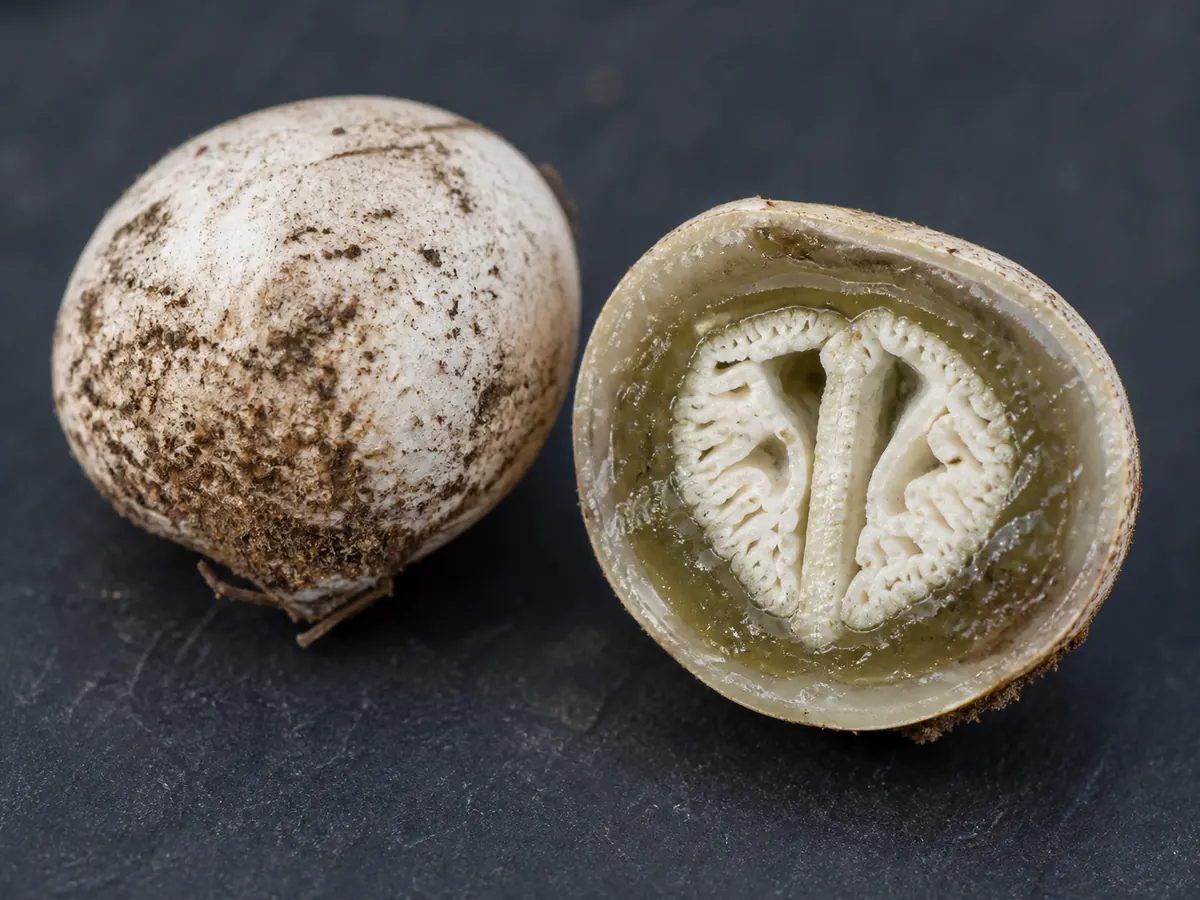
Do not cut the only remaining specimen if ingestion or formal identification is a concern.
Preserve it intact, photograph the outside and attachment, and follow the evidence instructions from the relevant poison or diagnostic service.
The egg stage is the useful nuisance-control window. Lifting the whole egg before expansion prevents that individual body from exposing gleba and producing the strongest odor.
Why Does a Stinkhorn Smell, and How Do Flies Spread It?
Most gilled mushrooms release dry spores to air currents, but stinkhorns use animals. Volatile compounds make the gleba smell like carrion or dung, which draws insects that normally search for those materials.
Expansion can be remarkably fast because the body unfolds and inflates from tissue already organized inside the egg.
Some observed stinkhorns have grown several inches within an hour, though temperature, moisture, species, and starting stage change the rate.
Removing a mature body can reduce the smell at that moment. It cannot retrieve spores already carried away, and it does not remove the mycelium that formed other eggs.

The odor often weakens as insects consume or remove gleba and the fruiting body collapses.
That short natural life is why tolerance can be a reasonable choice when the bed is away from doors, windows, patios, and play areas.
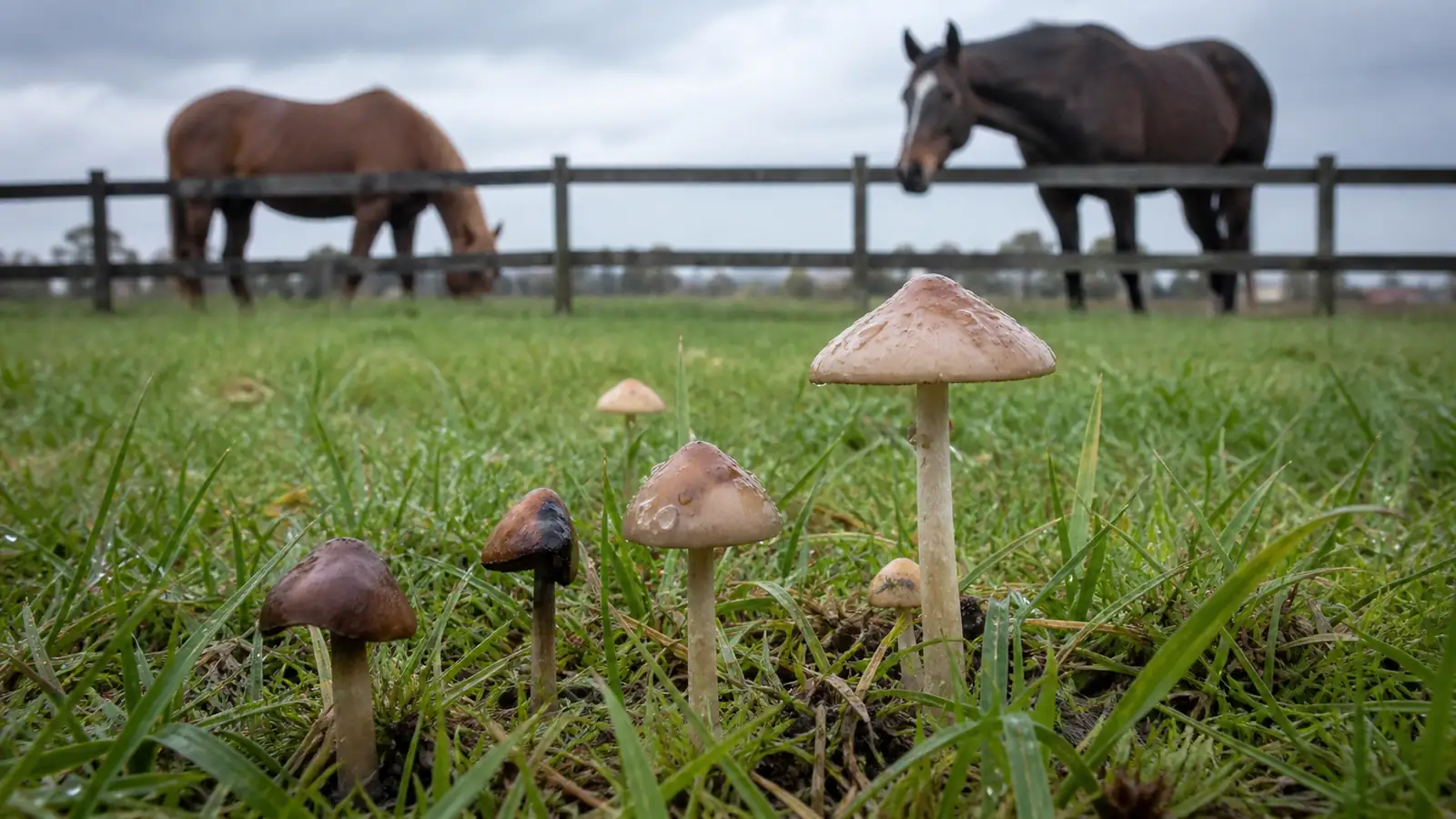
IdentificationWhat Should You Do About Mushrooms in a Horse Pasture?Are Stinkhorns Poisonous or Harmful?
Stinkhorn mycelium feeds on dead organic matter and does not cause disease in healthy flowers, shrubs, turf, or vegetable roots. Its decomposition can return nutrients from mulch and wood to the garden soil.
Ordinary brief skin contact is not the same as swallowing an unknown mushroom. Gloves and handwashing are sensible because gleba is sticky, attracts insects, and may carry garden contamination.
Warning
Do not treat a garden stinkhorn as food | Some references discuss edible uses for certain species and stages, but a common name or phone photograph cannot verify an unknown garden specimen. Keep children and pets from mouthing the body, and contact the appropriate poison or veterinary service after a possible ingestion.
Strong odor can cause nausea or headache in sensitive people without mushroom poisoning. Bagging mature bodies, closing a nearby window, or limiting time beside a heavy flush can reduce the immediate exposure.
If the structure lacks the expected egg, gleba, spongy body, or fly activity, preserve the uncertainty. A safety decision should not depend on forcing an unusual mushroom into the stinkhorn group because it smells unpleasant.
How Do You Remove Stinkhorns Before They Smell?
Search the affected patch early in the day after rain or irrigation. Unopened eggs can sit just below the mulch surface in small groups around older collapsed bodies.
Use a narrow trowel to lift each egg with a small margin of surrounding material.
Place it directly into a bag, check the hole for connected eggs, and wash the tool before moving to another garden bed.
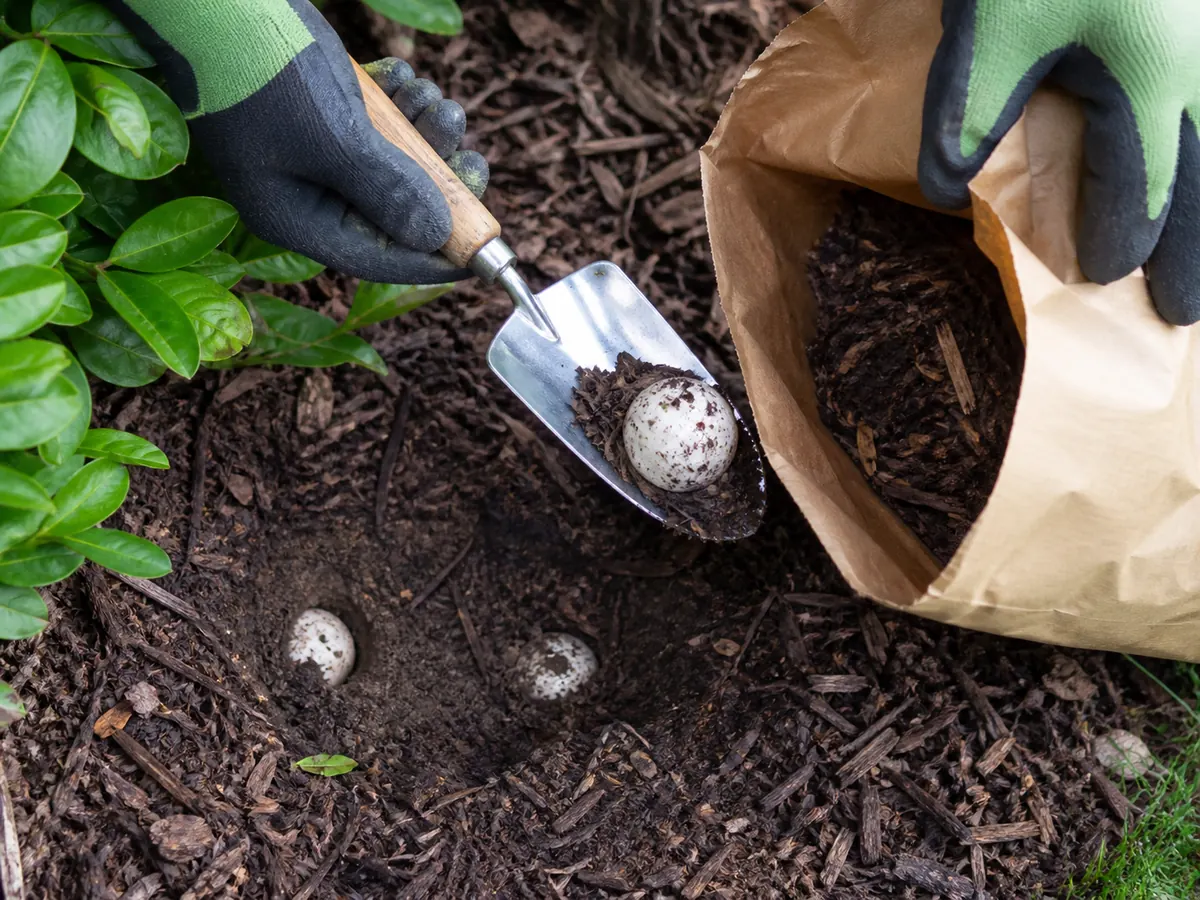
The correct response depends on what stage and nuisance you found.
Unopened eggs near a doorway or patio
Lift and bag the eggs before they splitThis prevents those bodies from exposing gleba in the high-impact location.
Mature bodies already smell
Remove and bag the visible bodies, then clean the toolCurrent odor decreases, but the site still needs monitoring for new eggs.
Fruiting repeats in a wet irrigated patch
Shorten unnecessary irrigation and improve surface dryingLess prolonged moisture can reduce the conditions that support repeated development.
Eggs follow buried roots, old sawdust, or deep decomposed mulch
Remove accessible concentrated debris or replace only the affected excessThe mycelium retains food when fresh mulch is simply added above the colonized layer.
Stirring the surface can disrupt some fruiting in loose mulch, but deep aggressive raking can damage plant roots and spread fragments. Work only where the observed source and nuisance justify it.
There is no reliable practical fungicide program that eradicates an extensive stinkhorn network in a home garden.
Chemical treatment adds cost and possible plant or soil impact while leaving buried organic food and future insect-delivered spores available.
Expect occasional new fruiting after wet weather even after careful egg removal. Success means fewer high-impact bodies near occupied areas, not a guarantee that a living outdoor bed will never produce another stinkhorn.
Sources & References
- University of Florida IFAS Identification, egg stage, decomposer role, dispersal, and management.
- Wisconsin Plant Disease Diagnostics Clinic Body forms, rapid growth, origin, plant safety, and prevention limits.
- University of Nebraska Extension Egg anatomy, lookalikes, and rapid emergence.
- Iowa State University Extension Height, gleba, insect dispersal, and optional removal.