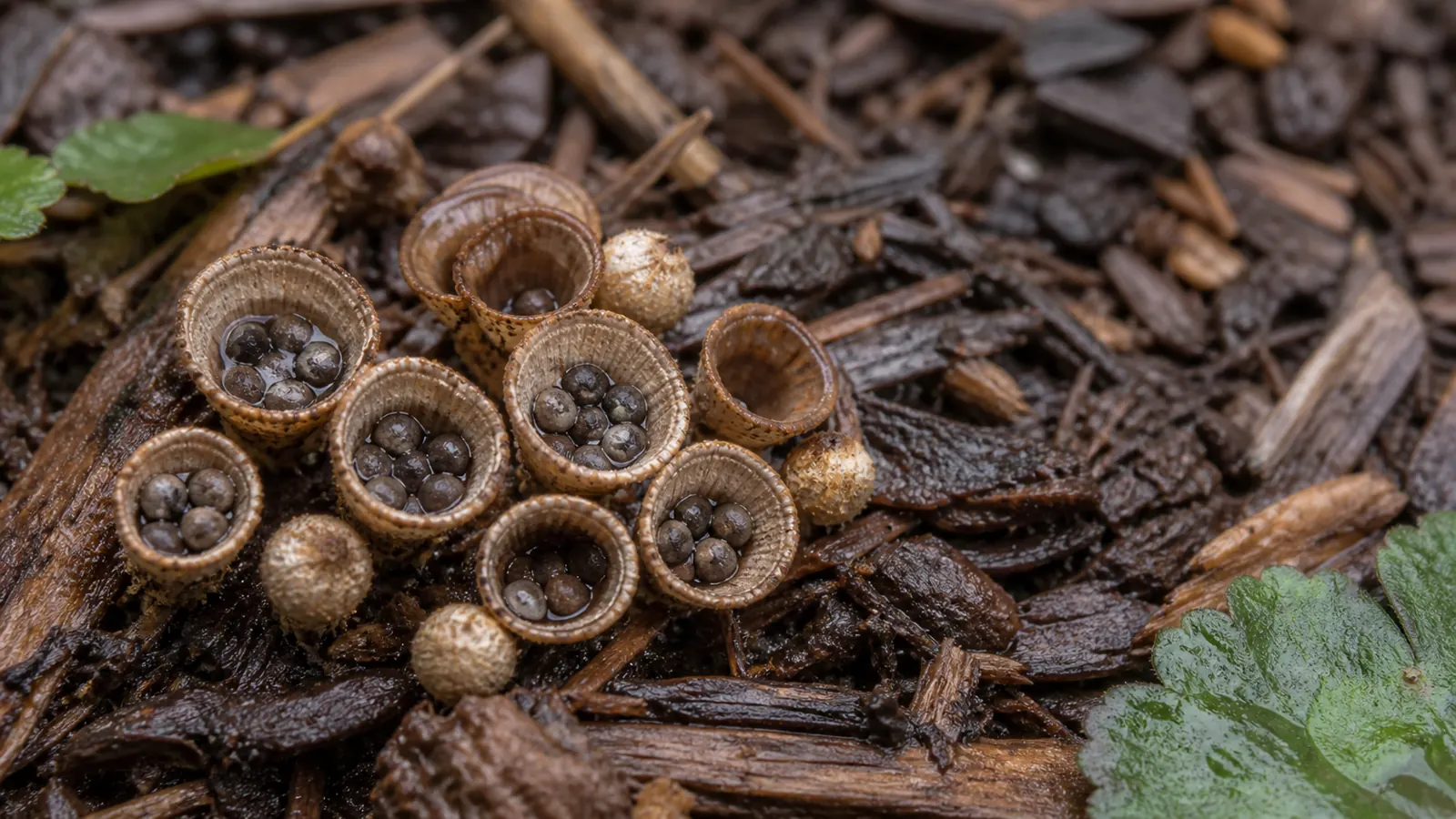
Bird's nest fungi are harmless decomposers that form tiny cups filled with spore packets called peridioles. Rain splashes the packets from the cups, while damp decaying mulch supports repeated fruiting.
Bird's nest fungi in mulch are tiny decomposers whose fruiting bodies resemble cups filled with eggs. The cups do not hold insect eggs, because each seedlike disc is a spore packet called a peridiole.
Most finds can remain in the bed. A useful response starts by confirming the cup-and-packet structure, then checking whether rain-splashed packets or persistently wet mulch create a practical nuisance.
What Are the Tiny Nests in Your Mulch?
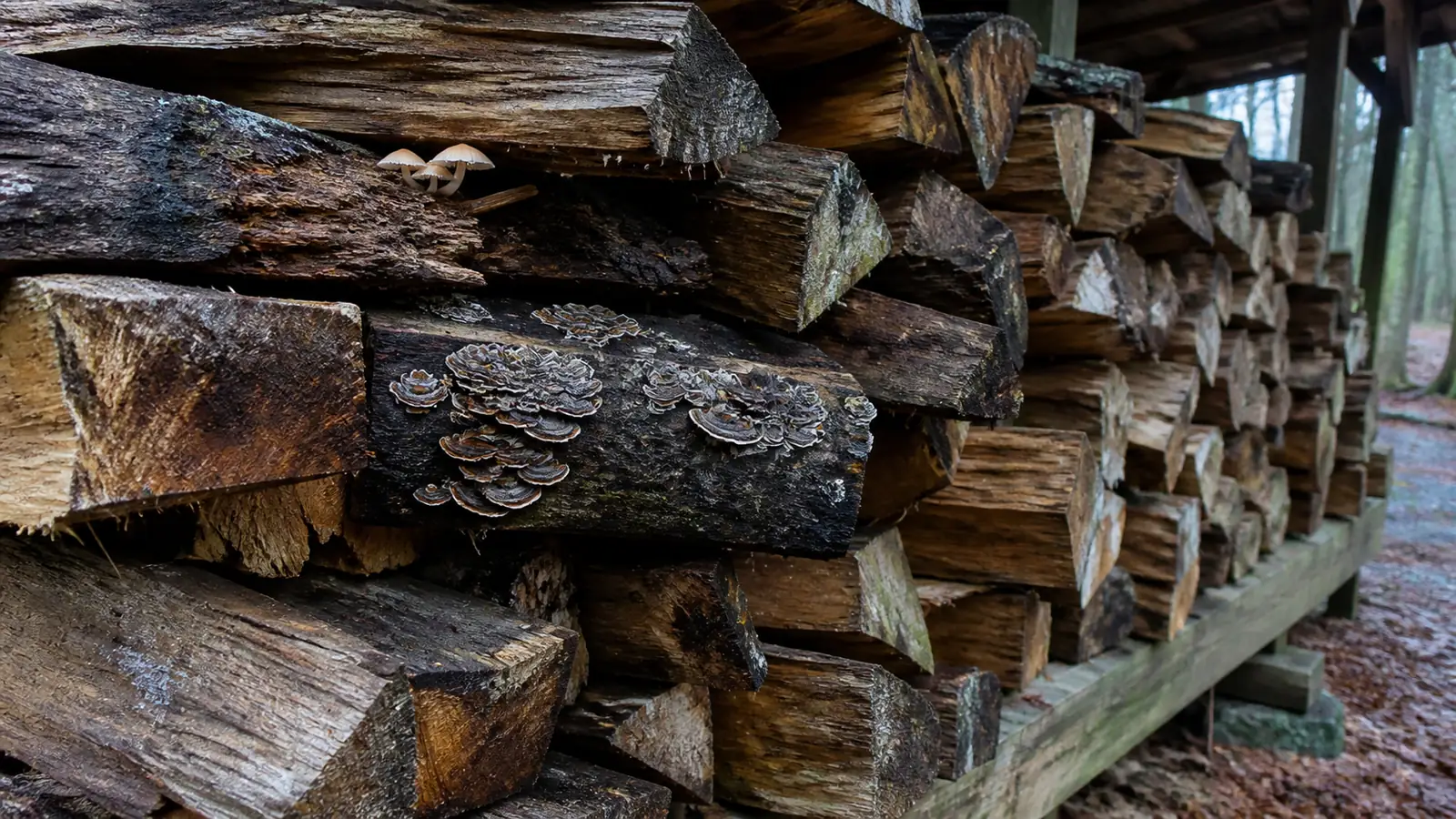
Bird's nest fungi belong to a group of gilled-mushroom relatives that package their spores inside small discs. The visible cup is the reproductive structure, while fine mycelium threads spread through wood chips, leaf litter, twigs, and other dead plant material below it.
The formal name for the cup is a peridium. Several peridioles sit inside the mature cup, and each peridiole contains many spores behind a tough outer covering.
A mature fruiting body commonly measures about one quarter to one half inch across. That small scale explains why a dense colony can look like scattered seeds until you kneel beside the mulch and inspect it closely.
Young fruiting bodies do not always look like open nests.
They can begin as rounded or cushion-shaped structures covered by a thin lid. The lid breaks or disappears as the cup opens, rain ejects the peridioles, and an old empty cup remains.
Finding all three stages in one patch is stronger evidence than finding one weathered cup. It also shows that the fungus is actively fruiting in the material rather than arriving as loose debris.
Which Bird's Nest Fungus Is in the Mulch?
Cup color alone cannot identify a bird's nest fungus. Texture inside the cup, hair on the outside, rim shape, peridiole color, and the presence of a cord provide a more useful combination.
Several common forms can share one mulched bed, and weather changes their colors quickly.
Fluted bird's nest, common bird's nest, and field bird's nest are useful candidates for field identification, but they are not conclusions from one photograph. Exact species work can require a magnifier, an intact cord and peridiole, or microscopic characters that a weathered garden specimen no longer preserves.
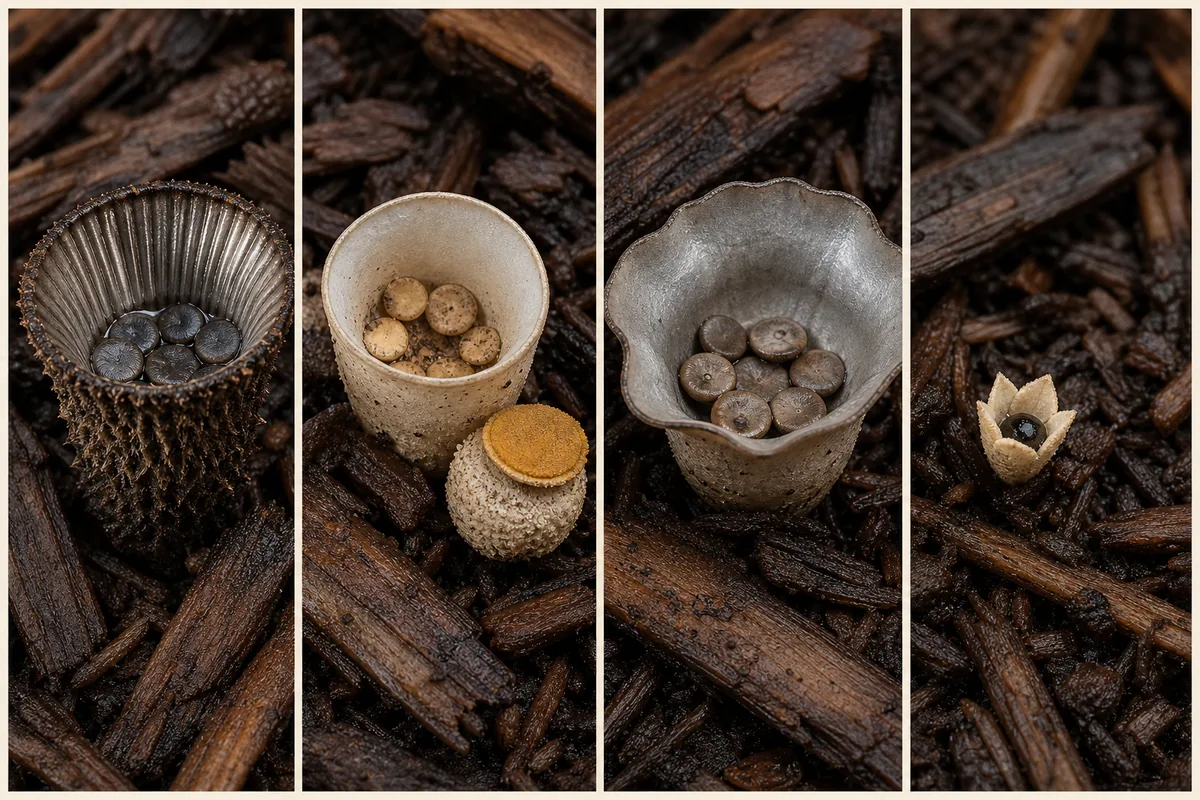
Raking destroys the substrate pattern and can dislodge fragile cups, so record the evidence before touching the patch. The useful record preserves both habitat and small structural details.
- Photograph the whole colony so the wood-chip substrate and cluster pattern remain visible.
- Place a ruler beside the cups without pressing or moving them.
- Photograph a closed young body, an open cup, and an old empty cup when all are present.
- Show the inner wall straight on so grooves or a smooth surface can be compared.
- Record the outside texture, rim shape, lid color, and peridiole color.
- Note whether each cup holds several discs or only one dark packet.
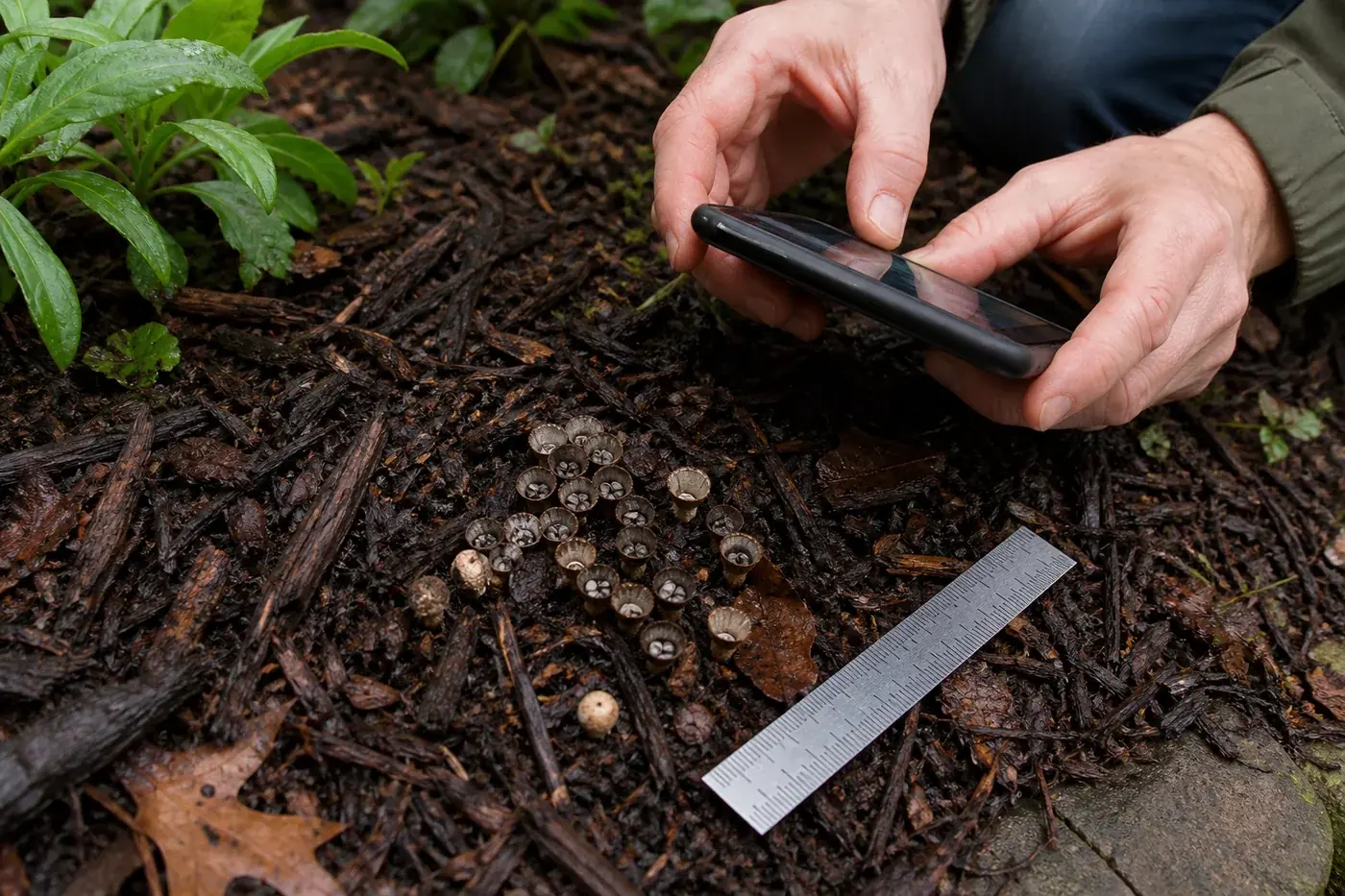
Photographing the patch works best when scale and habitat appear beside the close detail. A single top-down image of a wet cup can hide the shaggy exterior, flared rim, or substrate attachment that separates the candidates.
Artillery fungus is the most relevant mulch lookalike because both groups use packets rather than exposed gills or pores. The decisive visible difference is packet number and cup form, since a bird's nest cup displays several peridioles while an artillery fungus cup launches one.
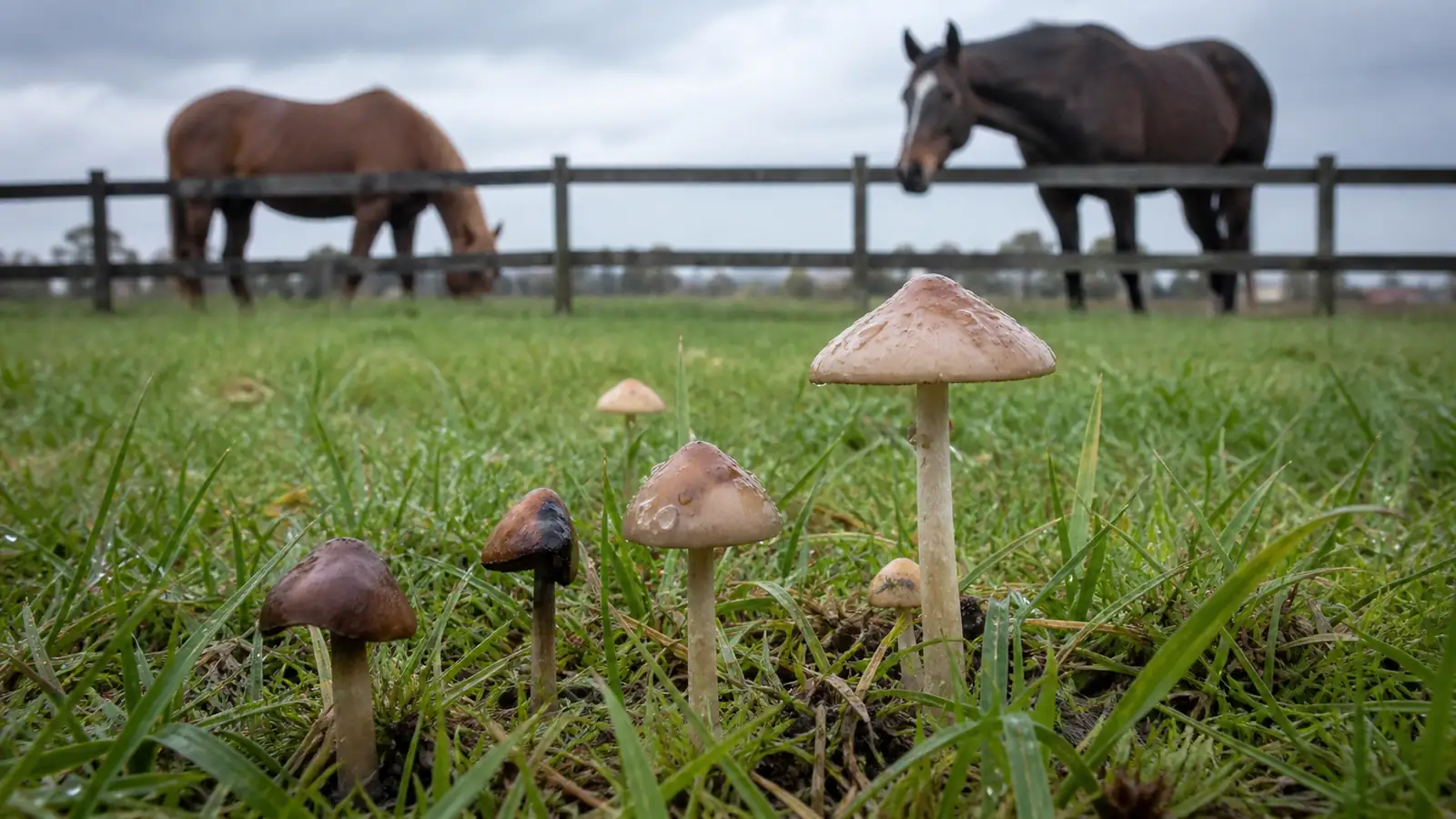
IdentificationWhat Should You Do About Mushrooms in a Horse Pasture?Are Bird's Nest Fungi Harmful?
Bird's nest fungi are decomposers, not pathogens of healthy garden plants. Their mycelium uses dead organic matter in mulch and does not explain leaf spots, root collapse, stem lesions, or another symptom on a nearby plant.
An ordinary flush therefore does not require plant treatment.
Can You Eat Bird's Nest Fungi?
Do not eat them. A garden photograph can support group-level recognition, but it cannot establish a safe species or rule out contaminants on treated landscape material.
Warning
Treat ingestion as an unknown exposure | Do not let a child or pet mouth a mulch fungus because a photograph resembles a harmless bird's nest fungus. Remove visible fruiting bodies and block access when repeated ingestion is possible, and contact the appropriate medical or veterinary service if an unknown fungus was swallowed.
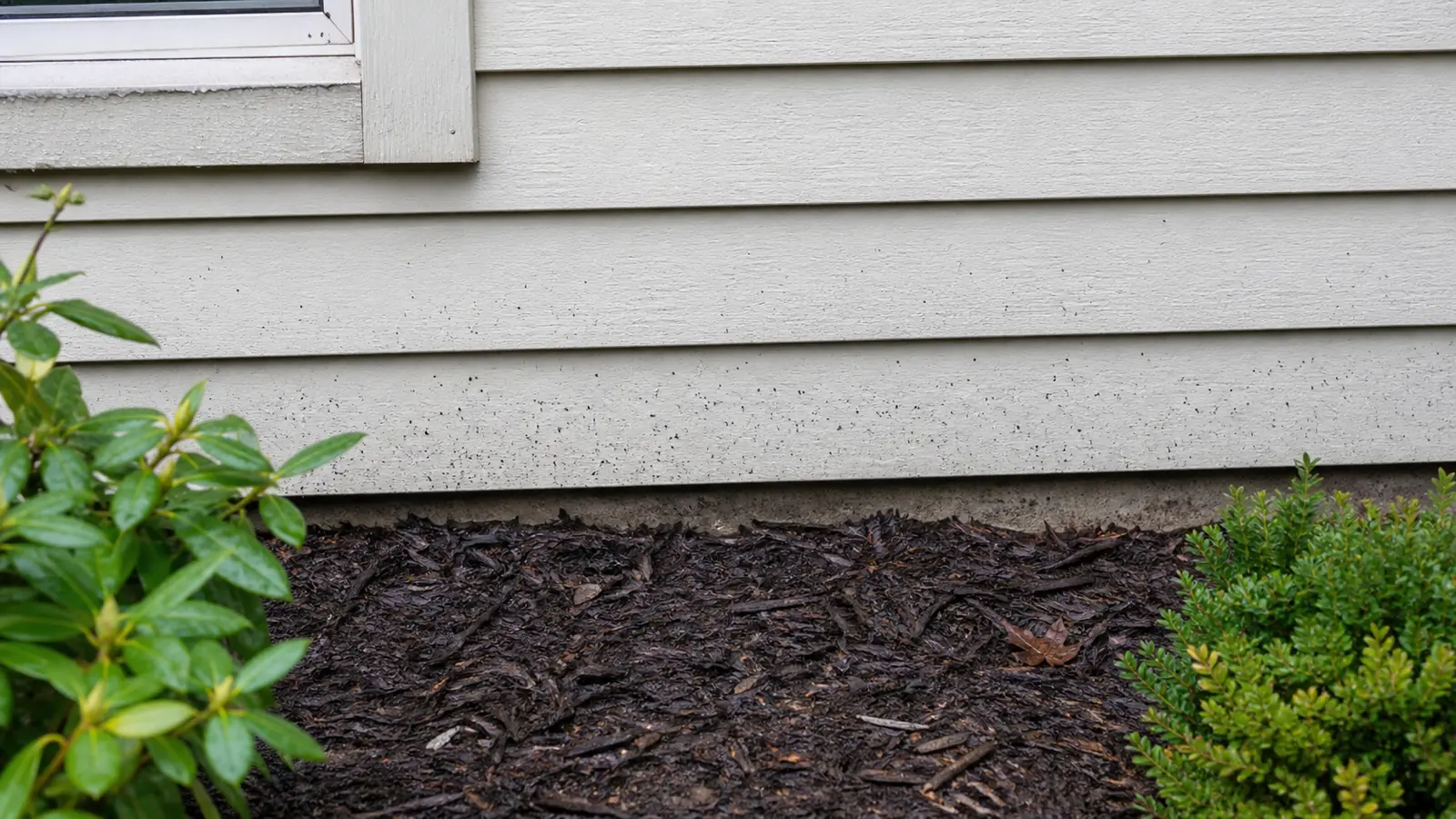
The practical property issue comes from the peridioles rather than the colony feeding below. Rain can splash the packets onto low siding, foundations, garden furniture, pots, or a parked vehicle, where their adhesive surfaces can make them difficult to lift after drying.
That nuisance depends on placement.
Cups deep in a bed away from vulnerable surfaces can be observed, while a dense colony beside pale siding or a regular parking place deserves earlier source control. Removing the cups alone changes the current display but leaves colonized mulch capable of fruiting again.
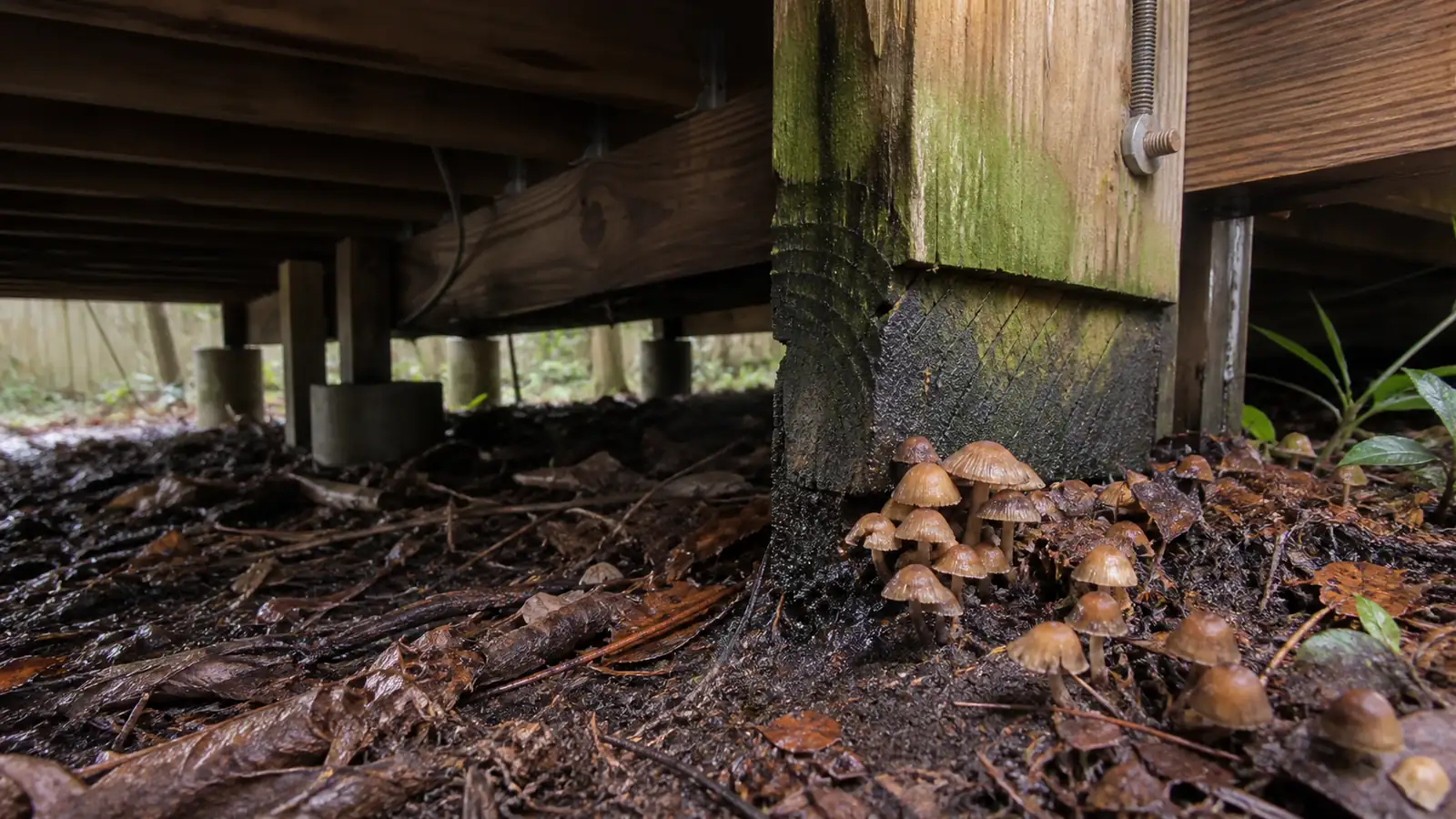
IdentificationWhy Are Mushrooms Growing Under Your Deck?How Do Bird's Nest Fungi Spread?
A falling raindrop supplies the energy that launches a peridiole. The cup shape redirects the impact upward, so the packet leaves the nest rather than washing over its rim with the rest of the water.
Under favorable conditions, a packet can travel about three feet, or roughly one meter. Sprinkler irrigation can trigger the same splash process when droplets strike the cup with enough force.
In cord-bearing bird's nest fungi, the departing peridiole pulls out a fine funicular cord.
The sticky end can catch a twig, blade, leaf, or rough surface, and momentum can wrap the cord around that support. This places the spore packet above the original mulch, where drying and weathering eventually expose or release its spores.
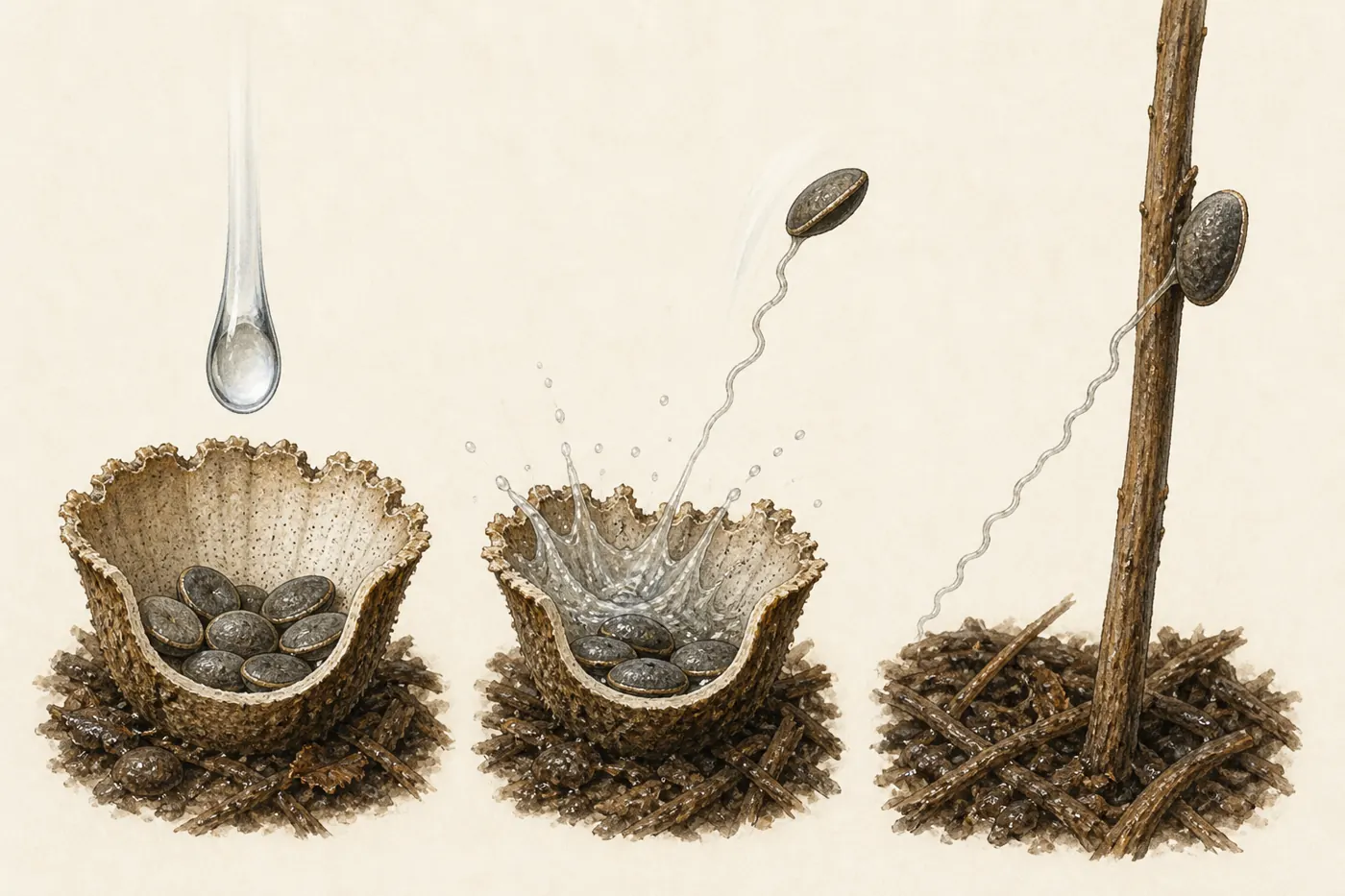
The spores can germinate when they reach suitable damp organic material. Compatible mycelia grow through the substrate before later conditions support another crop of fruiting bodies.
Empty cups after rain are therefore evidence of dispersal, not evidence that the fungus died. Sticky discs on nearby objects also make more sense once the launch direction and approximate distance are considered.
Why Do Bird's Nest Fungi Return, and How Can You Reduce Them?
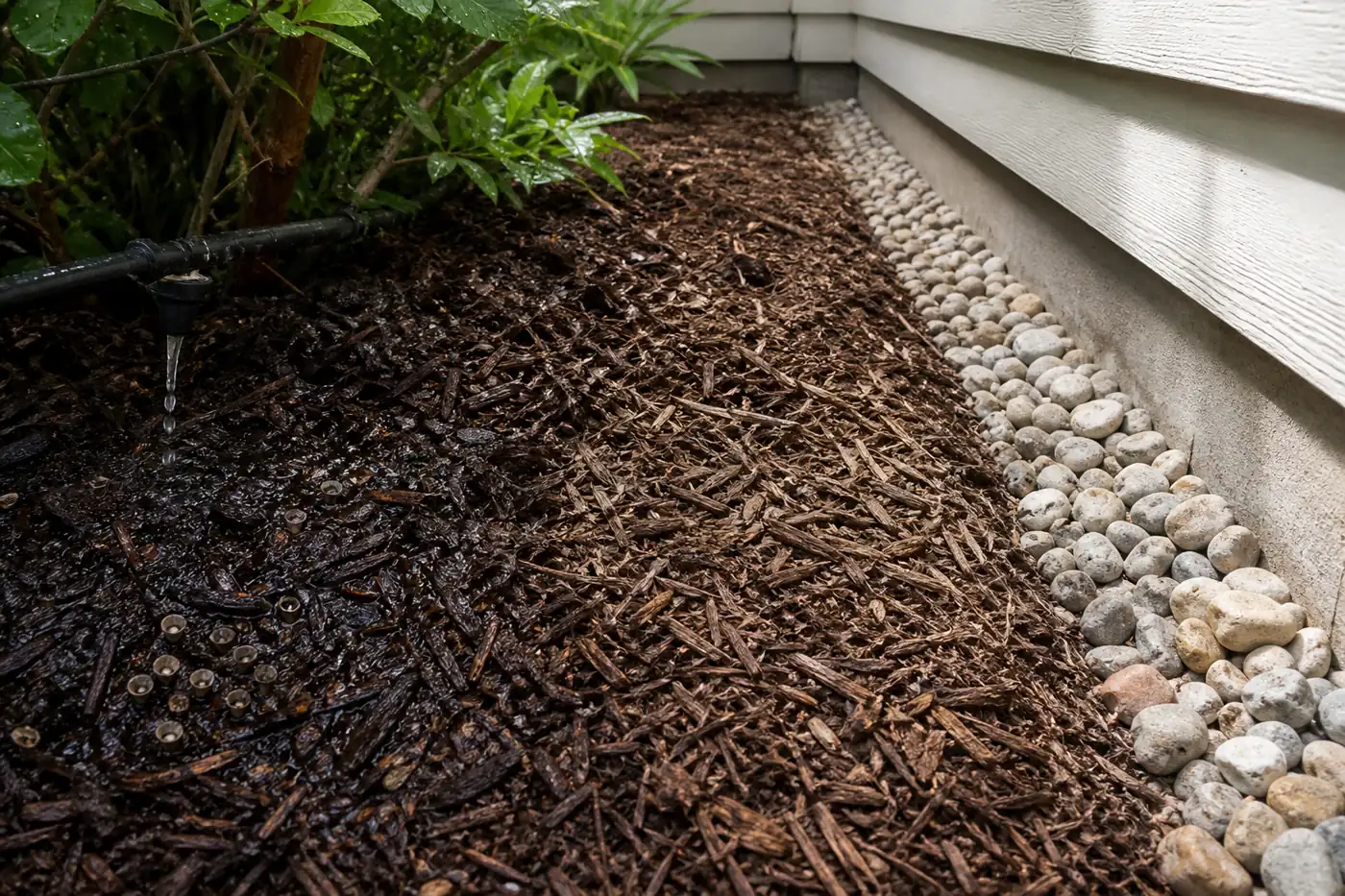
Repeated fruiting means the bed still supplies moisture and digestible plant debris. Shaded wood chips, decomposed mulch fines, trapped leaf litter, frequent irrigation, and a leaking downspout can keep that material wet long enough for the hidden mycelium to produce new cups.
Map the wet pattern before removing the visible colony.
- Check whether sprinkler droplets strike the patch or keep it wet between rain events.
- Lift the newest chips and inspect the darker fine layer beneath them.
- Look for leaf litter, buried twigs, old edging, or wood pressed against the soil.
- Trace roof runoff, a leaking hose connection, or a low spot that drains into the bed.
- Compare how quickly the affected patch and an open sunny section dry after the same rain.
The right action depends on what the cups are affecting.
A few cups away from paths and buildings
Leave them in place or rake them aside after observationThey are completing decomposition and create no plant-health problem.
Repeated cups in a constantly wet patch
Reduce unnecessary irrigation, repair leaks, and rake the surface so it driesShorter wet periods make repeated fruiting less favorable without rebuilding the entire bed.
A dense colony in old mulch fines
Remove the heavily decomposed layer and replace only the material the planting actually needsThe food source and colonized fine layer remain when fresh chips are simply piled on top.
Sticky packets near siding or a parked car
Create a drier separation strip or use a suitable inorganic buffer at the vulnerable edgeDistance and lack of organic substrate reduce the chance that new packets reach the surface.
Fungicides are not recommended for routine treatment of bird's nest fungi in mulch. Spraying the cups also leaves the wet organic substrate unchanged, so it does not address the condition supporting the colony.
What if the peridioles are already stuck to siding or a car?
Treat the receiving surface as carefully as the fungus source. Start with the manufacturer-approved gentle method on a hidden area, because aggressive scraping, solvents, or high pressure can damage paint, vinyl, coatings, seals, or vehicle clear coat before the dried packet releases.
Fresh packets offer the best chance for careful lifting, but a faint residual mark can remain.
Removing artillery fungus spots from siding involves the same finish-first limit even though that fungus launches a different packet. For a vehicle, use automotive wash guidance or a qualified detailer rather than transferring a household siding cleaner to the clear coat.
Judge control after later wet weather, not immediately after raking. Fewer new cups and no fresh packets on nearby surfaces show that the moisture and substrate changes are working, while old empty nests can persist after active fruiting slows.
Sources & References
- LSU AgCenter Habitat, harmlessness, splash distance, adhesive peridioles, and management.
- University of Wisconsin Plant Disease Diagnostics Clinic Cup size, habitat, dispersal, and control guidance.
- MushroomExpert Bird's nest fungal anatomy, genera, and identification limits.
- MushroomExpert species accounts Field characters of common bird's nest fungi.