What does a ghost fungus look like in daylight?
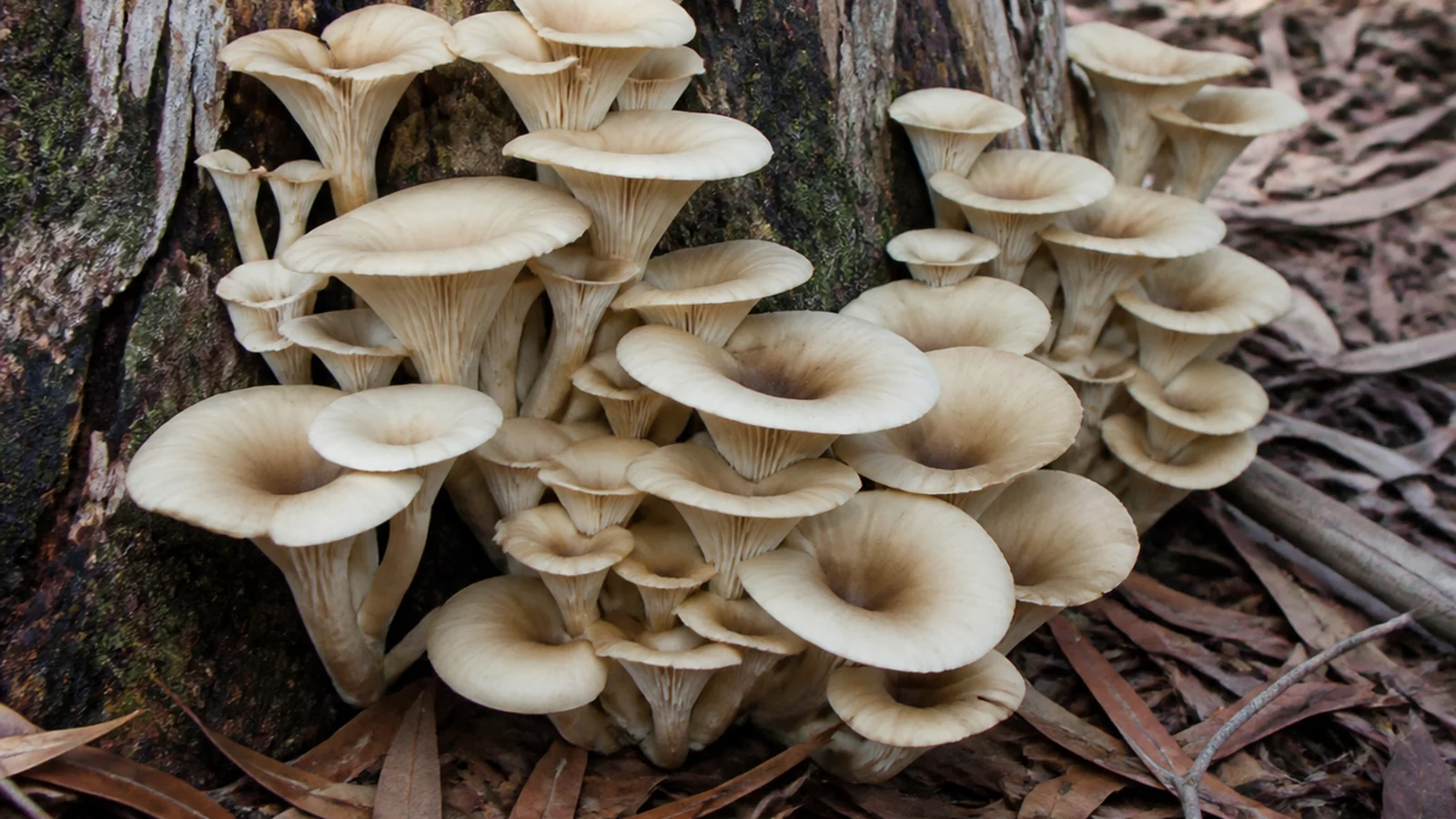
Ghost fungus grows in overlapping clusters on wood, with fan- to funnel-shaped caps that can reach about 30 centimetres across. A large cluster on a eucalypt stump is one of the more striking things in an Australian wood.
The color is variable and unhelpful. Caps run from cream through pale gray to smoky brown, often darker toward the center and paler at the margin, and the same cluster can show most of that range at once.
What does not vary is the gills.
They are crowded, pale, and decurrent, which means they run a long way down the stem instead of stopping where the cap ends.
That decurrent run is easy to see and easy to feel. Draw a finger down from the cap edge toward the base and the gill ridges continue under your fingertip well past the point where a cap-and-stem mushroom would have become smooth.
The flesh is thin in the cap and gets progressively tougher toward the base. By the time you reach the point of attachment it is closer to a piece of wood than to a mushroom, and that gradient is worth learning by hand.
How do you identify it without the glow?
Fan- to funnel-shaped, up to about 30 cm across, cream through pale gray to smoky brown and often darker toward the center, with a wavy inrolled margin when young, growing in overlapping clusters.
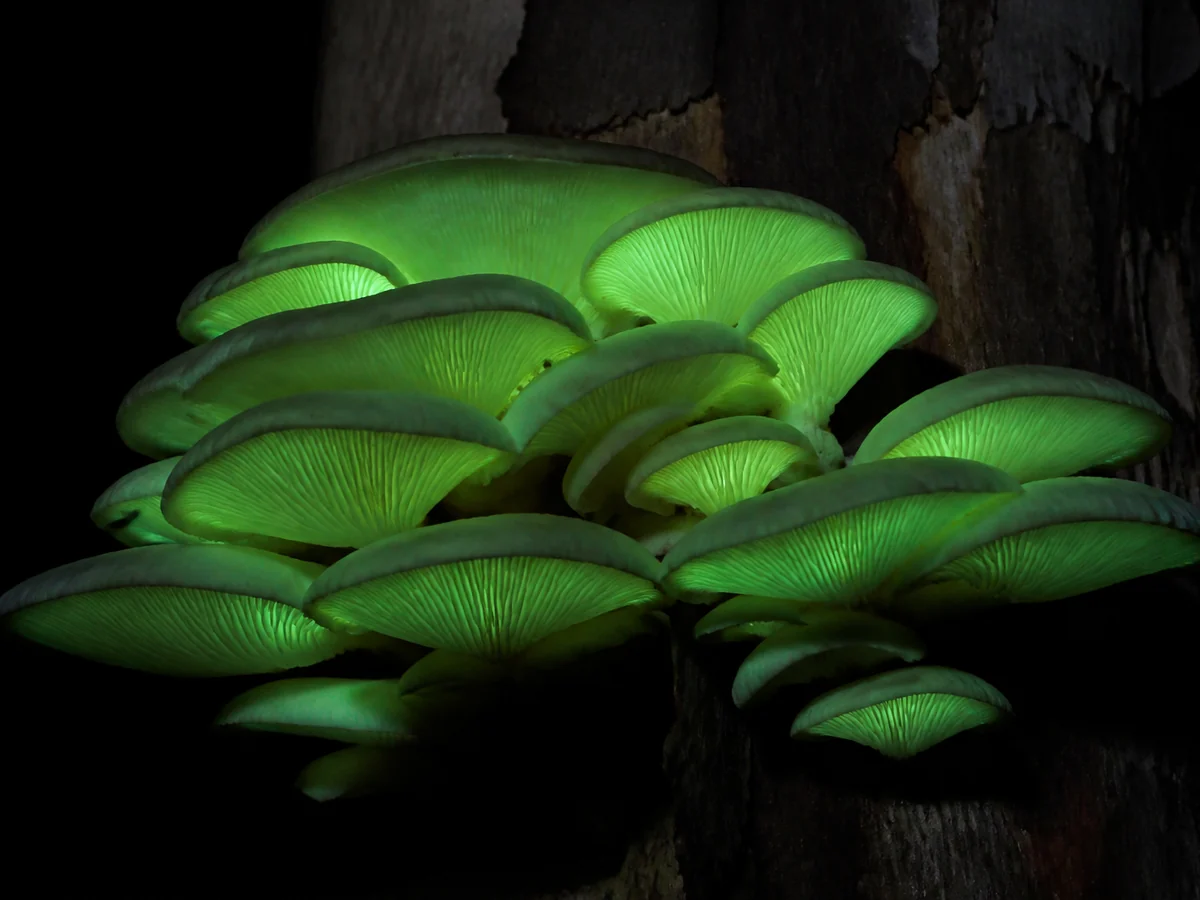
Crowded, pale cream, and decurrent, running a long way down the stem rather than stopping at it. The gills are the part that glows.
Short and often off-center, sometimes almost absent, and tough and fibrous throughout rather than soft, which is the field mark that matters most.
Whitish, thin in the cap and toughening toward the base, with a faint unpleasant smell in older specimens.
Almost everything written about this mushroom leads with the glow, and in the field the glow is not available to you.
It needs full darkness and eyes that have had ten or fifteen minutes to adapt, it is strongest in fresh mature specimens and fades as they age, and a torch beam or a phone screen erases it completely. Nobody stands in a wood at night deciding whether to eat something.
So identify it the way you would if the glow did not exist, using only what daylight shows.
The stem is where the decision gets made, and it is a texture rather than a shape.

Take hold of the base and try to tear it the way you would tear a piece of oyster mushroom. Ghost fungus resists, splits along fibres, and feels stringy. An oyster mushroom gives way softly and tears cleanly.
Do that before anything goes in a basket rather than after, because once several clusters are mixed together you have lost the chance to test each one at its base.
If someone may have eaten this mushroom, act now. Call Poison Control at 1-800-222-1222 (US) or emergency services before symptoms appear, and save a piece of the mushroom for identification.
What safety details matter for Ghost Fungus?
That is a stronger default than this site applies to most species. It is justified by how often the mistake is made and by how unpleasant the outcome is.
The tear test at the base takes two seconds and does not depend on light, color, size or season. Tough and stringy means leave it, and there is no version of that result worth arguing with.
Do not rely on the glow to clear a specimen either way. A fresh ghost fungus in a dark room may glow convincingly, and an older one may show nothing at all, so a dark test that produces no light has told you nothing.
If a meal is followed by vomiting within a few hours, seek medical advice and say what was eaten and when it started.
Onset timing is the single most useful thing a clinician can be given, and rapid onset genuinely does point away from the mushrooms that damage a liver.
How do you tell it from an oyster mushroom?
The confusion that matters is with oyster mushrooms, and it is the most consequential mushroom mistake made in Australia.
The reason is structural rather than careless. Both grow in overlapping clusters on wood, both can be pale, both have gills running down toward an off-center stem, and both were once placed in the same genus, so the resemblance is real and not a failure of attention.

Color will not separate them either, because oyster mushrooms range from near-white through gray to tan and ghost fungus covers most of the same ground.
Three things do separate them. None of the three is a photograph, which is why this confusion survives so well online.

Daylight photographs cannot show the glow, so check the other identification features.
Oyster mushroomSoft flesh that tears cleanly, thin and even toward the base, faint sweet aniseed smell
Ghost fungusTough fibrous base that tears in strings, thickening toward the attachment, unpleasant smell when older
The first is the tear test at the base already described. Oyster flesh is soft and yields; ghost fungus stays fibrous and stringy right through the point of attachment.
The second is thickness. An oyster mushroom is comparatively thin and even in cross-section, while a ghost fungus thickens noticeably as it approaches the base.
The third is smell, which is soft evidence but worth having.
Oyster mushrooms smell faintly sweet and aniseed-like when fresh, and older ghost fungus develops a smell most people describe as unpleasant rather than mushroomy.
If the cluster is on a eucalypt, treat that as a reason for more care rather than as proof either way. Oyster mushrooms do grow on eucalypts in Australia, so the host narrows the question without closing it.
Warning
Ghost fungus is poisonous. It contains the sesquiterpenoid toxins illudin S and illudin M, and eating it causes violent gastrointestinal illness: cramping, nausea, repeated vomiting and diarrhea. Symptoms typically begin within about thirty minutes to three hours and can continue for six to twenty-four hours. It is not usually fatal in a healthy adult, and the dehydration that comes with prolonged vomiting is the part that puts people in hospital.
The speed is the one mercy here, because a mistake announces itself the same evening rather than days later, which is the difference between this and the amatoxin mushrooms where a delay of many hours is itself the danger.
That difference is worth knowing precisely because it changes what a clinician needs to hear. Rapid onset points toward this kind of irritant poisoning, and onset many hours after a meal points somewhere far more serious.
Anyone who has eaten a suspected ghost fungus should keep a piece of it, uncooked and unwashed if possible, and keep taking fluids.
The specimen is worth more to an identifier than any description of it.
Where does ghost fungus grow?
Ghost fungus is a wood decomposer, and it works on living trees as well as dead ones.
It fruits in overlapping clusters at the base of trunks, on stumps, and from buried roots, which is why clusters sometimes appear to be growing out of bare ground with no wood in sight. Eucalypts are the usual host, which puts the species in the woodland and the suburb at once.
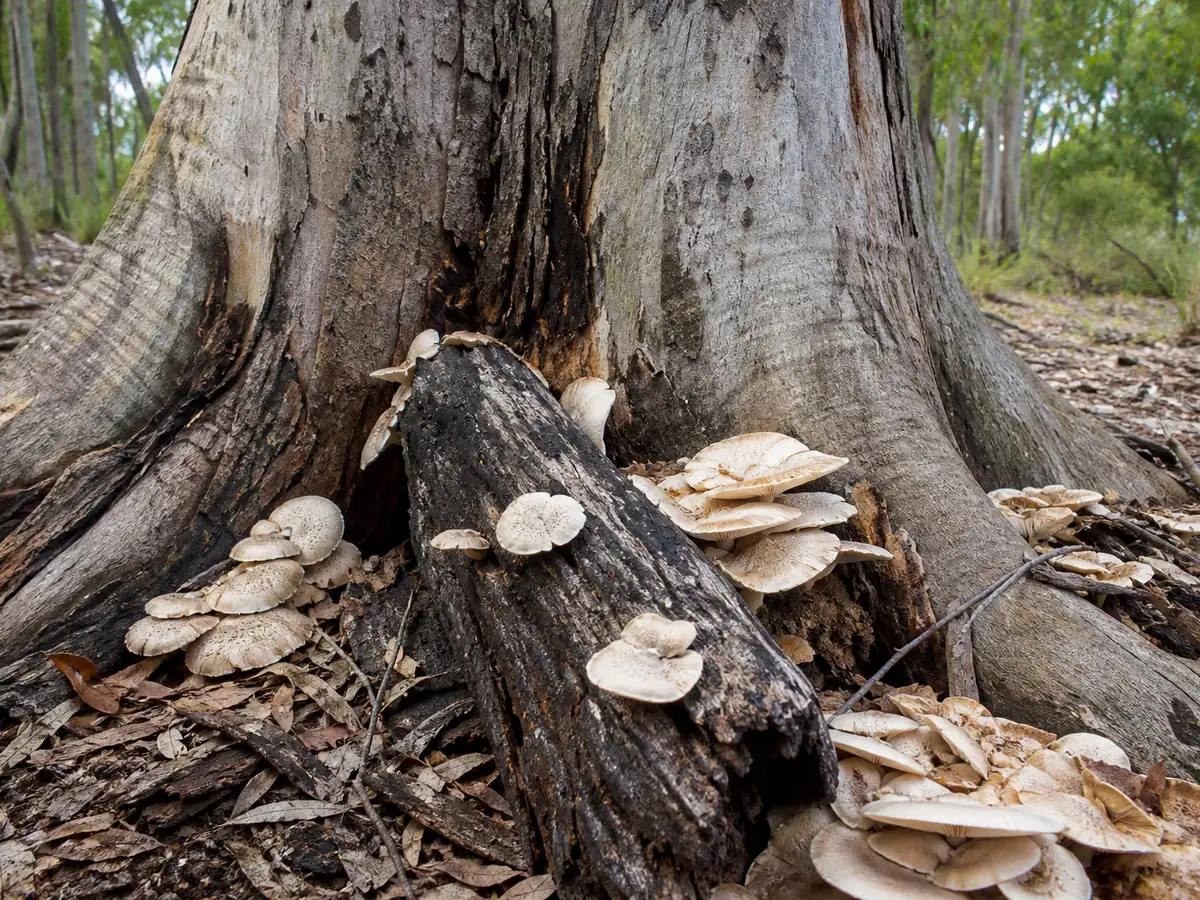
Street trees, park plantings and garden stumps produce it as reliably as bushland does.
That urban presence matters more than it sounds. A large share of the people who encounter this mushroom are not out foraging in a forest, they are looking at something that appeared overnight in a garden.
The season runs mainly through autumn and into early winter after rain, though a wet year can produce fruiting outside that window. Clusters can be large and persist for a couple of weeks, darkening and drying as they age.
Can cooking make it safe?
There are no culinary notes for this mushroom, and the absence is the point.
Cooking does not make it safe. The illudins are not deactivated by ordinary kitchen heat, and reports of poisoning include meals that were thoroughly cooked before they were eaten.
Nor does the usual folk reasoning help. It is not bitter enough to warn you off, it does not look diseased, and a young specimen can be firm and pleasant to handle.
The only correct handling is to leave it where it is, or to collect one specimen for identification and keep it well away from anything intended for a kitchen.
Do the illudins make it medicinal?
The illudins have a genuine research history, which is not the same as the mushroom having a medicinal use.
Illudin compounds have been studied as starting points for anticancer chemistry because they are potently cytotoxic, and that cytotoxicity is precisely why the mushroom makes people ill. A compound being interesting to a laboratory is not a reason to eat the organism that produces it.
Nothing about ghost fungus supports any traditional or supplemental use, and there is no preparation of it that is safe to consume.
Does it turn up in cultivated beds?
Nobody cultivates ghost fungus for food, and there is no reason to.
It has been grown in laboratories to study its bioluminescence, which is a research activity rather than a hobby one, and the practical interest for a grower is the opposite: making sure it is not what came up in a wood-chip bed intended for an edible species.
That does happen. Outdoor beds mulched with hardwood or eucalypt chips sit in exactly the habitat this fungus occupies, so anything appearing in a bed needs identifying rather than assuming.
Why is there no nutrition table here?
This poisonous mushroom has no place in a meal.
Publishing a composition table for a mushroom nobody should eat would suggest a use that does not exist, and the only quantity worth stating is that no amount is a safe amount.
Why was it once called an oyster mushroom?
The old name explains the modern problem.
Ghost fungus was once placed in Pleurotus, the oyster mushroom genus, which is a fair record of how similar the two look to a careful observer. It now sits in Omphalotus, a genus whose members are consistently bioluminescent and consistently poisonous.
That genus is worth knowing by name because it repeats elsewhere. The jack-o-lantern mushrooms of North America and Europe are Omphalotus too, they glow the same way, and they are confused with chanterelles rather than with oyster mushrooms.
So the pattern generalises even though the lookalike does not. A glowing gilled mushroom growing in clusters on wood is an Omphalotus, and no member of that genus is food.
Ghost fungus safety and identification questions
Is ghost fungus poisonous?
Does ghost fungus really glow?
How do you tell ghost fungus from an oyster mushroom?
Can you cook ghost fungus to make it safe?
Where does ghost fungus grow?
When does ghost fungus fruit?
Sources & References
- Edible and poisonous fungi, Royal Botanic Gardens Victoria The institutional Australian position on poisonous fungi and on the risk of identifying wild mushrooms from photographs and general resemblance
- Bioluminescence in the ghost fungus Omphalotus nidiformis does not attract potential spore dispersing insects, Fungal Biology 2016 That the bioluminescence is a measured phenomenon of this species and that its function is not settled, since the insect-attraction hypothesis was tested and not supported