Is woolly milkcap poisonous?
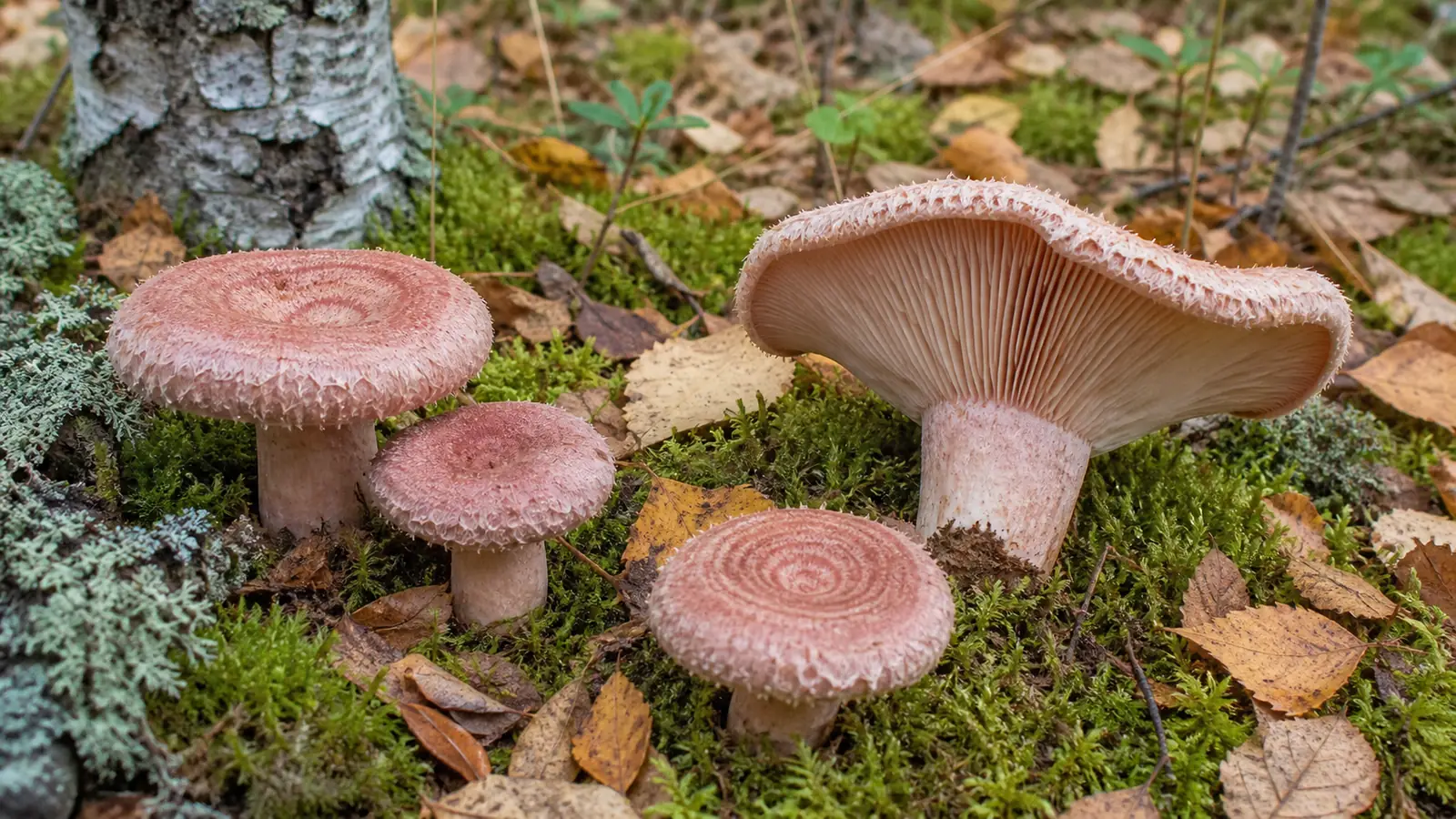
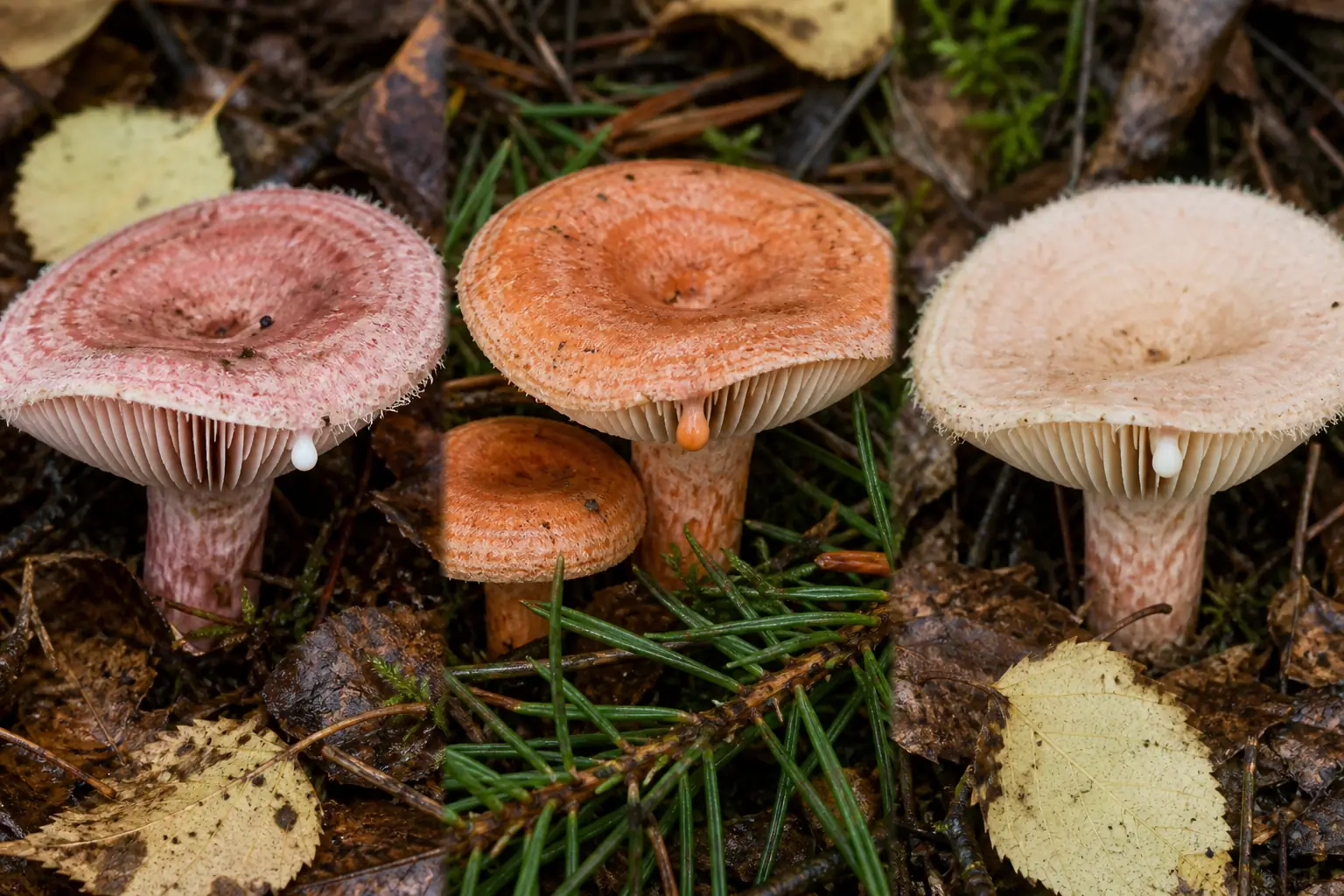
The woolly edge is most dramatic on a fresh young cap.
Long coarse hairs gather along the inrolled margin, creating a feature that can disappear as the cap expands, dries, weathers, or becomes slug-damaged.
Pink and salmon rings spread outward from the center in darker concentric bands. Moist caps can feel slightly sticky, while dry specimens lose saturation and may look cream or buff at a distance.
The center becomes shallowly depressed and can deepen into a funnel with age. This change exposes more of the pale crowded gills and reduces the compact button-like look of younger fruiting bodies.
Cut gills produce white latex, the defining milkcap response. The milk normally remains white rather than turning orange, and the brittle flesh snaps instead of bending in long fibers.
The stem is stout and ringless, usually shorter than the cap is wide. Shallow darker pits may mark its surface, and the interior can become hollow in mature specimens.
Birch is part of the identity, not background scenery. A pink hairy milkcap found far from birch roots needs a different explanation and should not be forced into this name.
How do you identify woolly milkcap?
About 4 to 12 cm across, pink to salmon with darker concentric zones, initially convex with a deeply inrolled shaggy margin, later depressed toward the center.
Crowded, pale cream to pinkish, attached broadly and running slightly down the stem, releasing white latex when cut.
Short, sturdy, pale pink to cream, often with shallow darker pits, becoming hollow with age, and without a ring.
Firm brittle pale flesh with copious white milk and a strongly acrid, burning taste. Tasting is not recommended.
Begin with the cap edge and host tree before testing the latex. Young specimens should show an inrolled margin clothed in conspicuous woolly hairs, with salmon-pink zones across the cap.
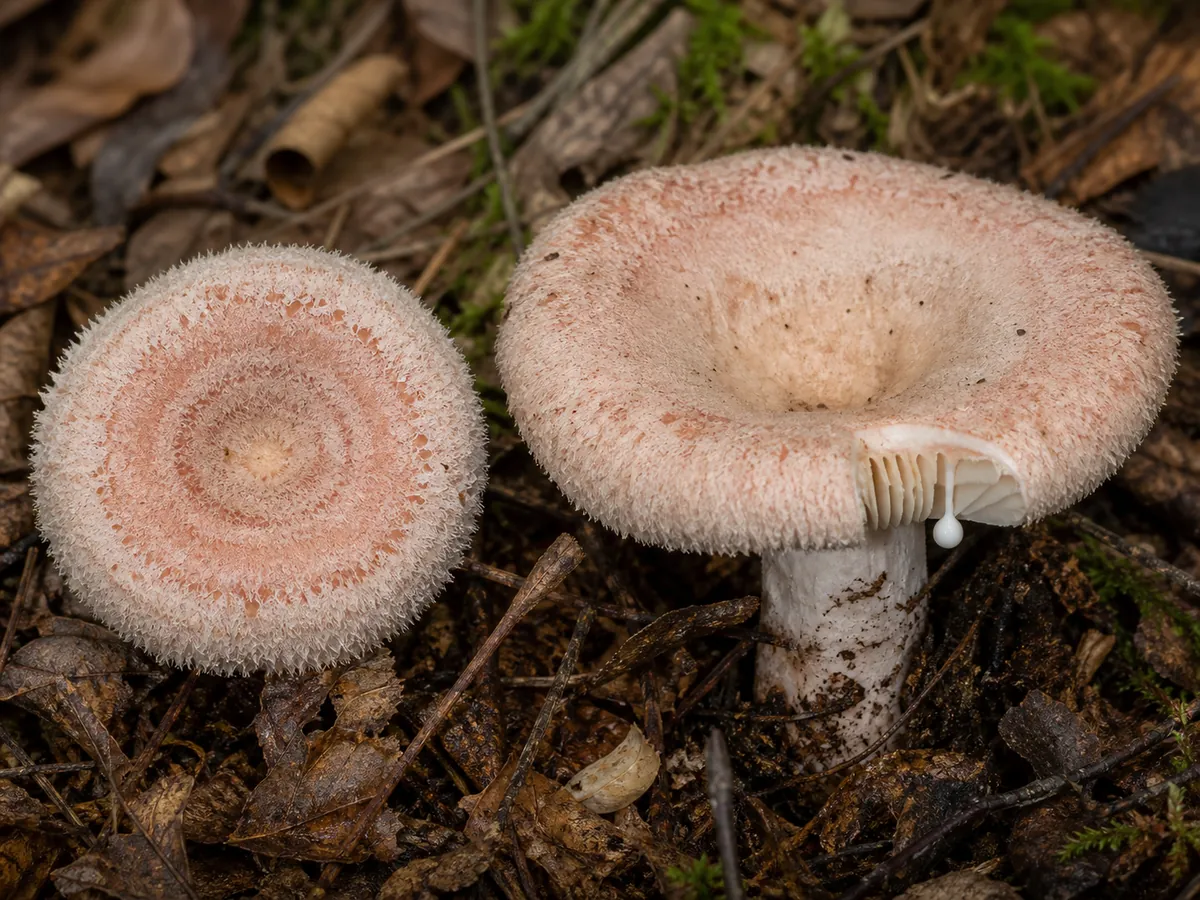
A gentle nick across one gill should release white milk. Keep that test away from the face and wash skin afterward because the latex and flesh are sharply acrid.
The cream spore print is useful at genus level but shared by several milkcaps. Ornamented spores and cap tissues under the microscope help confirm difficult or weathered material.
A specimen without visible hairs may still be woolly milkcap if age or rain removed them.
That is a reason to seek the remaining pattern, not permission to identify from pink color alone.
Never use the peppery burn as an identification test. The same evidence can be recorded from latex, anatomy, host, spores, and expert review without oral exposure.
If someone may have eaten this mushroom, act now. Call Poison Control at 1-800-222-1222 (US) or emergency services before symptoms appear, and save a piece of the mushroom for identification.
What happens if you eat woolly milkcap?
If someone becomes ill after eating it, contact Poison Control or local medical services. Preserve the remaining mushrooms and describe every preparation step, including boiling time, water changes, soaking, salting, fermentation, and portion size.
Do not copy a brief internet recipe for detoxification.
Traditional methods differ by region and household, and a mistaken species will not become safe because it went through the expected steps.
A name on a jar does not establish how the batch was processed. Commercially produced salted milkcaps may follow controlled identification and preparation practices that cannot be inferred from a home jar, informal market, or unlabeled gift.
Processing history must include whether the first liquid was discarded, how often water changed, salt concentration, storage temperature, fermentation duration, and whether raw pieces contaminated utensils. These details help a poison service evaluate the exposure without endorsing the method.
A person who has eaten a traditionally prepared batch before can still become ill from a different species, incomplete process, larger portion, or spoiled storage. Previous tolerance is not proof that the current jar is safe.
Symptoms usually fit gastrointestinal irritation rather than delayed amatoxin liver failure, but timing alone cannot identify a mixed meal. Delayed or severe illness needs urgent evaluation.
Check hydration through urine output, alertness, thirst, and dizziness rather than counting vomiting episodes alone. Children lose a larger fraction of body fluid from the same apparent serving and need a lower threshold for medical assessment.
The acrid latex can transfer to fingers and then eyes or mouth during cleaning. Wash hands, knives, boards, and containers after handling raw specimens, and keep the work separate from ready-to-eat food.
Warning
Never feed a processed batch to children, pregnant people, older adults, or anyone medically vulnerable as an experiment in tolerance.
Which pink milkcaps share the birch habitat?
Pink milkcaps overlap in color, latex, and birch habitat, so the comparison turns on margin texture, zoning, latex changes, and microscopic traits. Mature mushrooms lose several of the features that make young ones easy to illustrate.
Photograph a range of ages together when possible.
One weathered cap can hide the woolly edge, while one tight button can hide the mature central depression.
The birch milkcap, Lactarius pubescens, is paler and less strongly zoned but can carry a hairy margin and white latex. The bearded milkcap name is also used broadly, which makes common-name identification unreliable.
Saffron milkcaps have orange latex and usually partner with conifers rather than birch. Their color can overlap, but the milk reaction and host relationship point in a different direction.
| Lookalike | Better separating evidence | Failure case |
|---|---|---|
| L. pubescens | Paler cap, weaker zones, often smaller | Weathered L. torminosus fades |
| Saffron milkcap group | Orange latex and conifer host | Old or dry specimens may give little latex |
| L. cilicioides | Similar pink hairy cap in northern regions | Microscopy and geography may be needed |
| Pink Russula species | No latex when gills break | Both have brittle flesh |
Key takeaway
White latex plus birch still does not settle the species. A food decision cannot rest on a close field guess among acrid milkcaps.
How tightly is woolly milkcap tied to birch?
Woolly milkcap forms ectomycorrhiza with birch. The fungus wraps fine roots and trades mineral nutrients and water for carbohydrates made by the tree.
That partnership places fruiting bodies in birch woods, mixed woodland, heaths, parks, roadsides, and lawns where birch roots extend underground. The nearest trunk may stand well beyond the mushroom.

Fruiting often follows cool wet weather from late summer through autumn.
Mushrooms may occur singly, in scattered groups, or in arcs that trace active mycelium around host roots.
The species tolerates northern climates and often appears on acidic, sandy, or nutrient-poor soils. Its range broadly follows compatible birch hosts across Eurasia and northern North America.
Removing caps does not harm the tree-fungus partnership in the same way that soil compaction, root damage, or host removal can. Record the birch species and root zone before collecting a diagnostic specimen.
Why do regional food traditions disagree about woolly milkcap?
Woolly milkcap sits at the boundary between cultural food practice and conservative field-guide advice. Some northern and eastern European traditions process acrid milkcaps by repeated boiling, soaking, salting, or fermentation, while other authorities classify the same group as poisonous or unsuitable.
Those accounts do not transfer automatically between countries or kitchens. A traditional name may cover several pink milkcaps, a written method may omit water changes or fermentation time, and a shortened version may retain the irritants the original process was meant to remove.
Note
A history of use is evidence about a practice, not proof that a fresh specimen is correctly identified or that every processing method controls its risk.
The first decision remains species identity. A woolly margin, zoned pink cap, white latex, birch association, and pale spore deposit must agree, and damaged or faded specimens should not enter a food experiment.
The second decision concerns the authority you follow. Local poison centers, public-health agencies, and regional field guides should outrank an isolated recipe, translated forum post, or family recollection when their advice conflicts.
Do not improvise a shortened detoxification method. Leave the mushroom out of the kitchen when the identity, complete process, or local safety position is uncertain.
Why do food traditions disagree about edibility?
Woolly milkcap occupies a real cultural divide. Many English-language field guides reject it as poisonous, while cooks in Finland, Russia, and neighboring regions have used carefully processed mushrooms in salted or fermented preparations.
The traditional goal is to remove or reduce acrid water-soluble irritants through repeated boiling, soaking, water changes, brining, or fermentation. Methods are not interchangeable, and a short blanch is not equivalent to a practiced regional process.
The cap remains firm enough to hold texture after treatment, which helps explain its use in preserves rather than quick sautés. That culinary value depends on correct species identification and a complete preparation tradition.
KnowTheSpore does not provide a home detoxification recipe. Readers without local expert instruction should choose commercially sold edible mushrooms instead of trying to reverse-engineer safety from folklore.
Do not mix woolly milkcaps with saffron milkcaps or other edible collections. Orange and white latex species require different identification decisions before any kitchen method enters the discussion.
What causes illness after raw or poor preparation?
The poisoning is generally described as gastrointestinal irritation from raw or insufficiently processed tissue. Exact responsible compounds and thresholds are less clearly established than the amatoxins of deadly dapperlings.
Early nausea, cramps, vomiting, and diarrhea can cause significant fluid loss even when the toxin does not directly attack the liver. Clinical care follows symptoms, hydration status, vital signs, and the possibility of a mixed or misidentified collection.
There is no specific home antidote.
Do not use alcohol, salt water, induced vomiting, or additional mushroom consumption as a test or remedy.
Traditional food processing is not medicinal use. No credible clinical evidence supports woolly milkcap as a treatment or supplement, and its raw irritant effect makes self-experimentation especially poor practice.
What does torminosus warn about?
Lactarius torminosus belongs to Russulaceae, a family known for brittle fruiting bodies and, in milkcaps, latex released by damaged tissue. Molecular work has reorganized parts of the old broad Lactarius, but this species remains in Lactarius.
The epithet torminosus refers to colic or torment, a direct reminder of the gastrointestinal effects associated with eating it raw.
The name captures hazard rather than a morphological trait.
Varieties and similar northern species have been named around color and hairiness. Species concepts should follow current regional keys, not the intensity of one cap photograph.
Woolly milkcap questions
Is woolly milkcap edible?
What tree grows with it?
What color is the milk?
Is the shaggy edge always visible?
How is it different from saffron milkcaps?
Should I follow a boiling recipe online?
Sources & References
- The Mycota of Alaska Northern distribution and conservative edibility context.
- Städtische Museen Freiburg Measurements, woolly margin, gills, latex, and spores.
- Iowa State University Extension Field appearance and safe-foraging context.
- Mushroom poisoning review Clinical response to gastrointestinal mushroom illness and identification evidence.