
Shimeji Substitute: What Works for Which Dish
Shimeji contributes two things to a dish and only one of them is hard to find elsewhere. The flavor is mild enough that a cremini or an oyster mushroom covers it without anyone noticing. What is hard to replace is a stem small and dense enough to keep a slight bite after twenty minutes in broth, which is why the right substitute is a king oyster cut into batons rather than the enoki that looks like a cluster.
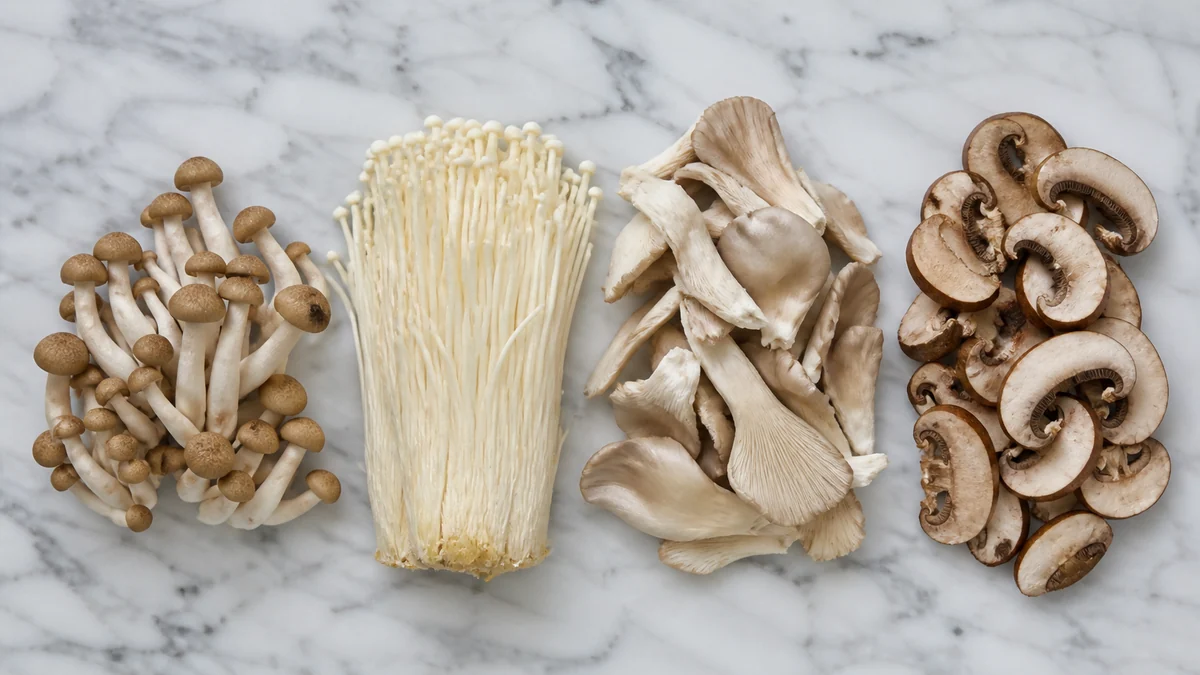
The best match and the one nobody suggests. Cut crosswise then into pencil-thick batons and it gives you the same small dense pieces, with a bite that survives twenty minutes in broth.
The supermarket answer. Quartered rather than sliced it holds firm through a simmer, and the flavor is a shade earthier than shimeji without being wrong for the dish.
Good in a fast pan and poor in a slow pot. Torn into small pieces it browns well and looks close enough, then softens faster than shimeji does once liquid is involved.
The closest in appearance and the furthest in behavior. It reads as a cluster of small pale mushrooms and then turns to threads within a few minutes of simmering.
Not a texture substitute at all, but the right move when the dish wants savory depth rather than bite. The soaking liquid is worth more than the rehydrated pieces.
The shop has no shimeji and the recipe wants a handful of it. What you do next depends on whether the dish has liquid in it.
Shimeji contributes two things, and only one of them is hard to find elsewhere.
What are you actually replacing?
Flavor and texture, in that order of importance to most people and the reverse order of difficulty.
Key takeaway
Shimeji flavor is mild enough that almost any mushroom covers it. What is hard to replace is a stem firm enough to keep a slight bite after twenty minutes in broth, and that narrows the field considerably.
The flavor half is genuinely easy. Cooked shimeji is nutty and savory without being strong, so a cremini or an oyster mushroom lands close enough that nobody at the table would name the difference.
The texture half is where the substitution actually happens or fails, barely mattering in a stir-fry and deciding how the whole bowl eats in a hotpot.
Almost every pack sold as shimeji is beech mushroom, so this is really a question about beech mushrooms under a market name. If the shop turns out to have some after all, our guide to cooking shimeji mushrooms covers the timing, which is the other thing people get wrong about it.
Texture is the hard part
A shimeji stem is small and dense. Density is what carries a bite through liquid, and size has very little to do with it.

Four properties are doing the work in that photograph, and only the first of them is obvious.
Most small mushrooms are thin because they are hollow or loosely built, and those go soft the moment they meet liquid. Shimeji is thin and solid, which is why it behaves like a much larger mushroom in a pot.
That single property explains the whole ranking below, because anything small and dense will work whatever it looks like on the shelf.
How much do you need?
Gram for gram is the default, with two exceptions worth knowing.
Shrinkage is where the arithmetic goes wrong, not the flavor.
Shimeji shrinks less than almost anything else in the aisle, and that is what throws the estimates off. A hundred grams of shimeji arrives on the plate looking like a hundred grams, and a hundred grams of enoki arrives looking like sixty.
That difference is the reason the conversions above are not all one to one, and it points to a simple rule: buy a little more than the recipe says whenever you are substituting downward in density. There is no dish that suffers from slightly too many mushrooms.
Anyone tracking this more carefully than by eye will find the figures on our shimeji nutrition record, which is also where the weight-to-portion question gets answered properly.
The options, ranked
Ranked on the bite in liquid, since that single test reverses most of the lists you will find elsewhere.
| Substitute | Bite in liquid | Looks like it | Verdict |
|---|---|---|---|
| King oyster in small batons | Excellent | Not at all | The best match, and nobody suggests it |
| Cremini, quartered | Good | No | The supermarket answer |
| Oyster mushroom, torn small | Fair | Somewhat | Fine in a stir-fry, soft in a soup |
| Enoki | Poor | Very much so | Right look, wrong behavior |
| Canned mushrooms | None | No | Do not |
Three of the five are worth buying and two are not:
- King oyster and cremini both survive a long wet cook, which is the whole test.
- Oyster mushroom passes in a dry pan and fails in a pot.
- Enoki and canned mushrooms fail everywhere except a four-minute stir-fry.
The winner is a mushroom nobody thinks of, because it arrives as one large stem rather than a cluster of small ones. Cut a king oyster mushroom crosswise and then into batons about the thickness of a pencil, and you have exactly the dense small pieces the dish wanted.
Cremini is second because it is everywhere and it holds up, though quartering matters more than people expect, since a slice has two flat faces and no thickness left to resist the broth.
The flavor argument runs the other way for once. Quartered rather than sliced, it stays firm through a simmer, and the flavor is a little earthier than shimeji without being wrong.
Oyster mushrooms torn into small pieces sit in the middle. They are excellent in anything cooked fast and disappointing in anything cooked long, which is the opposite of what you want here.

Then there are enoki mushrooms, which everybody reaches for and which fail hardest. They read as a cluster of small pale mushrooms, and that resemblance is what people are buying, but in liquid they turn to threads within a few minutes.
Brown and white shimeji, incidentally, are the same species, so if the shop has white and the recipe says brown then that is not a substitution at all.
Can you use dried instead of fresh?
Dried shimeji exists and it is not a substitute for fresh. It is a stock ingredient.
Drying collapses the cell structure that held the bite, and rehydrating puts water back without putting the structure back. What comes out of the bowl is soft, and soft was the one thing you were trying to avoid.
None of that makes dried shimeji useless, and there are three jobs the rehydrated pieces still do well:
- A filling for dumplings or buns, where everything is minced anyway.
- A stock, alongside the soaking liquid rather than instead of it.
- A braise long enough that nothing in it has texture left.
What they cannot do is sit in a clear broth and be the thing you notice, which is exactly the job shimeji was hired for.
Dried shiitake is the comparison worth making, because it works beautifully dried and shimeji does not. Shiitake was never about the bite in the first place, so drying takes nothing from it that mattered.
Matching the substitute to the dish
The dish decides, and almost all of it comes down to how long the mushroom sits in liquid.
- Miso soup, hotpot and clear broths: king oyster batons, and nothing else comes close.
- Rice dishes and takikomi gohan: king oyster or quartered cremini, both of which take twenty minutes covered.
- Stir-fries and quick pan dishes: almost anything, including enoki, since nothing gets long enough to collapse.
- Pasta and cream-free sauces: torn oyster mushroom or cremini, browned first.
- Anything you will reheat tomorrow: king oyster or cremini, and definitely not enoki.
The pattern is not complicated. The longer the mushroom is wet, the denser the substitute has to be, and that one line covers every case above.
Stir-fries are the forgiving case and worth stating plainly, because a lot of shimeji recipes are stir-fries. If the mushroom is in the pan for four minutes, use whatever the shop has and stop reading here.
What should you avoid?
Three swaps go wrong often enough to name. One of the three is the popular choice.
Every one of those four gets chosen in the same place and in about the same eight seconds.

The last line is not a joke, and it is the one people find hardest to accept when they have already decided the dish needs mushrooms.
Large caps are the subtler mistake of the three. A sliced portobello in a bowl of miso is not a worse dish exactly, but it is a different dish, and the person who wrote the recipe was after something else.
Leaving the mushroom out is a legitimate option in a clear broth. In a stir-fry it is not, since the mushroom is carrying texture the vegetables cannot.
If you did find shimeji and bought more than you need, our page on storing shimeji covers how long the pack really lasts. The short answer is about a week, which is longer than most of the alternatives on this page.