Bacterial blotch is caused by a Pseudomonas that is already present in almost every mushroom house, so the organism is not the variable. Blotches appear wherever caps stay wet for four to six hours or longer after watering, and condensation counts the same as irrigation. Sodium hypochlorite at 150 ppm in irrigation water controls the disease only if the mushrooms can be kept dry, because on a wet cap the bacteria reproduce faster than the oxidiser works. The fix is earlier and lighter watering, air that crosses the bed and leaves, and a humidity sensor mounted at the crop rather than on the far wall.
Caps that were clean at eight in the evening have yellow-brown pits in them by morning.
The instinct at that point is to disinfect something. Check whether the caps can dry before adding more treatment.
What does bacterial blotch actually look like?
Sunken marks on the cap surface, starting pale and darkening over a day or two.
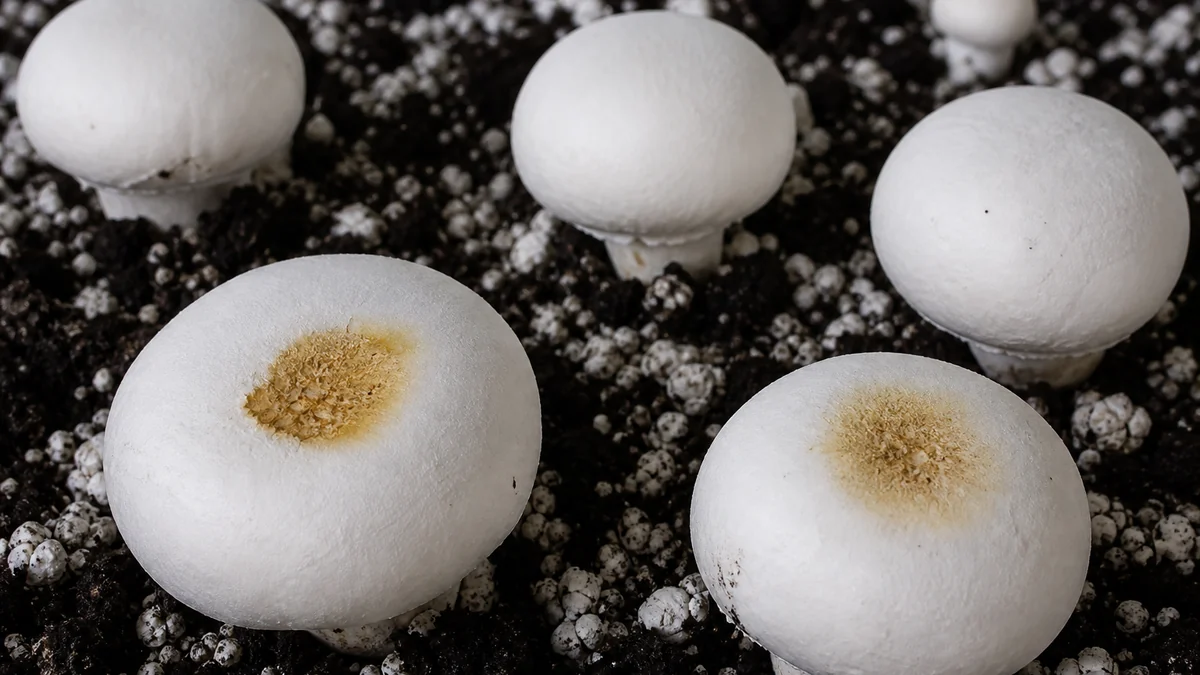
The lesions begin pale yellow and later become a golden yellow or rich chocolate brown. They sit slightly below the surrounding surface rather than standing proud of it, and they have no fuzz, no fiber and no visible growth on them.
Where they appear matters as much as what they look like, because blotch lands where water collected and stayed rather than scattering across a crop.
| Bacterial blotch | Dry bubble | Cobweb | Handling bruise | |
|---|---|---|---|---|
| Surface | Sunken pit | Raised, distorted | Gray fuzzy web | Flat discolouration |
| Color | Yellow to chocolate brown | Gray-brown | Gray-white | Dull brown |
| Spreads overnight | Yes, in wet conditions | Slowly | Fast across the bed | No |
| Follows water | Yes | No | Partly | No, follows fingers |
Three things separate blotch from everything else on that list:
- It is sunken, because bacteria degrade the surface tissue rather than growing on top of it.
- It follows the water, so the affected caps map onto drips, contact points and low spots.
- It arrives overnight, in the hours when the room is closed and the air is still.
Read that table from the surface row down. Anything raised, fuzzy or growing is fungal, and this page is about the one that leaves a dent.
Growing MushroomsWhat Does a Mushroom Farm Actually Cost to Start?What actually causes it?
A bacterium that was in your room before the crop went in.
The organism is a Pseudomonas, described in the extension literature as Pseudomonas fluorescens biotype G and elsewhere as P. tolaasii.
It lives in casing material, in water and on equipment. Being close to universal in mushroom houses is the whole reason it is not the variable.
Given conducive cap moisture nearly all mushroom crops will be affected.
That means the presence of the organism cannot explain why one crop blotches and the next does not.
It also explains why blotch tends to arrive in the same rooms year after year without anybody importing anything. The reservoir is structural, sitting in casing and water lines, and it is refreshed every cycle.
So the causal question a grower should ask is not where the infection came from. It is why the caps were wet for as long as they were.
How long does a cap have to stay wet?
Four to six hours is the number worth building an entire watering schedule around.
Penn State's guidance puts blotches wherever caps remain wet for a period of four to six hours or longer after water has been applied. Below that they largely do not appear, and above it they largely do.
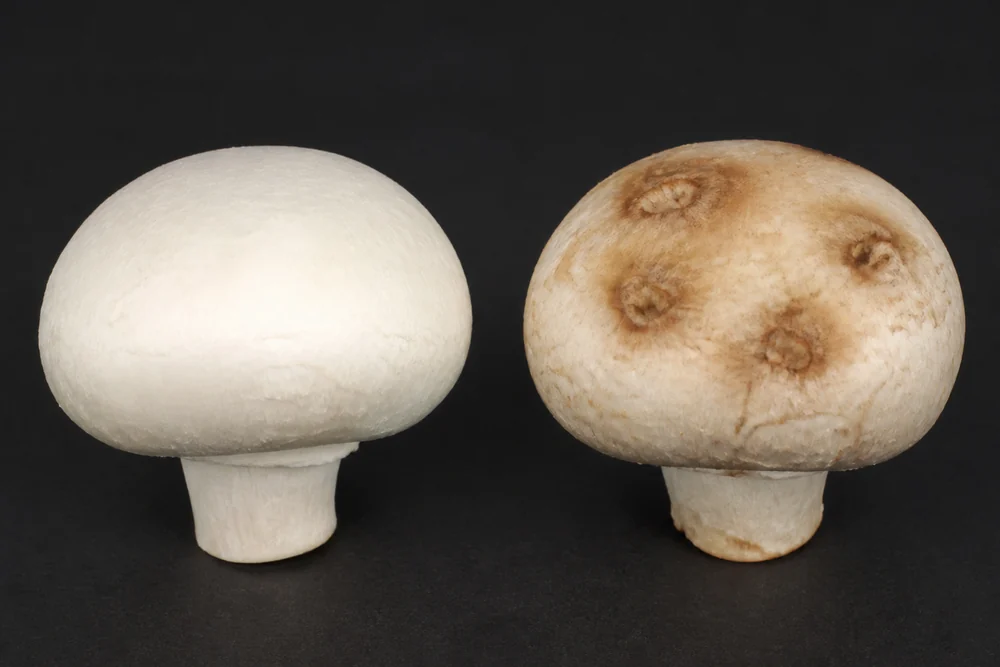
The clock starts when water lands on the mushroom rather than when the room reaches a humidity target. Rain is the uncontrolled version of the same thing, which is why outdoor beds blotch after a wet week and never after a dry one.
Key takeaway
Condensation counts exactly the same as irrigation. Water that forms on a cap because a cold surface met warm humid air is as good a growth medium as water from a hose, and it usually arrives at night when nobody is watching.
The range exists because drying is not one variable but four multiplied together.
How much water landed on the cap, how much air is moving across it, how dry that air is and how warm the room is all combine, which is why the same watering can be safe in one room and destructive in the next.
Treat the range as a working threshold rather than as vagueness and it becomes useful immediately. Water in the morning and you have a working day of air movement to get inside it; water at six in the evening and you do not.
Where does the bacterium come from?
Casing and water carry most of it. Equipment and hands make up the rest, roughly in that order.
The casing layer is the largest reservoir in a conventional house, because it is unsterilized material laid directly onto the crop by design.
Water lines come second, and standing water is worse than moving water because it warms to room temperature and sits there.
Growers running sawdust blocks rather than a cased bed lose that first reservoir entirely, which is one reason block systems see less of this disease.
Tip
Standing water in a hose left in a warm room is a bacterial culture by the afternoon. Draining lines between waterings costs nothing and removes a reservoir that sits closer to the crop than anything else in the building.
None of that means hygiene is pointless, and it is worth being precise about what hygiene buys you. Reducing the inoculum lowers the pressure on the crop; it does not change the four to six hour threshold, and it will not save a wet crop.
Drain and flush water lines between waterings
Keep casing material off the floor and covered before use
Clean tools and hands between rooms rather than between beds
Expect a disinfection programme to compensate for slow drying
Treat a blotch outbreak as evidence that the room is dirty
Reuse water that has stood warm overnight
It is worth naming the reservoirs precisely, because they are not where growers usually look:
- Casing material, which is unsterilized by design and laid directly onto the crop.
- Water standing in hoses and lines between waterings, warmed to room temperature.
- Harvest knives and picking trays moved between rooms without cleaning.
- Mushroom debris left on the floor or between beds after a pick.
Hygiene and drying are not alternatives. They are two dials, and only one of them decides whether the crop blotches this week.
Growing MushroomsHow Do Mushroom Sawdust Blocks Work from Mix to Fruit?Does chlorine in the watering help?
Yes, under a condition that almost nobody quotes alongside the figure. That condition is the reason the chemical answer keeps disappointing people.
Adding sodium hypochlorite at 150 ppm chlorine to irrigation water will control blotch, providing the mushrooms can be kept dry. That last clause is doing enormous work.

On a mushroom that stays wet, chlorine has little effect, because the bacterial population reproduces at a rate that neutralizes the oxidising agent.
There is a practical trap in the figure as well. A grower who doses at 150 ppm and still sees blotch usually concludes the concentration was too low and raises it, which does nothing at all and eventually damages the crop.
Sit with what that result implies. A chemical control that works on dry caps and fails on wet ones is not really a treatment for a bacterial disease at all; it is a marginal improvement on a moisture problem, and the moisture problem is the disease.
How do you tell it from other cap marks?
By what the surface is doing rather than by what color it went.
Fungal diseases build. Dry bubble distorts and raises tissue, cobweb throws a gray web across the bed, and both add material to the mushroom where blotch takes material away.
Bruising is the third confusion and the easiest of the three to rule out.
It appears where fingers went, it arrives immediately rather than overnight, and it does not spread once the mushroom is left alone.
Those three differences all take a hand lens or a second look. Timing is quicker than any of them, and it costs nothing:
- Marks present at pick that were not there the previous evening behave like blotch.
- Marks that grew slowly over several days behave like a fungal disease.
- Marks that appeared the moment a mushroom was handled are bruising.
Ginger blotch is the awkward middle case, since it is also bacterial and also moisture-driven but generally milder, and it responds to the same drying discipline. For practical purposes a grower does not need to separate them, because the correction is identical.
Growing MushroomsHow Do You Build an Outdoor Mushroom Bed That Lasts?Which species get it worst?
Button mushrooms, by a wide margin. That is where the disease was described and where it still does the most commercial damage.
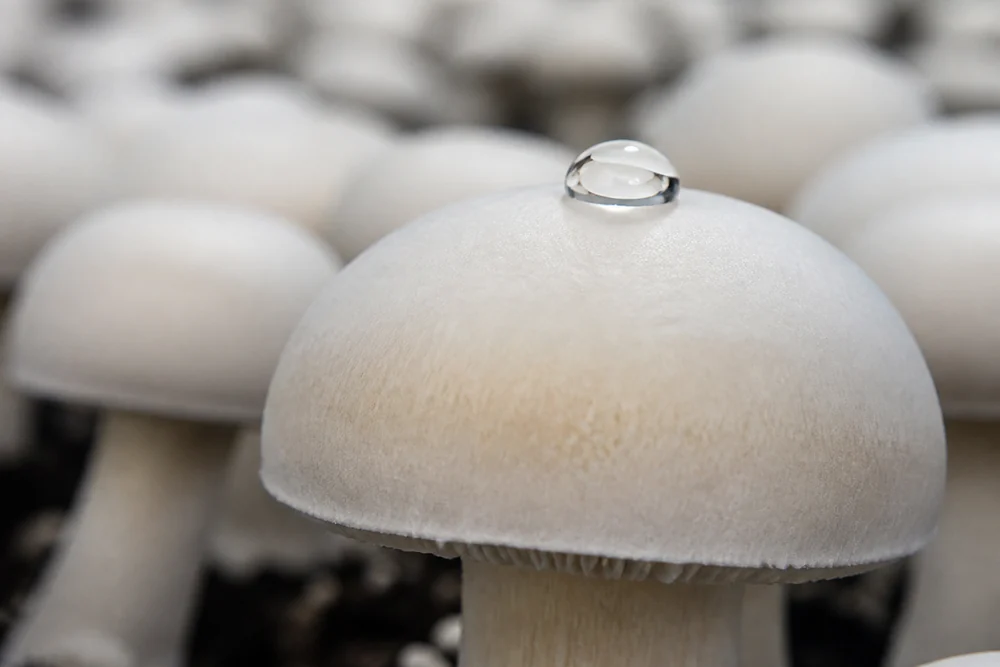
Agaricus has the exact combination the organism needs: a smooth cap that holds a droplet, a casing layer that carries the reservoir, and a growing regime built around regular watering.
On oyster mushrooms the tissue goes soft and translucent in patches rather than pitting, and the first reliable sign is often smell rather than sight.
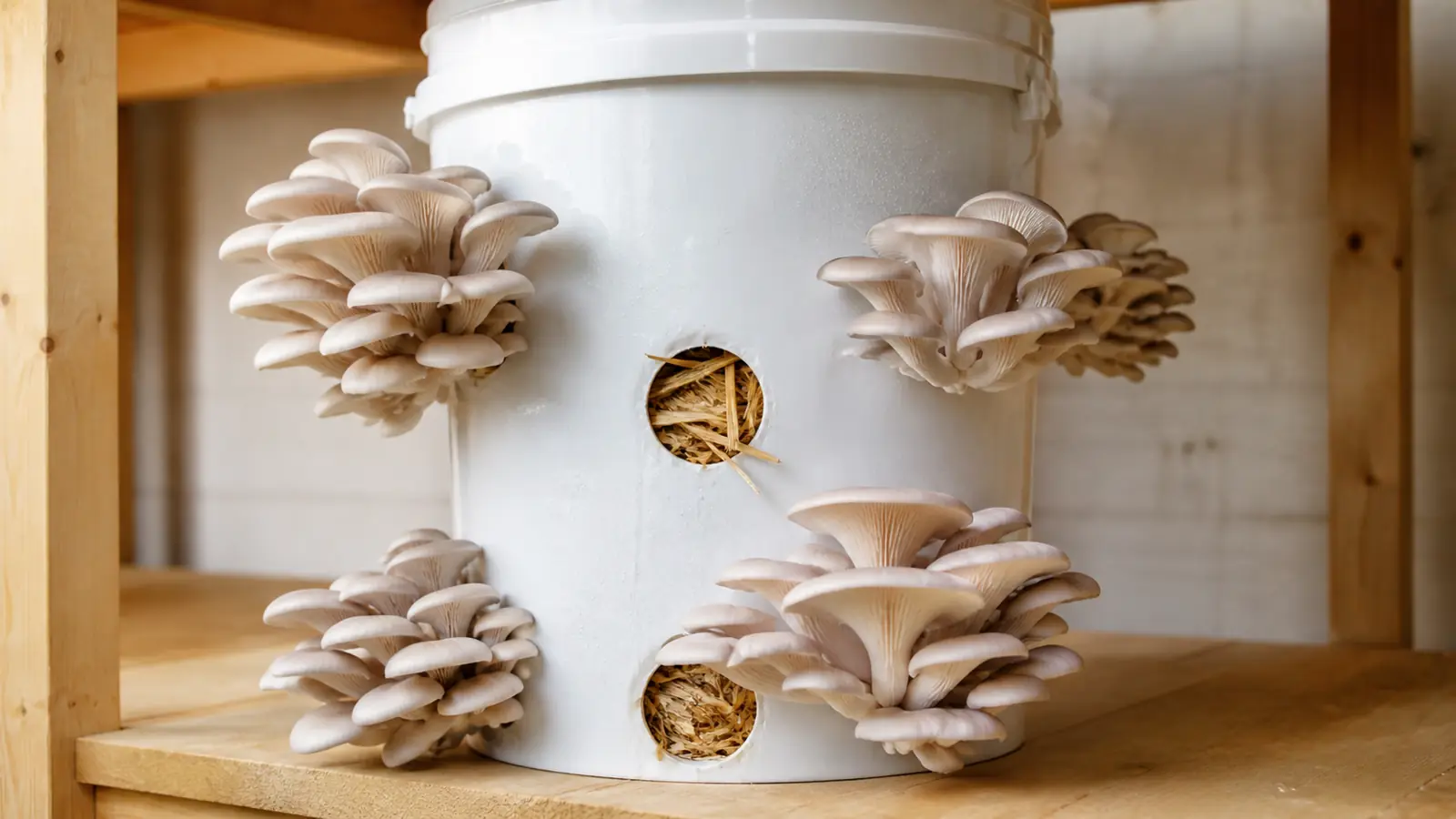
Growing method shifts the risk as much as species does. A monotub run kept with the lid barely cracked is the still-air, high-humidity case this disease was made for, while a chamber with real exchange rarely produces it at all.
What does not change across species is the mechanism, since any cap holding free water for hours in still air is running the same experiment whatever it grew on.
Where should the sensor sit?
At the crop. That is almost never where the probe is actually mounted.
A meter on the wall at head height reports the air in the middle of the room. The mushrooms live in a thin layer just above the bed, where transpiration raises the local humidity and where air movement is usually weakest.

Air will dry the mushroom surfaces if it can hold the additional moisture coming from transpiration, which means the air arriving at the bed has to be drier than the air leaving it.

Wet rot is the neighboring problem worth reading alongside this one, since it also begins with water that had nowhere to go and it also gets misdiagnosed as an infection arriving from outside.
That is why still air at ninety percent humidity is the single worst combination in this whole subject, and why growers who fix blotch usually fix it by moving air rather than by lowering a set point.
A controller will hold whatever number you ask it for, and none of them measure drying. Check whether the caps actually dry instead of relying on the humidity setting alone.
What is the routine?
Six changes, none of which involve buying anything.
Recording is the step that people skip and the one that actually finds the fault. Two numbers are enough, which is the time water went on and the time the caps were dry to the touch.
The salvage question comes up immediately, and the answer is unglamorous. Affected mushrooms are downgraded rather than saved, and the value of removing them is that they stop feeding the reservoir for the next flush.
- The organism
- A Pseudomonas already present in nearly every mushroom house.
- The trigger
- Free water on the cap for four to six hours or longer.
- The chemical answer
- 150 ppm chlorine, effective only if caps are kept dry.
- The real control
- Watering time, air exchange across the bed, and sensor placement.
- The wrong move
- Raising humidity to protect a crop that is already blotching.
Use those checks together when inspecting an affected bed. Everything above them is the argument for why the fourth one is the only lever that moves.
Warning
Do not respond to an outbreak by raising humidity to protect the crop. It is the intuitive move, it makes caps stay wet longer, and it reliably turns a bad flush into a bad room.
None of it is quick to see, since a watering change shows up in the flush after next rather than tomorrow.

One more destination is worth knowing before you start changing things. A crop that is blotching badly across every bed rather than in patches is usually reporting a ventilation fault rather than a watering one, because patchiness is what a watering pattern looks like.
Everything upstream of this belongs to a different problem. If the trouble started before pinning rather than after it, contamination during colonization is where to look, and caps that never formed at all are an aborted pin question rather than a bacterial one.
Sources & References
- Bacterial Blotch Disease (Penn State Extension) University extension guidance used for the pathogen identification as Pseudomonas fluorescens biotype G, for the description of lesions progressing from pale yellow to golden yellow or chocolate brown, for the four to six hour wet window after watering, for the 150 ppm sodium hypochlorite recommendation and the condition that mushrooms must be kept dry, and for the principle that air dries mushroom surfaces only if it can hold the additional moisture from transpiration.
- Identification and control of bacterial blotch on mushrooms (AHDB) Levy board research guidance used for the characterization of Pseudomonas tolaasii as a weak pathogen controlled by careful management of house hygiene and growing conditions, and for the statement that given conducive cap moisture nearly all crops will be affected.
- Pseudomonas tolaasii, bacterial blotch of mushroom (CABI Plantwise Knowledge Bank) Species datasheet used for the distribution of the organism across growing environments and for the relationship between surface moisture conditions and lesion development.